 Experience

Last verified · Next check due
On this page
- Sabi Sand vs Madikwe at a glance (2026)
- Malaria: the deciding difference for many families
- Getting there from Johannesburg
- Leopards, the Big Five and wild dogs
- Lodge prices and fees
- Families and children
- When to go: month by month
- Doing both, or adding Kruger
- Which should you choose?
- Common mistakes in Sabi Sand vs Madikwe comparisons
- Frequently asked questions
- Sources
Short answer: Madikwe is malaria-free; Sabi Sand lies in Kruger’s malaria risk area, where risk peaks from November to April. Madikwe is about 4.5 hours by road from Johannesburg or about 1 hour on FedAir; Sabi Sand is 1–1.5 hours on FedAir to lodge airstrips. Operators name Sabi Sand for leopards; one seller calls Madikwe’s “extremely elusive”. Sabi Sand lodges publish R7,300–60,470 per person sharing a night; no Madikwe lodge’s own rate is in our sources.
Key facts
- Only Madikwe is outside the malaria area. UK TravelHealthPro rates North West province, where Madikwe lies, no risk; Sabi Sand is in the same Lowveld zone as Kruger, where it recommends tablets from September to May.
- Both are lodge-only. Neither takes day visitors or allows self-drive game viewing; every drive is on a lodge vehicle with a guide.
- From Johannesburg, both are about an hour or so by air on FedAir’s daily shuttles (2026 schedule). By road Madikwe is about 4.5 hours; our sources hold no checked road time to the Sabi Sand gates.
- Sabi Sand charges R170 per person plus R370 per car at the gate in 2026; our sources give no Madikwe gate fee. The SANParks Wild Card covers neither.
- Madikwe has three wild dog packs; Sabi Sand lists wild dog among its species. Neither reserve publishes a leopard or wild dog sighting rate in our sources.
- Sabi Sand is open to Kruger (fences removed in 1993), so animals move between reserve and park; Madikwe sits on the Botswana border, far from Kruger.
Sabi Sand vs Madikwe at a glance (2026)
Both sell the same kind of trip, a lodge stay with guided drives and the Big Five, but in different corners of South Africa: Sabi Sand on Kruger’s open western edge, Madikwe on the Botswana border north-west of Johannesburg.
| Sabi Sand | Madikwe | Source | |
|---|---|---|---|
| Where | Mpumalanga, between the Sabie and Sand rivers, on Kruger’s western side | North West province, on the Botswana border, north of Groot-Marico; nearest town Zeerust | Sabi Sand; Wikipedia, Madikwe (secondary) |
| Size | About 65,000 ha (Wikipedia gives 623–650 km²) | 750 km² (75,000 ha) | Wikipedia, Sabi Sand (secondary); a safari agent’s guide, read 8–10 October 2026 |
| History | Founded 1948; fences with Kruger removed in 1993 | Former farmland restocked from 1992 (Operation Phoenix); opened 1994 | Sabi Sand; Wikipedia; South African Tourism (2019) |
| Malaria | Risk area, as Kruger; highest November–April | Malaria-free | Malaria-free safaris |
| Visitors | Lodge guests only; no self-drive game viewing | Overnight lodge guests only; no self-drive game viewing | Sabi Sand access; a safari agent’s guide, read 8–10 October 2026 |
| Reserve fee, 2026 | R170 per person + R370 per light vehicle, per entry | Not published in our sources | Sabi Sand access |
| From Johannesburg | FedAir 1–1.5 h to lodge strips; no checked road time | About 4.5 h by road; FedAir about 1 h | FedAir 2026 agent manual; a safari agent’s guide, read 8–10 October 2026 |
| Leopard | Operators credit it with leopard viewing; no statistics | “Extremely elusive”, says one safari seller | Operators’ pages (unnamed, see Sources) |
| Wild dog | Listed among its species | Three packs, from six reintroduced in 1994 | Wikipedia; a safari agent’s guide, read 8–10 October 2026 |
| Published bed, 2026 | R7,300–60,470 per person sharing (lodges’ own rates) | From US$291–873 per person sharing (a travel agent’s “from” prices) | Lodge rate pages; a safari travel agent’s listing |
| Lodges | Listed by gate on the reserve’s own list, plus Sabi Sabi | 22 listed | Sabi Sand lodges; a safari agent’s guide, read 8–10 October 2026 |
Read 8–10 October 2026. The Madikwe source is a safari agent’s guide, not the reserve authority; Wikipedia is a secondary source. The full Sabi Sand and Madikwe facts are on our Sabi Sand and Madikwe pages.
Malaria: the deciding difference for many families
Madikwe is outside South Africa’s malaria area; Sabi Sand is inside it, in the same Lowveld zone as Kruger. UK TravelHealthPro places the risk area in the low-lying parts of Mpumalanga and Limpopo, including Kruger National Park, and says “There is no risk in the rest of South Africa” (TravelHealthPro, South Africa). Our malaria-free safari page sets out the sources and the other malaria-free reserves.
| Sabi Sand | Madikwe | |
|---|---|---|
| Status | Risk area, as Kruger | No risk (North West province) |
| Peak | November–April; SANParks calls Kruger’s risk “generally low, even in summer” | – |
| Tablets | TravelHealthPro recommends them for the Kruger risk area from September to May; SANParks advises them after you see a doctor | Not recommended by TravelHealthPro for North West; bite avoidance still advised |
| Source | SANParks, Kruger malaria; TravelHealthPro | TravelHealthPro; a safari agent’s guide, read 10 October 2026 |
Checked 10 October 2026. This is what the sources say, not medical advice: ask a travel clinic.
- No month is malaria-free in Sabi Sand. SANParks exempts no month for Kruger, and no source we hold rates the reserve differently (safari malaria risk).
- A 2013 study draws the same line: transmission in South Africa is limited to north-eastern Limpopo and Mpumalanga and the far north of KwaZulu-Natal, with tablets recommended there from September to May (Morris et al. 2013).
- Combining the two? The Sabi Sand part puts the whole trip in the malaria question; plan it with the clinic as one trip.
Getting there from Johannesburg
Both are reached from O.R. Tambo on FedAir’s daily shuttles in about 1 to 1.5 hours; by road, Madikwe is about 4.5 hours, and our sources hold no checked road time to the Sabi Sand gates.
| Sabi Sand | Madikwe | |
|---|---|---|
| By air (FedAir 2026) | From O.R. Tambo: 10:45 → Ulusaba / Arathusa 12:15; 11:30 → Londolozi / MalaMala 12:30; 11:30 → Singita 13:00. Also from Kruger Mpumalanga International (MQP), and Skukuza Airport inside Kruger | From O.R. Tambo daily at 10:00 and 13:00, about 1 hour, to the Madikwe East or West airstrip |
| Airstrip to lodge | 5 minutes to 1 h 40 from Arathusa; up to 1 hour from Skukuza Airport | 10 minutes to 1 hour |
| By road | To the gate your lodge names (Shaws, Newington or Gowrie). No checked driving time; SANParks puts Kruger’s Paul Kruger Gate 460–470 km from Johannesburg, for scale | About 4.5 hours from Johannesburg or Pretoria; our sources do not describe the last stretch |
| Baggage | 20 kg hold + 5 kg hand, soft bags preferred | Same airline, same rules |
| Fare | Not in FedAir’s manual (separate rate sheet) | Not in FedAir’s manual |
Sources: FedAir 2026 agent manual (PDF), in effect from 30 April 2026, times can move by up to 1 hour; FedAir baggage; Sabi Sand access; SANParks gates; a safari agent’s guide. Read 8–9 October 2026.
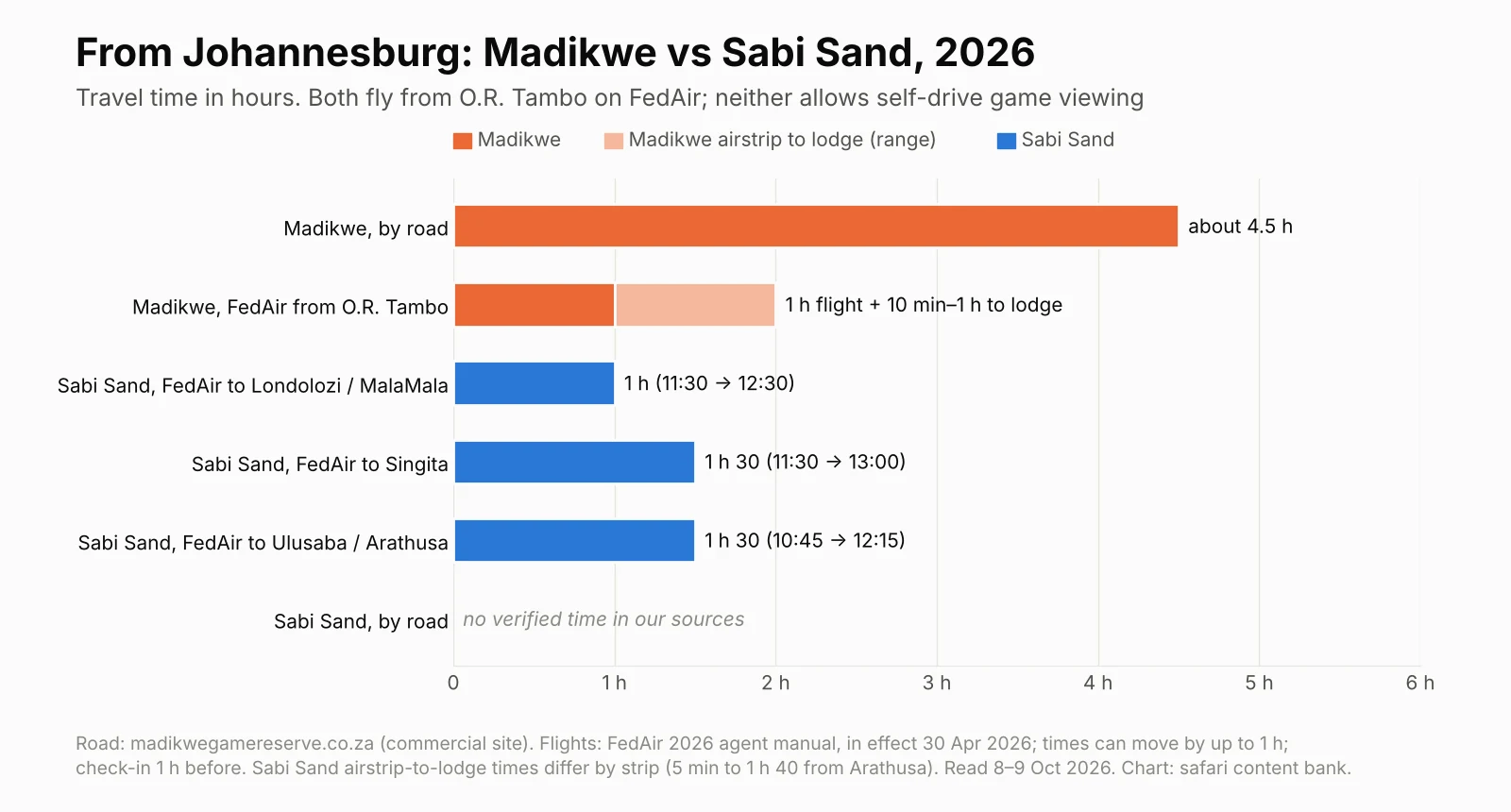 Road: a safari agent’s guide. Flights: FedAir 2026 agent manual. Read 8–9 October 2026. Chart: safari content bank.
- Check in 1 hour before a FedAir flight. Flying home, FedAir asks for 2 hours at O.R. Tambo before a domestic onward flight and 3 hours before an international one; excess baggage costs R800 (under 10 kg) or R1,500 (10–20 kg). See the safari packing list.
- Driving to Sabi Sand? Use the gate your lodge names; the lodge stamps your gate permit for the exit. Gates open at 05:00 and take the last entry at 22:00 (Sabi Sand access).
- From Botswana, Madikwe is the closer one: it can be reached from Gaborone; Botswana Tourism lists Tlokweng, the post for Gaborone, as open 06:00–24:00 (ports of entry). Our sources give no road time.
Leopards, the Big Five and wild dogs
Both reserves hold the Big Five; operators name Sabi Sand for leopards, while one safari seller calls Madikwe’s leopards “extremely elusive”. Neither publishes a sighting rate in our sources.
| Sabi Sand | Madikwe | Source | |
|---|---|---|---|
| Big Five | Yes; a safari seller says it “generally delivers all five within a couple of days” | Yes; the same seller calls Big Five viewing in malaria-free areas “easy” | A safari seller’s Big Five guide |
| Leopard | A Cape Town tour operator credits it with superb leopard viewing | “Extremely elusive”, says the same safari seller | Operators’ pages (unnamed) |
| Leopard sighting rate | Not published | Not published | Where to see leopards |
| Wild dog | Listed among about 145 mammal species | Three packs, from six reintroduced in 1994 | Wikipedia (secondary); a safari agent’s guide, read 8–10 October 2026 |
| Night drives | In Sabi Sabi’s rate; a Cape Town tour operator says off-road and night drives are allowed in the private reserves | Not described in our sources | Sabi Sabi; one tour operator’s blog |
| Open to Kruger | Yes, since 1993 | No | Sabi Sand |
Read 8–10 October 2026. These are operators’ and sellers’ claims, not counts.
- Leopards are mostly active between sunset and sunrise (Wikipedia, secondary), so night drives matter. Ask a Madikwe lodge whether its drives continue after dark.
- For wild dogs, Madikwe is the one of the two with a known population; neither publishes odds. Where the published odds are better: where to see wild dogs.
- Madikwe’s elephants have outgrown the reserve: about 220 in the 1990s, over 1,600 in 2025 (Wikipedia, citing Mongabay), and vegetation damage is visible.
- More on all five: where to see the Big Five.
Lodge prices and fees
Sabi Sand lodges publish their own 2026 rates, from R7,300 to R60,470 per person sharing a night; for Madikwe our sources hold only a travel agent’s 2026 “from” prices, US$291 to US$873. We do not convert between the two currencies.
| Lodge | Reserve | Per person sharing, per night | Valid | On top | Source |
|---|---|---|---|---|---|
| Elephant Plains rondavel / luxury suite | Sabi Sand | R7,300 / R9,300 | 2026 | Conservation contribution (amount not published); drinks | Elephant Plains |
| Simbambili | Sabi Sand | R27,000 | 2026 | Sabi Sand Wildtuin levy, R850 per person per day | Thornybush 2026 (PDF) |
| Sabi Sabi Bush Lodge / Earth Lodge | Sabi Sand | R29,600 / R44,000 | 1 Mar 2026–28 Feb 2027 | Levy R450 per person per night; +15% for arrivals 20 Dec–5 Jan | Sabi Sabi |
| Singita Ebony | Sabi Sand | R51,665 off-peak / R56,310 shoulder / R60,470 peak | Page undated | Tourism levy, carbon offset levy, conservation contribution | Singita |
| Madikwe River Lodge | Madikwe | From US$291 | 2026 | Not stated | A safari travel agent’s listing |
| Jamala Madikwe | Madikwe | From US$873 | 2026 | Not stated | A safari travel agent’s listing |
Read 8 October 2026. Sabi Sand rates are the lodges’ own rack rates, with meals and game drives. The Madikwe figures are an agent’s “from” prices, not lodge rate sheets. Singita’s page carries no year, so treat its rates as indicative.
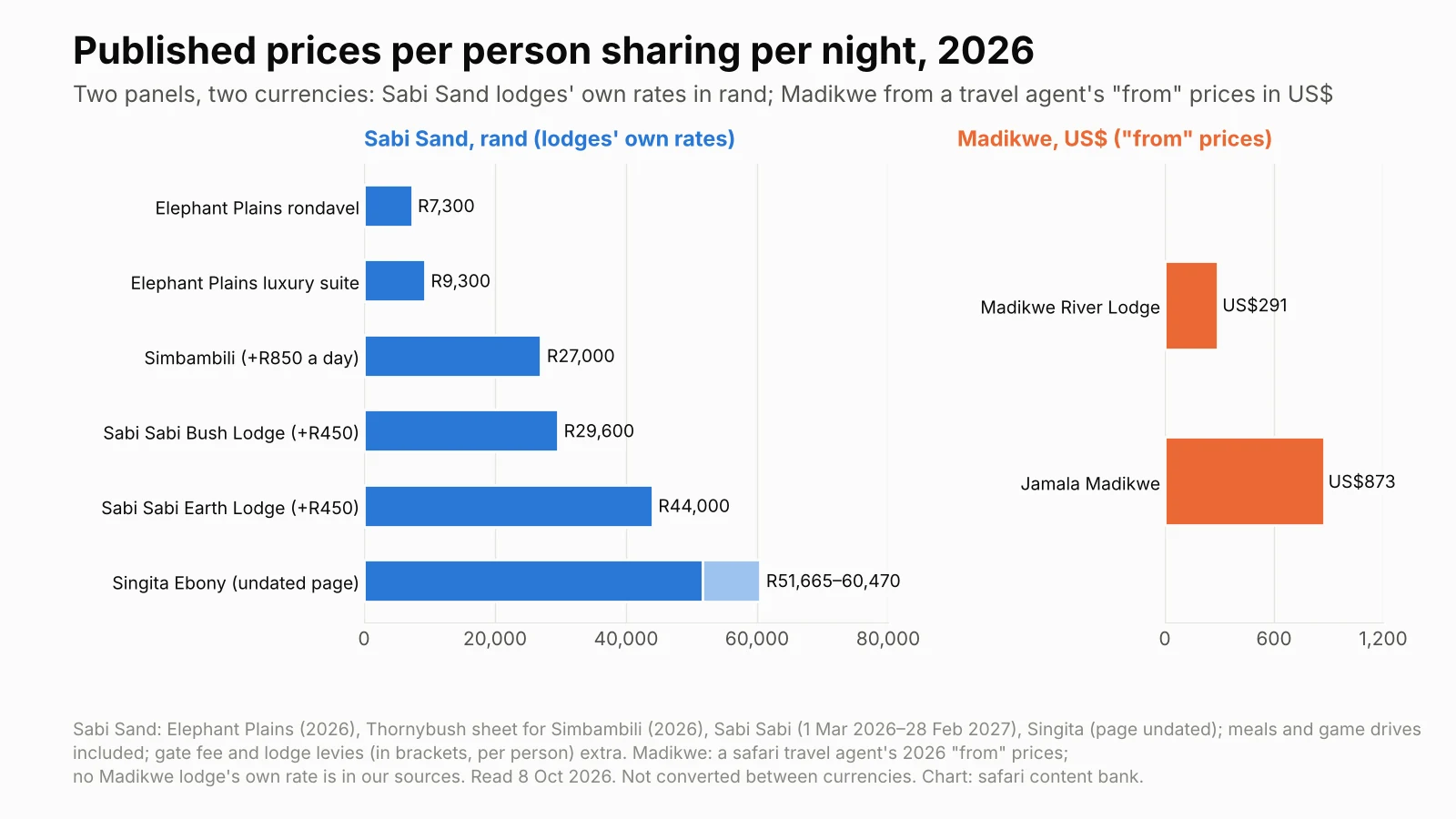 Lodge rate pages and sheets (Sabi Sand); a safari travel agent’s listing (Madikwe). Read 8 October 2026. Chart: safari content bank.
Reserve and park fees:
| Fee | Amount | Period | Source |
|---|---|---|---|
| Sabi Sand gate fee | R170 per person + R370 per light vehicle, per entry, VAT included; R180 / R390 in 2027 | 1 Jan–31 Dec 2026 | Sabi Sand access |
| Madikwe gate or conservation fee | Not published in our sources | – | – |
| Kruger (only for days inside Kruger National Park) | R602 per international adult per day | 1 Nov 2025 – 31 Oct 2026 | SANParks 2025/26 (PDF) |
| Kruger (only for days inside Kruger National Park) | R692 per international adult per day | 1 Nov 2026 – 31 Oct 2027 | SANParks 2026/27 (PDF) |
As printed on our South Africa safari cost page, read 8–9 October 2026. All Kruger fee tiers: Kruger park fees.
- Two adults arriving at Sabi Sand by car pay R710 at the gate (2 × R170 + R370), and air arrivals pay the per-person fee too. Three nights at Sabi Sabi add R2,700 in lodge levies for the two (our sums, as on our Sabi Sand vs Timbavati page).
- At a Madikwe lodge, ask what the gate fee is and whether the rate includes it, along with drinks and transfers.
- The Kruger fee is a separate charge: R692 (R602 until 31 Oct 2026), per international adult per day, for days in Kruger National Park itself.
- Packages in US dollars, for scale: 4-day Sabi Sand luxury fly-in safaris are listed at US$7,167–7,921 per person, and 4-day Kruger and Sabi Sand rustic-camp tours at US$1,245–1,420 (one operator’s published prices each, read 8 October 2026). All South African prices: South Africa safari cost.
The official fee lines, with the date each took effect and the source:
| Fee | Amount | In force from | Source |
|---|---|---|---|
| Sabi Sand Nature Reserve gate fee, per person, per entry (VAT included) | ZAR 170 (ZAR 180 in 2027) | 1 Jan to 31 Dec 2026 | Sabi Sand Nature Reserve, access and gate fees |
| Sabi Sand Nature Reserve gate fee, light vehicle under 3,500 kg, per entry (VAT included) | ZAR 370 (ZAR 390 in 2027) | 1 Jan to 31 Dec 2026 | Sabi Sand Nature Reserve, access and gate fees |
| Kruger National Park daily conservation fee, international adult (12+), per day | ZAR 602 | 1 Nov 2025 to 31 Oct 2026 (SANParks 2025/26 schedule) | SANParks daily conservation fees 2025/26 |
| Kruger National Park daily conservation fee, international adult (12+), per day | ZAR 692 | 1 Nov 2026 to 31 Oct 2027 (SANParks 2026/27 schedule, already published) | SANParks daily conservation fees 2026/27 |
Families and children
Madikwe’s appeal for families is that it is malaria-free; in Sabi Sand the question is each lodge’s minimum age, and many set 6 or older. No law sets a minimum age for a shared game drive; lodges typically set 5 or 6, and under-5s usually need a private vehicle (a safari travel company’s guide to age limits).
| Sabi Sand | Madikwe | |
|---|---|---|
| Malaria | Risk area; ask a travel clinic, especially for young children | Malaria-free |
| Youngest age to stay, by lodge | 6: Sabi Sabi Bush Lodge, Londolozi Founders. 8: Dulini lodges. 10: Leopard Hills, Singita Boulders. 12: Simbambili, Sabi Sabi Earth Lodge. 13: Sabi Sabi Little Bush Camp and Selati. 16: Londolozi Tree Camp | No lodge’s child policy in our sources |
| All ages | Cheetah Plains exclusive-use villas | Not in our sources |
| Family lodge named | – | Morukuru Family |
| Child rate example | Singita Ebony: children 2–16 sharing pay 50% | Not in our sources |
| Private vehicle | At Londolozi a private Land Rover (R25,000 a night) does not admit under-6s; at Savanna a vehicle (R18,950 a day) does not waive its 8+ rule | Not in our sources |
Sources: a safari seller’s survey of Greater Kruger lodges’ 2026 child policies, reviewed May 2026; Singita (undated); a safari agent’s guide. Read 8–10 October 2026.
- Ask every lodge for its minimum age in writing, in either reserve; policies change and some lodges’ own documents disagree.
- Planning with children: safari with children, family safari cost and single supplements and child rates.
When to go: month by month
Both get their rain in summer, so April or May to September is the easiest time for game viewing; the difference is malaria, which peaks in Sabi Sand from November to April and does not apply in Madikwe. Our sources have no climate figures for either reserve; the seasons follow SANParks’ climate page for Kruger.
| Months | Season (both) | Sabi Sand malaria | Madikwe malaria | Singita Ebony (Sabi Sand) |
|---|---|---|---|---|
| Jan–Mar | Wet, hot: green bush, birding, young animals | Highest | None | R51,665; peak R60,470 to 5 Jan |
| Apr | Dry season starts in April or May | Highest | None | R51,665 |
| May | Turning dry | Lower | None | R56,310 |
| Jun–Aug | Dry, winter; easiest game viewing; very cold morning drives | Lower | None | R60,470 (peak) |
| Sep | Dry | Lower; TravelHealthPro’s tablet season starts | None | R56,310 |
| Oct | Rains start; calving | Lower | None | R56,310 |
| Nov–Dec | Wet, hot; birding, calving | Highest | None | R51,665; peak R60,470 from 15 Dec |
Seasons: SANParks climate page (Kruger), read 8 October 2026; cold drives from travellers on TripAdvisor’s South Africa forum. Malaria: SANParks (Kruger area) and TravelHealthPro, checked 10 October 2026. Singita Ebony: its rates page, undated. Elephant Plains and Simbambili charge one rate all year (2026).
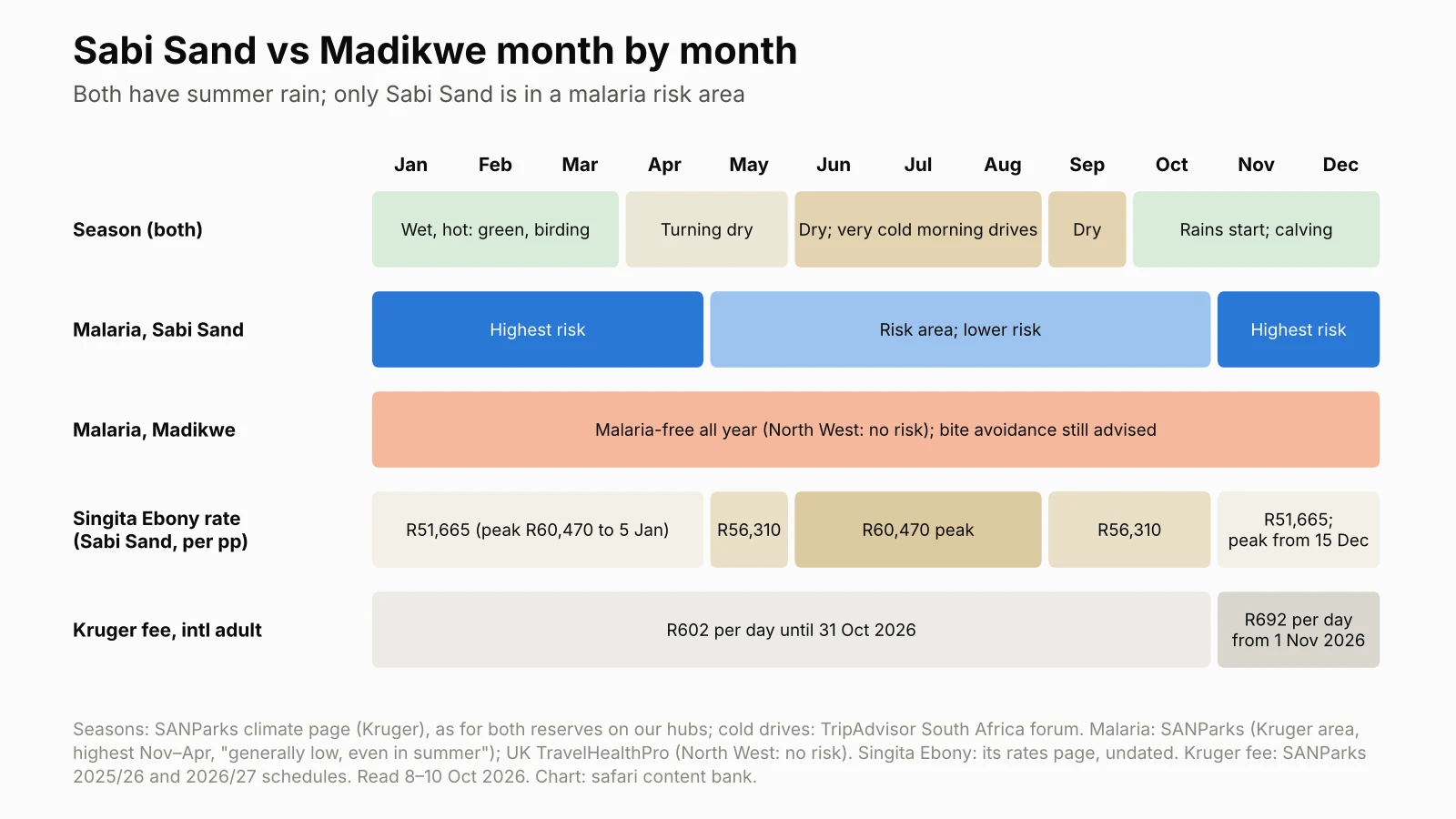 SANParks climate and malaria pages; UK TravelHealthPro; Singita rates page; SANParks fee schedules. Read 8–10 October 2026. Chart: safari content bank.
- For a malaria-sensitive trip in the green season, Madikwe is the simpler choice; Sabi Sand’s highest-risk months are the same as the wet season.
- Sabi Sabi adds 15% for arrivals from 20 December to 5 January; Sabi Sand’s gate fees rise to R180 per person and R390 per car on 1 January 2027 (Sabi Sand access). More on timing: best time for a safari.
Doing both, or adding Kruger
Our sources give no direct route between Madikwe and Sabi Sand; plan each from Johannesburg, on FedAir or by road.
- Madikwe first, then Sabi Sand, both via O.R. Tambo. FedAir’s return times from Madikwe are not in our sources, so ask the lodge to fit the connection.
- Adding Kruger itself: days inside Kruger National Park cost R692 per international adult from 1 November 2026 (R602 until 31 October 2026); neither reserve’s fee covers them, and from a Sabi Sand lodge you cannot drive into Kruger. See Kruger or a private reserve.
- Travellers on a TripAdvisor planning thread called 4 days of self-drive in Kruger plus 3 days in Sabi Sand a good split (TripAdvisor, c.2025). A safari travel agent suggests Johannesburg plus Madikwe for 3–4 nights (how many days for a safari).
- Other comparisons: Madikwe vs Pilanesberg for the malaria-free pair; Sabi Sand vs Timbavati for the Greater Kruger pair.
Which should you choose?
Choose Madikwe for a malaria-free lodge stay, young children or wild dogs; choose Sabi Sand for leopards, the widest choice of published lodge rates and a trip that adds Kruger.
| If you… | Pick | Why |
|---|---|---|
| Want to avoid malaria tablets | Madikwe | North West province is no risk (TravelHealthPro); Sabi Sand is in Kruger’s risk area |
| Travel with children under 6 | Madikwe | Malaria-free; many Sabi Sand lodges set 6 or older |
| Want the best chance of leopard | Sabi Sand | Operators name it for leopards; one seller calls Madikwe’s “extremely elusive” (no statistics for either) |
| Want wild dogs | Madikwe | Three packs; the only reserve of the two with a known population in our sources |
| Want to drive from Johannesburg | Madikwe | About 4.5 hours; no checked road time to Sabi Sand |
| Want to fly to the lodge | Either | FedAir daily: about 1 hour to Madikwe, 1–1.5 hours to Sabi Sand strips |
| Want to know the reserve fee in advance | Sabi Sand | R170 per person + R370 per car per entry; Madikwe’s fee is not in our sources |
| Want to compare lodges’ own rates | Sabi Sand | R7,300 to R60,470 per person sharing, published by the lodges |
| Want to add Kruger | Sabi Sand | Open to Kruger since 1993; Kruger charges R692 (R602 until 31 Oct 2026) |
| Want to self-drive | Neither | Choose Kruger self-drive or malaria-free Pilanesberg |
Before paying an agent for either, check the operator’s licence. More on the country: South Africa safaris.
Common mistakes in Sabi Sand vs Madikwe comparisons
| What you’ll often read | What is correct |
|---|---|
| “Sabi Sand is malaria-free in winter” | No source says so. SANParks calls Kruger-area risk “generally low, even in summer”, with a November–April peak, and exempts no month. |
| “Madikwe is a Greater Kruger reserve” | Madikwe is in North West province on the Botswana border, outside the malaria area and far from Kruger. |
| “You can visit either for the day” | Neither takes day visitors; both are lodge-only. |
| “You can drive into Kruger from a Sabi Sand lodge” | The fences are gone for animals, not vehicles. Lodge drives stay on the reserve’s land. |
| “Madikwe is the better leopard reserve” | One seller calls Madikwe’s leopards “extremely elusive”; operators name Sabi Sand. Neither publishes a sighting rate. |
| “The lodge rate covers everything” | Sabi Sand adds R170 per person and R370 per car per entry, and lodges such as Sabi Sabi (R450) and Simbambili (R850) add levies. Ask Madikwe lodges about the gate fee. |
| “The Wild Card gets you in” | The SANParks Wild Card covers neither reserve. |
| “Madikwe is untouched wilderness” | It is former farmland restocked from 1992; it opened in 1994. |
Frequently asked questions
Is Sabi Sand or Madikwe better? It depends on malaria and on what you want to see. Madikwe is malaria-free and has three wild dog packs; Sabi Sand is in Kruger’s malaria risk area but is the reserve operators name for leopards, with lodges publishing R7,300–60,470 per person sharing a night. Both are lodge-only.
Is Sabi Sand malaria-free? No. It lies in the same Lowveld risk area as Kruger, where SANParks puts the highest risk from November to April and UK TravelHealthPro recommends tablets from September to May. Madikwe, in North West province, is outside the risk area. Ask a travel clinic.
Which is closer to Johannesburg? By air they are similar: FedAir flies from O.R. Tambo to Madikwe in about 1 hour and to Sabi Sand lodge strips in 1 to 1.5 hours (2026 schedule). By road Madikwe is about 4.5 hours; our sources hold no checked road time to the Sabi Sand gates.
Where am I more likely to see a leopard? Sabi Sand, on operators’ word: a Cape Town tour operator credits it with superb leopard viewing, while a safari seller calls Madikwe’s leopards “extremely elusive”. Neither reserve publishes a sighting rate, so treat both as claims, not odds.
Which is better with young children? Madikwe avoids the malaria question. In Sabi Sand many lodges set a minimum age, from 6 at Sabi Sabi Bush Lodge to 12 at Simbambili and 16 at Londolozi Tree Camp, per a safari seller’s 2026 survey. Our sources give no Madikwe lodge’s child policy, so ask in writing.
How much are the gate fees? Sabi Sand charges R170 per person plus R370 per light vehicle per entry in 2026, rising to R180 and R390 in 2027. Our sources give no official Madikwe gate or conservation fee; ask your lodge whether its rate includes it.
Do I pay the Kruger fee in Sabi Sand? Only for days inside Kruger National Park: R692 per international adult per day from 1 November 2026 (R602 until 31 October 2026). Sabi Sand charges its own gate fee, and lodge drives do not enter Kruger.
When is the best time to visit Sabi Sand or Madikwe? For both, the dry season from April or May to September is the easiest for game viewing, with very cold winter morning drives. In Sabi Sand, malaria risk is lower then than in its November–April peak; Madikwe is malaria-free all year.
Sources
- Sabi Sand Nature Reserve: access and gate fees, about, lodges, read 8 Oct 2026
- Madikwe: a safari agent’s guide, read 8 Oct 2026; South African Tourism, De Safari Gids (PDF, Dutch, 2019)
- Lodge rates: Elephant Plains, Thornybush 2026 (PDF), Sabi Sabi, Singita Ebony (undated), read 8 Oct 2026
- Health: UK TravelHealthPro, South Africa, checked 10 Oct 2026; SANParks, Kruger malaria, read 8 Oct 2026; Morris et al. 2013
- SANParks: daily conservation fees 2025/26 (PDF) and 2026/27 (PDF); climate; entrance gates; Wild Card; read 8–9 Oct 2026
- Travel: FedAir, 2026 agent manual (PDF) and baggage, read 9 Oct 2026; Botswana Tourism, ports of entry
- Operators and sellers: a safari seller’s Big Five guide; a Cape Town tour operator’s blog; a safari seller’s survey of Greater Kruger child policies (May 2026); a safari travel company’s guide to age limits; a safari travel agent’s 2026 “from” prices for Madikwe lodges; one operator’s published package prices (names and links kept in our editor notes), read 8–10 Oct 2026
- Travellers: TripAdvisor, South Africa forum and Kruger and Sabi Sands trip planning (c.2025)
- Secondary: Wikipedia, Sabi Sand Game Reserve, Madikwe Game Reserve (citing Mongabay) and African leopard
- More: Sabi Sand, Madikwe, malaria-free safaris in South Africa, safari malaria risk, South Africa safari questions
Facts and fees read 8–10 October 2026; SANParks fees checked 1 November 2026. We will recheck by 21 November 2026, after Kruger’s fee change on 1 November, and again in January 2027, when Sabi Sand’s 2027 gate fees apply, or sooner if a Madikwe gate fee or a Madikwe lodge’s own rate sheet is found.
Ask for a quote
Tell us your dates and we send you a priced itinerary. Free, no obligation.
- Free quote, no obligation
- Trips run by licensed local operators