 Experience

Last verified
On this page
- Serengeti vs Masai Mara at a glance (2026)
- How much bigger is the Serengeti?
- Which park has the herds, and when?
- Park fees: a night in the Serengeti against a day in the Mara
- Crowds and vehicle rules
- Getting there: how long each park takes to reach
- What camps cost on each side (2026 rate cards)
- Which should you choose?
- Common mistakes in Serengeti vs Masai Mara comparisons
- Frequently asked questions
- Sources
Short answer: Choose by month first. Serengeti National Park (Tanzania) is about ten times the size of Kenya’s Maasai Mara National Reserve. From December to June the herds are only in Tanzania; from July to October they are on both sides of the Mara River, and the date decides which side is better. In fees, a night inside the Serengeti costs US$129.80–153.40 per adult (last published tariff, 2023/24); a Mara day costs US$100 (January–June) or US$200 (July–December).
Key facts
- Serengeti National Park covers 14,763 km² (a safari agent’s Serengeti guide). The Masai Mara reserve is about 1,500 km²: its western Mara Triangle is “510 km², representing about a third of the entire Reserve” (Mara Conservancy).
- The herds are in Tanzania for most of the year. Kenya’s Masai Mara usually sees them from July, with crossings July–October and August–September the busiest (Mara Conservancy; a Mara camp operator’s migration page, read 9 Oct 2026).
- Three nights cost an adult US$389.40–460.20 in park fees in a Serengeti lodge or camp, and US$300 (January–June) or US$600 (July–December) in the Mara reserve (our sums from TANAPA’s last published tariff, 2023/24, and Narok County’s last published schedule, FY2025/26).
- The Mara reserve caps a sighting at five vehicles; we found no published per-sighting limit for the Serengeti. Neither authority publishes a count of vehicles at sightings.
- Neither park sells night drives inside its boundary. They are sold in the Mara conservancies and in the private concessions on the Serengeti’s edge, Grumeti and Klein’s.
- The Mara is the quicker park to reach: about 1 hour by air from Nairobi’s Wilson Airport, or 5.5–6 hours by road to Sekenani Gate. Arusha to Seronera in the central Serengeti is a 7–7.5 hour drive (Operator A).
Serengeti vs Masai Mara at a glance (2026)
The two parks are one unfenced ecosystem split by the Kenya–Tanzania border, but they are run, priced and regulated separately. The comparison between the two countries, with visas, insurance and beach add-ons, is on Kenya vs Tanzania; this page compares the two parks.
| Serengeti National Park (Tanzania) | Maasai Mara National Reserve (Kenya) | Source | |
|---|---|---|---|
| Area | 14,763 km² | About 1,500 km²; the Mara Triangle is 510 km² of it | A safari agent’s Serengeti guide; Mara Conservancy |
| Run by | Tanzania National Parks (TANAPA) | Narok County; the Mara Triangle by the not-for-profit Mara Conservancy since 12 June 2001 | Mara Conservancy |
| Visitors | 491,398 in the 2024/25 financial year | 213,000 in 2025 | The Citizen, 18 Dec 2025; Kenya Economic Survey 2026 via Business Daily |
| Migration herds | Most of the year; calving late January to mid-March around Ndutu, in the Ngorongoro Conservation Area next to the park | Usually from July; crossings July–October, August–September the busiest | Great Migration month by month |
| Adult fee | US$82.60 entry per 24 h (US$70.80 15 Mar–15 May) + US$59–70.80 concession per night inside (last published tariff, 2023/24) | US$100 per 12-hour day 1 Jan–30 Jun, US$200 1 Jul–31 Dec, the same inside or outside the reserve | TANAPA 2023/24 (PDF); Narok County FY2025/26 (PDF) |
| Child fee | 5–15: US$23.60 entry + US$11.80 concession; under 5 free | 9–17: US$50 a day; under 9 free | Same |
| Vehicles at one sighting | No published limit found | Five; others wait at least 100 m away | Business Daily on Narok County’s plan |
| Night drives | Not inside the park; sold in private concessions on its edge | Not sold in the reserve; sold in the conservancies around it | Serengeti; Mara reserve vs conservancies |
| From the gateway by air | Arusha or Kilimanjaro → Serengeti airstrips 1–2 h | Nairobi Wilson → Masai Mara about 1 h | Operator B; Mombasa Air Safari 2026 |
| From the gateway by road | Arusha → Seronera 7–7.5 h, gravel after the Ngorongoro gate | Nairobi → Sekenani Gate 5.5–6 h, tarmac all the way | Operator A; The Kenya Times, 20 Aug 2026 |
| Camp rates, camps’ own rate cards | US$305 (Mar–May 2027) to US$1,480 (Jun–Sep 2026) per person a night inside the park; Singita’s Grumeti reserve outside it US$2,210–3,220 (2026) | US$453–2,028 per person a night (2026) | Camps’ own rate cards, read 9 Oct 2026 (see the camp table below) |
Non-resident (Kenya) or non-East African (Tanzania) adult. Serengeti fees are TANAPA’s last published tariff, 2023/24, with 18% VAT; Mara fees are Narok County’s last published schedule, FY2025/26, which expired on 30 June 2026 (for July–December 2026, The Kenya Times, 6 Aug 2026, a secondary source, reports US$200 still applies). Checked 10 October 2026.
How much bigger is the Serengeti?
About ten times: Serengeti National Park covers 14,763 km², and the Masai Mara reserve about 1,500 km². Both sit inside one larger, unfenced system that the herds cross without regard to the border.
| Area | Size | Source |
|---|---|---|
| Serengeti National Park | 14,763 km² | A safari agent’s Serengeti guide |
| Maasai Mara National Reserve | About 1,500 km² (the Triangle is “about a third of the entire Reserve”) | Mara Conservancy |
| Mara Triangle (western reserve) | 510 km² | Mara Conservancy |
| Greater Maasai Mara ecosystem (reserve, conservancies and surrounding land) | More than 6,600 km² | Narok County GMME Management Plan 2023–2032 (PDF) |
| Serengeti–Mara ecosystem | About 25,000 km² | Same plan |
Read 9 October 2026.
- The Serengeti had about 2.3 times as many visitors on about ten times the area: 491,398 in the 2024/25 financial year, up from 430,219 (The Citizen, 18 Dec 2025), against 213,000 in the Mara reserve in 2025 (our arithmetic; the two counts cover different 12-month periods).
- Visitors to the reserve fell from 420,000 in 2023 to 213,000 in 2025 (Kenya Economic Survey 2026, via Business Daily). Travellers still report queues at sightings.
- Size changes the trip more than the view. Seronera to Kogatende, on the Mara River in the far north of the Serengeti, is published as 4–5 hours by road (Operator C); in the Mara, Oloololo Gate to Purungat Gate across the Triangle is “a little over one hour” at 50 km/h (Mara Conservancy).
Which park has the herds, and when?
From December to June the herds are only in Tanzania; from July to October they are on both sides of the Mara River, and the date decides which side is better.
| You can travel in | Go to | Why | Source |
|---|---|---|---|
| January–March | Ndutu and the southern Serengeti | Calving and predators; Tanzania only | A camp operator’s migration guide |
| April–May | Central Serengeti (Seronera, Moru), and accept rain | Columns on the move; long rains | A camp operator’s migration guide; a UK safari operator’s guide |
| June | Western Corridor, Grumeti | Grumeti crossings, before July–September fees | A camp operator’s migration guide |
| Early to mid-July | Northern Serengeti (Kogatende) rather than the Mara | Lead herds reach northern Tanzania first. A destination expert: “Most years you would not find the migration in the Masai Mara as early as July 11-15” | TripAdvisor |
| August–September | Either bank of the Mara River | Choose by the rest of the trip and by budget. Kogatende and Lamai lie across the river from the Mara Triangle | A camp operator’s Mara vs Serengeti guide |
| October | Northern Serengeti early in the month; Lobo later | Tail end crosses back south | A camp operator’s migration guide; a safari operator’s migration guide |
| November–December | Eastern and central Serengeti, then south | Herds in transit; short rains | A camp operator’s migration guide |
Typical pattern from operator calendars, not a forecast; a camp operator’s migration guide: “timing all depends on the rains”. Every month’s herd position, crossing window and fee: where the Great Migration is each month. Read 9–10 October 2026.
- Calving peaks in February at Ndutu, which is in the Ngorongoro Conservation Area (NCA), not the national park. NCA fees apply there: US$70.80 entry per adult per 24 hours, single entry, and US$59 per person per night concession at Ndutu lodges (NCAA tariffs, read 9 Oct 2026).
- No authority or operator publishes the odds of seeing a crossing. The Mara Conservancy says crossings “happen frequently during the migration but are difficult to predict”; one Mara camp operator says “we cannot guarantee the timing”.
- The Mara has a smaller migration of its own. The resident Loita herd moves into Ol Kinyei Conservancy “usually by January”, calves in February–March, then moves through Naboisho into Olare Motorogi (a Kenyan camp operator’s Loita migration page). It is not the Serengeti migration, and it has shrunk from 122,790 wildebeest in 1977 to 23,510 in 2016 (Narok County GMME Management Plan 2023–2032 (PDF)).
Moving between the two sides takes a day. The Bologonja / Sand River crossing between the parks has been closed since 1977 (The EastAfrican, 4 Apr 2017). The options are a flight via Migori and Tarime, the road round through Isebania–Sirari, or Nairobi–Namanga–Arusha. Every leg and timetable: Masai Mara to Serengeti: fly via Migori and Tarime.
Park fees: a night in the Serengeti against a day in the Mara
The two parks charge differently: the Serengeti per 24 hours of entry plus a concession fee for each night inside, the Mara per 12-hour calendar day wherever you sleep. Over three nights an adult pays US$389.40–460.20 in a Serengeti lodge or camp and US$300 or US$600 in a Mara reserve camp (our sums).
- A Mara ticket lasts 12 hours, 06:00–18:00, and does not carry overnight; you pay for every calendar day you are in the reserve, wherever you sleep (Mara Conservancy).
- A Serengeti day permit is valid for 12 daylight hours; a sleep-over permit for 24 hours. The concession fee applies only if you sleep inside the park.
- Mara conservancies are the Kenyan alternative to the reserve fee. They charge US$130 per adult per night (Kicheche and Porini 2026 rate sheets); you pay the reserve fee as well only on days you drive into the reserve.
| 3 nights, per adult (our sums) | 15 Mar–15 May | 1 Jul–30 Sep | 1 Oct–31 Dec |
|---|---|---|---|
| Serengeti, lodge or camp inside the park: 3 × (entry + concession) | US$389.40 | US$460.20 | US$424.80 |
| Serengeti, public campsite: 3 × (entry + US$35.40) | US$318.60 | US$354 | US$354 |
| Masai Mara, camp in the reserve: 3 day tickets | US$300 | US$600 | US$600 |
| Masai Mara, camp in the reserve with a game drive on the departure day: 4 tickets | US$400 | US$800 | US$800 |
| Masai Mara, conservancy camp, no day in the reserve: 3 × US$130 | US$390 | US$390 | US$390 |
| Masai Mara, conservancy camp plus one day in the reserve | US$490 | US$590 | US$590 |
Non-resident (Kenya) or non-East African (Tanzania) adult. Serengeti: TANAPA Tariffs 2023/24 (PDF), the last published tariff, with 18% VAT. Mara: Narok County fee schedule FY2025/26 (PDF), the last published; conservancy fee from the Kicheche 2026 and Porini 2026 sheets (Offbeat prints US$150 for Mara North: add US$60). Many conservancy camps close from about April to late May. Fees only: bed rates are extra. Checked 10 October 2026.
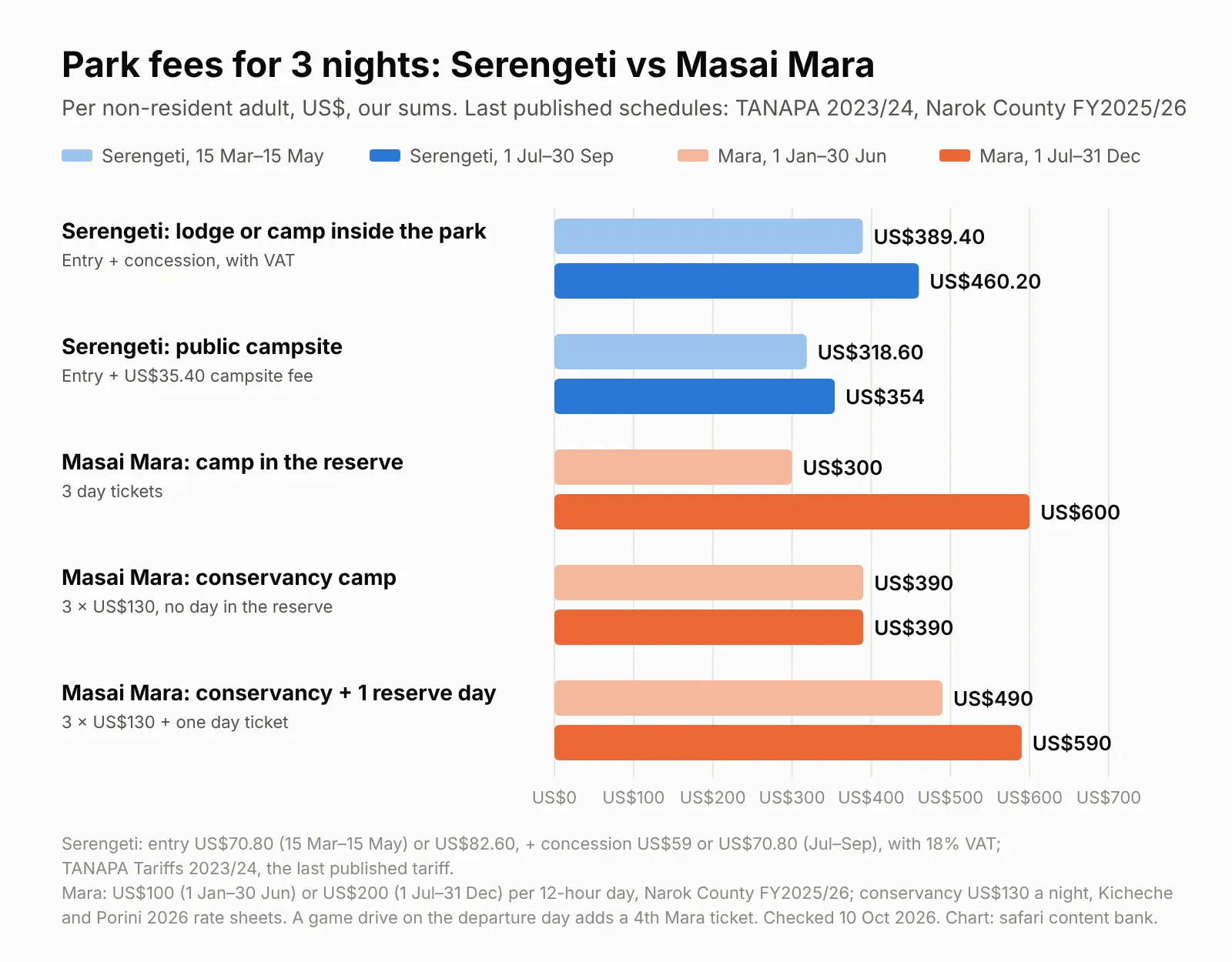 Our sums. Sources: TANAPA Tariffs 2023/24, the last published tariff; Narok County fee schedule FY2025/26, the last published; Kicheche and Porini 2026 rate sheets. Checked 10 October 2026. Chart: safari content bank.
- In fees, the Mara reserve is cheaper from January to June and dearer from July to December. The month-by-month fee table for both parks is on Kenya vs Tanzania and the Great Migration month by month.
- Children aged 5–8 are free in the Mara reserve but pay in the Serengeti; from 9 to 15 the Serengeti costs less. The Mara reserve is free under 9 and US$50 a day from 9 to 17; the Serengeti is free under 5, then US$23.60 entry and US$11.80 concession a night from 5 to 15 (last published tariff, 2023/24).
- Sleeping just outside does not avoid fees on either side. Ndutu lodges pay Ngorongoro fees of US$129.80 a night, and Singita’s Grumeti reserve adds a US$177 wildlife fee per adult per night (Serengeti safari cost). The Mara fee is the same inside and outside the reserve; a camp outside the gate saves it only on days you do not drive in (Masai Mara safari cost).
- The road to the Serengeti has its own fee. The drive from Arusha crosses the Ngorongoro Conservation Area, at US$70.80 per adult each way, single entry (NCAA). Nairobi to the Mara has no fee on the way.
- Some Mara reserve camps add a community fee: Governors’ charges US$50 per guest per night, payable to Narok County (Governors’ Camp).
Every fee line and ticket rule for each park: Serengeti park fees: US$82.60 per adult per 24 hours and Masai Mara park fees, US$100 or US$200 a day.
The official fee lines, with the date each took effect and the authority’s own source:
| Fee | Amount | In force from | Source |
|---|---|---|---|
| Serengeti and Nyerere National Parks, non-East African adult, entry per day, 16 May–14 Mar | USD 70 + 18% VAT = USD 82.60 | 1 Jul 2023 (2023/24 tariff, last published) | TANAPA Tariffs 2023/24 |
| Serengeti and Nyerere National Parks, non-East African adult, entry per day, 15 Mar–15 May | USD 60 + 18% VAT = USD 70.80 | 1 Jul 2023 (2023/24 tariff, last published) | TANAPA Tariffs 2023/24 |
| Serengeti and Nyerere, concession fee per person per night inside the park | Jul–Sep USD 60 + VAT = USD 70.80; Oct–Jun USD 50 + VAT = USD 59 | 1 Jul 2023 (2023/24 tariff, last published) | TANAPA Tariffs 2023/24 |
| Serengeti, non-East African child 5–15, entry per day (under 5 free) | USD 20 + 18% VAT = USD 23.60 | 1 Jul 2023 (2023/24 tariff, last published) | TANAPA Tariffs 2023/24 |
| Serengeti, concession fee per child 5–15 per night inside the park | USD 10 + 18% VAT = USD 11.80 | 1 Jul 2023 (2023/24 tariff, last published) | TANAPA Tariffs 2023/24 |
| Serengeti public campsite, adult, per night | USD 30 + 18% VAT = USD 35.40 | 1 Jul 2023 (2023/24 tariff, last published) | TANAPA Tariffs 2023/24 |
| Ngorongoro Conservation Area, non-East African adult, entry per 24 h (single entry) | USD 70.80 (NCAA's page does not say whether VAT is included) | Undated official page, read 9 Oct 2026 | NCAA |
| Maasai Mara National Reserve, non-resident adult, per day (12-hour ticket, 06:00–18:00), 1 Jan–30 Jun | USD 100 | Since 1 Jan 2024; Narok County FY2025/26 schedule, the last published | Narok County fee schedule FY2025/26 |
| Maasai Mara National Reserve, non-resident adult, per day (12-hour ticket, 06:00–18:00), 1 Jul–31 Dec | USD 200 | Since 1 Jul 2024; Narok County FY2025/26 schedule, the last published, expired 30 Jun 2026 (no 2026/27 schedule as of 9 Oct 2026); The Kenya Times (6 Aug 2026, secondary) reports US$200 still applies for Jul–Dec 2026 | Narok County fee schedule FY2025/26 |
| Maasai Mara National Reserve, non-resident child 9–17 or student, per day (under 9 free) | USD 50, all year | Narok County FY2025/26 schedule, the last published | Narok County fee schedule FY2025/26 |
Crowds and vehicle rules
Neither park publishes a count of vehicles at sightings; the Mara reserve has written sighting rules, and we found none published for the Serengeti. The crowd evidence on both sides is traveller reports.
| Rule | Serengeti National Park | Masai Mara reserve | Mara conservancies |
|---|---|---|---|
| Vehicles at one sighting | No published limit found | Five; the next vehicle waits at least 100 m away | No published cap for any Mara conservancy |
| Off-road driving | No official rule text found in our sources | Prohibited, except to approach big cats on nearby open ground, no closer than 25 m | Practised: Porini Lion Camp uses “off-road (4×4) safari vehicles” |
| Night drives | Not inside the park: TANAPA’s tariff names the parks that sell them, and the Serengeti is not among them | Not sold | Sold by some camps: Kicheche Valley (Naboisho), Porini Lion Camp (Olare Motorogi) |
| Speed limit | 50 km/h in national parks (Operator B) | Mara Triangle: 50 km/h on graded roads, 30 km/h on other tracks | Not published in our sources |
| Private cars on game drives | Self-drive is allowed; operators discourage it | Banned by Narok County’s memo of 3 June 2024 | Camp vehicles |
Sources: TANAPA Tariffs 2023/24 (PDF); Operator B, national park rules; Business Daily, reporting Narok County’s management plan; Mara Conservancy, driving; Kenyans.co.ke, 4 Jun 2024; Porini Lion Camp factsheet; Kicheche 2026; Serengeti self-drive: Serengeti safari cost. Read 9–10 October 2026.
Inside the Mara reserve, the rules come from Narok County’s management plan:
- Stay on the tracks. Vehicles “must stay on the tracks at all times. Off-road driving is prohibited, except to approach big cats which are sighted on nearby open ground”. The vehicle goes straight to the sighting, no nearer than 25 m, does not follow the animals and goes straight back to the track (Business Daily, reporting Narok County’s management plan).
- Five vehicles at a sighting. “If there are already five cars near the animals”, the next vehicle stops and waits at least 100 metres away (same source). The Mara Triangle’s own rules also limit viewing time once more than five vehicles are waiting (Mara Conservancy park rules).
- Fines are paid on the spot in the Triangle. Failure to pay “can result in banishment from the Mara Triangle for a period of six months” (Mara Conservancy).
What travellers report (traveller reports, not counts):
- Masai Mara reserve: Traveller reviews on a safari booking site from 2019 to 2026 describe 20 to 40 vehicles at a single sighting. Forum travellers found the Mara Triangle and the Keekorok area quieter, and advise a conservancy if vehicle numbers bother you (TripAdvisor).
- Serengeti river crossings: “it is not uncommon for fifty or more trucks to be parked” at a crossing point, according to a regular on the Serengeti forum (TripAdvisor).
- Ndutu in calving season: one reviewer wrote that it “was common to see 15–20 vehicles at a single sighting” there in March 2026 (TripAdvisor).
- Seronera, in the central Serengeti, has resident big cats all year but is “always busy” (a UK safari operator’s guide).
Reserve or conservancy, rule by rule and fee by fee: Masai Mara Reserve or a private conservancy.
Getting there: how long each park takes to reach
The Mara is closer to its gateway: about an hour by air from Nairobi’s Wilson Airport, or 5.5–6 hours by road to Sekenani Gate. The central Serengeti is 7–7.5 hours by road from Arusha, or 1–2 hours by light aircraft.
| Route | Time | Fare or fee on the way | Source |
|---|---|---|---|
| Nairobi Wilson → Masai Mara, by air | About 1 h (45–60 min) | US$200 + US$20 fuel surcharge per person one way | Mombasa Air Safari 2026; Operator B |
| Nairobi → Mara, Sekenani Gate, by road | 5.5–6 h | Tarmac throughout; no fee on the way | The Kenya Times, 20 Aug 2026 |
| Nairobi → Mara, Musiara or Oloololo Gate, by road | About 6.5 h | C13 via Aitong, which “can be rougher in some sections” | The Kenya Times |
| Kilimanjaro Airport (JRO) → Arusha | 1 h 20, 55 km | Tarmac | Operator D |
| Arusha or Kilimanjaro → Serengeti airstrips, by air | 1–2 h | Fares not printed: the fares in our sources disagree | Operator B |
| Arusha → Seronera (central Serengeti), by road | 7–7.5 h | Tarmac to Loduare Gate, then gravel; Ngorongoro entry US$70.80 per adult each way | Operator A; NCAA |
| Arusha → Ndutu, by road | About 5.5–6 h | Tarmac, conservation-area gravel, then plains tracks | Operator A |
| Seronera → Kogatende (Mara River), by road | 4–5 h | Park gravel | Operator C |
Times as published by each source, read 9 October 2026; Operator D’s page modified 1 July 2026. Operator B’s article revised 26 May 2026. Operators are labelled A–D; their names and links are kept in our editor notes.
- Tourists may not be driven outside towns after dark in Tanzania, so a same-day transfer to a park needs a flight landing at Kilimanjaro, Arusha or Dar es Salaam before 13:00 (Operator D, page modified 1 July 2026).
- By road, stay at least two nights in the Mara. Nairobi to Sekenani Gate takes 5.5–6 hours, so one night leaves two half-days in a vehicle; see Nairobi to the Masai Mara: flight or road?.
- The northern Serengeti is the far end of the park. Most travellers to Kogatende and Lamai fly; by road from Seronera, plan it as the whole day.
- The Mara–Serengeti air link runs 16 December–31 March and 1 July–31 October. At other times it flies on request with at least 4 passengers. It allows 15 kg of baggage and needs a yellow fever card (Safarilink).
What camps cost on each side (2026 rate cards)
The camps’ own rate cards put Mara camps at US$453–2,028 per person a night in 2026, and Serengeti camps at US$305–1,480 inside the park (2026 and March–May 2027), with Singita’s private reserve on the western edge at US$2,210–3,220. What each rate includes differs, so compare quotes line by line.
| Side | Camp, area | Lowest → highest season, per person sharing per night | Add per adult | Rate card |
|---|---|---|---|---|
| Serengeti | Lemala Ewanjan, Seronera (centre) | US$305 (1 Mar–31 May 2027) → US$595 (1 Jul–30 Sep 2026) | Park fees US$129.80–153.40 a night; guide and vehicle | Lemala |
| Serengeti | Lemala Mara Tented Camp, Kogatende (north; open June–October) | US$330 (June 2026) → US$825 (1 Jul–30 Sep 2026); US$560 in October 2026 | Park fees; guide and vehicle | Lemala |
| Serengeti | Lemala Nanyukie, east | US$585 (1 Mar–31 May 2027) → US$1,480 (1 Jun–30 Sep 2026) | Park fees; guide and vehicle | Lemala |
| Serengeti edge | Singita Sabora / Faru Faru, Grumeti private reserve, outside the park | US$2,210 (6 Jan–15 May) → US$3,220 (16 May–30 Sep), tax included, game drives included | US$177 wildlife fee | Singita |
| Masai Mara | Governors’ Camp, reserve, on the Mara River | US$453 Apr–May → US$998 Jul–Oct and 21–31 Dec | Reserve fee + US$50 community fee | Governors’ 2026 |
| Masai Mara | Offbeat Mara Camp, Mara North Conservancy | US$580 green season → US$950 Jul–Sep | US$150 conservancy fee (Offbeat’s sheet) | Offbeat 2026 |
| Masai Mara | Kicheche Mara North | US$625 → US$995 Jul–Oct and 20 Dec–2 Jan; closed 1 Apr–22 May | US$130 conservancy fee | Kicheche 2026 |
| Masai Mara | Governors’ Il Moran, reserve, ages 8 and over | US$667 Apr–May → US$1,592 Jul–Oct and 21–31 Dec | Reserve fee + US$50 community fee | Governors’ 2026 |
| Masai Mara | Hemingways Ol Seki, Naboisho | US$810 → US$1,305 Jul–Aug and 18 Dec–4 Jan; closed 13 Apr–22 May | US$130 conservancy fee + US$5 Reserve Fund | Hemingways 2026 |
| Masai Mara | Wilderness Mara, Mara Triangle | US$1,324 (1 Nov–15 Dec 2026) → US$2,028 (1 Jun–31 Oct 2026) | Nothing: “Conservation levy and government taxes are included” | Wilderness |
Read 9 October 2026. Lemala rates are full board with house drinks, without government levies, guide or vehicle; Governors’, Kicheche, Offbeat and Hemingways include game drives. Agent listings without a camp rate card are left out here; more camps, including budget options outside the Mara gate, are on the Serengeti and Masai Mara pages.
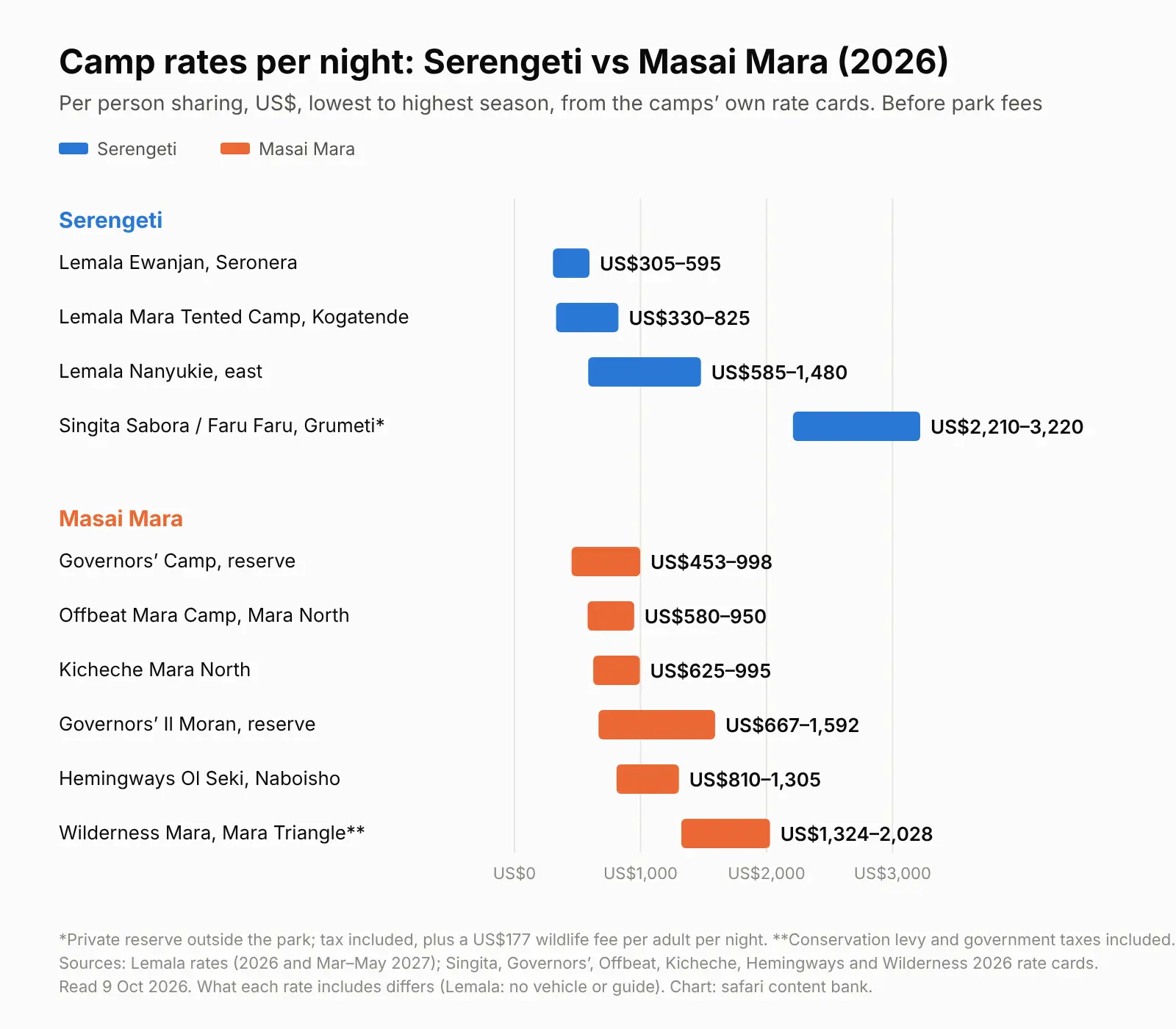 Camps’ own 2026 rate cards (Lemala to May 2027), read 9 October 2026. Sources: Lemala; Singita; Governors’; Offbeat; Kicheche; Hemingways; Wilderness. Chart: safari content bank.
One night on the Mara River in peak season
On the river in July–September, a night at Lemala’s Kogatende camp with Serengeti fees costs US$978.40 before a vehicle, against US$1,248 at Governors’ Camp in the Mara reserve with fees and game drives (our sums).
| One adult sharing, one night, July–September 2026 (our sums) | Bed | Fees | Bed + fees |
|---|---|---|---|
| Lemala Mara Tented Camp, Kogatende (Serengeti) | US$825 | US$153.40 entry + concession | US$978.40; US$1,078.40–1,128.40 with half of a US$200–300 private vehicle and guide for two |
| Governors’ Camp, Mara River (reserve), game drives included | US$998 | US$200 reserve day + US$50 community fee | US$1,248 |
| Kicheche Mara North (conservancy), game drives included | US$995 | US$130 conservancy fee | US$1,125; US$1,325 on a day in the reserve |
Bed rates: Lemala, Governors’ 2026, Kicheche 2026. Vehicle: one operator’s published price, US$200–300 per vehicle per day. Fees: TANAPA Tariffs 2023/24, the last published tariff; Narok County FY2025/26, the last published. Flights, tips and airstrip transfers not included.
Whole-trip costs for each park, with flights and worked examples: Serengeti safari cost and Masai Mara safari cost. Migration trips on both sides: Great Migration safari cost.
Which should you choose?
Choose the Serengeti for calving, June’s Grumeti crossings, early July in the north and space; choose the Mara for a short trip from Nairobi, a lower fee from January to June, written sighting rules and, in the conservancies, night drives and walks. For August–September, either bank of the Mara River works.
| If you… | Pick | Why |
|---|---|---|
| Travel January–March | Serengeti: Ndutu and the southern plains | Calving peaks in February; the Mara has the smaller Loita herd |
| Travel in June | Serengeti: Western Corridor | Grumeti crossings, about the first half of June |
| Travel early to mid-July | Northern Serengeti (Kogatende) | Lead herds reach northern Tanzania first |
| Travel August–September | Either bank of the Mara River | Compare camps: US$978.40 at Lemala Kogatende before a vehicle, US$1,248 at Governors’ with drives (our sums) |
| Have three nights or fewer from Nairobi | Masai Mara | About 1 hour by air, or 5.5–6 hours by road |
| Travel January–June and count fees | Masai Mara | US$100 a day, against US$129.80–141.60 a night inside the Serengeti |
| Travel July–December and count fees | Serengeti, or a Mara conservancy | US$141.60–153.40 a night in the Serengeti, US$130 in a conservancy, against US$200 a reserve day |
| Want night drives or walks | A Mara conservancy, or a private concession on the Serengeti’s edge (Grumeti, Klein’s) | Neither park sells night drives inside its boundary |
| Travel with children under 9 | Masai Mara reserve | Free under 9; the Serengeti charges US$23.60 a day from age 5 |
| Want to add the Ngorongoro Crater | Serengeti | The road from Arusha crosses the Ngorongoro Conservation Area; a crater descent is US$295 per vehicle (NCAA, read 9 Oct 2026) |
Choosing between the two countries rather than the two parks (entry documents, insurance, beaches, other parks): see Kenya vs Tanzania. Whichever you choose, check that your operator holds a current licence: see how to check a safari operator is licensed.
See also: Serengeti vs Ngorongoro, Laikipia vs Masai Mara, Kruger vs Masai Mara, Okavango Delta vs Serengeti and Serengeti vs Kruger.
Common mistakes in Serengeti vs Masai Mara comparisons
| What you’ll often read | What is correct |
|---|---|
| “The Masai Mara is part of the Serengeti” | They are one unfenced ecosystem but two protected areas in two countries, with separate authorities, fees and rules. |
| “The migration is in the Masai Mara from July” | In early to mid-July most of the herds are usually still in the northern Serengeti. The Mara usually fills in August–September. |
| “Calving is in the Serengeti National Park” | The calving plains around Ndutu are in the Ngorongoro Conservation Area, with NCA fees (US$70.80 entry per 24 h). |
| “The Mara is always cheaper in park fees” | Only from January to June (US$100 a day). From July to December a Mara reserve day costs US$200, more than a night inside the Serengeti (US$141.60–153.40, last published tariff, 2023/24). |
| “Serengeti entry is US$70” | US$70 is before VAT. The visitor pays US$82.60, and it is the 2023/24 figure, the last published. |
| “Night drives in the Serengeti and the Mara” | Neither park sells them inside its boundary: only Mara conservancies and private concessions on the Serengeti’s edge. |
| “The Serengeti side of the river has fewer vehicles” | No source counts vehicles on either bank. A Serengeti forum regular reports “fifty or more trucks” at a crossing point. |
| “Drive from the Mara into the Serengeti” | The border crossing between the parks has been closed since 1977. |
Frequently asked questions
Which is better, the Serengeti or the Masai Mara? It depends on the month and the length of the trip. The Serengeti has the herds from December to June, including calving at Ndutu in February, and is about ten times the size of the Mara reserve. The Mara is about an hour by air from Nairobi and shares the July–October river crossings with the northern Serengeti.
Is the Masai Mara part of the Serengeti? Ecologically yes, administratively no. The Maasai Mara National Reserve (Kenya) and Serengeti National Park (Tanzania) are one unfenced ecosystem of about 25,000 km² (Narok County’s management plan), but they have separate authorities, fees and rules. The road crossing between them has been closed since 1977.
Is the Masai Mara cheaper than the Serengeti? In park fees, from January to June: the Mara reserve costs US$100 per adult per day, against US$129.80–141.60 a night inside the Serengeti (last published tariff, 2023/24). From July to December the Mara reserve costs US$200 a day, more than the Serengeti’s US$141.60–153.40. Camp rates overlap: the rate cards we hold start at US$453 a night in the Mara (2026) and US$305 in the Serengeti (March–May 2027).
Where is the migration in August, the Serengeti or the Masai Mara? On both sides of the Mara River. August is the one month every Mara River calendar agrees on, with crossings mostly south to north, and herds in the northern Serengeti (Lamai Wedge, Kogatende) and the Masai Mara. No source can date or guarantee a crossing.
Which is less crowded, the Serengeti or the Masai Mara? No authority publishes vehicle counts for either park, so there is no measured answer. The Mara reserve had 213,000 visitors in 2025 on about 1,500 km²; the Serengeti had 491,398 in 2024/25 on 14,763 km². Travellers report 20–40 vehicles at Mara sightings and fifty or more at Serengeti crossing points.
Can you visit the Serengeti and the Masai Mara on one trip? Yes, usually by air. Safarilink leaves the Mara at 11:30 for Migori, you cross the Isebania–Sirari border by road, and Coastal Aviation leaves Tarime at 14:00 for the Serengeti. You need Kenya’s eTA and Tanzania’s visa; the costs are on Kenya vs Tanzania.
How big is the Serengeti compared with the Masai Mara? About ten times bigger. Serengeti National Park covers 14,763 km² (a safari agent’s park guide), and the Masai Mara reserve about 1,500 km²: the Mara Conservancy describes its 510 km² Triangle as about a third of the reserve.
Sources
- TANAPA, Tariffs 2023/24 (PDF), the last published tariff; NCAA, tariffs, undated, read 9 Oct 2026
- Narok County, Maasai Mara fee schedule FY2025/26 (PDF), the last published, expired 30 June 2026; for July–December 2026, The Kenya Times, 6 Aug 2026 (press, secondary); GMME Management Plan 2023–2032 (PDF), and its vehicle rules as reported by Business Daily
- Mara Conservancy: history, conservation fees, park rules, driving, wildebeest migration; a safari agent’s Serengeti guide
- Visitors: The Citizen, 18 Dec 2025; Kenya Economic Survey 2026 via Business Daily
- Migration: a camp operator’s migration guide and a camp operator’s Mara vs Serengeti guide; two guides by a UK safari operator; a Mara camp operator’s migration page; a safari operator’s migration guide; a Kenyan camp operator’s Loita migration page
- Routes and times: The EastAfrican, 4 Apr 2017; Safarilink, Masai Mara to Serengeti; Mombasa Air Safari 2026 schedule; The Kenya Times, 20 Aug 2026; Operator A; Operator D, modified 1 Jul 2026; Operator C; Operator B, Masai Mara vs Serengeti, revised 26 May 2026, and national park rules
- Camp rate cards: Lemala; Singita; Governors’ 2026 and its community fee; Offbeat 2026; Kicheche 2026; Hemingways 2026; Wilderness; Porini 2026 and Porini Lion Camp factsheet; vehicle price: one operator’s published price
- Rules and traveller reports: Kenyans.co.ke, 4 Jun 2024; a safari booking site’s traveller reviews; TripAdvisor threads as linked in the text, read 9 Oct 2026
- Our own pages for the detail: Serengeti, Serengeti park fees, Masai Mara, Masai Mara park fees, Kenya vs Tanzania, Great Migration month by month, Mara to Serengeti, Mara reserve vs conservancies
Fees, rates and times checked 9–10 October 2026. We will update this page when Narok County publishes a 2026/27 Mara fee schedule, when TANAPA publishes a new tariff, and when the camps above publish their 2027 peak rates.