 Experience

Last verified · Next check due
On this page
Short answer: Pack for the smallest plane on your route. Safarilink, AirKenya and Aerolink allow 15 kg per person including hand luggage; Auric Air, Mack Air and Botswana’s camp airlines allow 20 kg, in a soft bag (carriers’ baggage pages, read 9 October 2026). Wear neutral colours, not dark blue or black, where tsetse flies live. Kenya bans single-use plastic bags, and Kenya and Tanzania require civil-aviation permits before a drone enters the country.
Key facts
- Kenyan bush flights allow 15 kg per person, hand luggage included. Safarilink and AirKenya both set 15 kg on safari routes; AirKenya’s 15 kg includes 5 kg of hand luggage (Safarilink; AirKenya, read 9 October 2026).
- Auric Air in Tanzania allows 20 kg including hand luggage and cameras, in a piece of up to 90 × 65 × 35 cm (Auric Air, read 9 October 2026).
- Botswana’s light aircraft allow 20 kg per person including hand luggage, in a soft bag; Moremi Air states that “hard case bags will not be accepted” (Mack Air; a safari agent’s reference page). Details on our Botswana bush flights page.
- A foreign visitor cannot import a drone into Tanzania without a TCAA import permit: “Without TCAA Import Permit, the drone will be confiscated at the entry point upon arrival” (Tanzania Civil Aviation Authority, read 8 October 2026).
- Kenya’s ban on single-use plastic carrier bags has applied since 28 August 2017, including to visitors’ luggage, according to travellers on a German forum (HolidayCheck); Kenya Wildlife Service’s park rules list single-use plastic as prohibited (KWS, Amboseli).
- Rwanda’s official gorilla kit list: solid walking shoes with gaiters, sturdy long clothing against stinging nettles, gardening or leather gloves and a light rain jacket (Visit Rwanda, read 9 October 2026).
Bush-flight luggage limits by airline
Your bag allowance is set by the smallest aircraft on the trip: 15 kg on most East African bush flights, 20 kg on Auric Air and in Southern Africa, in both cases with hand luggage inside the limit. The long-haul flight that brings you to Africa usually allows more; the light aircraft that takes you to camp is where bags get left behind.
East Africa
| Airline | Country | Allowance per person | Bag rule and maximum size | Excess and extra seat | Source |
|---|---|---|---|---|---|
| Safarilink | Kenya (also Kilimanjaro, Arusha, Zanzibar, Entebbe) | 15 kg incl. hand baggage; 20 kg on Zanzibar, Kisumu, Diani, Lamu, Malindi, Entebbe and Mombasa routes | Soft bags requested; large rigid suitcases may be offloaded to the next flight | Listed as 2023/24 rates: 0–10 kg US$50; 11–20 kg US$80 prepaid or US$100 at check-in; 21–30 kg US$145 / US$165. A freight seat at the adult fare carries 75 kg more (safari routes) | Safarilink |
| AirKenya | Kenya (also Arusha, Kilimanjaro) | 15 kg incl. 5 kg hand luggage | Soft-sided required; checked 60 × 45 × 33 cm, hand 53 × 30 × 23 cm; soft bags sold at Wilson | US$5 per kg, may be refused on the day; freight seat up to 75 kg | AirKenya |
| Mombasa Air Safari | Kenya | 15 kg incl. hand luggage | Soft | not stated | Safari agent’s reference page |
| Auric Air | Tanzania (also Masai Mara, Entebbe, Kigali) | 20 kg incl. hand luggage and cameras | All bag types accepted, soft-sided recommended; max piece 90 × 65 × 35 cm | Pre-booked 10 kg slabs, at most 4: US$30 each on coast routes, US$60 on safari routes; freight seat 75 kg | Auric Air |
| Aerolink | Uganda | 15 kg incl. 5 kg hand luggage | Soft-sided; checked 60 × 45 × 33 cm, hand 30 × 53 × 23 cm | US$5 per kg; freight space up to 75 kg at the child fare plus taxes | Aerolink baggage policy 2025 (PDF) |
| Helicopter transfers | Rwanda | 15 kg incl. hand luggage | Soft | not stated | Safari agent’s reference page |
Sources: airlines’ own baggage pages (Safarilink, AirKenya, Auric Air, Aerolink), read 9 October 2026. The helicopter row comes from a safari agent’s reference page, and the Mombasa Air Safari row from another, read 8 October 2026. Coastal Aviation’s and Regional Air’s own baggage pages were not in our sources, so we print no limit for them: ask your operator. The airline’s conditions of carriage on your ticket win.
Southern Africa
| Airline | Country | Allowance per person | Bag rule and maximum size | Source |
|---|---|---|---|---|
| Mack Air | Botswana, Zimbabwe | 20 kg incl. hand luggage | Soft-shell required on light aircraft; 70 × 42 × 30 cm | Mack Air |
| Moremi Air | Botswana | 20 kg incl. cameras and hand luggage | Soft-sided; “hard case bags will not be accepted”; 70 × 35 × 30 cm | Kwando 2024 rate sheet; a safari agent’s reference page |
| Safari Air (Ker & Downey) | Botswana | 20 kg incl. camera gear and hand luggage | Soft duffel, “no wheels or frames”; 65 × 40 × 30 cm | Ker & Downey |
| Skeleton Coast fly-in safaris | Namibia | 10 kg incl. hand luggage | Soft; 60 × 40 × 40 cm | Safari agent’s reference page |
| Proflight Zambia (scheduled routes) | Zambia | 23 kg checked on domestic routes, 30 kg international, plus 5 kg hand | not stated | Proflight Zambia |
| FedAir (Federal Airlines) | South Africa (Sabi Sand, Timbavati, Madikwe, Phinda) | 20 kg in the hold plus 5 kg hand luggage; X-Class fare 32 kg | Soft-sided preferred; hard shell at most 40 × 30 × 60 cm; soft bags sold in the lounge | FedAir; FedAir Agent Manual 2026 (PDF) |
Sources: as linked. Mack Air, Proflight and FedAir pages read 9 October 2026; Ker & Downey and the Kwando 2024 rate sheet read 10 October 2026; agent reference pages read 8 October 2026. Wilderness Air’s own baggage page was not in our sources, so we print no limit for it: ask your camp or operator.
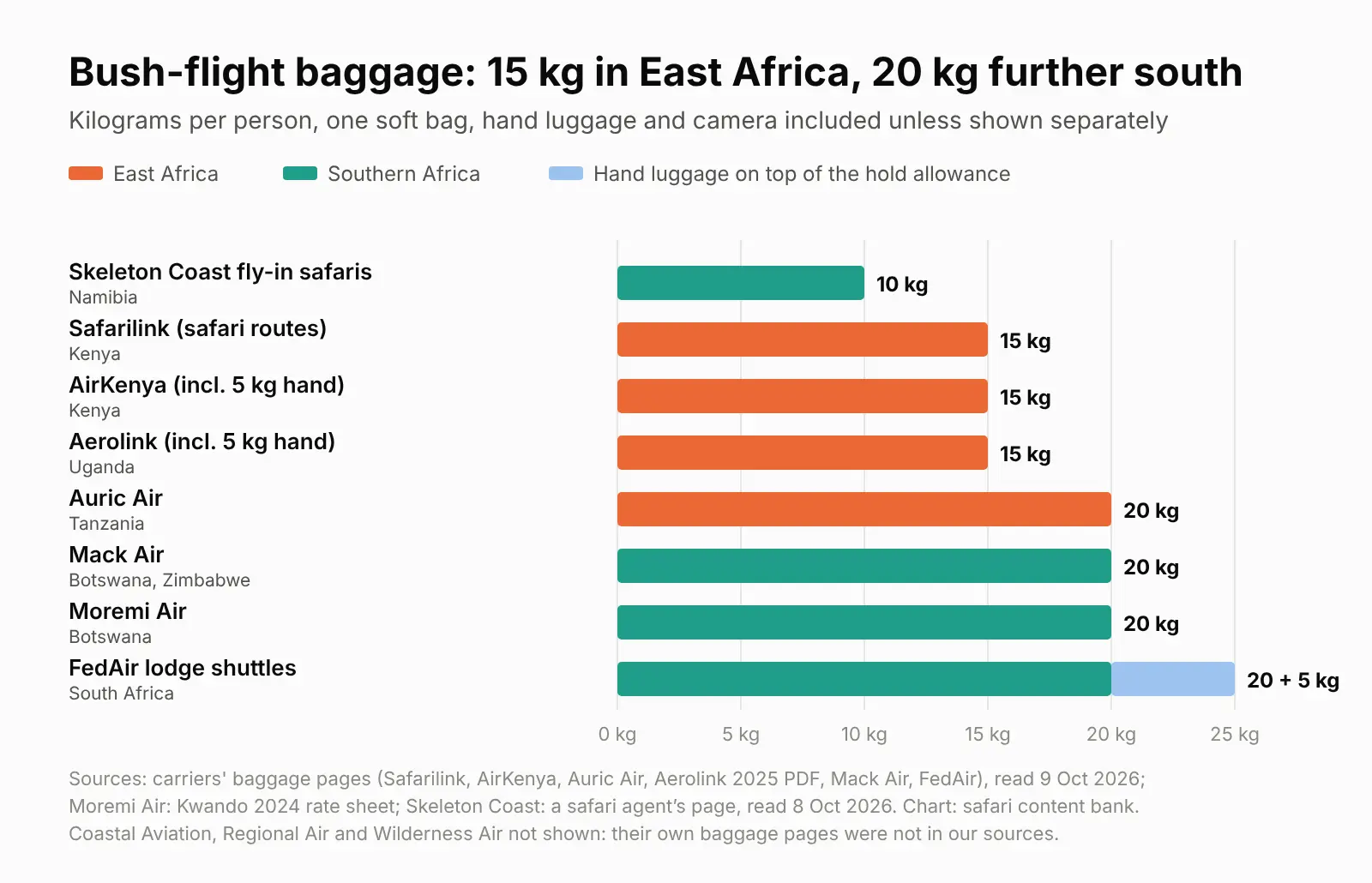 Check the limit of every carrier on your route; the lowest one applies to the whole trip. Sources: airlines’ baggage pages, read 9 October 2026; Kwando 2024 rate sheet (Moremi Air); a safari agent’s reference page (Skeleton Coast), read 8 October 2026. Coastal Aviation, Regional Air and Wilderness Air are not shown: their own baggage pages were not in our sources. Chart: safari content bank.
- A Mara–Serengeti trip is held to 15 kg. The Safarilink link via Migori and Tarime allows 15 kg and needs a yellow fever card; see Masai Mara to the Serengeti.
- Weight is what gets checked. Forum travellers on Mara flights say “The key metric is weight”, and soft bags with wheels have been accepted (TripAdvisor; traveller reports).
- Extra bags can stay behind. AirKenya stores luggage free at Wilson for returning passengers, and FedAir at Johannesburg and Kruger airports (carriers’ pages). Ker & Downey stores it free in Maun if the safari starts and ends there.
- Johannesburg airport wants one flat side. Checked bags with irregular shapes or long straps are not accepted there (a safari agent’s reference page), so a soft duffel may need a tray or wrap on the long-haul leg.
What 5 kg too much costs (our sums)
On the published excess rates, 5 kg over costs US$25–125 depending on the airline.
| Airline | Rule | 5 kg over | Source |
|---|---|---|---|
| AirKenya | US$5 per kg | US$25 (our sum) | AirKenya |
| Aerolink (Uganda) | US$5 per kg | US$25 (our sum) | Aerolink 2025 (PDF) |
| Safarilink | 0–10 kg slab | US$50 (listed as 2023/24 rate) | Safarilink |
| Auric Air | 10 kg slab, safari route, pre-booked | US$60 | Auric Air |
| FedAir | under 10 kg | R800 | FedAir Agent Manual 2026 |
| Moremi Air (Kwando) | 50% of the seat rate for up to 15 kg extra | US$125 on the US$250 Maun–Kwara sector (our sum) | Kwando 2024 |
Per sector, one way. AirKenya and FedAir say excess may be refused or not loaded unless pre-booked. Sources read 9–10 October 2026.
Clothing: colours, layers and what we found on camouflage
Wear neutral colours; leave dark blue and black at home if you are visiting a tsetse area; pack a warm layer for the dawn drive. Khaki is not required: forum regulars call it an overspill from colonial Britain and say neutral colours and closed shoes are the real rule (TripAdvisor, “Clothing and packing for safaris”; traveller reports).
| Rule | What applies | Source |
|---|---|---|
| No dark blue or black in tsetse areas | Tsetse flies are attracted to dark colours: avoid black, blue and bright clothing (blue jeans, black shirts) in Zambia’s and Zimbabwe’s tsetse areas | Operator guide |
| Where tsetse are reported in Tanzania | Guides place them at Kusini, the Western Corridor and the Lobo road in the Serengeti and at Tarangire’s north gate and river, and report none at Seronera, in Arusha National Park or in Ngorongoro | TripAdvisor Tanzania forum (traveller and guide reports) |
| Botswana | “Tsetse flies have been eradicated” | Operator guide |
| Camouflage clothing | We found no official text on camouflage clothing for any safari country in our sources, so we state no ban | — |
| Cold mornings | Night lows in the Masai Mara are 11–13 °C in every month; Windhoek averages 7.2 °C on July nights | Climates to Travel, Kenya; Climates to Travel, Namibia |
Sources as linked, read 8–10 October 2026. Tsetse locations are traveller and guide reports, not a park authority map.
- The disease risk from tsetse is low, but there is no vaccine. Cases of the East and Southern African form of sleeping sickness (T. b. rhodesiense) fell to 37 in 2024 and 41 in 2025; the risk from a single bite is put at under 0.1%, and there is no vaccine or preventive drug (Wikipedia, African trypanosomiasis, citing WHO data). Prevention is long sleeves and avoiding dense tsetse areas.
- Repellent barely helps against tsetse, according to a guide on the Tanzania forum: “I don’t know of any repellent that works for tsetse fly” (TripAdvisor). Against malaria mosquitoes, UK health guidance makes avoiding bites “day and night” the core protection: repellent, long sleeves and trousers in the evening (TravelHealthPro, Kenya).
- Plan on laundry, not a week of clothes. Ker & Downey says every one of its Botswana camps does laundry (Ker & Downey); budget tours often exclude it (a budget operator’s cost guide).
Plastic bags: what is banned
Kenya bans single-use plastic carrier bags, and travellers report that the ban covers what visitors bring; plastic bottles are not banned. For Tanzania and Rwanda we have no official text in our sources, so we print no rule for either.
| Country | Rule | Source |
|---|---|---|
| Kenya | Ban on single-use plastic carrier bags in force since 28 August 2017, applied to visitors’ luggage | HolidayCheck forum (traveller reports) |
| Kenya, KWS national parks | Single-use plastic is listed as prohibited in the parks’ safety guidelines | KWS, Amboseli National Park |
| Kenya: plastic bottles | Not banned, according to French forum regulars | Routard forum (traveller reports) |
| Tanzania | No official text in our sources | — |
| Rwanda | No official text in our sources | — |
Sources as linked, read 8–10 October 2026. We found no copy of Kenya’s National Environment Management Authority (NEMA) notice or of Tanzanian or Rwandan regulations: ask your operator before you pack carrier bags or bin liners.
- Zip-lock bags for liquids are tolerated in Kenya, according to forum regulars (traveller reports, same threads).
Drones: permits before you fly in
Do not pack a drone for a Kenya or Tanzania safari unless you hold the civil-aviation permits before you arrive; in Namibia you need approval at least 60 days ahead. None of the rules below allows a tourist to fly from a game-drive vehicle without permission.
| Country | What the rules say | Cost published | Source |
|---|---|---|---|
| Kenya | Importing or exporting a drone without prior Kenya Civil Aviation Authority (KCAA) approval is illegal. Ownership is limited to Kenyan citizens or residents, companies and government (reg. 6); the authority may grant a temporary permit of up to 30 days, renewable once (reg. 11). No flight above 400 ft or within 50 m of any person, vehicle or structure, and none at night (reg. 24). No image of a person without that person’s written consent (reg. 41) | Temporary permit KES 20,000; import permit KES 3,000; registration KES 3,000 (KCAA). In KWS parks, drone use costs US$300 per drone per day per park for non-residents, with a KCAA licence (KWS fees from 1 October 2025). Penalty up to KES 2,000,000 or three years | FCDO, Kenya entry requirements; KCAA Unmanned Aircraft Systems Regulations 2020 (PDF); KCAA charges (PDF); KWS Fees Regulations 2025 (PDF) |
| Tanzania | Non-residents apply at least 3 weeks before arrival for an import permit, drone registration, pilot registration and an operations permit; “Without TCAA Import Permit, the drone will be confiscated at the entry point upon arrival”. No refund if the applications are not completed in time. No flight in restricted areas “or any other area notified by the Authority” without written permission (reg. 19) | Non-resident, drone under 5 kg: import permit US$50, registration US$100, operations permit US$10 per day | TCAA, drones; TCAA, drone charges; RPAS Regulations 2018, GN 758 (PDF) |
| Namibia | Namibia Civil Aviation Authority (NCAA) authorisation applied for at least 60 days ahead, plus Ministry of Environment, Forestry and Tourism (MEFT) permission for any national park and Namibia Film Commission permission for filming; maximum 45 m (150 ft), not within 5 nautical miles of an aerodrome, not over populated areas | Application fee N$1,200 | Drone Laws, Namibia (secondary summary; NCAA’s own page not read) |
| Botswana, Uganda, Rwanda, Zambia, Zimbabwe | No civil-aviation drone rules in our sources | — | — |
Sources as linked: KCAA and TCAA documents read 8 October 2026; FCDO and KWS read 8–10 October 2026. Rules change; check the aviation authority’s page before you travel.
- The Kenyan park fee does not replace the KCAA permit. The KWS schedule prices drone use “KCAA licenses required”, per drone, per day, per park.
See also: Photography safari.
Plugs and power: which adaptor
A UK-style Type G adaptor covers Kenya, Uganda and Rwanda’s standard; Tanzania, Zambia, Zimbabwe and Botswana also use the round-pin Type D, and Namibia and South Africa need the large round-pin Type M. Every country on the list runs at 220–240 V and 50 Hz, so chargers made only for 110–120 V will not work.
| Country | Plug types | Voltage, frequency |
|---|---|---|
| Kenya | G | 240 V, 50 Hz |
| Tanzania | D, G | 230 V, 50 Hz |
| Uganda | G | 240 V, 50 Hz |
| Rwanda | C, E, G (G is the official standard; E persists in older buildings) | 230 V, 50 Hz |
| Botswana | D, G, M | 230 V, 50 Hz |
| Namibia | D, M | 220 V, 50 Hz |
| Zambia | C, D, G | 230 V, 50 Hz |
| Zimbabwe | D, G | 220 V, 50 Hz |
| South Africa | C, M, N | 230 V, 50 Hz |
Source: Wikipedia, Mains electricity by country, read 8 October 2026; the page itself warns that its data may be out of date. Lodges may fit other sockets: check with your camp.
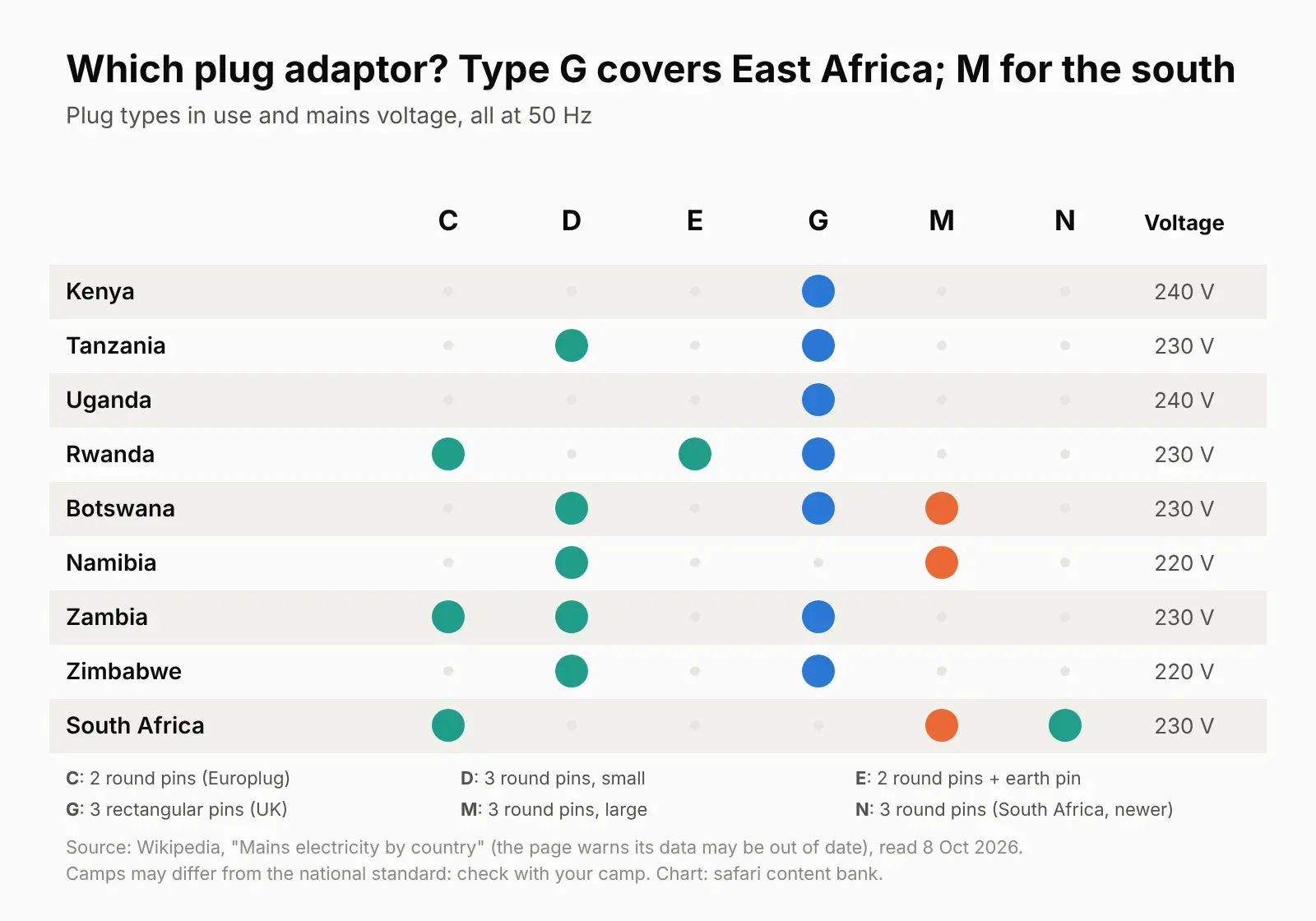 Type G is the UK three-rectangular-pin plug; Type M is the large three-round-pin plug used in South Africa and Namibia. Source: Wikipedia, “Mains electricity by country”, read 8 October 2026. Chart: safari content bank.
- There is no charging on multi-day canoe trails. Carry spare batteries and a waterproof case on the water (a safari agent’s canoe-trail notes).
- Camera gear counts inside the bag limit. Ker & Downey, Moremi Air and Auric Air all include cameras in the 20 kg.
Gorilla and chimpanzee trekking kit
For a gorilla trek, pack what Rwanda’s tourism board lists: solid walking shoes with gaiters, sturdy long clothing against stinging nettles, gardening or leather gloves and a light rain jacket. The ground is steep and wet, and the altitude is high.
| Item or fact | Rwanda (Volcanoes National Park) | Uganda (Bwindi, Mgahinga) | Source |
|---|---|---|---|
| Official kit list | Solid walking shoes with gaiters; sturdy long clothing against stinging nettles; gardening or leather gloves; light rain jacket | No official kit list in our sources | Visit Rwanda |
| Altitude | Treks reach 2,500–4,000 m | Bwindi lies at 1,160–2,607 m | Visit Rwanda; UWA (see Uganda or Rwanda for gorillas) |
| Trek length | 30 minutes to 4+ hours; families allocated on the morning by fitness | A few hours to a full day | Visit Rwanda; UWA brochure |
| Minimum age | 15 | 15 | Visit Rwanda; UWA |
| Porter | About US$10 plus a tip | About US$20 plus a tip | One operator’s guide; one tour operator’s trip notes |
| Bush flight to the park | — | Aerolink: 15 kg including 5 kg hand luggage | Aerolink 2025 (PDF) |
Sources as linked, read 9 October 2026. Permit prices are on our gorilla permit prices page.
- A porter carries your daypack. Nyungwe National Park (Rwanda) lists porters at US$10 a full day and US$5 a half day for chimpanzee treks (Nyungwe pricing 2025–2026; see chimpanzee trekking permits).
- Pack a fleece for the lodge as well as the trail. Bwindi travellers on the forum recommend fleece, waterproof and boots, and one worried about freezing at night in the room (TripAdvisor, Bwindi in late May; traveller reports).
- Follow the morning briefing. Rwanda’s official page leaves the visiting protocol to the rangers’ briefing (Visit Rwanda). Sources give different viewing distances (7 m or 10 m), so we print no single figure.
Documents and cash
Carry your passport with blank pages, your visa or eTA, your insurance details and, on some routes, a yellow fever certificate; bring US dollar notes printed in 2009 or later.
- Yellow fever: the Mara–Serengeti air link asks for the card (Safarilink). Which countries ask for it, and when, is on our yellow fever page.
- Insurance: Kenya and Tanzania rules are on our pages for Kenya and Tanzania.
- US dollar notes must be series 2009 or newer; older bills are often refused. Bring small denominations for tips (operator guide). Amounts are on our safari tipping page.
- Zimbabwe: two blank passport pages plus one for each other country visited, according to an operator guide.
Common mistakes
| What you’ll often read | What is correct |
|---|---|
| “20 kg is the safari bag limit” | Kenyan bush flights allow 15 kg, as does Aerolink in Uganda. 20 kg applies on Auric Air and in Botswana, and 10 kg on Skeleton Coast fly-ins. |
| “The limit is for the checked bag; hand luggage is extra” | Hand luggage is inside the limit on Safarilink, AirKenya, Auric Air, Aerolink, Mack Air and Moremi Air. FedAir is the exception: 20 kg hold plus 5 kg hand. |
| “Hard suitcases are banned on safari” | Rules differ by airline. Moremi Air refuses hard cases; Safarilink may offload rigid suitcases to the next flight; Auric Air accepts all bag types. |
| “Wear khaki” | Khaki is not required. The rule with a reason is no dark blue or black in tsetse areas. |
| “Camouflage clothing is banned across Africa” | We found no official text for any safari country. Check your country’s rule with your operator. |
| “You can fly a drone in the parks with a park ticket” | Kenya and Tanzania require civil-aviation permits first, and Tanzania confiscates drones without an import permit at the entry point. |
| “Any European adaptor will do” | East Africa uses UK-style Type G; Namibia and South Africa use Type M. |
Frequently asked questions
How much luggage can I take on a safari? 15 kg per person on Kenyan bush flights (Safarilink, AirKenya) and on Aerolink in Uganda, and 20 kg on Auric Air and Botswana’s light aircraft. In each case the limit includes hand luggage and usually your camera. FedAir in South Africa allows 20 kg in the hold plus 5 kg hand luggage.
Do I need a soft bag for a safari? On a fly-in safari, yes. Moremi Air in Botswana says “hard case bags will not be accepted”, AirKenya requires soft-sided bags and Safarilink may offload large rigid suitcases to the next flight. Auric Air accepts all bag types but recommends soft-sided ones.
What colours should I not wear on safari? Dark blue and black in tsetse areas, because tsetse flies are drawn to dark colours. Operators name Zambia’s and Zimbabwe’s tsetse areas, and guides report tsetse in parts of the Serengeti and at Tarangire. Khaki is not required; neutral colours are enough.
Can I bring plastic bags to Kenya? No single-use plastic carrier bags. Kenya’s ban has applied since 28 August 2017, and travellers report that it covers visitors’ luggage; KWS park rules list single-use plastic as prohibited. Plastic bottles are not banned, according to forum regulars.
Can I fly a drone on safari? Not without permits arranged before you travel. Kenya needs prior KCAA approval to import a drone and charges US$300 per drone per day in KWS parks; Tanzania confiscates drones without a TCAA import permit at the entry point; Namibia needs NCAA approval at least 60 days ahead.
What plug adaptor do I need for a safari? Type G (UK-style) for Kenya and Uganda; G is also among the types in use in Tanzania, Rwanda, Botswana, Zambia and Zimbabwe. Type M (large round pin) for Namibia and South Africa; Botswana uses D, G and M. All run at 220–240 V and 50 Hz.
What should I wear for gorilla trekking? Rwanda’s tourism board lists solid walking shoes with gaiters, sturdy long clothing against stinging nettles, gardening or leather gloves and a light rain jacket. Treks reach 2,500–4,000 m in Rwanda, so add a warm layer.
Sources
- Airlines: Safarilink baggage; AirKenya baggage policy; Auric Air baggage policy; Aerolink baggage policy 2025 (PDF); Mack Air; Ker & Downey Botswana, Transfers; Kwando 2024 rate sheet; Proflight Zambia; FedAir baggage and Agent Manual 2026 (PDF)
- Luggage reference pages (safari agents): two safari agents’ pages (names and links kept in our editor notes)
- Drones: FCDO, Kenya entry requirements; KCAA UAS Regulations 2020 (PDF); KCAA UAS charges (PDF); KWS Fees Regulations 2025 (PDF); TCAA drones and charges; Tanzania RPAS Regulations 2018 (PDF); Drone Laws, Namibia
- Plastic: KWS, Amboseli National Park; traveller reports on HolidayCheck and Routard
- Clothing and health: a safari seller’s guide; Wikipedia, African trypanosomiasis; TravelHealthPro, Kenya; Climates to Travel, Kenya and Namibia; a budget operator’s cost guide
- Power: Wikipedia, Mains electricity by country; a safari agent’s canoe-trail notes
- Gorillas: Visit Rwanda, gorilla tracking; one operator’s guide and one tour operator’s trip notes (names and links kept in our editor notes)
- Money and documents: one operator’s tipping guide; one safari booking site’s guide (names and links kept in our editor notes)
- Traveller reports (TripAdvisor forum threads, not rules): Safarilink luggage with wheels; tsetse by location; Bwindi in late May
More country detail: Kenya safari questions, Tanzania safari questions, Botswana safari questions, Namibia safari questions, Nairobi to the Masai Mara.
Baggage rules, drone rules and plug data checked 8–10 October 2026. We will update this page when Coastal Aviation, Regional Air or Wilderness Air publish baggage rules we can read, when Safarilink publishes excess rates newer than 2023/24, when KCAA’s 2026 civil aviation regulations or a TANAPA drone rule can be read, and when we find official plastic-bag rules for Tanzania and Rwanda.