 Experience

Last verified · Next check due
On this page
- Northern vs southern circuit at a glance (2026)
- Park fees: is the south cheaper?
- What a day costs on each circuit
- Getting there: Arusha and Kilimanjaro vs Dar es Salaam
- Crowds: how busy each circuit is
- Wildlife: what each circuit is best for
- Walking, boat safaris and night drives
- When to go, and when camps close
- Combining either circuit with Zanzibar
- Which circuit suits you?
- Common mistakes in northern vs southern circuit comparisons
- Frequently asked questions
- Sources
Short answer: Choose the northern circuit (Serengeti, Ngorongoro, Tarangire) for the wildebeest migration, the crater and group trips from US$220–300 per person per day. Choose the southern circuit (Nyerere, Ruaha) for walks, boat safaris, night drives and fewer itineraries. A night inside Nyerere costs the same in park fees as the Serengeti, US$129.80–153.40 per adult; Ruaha costs US$70.80 (last published tariff, 2023/24). Most southern camps close from mid-March to May.
Key facts
- Nyerere’s park fees are the Serengeti’s; only Ruaha is cheaper. A night inside Nyerere or the Serengeti costs US$129.80–153.40 per adult in entry and concession fees, Tarangire or Lake Manyara US$100.30–106.20, and Ruaha US$70.80 (TANAPA, last published tariff, 2023/24; our sums).
- The north is a road circuit from Arusha; the south starts in Dar es Salaam. Arusha to Tarangire is about 2 hours by road and to the central Serengeti 7–7.5 hours; Dar es Salaam to Nyerere is 175 km and about 4 hours in one published travel-time table, to Ruaha 600 km and at least 10 hours, or about 2.5 hours by air.
- The cheapest published trips are in the north: group camping from Arusha at US$220–300 per person per day, park fees included. We found no group-joining Nyerere trip with park fees included; a 10-day southern fly-in package starts at US$318 a day for six people in low season.
- Night drives are not allowed in the Serengeti or the Ngorongoro Conservation Area; they are on TANAPA’s list for Tarangire, Lake Manyara, Ruaha and Nyerere, at US$59 per adult. Nyerere sells boat safaris at US$23.60 per person; we found none priced on the northern circuit.
- Most Ruaha and Nyerere camps close from mid-March to the end of May. In the north, Serengeti camps such as Lemala Ewanjan publish March–May rates.
- The south sees far fewer itineraries: Nyerere and Ruaha each appear in 13 of 150 published Tanzania itineraries in our dataset (9%), the Serengeti in 131 (87%). No Tanzanian authority publishes vehicle counts at sightings.
Northern vs southern circuit at a glance (2026)
The northern circuit is a drive from Arusha through Tarangire, Lake Manyara, Ngorongoro and the Serengeti; the southern circuit is Nyerere and Ruaha, reached from Dar es Salaam, usually by light aircraft. Both are in Tanzania, on one visa and one insurance policy.
| Northern circuit | Southern circuit | Source | |
|---|---|---|---|
| Parks | Serengeti, Ngorongoro Conservation Area (NCA), Tarangire, Lake Manyara | Nyerere (the former northern Selous Game Reserve), Ruaha | Serengeti, Ngorongoro, Tarangire, Nyerere, Ruaha |
| Size | Serengeti 14,763 km² | Nyerere 30,893 km², Ruaha 20,226 km² | A safari agent’s guide, read 8–10 October 2026; Wikipedia, Ruaha |
| Gateway | Kilimanjaro airport (JRO), then Arusha, 55 km, about 1 h 20 | Dar es Salaam | Tanzania safari and Zanzibar |
| Usual way round | By road: Arusha → Tarangire → Lake Manyara → Ngorongoro → Serengeti | Light aircraft between Dar es Salaam, Nyerere and Ruaha; Nyerere also by road | Tarangire, Nyerere and Ruaha pages |
| Park fees, a night inside, per adult | Serengeti US$129.80–153.40; Tarangire, Lake Manyara US$100.30–106.20; Ngorongoro rim US$129.80 + crater US$295 per vehicle | Nyerere US$129.80–153.40; Ruaha US$70.80, all year | TANAPA 2023/24 (PDF), last published; NCAA |
| Cheapest published trip | Group camping from Arusha, US$220–300 a day, park fees included | 10-day fly-in package, US$318–558.76 a day, park fees and internal flights included | Operators’ published 2026 prices (unnamed) |
| Mid-range, per day with park fees | Private circuit for two US$406–656; Serengeti camp with a private vehicle US$480–900 | Ruaha US$420–490; Nyerere US$550–835, game drives included | Our cost pages |
| Wildebeest migration | Yes: 1,366,109 wildebeest counted at the end of March 2023 | No | TAWIRI 2023 census (PDF) |
| Wild dog | No dated count or sighting rate for the Serengeti in our sources | Selous about 800 dogs; Nyerere and Ruaha are Tanzania’s strongholds | IUCN via CMS (PDF) |
| Night drives | Not in the Serengeti or the NCA; allowed in Tarangire and Lake Manyara | Allowed in Ruaha and Nyerere | TANAPA 2023/24 |
| Boat safaris | None priced in our sources | Nyerere, US$23.60 per person | TANAPA 2023/24 |
| Camps closed | Some, in the long rains: Oliver’s Camp (Tarangire) 16 Mar–15 May | Most, mid-March to May | 2026 camp listings |
| Share of 2025 visitors | Ngorongoro 14.2%, Serengeti 13.1%, Tarangire 9.0% | Not in the top five | Bank of Tanzania exit survey 2025 (PDF) |
Non-East African adult. TANAPA fees are the last published tariff, 2023/24, with 18% VAT; the NCAA tariff page does not say whether VAT is included. Prices per person sharing, without international flights, as printed on our Tanzania, Serengeti, Nyerere and Ruaha cost pages (read 8–10 October 2026). Checked against those pages on 17 October 2026.
Park fees: is the south cheaper?
Only in Ruaha. Nyerere sits on the Serengeti’s fee line, so a night inside costs US$129.80–153.40 per adult in either park; Ruaha costs US$70.80 a night all year, and Tarangire and Lake Manyara US$100.30–106.20 (TANAPA, last published tariff, 2023/24; our sums).
| Park | Entry per adult per day, with 18% VAT | Concession per adult per night inside | A night inside, per adult (our sum) |
|---|---|---|---|
| Serengeti (north) | US$82.60; US$70.80 from 15 Mar to 15 May | US$70.80 Jul–Sep; US$59 Oct–Jun | US$129.80–153.40 |
| Ngorongoro Conservation Area (north) | US$70.80 per 24 h, single entry (NCAA) | US$59, rim and Ndutu lodges (NCAA) | US$129.80, plus US$295 per vehicle for each crater descent |
| Tarangire, Lake Manyara (north) | US$59; US$53.10 from 15 Mar to 15 May | US$47.20 | US$100.30–106.20 |
| Nyerere (south) | US$82.60; US$70.80 from 15 Mar to 15 May | US$70.80 Jul–Sep; US$59 Oct–Jun | US$129.80–153.40 |
| Ruaha (south) | US$35.40, all year | US$35.40 | US$70.80 |
Sources: TANAPA Tariffs 2023/24 (PDF), the last published tariff, valid 1 July 2023 to 30 June 2024; on 9 October 2026 still the only tariff on TANAPA’s “Park Fees and Regulations” page. Ruaha’s concession fee as printed on our Tanzania safari cost page. NCAA tariffs, undated page, read 9 October 2026; it does not say whether VAT is included.
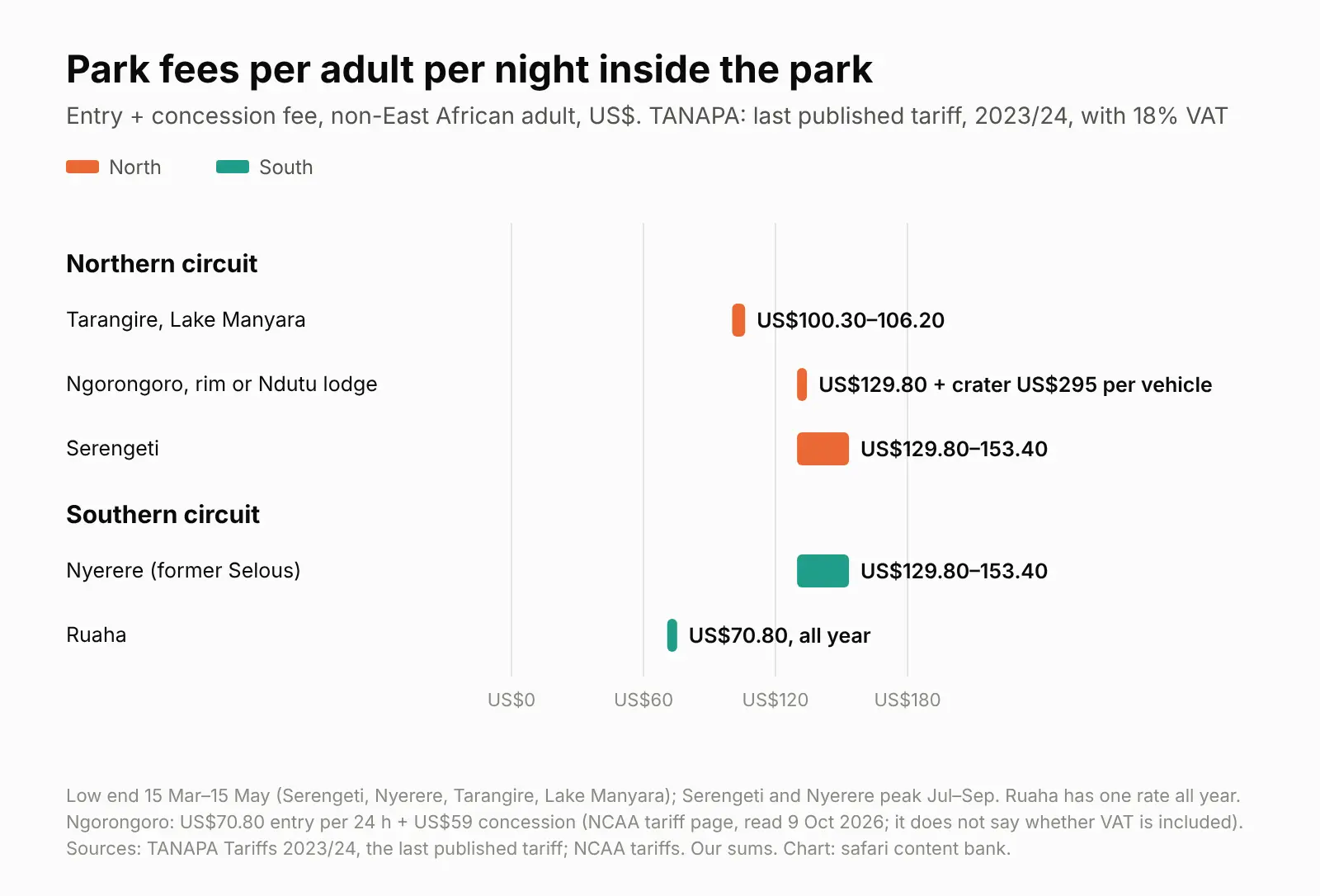 Our sums of entry and concession fees. Sources: TANAPA Tariffs 2023/24, the last published tariff; NCAA tariffs, read 9 October 2026. Chart: safari content bank.
Three nights inside, in park fees alone, per adult (our sums):
| 3 nights, per adult | 15 Mar–15 May | 16 May–30 Jun, 1 Oct–14 Mar | 1 Jul–30 Sep |
|---|---|---|---|
| Serengeti | US$389.40 | US$424.80 | US$460.20 |
| Nyerere | US$389.40 (most camps closed) | US$424.80 | US$460.20 |
| Tarangire or Lake Manyara | US$300.90 | US$318.60 | US$318.60 |
| Ruaha | US$212.40 (most camps closed) | US$212.40 | US$212.40 |
Our sums: 3 × (entry + concession), from TANAPA Tariffs 2023/24, the last published tariff. Camp, vehicle and activity fees are extra.
- The road to the Serengeti has a fee of its own. The drive from Arusha crosses the Ngorongoro Conservation Area at US$70.80 per adult each way, single entry (NCAA). Nothing comparable applies on the way to Nyerere or Ruaha.
- Nyerere’s extras cost more. Its guide or ranger fee is US$47.20 per group per day, against US$23.60 in most parks, Ruaha included (last published tariff, 2023/24).
- No 2024/25, 2025/26 or 2026/27 TANAPA tariff has been published. TANAPA and the Tanzania Wildlife Management Authority (TAWA) froze fee increases for 12 months on 24 March 2025 (The Citizen), and in May 2025 the government promised “a minimum of 12 months’ notice before any future changes” (Tourism Update).
Every Tanzanian fee line: Tanzania park fees.
The official fee lines, with the date each took effect and the authority’s own source:
| Fee | Amount | In force from | Source |
|---|---|---|---|
| Serengeti and Nyerere National Parks, non-East African adult, entry per day, 16 May–14 Mar | USD 70 + 18% VAT = USD 82.60 | 1 Jul 2023 (2023/24 tariff, last published) | TANAPA Tariffs 2023/24 |
| Serengeti and Nyerere National Parks, non-East African adult, entry per day, 15 Mar–15 May | USD 60 + 18% VAT = USD 70.80 | 1 Jul 2023 (2023/24 tariff, last published) | TANAPA Tariffs 2023/24 |
| Serengeti and Nyerere, concession fee per person per night inside the park | Jul–Sep USD 60 + VAT = USD 70.80; Oct–Jun USD 50 + VAT = USD 59 | 1 Jul 2023 (2023/24 tariff, last published) | TANAPA Tariffs 2023/24 |
| Tarangire, Lake Manyara and Arusha National Parks, non-East African adult, entry per day | Peak USD 50 + VAT = USD 59; low USD 45 + VAT = USD 53.10 | 1 Jul 2023 (2023/24 tariff, last published) | TANAPA Tariffs 2023/24 |
| Tarangire, Lake Manyara and Arusha, concession fee per person per night inside the park | USD 40 + 18% VAT = USD 47.20 | 1 Jul 2023 (2023/24 tariff, last published) | TANAPA Tariffs 2023/24 |
| Ruaha, Katavi, Mikumi, Saadani, Udzungwa, Mkomazi, Rubondo, Kitulo and the other parks in this group, non-East African adult, entry per day | USD 30 + 18% VAT = USD 35.40 | 1 Jul 2023 (2023/24 tariff, last published) | TANAPA Tariffs 2023/24 |
| Ngorongoro Conservation Area, non-East African adult, entry per 24 h (single entry) | USD 70.80 (NCAA's page does not say whether VAT is included) | Undated official page, read 9 Oct 2026 | NCAA |
| Ngorongoro Crater descent (crater service fee), per vehicle | USD 295 (NCAA's page does not say whether VAT is included) | Undated official page, read 9 Oct 2026 | NCAA |
| Ngorongoro concession fee, rim and Ndutu lodges, per person per night | USD 59 (NCAA's page does not say whether VAT is included) | Undated official page, read 9 Oct 2026 | NCAA |
| Walking safari, adult, per person (Nyerere and other TANAPA parks) | Short (1–4 h) USD 20, long (over 4 h) USD 25; + 18% VAT = USD 23.60 / USD 29.50 | 1 Jul 2023 (2023/24 tariff, last published) | TANAPA Tariffs 2023/24 |
| Nyerere guide or ranger fee, per group per day (USD 20 in most other parks) | USD 40 + 18% VAT = USD 47.20 | 1 Jul 2023 (2023/24 tariff, last published) | TANAPA Tariffs 2023/24 |
| Nyerere boating safari fee, per person | USD 20 + 18% VAT = USD 23.60 | 1 Jul 2023 (2023/24 tariff, last published) | TANAPA Tariffs 2023/24 |
| Night game drive (Katavi, Ruaha, Mikumi, Tarangire, Lake Manyara, Nyerere, Burigi-Chato, Ibanda-Kyerwa), per person | Adult USD 50 + VAT = USD 59; child USD 25 + VAT = USD 29.50 | 1 Jul 2023 (2023/24 tariff, last published) | TANAPA Tariffs 2023/24 |
What a day costs on each circuit
The north is cheaper at the budget end, because group camping trips from Arusha cost US$220–300 per person per day with park fees; in the mid-range the two overlap, at about US$400–900 a day on either circuit. All prices are per person sharing, without international flights.
| Style | Northern circuit, per person per day | Southern circuit, per person per day | Source |
|---|---|---|---|
| Group camping, park fees included | US$220–300 (3–5-day trips from Arusha, US$900–1,100) | None found with park fees included | Operators’ published 2026 prices (unnamed), read 9 Oct 2026 |
| Package, mid-range | Private 7-day circuit for two: US$406–656 | 10-day fly-in package through Mikumi, Udzungwa, Ruaha and Nyerere: US$318–558.76, internal flights included | One operator’s published price each (unnamed), read 9 Oct 2026 |
| Package, luxury | Private 7-day circuit for two, 5★ tier: US$578–873 | No luxury package price in our sources | One operator’s published price (unnamed) |
| Mid-range camp, with park fees | Serengeti, with a private vehicle for two: US$480–900 | Ruaha River Lodge US$420.80–490.80; Nyerere (Rufiji River Camp, Selous Impala Camp) US$551.60–835.40; game drives included | Serengeti, Ruaha, Nyerere cost pages |
| Luxury camp, with park fees | Serengeti US$870–2,400 | Ruaha US$685.80–1,670.80; Nyerere US$1,091.60–1,528.40 | Same pages |
| Lowest camp rate, before fees | Serengeti Wilderness Camp US$250 (Apr–May, 1 Nov–14 Dec) | Ruaha River Lodge US$350; Rufiji River Camp (Nyerere) US$410 | Same pages (agent listings, 2026–27) |
Package prices are operators’ published 2026 prices, divided by their number of days (our sums), with names and links kept in our editor notes. Camp figures are agent-listed 2026–27 rates plus TANAPA fees (last published tariff, 2023/24), summed on the linked cost pages; southern camps include game drives, so no separate vehicle is needed once you are there. Read 8–10 October 2026.
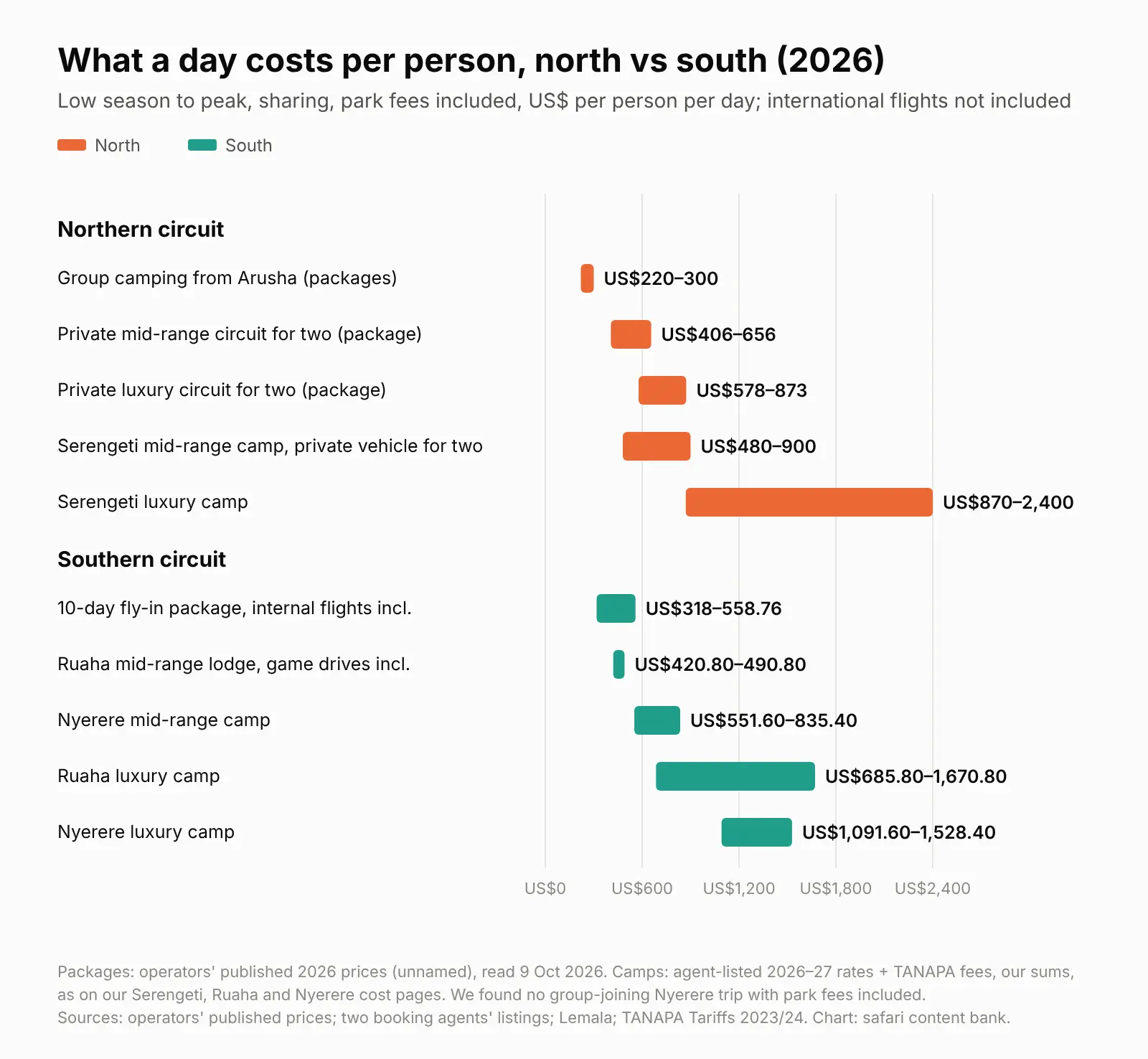 Operators’ published 2026 prices and agent-listed camp rates plus TANAPA fees (our sums), read 8–10 October 2026. Sources: operators’ published prices; two booking agents’ listings; Lemala; TANAPA Tariffs 2023/24, the last published tariff. Chart: safari content bank.
- The south usually means a flight; the north a vehicle every day. A travel-guide site lists Coastal Aviation’s Dar es Salaam–Nyerere fare at US$150–220 one way, 10–15% more from June to October (secondary source); we found no verified Dar es Salaam–Ruaha fare. The northern road circuit needs a vehicle and guide every day, at about US$200–300 per vehicle per day (one operator’s published price).
- “From” prices assume a full vehicle in low season. On the 10-day southern package, two people in high season pay 76% more per person than six in low season (our sum, Ruaha safari cost); in the north, the same route for two in peak season costs 54–78% more than the “from” price (Tanzania safari cost).
- Ask what the camp rate includes. Roho ya Selous (Nyerere) and Asilia’s Jabali Ridge and Usangu (Ruaha) listings exclude park fees, and Asanja Ruaha’s rate leaves out game drives.
On top on either circuit, per person: a Tanzania visa at US$50 (US$100 for US citizens; see Tanzania visa) and US$44 of compulsory insurance (below).
Getting there: Arusha and Kilimanjaro vs Dar es Salaam
The northern circuit starts at Kilimanjaro airport and is driven from Arusha; the southern parks start at Dar es Salaam, with Nyerere about 4 hours by road and Ruaha about 2.5 hours by air or a full day’s drive.
| Route | Time | Fare or fee on the way | Source |
|---|---|---|---|
| Kilimanjaro airport (JRO) → Arusha, road | 1 h 20, 55 km | Tarmac | One operator’s travel-times page |
| Arusha → Tarangire, road | About 2 h, 109 km | None until the gate | One operator’s travel-times page |
| Tarangire → Lake Manyara, road | 1 h 20, 68 km | One operator’s travel-times page | |
| Lake Manyara → Ngorongoro, road | About 1 h, 56 km | NCA entry US$70.80 per adult | One operator’s travel-times page; NCAA |
| Ngorongoro → Seronera (central Serengeti), road | About 3.5 h, 135 km | One operator’s travel-times page | |
| Arusha → Seronera, road, in one go | 7–7.5 h | Tarmac to Loduare Gate, then gravel; NCA entry US$70.80 per adult each way | One operator’s Serengeti guide; NCAA |
| Arusha or Kilimanjaro → Serengeti airstrips, air | 1–2 h | Fares not printed: the fares in our sources disagree | One operator’s Serengeti guide |
| Dar es Salaam → Nyerere, road | About 4 h, 175 km via Kisarawe; other published distances and times differ by gate | The road to the eastern Mtemere gate ends in 90 km of gravel, “very challenging in the rainy season” | One operator’s travel-times table; a self-drive operator’s guide |
| Dar es Salaam → Nyerere, air | No verified flight time | US$150–220 one way, +10–15% June–October (secondary source) | A travel-guide site relaying Coastal Aviation’s fares, 2 Jun 2026 |
| Dar es Salaam → Ruaha, road | 600 km, “10 h minimum” | None until the gate | A safari booking site’s getting-there guide |
| Dar es Salaam → Ruaha, air | About 2.5 h | No verified fare | A safari booking site’s getting-there guide |
Times as published by each source, read 9–10 October 2026, as printed on our Tanzania safari and Zanzibar, Tarangire, Nyerere and Ruaha pages; operators unnamed, names kept in our editor notes.
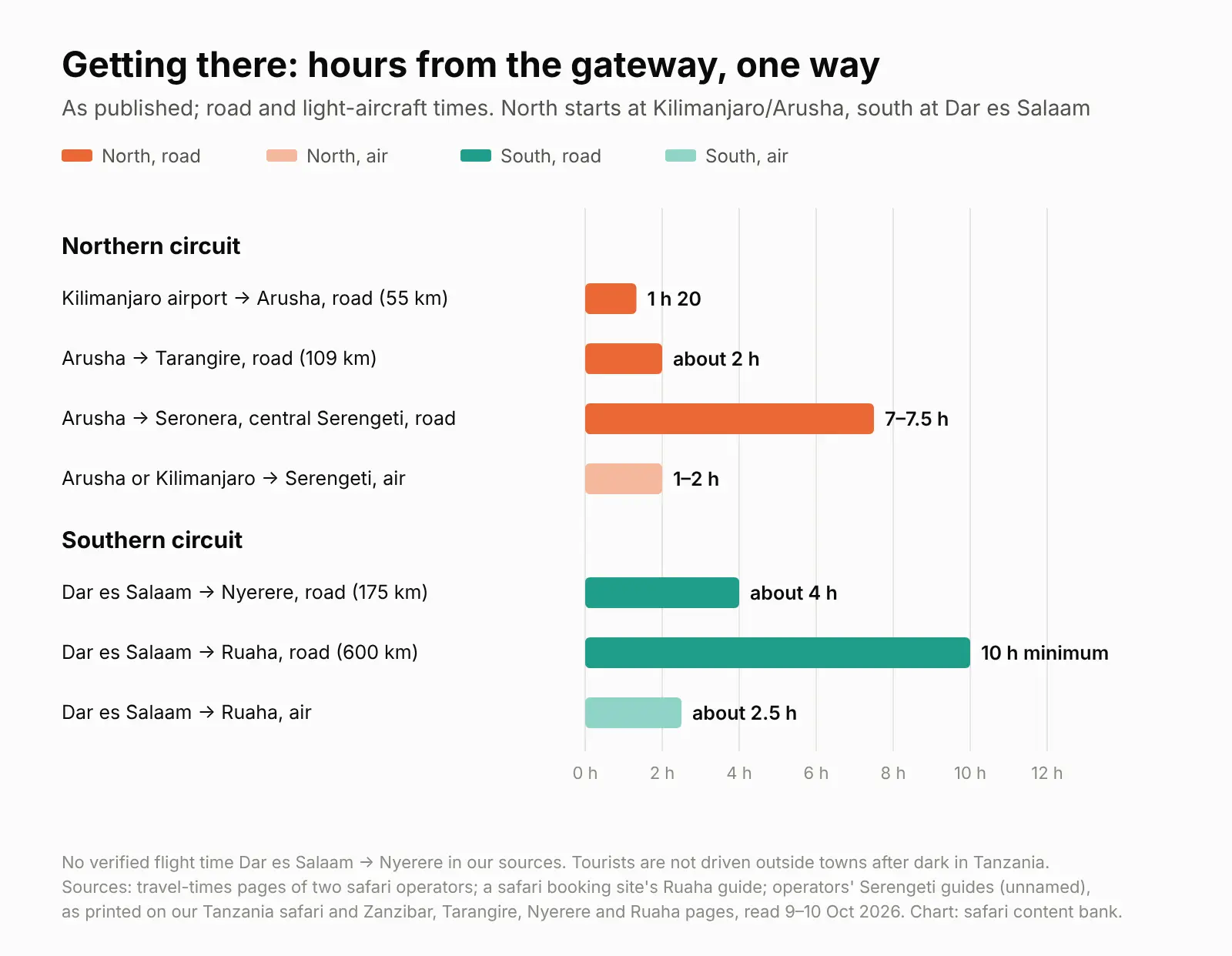 Times as published, read 9–10 October 2026; for Nyerere, other published road distances and times differ by gate. Sources: two safari operators’ travel-times pages; a safari booking site’s Ruaha guide; operators’ Serengeti guides. Chart: safari content bank.
- Tourists may not be driven outside towns after dark in Tanzania, so a same-day transfer to a park needs a flight landing at Kilimanjaro, Arusha or Dar es Salaam before 13:00 (one operator’s travel-times page, modified 1 July 2026).
- Auric Air allows 20 kg including hand luggage on its light aircraft (Auric Air); extra 10 kg slabs cost US$60 on safari routes.
- Ruaha links west to Katavi and Mahale. Safari Air Link flies Ruaha–Katavi–Mahale on Mondays and Thursdays from 1 June to 31 October, with 4-passenger minimums on several legs (Safari Air Link 2026–27, PDF).
- The Iringa–Msembe road into Ruaha is being rebuilt. A 104 km tarmac upgrade was contracted on 23 September 2024 for 24 months; we could not confirm in October 2026 that it is finished (The Guardian, Tanzania).
- No north–south flight is priced in our sources. Published trips that do both, such as one operator’s 17-day private northern circuit with Ruaha, include the flight in the package price.
Crowds: how busy each circuit is
The north is where most visitors go, and the south is quieter, but no Tanzanian authority publishes vehicle counts at sightings, so the evidence is visitor shares, itinerary counts and traveller reports.
| Measure | Northern circuit | Southern circuit | Source |
|---|---|---|---|
| Share of surveyed international visitors, 2025 | Ngorongoro 14.2%, Serengeti 13.1%, Tarangire 9.0% | Neither park is in the top five (Ngorongoro, Serengeti, Stone Town, beaches, Tarangire) | Bank of Tanzania, 2025 International Visitors Exit Survey (PDF) |
| Visitors to the park | Serengeti 491,398 in the 2024/25 financial year, up from 430,219 | No visitor count for Nyerere or Ruaha in our sources | The Citizen, 18 Dec 2025 |
| Published itineraries that include the park | Serengeti 131 of 150 (87%) | Nyerere 13 of 150 (9%); Ruaha 13 of 150 (9%) | Our count of operators’ published Tanzania itineraries with a stated route, captured 8 October 2026 |
| Vehicles at one sighting | No count published; traveller reports below | No count published | — |
| Park area | Serengeti 14,763 km² | Nyerere 30,893 km²; Ruaha 20,226 km² | A safari agent’s guide, read 9–10 October 2026; Wikipedia |
Visitor shares are the share of surveyed visitors who went to each attraction, not park entries. Read 9–10 October 2026.
What travellers report (traveller reports, not counts):
- Ndutu in calving season: one reviewer wrote that it “was common to see 15–20 vehicles at a single sighting” there in March 2026 (TripAdvisor).
- Serengeti river crossings: “it is not uncommon for fifty or more trucks to be parked” at a crossing point, according to a regular on the Serengeti forum (TripAdvisor).
- The south: “on rencontre moins de monde sur les pistes”, you meet fewer people on the tracks, a French forum post said in May 2026 (Routard).
Wildlife: what each circuit is best for
The north has the wildebeest migration and the crater; the south has Tanzania’s wild dog strongholds and large, little-visited elephant ranges. Neither circuit publishes sighting rates in our sources.
| Northern circuit | Southern circuit | Source | |
|---|---|---|---|
| Wildebeest migration | 1,366,109 wildebeest counted at the end of March 2023; calving around Ndutu, river crossings in the northern Serengeti July–October | No migration | TAWIRI 2023 census (PDF); Great Migration month by month |
| Wild dog | No dated count or sighting rate for the Serengeti in our sources | Selous about 800 dogs; Nyerere and Ruaha are Tanzania’s strongholds | IUCN via CMS (PDF); where to see wild dogs |
| Lion | The Serengeti is one of four strongholds with more than 1,000 lions each (Craig Packer, 2012) | So is the Selous (same source) | PBS, 6 Sep 2012 |
| Elephant | Tarangire: no verified count | Ruaha 15,836 ± 4,759 (2015); Nyerere about 13,000 (2013) | Wikipedia, Ruaha; Wikipedia, Nyerere |
| Birds | No species count in our sources | Ruaha over 570 species; Nyerere about 440 | A safari agent’s guides to Ruaha and Nyerere, read 9–10 October 2026 |
Read 9–10 October 2026. Counts are from different years and methods; none is a sighting rate.
- Lions, country-wide: Tanzania holds more than 8,000 of Africa’s about 23,000 wild lions (CITES, 2023, PDF).
- Rhino, national counts only: the IUCN specialist groups estimate 268 rhinos in Tanzania at the end of 2024, and Tanzania’s own 2025 census counted 285 black rhinos, as reported by Xinhua on 22 September 2026 (The Star / Xinhua). We do not publish where rhino are found; see where to see rhino.
- Ruaha’s elephants fell from 34,000 in 2009 to the 2015 figure above (Wikipedia); Nyerere’s (as the Selous) from more than 100,000 in the mid-1970s (Wikipedia).
Walking, boat safaris and night drives
The south sells all three inside its parks; the north sells walks and, in Tarangire and Lake Manyara, night drives, but no night drives in the Serengeti or the Ngorongoro Conservation Area. Each is a separate fee line on top of entry.
| Activity | Northern circuit | Southern circuit | Fee per adult, with VAT |
|---|---|---|---|
| Walking safari | Allowed with an armed ranger in the Serengeti, Tarangire and other TANAPA parks; in the NCA with an NCAA ranger | Ruaha: armed guides, at most six walkers per group (a camp operator’s Ruaha activities guide); Nyerere: “in the company of an armed ranger” (a safari agent’s guide, read 9 October 2026) | TANAPA US$23.60 (1–4 h) or US$29.50 (over 4 h), plus a guide fee per group per day of US$23.60 (US$47.20 in Nyerere); NCAA US$23.60 / US$29.50 |
| Fly camping | Not priced for the north in our sources | Runs from Jongomero and Kichaka (Ruaha) and Sand Rivers, Selous Impala and Rufiji River Camp (Nyerere) | TANAPA fly campsite US$59 per night |
| Night game drive | Not in the Serengeti or the NCA; allowed in Tarangire and Lake Manyara | Allowed in Ruaha and Nyerere | US$59 (child US$29.50) |
| Boat safari | None priced in our sources | Nyerere, on the Rufiji and its lakes; boating at Usangu Expedition Camp (Ruaha, June–November) | Nyerere US$23.60 per person |
Sources: TANAPA Tariffs 2023/24 (PDF), the last published tariff; NCAA tariffs, read 9 October 2026; a camp operator’s Ruaha activities guide; a safari agent’s guide to Nyerere; fly-camps as listed on our Ruaha and Nyerere pages. Camps add their own charge.
- Two adults on a short walk pay US$70.80 in TANAPA fees in Ruaha and US$94.40 in Nyerere (our sums: 2 × US$23.60 plus the guide fee), on top of entry.
- Private concessions on the Serengeti’s edge, Grumeti in the west and Klein’s in the north-east, sell night drives and walks at their own rates (Serengeti).
- Walking is best from June to October in Ruaha and Nyerere, in a tour operator’s walking guide. Walking costs across Africa: walking safari cost.
When to go, and when camps close
June to October is the main season on both circuits; from mid-March to May the north is wet but mostly open, while most southern camps shut. The migration sets the northern calendar; the dry season sets the southern one.
| Months | Northern circuit | Southern circuit |
|---|---|---|
| January–February | Calving around Ndutu, peak in February | Camps open at lower rates; Ruaha’s wettest months (Iringa 120–180 mm a month, December–March) |
| March–May | Long rains (Serengeti 155 mm in April); Serengeti and Tarangire entry lower from 15 March to 15 May; Oliver’s Camp (Tarangire) closed 16 March–15 May, Sanctuary Swala April–May | Most camps closed: Kigelia March–May, Ikuka 16 March–31 May, Jabali Ridge 15 March–31 May (Ruaha); Sand Rivers March–May, Roho ya Selous and Beho Beho 15 March–31 May (Nyerere). Ruaha River Lodge and Rufiji River Camp list rates |
| June | Grumeti River crossings, about the first half of June | Camps reopen; Iringa 0 mm of rain from June to September |
| July–September | Mara River crossings in the northern Serengeti; Serengeti concession US$70.80 a night | Peak camp rates (Jabali Ridge US$1,600, Sand Rivers US$950); Nyerere concession US$70.80 |
| October | Herds leave the north; Serengeti and Nyerere concession back to US$59 | Still dry in Ruaha (Iringa 5 mm); Dar es Salaam 70 mm |
| November–December | Short rains (Serengeti 115 mm in November); herds head south | On 1 November Jabali Ridge drops to US$880 and Sand Rivers to US$625 a night |
Typical year, not a forecast. Herds: a camp operator’s migration guide. Rain: Climates to Travel (Serengeti, Iringa and Dar es Salaam stations; aggregator). Camp seasons: 2026–27 agent listings as on our Ruaha, Nyerere and Tarangire pages. Fees: TANAPA 2023/24, the last published tariff. Read 8–10 October 2026.
- Mid-March to May is cheapest on paper in the south but mostly shut. Nyerere entry drops to US$70.80 from 15 March to 15 May, but most camps are closed for most of that window.
- November is the south’s value month. Camps drop their rates on 1 November and stay open, while park fees stay at US$141.60 a night in Nyerere and US$70.80 in Ruaha.
- Month by month across Africa: January, February, March, April, May, June, July, August, September, October, November, December. Herd positions: Great Migration month by month.
Combining either circuit with Zanzibar
Both circuits end on Zanzibar easily: the north by a one-hour flight from Kilimanjaro, from US$200 one way; the south by light aircraft from the parks, or via Dar es Salaam by fast ferry or a 25-minute flight. One visa and one insurance policy cover the mainland and Zanzibar.
| Route to Zanzibar, one way | Time | Fare per person | Source |
|---|---|---|---|
| Kilimanjaro (JRO) → Zanzibar (north) | 13:00 → 14:00 | From US$200 | Flightlink, read 9 Oct 2026 |
| Arusha → Zanzibar (north) | Not obtained | US$200–280; about 10–15% more June–October | A travel-guide site relaying Coastal Aviation’s fares, 2 Jun 2026 (secondary) |
| Ndutu, southern Serengeti → Zanzibar (north) | About 2 h 45 | Not published | One operator’s travel-times page |
| Kogatende, northern Serengeti → Zanzibar (north) | About 3 h, with stops | Not published per route | One operator’s travel-times page |
| Nyerere or Ruaha → Zanzibar (south) | Light aircraft in published southern itineraries | No verified fare or time | Operators’ published southern itineraries (unnamed) |
| Dar es Salaam → Zanzibar (south), fast ferry | 1.5–2 h, several sailings a day | From about US$42 economy | Seat61, April 2026 |
| Dar es Salaam → Zanzibar, flight | 25 minutes | Not collected | One operator’s travel-times page |
As printed on our Tanzania safari and Zanzibar and Nyerere pages, read 9 October 2026. Flightlink fares include taxes and fuel.
- As of October 2026, foreign visitors to mainland Tanzania, except residents of East African Community (EAC) and SADC countries, must buy government travel insurance: US$44 per adult, valid 92 days (Clyde & Co, 16 Sep 2026). You buy one policy only, for your first port of entry; arriving in Zanzibar first, you buy Zanzibar’s policy instead (UK FCDO). Your own travel insurance does not replace it.
- One Tanzanian visa covers the mainland and Zanzibar: US$50, or US$100 for US citizens (e-visa guidelines). Details: Tanzania visa and Tanzania visitor insurance.
- April and May are weak for both halves of a southern trip: most southern camps are closed, Zanzibar averages 385 mm of rain in April, and some beach hotels close (Pongwe Beach Hotel 10 April–31 May).
- From Zanzibar, a short southern safari is one option. On a June–July 2026 forum thread, a destination expert told honeymooners in Zanzibar to do a southern park such as Nyerere first, then fly to Zanzibar (TripAdvisor; a traveller forum, not official advice).
Routing, beach hotel prices and Zanzibar taxes: Tanzania safari and Zanzibar.
Which circuit suits you?
Choose the north for a first safari, the migration, the crater or a tight budget; choose the south for walking, boats, wild dogs and fewer itineraries, if you can travel between June and mid-March.
| If you… | Pick | Why |
|---|---|---|
| Want the wildebeest migration | North | 1,366,109 wildebeest (TAWIRI, 2023); there is no migration in the south |
| Want the Ngorongoro Crater | North | US$295 per vehicle per descent, plus NCA entry of US$70.80 per adult |
| Have the lowest budget | North | Group camping from Arusha, US$220–300 a day with park fees; no fee-inclusive group trip found for Nyerere |
| Want to walk, take a boat or go on a night drive | South | All three inside Nyerere; walks and night drives in Ruaha. No night drives in the Serengeti or the NCA |
| Want wild dog | South | Nyerere and Ruaha are Tanzania’s strongholds; no Serengeti count or sighting rate in our sources |
| Want the lowest park fees | Ruaha | US$70.80 a night, against US$129.80–153.40 in Nyerere and the Serengeti |
| Want fewer vehicles | South | Each in 9% of published itineraries, the Serengeti in 87%; no vehicle counts are published |
| Travel mid-March to May | North | Most Ruaha and Nyerere camps are closed |
| Have five days or fewer from Dar es Salaam or Zanzibar | Nyerere | About 4 hours by road from Dar es Salaam |
| Want one road trip, no light aircraft | North | Arusha → Tarangire → Ngorongoro → Serengeti by road; Ruaha is 10 hours from Dar es Salaam |
More Tanzania planning answers: Tanzania safari questions. Comparing Tanzania’s southern parks with Zambia’s walking parks: Tanzania vs Zambia. Whichever circuit you pick, check that your operator holds a current licence.
See also: Serengeti vs Ngorongoro, Tarangire vs Lake Manyara and Ruaha vs Nyerere.
Common mistakes in northern vs southern circuit comparisons
| What you’ll often read | What is correct |
|---|---|
| “The southern circuit is cheaper” | Only Ruaha’s park fees are lower (US$70.80 a night). Nyerere’s equal the Serengeti’s (US$129.80–153.40), and the lowest southern camp rates (US$350 Ruaha, US$410 Nyerere) are above the Serengeti’s US$250. |
| “Ruaha entry is US$82.60, like the Serengeti” | Ruaha is US$35.40 with VAT (last published tariff, 2023/24). |
| “Southern Tanzania is good all year” | Most Ruaha and Nyerere camps close from mid-March to May. |
| “Night drives are part of any Tanzania safari” | Not in the Serengeti or the Ngorongoro Conservation Area. They are sold in Tarangire, Lake Manyara, Ruaha and Nyerere. |
| “The migration passes through southern Tanzania” | It does not. The herds move between the southern Serengeti, around Ndutu, and the Masai Mara. |
| “The south has no vehicles, the north is overrun” | No authority publishes vehicle counts for any Tanzanian park. The evidence is visitor shares, itinerary counts and traveller reports. |
| “Nyerere is still the Selous Game Reserve” | The photographic north has been Nyerere National Park, run by TANAPA, since 2019; the reserve to the south stays under TAWA. |
| “You need a second insurance policy for Zanzibar” | One policy, for your first port of entry, US$44 per adult. |
Frequently asked questions
Which is better, Tanzania’s northern or southern circuit? It depends on what you want to see and when. The north has the wildebeest migration, the Ngorongoro Crater and the cheapest group trips, from US$220–300 per person per day. The south, Nyerere and Ruaha, has walks, boat safaris, night drives and Tanzania’s wild dog strongholds, but most of its camps close from mid-March to May.
Is the southern circuit cheaper than the northern circuit? Only partly. Ruaha’s park fees are US$70.80 per adult per night, but Nyerere’s equal the Serengeti’s at US$129.80–153.40 (last published tariff, 2023/24). Mid-range camps with fees cost about US$420–490 a day in Ruaha and US$550–835 in Nyerere, and the cheapest group camping trips, US$220–300 a day, are in the north.
Can you combine the northern and southern circuits on one trip? Yes, on published trips. One operator publishes a 17-day private northern circuit with Ruaha from US$9,256 per person, about US$544 a day (our sum), priced for five people in April–May with park fees included. Most Ruaha camps are closed in April–May, so plan a combined trip for June to mid-March.
When is the best time for a southern circuit safari? June to October, the dry season, when Iringa near Ruaha averages 0–5 mm of rain a month. November to mid-March is quieter and cheaper: on 1 November Jabali Ridge drops from US$1,600 to US$880 per person a night. From mid-March to May most camps are closed.
Where can you do night drives and walking safaris in Tanzania? Night drives are on TANAPA’s list for Tarangire, Lake Manyara, Ruaha, Nyerere, Katavi and Mikumi, at US$59 per adult (last published tariff, 2023/24); they are not allowed in the Serengeti or the Ngorongoro Conservation Area. Walks are sold in the national parks at US$23.60–29.50 per adult plus a guide fee, and in the Ngorongoro Conservation Area at the same rates.
How do you get to Nyerere and Ruaha? From Dar es Salaam. Nyerere is 175 km and about 4 hours by road in one published travel-time table (other tables differ by gate), or a light-aircraft flight listed at US$150–220 one way (secondary source). Ruaha is about 2.5 hours by air or 600 km and at least 10 hours by road; we found no verified fare.
Can you see the Great Migration in southern Tanzania? No. The wildebeest migration moves between the southern Serengeti, around Ndutu, and Kenya’s Masai Mara; Nyerere and Ruaha are not on its route. For herds, plan a northern circuit and check where the herds are each month.
Sources
- Fees: TANAPA, Tariffs 2023/24 (PDF), the last published national parks tariff, site checked 9 Oct 2026; NCAA, tariffs, undated, read 9 Oct 2026; The Citizen, 24 Mar 2025; Tourism Update
- Visitors: Bank of Tanzania, 2025 International Visitors Exit Survey (PDF); The Citizen, 18 Dec 2025; our count of operators’ published Tanzania itineraries, captured 8 Oct 2026
- Wildlife: TAWIRI 2023 wildebeest census (PDF); IUCN via CMS (PDF); CITES, 2023 (PDF); PBS, Craig Packer, 2012; The Star / Xinhua, 22 Sep 2026; Wikipedia, Ruaha National Park and Nyerere National Park; a safari agent’s guides to Serengeti, Ruaha and Nyerere, read 17 October 2026
- Seasons: a camp operator’s migration guide; a camp operator’s Ruaha activities guide; Climates to Travel; camp rate listings as cited on our cost pages (two booking agents’ listings; Lemala), read 8–10 Oct 2026
- Travel: Flightlink; Safari Air Link 2026–27 (PDF); Auric Air; Seat61; a self-drive operator’s guide; The Guardian, Tanzania, 23 Sep 2024; a travel-guide site relaying Coastal Aviation’s fares (2 Jun 2026, secondary); a safari booking site’s Ruaha guide
- Entry: Tanzania e-visa guidelines; Clyde & Co, 16 Sep 2026; UK FCDO
- Tour operators’ published 2026 package prices, travel-times pages, Serengeti guides and walking guide (names and links kept in our editor notes)
- Traveller reports: TripAdvisor threads as linked in the text; Routard
- Our own pages for the detail: Tanzania, Tanzania safari cost, Serengeti and Serengeti safari cost, Ngorongoro and Ngorongoro safari cost, Tarangire and Tarangire safari cost, Nyerere and Nyerere safari cost, Ruaha and Ruaha safari cost, Tanzania safari and Zanzibar, Tanzania vs Zambia
Fees, prices and travel times as read 8–10 October 2026 on the sources above, checked against our cost and park pages on 17 October 2026. We will update this page when TANAPA publishes a new tariff, when the southern camps publish their 2027–28 rates, and when a Dar es Salaam–Ruaha air fare can be confirmed.