 Experience

Last verified · Next check due
On this page
- Where to see leopards: places, odds and fees (2026)
- Zambia: South Luangwa and Lower Zambezi
- Botswana: Moremi, the Delta concessions and the Linyanti
- South Africa: Sabi Sand and Kruger
- Tanzania and Kenya: Seronera, the Masai Mara and Samburu
- Night drives, off-road driving and vehicles per sighting
- When is the best time to see leopards?
- What a leopard safari costs
- How many leopards are there?
- Common mistakes about seeing leopards
- Frequently asked questions
- Sources
Short answer: Zambia and northern Botswana have the best published odds: 88% of one operator’s traveller groups saw a leopard in Lower Zambezi, 83% in South Luangwa and 76% in Moremi, against 59% in Chobe (read September–October 2026). Sabi Sand, Kruger, the Serengeti and the Masai Mara hold leopards but publish no rate. Leopards are most active at night; night drives run in South Luangwa and on private reserves and concessions, not in Moremi, Chobe, the Serengeti or the Mara reserve.
Key facts
- The highest leopard sighting rates in our sources are in Zambia: 88% of one operator’s traveller groups in Lower Zambezi National Park and 83% in South Luangwa National Park saw a leopard (its Zambia pages, read 8 October 2026). These are per-trip rates over a whole stay, not the chance on one drive.
- In Botswana, Moremi Game Reserve leads at 76%, followed by the Okavango Delta reserves (73%) and Kwando-Linyanti (70%); Chobe National Park is at 59% and the Botswana-wide figure is 66% (the same operator, read September 2026).
- No leopard sighting rate is published for Sabi Sand, Kruger, the Serengeti, the Masai Mara or Samburu in the sources we hold. What exists for them is operators’ and travellers’ descriptions, not counts.
- Most of a leopard’s activity and most of its kills fall between sunset and sunrise (Wikipedia, citing Hamilton 1976; secondary). Night drives are allowed inside South Luangwa, but not in Moremi, Chobe, the Serengeti or the Masai Mara National Reserve.
- The Masai Mara reserve is the one leopard area in our sources with a written cap on vehicles at a sighting: five, with any others waiting at least 100 m away (Narok County’s management plan). Kruger, Sabi Sand, the Serengeti and the Mara conservancies publish none.
- The leopard is listed as Vulnerable, and no credible estimate of Africa’s leopard population exists: Panthera gives no figure, and says leopards have lost at least two-thirds of their historical habitat in Africa and are extinct in 13 countries (Panthera, read 9 October 2026).
Where to see leopards: places, odds and fees (2026)
Lower Zambezi, South Luangwa and Botswana’s Moremi, Okavango Delta and Linyanti areas are the only places in our sources with a published leopard sighting rate of 70% or more. The other places below hold leopards, but no comparable rate is published for them, so we print none.
| Place | Country | Leopard evidence | Seen by (per trip) | Night drives | Fee to be there, per adult | Source |
|---|---|---|---|---|---|---|
| Lower Zambezi National Park | Zambia | Highest rate in our sources | 88% | In the dry season, per one operator | US$25 a day (DNPW 2025 schedule, the last published) | one operator’s Lower Zambezi page |
| South Luangwa National Park | Zambia | Night drives inside the park | 83% | Yes, inside the park | US$25 a day (DNPW 2025, last published); camps bill US$90–110 a night in fees and levies | one operator’s South Luangwa page; South Luangwa |
| Moremi Game Reserve | Botswana | Highest Botswana rate | 76% | No | P270 a day (last published DWNP schedule, 1 April 2022) | one operator’s Moremi page; Botswana Tourism |
| Okavango Delta reserves (private concessions) | Botswana | Concessions around Moremi | 73% | Yes, on concessions | In the camp rate at many camps; levies US$20–100 a night | one operator’s Okavango Delta page |
| Kwando-Linyanti | Botswana | Concessions next to Chobe | 70% | Yes, on concessions | Camp rate plus levy | one operator’s Kwando-Linyanti page |
| Chobe National Park (incl. Savuti) | Botswana | Below the Botswana average | 59% | No | P270 a day (same DWNP line as Moremi) | one operator’s Chobe page |
| Sabi Sand (Greater Kruger) | South Africa | Operators credit it with leopard viewing; no statistics | Not published | Lodge drives, per operators | R170 per person + R370 per car per entry (2026) | Sabi Sand vs Timbavati; Sabi Sand access |
| Kruger National Park | South Africa | About 1,000 leopards in the 2010 and 2011 counts; nothing newer in our sources | Not published | SANParks guided drives only | R692 (R602 until 31 Oct 2026) | Wikipedia (secondary); SANParks 2025/26 |
| Serengeti National Park (Seronera) | Tanzania | Sellers name the Seronera valley | Not published | No | US$82.60 a day, 16 May–14 March (last published tariff, 2023/24) | TANAPA 2023/24; sellers’ guides |
| Masai Mara National Reserve and conservancies | Kenya | Leopard sightings in traveller reviews | Not published | Reserve no; conservancies at some camps | Reserve US$100 a day (Jan–Jun), US$200 (Jul–Dec) | Mara reserve vs conservancies |
| Samburu National Reserve | Kenya | No leopard source in our bank | Not published | Not in our sources | US$85 a day (basis not stated by the county) | Samburu County Finance Act 2025 |
Sighting rates: one operator’s traveller reports, share of groups who saw a leopard at least once on their trip; Botswana pages read September 2026, Zambia pages read 8 October 2026. Fees per non-resident or international adult, copied from our Zambia, Botswana, South Africa, Tanzania and Kenya cost pages, read 8–10 October 2026. Botswana’s fee line is the last published DWNP schedule; no official current tariff is published.
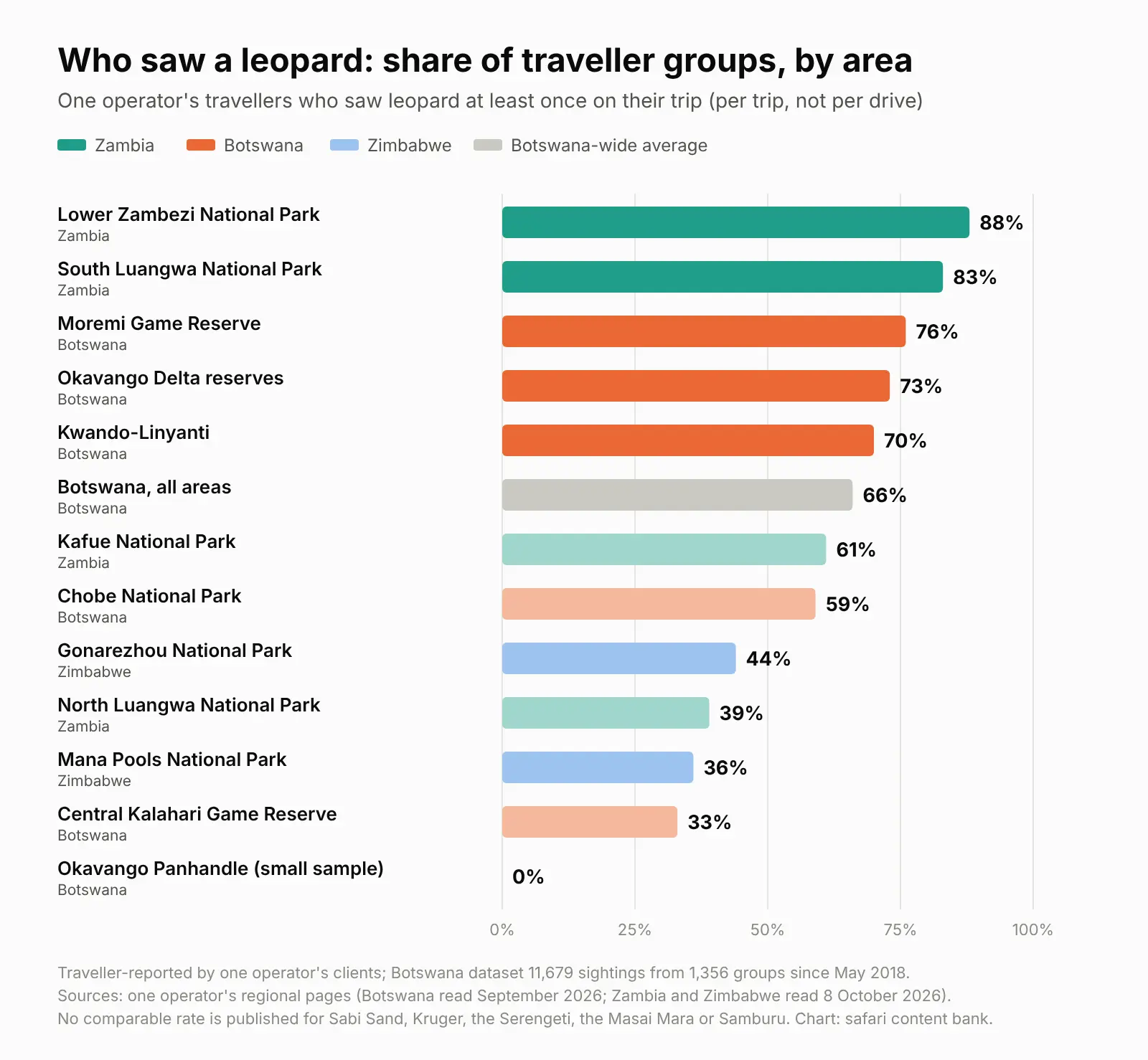 Traveller-reported, per trip, from one operator’s clients; Botswana dataset 11,679 sightings from 1,356 groups since May 2018. Sources: one operator’s regional pages, Botswana read September 2026, Zambia and Zimbabwe read 8 October 2026. Chart: safari content bank.
- Read these as best-case numbers. They come from one operator’s own clients, who tend to take longer, guided, dry-season trips, and the operator does not publish how many groups each regional figure rests on.
- Outside the places above, the same operator’s rates are 61% in Zambia’s Kafue, 44% in Zimbabwe’s Gonarezhou, 39% in North Luangwa, 36% in Mana Pools and 33% in Botswana’s Central Kalahari (its regional pages, read September–October 2026).
Zambia: South Luangwa and Lower Zambezi
Zambia’s two Category A parks have the highest leopard rates in our sources: 88% of one operator’s travellers saw a leopard in Lower Zambezi and 83% in South Luangwa (its Zambia pages, read 8 October 2026). Both charge US$25 per international adult per day (DNPW 2025 schedule, the last published).
- South Luangwa allows night drives inside the national park. Afternoon drives continue after sunset with a spotlight (one operator’s South Luangwa guide); Flatdogs says its guests’ park fee covers them until 20:00, two hours past the 06:00–18:00 DNPW day (Flatdogs rates, 2026). See South Luangwa National Park.
- Lower Zambezi runs night drives in the dry season, along with canoeing, boat trips and walks with a guide and armed scout (one operator’s Lower Zambezi guide). It scores higher than South Luangwa for leopard (88% against 83%) and lion (96% against 86%) in that operator’s traveller surveys (Zambia safari questions).
- Camp bills are larger than the gate fee. Full-board South Luangwa camps add US$90–110 per person per night in park fees and levies, which include the US$25 gate fee (South Luangwa safari cost).
- BBC Kingdom (2025) followed leopard, lion, hyena and wild dog families in South Luangwa’s Nsefu Sector over 1,700 filming days in five years (a safari agent’s guide, read 10 October 2026).
- Most bush camps close in the rains: in South Luangwa from mid-November to late May, in Lower Zambezi from mid-November to April (Zambia safari cost).
See also: South Luangwa vs Lower Zambezi and Kafue vs South Luangwa.
Botswana: Moremi, the Delta concessions and the Linyanti
Moremi Game Reserve has Botswana’s highest leopard rate, 76% of one operator’s traveller groups, against 59% in Chobe National Park (read September 2026). The concessions around them allow what the reserve does not: night drives and off-road driving.
- The official rule: Botswana Tourism states that in the national parks and reserves “off-roading and night driving [are] prohibited”, while “private concession areas outside the parks and reserves provide opportunities for off-road driving and night drives”, done “in moderation” (Botswana Tourism). Moremi and Chobe are a reserve and a park; Khwai, the Delta concessions and the Linyanti concessions are not. See night drives, walking and off-road driving in Botswana.
- Mombo: our Botswana safari cost page places it in Moremi Game Reserve, where the official rule above applies. We make no claim about what the camp itself offers; ask it.
- Moremi or Chobe: 76% saw leopard in Moremi and 59% in Chobe; the wild dog gap is wider, 65% against 23%. Full comparison: Moremi or Chobe?
- A water camp is a poor bet for leopard. In the Okavango Panhandle the same operator’s travellers saw leopard on 0% of trips, on a small sample, against 73% across the Delta’s reserves (Okavango Delta; water or land camps).
- Moremi and Chobe share one park-fee line: P270 per non-resident adult per day in the last published DWNP schedule (1 April 2022, via Tourism Update). In February 2026 the government news agency BOPA called the existing non-resident fee P380 (Botswana Daily News); a P500 rise was announced, then reported postponed (Gabz FM, 5 May 2026). No official current tariff is published; confirm with DWNP or your operator.
More on Botswana’s wildlife odds: Botswana safari questions, Chobe, where to see wild dogs and where to see the Big Five.
South Africa: Sabi Sand and Kruger
Sabi Sand is the reserve operators name for leopards, but neither it nor Kruger publishes a leopard sighting rate in our sources. A Cape Town tour operator credits Sabi Sand with superb leopard viewing (its blog); that is an operator’s claim, not a count (Sabi Sand vs Timbavati).
- Sabi Sand admits lodge guests only, who game-view on lodge vehicles; there is no self-drive game viewing (Sabi Sand access). A Cape Town tour operator says off-road and night drives are allowed in the private reserves, Sabi Sand among them; the reserve keeps an internal curfew of 23:30–04:30 (Kruger vs private reserves).
- Sabi Sand’s fences with Kruger came down in 1993, so leopards move between reserve and park; lodge vehicles do not (Sabi Sand).
- Sabi Sand charges R170 per person plus R370 per car per entry in 2026 (R180 and R390 in 2027), and its cheapest published 2026 bed is R7,300 per person sharing at Elephant Plains (Elephant Plains).
- In Kruger, private cars may not drive off-road or at night; for a night drive, book one with SANParks (SANParks rules). Kruger charges R692 per international adult per day from 1 November 2026 (R602 until 31 October 2026) (Kruger park fees).
- Kruger’s leopard count is old: the counts tabulated on Wikipedia, citing SANParks, give about 1,000 leopards in 2010 and 2011 (2,000 in 2009); no newer count is in our sources (Kruger).
Tanzania and Kenya: Seronera, the Masai Mara and Samburu
East Africa’s leopards are seen in the Serengeti and the Masai Mara, but no leopard sighting rate is published for either in our sources, and neither park allows night drives. Sellers name the Serengeti’s Seronera valley as its leopard area (a tour operator’s and one seller’s Big Five guides).
- No night drives in Serengeti National Park. TANAPA’s tariff names the parks that sell them, and the Serengeti is not among them (last published tariff, 2023/24; Serengeti). Daytime leopard hunts rarely work: in one Serengeti study, 3 of 64 daylight attempts succeeded (Wikipedia, citing Bertram 1974; secondary).
- Serengeti entry costs US$82.60 per non-East African adult per day (US$70.80 from 15 March to 15 May), plus a concession fee of US$59 a night (US$70.80 in July–September) inside the park (last published tariff, 2023/24; Serengeti park fees).
- In the Masai Mara reserve, vehicles may leave the track only to approach big cats on nearby open ground, no closer than 25 m, and no more than five vehicles may wait at a sighting (Narok County’s management plan, via Business Daily). Reviewers on a safari booking site still describe “25 safari jeeps around one single leopard” (February 2026; traveller reports).
- The Mara conservancies sell night drives at some camps and drive off-road; travellers on the TripAdvisor Mara forum suggest splitting four or more nights between two conservancies to see different lion prides, leopards and cheetahs (TripAdvisor, traveller reports). Conservancies charge US$130 per adult per night on camps’ 2026 rate sheets (Mara reserve vs conservancies).
- Samburu National Reserve: our sources hold no leopard count, sighting rate or rule text for it, so we do not rank it. Samburu County charges US$85 per non-resident adult per day (Samburu County Finance Act 2025; the county does not state the basis). See Samburu vs Masai Mara.
More: Serengeti vs Masai Mara, Masai Mara, Tanzania safari cost, Kenya safari cost.
Night drives, off-road driving and vehicles per sighting
The rules that matter most for leopards are set by the land, not the lodge: night drives and off-road driving are allowed in South Luangwa, Botswana’s private concessions, the Greater Kruger reserves and the Mara conservancies, and banned or limited in Moremi, Chobe, Kruger for private cars, the Serengeti and the Mara reserve. Only the Mara reserve publishes a vehicle cap at a sighting.
| Where | Night drives | Off-road driving | Vehicles at one sighting | Source |
|---|---|---|---|---|
| South Luangwa NP | Yes, inside the park | Not in our sources | No published cap | one operator’s South Luangwa guide |
| Lower Zambezi NP | In the dry season | Not in our sources | No published cap | one operator’s Lower Zambezi guide |
| Moremi GR, Chobe NP | No | No | No published cap | Botswana Tourism |
| Botswana private concessions (Khwai, Delta, Linyanti) | Yes | Yes, “in moderation” | Only guests of the camps on that lease drive there | Botswana Tourism; Botswana concession rules |
| Kruger National Park | SANParks guided drives only | Not in private cars | No published limit | SANParks |
| Sabi Sand | Lodge drives, per operators; curfew 23:30–04:30 | Lodge vehicles, per operators | No published rule | Sabi Sand access; Kruger vs private reserves |
| Serengeti NP | No | No official rule text in our sources | No published limit | TANAPA 2023/24 |
| Masai Mara reserve | Not sold | Prohibited, except to approach big cats on nearby open ground, no closer than 25 m | Five; the next vehicle waits at least 100 m away | Narok County plan via Business Daily |
| Mara conservancies | At some camps (Kicheche Valley, Porini Lion Camp) | Practised | No published cap | Mara reserve vs conservancies |
| Samburu NR | Not in our sources | Not in our sources | Not in our sources | — |
Read 8–10 October 2026. “Per operators” means a Cape Town tour operator’s account; Sabi Sand publishes no drive rules in the pages we hold.
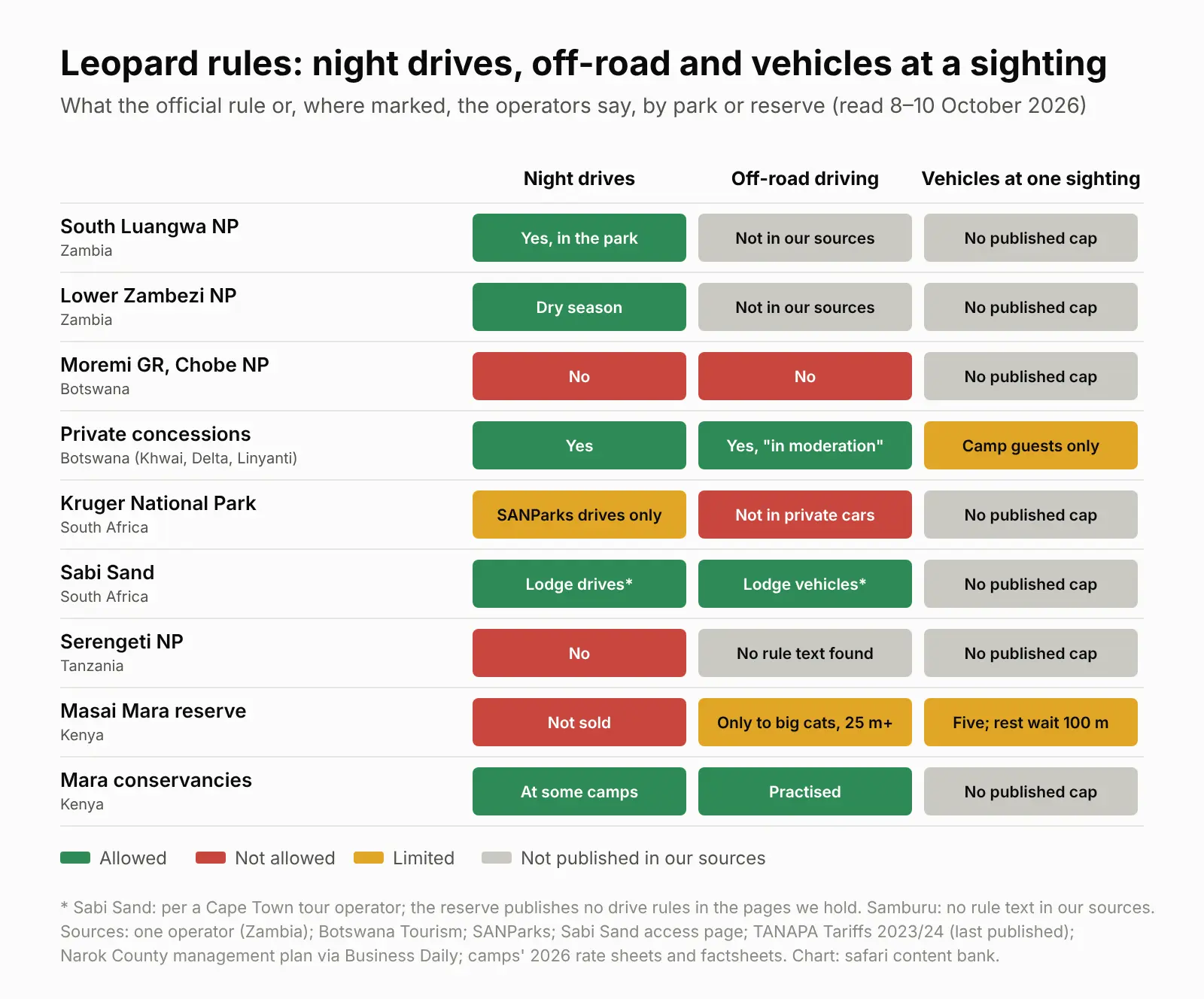 Sources: one operator (Zambia); Botswana Tourism; SANParks; Sabi Sand; TANAPA Tariffs 2023/24 (last published); Narok County’s management plan via Business Daily; camps’ 2026 rate sheets and factsheets. Read 8–10 October 2026. Chart: safari content bank.
- The vehicle cap is the rule almost nobody publishes. We found no written limit for Kruger, Sabi Sand, the Serengeti or any Mara conservancy. Elsewhere in Kenya, Ol Pejeta allows six vehicles at a sighting for up to 10 minutes each (OPC Tariff Guide 2026) and Lewa two (Lewa Code of Conduct); our sources do not describe either as a leopard area. Ask your camp how many vehicles it allows. More: safari vehicles.
- A camp inside a park or reserve works under park rules whatever it charges. A camp on a concession or private reserve can drive off-road and at night.
See also: Photography safari.
When is the best time to see leopards?
No source in our bank gives leopard-specific months; the dry season, which the sources below name as best for game in general, is also when Zambia’s bush camps are open. Leopards live in all of these places all year.
| Place | Best months in our sources | What the source says | Source |
|---|---|---|---|
| South Luangwa | September for game; June–October for walking | Most bush camps open late May to mid-November | one operator’s South Luangwa guide, via South Luangwa |
| Lower Zambezi | About April to mid-November | Camps close from mid-November to April | Zambia safari cost |
| Moremi, Okavango Delta, Linyanti | June–October | Best game viewing “because animals gather at the remaining water” | A camp operator’s best-time guide for Botswana |
| Kruger and the Greater Kruger reserves | April–September | Dry season, best for game viewing | Kruger |
| Serengeti | June–October | Dry season | Best time for a safari |
| Masai Mara | Not stated for leopard | Reserve fee US$100 a day from January to June, US$200 from July to December | Narok County FY2025/26 (last published) |
| Samburu | Not in our sources | — | — |
Read 8–10 October 2026. These are general game-viewing seasons, not leopard calendars.
- The dry months are the peak-price months. July to September is peak price at every South Luangwa camp whose rate seasons we have (South Luangwa), and Botswana’s top rates begin in June (best time for a safari).
- In the Mara, January to June halves the reserve fee (US$100 against US$200 a day), and a destination expert on the TripAdvisor Kenya forum suggests January–February for far fewer vehicles (Kenya safari questions).
What a leopard safari costs
Published prices run from about US$214 per person per day on a shared Kruger tour or a mokoro and camping trip from Maun to US$1,792–1,980 a day on a Sabi Sand fly-in safari and US$3,220–4,989 a day on a top-tier Okavango fly-in package. Package prices below are other operators’ published prices, shown without their names; camp and lodge rates are named.
| Where | Option | Price per person | Basis | Source |
|---|---|---|---|---|
| South Luangwa | 7-day group camping trip | US$275–306 a day | Published 2026 prices, read 8 Oct 2026 | South Luangwa safari cost |
| South Luangwa | Mfuwe Lodge; seasonal bush camps; Chinzombo | US$565–751; US$595–1,200; up to US$1,840 a night | 2026; plus US$90–110 fees and levies | South Luangwa safari cost |
| Okavango and Moremi | Guided mokoro or camping trip from Maun | US$214–307 a day | Operators’ published prices, captured Sept 2026; our per-day sums | Okavango Delta safari cost |
| Okavango and Moremi | Mobile safari through Moremi | US$450–593 a day | As above | same |
| Okavango and Moremi | 7-day fly-in package with flights; top-tier fly-in package | US$1,290–1,630; US$3,220–4,989 a day | As above | same |
| Moremi | Camp Moremi, Camp Xakanaxa (Desert & Delta) | US$645–1,160 a night | 2024 rate card, 1–4 nights | Botswana safari cost |
| Kruger | Shared Kruger tour | US$214–242 a day | Operators’ published “from” prices, read 8 Oct 2026 | Kruger safari cost |
| Sabi Sand and Kruger | Private safari; luxury fly-in | US$579–652; US$1,792–1,980 a day | As above | same |
| Sabi Sand | Elephant Plains | R7,300 a night | 2026, per person sharing; plus R170 per person + R370 per car at the gate | Elephant Plains |
| Serengeti | 3-day group camping trip from Arusha | About US$300 a day | Park fees included; checked 10 Oct 2026 | Serengeti safari cost |
| Masai Mara | Budget; mid-range; luxury camp | US$157–290; US$352–1,248; US$730–2,028 a day | Reserve or conservancy fee counted; our sums of 2026 published prices, read 9–10 Oct 2026 | Masai Mara safari cost |
Per person sharing unless stated. Package figures are copied from our cost pages, which keep the operators’ names and links; listing prices are usually based on two travellers, so ask what each includes. Before paying an agent, check the operator’s licence.
The official fee lines, with the date each took effect and the authority’s own source:
| Fee | Amount | In force from | Source |
|---|---|---|---|
| South Luangwa and Lower Zambezi National Parks (DNPW Category A), international adult, entry per day (06:00–18:00) | USD 25 (SADC and resident USD 20; Zambian citizen ZMW 55.60); child 5–13 half price, under 5 free | DNPW 2025 schedule ("official 2025 rates"), the last published; page last modified 8 May 2025, still shown 9 Oct 2026 | DNPW 2025 fee schedule, as shown on a Zambia travel portal |
| Chobe National Park and Moremi Game Reserve (DWNP), non-resident adult, per person per day | BWP 270 (SADC residents BWP 205; Botswana citizens and residents BWP 30) | Last published DWNP schedule, 1 April 2022 (via Tourism Update). In Feb 2026 the government news agency BOPA called the existing non-resident fee P380; a P500 rise was announced, then reported postponed. No official current tariff: confirm with DWNP or your operator | Tourism Update, 23 Feb 2022 (DWNP fee schedule) |
| Kruger National Park daily conservation fee, international adult (12+), per day | ZAR 602 | 1 Nov 2025 to 31 Oct 2026 (SANParks 2025/26 schedule) | SANParks daily conservation fees 2025/26 |
| Kruger National Park daily conservation fee, international adult (12+), per day | ZAR 692 | 1 Nov 2026 to 31 Oct 2027 (SANParks 2026/27 schedule, already published) | SANParks daily conservation fees 2026/27 |
| Sabi Sand Nature Reserve gate fee, per person, per entry (VAT included) | ZAR 170 (ZAR 180 in 2027) | 1 Jan to 31 Dec 2026 | Sabi Sand Nature Reserve, access and gate fees |
| Sabi Sand Nature Reserve gate fee, light vehicle under 3,500 kg, per entry (VAT included) | ZAR 370 (ZAR 390 in 2027) | 1 Jan to 31 Dec 2026 | Sabi Sand Nature Reserve, access and gate fees |
| Serengeti and Nyerere National Parks, non-East African adult, entry per day, 16 May–14 Mar | USD 70 + 18% VAT = USD 82.60 | 1 Jul 2023 (2023/24 tariff, last published) | TANAPA Tariffs 2023/24 |
| Serengeti and Nyerere National Parks, non-East African adult, entry per day, 15 Mar–15 May | USD 60 + 18% VAT = USD 70.80 | 1 Jul 2023 (2023/24 tariff, last published) | TANAPA Tariffs 2023/24 |
| Serengeti and Nyerere, concession fee per person per night inside the park | Jul–Sep USD 60 + VAT = USD 70.80; Oct–Jun USD 50 + VAT = USD 59 | 1 Jul 2023 (2023/24 tariff, last published) | TANAPA Tariffs 2023/24 |
| Maasai Mara National Reserve, non-resident adult, per day (12-hour ticket, 06:00–18:00), 1 Jan–30 Jun | USD 100 | Since 1 Jan 2024; Narok County FY2025/26 schedule, the last published | Narok County fee schedule FY2025/26 |
| Maasai Mara National Reserve, non-resident adult, per day (12-hour ticket, 06:00–18:00), 1 Jul–31 Dec | USD 200 | Since 1 Jul 2024; Narok County FY2025/26 schedule, the last published, expired 30 Jun 2026 (no 2026/27 schedule as of 9 Oct 2026); The Kenya Times (6 Aug 2026, secondary) reports US$200 still applies for Jul–Dec 2026 | Narok County fee schedule FY2025/26 |
| Samburu National Reserve (Samburu County), non-resident adult, per day (basis not stated by the county) | USD 85 (child USD 50) | Samburu County Finance Act 2025, published 22 Dec 2025 | Samburu County Finance Act 2025 |
How many leopards are there?
Nobody knows for Africa as a whole: Panthera publishes no continental or global leopard figure, and the species is listed as Vulnerable (Panthera, read 9 October 2026). The counts that exist are national or park figures with wide margins or old dates.
| Measure | Figure | Method and year | Source |
|---|---|---|---|
| Status | Vulnerable | IUCN Red List category, as given by Panthera | Panthera |
| Range in Africa | At least two-thirds of historical habitat lost; extinct in 13 countries, present in about 62 | Panthera species page, read 9 Oct 2026 | same |
| Kruger National Park | About 1,000 (2010 and 2011); 2,000 in 2009 | SANParks counts tabulated on Wikipedia; 15 years old | Wikipedia (secondary) |
| Namibia, national | 11,733, mean error about ±5,494 (±47%) | National survey, fieldwork June 2017–December 2018, reported 2019 | Conservation Namibia |
Read 9 October 2026. No published count for South Luangwa, Botswana, Sabi Sand, the Serengeti or the Mara is in our sources.
- Leopards cache kills in trees: they have hauled young giraffe carcasses of up to 125 kg as high as 5.7 m (Wikipedia, citing Hamilton 1976; secondary).
- Any “700,000 leopards in Africa” figure is unsupported: neither Panthera nor Wikipedia’s African leopard page gives a continental estimate.
Common mistakes about seeing leopards
| What you’ll often read | What is correct |
|---|---|
| “Sabi Sand guarantees a leopard” | No reserve publishes a leopard sighting rate in our sources. Operators credit Sabi Sand with leopard viewing; that is a claim, not a count. |
| “Sabi Sand has the best leopard odds in Africa” | The highest published rates in our sources are 88% in Lower Zambezi and 83% in South Luangwa (one operator’s travellers, per trip). Nothing comparable is published for Sabi Sand. |
| “You can go on a night drive in the Serengeti” | Night drives are not allowed in Serengeti National Park; TANAPA’s tariff does not list it among the parks that sell them. |
| “A camp in Moremi can follow a leopard off-road at night” | Off-roading and night driving are prohibited in Botswana’s parks and reserves, Moremi included (Botswana Tourism). The concessions next to it allow both. |
| “Chobe is as good as Moremi for leopard” | 59% against 76% of one operator’s travellers (read September 2026). |
| “Any Okavango camp is a leopard camp” | In the Okavango Panhandle the same operator’s travellers saw leopard on 0% of trips (small sample), against 73% across the Delta’s reserves. |
| “Kruger costs R602 a day” | That was the 2025/26 rate, which ended on 31 October 2026. Since 1 November 2026: R692 per international adult per day. |
| “Botswana’s park fee is P500” | The P500 rise was announced, then reported postponed. The last published DWNP schedule (1 April 2022) is P270; BOPA called the existing fee P380. No official current tariff is published. |
Frequently asked questions
Where is the best place in Africa to see leopards? On published figures, Zambia: 88% of one operator’s traveller groups saw a leopard in Lower Zambezi and 83% in South Luangwa (read 8 October 2026). In Botswana, Moremi Game Reserve is highest at 76% (read September 2026). No comparable rate is published for Sabi Sand, Kruger, the Serengeti or the Masai Mara.
Is Sabi Sand the best place to see leopards? Operators say so, but no sighting rate is published for it in our sources, so we cannot rank it against South Luangwa or Moremi. Sabi Sand admits lodge guests only and charges R170 per person plus R370 per car per entry (2026); its cheapest published 2026 bed is R7,300 per person sharing at Elephant Plains.
Why do night drives matter for leopards? Because most of a leopard’s activity and most of its kills fall between sunset and sunrise (Wikipedia, citing Hamilton 1976). Night drives are allowed inside South Luangwa National Park, on Botswana’s private concessions and in the Mara conservancies, but not in Moremi, Chobe, the Serengeti or the Masai Mara reserve; in Kruger only SANParks runs them.
Is Moremi or Chobe better for leopards? Moremi: 76% of one operator’s Moremi travellers saw a leopard, against 59% in Chobe (read September 2026). Both charge P270 a day in the last published DWNP schedule (1 April 2022); no official current tariff is published, so confirm with DWNP or your operator.
Can you see leopards in the Serengeti or the Masai Mara? Yes, but no sighting rate is published for either in our sources. Sellers name the Serengeti’s Seronera valley, and traveller reviews describe leopard sightings in the Mara, sometimes with many vehicles. Neither the Serengeti nor the Mara reserve allows night drives; some Mara conservancy camps sell them.
When is the best time to see leopards? No source in our bank gives leopard-specific months. The dry season is named best for game in general: June–October in Botswana and the Serengeti, April–September in Kruger, and September for game in South Luangwa, where most bush camps open from late May to mid-November.
How many vehicles are allowed at a leopard sighting? Five in the Masai Mara reserve, with any others waiting at least 100 m away (Narok County’s management plan). Kruger, Sabi Sand, the Serengeti and the Mara conservancies publish no cap in our sources, so ask your camp.
Sources
- Sighting rates: one operator’s pages on Botswana wildlife, Moremi, the Okavango Delta reserves, Kwando-Linyanti, Chobe, the Okavango Panhandle and the Central Kalahari (read September 2026); South Luangwa, Lower Zambezi, Kafue, North Luangwa, Mana Pools and Gonarezhou (read 8 October 2026) (names and links kept in our editor notes)
- Leopard status and behaviour: Panthera, leopard, read 9 Oct 2026; Wikipedia, African leopard (secondary; citing Hamilton 1976 and Bertram 1974); Conservation Namibia, “Counting Cats”; Wikipedia, Kruger National Park (secondary)
- Zambia: a safari agent’s guide to park entry fees, read 10 October 2026 (DNPW 2025 schedule, the last published); Flatdogs rates; a safari agent’s page on the BBC series Kingdom, read 10 October 2026
- Botswana: Botswana Tourism, game viewing; DWNP schedule effective 1 April 2022 via Tourism Update, 23 Feb 2022; Botswana Daily News (BOPA), 24 Feb 2026; Gabz FM, 5 May 2026; a camp operator’s best-time guide for Botswana
- South Africa: SANParks daily conservation fees 2025/26 and 2026/27; SANParks, vital information; Sabi Sand access and about; Elephant Plains rates; a Cape Town tour operator’s blog (names and links kept in our editor notes)
- Tanzania: TANAPA Tariffs 2023/24 (PDF), the last published tariff; a tour operator’s and a seller’s Big Five guides (names and links kept in our editor notes)
- Kenya: Narok County fee schedule FY2025/26 (PDF), the last published; Business Daily on Narok County’s management plan; Samburu County Finance Act 2025; OPC Tariff Guide 2026 (PDF); Lewa Code of Conduct; traveller reports on TripAdvisor and a safari booking site (names and links kept in our editor notes)
- Package prices: other operators’ published prices as printed on our Kruger, South Luangwa, Okavango Delta, Serengeti and Masai Mara cost pages (names and links kept there)
More on where to see the other animals: lions, cheetahs and elephants.
Figures, rates and fees checked 10 October 2026; SANParks fees checked 1 November 2026. We will update this page when the operator’s sighting rates change, when SANParks’ 2026/27 fees take effect on 1 November 2026, when DNPW publishes a 2026 Zambia schedule or an official Botswana tariff, when TANAPA or Narok County publish new fee schedules, and when any park or reserve publishes a leopard count or a vehicle limit at sightings.