 Experience

Last verified · Next check due
On this page
- What green season means in each country
- How much do you save on the camp?
- Do park fees drop in green season?
- Country by country: when it is, what it costs, what changes
- What you gain in green season
- What you lose in green season
- Which parks are worst in the rains?
- Worked examples: what green season saves (our sums)
- Common mistakes about green-season safaris
- Frequently asked questions
- Sources
Short answer: Yes for the price, if you accept rain, some closed camps and game that is harder to find. On 2024–2026 rate cards, green-season beds cost up to 55% less than peak (our sums): Governors’ Camp in the Masai Mara charges US$453 a night in April–May against US$998 in July–October. Few park fees fall: the Mara reserve halves to US$100 a day (January–June), but KWS, Kruger and Etosha fees are the same all year.
Key facts
- “Green season” is the trade’s name for the rainy months, and every camp draws its own dates. In Botswana and Namibia the cheapest rates mostly run from about 10 January to 31 March; in Kenya the low season at most camps is April–May; in Tanzania, TANAPA’s low fee season is 15 March–15 May, the long rains.
- The biggest saving is in the bed, not the gate. Mombo in Botswana falls from US$5,345 to US$3,062 per person a night from January to March (Wilderness), and Machaba Camp from US$1,315 to US$718 (2026 rate card).
- Only some government fees drop. The Masai Mara reserve charges US$100 per adult per day from January to June and US$200 from July to December (Narok County FY2025/26, the last published schedule); Serengeti entry is US$70.80 instead of US$82.60 from 15 March to 15 May (last published tariff, 2023/24). KWS national parks, Kruger and Namibia’s parks have no seasonal fees.
- Gorilla permits are cheaper in the rains: Uganda charges US$600 instead of US$800 in April, May and November (UWA, 26 February 2026), and those permits cannot be rescheduled; Rwanda takes 30% off from November to May only with a stay in Akagera or Nyungwe.
- Some camps close outright. Kicheche’s Mara camps closed from 1 April to 22 May 2026, Singita’s Mara River Tented Camp in the northern Serengeti from 15 January to 31 May, and Wolwedans Desert Lodge in Namibia from 11 January to 31 March (2026 rate sheets).
- The calving season in the southern Serengeti is a green-season event, but not a quiet or cheap one. It peaks in February at Ndutu, where Ngorongoro Conservation Area fees have no low season.
What green season means in each country
Green season is the rainy months: about November to March or April in southern Africa, and the long rains (about March to May) plus the short rains (about November–December) in East Africa. The rate seasons follow the rains only roughly, so check the camp’s own dates.
| Country | Rainy months | Cheapest rate window (examples) | Park fees in green season | What changes |
|---|---|---|---|---|
| Kenya | Long rains March–May; short rains November–December (Masai Mara: 210 mm in April, 60 mm in July) | April–May at Governors’ Camp and Ol Tukai Lodge; March–May (“green”) at Offbeat Mara | Mara reserve US$100 a day January–June (US$200 July–December); KWS parks: no seasons | Several Mara and Amboseli camps close in April–May |
| Tanzania | Long rains; TANAPA’s low fee season is 15 March–15 May | Singita Grumeti: low season 6 January–15 May 2026 | Serengeti entry US$70.80 (US$82.60 the rest of the year); Tarangire US$53.10 (US$59); Ngorongoro no season | Calving at Ndutu, late January to mid-March; parts of Nyerere closed March–May |
| Botswana | About November–March | “Green” 10 January–31 March (Natural Selection), 11 January–31 March (Great Plains; Machaba’s “Secret” season) | No official current DWNP tariff (see Botswana safari cost) | Zebra on the pans December–March; low water in the Okavango |
| Namibia | About November–April | “Green” 11 January–31 March 2026 (Wolwedans); NWR low season November–June | No seasons: N$280 per foreign adult at Etosha and Sossusvlei since 1 April 2026 | Nkasa Rupara and Khaudum roads can be impassable |
| South Africa (Kruger) | October–March (“hot and green”) | Few: Sabi Sabi and Umlani charge one rate all year; Eastern Cape lodges are cheapest in winter | No seasons: Kruger R692 per international adult (R602 until 31 Oct 2026) | Malaria risk highest November–April |
| Uganda | – | Gorilla permit US$600 in April, May and November (US$800 otherwise) | The permit is the fee | A safari booking site rates Bwindi “Poor” in April, May, October and November |
| Rwanda | – | 30% off the US$1,500 gorilla permit, November–May, with two nights in Akagera or Nyungwe | The permit is the fee | US$1,050 per permit (our sum) |
Rain: Masai Mara station, Climates to Travel (an aggregator); a camp operator’s best-time guide for Botswana; a safari booking site, Nkasa Rupara; SANParks climate. Rates and fees as linked in the sections below, read 3 September–10 October 2026. TANAPA fees: Tariffs 2023/24, the last published tariff, with 18% VAT.
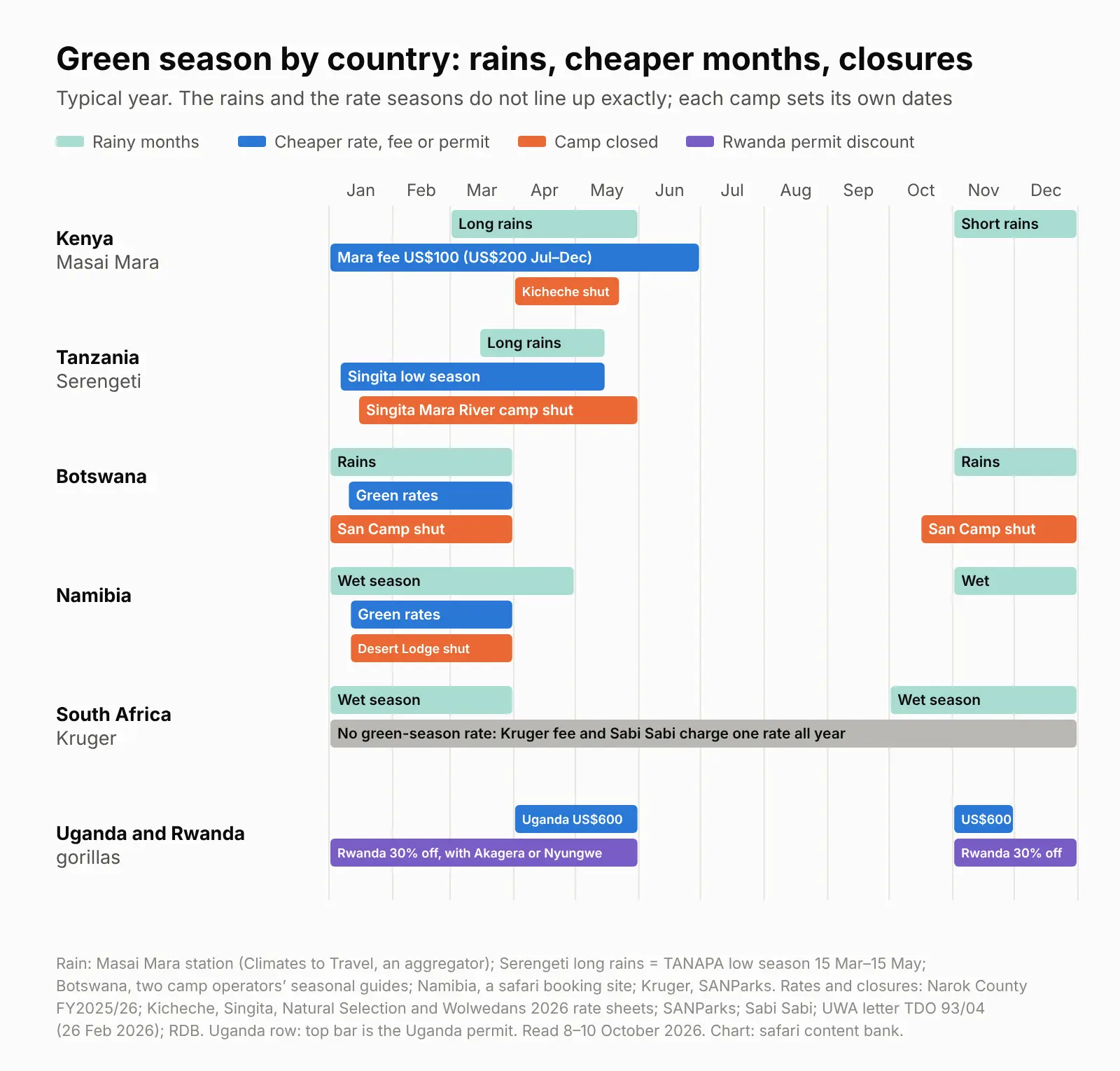 Typical year. Sources: Climates to Travel; TANAPA 2023/24; two camp operators’ seasonal guides; a safari booking site; SANParks; Narok County FY2025/26; Kicheche, Singita, Natural Selection and Wolwedans 2026 rate sheets; Sabi Sabi; UWA letter of 26 February 2026; RDB. Read 8–10 October 2026. Chart: safari content bank.
How much do you save on the camp?
At the camps we checked, the lowest-season rate is up to 55% below the peak rate (our sums), and at a few it is the same all year. The swing is largest in Kenya’s Mara, Botswana and at Namibia’s Wilderness camps, and smallest in South Africa’s private reserves.
| Camp (country) | Green or low season, per person per night | Peak, per person per night | Below peak (our sum) | Rate card |
|---|---|---|---|---|
| Governors’ Camp, Masai Mara (Kenya) | US$453 (April–May) | US$998 (July–October) | 55% | Governors’ 2026 |
| Ol Tukai Lodge, Amboseli (Kenya), per double room | US$380 (April–May) | US$650 (June–October) | 42% | Ol Tukai rack rates |
| Offbeat Mara (Kenya) | US$580 (green, March–May) | US$950 (July–September) | 39% | Offbeat 2026 |
| Singita Faru Faru, Sabora, Explore, Grumeti (Tanzania) | US$2,210 (6 January–15 May) | US$3,220 (16 May–30 September) | 31% | Singita Serengeti 2026 |
| Machaba Camp, Khwai (Botswana) | US$718 (Secret, 11 January–31 March) | US$1,315 (1 May–31 October) | 45% | Machaba 2026 |
| Desert & Delta standard camps (Botswana), 1–4 nights | US$645 (Green) | US$1,160 (Peak) | 44% | D&D 2024 |
| Mombo, Moremi Game Reserve (Botswana) | US$3,062 (January–March) | US$5,345 (June–October) | 43% | Wilderness |
| Chobe Game Lodge, suite (Botswana) | US$942 (Green, January–March, December) | US$1,406 (Peak, June–October) | 33% | D&D 2024 |
| Kwando Nxai Pan, Tau Pan (Botswana) | US$800 | US$800 | 0%: same rate all seasons | Kwando 2024 |
| Wilderness Damaraland Camp (Namibia) | N$9,131 (January–March) | N$16,019 (June–October) | 43% | A safari agent’s listing |
| NWR Sossus Dune Lodge (Namibia), dinner, bed and breakfast | N$4,030 (November–June) | N$7,000 (July–October) | 42% | NWR rates from a booking agent’s listing |
| NWR Okaukuejo room, Etosha (Namibia), bed and breakfast | N$1,900 (November–June) | N$2,380 (July–October) | 20% | NWR rates from a booking agent’s listing |
| Wolwedans Dune Camp (Namibia) | N$13,550 (green, 11 January–31 March 2026) | N$14,900 | 9% | Wolwedans 2026 |
| Singita Ebony Lodge, Sabi Sand (South Africa) | R51,665 (off-peak) | R60,470 (peak) | 15% | Singita (page undated) |
| Sabi Sabi Bush Lodge, Sabi Sand (South Africa) | R29,600 | R29,600 (+15% for arrivals 20 December–5 January) | 0% | Sabi Sabi (1 Mar 2026 – 28 Feb 2027) |
Per person sharing unless marked; fully inclusive in Botswana, Namibia’s Wilderness and Wolwedans camps and South Africa; park and conservancy fees extra in Kenya and at NWR. Rates as printed on our Kenya, Botswana, Namibia and South Africa cost pages, read 3 September–9 October 2026; Singita Grumeti from Singita’s 2026 trade rate sheet (valid 6 January 2026–5 January 2027, read 8 October 2026). Percentages are our sums: (peak − low) ÷ peak.
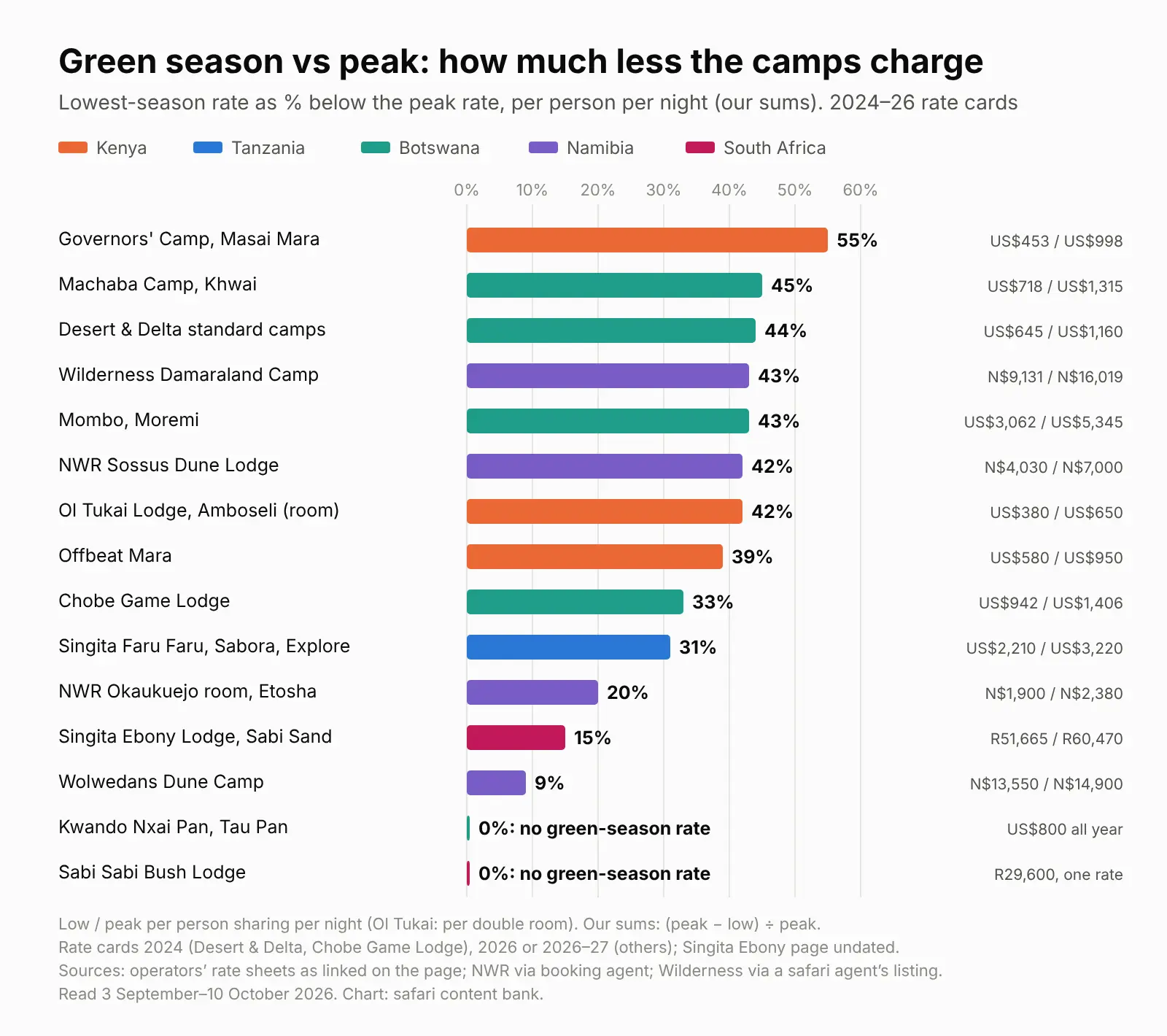 Our sums from each camp’s published rate card (2024–2026), read 3 September–10 October 2026. Chart: safari content bank.
- Not every Tanzanian price list says which months are “low”. Our Tanzania safari cost page prints Namiri Plains at US$740 → US$2,250 and Lemala Ewanjan at US$305 → US$595 per person a night (2026 agent and lodge listings), and finds that luxury Serengeti camps charge up to three times as much in July–September as in April–May.
- Budget trips barely move. One operator’s 3-day Masai Mara group safari costs US$170 in low season and US$180 in high season, park fees not included (read 9 October 2026); Gondwana’s Namibian lodges charge one rate all year.
- Single supplements can disappear. Natural Selection waives its single supplement in Botswana from 10 January to 31 March and from 1 October to 19 December 2026; see single supplements and child rates.
- Private vehicles cost less too, where they are priced by season. Governors’ Camp charges US$385 a day for an exclusive vehicle in low season and US$512 in peak (2026).
Do park fees drop in green season?
Only a few do: the Masai Mara reserve fee, the TANAPA parks’ fees from 15 March to 15 May, and the gorilla permits in Uganda and Rwanda. Kenya’s KWS parks, Ngorongoro, Namibia’s parks and Kruger charge the same rate all year.
| Park or permit | Green or low season, per adult | Rest of the year | Below the top fee (our sum) | Status and source |
|---|---|---|---|---|
| Maasai Mara National Reserve (Kenya), per day | US$100 (1 January–30 June) | US$200 (1 July–31 December) | 50% | Narok County FY2025/26, the last published schedule |
| Serengeti (Tanzania), entry per day | US$70.80 (15 March–15 May) | US$82.60 | 14% | Last published tariff, 2023/24, with 18% VAT |
| Serengeti, entry + concession, a night inside the park | US$129.80 (15 March–15 May) | US$141.60; US$153.40 (July–September) | 15% against July–September; 8% against the rest of the year | Last published tariff, 2023/24 |
| Tarangire, Lake Manyara, Arusha, entry per day | US$53.10 (low season, 15 March–15 May) | US$59 | 10% | Last published tariff, 2023/24 |
| Ngorongoro Conservation Area, including Ndutu, per 24 h | US$70.80 | US$70.80 | 0% | NCAA tariffs page, undated, read 9 October 2026 |
| KWS parks: Amboseli, Lake Nakuru (Kenya), per 24 h | US$90 | US$90 | 0%: no seasons | 1 October 2025, Legal Notice 160 of 2025 |
| Etosha, Sossusvlei and other Tier 1 parks (Namibia) | N$280 per foreign adult + N$60 per vehicle | same | 0% | From 1 April 2026, Government Notice 115 of 2026 |
| Kruger National Park (South Africa), per day | R692 (R602 until 31 October 2026) | same | 0% | SANParks 2025/26 and 2026/27 schedules |
| Uganda gorilla permit, foreign non-resident | US$600 (April, May, November) | US$800 | 25% | UWA letter TDO 93/04, 26 February 2026 |
| Rwanda gorilla permit, international | US$1,050 (November–May, with an Akagera or Nyungwe stay; our sum) | US$1,500 | 30% | RDB booking portal, checked 9 October 2026 |
Fees copied from our Kenya, Tanzania, Namibia and South Africa cost pages and our gorilla permit page, read 9–10 October 2026. TANAPA’s low season of 15 March–15 May for Tarangire, Lake Manyara and Arusha is in the TANAPA Tariffs 2023/24 (PDF), the last published tariff.
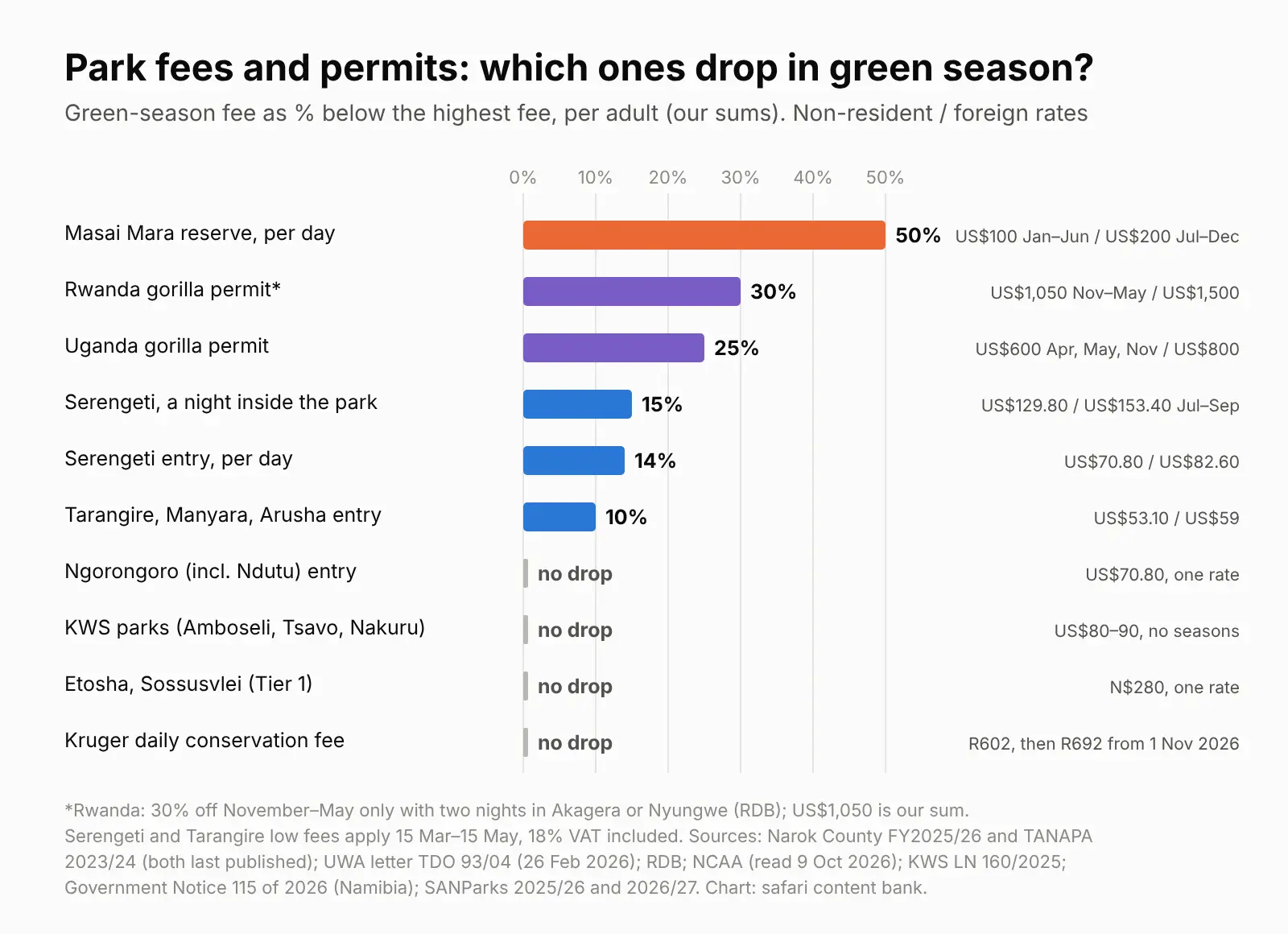 Non-resident or foreign adult. Sources: Narok County FY2025/26 and TANAPA 2023/24 (both last published); NCAA; KWS LN 160/2025; Government Notice 115 of 2026; SANParks; UWA; RDB. Chart: safari content bank.
- The Serengeti saving is small: three nights inside the park cost US$389.40 in fees from 15 March to 15 May and US$460.20 in July–September, a saving of US$70.80 per adult (our sums, last published tariff, 2023/24).
- The Mara’s cheaper half has no migrating herds in it, and Kenya’s short rains (November–December) fall in the US$200 half. See Kenya vs Tanzania for the fees month by month.
- Rwanda’s discount pays only if you want Akagera or Nyungwe anyway. Two nights’ Akagera entry alone costs an international adult US$150 (African Parks, Akagera price list 2024, the latest we found, PDF).
- Botswana has no official current park-fee tariff. The last published DWNP schedule (1 April 2022, via Tourism Update) is on our Botswana safari cost page with its caveats.
The official fee lines, with the date each took effect and the authority’s own source:
| Fee | Amount | In force from | Source |
|---|---|---|---|
| Maasai Mara National Reserve, non-resident adult, per day (12-hour ticket, 06:00–18:00), 1 Jan–30 Jun | USD 100 | Since 1 Jan 2024; Narok County FY2025/26 schedule, the last published | Narok County fee schedule FY2025/26 |
| Maasai Mara National Reserve, non-resident adult, per day (12-hour ticket, 06:00–18:00), 1 Jul–31 Dec | USD 200 | Since 1 Jul 2024; Narok County FY2025/26 schedule, the last published, expired 30 Jun 2026 (no 2026/27 schedule as of 9 Oct 2026); The Kenya Times (6 Aug 2026, secondary) reports US$200 still applies for Jul–Dec 2026 | Narok County fee schedule FY2025/26 |
| Amboseli and Lake Nakuru National Parks (KWS), non-resident adult, per 24 hours | USD 90 (child under 18, 5 and under free, USD 45) | 1 Oct 2025 (Legal Notice 160 of 2025) | KWS Fees Regulations 2025 (LN 160/2025) |
| Serengeti and Nyerere National Parks, non-East African adult, entry per day, 16 May–14 Mar | USD 70 + 18% VAT = USD 82.60 | 1 Jul 2023 (2023/24 tariff, last published) | TANAPA Tariffs 2023/24 |
| Serengeti and Nyerere National Parks, non-East African adult, entry per day, 15 Mar–15 May | USD 60 + 18% VAT = USD 70.80 | 1 Jul 2023 (2023/24 tariff, last published) | TANAPA Tariffs 2023/24 |
| Serengeti and Nyerere, concession fee per person per night inside the park | Jul–Sep USD 60 + VAT = USD 70.80; Oct–Jun USD 50 + VAT = USD 59 | 1 Jul 2023 (2023/24 tariff, last published) | TANAPA Tariffs 2023/24 |
| Tarangire, Lake Manyara and Arusha National Parks, non-East African adult, entry per day | Peak USD 50 + VAT = USD 59; low USD 45 + VAT = USD 53.10 | 1 Jul 2023 (2023/24 tariff, last published) | TANAPA Tariffs 2023/24 |
| Ngorongoro Conservation Area, non-East African adult, entry per 24 h (single entry) | USD 70.80 (NCAA's page does not say whether VAT is included) | Undated official page, read 9 Oct 2026 | NCAA |
| Tier 1 parks (Etosha, Namib-Naukluft including Sossusvlei, Skeleton Coast, Ai-Ais/Fish River Canyon, Waterberg Plateau, Cape Cross, Dorob, Tsau //Khaeb), foreign adult 16+, per person | NAD 280 (NAD 140 park entrance + NAD 140 conservation fee) | 1 Apr 2026 (Government Notice 115 of 2026; the notice prices fees per person with no period; MEFT's 2021 schedule made fees valid for 24 hours from entry); was NAD 150 under the 2021 schedule | Government Gazette 8877 (Government Notice 115 of 2026), hosted by the Legal Assistance Centre |
| Kruger National Park daily conservation fee, international adult (12+), per day | ZAR 602 | 1 Nov 2025 to 31 Oct 2026 (SANParks 2025/26 schedule) | SANParks daily conservation fees 2025/26 |
| Kruger National Park daily conservation fee, international adult (12+), per day | ZAR 692 | 1 Nov 2026 to 31 Oct 2027 (SANParks 2026/27 schedule, already published) | SANParks daily conservation fees 2026/27 |
| Uganda: gorilla tracking permit, Bwindi Impenetrable and Mgahinga Gorilla NPs, foreign non-resident, per person per trek (guide and that day's park entry included) | USD 800 (foreign resident USD 700; rest of Africa USD 500; East African citizens UGX 300,000) | Since 1 Jul 2024 (UWA tariff 2024–26); confirmed unchanged from 1 Jan 2027 by UWA letter TDO 93/04 of 26 Feb 2026 | UWA letter TDO 93/04, 26 Feb 2026 |
| Uganda: gorilla tracking permit in April, May and November (low season), foreign non-resident, per person per trek; cannot be rescheduled | USD 600 (foreign resident USD 500) | Immediate effect from the UWA letter of 26 Feb 2026 | UWA letter TDO 93/04, 26 Feb 2026 |
| Rwanda: mountain gorilla tracking permit, Volcanoes NP, international visitor, per person per day | USD 1,500 | Current RDB price, checked 9 Oct 2026 | Visit Rwanda (Rwanda Development Board) |
| Rwanda: gorilla permit low-season discount, November–May, with two nights in Akagera or Nyungwe (paid hotel receipt and one paid activity) or one night in each | 30% off (USD 1,050, our sum); one discounted permit per person per 3-day/2-night stay | November–May; conditions checked 9 Oct 2026 | RDB booking portal, low-season discount |
Country by country: when it is, what it costs, what changes
The case for green season is strongest in Botswana and Tanzania’s southern Serengeti, mixed in Kenya and Namibia, and weakest in South Africa, where most park fees and many lodge rates do not change.
Kenya: April–May, the long rains
Kenya’s camps are cheapest in April–May, but that is also when the Mara’s conservancy camps shut. The Mara reserve fee is lower for the whole first half of the year.
- Rain: the Masai Mara station averages 210 mm in April against 60 mm in July (Climates to Travel, an aggregator); no month there averages under 60 mm.
- Closures: Kicheche’s three Mara camps were closed from 1 April to 22 May 2026 (Kicheche 2026 rack rates), and Porini Amboseli Camp from 16 April to 31 May (Porini Kenya & Tanzania itinerary, 2026). Our Kenya safari cost page notes that many conservancy camps close in April–May.
- What stays: the Mara has resident predators all year; the migrating herds are there from about July to October (great migration month by month).
Tanzania: calving season and the long rains
Tanzania has two different “green seasons”: the calving months at Ndutu (late January to mid-March), which are wet but popular, and the long rains (about mid-March to mid-May), which are the cheapest.
- Calving peaks in February at Ndutu, in the Ngorongoro Conservation Area, where entry is US$70.80 per adult per 24 hours and lodges add US$59 per person per night, with no low season (NCAA, read 9 October 2026). “February is the driest month of the wet season on the southern plains” (a camp operator’s migration guide). See Serengeti calving season.
- The long rains: TANAPA’s lower fees run from 15 March to 15 May (last published tariff, 2023/24). In April the herds are in the southern and central Serengeti, and “some camps close” (great migration month by month). Over Easter, see Easter safari.
- Singita prices its Grumeti camps at US$2,210 per adult a night from 6 January to 15 May 2026, against US$3,220 from 16 May to 30 September, VAT included; it closes its Explore camp from 15 March to 15 May and its Mara River Tented Camp from 15 January to 31 May (Singita Serengeti 2026, PDF, read 8 October 2026).
Botswana: January to March
Botswana’s green season is the strongest value case of the five countries: the camps above cut rates by 33–46% (our sums), and the Kalahari pans are at their best.
- Rain: November to March, when the rains fill the pans and the game disperses (a camp operator’s best-time guide for Botswana); see Botswana safari questions.
- The flood is not in the rains. The Okavango’s water is highest from about May to August, and seasonal camps run no boats in January and February; see the Okavango flood calendar.
- Closures: Natural Selection’s San Camp (Makgadikgadi) opens only from 1 April to 15 October and its Skybeds from 1 April to 31 October (NS 2026 Botswana rack).
- Solo travellers gain most: a solo stay of 3 nights at Jack’s Camp costs US$6,465 in green season (supplement waived) against US$16,539 in peak season (our sums from the NS 2026 card, as on our single supplements page).
Namibia: January to March for rates, November to April for rain
Namibia’s green season saves 9–43% at the lodges above (our sums) but nothing at the park gate, and the north-east loses its roads.
- Rates: NWR’s low season runs November–June; Wolwedans’ green season ran 11 January–31 March 2026, when its Desert Lodge was closed (Wolwedans 2026). Natural Selection’s Hoanib Elephant Camp and Nkasa Linyanti close in green season (NS 2026 Namibia rack).
- Self-drive: a Namibia2Go rooftop-tent double cab costs N$2,910 a day in low season and N$3,880 in high season (1–14 days, 2026 rates; see Namibia safari cost).
- Etosha: a safari booking site calls the dry season, May–October, “exceptionally good” for game.
South Africa: little to save in Kruger
In Kruger and its private reserves, green season saves little: the park fee is the same all year and many lodges publish one rate. The cheap season in the Eastern Cape is the dry winter, not the rains.
- Kruger: October to March is “hot and green”; April to September is the dry season and the easiest time to see animals (Kruger). Entrance gates open longer in summer, 05:30–18:30 from November to February against 06:00–17:30 from May to July (SANParks gates).
- Lodges: Sabi Sabi charges one rate from 1 March 2026 to 28 February 2027 (Sabi Sabi); Umlani Bushcamp in Timbavati charges R7,761 with “no seasons” (16 December 2025–15 December 2026; see Sabi Sand vs Timbavati).
- Eastern Cape: Kwandwe charges R17,930 per person sharing from 1 May to 30 September 2026 and R26,180 from 1 October 2026 to 30 April 2027 (Kwandwe 2026–27, PDF), so the cheaper months there are winter.
Uganda and Rwanda: cheaper permits, muddier trails
Uganda’s gorilla permit costs US$600 in April, May and November against US$800, and Rwanda takes 30% off from November to May with conditions. Details are on our gorilla permit page.
- Uganda’s low-season permits cannot be rescheduled (UWA letter TDO 93/04, PDF).
- The discount months are the muddy ones: a safari booking site rates Bwindi “Poor” in April, May, October and November.
What you gain in green season
Lower rates, newborn animals, migrant birds and, in some places, the best wildlife of the year.
- Calving: wildebeest calving peaks in February at Ndutu, compressed into two to three weeks (great migration month by month).
- Zebra on Botswana’s pans: zebra gather at Nxai Pan and the Makgadikgadi from December to March; more than 20,000 move between the Chobe floodplains and Nxai Pan (Africa Geographic).
- Birds: “The birdlife in Namibia is at its best from November to April, when migratory birds from Europe and Asia are present” (a safari booking site). Botswana’s green season brings migrant birds too (a camp operator’s best-time guide for Botswana).
- Fewer vehicles, in most places: fewer camps are open, but we found no vehicle counts by month for any park. Calving at Ndutu is the exception: a traveller reported that “it was common to see 15–20 vehicles at a single sighting” there in March 2026 (TripAdvisor forum, traveller report).
- Longer days in the park in Kruger, where gates open about 13 hours a day from November to February.
What you lose in green season
Rain, closed camps, impassable roads in some parks, dispersed game and, in southern Africa, a higher malaria risk.
- Rain and roads: in March 2026 a traveller in the southern Serengeti wrote “We were stuck 11 times in 7 days” and that reaching Namiri “required a 25 km tractor tow due to impassable roads” (TripAdvisor forum, traveller report).
- Closed camps: see the Kenya, Tanzania, Botswana and Namibia closures above. Ask whether the camp you want is open before you compare prices.
- Dispersed game: in Botswana the rains fill the pans and the game disperses (a camp operator’s best-time guide for Botswana); a safari booking site rates Etosha’s dry season, May–October, “exceptionally good”.
- Activities: Okavango boating at seasonal camps stops in January–February (Okavango flood calendar).
- Non-refundable deals: Uganda’s US$600 permits cannot be rescheduled.
Malaria in the rainy season
In southern Africa the malaria peak matches the rains; in Kenya and Tanzania the risk is year-round. Take medical advice for your month and itinerary.
| Area | Season of highest risk | Source |
|---|---|---|
| Kruger National Park (South Africa) | November–April; “generally low, even in summer” | SANParks malaria |
| Northern Botswana, including the Okavango | October–May (high); June–September (low) | TravelHealthPro, Botswana |
| Northern Namibia (Etosha, Zambezi) | November–April, the rainy season | A safari booking site, Namibia malaria |
| Kenya | “Throughout the year in the entire country”; low in Nairobi and the highlands above 2,500 m | WHO, ITH country list 2022 (PDF) |
| Tanzania | “Throughout the year in the entire country below 1800 m” | WHO, ITH country list 2022 (PDF) |
Read 8–10 October 2026. For reserves outside the malaria area, see malaria-free safaris in South Africa.
Which parks are worst in the rains?
Nyerere in Tanzania, Nkasa Rupara and Khaudum in Namibia, and the Mara and Amboseli conservancy camps that close are the places where the rains change the trip most. Gorilla trekking goes ahead in the rain, but on muddier trails.
| Park or area | What happens in the rains | When | Source |
|---|---|---|---|
| Nyerere National Park (Tanzania) | “Some parts of the park are temporarily closed for game drives due to poor accessibility”; one safari operator says many camps close in April–May | March–May | A safari agent’s Nyerere guide; one safari operator’s Nyerere page |
| Southern Serengeti and Ndutu (Tanzania) | Vehicles stuck and a tractor tow on the plains roads (traveller report) | March 2026 | TripAdvisor forum |
| Northern Serengeti (Tanzania) | Singita Mara River Tented Camp closed | 15 January–31 May 2026 | Singita 2026 |
| Masai Mara conservancies (Kenya) | Kicheche’s Mara camps closed | 1 April–22 May 2026 | Kicheche 2026 |
| Amboseli (Kenya) | Porini Amboseli Camp closed | 16 April–31 May 2026 | Porini 2026 |
| Nkasa Rupara (Namibia) | “Roads become impassable during wet months (November–April), with potential 80% park flooding in high-rainfall years” | November–April | A safari booking site |
| Khaudum (Namibia) | “Roads may be impassable during wet season (November–April)” | November–April | A safari booking site |
| Makgadikgadi (Botswana) | San Camp closed | 16 October–31 March | NS 2026 |
| Bwindi (Uganda) | Rated “Poor” by a safari booking site | April, May, October, November | A safari booking site |
Read 8–10 October 2026. Closure dates are each operator’s 2026 rate sheet; other camps in the same area may stay open.
Worked examples: what green season saves (our sums)
These totals use only the rates and fees printed above; they leave out flights, tips, levies and drinks.
| Trip | Green or low season | Peak | Saving |
|---|---|---|---|
| Couple, 3 nights at Governors’ Camp + 3 days’ Mara reserve fee | 2 × 3 × US$453 + 2 × 3 × US$100 = US$3,318 (April–May) | 2 × 3 × US$998 + 2 × 3 × US$200 = US$7,188 (July–October) | US$3,870 |
| One adult, 3 nights at Mombo | 3 × US$3,062 = US$9,186 (January–March) | 3 × US$5,345 = US$16,035 (June–October) | US$6,849 |
| Solo, 3 nights at Jack’s Camp (NS 2026) | US$6,465 (supplement waived) | US$16,539 | US$10,074 |
| One adult, 3 nights inside the Serengeti, park fees only | 3 × US$129.80 = US$389.40 (15 March–15 May) | 3 × US$153.40 = US$460.20 (July–September) | US$70.80 |
| Two Uganda gorilla permits | 2 × US$600 = US$1,200 (April, May, November) | 2 × US$800 = US$1,600 | US$400 |
| 14 days’ 4x4 rooftop-tent hire, Namibia (Namibia2Go, 1–14 days) | 14 × N$2,910 = N$40,740 | 14 × N$3,880 = N$54,320 | N$13,580 |
Governors’ rates exclude its US$50 community fee and Mara fees; you need a reserve ticket for every calendar day inside. Serengeti fees: last published tariff, 2023/24. Jack’s Camp totals as on our single supplements page, including the US$60 nightly CCR fee.
Common mistakes about green-season safaris
| What you’ll often read | What is correct |
|---|---|
| “Green season is 30–50% cheaper everywhere” | It depends on the camp. On the rate cards above the saving runs from 0% to 55% (our sums): Kwando’s Nxai Pan and Sabi Sabi charge one rate all year; Wolwedans Dune Camp is 9% cheaper. |
| “Park fees are lower in the rainy season” | Only some are: the Mara reserve (US$100 January–June), TANAPA parks from 15 March to 15 May, and gorilla permits. KWS parks, Ngorongoro, Namibia’s parks and Kruger charge the same all year. |
| “Calving season is the quiet, cheap season” | Ndutu has no low-season fee (US$70.80 entry per 24 h, NCAA), Serengeti entry is US$82.60 until 14 March (last published tariff, 2023/24), and a traveller reported 15–20 vehicles at a sighting in March 2026. |
| “The Okavango floods in the green season” | It floods in the dry season. Water is highest from about May to August; seasonal camps run no boats in January–February. |
| “Kenya’s short rains are a cheap time for the Mara” | November–December falls in the Mara’s US$200 half. The cheaper fee runs January–June. |
| “Winter is the expensive season in South Africa” | Not in the Eastern Cape: Kwandwe charges R17,930 from 1 May to 30 September 2026 and R26,180 from 1 October. |
| “A cheap low-season gorilla permit can be moved if it rains” | Uganda’s US$600 permits cannot be rescheduled (UWA, 26 February 2026). |
Frequently asked questions
Is a green-season safari worth it? Yes, if price, birds or newborn animals matter more to you than concentrated game and dry roads. Camp rates at the lodges we checked are up to 55% below peak (our sums from 2024–2026 rate cards), and Botswana’s pans and the southern Serengeti’s calving are at their best then. It is a poorer choice for a first, short trip set on big cats at waterholes, or for parks whose roads close.
How much cheaper is a safari in green season? At the camps we checked, the lowest-season rate is 0–55% below peak: 55% at Governors’ Camp in the Masai Mara, 43% at Mombo in Botswana and 31% at Singita’s Grumeti camps in Tanzania, but nothing at Kwando’s Nxai Pan or Sabi Sabi (our sums). Budget group safaris barely change: US$170 against US$180 for a 3-day Mara trip.
When is green season in Kenya, Tanzania, Botswana and Namibia? In Kenya the low rates are mostly April–May, the long rains. In Tanzania, TANAPA’s low fee season is 15 March–15 May (last published tariff, 2023/24), and Singita’s low season runs 6 January–15 May. In Botswana and Namibia the green rates mostly run from about 10 January to 31 March, inside a rainy season of about November to March or April.
Do park fees go down in green season? Only some. The Masai Mara reserve charges US$100 per adult per day from January to June against US$200 from July to December, and Serengeti entry is US$70.80 instead of US$82.60 from 15 March to 15 May (last published tariff, 2023/24). Kenya’s KWS parks, Ngorongoro, Etosha and Kruger charge the same all year.
Is the calving season in the Serengeti part of green season? Yes: calving peaks in February at Ndutu, in the rainy season. It is not a cheap or empty time, though: Ngorongoro Conservation Area fees have no low season, Serengeti entry stays at US$82.60 until 14 March, and a traveller reported 15–20 vehicles at a single sighting in March 2026. See the great migration month by month.
Which safari parks should you avoid in the rainy season? Nyerere National Park closes parts of the park to game drives from March to May (a safari agent’s park guide), and a safari booking site says roads in Namibia’s Nkasa Rupara and Khaudum can be impassable from November to April. Several Mara, Amboseli and northern Serengeti camps close in the long rains, so check the camp first.
Is malaria worse in green season? In southern Africa, yes: SANParks puts Kruger’s highest risk in November–April, and TravelHealthPro rates northern Botswana high from October to May and low from June to September. In Kenya and Tanzania the WHO lists malaria risk throughout the year below the highlands. Take medical advice for your dates.
Sources
- Park fees: Narok County, Maasai Mara fee schedule FY2025/26 (PDF), the last published; KWS, Legal Notice 160 of 2025 (PDF); TANAPA, Tariffs 2023/24 (PDF), the last published tariff; NCAA tariffs; Government Gazette 8877 (Government Notice 115 of 2026), hosted by the Legal Assistance Centre; SANParks daily conservation fees 2025/26 (PDF) and 2026/27 (PDF)
- Permits: UWA letter TDO 93/04, 26 Feb 2026 (PDF); Visit Rwanda; RDB low-season discount; African Parks, Akagera price list 2024 (PDF)
- Kenya rate cards: Governors’ Camp 2026 (PDF); Ol Tukai rack rates (PDF); Offbeat 2026; Kicheche 2026 (PDF); Porini Kenya & Tanzania 2026 (PDF)
- Tanzania: Singita Serengeti 2026 (PDF); a camp operator’s migration guide; a safari agent’s Nyerere guide; one safari operator’s Nyerere page
- Botswana: Machaba 2026; Natural Selection 2026 (PDF); Desert & Delta 2024 (PDF); Kwando 2024 (PDF); Wilderness, Mombo (rates); a camp operator’s best-time guide for Botswana; Africa Geographic, zebra migrations
- Namibia: Wolwedans 2026 (PDF); Natural Selection Namibia 2026 (PDF); NWR rates from a booking agent’s listing; a safari agent’s listing for Damaraland Camp; a safari booking site: Etosha, Nkasa Rupara, Khaudum, birding, malaria
- South Africa: SANParks climate, gates and malaria; Sabi Sabi rates; Singita Ebony Lodge; Kwandwe 2026–27 (PDF)
- Health and climate: TravelHealthPro, Botswana; WHO ITH country list 2022 (PDF); Climates to Travel, Kenya (aggregator); a safari booking site, Uganda best time
- Traveller reports: TripAdvisor Tanzania forum, March 2026 safari review
- More: Kenya safari cost, Tanzania safari cost, Botswana safari cost, Namibia safari cost, South Africa safari cost, Kenya vs Tanzania, great migration month by month, Okavango flood calendar, gorilla permits
Rates and fees checked 3 September–10 October 2026; SANParks fees checked 1 November 2026. We will update this page by 31 December 2026, when the 2027 rate cards are published, and when Narok County, TANAPA or DWNP publish a new fee schedule.