 Experience


Last verified · Next check due
Plan it: costs, fees and practical answers
- Park feesNgorongoro fees 2026: US$70.80 per adult per 24 h, crater descent US$295 per vehicle (US$49.17 each for six), US$59 a night in rim lodges. Single entry only.Read the answer
- Safari costA Ngorongoro Crater safari costs US$260–425 a day on shared trips and US$443–1,147 private for two, up to US$1,667 luxury, with the US$295 crater fee shared.Read the answer
Short answer: A day in Ngorongoro Crater (Tanzania) costs US$70.80 per adult for 24 hours’ entry to the Ngorongoro Conservation Area (NCA) plus US$295 per vehicle for the crater descent, so two people sharing a vehicle pay US$218.30 each in entry and crater fees, before the vehicle permit. A night in a rim lodge or permanent camp adds US$59 per adult; Karatu, outside the gate, adds no NCA fee. Figures from the NCAA tariff page (undated), read 9 October 2026.
Key facts
- Ngorongoro is not part of Serengeti National Park. The Ngorongoro Conservation Area (Tanzania) is run by the Ngorongoro Conservation Area Authority (NCAA), not TANAPA, and Serengeti fees do not cover it.
- The crater fee is per vehicle: US$295 per descent, so six people sharing pay US$49.17 each.
- An NCA permit allows one entry within 24 hours. The Arusha–Serengeti road crosses the NCA, so driving in and back out the same way pays entry twice.
- The NCAA visitor guidelines state no time limit on the crater floor. Descent gates close at 16:00, all driving ends at 18:00, and there are no night drives.
- Only 4×4 vehicles up to 3,500 kg tare weight may go down, with a licensed guide or an NCAA guide.
- The last published black rhino figure for the crater is “more than 50”, from June 2018.
Ngorongoro Crater at a glance (2026)
| Figure | Source | |
|---|---|---|
| Area of the conservation area | 8,292 km² | NCAA |
| Status | Split from Serengeti National Park in 1959; UNESCO World Heritage 1979, mixed natural and cultural site since 2010 | Wikipedia |
| Entry, non-East African adult | US$70.80 per 24 h, one entry; child 5–15 US$23.60; under 5 free | NCAA tariffs |
| Crater service fee | US$295 per vehicle per descent | same |
| Concession, lodges and permanent camps inside the NCA | US$59 per adult per night | same |
| Hours | Driving 06:00–18:00; crater descent closes at 16:00 | NCAA guidelines |
| Places to stay inside | 11 lodges (5 on the rim, 1 at Ndutu), 49 special campsites, 1 public campsite | NCAA accommodation |
NCAA pages read 8 and 9 October 2026. The tariff page is undated and says tariffs may change without notice. All fees, with child, camping and vehicle rates: Ngorongoro park fees.
Ngorongoro Crater or the conservation area?
The crater is one part of the 8,292 km² NCA, which also takes in Olduvai Gorge, the Ndutu plains, the Empakaai and Olmoti craters, and land where Maasai pastoralists live.
The NCA is a multiple-use area, not a national park. 93,136 Maasai lived in it in 2017. Since 2021 residents have been moved to Msomera under a scheme the government calls voluntary, and Human Rights Watch has documented concerns about coercion (Wikipedia). Photographing residents is prohibited except in designated cultural bomas (NCAA guidelines).
Olduvai Gorge and the Shifting Sands have their own NCAA fee of US$35.40 per adult; the Laetoli footprints site costs US$23.60. Ndutu, on the south-western plains, is the calving-season base; it is NCA land, so NCAA fees apply there, not Serengeti ones.
In 2025 Ngorongoro was the attraction most visited by Tanzania’s international visitors (14.2%), ahead of the Serengeti (13.1%) (Bank of Tanzania exit survey, PDF).
What you can see in the crater
Black rhino and spotted hyena live on the crater floor and lions are recorded in Ngorongoro, but the last published rhino figure is from June 2018 and no lion count is current.
- Black rhino: about 108 in 1964–66 and 13 in 1993 (Wikipedia), and “more than 50” according to the Chief Conservator in June 2018 (The Citizen). Home ranges here are 2.6–58 km², against 70–100 km² in the Serengeti (Wikipedia).
- Lion: a 2026 photo record is located in “Ngorongoro, Arusha” (iNaturalist). No current crater count has been published, so we print none.
- Spotted hyena: territories in the crater are under 40 km²; in the Kalahari they exceed 1,000 km² (Wikipedia).
Travellers rate the crater 4.8 out of 5 in 638 reviews on a safari booking site. Lower-rated reviews mention too many vehicles, feeling rushed, and cold or overcast days in June and August.
Crater rules and time limits
The NCAA’s visitor guidelines allow driving from 06:00 to 18:00 and close the descent at 16:00; they state no time limit on the crater floor.
- No night drives: driving outside 06:00–18:00 needs permission.
- Vehicles: “Only 4×4 vehicles up to 3,500 Kgs of tare weight are allowed in the Ngorongoro Crater floor.” It is the only 4×4 rule we have found in Tanzania’s park regulations.
- Guides: “A licensed guide or an official NCAA guide must accompany all crater visitors.” Commercial vehicles need a TALA licence; see how to check a safari operator’s licence.
- No off-road driving unless the Conservation Commissioner authorises it.
- Walking only with an NCAA armed ranger: US$23.60 per adult for 1–4 hours, US$29.50 for longer (NCAA guidelines; tariffs). Routes include Empakaai, Olmoti and Nasera Rock (a Tanzania travel site).
- Picnics are free at designated sites; a bush lunch permit costs US$23.60 per vehicle.
When to go: Ngorongoro month by month
February is calving month on the Ndutu plains inside the NCA; April is the wettest month at the Serengeti weather station (155 mm), and Karatu lodges charge least in April and May.
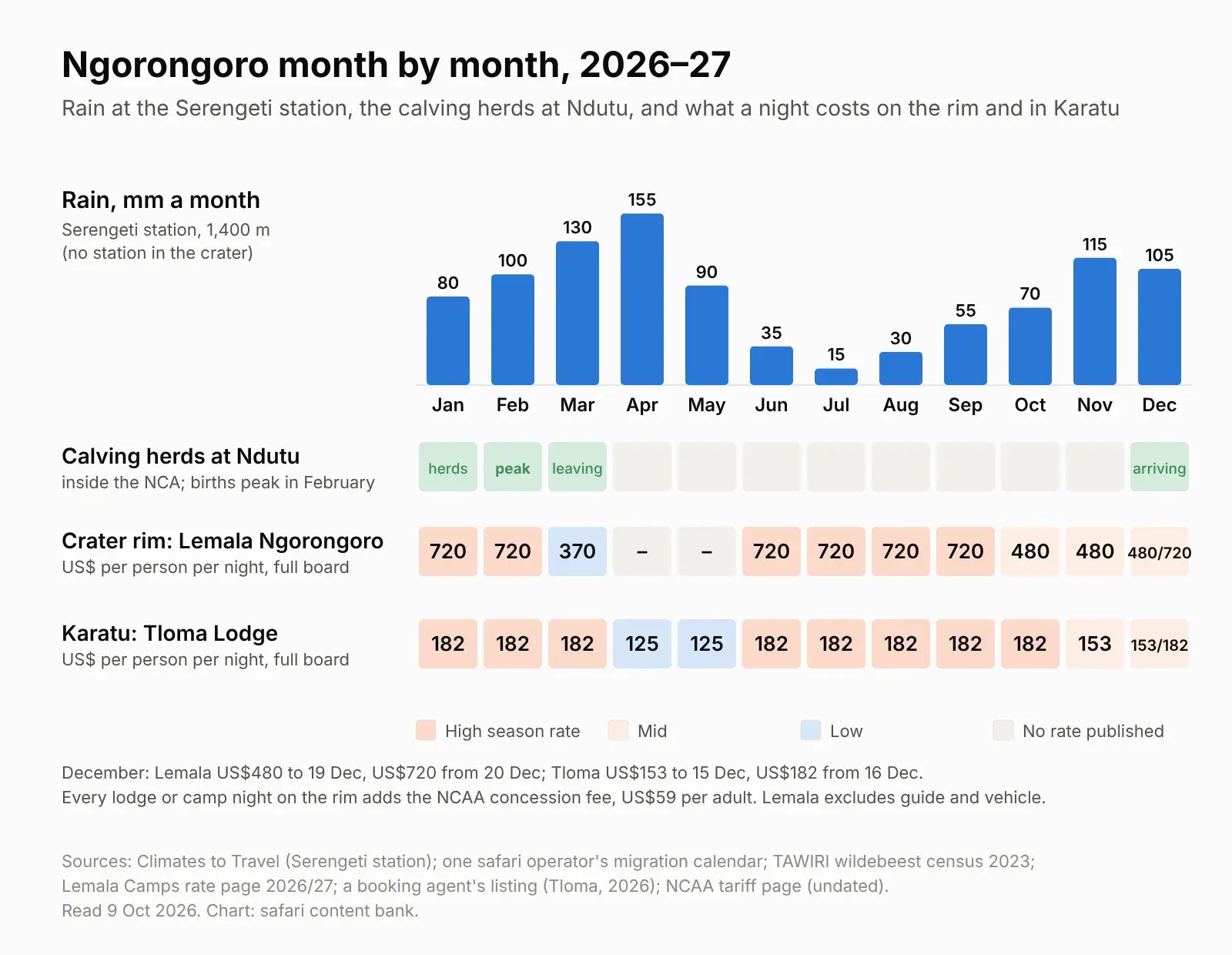 Rain: Climates to Travel, Serengeti station (1,400 m). Calving: one safari operator’s migration calendar; TAWIRI 2023. Rates: Lemala 2026/27 rate page; a booking agent’s listing for Tloma. Read 9 October 2026.
- Rain: long rains March–May (April 155 mm), short rains November–December, driest in July (15 mm). Highs are 26–29 °C and lows 14–16 °C all year at the Serengeti station (Climates to Travel); our source has no station in the crater.
- Calving: herds reach the plains around Ndutu in late November and December, and most calves are born “in a short window around February” (one safari operator’s migration guide). Timing depends on the rain: the end-March 2023 census found the lowest wildebeest density at Ndutu (TAWIRI, PDF). See the Great Migration month by month.
- Prices: Lemala Ngorongoro Tented Camp charges US$720 per person per night in June–September and from 20 December to February, US$480 from October to 19 December and US$370 in March 2027, and publishes no April–May rate. Sanctuary Ngorongoro Crater Camp closes in April and May.
Where to stay: crater rim or Karatu
Rim lodges give the earliest access to the descent but add the US$59 concession per adult per night. Karatu has no NCA charge for the night; it is 15 km (30 min) from Loduare Gate and another 15 km of gravel (about 1 h) from the rim (a self-drive operator’s guide).
| Base | Property | Per person per night, sharing, 2026–27 (low → peak) | Source |
|---|---|---|---|
| Rim | Simba A public campsite | US$35.40 camping fee | NCAA |
| Karatu | Tloma Lodge, full board | US$125 → 182 | A booking agent’s listing |
| Karatu | Gibb’s Farm, full board | US$518 → 683 | A booking agent’s listing |
| Karatu | The Manor at Ngorongoro, meals and most drinks | US$866 → 1,074 | A booking agent’s listing |
| Rim | Lemala Ngorongoro Tented Camp; guide and vehicle extra | US$370 → 720 | Lemala rates |
| Rim | Sanctuary Ngorongoro Crater Camp; closed April–May | US$585 → 825 | A booking agent’s listing |
| Rim | LABA Ngorongoro Lodge, drinks included | US$895 → 1,095 | A booking agent’s listing |
| Olmoti | The Highlands, game drives included | US$710 → 1,390 | A booking agent’s listing |
| Rim | Entamanu Ngorongoro | US$1,280 → 2,250 | A booking agent’s listing |
| Ndutu | Lake Masek Tented Camp (peak January–March, December) | US$280 → 545 | A booking agent’s listing |
| Ndutu | Ndutu Safari Lodge (peak 15 December–31 March) | US$305 → 451 | A booking agent’s listing |
Read 9 October 2026. Rates marked as a booking agent’s listing are not the lodge’s own sheet. At lodges and permanent camps inside the NCA (rim, Olmoti, Ndutu) add the US$59 concession per adult per night; the Simba A figure is the camping fee itself.
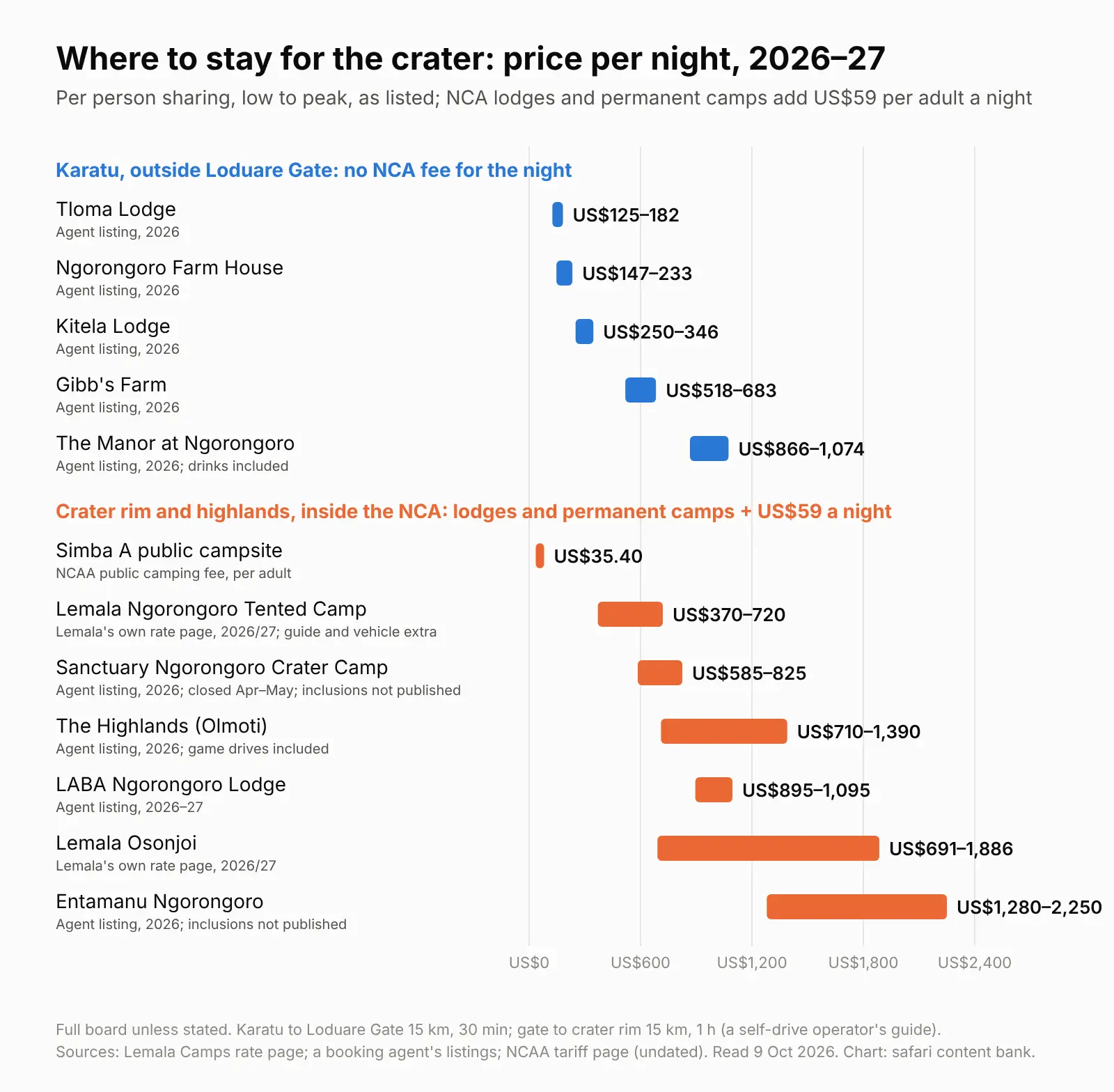 Also on the chart: Ngorongoro Farm House and Kitela (Karatu), Lemala Osonjoi (rim). Lemala rate page 2026/27; a booking agent’s listings. Read 9 October 2026.
andBeyond Ngorongoro Crater Lodge is closed for a complete rebuild, with reopening expected in January 2027 (a booking agent’s listing, read 9 October 2026). Elewana plans an 84-room Ngorongoro Explorer Lodge on the eastern rim for June 2027 (Tourism Update, 2 Oct 2026).
Getting to Ngorongoro Crater
The road from Arusha runs via Lake Manyara and Karatu to Loduare Gate; from the rim it is 85 km (2–3 h) on to the Serengeti’s Naabi Hill Gate.
| Route | Distance | Published time | Source |
|---|---|---|---|
| Karatu → Loduare Gate | 15 km | 30 min | A self-drive operator’s guide |
| Loduare Gate → crater rim | 15 km | about 1 h | same |
| Southern Tarangire → Ngorongoro Crater | 148 km | 2 h 30 | A Tanzanian operator’s travel-times table |
| Crater rim → Naabi Hill Gate (Serengeti) | 85 km | 2–3 h | A self-drive operator’s guide |
| Ngorongoro Crater → Ndutu | 106 km | 2 h 30 | A Tanzanian operator’s travel-times table |
| Ngorongoro Crater → Seronera | 135 km | 3 h 30; travellers report 4 h 30–5 h | same; TripAdvisor, Fodor’s |
Read 9 October 2026.
A vehicle crossing the NCA to the Serengeti without going into the crater pays entry and vehicle fees but no crater fee (a self-drive operator’s guide). By air, Lake Manyara airstrip (LKY), which Flightlink labels Ngorongoro/Manyara, serves Karatu and the highland lodges (Flightlink).
What a crater day costs
In NCAA entry and crater fees, a crater day costs US$365.80 for one person alone in a vehicle and US$119.97 each for six sharing; a night in a rim lodge adds US$59 each.
| Fee | Amount | In force from | Source |
|---|---|---|---|
| Ngorongoro Conservation Area, non-East African adult, entry per 24 h (single entry) | USD 70.80 (NCAA's page does not say whether VAT is included) | Undated official page, read 9 Oct 2026 | NCAA |
| Ngorongoro Crater descent (crater service fee), per vehicle | USD 295 (NCAA's page does not say whether VAT is included) | Undated official page, read 9 Oct 2026 | NCAA |
| Ngorongoro concession fee, rim and Ndutu lodges, per person per night | USD 59 (NCAA's page does not say whether VAT is included) | Undated official page, read 9 Oct 2026 | NCAA |
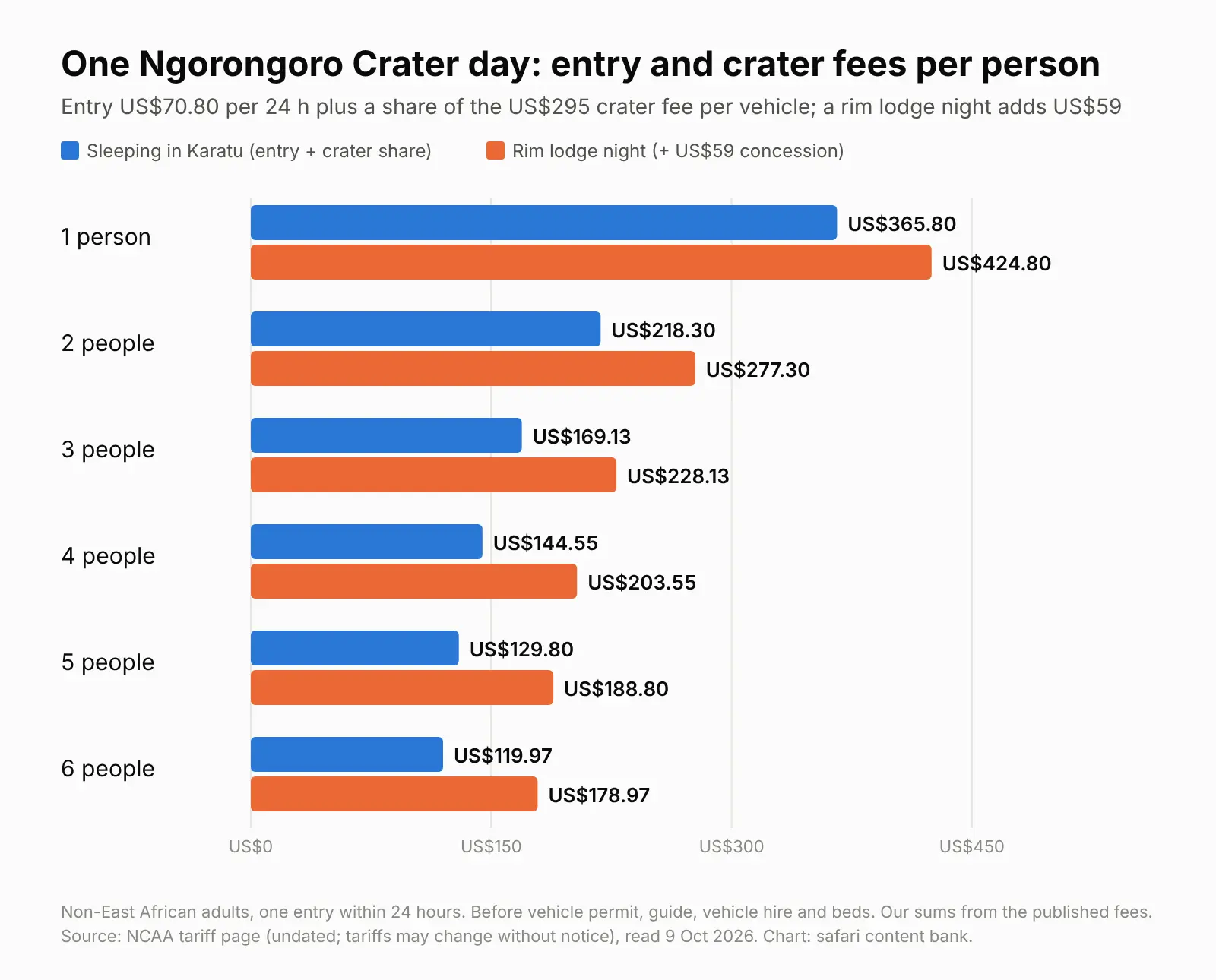 Our sums from the NCAA tariff page (undated), read 9 October 2026: entry US$70.80 per adult plus an equal share of the US$295 crater fee.
Guide, vehicle, beds and the vehicle permit (from TZS 23,600 for a Tanzanian-registered vehicle, US$47.20 for a foreign-registered one up to 2,000 kg) are extra. Some short safaris from Arusha are sold with park fees included:
| Published package | Per person | Basis | Source |
|---|---|---|---|
| 3-day group safari, Serengeti and Ngorongoro | US$900–1,220 | Park fees and meals included; US$900 is camping with vehicle and guide, 4–7 per vehicle; US$1,220 has a maximum of 6 per vehicle | Published prices of two operators, read 9 October 2026 |
| 4-day private safari, Tarangire and Ngorongoro | from US$1,040 | 5 people, April–May, 3-star, private vehicle, park fees | One operator’s published price, read 9 October 2026 |
Operators’ published prices, read 9 October 2026. For a full budget, see Tanzania safari cost; for the wider trip, Tanzania safaris.
Common mistakes about Ngorongoro
| What you’ll often read | What is correct |
|---|---|
| “Ngorongoro entry is US$82.60” | US$70.80 per adult per 24 h. US$82.60 is peak-season (16 May–14 March) Serengeti entry with VAT under TANAPA’s last published tariff, 2023/24 (PDF). |
| “The crater fee is per person” | US$295 per vehicle per descent. |
| “The concession fee is US$70.80” | US$59; US$70.80 is the entry permit. |
| “You get six hours on the crater floor” | The NCAA guidelines state no time limit; descent closes at 16:00, driving ends at 18:00. |
| “Ndutu is in the Serengeti” | Ndutu is in the NCA, with NCAA fees. |
| “Staying in Karatu avoids Ngorongoro fees” | It avoids the concession, but every re-entry is a new 24-hour permit. |
| “Ngorongoro is untouched wilderness” | 93,136 Maasai lived in the NCA in 2017. |
Compare: Serengeti vs Ngorongoro.
Frequently asked questions
How much does it cost to go into Ngorongoro Crater? US$70.80 per adult for 24 hours’ NCA entry plus US$295 per vehicle for the descent (NCAA, read 9 October 2026). Two people sharing a vehicle pay US$218.30 each in these fees; six pay US$119.97 each. Guide, vehicle, vehicle permit and beds are extra.
Do I need a guide to drive into Ngorongoro Crater? Yes. The NCAA guidelines say “A licensed guide or an official NCAA guide must accompany all crater visitors.” Only 4×4 vehicles up to 3,500 kg tare weight may go down.
Is Ndutu in the Serengeti or in Ngorongoro? Ndutu is in the Ngorongoro Conservation Area. Its lodges and permanent camps charge the NCAA concession of US$59 per adult per night, guests at seasonal mobile camps pay the special-campsite fee of US$70.80, and a Ndutu stay does not include Serengeti entry.
Should I stay on the crater rim or in Karatu? The rim gives the earliest start and costs US$59 per adult per night in concession fees on top of the lodge rate. Karatu has no NCA charge for the night but is 30 km by road from the rim, the last 15 km on gravel (about 1 h). Tloma Lodge there lists US$125 per person per night in April–May 2026 (agent listing).
How much is Olduvai Gorge? US$35.40 per adult and US$11.80 per child, an NCAA fee separate from the NCA entry permit. The Laetoli footprints site is US$23.60 per adult.
Are there tsetse flies in Ngorongoro? Guides on the TripAdvisor Tanzania forum report none in Ngorongoro (thread from about 2023), but some in Tarangire and the Serengeti’s Western Corridor.
Can I visit a Maasai boma in Ngorongoro? Yes. Boma visits are offered around Ngorongoro, Karatu and Manyara, and the NCAA charges US$20 per vehicle to enter a cultural boma. Photographing residents is prohibited outside designated cultural bomas.
Sources
- NCAA: tariffs (undated; read 9 Oct 2026), visitor guidelines, accommodation and home page (read 8 Oct 2026)
- TANAPA, Tariffs 2023/24 (PDF), the last published national parks tariff
- Bank of Tanzania 2025 exit survey (PDF); Wikipedia, Ngorongoro Conservation Area; The Citizen, June 2018
- One safari operator’s migration guide; TAWIRI 2023 (PDF); Climates to Travel
- Lodge and drive-time sources as given in each table: Lemala rates, a booking agent’s listings, a self-drive operator’s guide and a Tanzanian operator’s travel-times table; walking routes: a Tanzania travel site; package prices: three tour operators’ published prices, read 9 October 2026; traveller views from a safari booking site’s reviews and the TripAdvisor Tanzania forum
Fees and prices checked 9 October 2026. We will update this page when the NCAA publishes a dated tariff, when andBeyond Ngorongoro Crater Lodge reopens (expected January 2027) and when Lemala publishes April–May rates.
What visitors say
4.8/5 · 6,336 reviews · Tripadvisor · read
What visitors praise
- A very high density of wildlife in one compact caldera
- Good chances of black rhino and four of the Big Five within hours
- Lions, hippos, flamingos, wildebeest and zebra at close range
- Breathtaking views from the rim
- An ideal first game drive
What visitors criticise
- Heavy vehicle traffic and a crowded picnic area in peak season
- Very bad, dusty roads up to the rim
- Can feel enclosed and touristy compared with open plains
- Occasional poor behaviour by staff or guides around animals
Tips visitors repeat
- Be at the descent gate when it opens around 6am to beat the crowds
- Take a packed lunch and reach the picnic site early
- A full day is far better than half a day
- There are no giraffes in the crater
Steady and very high: almost all 4-5 stars through 2026.
Photos from Ngorongoro Crater
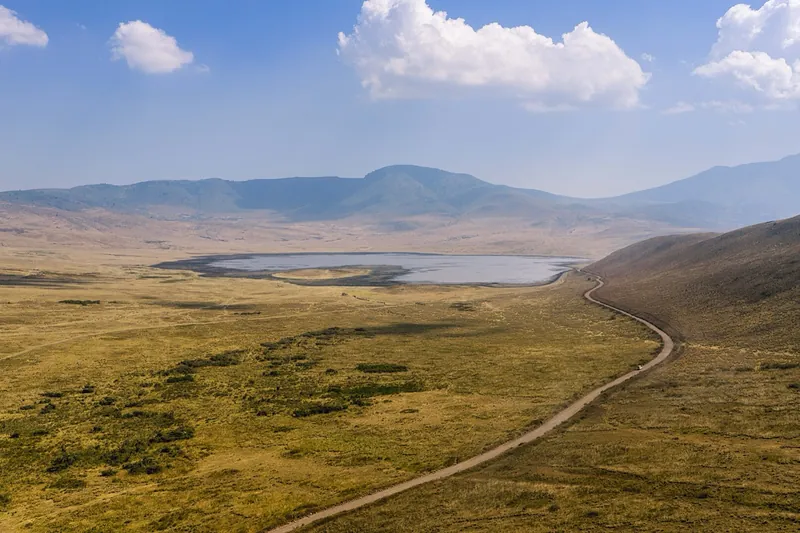
Road winding down into the Ngorongoro Crater and its lake. Arnold Tibaijuka, Wikimedia Commons, CC BY-SA 4.0, cropped 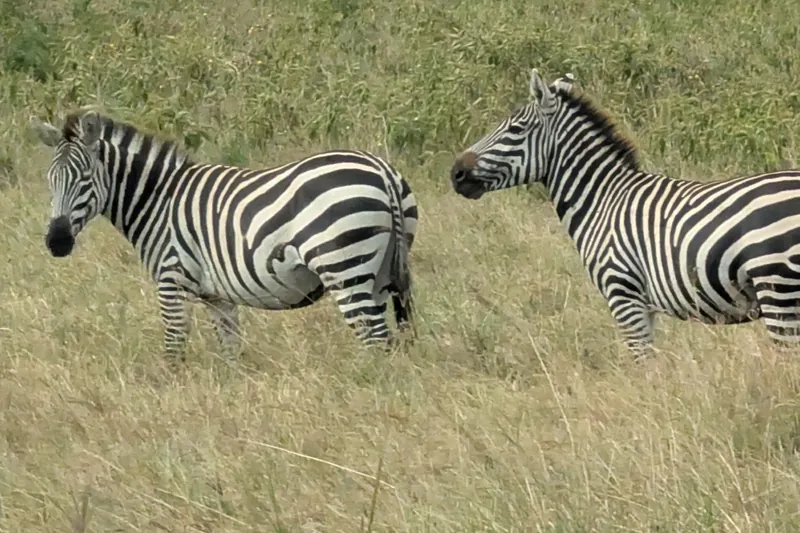
Plains zebra in the Ngorongoro Conservation Area. Christine Stone, iNaturalist, CC0 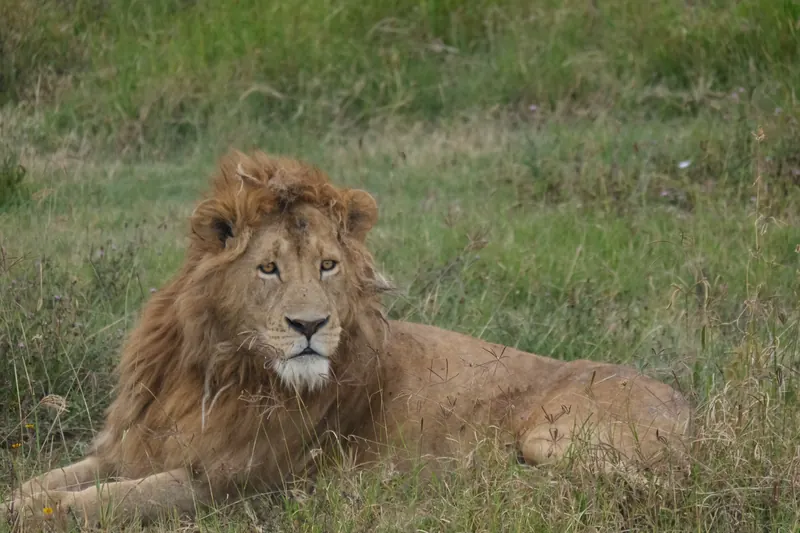
Male lion resting in the grass, Ngorongoro. Jack Christmas, iNaturalist, CC0 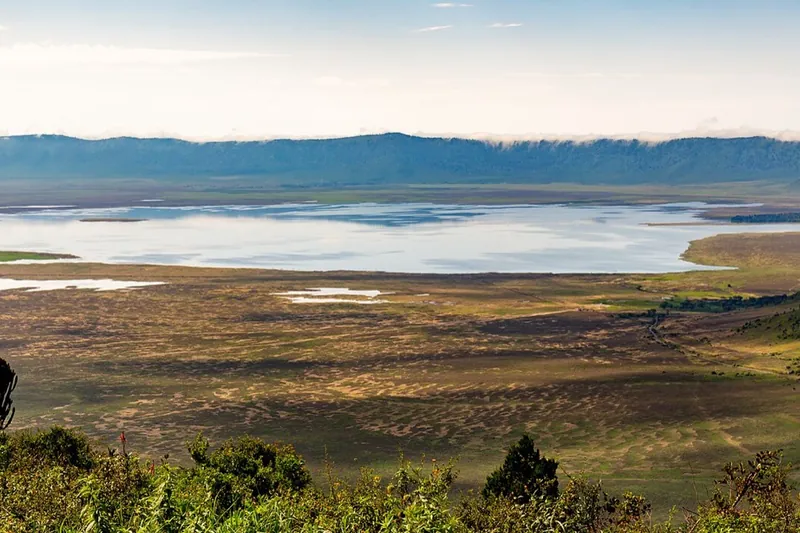
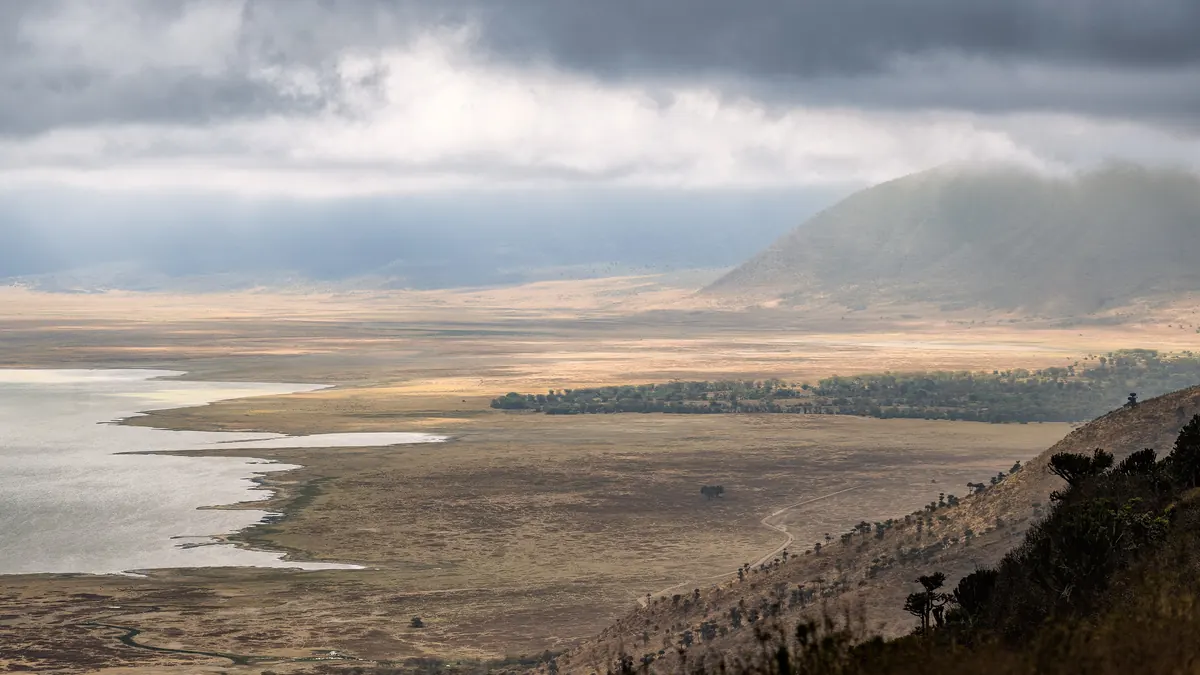
Ngorongoro Crater floor and lake seen from the rim. Diego Delso, Wikimedia Commons, CC BY-SA 4.0, cropped 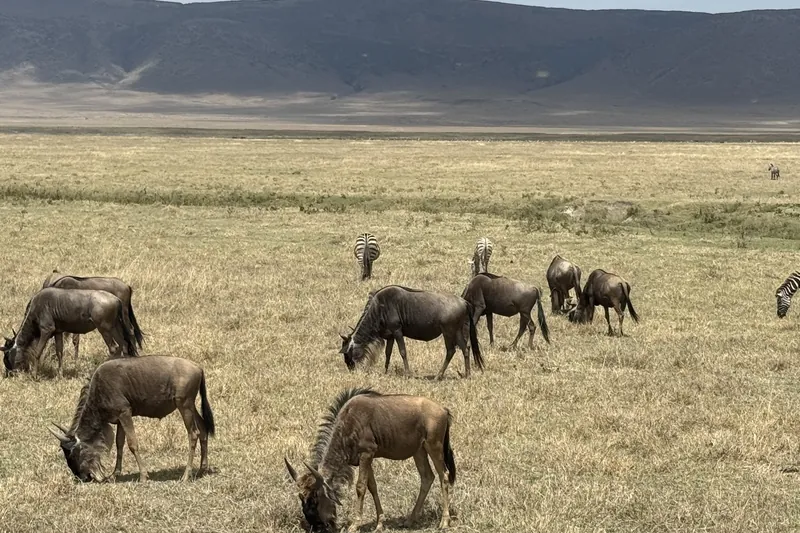
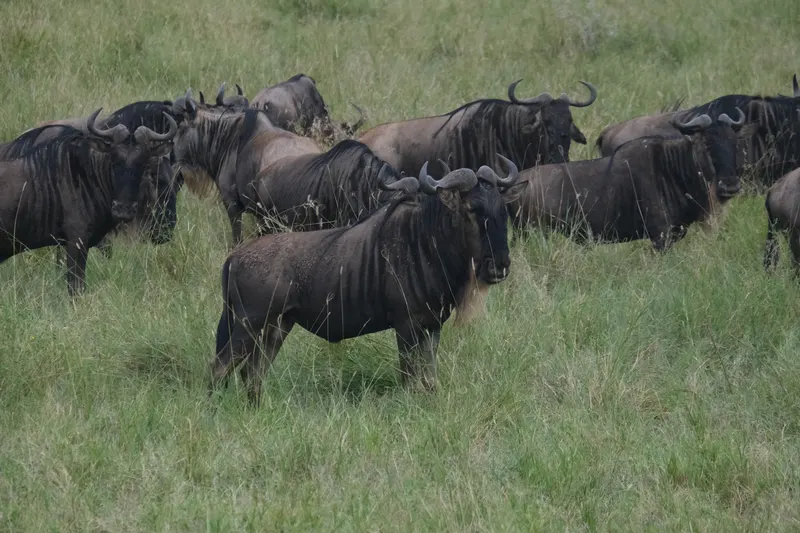
Blue wildebeest in the Ngorongoro Conservation Area. Nicole Kearney, iNaturalist, CC BY 4.0, cropped 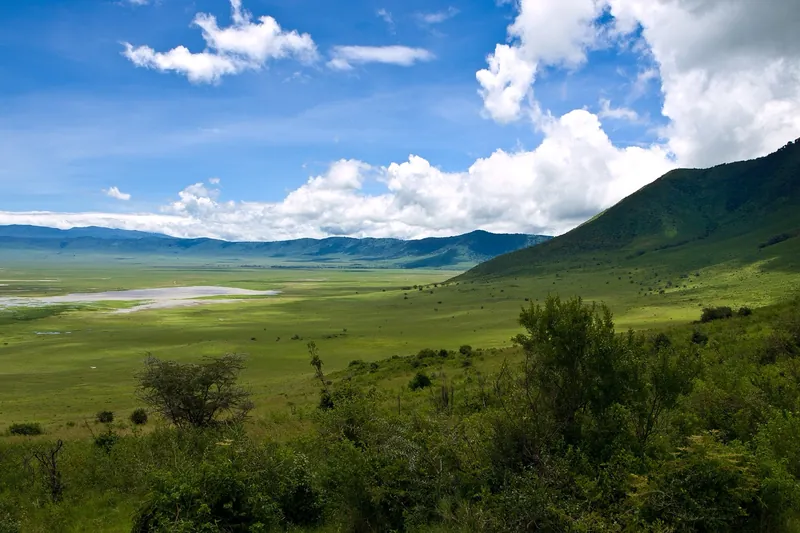
Green crater floor below the Ngorongoro rim. William Warby, Wikimedia Commons, CC BY 2.0, cropped 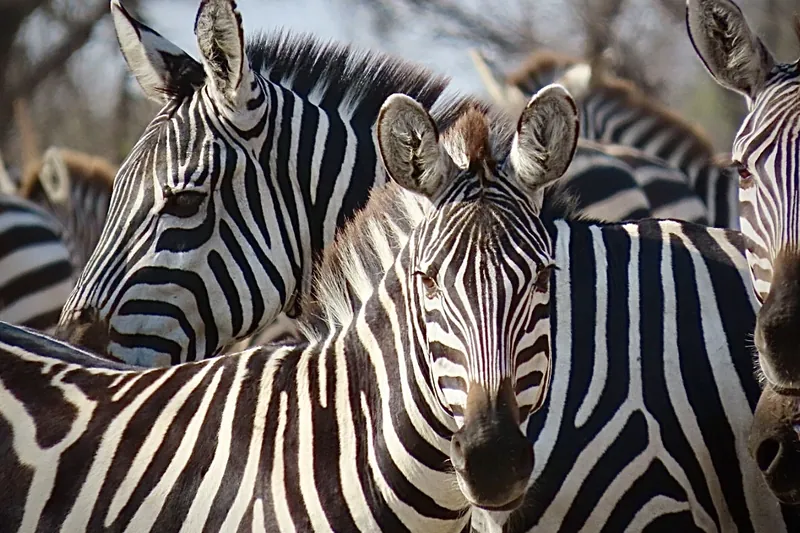
Plains zebra in the Ngorongoro Conservation Area. Irene, iNaturalist, CC0 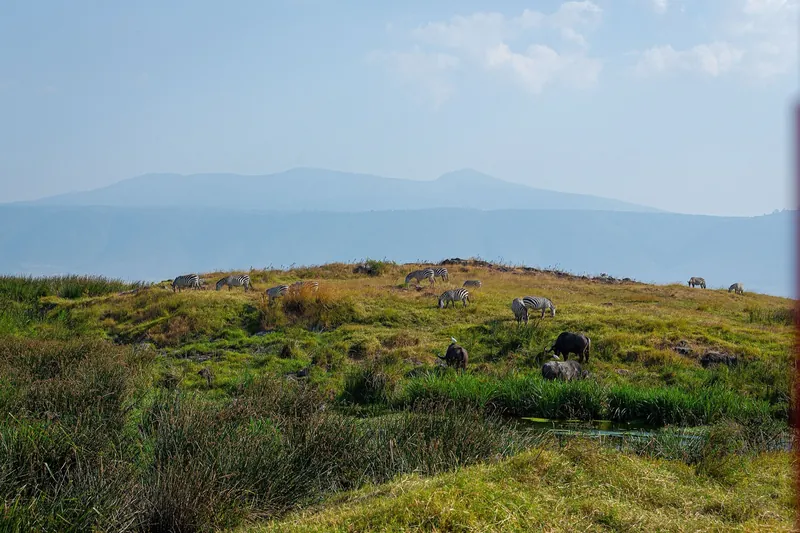
Zebras and buffalo grazing in the Ngorongoro Crater. Rasheedhrasheed, Wikimedia Commons, CC BY-SA 4.0, cropped 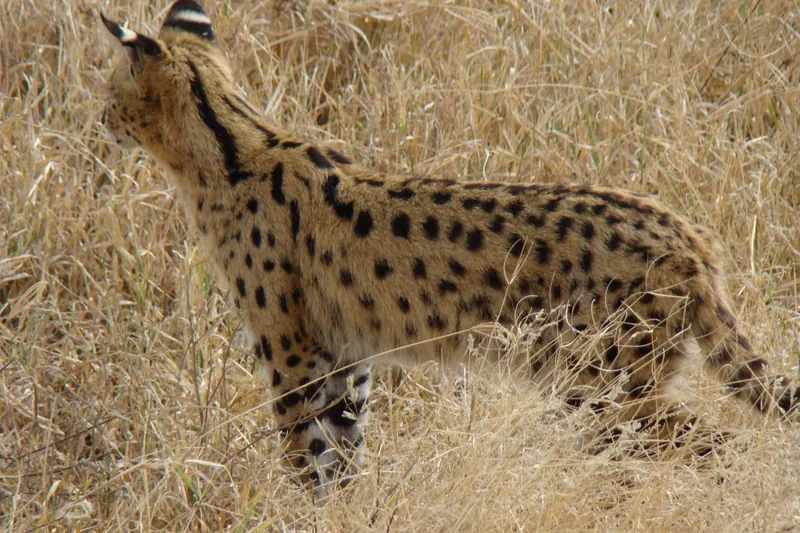
Serval stalking through dry grass in the Ngorongoro Conservation Area. Jean-Paul Boerekamps, iNaturalist, CC0


Photos by visitors and photographers, used under their free licences. Click a name to see the original.
Ask for a quote
Tell us your dates and we send you a priced itinerary. Free, no obligation.
- Free quote, no obligation
- Trips run by licensed local operators