 Experience

Last verified · Next check due
On this page
- July country by country
- Kenya: the Mara fee doubles, the herds arrive late in the month
- Tanzania: the northern Serengeti and the first crossings
- South Africa: Kruger’s dry winter
- Botswana: the Okavango near its flood peak
- Namibia: cold dawns, dry waterholes, high season
- Zambia and Zimbabwe: every camp open, peak rates from July
- Uganda and Rwanda: dry trails, full-price permits
- July park fees
- When peak rates start, camp by camp
- Package prices in July
- Worked examples: what 1 July does to the bill (our sums)
- Cold, rain and malaria in July
- How far ahead to book July
- Common mistakes about a July safari
- Frequently asked questions
- Sources
Short answer: Go to the northern Serengeti for the first Mara River crossings, or to Botswana, Zambia, Zimbabwe and Namibia for dry-season game; the Okavango is near its flood peak. July is peak season: on 1 July the Masai Mara fee doubles to US$200 a day and Governors’ Camp rises from US$623 to US$998 a night. Uganda’s gorilla permit is US$800. Windhoek’s July nights average 7.2 °C. Kruger is R692 (R602 until 31 October 2026).
Key facts
- The Mara River crossings begin in July, and early in the month the herds are usually in Tanzania. A camp operator’s calendar has only the lead herds at Kogatende, in the northern Serengeti, in July; the crossing season runs July–October, busiest in August–September (Great Migration month by month). In 2026 the first crossings were reported in the second week of July (TripAdvisor forum, traveller report). Where to watch: Great Migration river crossings.
- Peak rates start on 1 July at most camps we checked in Kenya, the northern Serengeti, Zambia and Namibia. Lemala Mara Tented Camp goes from US$330 in June to US$825 (1 July–30 September 2026); Botswana’s top camps switch earlier, in May or June (2024–2026 rate cards).
- The Masai Mara reserve fee is US$200 per adult per day from 1 July, against US$100 to 30 June (Narok County FY2025/26, the last published schedule). Serengeti fees rise to US$153.40 a night inside the park in July–September (last published tariff, 2023/24).
- July is full price for gorillas: Uganda’s permit is US$800 (US$600 only in April, May and November) and Rwanda’s US$1,500, with no discount, which runs November–May (UWA letter TDO 93/04, PDF; RDB).
- It is winter in southern Africa. Windhoek averages 7.2 °C on July nights and Etosha 8 °C (Climates to Travel, an aggregator); one operator says late-July nights in Hwange “can fall to freezing”. Kruger’s gates close at 17:30 from May to July.
- Kruger’s fee is R692 (R602 until 31 October 2026), so a July 2027 trip falls under the R692 schedule, which runs to 31 October 2027 (SANParks 2026/27, PDF).
July country by country
July suits the northern Serengeti, the Okavango Delta, Hwange, South Luangwa, Etosha and the gorilla parks; it is the most expensive month to start a trip in most of them, and the coldest in southern Africa. The whole year is on best time for a safari, the month after on safari in August, and the other end of the year on safari in December; this table covers July only.
| Country | Weather in July | Wildlife in July | Peak rate starts (example) | Main park fee in July, per adult |
|---|---|---|---|---|
| Kenya (Masai Mara, Amboseli) | Driest month: Mara 60 mm, Amboseli 5 mm; Mara nights 11–13 °C | First herds arrive in the Mara from mid or late month | Governors’ and Kicheche 1 July (US$623 → 998; US$625 → 995) | Mara reserve US$200 a day (1 July–31 December); Amboseli US$90 per 24 h |
| Tanzania (northern Serengeti) | Driest month: Serengeti 15 mm | Lead herds at Kogatende; Mara River crossings begin | Lemala Mara Tented Camp 1 July (US$330 → 825); Singita Grumeti 16 May | Serengeti US$153.40 a night inside (July–September) |
| South Africa (Kruger) | Dry season, April–September; winter nights | “Easiest time to see animals” (SANParks) | SANParks’ high season is the December holidays; Eastern Cape lodges are cheapest in winter | R692 (R602 until 31 October 2026) |
| Botswana (Okavango, Chobe) | Dry season; no rain since March | Delta near its flood peak; zebra on the Chobe floodplains | Machaba 1 May; Mombo June; Duba Plains 15 June; Kwando 1 July | Chobe, Moremi P270 a day (last published, 2022); P380 and P500 reported since |
| Namibia (Etosha, Sossusvlei) | Tsumeb 0 mm; Windhoek nights 7.2 °C | Game at Etosha’s waterholes, “very good” | NWR high season 1 July (Sossus Dune Lodge N$4,030 → 7,000) | N$280 per foreign adult, no seasons |
| Zambia (South Luangwa) | Cool dry season, June–August | All bush camps open; walking season | Nsefu, Chinzombo, The Bushcamp Company 1 July | South Luangwa US$25 a day |
| Zimbabwe (Hwange, Mana Pools, Victoria Falls) | Late-July nights “can fall to freezing” in Hwange (one operator) | Hwange’s best months start; Falls at full curtain with less spray | Camp Hwange July (US$724 → 1,080); Victoria Falls hotels high from 1 July | Hwange US$24 day visitor, US$12 staying inside; Mana Pools US$24 |
| Uganda (Bwindi) | Dry season, June–September; June–July Bwindi’s coldest months | Gorilla trekking, rated “Excellent” | Buhoma Lodge July (US$455 → 535) | Gorilla permit US$800 |
| Rwanda (Volcanoes) | Dry season, June–September | Gorilla trekking | Park-run lodges and Singita Kwitonda 1 June | Permit US$1,500; no discount in July |
Typical year, not a forecast; camp rates per person sharing per night, 2024–2026 cards, read September–October 2026. Rain and temperature: Climates to Travel (Masai Mara, Amboseli; Tanzania; Namibia), an aggregator. Herds: a camp operator’s migration guide. Fees: Narok County FY2025/26 and TANAPA, last published tariff, 2023/24; KWS LN 160/2025; SANParks 2025/26 and 2026/27; DWNP via Tourism Update (1 April 2022); Government Notice 115 of 2026; DNPW 2025 schedule; ZimParks Tariff 2026; UWA; RDB. Each rate card is linked in the sections below.
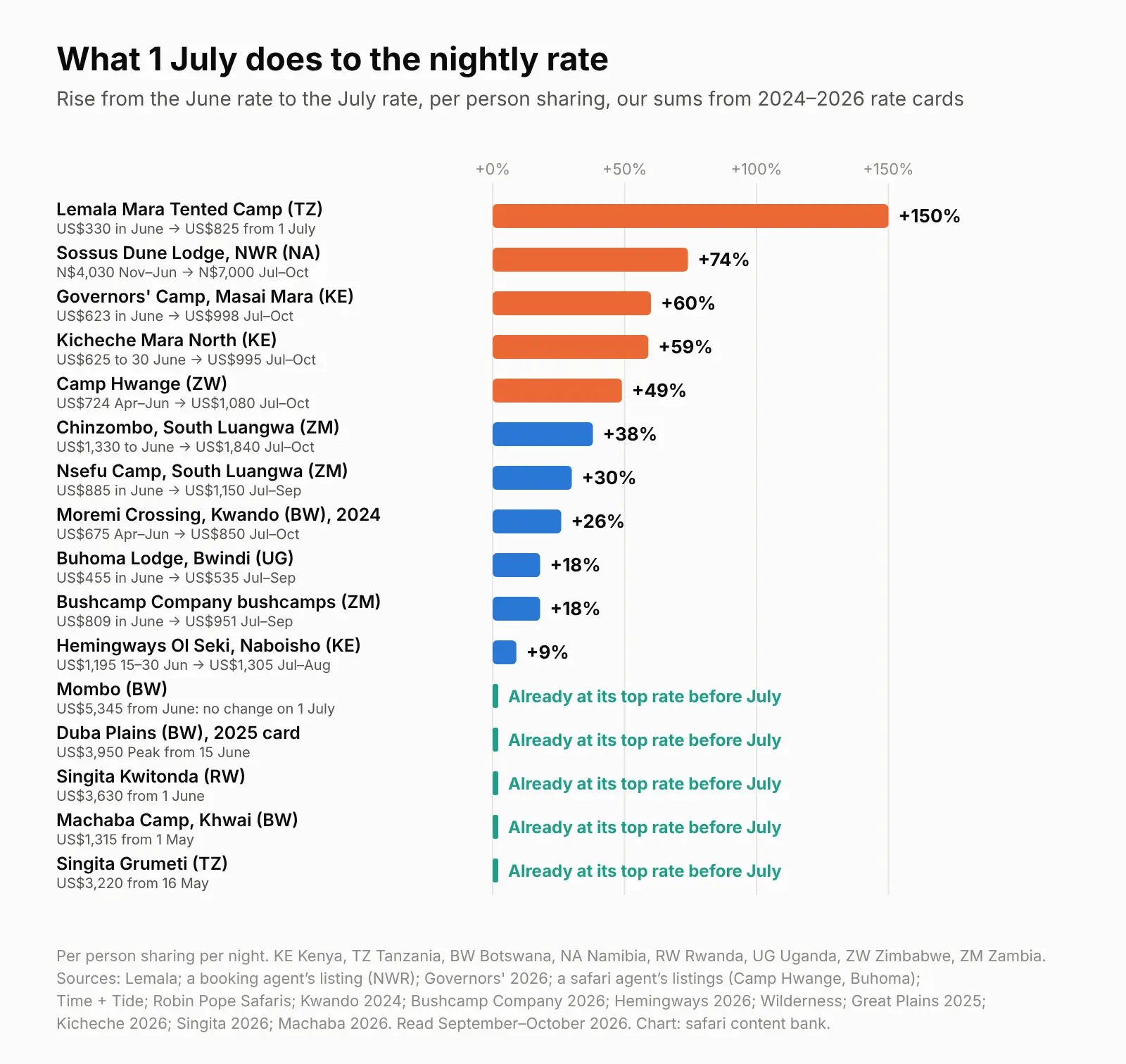 Our sums from each camp’s published rate card or agent listing (2024–2026), read September–October 2026. Chart: safari content bank.
Kenya: the Mara fee doubles, the herds arrive late in the month
Kenya in July means the driest weather of the year, the full US$200 Mara reserve fee from 1 July and peak camp rates, while most of the herds reach the Mara only from mid or late July.
- Where the herds are: in early and mid-July most of them are usually still in the northern Serengeti; a camp operator’s pattern has them in the Mara from mid or late July, with most animals there in August and September (Masai Mara). A destination expert on the TripAdvisor Serengeti forum: “Most years you would not find the migration in the Masai Mara as early as July 11-15” (traveller forum, April 2026). In 2026 the first crossings were reported in the second week of July (TripAdvisor Masai Mara forum, traveller reports).
- The Mara fee doubles on 1 July on the last published schedule: US$100 per non-resident adult per day from 1 January to 30 June, US$200 from 1 July to 31 December (Narok County FY2025/26). That schedule expired on 30 June 2026 and no 2026/27 schedule had been published by 9 October 2026; for July–December 2026, The Kenya Times (6 August 2026, a secondary source) reports US$200 still applies. Check the fee for July 2027 before you book. Detail: Masai Mara park fees.
- Camps switch to peak on 1 July: Governors’ Camp charges US$623 per person a night in June and US$998 from July to October, and its exclusive vehicle rises from US$385 to US$512 a day (Governors’ 2026, PDF). Kicheche Mara North goes from US$625 (23 May–30 June) to US$995 (July–October) (Kicheche 2026, PDF); Hemingways Ol Seki charges US$1,305 in July–August (Hemingways 2026, PDF).
- A conservancy night costs less in fees than a reserve day: US$130 per adult per night in a Mara conservancy against US$200 a day in the reserve; a conservancy guest pays the reserve fee only for a day spent in the reserve, such as a crossing day (Mara reserve vs conservancies).
- Weather: July is the Mara’s driest month but not dry, at 60 mm; nights are 11–13 °C in every month (Climates to Travel, an aggregator). A forum regular warns that in July “temperatures can get down to single figures (centigrade), particularly night/early mornings – there’s no heating” (Kenya safari questions). Amboseli averages 5 mm in July, 24 °C by day and 14 °C at night, and Ol Tukai Lodge charges its peak US$325 from June to October (Amboseli).
- KWS parks have no seasons: Amboseli and Lake Nakuru charge US$90 per non-resident adult per 24 hours, US$45 for a child under 18, 5 and under free (KWS Legal Notice 160 of 2025).
- Entry: the eTA costs US$30, and since 5 October 2026 (U.S. Embassy Nairobi) arrivals have needed a government health policy, up to US$44 (eCitizen) (Kenya visitor insurance).
Full costs: Kenya safari cost, Masai Mara safari cost; the country hub: Kenya.
Tanzania: the northern Serengeti and the first crossings
Tanzania is the better bet for the herds in early and mid-July: the lead herds reach Kogatende in the northern Serengeti, the Mara River crossings begin, and the far-north camps switch to peak rates on 1 July.
- Where the herds are: a camp operator’s calendar has the lead herds at Kogatende in July, with the Mara River and Sand River crossings beginning; base in the northern Serengeti (Kogatende, Lamai) in the first half of the month (a camp operator’s migration guide; Great Migration month by month). The Western Corridor is best from May to July (Serengeti). No one can date or guarantee a crossing: “No one can guarantee river crossing sightings on the Mara River”, every reply agreed in a July 2026 forum thread (TripAdvisor, traveller reports).
- Park fees rise on 1 July: the concession fee for a night inside the Serengeti goes from US$59 to US$70.80 for July–September, so entry and concession come to US$153.40 per adult a night against US$141.60 in June (last published tariff, 2023/24). Detail: Serengeti park fees.
- Camp rates on the Mara River jump on 1 July: Lemala Mara Tented Camp, open June–October, charges US$330 per person a night in June and US$825 from 1 July to 30 September 2026, guide and vehicle extra (Lemala rates). Sayari is listed at US$2,250 from 1 July to 31 October (a safari agent’s listing). In Seronera, Lemala Ewanjan charges US$595 from 1 July to 30 September 2026. In the Grumeti reserve, outside the park, Singita’s camps are already at US$3,220 from 16 May (Serengeti).
- Mara–Serengeti by air: the Safarilink and Coastal Aviation link via Migori and Tarime runs from 1 July to 31 October (and 16 December–31 March), and on request with at least 4 passengers at other times; the road border between the parks has been closed since 1977 (Mara to Serengeti).
- Weather and queues: July is the Serengeti’s driest month, 15 mm, and nights are 14–16 °C all year (Climates to Travel, an aggregator). A self-drive operator’s guide says to allow about 30 minutes at the Ngorongoro gate and 30 at the Serengeti gate in July–September (Mara to Serengeti).
- Ngorongoro on the way: Ngorongoro Conservation Area entry is US$70.80 per adult per 24 hours and the crater descent US$295 per vehicle, with no seasons (NCAA, read 9 October 2026). Tarangire charges its peak US$59 a day (last published tariff, 2023/24).
- Entry: a tourist visa costs US$50 (US citizens US$100), and mainland Tanzania’s government travel insurance costs US$44 per adult as of October 2026, for foreign visitors except EAC and SADC residents (Tanzania visitor insurance).
Full costs: Tanzania safari cost, Great Migration safari cost; hubs: Tanzania, Serengeti, Ngorongoro.
South Africa: Kruger’s dry winter
Kruger in July is dry and cold at night: the fee is R692 in July 2027 (R602 in July 2026), and the gates shut at 17:30.
- Season: April to September is Kruger’s dry season and “the easiest time to see animals” (SANParks climate). Traffic at sightings is heaviest in the far south during South Africa’s mid-year school holidays (Kruger); a July 2026 TripAdvisor poster gave 26 June–20 July 2027 for them, a poster’s dates, not an official calendar (South Africa safari questions).
- The fee: Kruger’s daily conservation fee for an international adult is R692 (R602 until 31 October 2026); children aged 2–11 pay R345 (R300 until 31 October 2026) (SANParks 2025/26, PDF; 2026/27, PDF). The 2026/27 schedule runs to 31 October 2027, so July 2027 costs R692 a day. Detail: Kruger park fees.
- Short days: entrance gates open at 06:00 and close at 17:30 from May to July, 11.5 hours, and late arrivals are turned away (SANParks gates; South Africa safari questions).
- Cold: a July 2026 TripAdvisor thread reports safari tents at about 5 °C on winter nights, and forum regulars warn that morning drives in open vehicles are very cold (traveller reports; South Africa safari questions).
- Winter rates go both ways: in the Eastern Cape, winter is the cheap season: Kwandwe charges R17,930 per person sharing from 1 May to 30 September 2026 against R26,180 from 1 October (Kwandwe 2026–27, PDF), and Amakhala’s lowest season is 1 May–31 July 2027, from R5,290 (malaria-free safaris). In the Sabi Sand, Singita Ebony charges R60,470 per person from 1 June to 31 August against R51,665 (+17%; rate page undated; Kruger safari cost).
- Entry: UK and US passport holders need no visa for up to 90 days, and since 1 July 2026 every arrival and departure needs an online traveller declaration (UK FCDO; South Africa safari cost).
Full costs: South Africa safari cost, Kruger safari cost; hubs: South Africa, Kruger.
Botswana: the Okavango near its flood peak
Botswana in July is dry-season high water: the Okavango flood is near its peak and the flooded area is at its largest from July, game gathers at the remaining water, and every camp we checked is at its top rate.
- The flood: the Delta’s water is highest from about May to August (a UK safari operator’s guide), UNESCO puts the peak around June–July (UNESCO), and the largest flooded area comes in July–September (IntechOpen review). Boats run at seasonal-floodplain camps from about late May to September (a Botswana camp operator’s seasonal guide). Month by month: Okavango flood calendar; camp types: Okavango water vs land camps.
- Game: June to October is best “because animals gather at the remaining water” (a camp operator’s best-time guide for Botswana). More than 20,000 zebra spend June to early November on the Chobe and Zambezi floodplains (Africa Geographic), and wild dog pups emerge around June (one operator’s Botswana guide).
- Top rates: Mombo charges US$5,345 from June to October (Wilderness, Mombo); Duba Plains its Peak US$3,950 from 15 June (Great Plains 2025, PDF); Machaba Camp US$1,315 from 1 May to 31 October 2026 (Machaba 2026). Kwando calls July–October its “Flood” season: Moremi Crossing goes from US$675 (April–June) to US$850, and Kwara is US$2,100 (Kwando 2024, PDF). On the Chobe riverfront every operator in our sources charges its top rate from July to October (Chobe).
- Book early: “Bookings should be done a year in advance”, Tracks4Africa says of park campsites, and in a July 2026 forum thread mid-range camps had “hardly any space” in peak season (Botswana safari questions).
- Park fees: no official current tariff. The last published DWNP schedule (1 April 2022) charges P270 per non-resident adult a day in Chobe and Moremi and P190 in Nxai Pan, the Makgadikgadi and the Central Kalahari; in February 2026 the government news agency called the existing fee P380, and a P500 rise was announced, then reported postponed (Botswana park fees). Fly-in camp rates usually include park fees.
- Weather and malaria: July is in the dry season; Botswana’s rains fall from November to March (two camp operators’ seasonal guides), and our sources hold no July temperature for Botswana. TravelHealthPro rates the north, including the Okavango and Chobe, low risk from June to September, with bite avoidance only (Botswana safari questions).
Full costs: Botswana safari cost, Okavango Delta safari cost; hubs: Botswana, Okavango Delta, Chobe, Moremi.
Namibia: cold dawns, dry waterholes, high season
Namibia in July is dry and cold at night: Etosha’s game is at the waterholes, NWR’s high season starts on 1 July, and rental 4x4s cost most from July to October.
- Weather: Tsumeb, near Etosha, records 0 mm of rain from June to September, with lows of 8 °C and highs of 27 °C in July–August, “cold dawns” (Etosha). Windhoek averages 22.8 °C by day and 7.2 °C at night in July, and pre-dawn temperatures at altitude and in the desert approach freezing (Climates to Travel, an aggregator). Swakopmund’s daytime high is 16–21 °C in every month (Namibia safari questions).
- Game: July–August is “very good” at Etosha as game concentrates on the waterholes; September and October are the peak (Etosha). Okaukuejo’s gates open latest in July, at 07:30 (a safari agent’s Etosha guide).
- Rates: NWR’s high season runs July–October: Sossus Dune Lodge goes from N$4,030 to N$7,000 per person, dinner, bed and breakfast (NWR rates from a booking agent’s listing, read September 2026). Etosha Mountain Lodge in Etosha Heights charges N$10,795 per person in July–August against N$7,325 in the green season, park entry fees included, plus a N$650 reserve fee a night (Natural Selection Namibia 2026, PDF). One Namibian rental firm’s camping double cab costs N$3,880 a day in high season against N$2,910 in low season (Namibia safari cost).
- Book early: forum regulars advise booking NWR’s Etosha camps 6–12 months ahead for July–September (TripAdvisor Etosha forum, traveller reports).
- Fees: N$280 per foreign adult at Etosha, Sossusvlei and the other Tier 1 parks, with no seasons (Government Notice 115 of 2026; Namibia park fees).
- Malaria: in 2026 prophylaxis advice was extended to cover June–August in Namibia’s seasonal-risk regions; Etosha is at the edge of that zone, and the Zambezi Region has year-round high risk (HealthyTravel / Swiss TPH; Namibia safari questions).
Full costs: Namibia safari cost; hubs: Namibia, Etosha, Sossusvlei.
Zambia and Zimbabwe: every camp open, peak rates from July
Zambia and Zimbabwe are at their dry-season best in July: South Luangwa’s bush camps and Mana Pools’ camps are open, Hwange’s best months begin, and Victoria Falls shows a full curtain with less spray. Nights are cold.
- South Luangwa: all camps are open from June, and July–August is high season with peak rates from 1 July (South Luangwa). Nsefu Camp goes from US$885 in June to US$1,150 in July–September (Robin Pope Safaris, page undated); The Bushcamp Company’s bushcamps from US$809 to US$951 (2026); and Chinzombo from US$1,330 to US$1,840 for July–October (Time + Tide). One safari operator calls June–August the cool dry season (Zambia safari questions), and June brings ideal walking and nights of about 10 °C (South Luangwa).
- Elsewhere in Zambia: most Busanga Plains camps in Kafue are open June to the end of October, and Remote Africa’s North Luangwa camps 15 June–31 October (Zambia safari questions). Fees: South Luangwa US$25 per international adult a day (DNPW 2025 schedule, the last published); camps bill US$90–110 a night in fees and levies (Zambia safari cost).
- Hwange: July to October is Hwange’s best period, when game gathers at the pumped waterholes, and “late July and early August nights can fall to freezing” (one operator’s Hwange guide; Hwange). Every camp in our sources charges its top rate from July to October: Camp Hwange US$1,080 against US$724 in April–June (a safari agent’s listing), Verney’s Camp US$1,250 (June–October) and Bomani Tented Lodge US$670 (May–October). Hwange’s conservation fee is US$24 a day for a day visitor and US$12 staying inside the park (ZimParks Tariff 2026).
- Mana Pools: best from June to October, with camps open from about April to November (one operator’s Mana Pools guide); Kanga Camp charges US$930 from June to October 2026 (Zimbabwe safari cost). Conservation fee US$24 a day (ZimParks Tariff 2026).
- Victoria Falls in July: June–August brings a “full curtain” with less spray, “the best balance of volume and visibility” (a safari agent’s guide to the Falls); hotels switch to high season on 1 July (a Victoria Falls booking agent), and Devil’s Pool opens only at low water, broadly from late August (Victoria Falls). Entry on the Zimbabwe side is US$58 per international adult (ZimParks Tariff 2026).
- Malaria: one UK safari operator says malaria is present across Zambia and all year in the valleys; a Zimbabwe travel site puts the highest risk in the Zambezi Valley and Victoria Falls from November to May. We have read no official source for either country (Zambia safari questions, Zimbabwe safari questions).
Full costs: Zambia safari cost, Zimbabwe safari cost, Victoria Falls safari cost; hubs: South Luangwa, Hwange, Victoria Falls.
Uganda and Rwanda: dry trails, full-price permits
July is in the main dry season in both countries, and it is full price: Uganda’s permit is US$800, Rwanda’s US$1,500 with no discount, and peak permits sell out months ahead.
- Uganda: the drier months are about June–September and December–February (one operator’s guide), and a safari booking site rates Bwindi “Excellent” in June and July (Bwindi). The gorilla permit costs US$800 in July; the US$600 low-season permit applies only in April, May and November (UWA letter TDO 93/04, PDF), and UWA confirms US$800 again from 1 January 2027. Buhoma Lodge charges US$535 per person a night in July–September against US$455 in June (a safari agent’s listing).
- Cold in the forest: Bwindi’s temperatures range from about 7 °C to 20 °C, and June–July are its coldest months (UWA Bwindi brochure, PDF).
- Book six months or more ahead for July and August, as one Uganda-based operator advises. A traveller who tried four months before an August 2026 trip was told peak permits were probably gone and went without seeing gorillas (Uganda safari questions, traveller report). Since 1 March 2026 a permit is held only against full payment (Bwindi).
- Rwanda: June–September is the dry season (Volcanoes). The permit is US$1,500; the 30% discount, to US$1,050, runs only from November to May with a stay in Akagera or Nyungwe (RDB). Park-run lodges are in high season from 1 June to 30 September: Ruzizi Tented Lodge charges US$258 (Ruzizi 2026–2027, PDF), and Singita Kwitonda US$3,630 per adult a night from 1 June to 31 October 2026 (Singita 2026, PDF).
- Malaria: the WHO lists malaria risk all year in the whole of Rwanda; we have read no official malaria source for Uganda (Rwanda safari questions, Uganda safari questions).
Full costs: Uganda safari cost, Rwanda safari cost, gorilla permit prices; hubs: Bwindi, Volcanoes.
July park fees
Two government fees rise on 1 July: the Masai Mara reserve fee doubles and the Serengeti concession fee goes up by US$11.80 a night. Kruger’s July 2027 fee is R692 (R602 in July 2026); everything else charges its normal, or only, rate.
| Park or permit | Fee per adult in July | Changes around July | Status and source |
|---|---|---|---|
| Maasai Mara National Reserve (Kenya), per day | US$200 (1 July–31 December) | US$100 to 30 June on the last published schedule | Narok County FY2025/26, the last published; expired 30 June 2026 |
| Amboseli, Lake Nakuru (KWS), per 24 h | US$90; child under 18, 5 and under free, US$45 | No seasons | KWS Legal Notice 160 of 2025 |
| Serengeti (Tanzania), a night inside the park | US$153.40 (entry US$82.60 + concession US$70.80) | US$141.60 to 30 June and from 1 October | Last published tariff, 2023/24 |
| Ngorongoro Conservation Area | US$70.80 entry per 24 h; crater US$295 per vehicle | No seasons | NCAA tariffs page, undated, read 9 October 2026 |
| Tarangire, Lake Manyara, Arusha (Tanzania), per day | US$59 | Low fee (US$53.10) only 15 March–15 May | Last published tariff, 2023/24 |
| Kruger National Park (South Africa), per day | R692 in July 2027 (R602 in July 2026) | R692 (R602 until 31 October 2026) | SANParks 2025/26 and 2026/27 schedules |
| Chobe, Moremi (Botswana), per day | P270 (last published, 2022) | P380 called existing by BOPA; P500 reported postponed | DWNP via Tourism Update; no official current tariff |
| Etosha, Sossusvlei (Namibia) | N$280 | No seasons | Government Notice 115 of 2026 |
| South Luangwa (Zambia), per day | US$25 | No seasons | DNPW 2025 schedule, the last published |
| Hwange; Mana Pools (Zimbabwe), per day | Hwange US$24 day visitor, US$12 staying inside; Mana Pools US$24 | No seasons | ZimParks Tariff 2026 |
| Victoria Falls Rainforest (Zimbabwe side), per entry | US$58 | No seasons | ZimParks Tariff 2026 |
| Uganda gorilla permit | US$800 | US$600 only in April, May and November | UWA letter TDO 93/04, 26 February 2026 |
| Rwanda gorilla permit | US$1,500 | Discount (US$1,050, our sum) only November–May | RDB, checked 9 October 2026 |
Fees copied from our Kenya, Tanzania, Botswana, Namibia, South Africa, Zambia, Zimbabwe, Uganda and Rwanda cost pages, read 17 October 2026. The Serengeti and Mara fees by date are charted on Great Migration month by month.
The official fee lines, with the date each took effect and the authority’s own source:
| Fee | Amount | In force from | Source |
|---|---|---|---|
| Maasai Mara National Reserve, non-resident adult, per day (12-hour ticket, 06:00–18:00), 1 Jul–31 Dec | USD 200 | Since 1 Jul 2024; Narok County FY2025/26 schedule, the last published, expired 30 Jun 2026 (no 2026/27 schedule as of 9 Oct 2026); The Kenya Times (6 Aug 2026, secondary) reports US$200 still applies for Jul–Dec 2026 | Narok County fee schedule FY2025/26 |
| Amboseli and Lake Nakuru National Parks (KWS), non-resident adult, per 24 hours | USD 90 (child under 18, 5 and under free, USD 45) | Legal Notice 160 of 2025, gazetted 22 Sep 2025, which states no start date; in force 1 Oct 2025 per the KWS press release of 29 Sep 2025 | KWS Fees Regulations 2025 (LN 160/2025) |
| Serengeti and Nyerere National Parks, non-East African adult, entry per day, 16 May–14 Mar | USD 70 + 18% VAT = USD 82.60 | 1 Jul 2023 (2023/24 tariff, last published) | TANAPA Tariffs 2023/24 |
| Serengeti and Nyerere, concession fee per person per night inside the park | Jul–Sep USD 60 + VAT = USD 70.80; Oct–Jun USD 50 + VAT = USD 59 | 1 Jul 2023 (2023/24 tariff, last published) | TANAPA Tariffs 2023/24 |
| Tarangire, Lake Manyara and Arusha National Parks, non-East African adult, entry per day | Peak USD 50 + VAT = USD 59; low USD 45 + VAT = USD 53.10 | 1 Jul 2023 (2023/24 tariff, last published) | TANAPA Tariffs 2023/24 |
| Ngorongoro Conservation Area, non-East African adult, entry per 24 h (single entry) | USD 70.80 (NCAA's page does not say whether VAT is included) | Undated official page, read 9 Oct 2026 | NCAA |
| Ngorongoro Crater descent (crater service fee), per vehicle | USD 295 (NCAA's page does not say whether VAT is included) | Undated official page, read 9 Oct 2026 | NCAA |
| Chobe National Park and Moremi Game Reserve (DWNP), non-resident adult, per person per day | BWP 270 (SADC residents BWP 205; Botswana citizens and residents BWP 30) | Last published DWNP schedule, 1 April 2022 (via Tourism Update). In Feb 2026 the government news agency BOPA called the existing non-resident fee P380; a P500 rise was announced, then reported postponed. No official current tariff: confirm with DWNP or your operator | Tourism Update, 23 Feb 2022 (DWNP fee schedule) |
| Other DWNP parks and reserves (Central Kalahari Game Reserve, Khutse, Nxai Pan, Makgadikgadi Pans), non-resident adult, per person per day | BWP 190 (SADC residents BWP 145; Botswana citizens and residents BWP 20) | Last published DWNP schedule, 1 April 2022 (via Tourism Update). In Feb 2026 the government news agency BOPA called the existing non-resident fee P380; a P500 rise was announced, then reported postponed. No official current tariff: confirm with DWNP or your operator | Tourism Update, 23 Feb 2022 (DWNP fee schedule) |
| Tier 1 parks (Etosha, Namib-Naukluft including Sossusvlei, Skeleton Coast, Ai-Ais/Fish River Canyon, Waterberg Plateau, Cape Cross, Dorob, Tsau //Khaeb), foreign adult 16+, per person | NAD 280 (NAD 140 park entrance + NAD 140 conservation fee) | 1 Apr 2026 (Government Notice 115 of 2026; the notice prices fees per person with no period; MEFT's 2021 schedule made fees valid for 24 hours from entry); was NAD 150 under the 2021 schedule | Government Gazette 8877 (Government Notice 115 of 2026), hosted by the Legal Assistance Centre |
| Kruger National Park daily conservation fee, international adult (12+), per day | ZAR 602 | 1 Nov 2025 to 31 Oct 2026 (SANParks 2025/26 schedule) | SANParks daily conservation fees 2025/26 |
| Kruger National Park daily conservation fee, international adult (12+), per day | ZAR 692 | 1 Nov 2026 to 31 Oct 2027 (SANParks 2026/27 schedule, already published) | SANParks daily conservation fees 2026/27 |
| South Luangwa and Lower Zambezi National Parks (DNPW Category A), international adult, entry per day (06:00–18:00) | USD 25 (SADC and resident USD 20; Zambian citizen ZMW 55.60); child 5–13 half price, under 5 free | DNPW 2025 schedule ("official 2025 rates"), the last published; page last modified 8 May 2025, still shown 9 Oct 2026 | DNPW 2025 fee schedule, as shown on a Zambia travel portal |
| Hwange National Park, Main Camp (row as labelled in the ZimParks 2026 tariff), international adult, conservation fee per day | USD 24 day visitor; USD 12 if staying overnight in the park (SADC USD 18 / 10; local USD 5 / 3) | ZimParks Tariff 2026 (tariff year 2026, published February 2026); the conservation-fee table does not say whether VAT is included; Robins, Sinamatella and Kazuma Pan are not listed separately in our sources | ZimParks De-Gazetted Tariff 2026 |
| Mana Pools National Park, Sapi and Chewore, international adult, conservation fee per day | USD 24, day visitor or staying overnight (SADC USD 18; local USD 8) | ZimParks Tariff 2026 (tariff year 2026, published February 2026); the conservation-fee table does not say whether VAT is included | ZimParks De-Gazetted Tariff 2026 |
| Victoria Falls Rainforest (Zimbabwe), main gate, international adult, per entry | USD 58 (SADC USD 35; local USD 7) | ZimParks Tariff 2026 (tariff year 2026, published February 2026); the fee table does not say whether VAT is included | ZimParks De-Gazetted Tariff 2026 |
| Uganda: gorilla tracking permit, Bwindi Impenetrable and Mgahinga Gorilla NPs, foreign non-resident, per person per trek (guide and that day's park entry included) | USD 800 (foreign resident USD 700; rest of Africa USD 500; East African citizens UGX 300,000) | Since 1 Jul 2024 (UWA tariff 2024–26); confirmed unchanged from 1 Jan 2027 by UWA letter TDO 93/04 of 26 Feb 2026 | UWA letter TDO 93/04, 26 Feb 2026 |
| Rwanda: mountain gorilla tracking permit, Volcanoes NP, international visitor, per person per day | USD 1,500 | Current RDB price, checked 9 Oct 2026 | Visit Rwanda (Rwanda Development Board) |
When peak rates start, camp by camp
Most Kenyan, northern Serengeti, Zambian and Namibian camps we checked switch to their top rate on 1 July; Botswana’s and Rwanda’s top camps switch in May or June, Hwange’s camps between May and July, and South Africa’s lodges follow their own calendars. A trip that starts on 30 June can cost half as much a night as one that starts on 1 July.
| Camp or group (country) | June rate | July rate | Peak dates | Rate card |
|---|---|---|---|---|
| Lemala Mara Tented Camp, Mara River (Tanzania) | US$330 | US$825 | 1 July–30 September 2026 | Lemala |
| Governors’ Camp, Masai Mara (Kenya) | US$623 | US$998 | July–October; 21–31 December | Governors’ 2026 (PDF) |
| Kicheche Mara North (Kenya) | US$625 (23 May–30 June) | US$995 | July–October; 20 December–2 January | Kicheche 2026 (PDF) |
| Hemingways Ol Seki, Naboisho (Kenya) | US$1,195 (15–30 June) | US$1,305 | July–August; 18 December–4 January | Hemingways 2026 (PDF) |
| Singita Sabora / Faru Faru, Grumeti (Tanzania) | US$3,220 | US$3,220 | 16 May–30 September | Serengeti |
| Mombo, Moremi (Botswana) | US$5,345 | US$5,345 | June–October | Wilderness |
| Duba Plains, Great Plains (Botswana) | US$3,950 from 15 June | US$3,950 (Peak) | 15 June–31 October | Great Plains 2025 (PDF) |
| Machaba Camp, Khwai (Botswana) | US$1,315 | US$1,315 | 1 May–31 October 2026 | Machaba 2026 |
| Moremi Crossing, Kwando (Botswana) | US$675 (April–June) | US$850 (“Flood”) | July–October, 2024 card | Kwando 2024 (PDF) |
| Sossus Dune Lodge, NWR (Namibia), dinner, bed and breakfast | N$4,030 | N$7,000 | July–October | NWR rates from a booking agent’s listing |
| Nsefu Camp, South Luangwa (Zambia) | US$885 | US$1,150 | July–September | Robin Pope Safaris (page undated) |
| The Bushcamp Company bushcamps (Zambia) | US$809 | US$951 | July–September 2026 | Zambia safari cost |
| Chinzombo, South Luangwa (Zambia) | US$1,330 | US$1,840 | July–October | Time + Tide |
| Camp Hwange (Zimbabwe) | US$724 | US$1,080 | July–October 2026 | A safari agent’s listing |
| Verney’s Camp, Hwange (Zimbabwe) | US$1,250 | US$1,250 | June–October 2026 | A safari agent’s listing |
| Buhoma Lodge, Bwindi (Uganda) | US$455 | US$535 | July–September | A safari agent’s listing (2026) |
| Singita Kwitonda, Volcanoes (Rwanda) | US$3,630 | US$3,630 | 1 June–31 October 2026 | Singita 2026 (PDF) |
| Ruzizi Tented Lodge, Akagera (Rwanda) | US$258 | US$258 | 1 June–30 September | Ruzizi 2026–2027 (PDF) |
| Kwandwe (South Africa, Eastern Cape) | R17,930 | R17,930, its winter low | 1 May–30 September 2026 | Kwandwe 2026–27 (PDF) |
Per person sharing per night unless marked. What a rate includes differs: Kenyan rates exclude park and conservancy fees; Botswana’s fly-in rates include park fees; Lemala’s exclude guide and vehicle. Read September–October 2026; Great Plains and Kwando cards are the latest we hold (2025 and 2024). Rates for July–October 2027 were not yet listed for most camps on 10 October 2026.
Package prices in July
Published package prices rise by about 13–46% from June to July (our sums from one Kenya-based safari company’s 2026 prices). Operators are not named here; the ranges are their published prices.
| Package type | June 2026 | July–September 2026 | Source |
|---|---|---|---|
| Kenya fly-in conservancy safaris, 4–10 nights, internal flights and park and conservancy fees included | US$3,655–6,820 per person sharing | US$5,065–9,590; about 38–46% more per package, our sums | One Kenya-based safari company’s 2026 published prices, read 8 October 2026 |
| Kenya fly-in, 12 days, same inclusions | Not published for June | US$10,160 (1 July–30 September 2026); US$10,455 for 1 July–30 September 2027 | Same company |
| Kenya and Tanzania, 10 days | US$8,770 | US$9,890; 13% more, our sum | Same company |
| Zambia, 11 days (South Luangwa, Lower Zambezi, Livingstone) | US$9,630 (22 May–30 June) | US$11,480 (1 July–31 October); 19% more, our sum; single supplement US$1,805 → 2,260 | Same company |
Package prices per person sharing, read 8 October 2026; names and links in our editor notes. Compare inclusions line by line: what each covers differs. Three of the Kenya fly-in packages list July–September 2027 at US$5,195–9,355.
- Entry costs come on top of every package: Kenya’s eTA is US$30 plus a government health policy of up to US$44 (eCitizen) (Kenya visitor insurance); Tanzania’s visa is US$50 plus US$44 government insurance per adult as of October 2026 (Tanzania visitor insurance).
- More on peak-season costs: Great Migration safari cost, safari cost per day by country.
Worked examples: what 1 July does to the bill (our sums)
The same three nights cost 61% more at Governors’ Camp and 107% more at Lemala Mara Tented Camp in July than in June, fees included (our sums from the rates and fees above). Flights, tips, drinks and the guide and vehicle are left out.
| Trip | June | July | Difference |
|---|---|---|---|
| Couple, 3 nights at Governors’ Camp, with 3 days’ Mara reserve fee and the US$50 community fee | 2 × 3 × (US$623 + US$100 + US$50) = US$4,638 | 2 × 3 × (US$998 + US$200 + US$50) = US$7,488 | US$2,850 |
| Couple, 3 nights at Lemala Mara Tented Camp, with Serengeti entry and concession | 2 × 3 × (US$330 + US$141.60) = US$2,829.60 | 2 × 3 × (US$825 + US$153.40) = US$5,870.40 | US$3,040.80 |
| Seven nights at The Bushcamp Company’s South Luangwa camps, per person, with levies and the Lusaka–Mfuwe flight | US$6,281 | US$7,140 (July–September) | US$859 |
| Two adults, 3 days in Kruger, park fee only | — | July 2027: 2 × 3 × R692 = R4,152; July 2026, at the previous R602 fee: 2 × 3 × R602 = R3,612 | R540 |
| Two Uganda gorilla permits | May: 2 × US$600 = US$1,200 | July: 2 × US$800 = US$1,600 | US$400 |
Governors’ rates exclude park and community fees; Lemala’s exclude guide and vehicle. Mara fee: Narok County FY2025/26, the last published schedule. Serengeti fees: last published tariff, 2023/24. Bushcamp Company totals from our Zambia safari cost page.
Cold, rain and malaria in July
July is dry almost everywhere and cold at night in southern Africa; malaria risk is at its seasonal low in Kruger and northern Botswana but runs all year in Kenya, Tanzania and Rwanda. Take medical advice for your dates and route; this page gives no tablet advice.
| Area | July rain | July nights | Malaria in July | Source |
|---|---|---|---|---|
| Masai Mara (Kenya) | 60 mm, the driest month | 11–13 °C in every month | Risk all year in the entire country; low only in Nairobi and above 2,500 m | Climates to Travel (aggregator); WHO ITH country list 2022 (PDF) |
| Amboseli (Kenya) | 5 mm | 14 °C | As above | Climates to Travel; WHO |
| Serengeti (Tanzania) | 15 mm, the driest month | 14–16 °C all year | Risk all year below 1,800 m | Climates to Travel; WHO |
| Kruger (South Africa) | Dry season | Tents about 5 °C (traveller report) | Outside SANParks’ November–April peak; TravelHealthPro recommends tablets September–May; no source calls winter malaria-free | SANParks malaria; TravelHealthPro |
| Okavango and Chobe (Botswana) | Dry season | No July figure in our sources | Low risk June–September (bite avoidance) | TravelHealthPro |
| Etosha (Namibia) | 0 mm | 8 °C (July–August) | Edge of the seasonal zone; 2026 advice extended to June–August | Climates to Travel; HealthyTravel / Swiss TPH |
| Windhoek (Namibia) | Dry | 7.2 °C | — | Climates to Travel |
| South Luangwa (Zambia) | Dry | About 10 °C in June (one operator) | Present across Zambia, all year in the valleys (one UK operator; no official source read) | One operator’s guides |
| Hwange (Zimbabwe) | Dry | “Can fall to freezing” late July (one operator) | Highest November–May in the Zambezi Valley and Victoria Falls (a Zimbabwe travel site; no official source read) | Zimbabwe safari questions |
| Bwindi (Uganda) | Dry season | About 7 °C at the coldest; June–July coldest | No official source read | UWA Bwindi brochure (PDF) |
| Volcanoes (Rwanda) | Dry season | No figure in our sources | Risk all year in the whole country | WHO |
Read 8–10 October 2026. No national weather service’s monthly normals are in our sources.
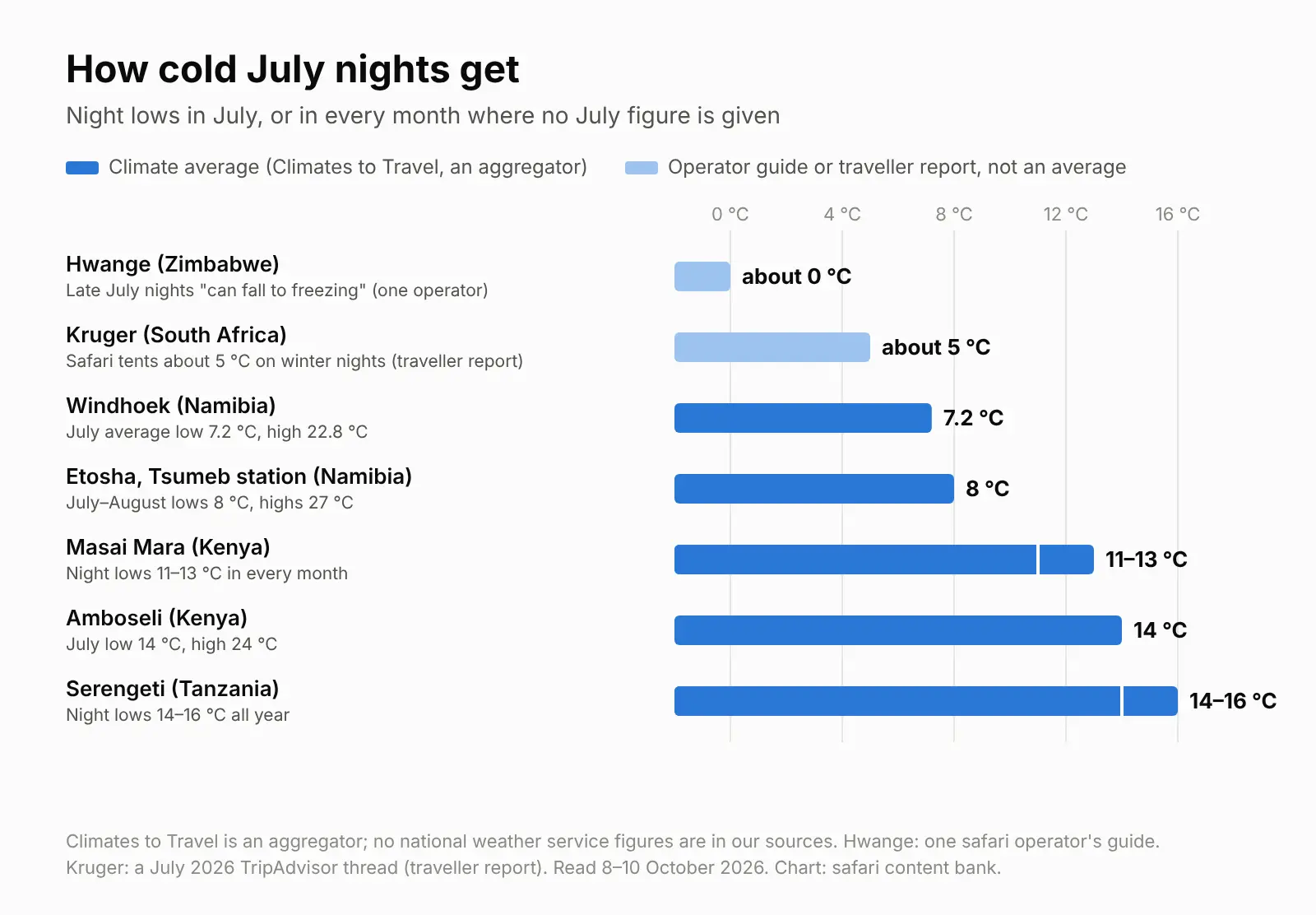 Averages from Climates to Travel, an aggregator; Hwange from one safari operator’s guide; Kruger from a July 2026 TripAdvisor thread (traveller report). Read 8–10 October 2026. Chart: safari content bank.
- Pack for a cold start: open vehicles leave at dawn, when the night’s low is still in the air. Layers, a warm hat and gloves are on our safari packing list.
How far ahead to book July
Book July 6–18 months ahead, depending on where: the advice in our sources ranges from 12–18 months on the migration route to 6 months for gorilla permits. None of these is an official rule.
| Where | Advice | Source |
|---|---|---|
| Migration route, July–October | 12–18 months ahead | One safari operator (page modified 6 October 2026) |
| Masai Mara reserve camps near the river, mid-July to early September | Up to a year | TripAdvisor Mara forum regulars (traveller reports) |
| Northern Serengeti, mid-July | “Most accommodations have already filled up their spots”, a Tanzanian operator wrote in April 2026 | Tanzania safari questions |
| Botswana park campsites and mid-range camps | About a year | Tracks4Africa; TripAdvisor forum, July 2026 |
| Etosha NWR camps, July–September | 6–12 months | TripAdvisor Etosha forum regulars |
| Uganda gorilla permits, July–August | 6 months or more | One Uganda-based operator; a traveller report |
Read 8–10 October 2026. Forum lines are travellers’ reports, not fact.
Common mistakes about a July safari
| What you’ll often read | What is correct |
|---|---|
| “The migration is in the Masai Mara in July” | In early and mid-July most of the herds are usually still in the northern Serengeti; the Mara usually fills in August–September (Great Migration month by month). |
| “A river crossing is guaranteed in July” | No source guarantees a crossing or publishes odds. Crossings begin in July and are busiest in August–September. |
| “The Mara fee is the same all year” | It doubles on 1 July, from US$100 to US$200 per adult per day, on the last published schedule. |
| “Africa is hot in July” | Southern Africa is in winter: Windhoek averages 7.2 °C on July nights, and Hwange’s late-July nights can fall to freezing (one operator). |
| “Kruger is malaria-free in winter” | No source says so. TravelHealthPro recommends tablets September to May; SANParks puts the peak in November–April and exempts no month. |
| “Kruger’s fee is R692” | Right since 1 November 2026, so July 2027 costs R692 a day; July 2026 cost R602 under the 2025/26 rate, which ended on 31 October 2026. |
| “Gorilla permits are cheaper in the dry season” | July is full price: US$800 in Uganda (US$600 only in April, May and November) and US$1,500 in Rwanda, whose discount runs November–May. |
| “The Okavango is dry in July” | The Delta is near its flood peak in July; the flooded area is largest in July–September (IntechOpen review). |
Frequently asked questions
Is July a good month for a safari? Yes, for most of the classic safari countries: it is the dry season in Kenya, Tanzania, Botswana, Namibia, Zambia, Zimbabwe, Uganda and Rwanda, and Kruger’s dry season too. It is also peak price: Governors’ Camp in the Masai Mara rises from US$623 to US$998 a night on 1 July, and the Mara reserve fee doubles to US$200 a day. Southern Africa is cold at night.
Where is the Great Migration in July? In early and mid-July most of the herds are usually in the northern Serengeti, with the lead herds at Kogatende, and the Mara River crossings begin (a camp operator’s migration guide). They reach the Masai Mara from mid or late July. In 2026 the first crossings were reported in the second week of July (traveller reports). See Great Migration month by month.
How much is the Masai Mara fee in July? US$200 per non-resident adult per day, the rate for 1 July–31 December on Narok County’s FY2025/26 schedule, the last published; press reports say it still applies for July–December 2026. It is US$100 to 30 June. Conservancy nights cost US$130 per adult instead.
What is the Kruger park fee in July? Kruger’s fee is R692 per international adult per day since 1 November 2026, and the 2026/27 schedule runs to 31 October 2027, so a July 2027 trip costs R692 a day. July 2026 cost R602, the previous rate (to 31 October 2026). Two adults spending 3 days pay R4,152 at that rate (our sum).
How cold is a safari in July? Cold at dawn in southern Africa: Windhoek averages 7.2 °C on July nights and Etosha 8 °C (Climates to Travel, an aggregator), and one operator says late-July nights in Hwange can fall to freezing. In East Africa nights are milder, 11–13 °C in the Masai Mara and 14–16 °C in the Serengeti. Bwindi’s coldest months are June and July.
Is the Okavango Delta flooded in July? Yes. The Delta’s water is highest from about May to August, UNESCO puts the peak around June–July, and the flooded area is largest in July–September. Boats run at seasonal-floodplain camps from about late May to September. See the Okavango flood calendar.
Are gorilla permits cheaper in July? No. July is full price: Uganda’s permit is US$800 (US$600 only in April, May and November) and Rwanda’s US$1,500, with its 30% discount only from November to May. One Uganda-based operator advises booking July and August permits six months or more ahead.
When do peak safari rates start? On 1 July at most of the Kenyan, northern Serengeti, Zambian and Namibian camps we checked, such as Governors’, Kicheche, Lemala Mara, Nsefu, Chinzombo and NWR; Camp Hwange also switches in July. Botswana’s and Rwanda’s top camps switch earlier: Machaba on 1 May, Mombo in June, Duba Plains on 15 June and Singita Kwitonda on 1 June.
Sources
- Seasons and herds: a camp operator’s migration guide; Africa Geographic, zebra migrations; a camp operator’s best-time guide for Botswana; a Botswana camp operator’s seasonal guide (PDF); UNESCO, Okavango Delta; IntechOpen review; a safari agent’s guide to the Falls, read 9 October 2026; safari operators’ guides (Okavango flood, Botswana wild dogs, Hwange, Mana Pools, Zambia weather, Uganda gorillas, migration-route booking); a safari booking site (Bwindi ratings); a self-drive operator’s guide (gate queues); a Victoria Falls booking agent (hotel seasons); names and links kept in our editor notes
- Climate and health: Climates to Travel (Kenya, Tanzania, Namibia; an aggregator); SANParks climate, gates and malaria; TravelHealthPro, Botswana and South Africa; HealthyTravel / Swiss TPH, Namibia; WHO ITH country list 2022 (PDF); UWA Bwindi brochure (PDF)
- Fees and permits: Narok County, Maasai Mara fee schedule FY2025/26 (PDF), the last published; KWS, Legal Notice 160 of 2025 (PDF); TANAPA, Tariffs 2023/24 (PDF), the last published tariff; NCAA tariffs; SANParks daily conservation fees 2025/26 (PDF) and 2026/27 (PDF); Tourism Update, DWNP fees (1 April 2022); Government Gazette 8877 (Government Notice 115 of 2026); a safari agent’s guide to DNPW fees, read 9 October 2026; ZimParks Tariff 2026 (PDF); UWA letter TDO 93/04 (PDF); Visit Rwanda; RDB low-season discount
- Rate cards: as linked in the peak-rate table and sections (Governors’, Kicheche, Hemingways, Lemala, Singita, Wilderness, Great Plains, Machaba, Kwando, Natural Selection, Robin Pope Safaris, The Bushcamp Company, Time + Tide, Ruzizi/Akagera, Kwandwe; NWR rates from a booking agent’s listing, read September 2026; a safari agent’s listings)
- Package prices: one Kenya-based safari company’s 2026 published packages (name and links kept in our editor notes)
- Traveller reports: TripAdvisor Masai Mara, Serengeti, Kruger, Etosha, Botswana and Uganda forums, linked in the text or on the pages linked
- More on this site: best time for a safari, Great Migration month by month, safari in January, safari in February, safari in March, safari in April, safari in May, safari in June, safari in August, safari in September, safari in October, safari in November, safari in December, Okavango flood calendar, green-season safari, Great Migration safari cost, safari cost per day by country
Rates, fees and seasons checked 8–10 October 2026, fee lines re-copied from the cost pages on 17 October 2026; SANParks fees checked 1 November 2026. We will update this page when camps publish their July 2027 rates, when Narok County publishes a new Mara fee schedule, and when TANAPA, SANParks or DWNP publish a new fee schedule.