 Experience

Last verified · Next check due
On this page
Short answer: Book the parts with fixed places first. Mara River camps for July–October go about a year ahead (forum regulars; one operator says 12–18 months), Kruger rest camps when SANParks opens bookings 11–12 months out, and Uganda’s July–August gorilla permits 6+ months ahead, paid in full. Then check the operator’s licence, compare itemised quotes and pay a 20–25% deposit; the published terms we hold put the balance 45–60 days before arrival. Checked 17 October 2026.
Key facts
- SANParks opens Kruger rest-camp bookings 11–12 months ahead, in tranches: stays to 31 October 2027 have been bookable since 13 October 2026 at SANParks offices and since 14 October online (SANParks booking periods).
- Since 1 March 2026 a Uganda gorilla permit is held only against full payment; UWA ended the 7-day unpaid reservation window (UWA letter TDO 93/04, PDF).
- The camps’ published terms in our sources ask for a 20–25% deposit (Kwando Safaris, Great Plains, Time + Tide, African Parks) and, where they state it, full payment 45 days before arrival; one Tanzanian ground operator asks for 25% and the balance at 60 days.
- Cancel inside 29–44 days and you lose 100% under every published scale in our sources; even 90+ days out, one Tanzanian operator keeps 10% and Kwando keeps its 20% deposit.
- A land-only safari bought from an African operator is outside ATOL, the UK’s air-package protection scheme (ATOL); no East African operators’ association runs a consumer compensation scheme in our sources.
- Kenya and Tanzania add a government insurance policy at entry: Kenya’s has been required for arrivals since 5 October 2026, at up to US$44 (eCitizen); Tanzania’s costs US$44 per adult as of October 2026.
How far ahead to book, by destination and season
Book a year ahead for migration river camps, Botswana’s peak season and Kruger; six months or more for peak gorilla permits; and a few weeks for a low-season Rwanda permit. Nothing in our sources sets a lead time for an off-peak lodge safari in Kenya or Tanzania beyond one operator’s 6–12 months. For the full countdown by trip type, holidays and last-minute offers, see how far in advance to book a safari.
| What you are booking | Season | How far ahead | What the source says | Source |
|---|---|---|---|---|
| Camps on the migration route (Kenya and Tanzania) | July–October | 12–18 months | One safari operator’s advice; 6–12 months off-peak | One operator’s migration page, modified 6 Oct 2026 |
| Masai Mara reserve camps near the river (Kenya) | Mid-July to early September | Up to a year | Forum regulars; camps outside the reserve and in the conservancies still had space three months out | TripAdvisor Mara forum, “Booking a camp?!?” (traveller reports) |
| Same, any river camp | Peak migration | 9–12 months | Forum regulars call planning in March for the same July “very late” | TripAdvisor Mara forum (traveller reports) |
| Northern Serengeti (Tanzania) | July–September | About a year | In April 2026 a Tanzanian operator wrote that for mid-July “most accommodations have already filled up their spots” | TripAdvisor Serengeti forum |
| Mid-range camps in the Okavango Delta and Khwai (Botswana) | Peak season | Up to a year | In a July 2026 thread, mid-range camps such as Oddballs, Camp Khwai and Jackalberry had “hardly any space” in peak season, while some higher-priced Kwando and Natural Selection camps still had rooms | TripAdvisor Botswana forum, 2026 (traveller reports) |
| Botswana park campsites (Moremi, Chobe, Central Kalahari) | All year, peak first | A year | “Bookings should be done a year in advance”; DWNP takes park fees only once every campsite is paid | Tracks4Africa; Botswana self-drive |
| Kruger rest camps (SANParks) | All year | 11–12 months, when the tranche opens | Stays to 30 November 2027 open on 1 December 2026 at offices and 2 December online | SANParks booking periods |
| Etosha NWR camps (Namibia) | July–September | 6–12 months | Forum regulars’ advice | Traveller reports, as on our Etosha page |
| Uganda gorilla permit | July–August | 6+ months | One operator’s advice; a traveller who tried four months before an August 2026 trip was told peak permits were probably gone | One operator’s FAQ; TripAdvisor Uganda forum (traveller report) |
| Rwanda gorilla permit | Low season | 4–6 weeks | A forum reply in October 2026; low-season permits are easiest from March to May | TripAdvisor Rwanda forum (traveller report) |
Lead times as published or reported, read 9–10 October 2026; SANParks dates checked 17 October 2026. Forum lines are traveller reports, not rules. The operator’s name and link are in our editor notes.
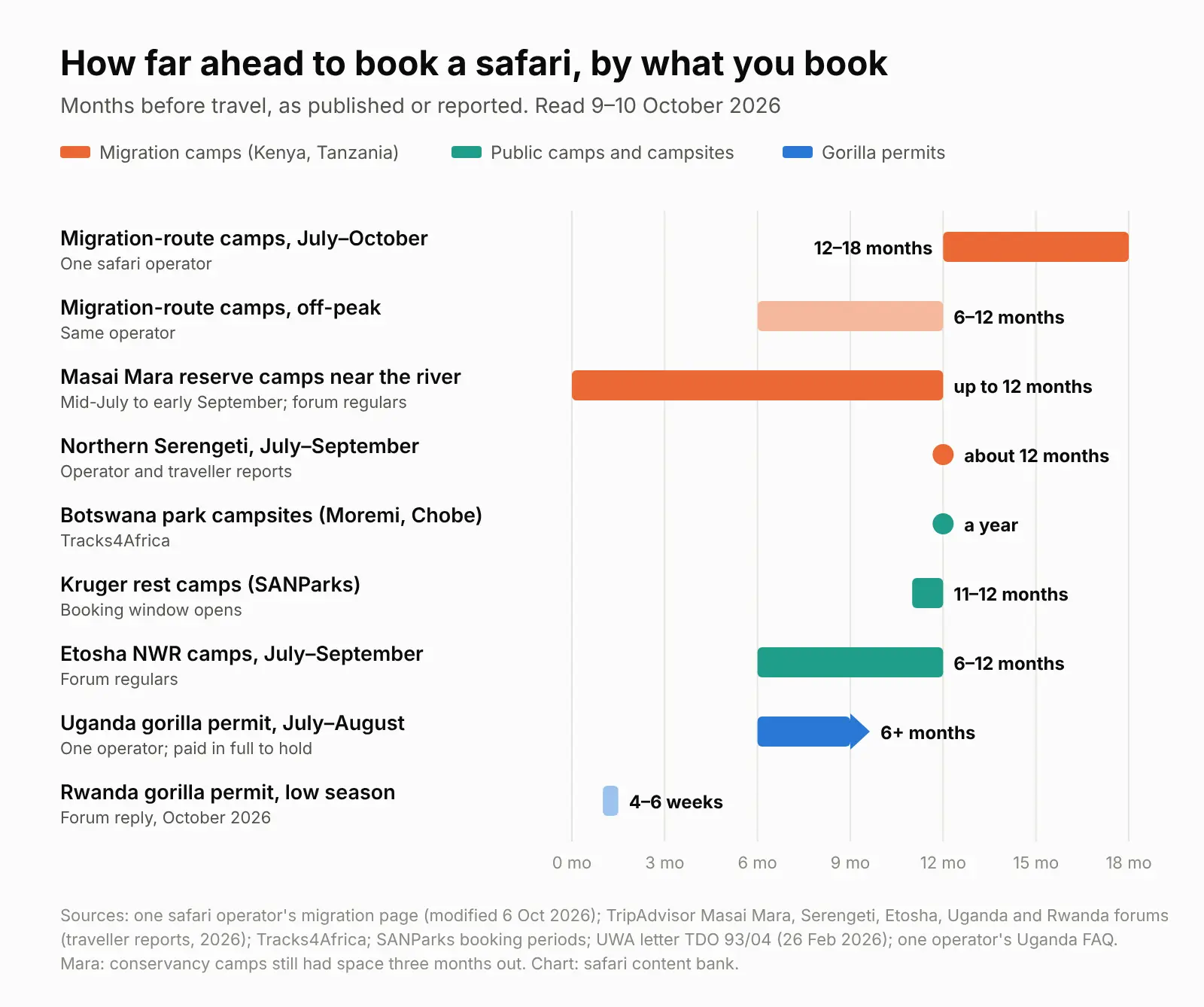 Months before travel. Sources: one safari operator’s migration page (6 Oct 2026); TripAdvisor forums (traveller reports, 2026); Tracks4Africa; SANParks booking periods; UWA letter TDO 93/04; one operator’s Uganda FAQ. Chart: safari content bank.
- The herds set the Kenya and Tanzania dates. River crossings run roughly July–October and cannot be dated in advance; month by month, see the Great Migration month by month. Other countries’ peak months are on the best time for a safari.
- Scarcity is not only at the top. In Botswana’s July 2026 thread the mid-range camps filled first, not the most expensive ones (traveller reports).
- A Botswana camp’s water is a forecast. A camp on permanent water has water every year; a camp on the seasonal floodplain has it only in months and years when the flood reaches it, so a year-ahead booking cannot promise boating (our Okavango flood calendar).
The booking steps, in order
Decide where and when, fix the budget and length, check the operator, compare written quotes, then pay the deposit and the balance on the dates in the contract. Permits and peak camps go first because they have a fixed number of places.
| Step | What to do | Why it comes here | Where to check |
|---|---|---|---|
| 1. Country and season | Pick the country and the months; for the migration, the month decides Kenya or Tanzania | The season sets the lead time and the rate band | Best time for a safari; Great Migration month by month |
| 2. Length | Fix the number of nights: published itineraries run 3–4 days for the Masai Mara or Kruger, 7–8 for Tanzania’s northern circuit, 10 for Botswana | Camps that set a minimum usually ask for 2 nights | How many days for a safari |
| 3. Budget | Set a per-person, per-day figure for the tier you want | Prices per day differ more by tier than by country | Safari cost per day by country |
| 4. Licensed operator | Kenya: search verify.tra.go.ke and the KATO directory. Tanzania: ask for the TALA licence and check TATO | A licence is a legal minimum, not a guarantee | Check a safari operator’s licence |
| 5. Permits and scarce beds | Gorilla permits, river camps, SANParks and Botswana campsites | They sell out first; Uganda permits need full payment to hold | Gorilla permit prices |
| 6. Written quote | Every fee, flight, transfer and levy as its own line | Inclusions differ: one budget price says “park fees NOT included” | See the quote checklist below |
| 7. Deposit and travel insurance | Pay 20–25% to a company account; buy your own policy | Cancellation charges start with the deposit | See deposits and cancellation below |
| 8. Entry documents | Kenya eTA (US$30), Tanzania visa (US$50; US$100 for US citizens), Namibia visa on arrival (N$1,600 aged 12+) | Buy them on the official portals | Kenya visa; Tanzania visa; Namibia visa; Botswana visa |
| 9. Balance | Pay on the date in the contract, usually 45–60 days before arrival | After that date, cancelling costs 50–100% | Your contract |
Sources as on each linked page, checked 9–11 October 2026. The deposit and balance range comes from the published terms in the table below.
- Kenya’s eTA is not a months-ahead job: standard processing is 3 working days, the authorities recommend applying at least 2 weeks before departure, and you must enter within 90 days of issue (Kenya visa).
- In Uganda, the permit is bought through a licensed tour company in practice. UWA has no online booking system; Rwanda sells permits on Irembo, on RDB’s booking portal or through a licensed operator (gorilla permit prices).
Deposits, balances and cancellation terms
In the published terms we hold, camps take a 20–25% deposit and want full payment about 45 days before arrival; cancelling inside 29–44 days costs the whole price. We name camps and parks authorities as sources; tour operators’ terms appear unnamed.
| Who | Deposit | Balance due | Cancellation charge | Source |
|---|---|---|---|---|
| Kwando Safaris (Botswana camps) | 20%, non-refundable, within 7 days | 45 days before arrival | 65+ days: deposit forfeited; 45–64 days: 50%; 44 days or fewer: 100% | Kwando 2024 rate sheet (PDF) |
| Moremi Air (Kwando’s flights) | — | — | Within 7 days: 25%; 48 hours: 50%; 24 hours: 100% | Kwando 2024 rate sheet |
| Great Plains Conservation (Botswana, Kenya, Zimbabwe camps) | 20% to secure dates | Not stated in our extract | Not stated in our extract; “fully comprehensive travel and medical insurance” required | Great Plains 2025 published camp rates (PDF) |
| Wolwedans (Namibia) | Provisional hold 14 days | Full payment 45 days before arrival | 46+ days: 20% commitment fee; 45–30 days: 50%; 29 days or less: 100% | Wolwedans 2026 rack rates (PDF) |
| Time + Tide (Zambia camps) | 20% commitment fee | 45 days before arrival | Not stated in our extract; 4% card fee | Time + Tide 2027 rack rates (PDF) |
| The Bushcamp Company (South Luangwa, Zambia) | — | — | From 20% more than 90 days out, rising to 100% within 30 days | Bushcamp Company 2026 rates (PDF) |
| African Parks camps (Bangweulu, Zambia) | 25% | 45 days before arrival | More than 45 days: 25%; 30–45 days: 50%; under 30 days: 100% | visitbangweulu.org (African Parks), 2026 |
| Kwalate Safaris (Botswana park campsites) | Non-refundable | — | Refund of 50% if you cancel two months or more before arrival, 20% inside two months | A safari operator’s public campsite sheet, as on our Botswana self-drive page |
| One Tanzanian ground operator | 25% per person at booking | 60 days before the trip | 90+ days: 10%; 60–90 days: 25%; 30–60 days: 50%; under 30 days: 100% | Its policies page, read 9 Oct 2026 |
| Uganda gorilla permit (UWA) | 100% at booking since 1 March 2026 | — | Late rescheduling 25%; changing sector 50%; April, May and November permits cannot be rescheduled | UWA letter TDO 93/04 (PDF); UWA tariff 2024–26 |
| Rwanda gorilla permit (RDB) | — | — | Full refund or a second attempt if gorilla movement prevents tracking all day; 75% if you track all day without seeing them; nothing for lateness or any other cancellation | RDB booking portal, checked 9 Oct 2026 |
Terms as published by each camp or authority, read 3 September–9 October 2026. Kwando’s are trade terms on its 2024 rate sheet, the latest in our sources; the Great Plains sheet is for 2025. “Not stated in our extract” means the terms were not in the part of the document we hold, not that none exist. The Tanzanian operator’s name is in our editor notes.
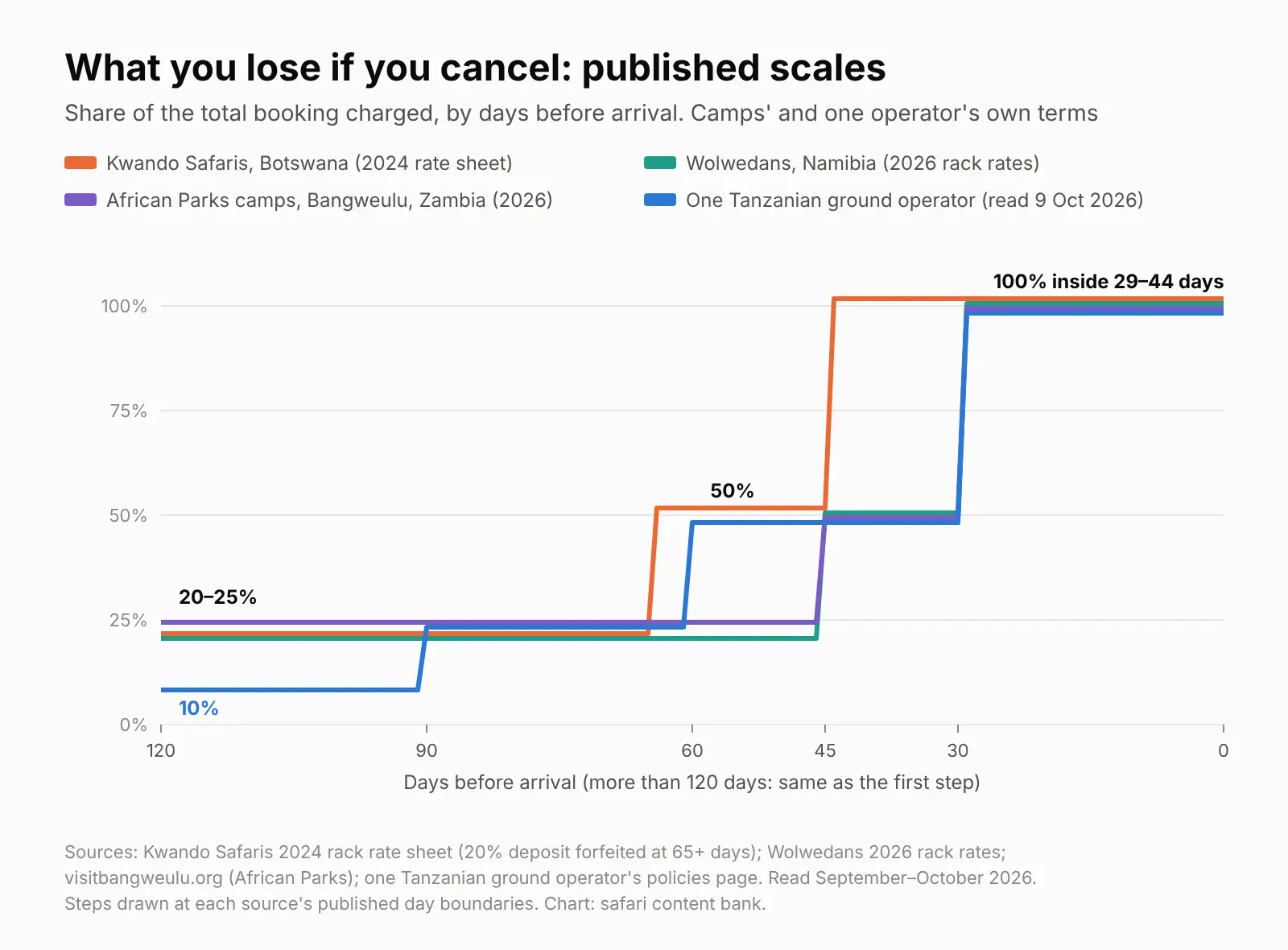 Share of the total charged if you cancel. Sources: Kwando Safaris 2024 rate sheet; Wolwedans 2026 rack rates; visitbangweulu.org (African Parks); one Tanzanian ground operator’s policies page. Read September–October 2026. Chart: safari content bank.
- Read the other clauses too. One Tanzanian operator’s terms give no refunds for services missed during the trip, reserve the right to change accommodation “due to circumstances beyond our control”, and let it pass on increased costs, tariffs, taxes or exchange-rate changes.
- Price rises after booking are real. Zimbabwe has charged 15.5% VAT on tourism services for foreign visitors since 1 January 2026; it was added to bookings further out, while near-term bookings were mostly honoured (Tourism Update, 6 Oct 2026).
- The Kruger day-visit booking fee is non-refundable: R50 per adult and R25 per child in the 2024/25 tariff, the latest in our sources, Wild Card holders included (Kruger self-drive). Kruger’s park and camp costs are on Kruger safari cost.
- Buy your own travel insurance when you pay the deposit. Forum regulars advise buying cover at booking, because a travel advisory issued later can block it (traveller reports, TripAdvisor Uganda forum).
What a safari quote should include
A quote you can compare lists park and reserve fees, conservancy or camp levies, flights and transfers, and states what it leaves out: tips, visas, the government insurance policies and your own travel insurance. Ask for each as a separate line before you pay a deposit.
| Line on the quote | Why it matters | Example figure | Source |
|---|---|---|---|
| Park and reserve fees, per day | A cheap price can leave them out: one budget Mara safari costs US$170–180 for 3 days and says “park fees NOT included” | Masai Mara reserve US$100 a day (January–June), US$200 (July–December) | Kenya safari cost; Narok County FY2025/26, the last published schedule |
| Concession and conservancy fees | Charged per night on top of entry where you sleep inside or in a conservancy | Mara conservancy US$130 per adult per night (Kicheche 2026) | Great Migration month by month |
| Camp levies | Most Botswana camps add one to the nightly rate | US$20–100 per person per night (Kwando, Machaba, Natural Selection, Great Plains) | Botswana safari cost |
| Gorilla permit | Not always in a Uganda tour price, which then runs US$600–800 per person short | US$800 Uganda (US$600 in April, May and November); US$1,500 Rwanda | Gorilla permit prices |
| Flights, with carrier and taxes | Scheduled and light-aircraft sectors are priced separately from beds | Nairobi Wilson → Masai Mara US$200 + US$20 fuel surcharge one way (Mombasa Air Safari 2026) | Kenya safari cost; Botswana bush flights |
| Transfers | Airport, road and inter-camp legs; on a road safari the vehicle | A private Tanzanian vehicle with driver-guide about US$200–300 per vehicle per day (one operator’s cost guide) | Tanzania safari questions |
| Tips | Rarely in the price; paid per guest, in cash, at the end | Kenya and Tanzania: US$10–20 per guest per day for the guide and US$5–15 for the staff box (operators’ suggestions) | Safari tipping |
| Government insurance | Required for entry, separate from your own policy | Kenya: up to US$44 (eCitizen); Tanzania: US$44 per adult as of October 2026 | Kenya visitor insurance; Tanzania visitor insurance |
| Your own travel insurance | Cancellation, medical and evacuation; some camps require it | Great Plains requires “fully comprehensive travel and medical insurance” | Great Plains 2025 published camp rates |
Figures as on the linked pages, read 9–11 October 2026. Kicheche and Mombasa Air Safari are named as camp and airline sources.
The official fee lines behind the park and permit figures, with the date each took effect:
| Fee | Amount | In force from | Source |
|---|---|---|---|
| Maasai Mara National Reserve, non-resident adult, per day (12-hour ticket, 06:00–18:00), 1 Jan–30 Jun | USD 100 | Since 1 Jan 2024; Narok County FY2025/26 schedule, the last published | Narok County fee schedule FY2025/26 |
| Maasai Mara National Reserve, non-resident adult, per day (12-hour ticket, 06:00–18:00), 1 Jul–31 Dec | USD 200 | Since 1 Jul 2024; Narok County FY2025/26 schedule, the last published, expired 30 Jun 2026 (no 2026/27 schedule as of 9 Oct 2026); The Kenya Times (6 Aug 2026, secondary) reports US$200 still applies for Jul–Dec 2026 | Narok County fee schedule FY2025/26 |
| Uganda: gorilla tracking permit, Bwindi Impenetrable and Mgahinga Gorilla NPs, foreign non-resident, per person per trek (guide and that day's park entry included) | USD 800 (foreign resident USD 700; rest of Africa USD 500; East African citizens UGX 300,000) | Since 1 Jul 2024 (UWA tariff 2024–26); confirmed unchanged from 1 Jan 2027 by UWA letter TDO 93/04 of 26 Feb 2026 | UWA letter TDO 93/04, 26 Feb 2026 |
| Uganda: gorilla tracking permit in April, May and November (low season), foreign non-resident, per person per trek; cannot be rescheduled | USD 600 (foreign resident USD 500) | Immediate effect from the UWA letter of 26 Feb 2026 | UWA letter TDO 93/04, 26 Feb 2026 |
| Rwanda: mountain gorilla tracking permit, Volcanoes NP, international visitor, per person per day | USD 1,500 | Current RDB price, checked 9 Oct 2026 | Visit Rwanda (Rwanda Development Board) |
- Tanzania’s park fees carry 18% VAT. Our Tanzania safari questions page quotes a forum warning for anyone hiring a vehicle alone: “Don’t forget 18% sales tax”.
- Ask what happens if a park fee or tax changes after you book. Narok County’s last published Mara schedule expired on 30 June 2026, with no 2026/27 schedule as of 9 October 2026, so a Mara fee in a quote is a last published figure.
See also: Accessible safari and Solo safari.
Paying: currency, cards and transfers
Pay by card or by bank transfer to the company’s registered business account; expect a card surcharge of about 3–4.5%, and know which currency the contract is in.
- Card fees: one Tanzanian operator charges 4% on cards and nothing on bank transfer; Time + Tide’s 2027 rate sheet shows a 4% card fee. On the TripAdvisor Tanzania forum, a card link or Pesapal invoice adds 3–4.5% (TripAdvisor, “Tour Payment”, traveller reports).
- Currency: most camp rate sheets in our sources are in US dollars. Wolwedans charges in Namibian dollars only (2026), and the Gondwana Collection’s group terms trade in Namibian dollars, with the client bearing all bank charges and exchange risk (Gondwana terms, PDF, read 3 Sep 2026).
- Exchange-rate swings hit the balance, not the deposit. Forum regulars describe currency moves between deposit and balance; one was “caught out by the Liz Truss budget in 2022” (TripAdvisor Okavango forum, traveller report). A tour operator in your own country can fix the price in your currency.
- A card payment may give card-scheme protection; a bank transfer to a company you have not checked gives none. Check your card issuer’s terms (check a safari operator’s licence).
- Home-country protection is narrow. ATOL covers air packages sold in the UK, not a land-only safari bought from an African operator; South Africa’s SATSA bond pays at most ZAR 150,000 per incident and “does not guarantee a full refund” (SATSA).
Red flags before you pay
Stop if the seller wants cash on arrival or a personal account, cannot show a licence, or will not put the deposit, balance date and cancellation scale in writing.
| Red flag | Why it matters | Source |
|---|---|---|
| Balance in cash at the airport, or into a personal account | Leaves you nothing to show a regulator, bank or card issuer | Traveller reports, as on check a safari operator’s licence |
| No licence you can verify | Kenya: verify.tra.go.ke (Class C). Tanzania: TALA licence, then the TATO directory | TRA; TATO |
| No written terms | Deposit, balance date, cancellation scale and inclusions belong in writing before you pay | Check a safari operator’s licence |
| A low price “park fees NOT included” | The Mara reserve can cost more per day than the safari itself: US$200 a day from July to December | Kenya safari cost |
| A Uganda gorilla permit “held” without payment | Since 1 March 2026 UWA holds a permit only against full payment | UWA letter TDO 93/04 |
| Look-alike visa sites | Look-alike eTA sites charged US$129 and nearly AUD 500 for a US$30 document | Is Kenya safe? |
| Glowing forum posts from new accounts | Operator accounts post as travellers to recommend themselves | Traveller reports, TripAdvisor and Routard forums |
Traveller reports are what forum members describe, not established fact. Checked 9–11 October 2026.
- Deposits that were never refunded: travellers kept from Tanzania by flight cancellations during the October 2025 unrest report that “Agent in Tanzania could not refund our deposit” (traveller reviews on a safari booking site, December 2025). Read the cancellation scale and buy insurance before you need either.
- Ask for the day-by-day plan at the deposit stage. A German traveller received the exact plan only two weeks before departure, too late to fix errors (traveller report, Botswana).
Common mistakes when booking a safari
| What you’ll often read | What is correct |
|---|---|
| “Book a safari three months ahead and you’ll be fine” | For peak migration months that is late: forum regulars book Mara river camps up to a year ahead, and a Tanzanian operator wrote in April 2026 that mid-July was mostly full. Off-peak and outside the river camps, three months can still work. |
| “Book Kruger whenever you like” | SANParks opens bookings 11–12 months ahead in tranches; South African school holidays fill the southern camps first. |
| “A Uganda gorilla permit can be reserved now and paid later” | Not since 1 March 2026: UWA holds a permit only against full payment. |
| “The deposit is all I can lose” | Inside 29–44 days the published scales in our sources charge 100%; Kwando charges 50% from 64 days. |
| “Booking direct with the lodge is always cheaper” | Lodges usually keep the same public rate whoever sells it; agents are paid from the lodge’s margin (check a safari operator’s licence). |
| “My own travel insurance covers the entry rules” | Tanzania requires its US$44 government policy as of October 2026, and Kenya has required a government policy, up to US$44, for arrivals since 5 October 2026. |
| “A cheap Rwanda permit can be moved if it rains” | RDB refunds only for gorilla movement, and Uganda’s April, May and November permits cannot be rescheduled. |
Frequently asked questions
How far in advance should you book an African safari? About a year for peak months in the busiest places: Mara and northern Serengeti river camps in July–September, Botswana’s peak season and Kruger’s rest camps. One operator advises 12–18 months for July–October migration camps and 6–12 months off-peak. A low-season Rwanda gorilla permit needed 4–6 weeks in an October 2026 forum reply.
How much deposit do you pay for a safari? In the published terms we hold, 20–25% of the price. Kwando, Great Plains and Time + Tide ask 20%, African Parks camps and one Tanzanian operator 25%. Uganda gorilla permits are paid in full at booking.
When is the balance due? Usually 45–60 days before arrival. Kwando, Wolwedans, Time + Tide and African Parks camps set 45 days; one Tanzanian ground operator sets 60.
Can you get your safari deposit back? Rarely in full. Kwando’s 20% deposit is non-refundable, Wolwedans keeps a 20% commitment fee from 46 days or more out, and one Tanzanian operator keeps 10% even 90+ days out. Rwanda refunds a gorilla permit only if gorilla movement stops the trek.
What should a safari quote include? Park and reserve fees, conservancy fees and camp levies, flights with taxes, transfers and any permits, each as a separate line. It should also say what it leaves out, usually tips, visas, Kenya’s or Tanzania’s government insurance and your own travel insurance.
Is it safe to pay a safari operator by bank transfer? It can be, to a licensed company’s registered business account. Check the licence first: verify.tra.go.ke in Kenya, the TALA licence and TATO directory in Tanzania. A transfer gives no card-scheme protection, and ATOL does not cover a land-only safari bought from an African operator.
When should you book a gorilla permit? Six months or more for July and August in Uganda, one operator advises, and the permit is held only against full payment since 1 March 2026. In Rwanda’s low season a forum reply gave 4–6 weeks. Uganda’s US$600 low-season permits for April, May and November cannot be rescheduled.
Sources
- Lead times: SANParks, booking periods; Tracks4Africa; one safari operator’s migration page (modified 6 Oct 2026) and one operator’s Uganda FAQ (names and links in our editor notes)
- Traveller reports (not fact): TripAdvisor forums for the Masai Mara, Serengeti, Botswana, Okavango Delta, Uganda, Rwanda and Tanzania, 2026; reviews on a safari booking site (Dec 2025)
- Camp and authority terms: Kwando 2024 rate sheet (PDF); Great Plains 2025 (PDF); Wolwedans 2026 (PDF); Time + Tide 2027 (PDF); Bushcamp Company 2026 (PDF); visitbangweulu.org (African Parks); Gondwana group terms (PDF); UWA letter TDO 93/04, 26 Feb 2026 (PDF); RDB booking portal; one Tanzanian ground operator’s policies page (read 9 Oct 2026; name in our editor notes)
- Fees: Narok County, Maasai Mara fee schedule FY2025/26 (PDF), the last published; Visit Rwanda; other figures as on our linked cost, fee and visa pages
- Protection and tax: ATOL; SATSA bonding; Tourism Update, Zimbabwe VAT, 6 Oct 2026
Checked 17 October 2026. We will update this page when SANParks opens its next booking tranche on 1 December 2026, when Narok County publishes a 2026/27 Mara schedule, and when the camps in our sources publish new terms.