 Experience

Last verified · Next check due
On this page
- Where to see elephants: places, counts, odds and fees (2026)
- Botswana and the KAZA area: the largest numbers
- The Chobe River by boat, and other water safaris
- Zimbabwe and Zambia: Hwange, Mana Pools and the Luangwa
- East Africa: Amboseli, Tarangire and Ruaha
- South Africa and Namibia: Kruger, Etosha and the desert elephants
- Walking near elephants: where it is allowed, and the rules
- When is the best time to see elephants?
- What an elephant safari costs
- How many elephants are left in Africa?
- Common mistakes about seeing elephants
- Frequently asked questions
- Sources
Short answer: Northern Botswana and the neighbouring Kavango-Zambezi (KAZA) area hold the most: a 2022 aerial survey counted about 227,900 elephants across KAZA, 126,637 of them in northern Botswana. On published traveller figures, 99–100% of one operator’s groups saw elephant in Chobe, Moremi, Kwando-Linyanti, Lower Zambezi, South Luangwa and Mana Pools (read September–October 2026). Kenya’s Amboseli had 2,065 at the end of 2025. No sighting rate is published for Kruger, Hwange, Tarangire or Etosha.
Key facts
- The KAZA Elephant Survey counted about 227,900 elephants (±7%) from August to October 2022, in the first synchronised aerial survey of the whole five-country area, flown to CITES-MIKE standards; the 2014/15 comparison figure was 216,970, so the population “appears stable” (KAZA, results released 31 Aug 2023; KAZA communiqué, PDF).
- Northern Botswana held 126,637 ± 5,856 elephants in 2022, against 120,280 ± 4,820 in 2018, in dry-season transect aerial surveys; the rise is not statistically significant (Elephants Without Borders, March 2024, PDF).
- The highest published elephant sighting rate is 100%, in Kwando-Linyanti (Botswana), Lower Zambezi and North Luangwa (Zambia), and Mana Pools and Gonarezhou (Zimbabwe): every one of one operator’s traveller groups there saw elephant on its trip (its regional pages, read September–October 2026). These are per-trip rates, not the chance on one drive.
- No elephant sighting rate is published for Kruger, Hwange, Amboseli, Tarangire, Ruaha or Etosha in the sources we hold. What exists for most of them is counts, some of them old; for Etosha we hold no current official count.
- Amboseli National Park (Kenya) had 2,065 elephants at the end of 2025, and more than 3,200 have been born into its 68 families since 1972, according to the Amboseli Trust for Elephants (Born Free, 23 May 2026).
- Elephants caused about 32% of 322 confirmed wildlife-related human deaths in Zimbabwe from 2016 to 2022 (Scientific Reports, 2025). On foot, walk with a qualified guide unless you have the experience and a permit.
Where to see elephants: places, counts, odds and fees (2026)
Northern Botswana’s Chobe, Moremi, Delta and Linyanti areas, Zambia’s Lower Zambezi, Luangwa and Kafue parks and Zimbabwe’s Mana Pools and Gonarezhou all have a published elephant sighting rate of 94% or more; northern Botswana, Zimbabwe’s KAZA area, Amboseli, Ruaha and Kruger have dated counts. No park in our sources publishes both.
| Place | Country | Elephant count in our sources (method, year) | Seen by (per trip) | Fee to be there, per adult | Source |
|---|---|---|---|---|---|
| Chobe National Park (riverfront, Savuti) | Botswana | Part of northern Botswana’s 126,637 (aerial survey, 2022); no Chobe-only count | 99% | P270 a day (last published DWNP schedule, 1 April 2022) | one operator’s Chobe page; EWB, 2024; Chobe |
| Kwando-Linyanti (private concessions) | Botswana | As above | 100% | Camp rate plus levy | one operator’s Kwando-Linyanti page |
| Okavango Delta reserves (private concessions) | Botswana | As above | 99% | In the camp rate at many camps; levies US$20–100 a night | one operator’s Okavango Delta page; Okavango Delta |
| Moremi Game Reserve | Botswana | As above | 99% | P270 a day (same DWNP line as Chobe) | one operator’s Moremi page |
| Makgadikgadi and Nxai Pan | Botswana | As above | 79% | P190 a day (last published DWNP schedule, 1 April 2022) | one operator’s salt pans page |
| Hwange National Park | Zimbabwe | Zimbabwe’s KAZA area 65,028 (aerial survey, 2022); no Hwange-only count | Not published | US$12 a day staying inside, US$24 as a day visitor (ZimParks Tariff 2026) | KAZA; Hwange |
| Mana Pools National Park | Zimbabwe | Middle Zambezi Valley fell from about 18,000 to about 11,500 by the 2014 national aerial survey | 100% | US$24 a day (ZimParks Tariff 2026) | one operator’s Mana Pools page; Zimbabwe Field Guide |
| Gonarezhou National Park | Zimbabwe | No count in our sources | 100% | US$30 a day as a day visitor, US$20 staying inside (ZimParks Tariff 2026) | one operator’s Gonarezhou page; Zimbabwe safari cost |
| Lower Zambezi National Park | Zambia | No count in our sources | 100% | US$25 a day (DNPW 2025 schedule, the last published) | one operator’s Lower Zambezi page |
| South Luangwa National Park | Zambia | No count in our sources | 99% | US$25 a day (DNPW 2025, last published) | one operator’s South Luangwa page; South Luangwa |
| North Luangwa National Park | Zambia | No count; FZS calls it Zambia’s “largest, most stable and only increasing” population | 100% | US$20 a day (DNPW 2025, last published) | one operator’s North Luangwa page; FZS |
| Kafue National Park | Zambia | No count in our sources | 94% | US$20 a day (DNPW 2025, last published) | one operator’s Kafue page |
| Amboseli National Park | Kenya | 2,065 at the end of 2025 (individual families followed since 1972) | Not published | US$90 per 24 hours (KWS, LN 160/2025) | Born Free; Amboseli |
| Tarangire National Park | Tanzania | No verified count in our sources | Not published | US$59 a day (last published tariff, 2023/24) | Tarangire |
| Ruaha National Park | Tanzania | 34,000 (2009), 15,836 ± 4,759 (2015); about 20,145 in the Ruaha-Rungwa and Katavi-Rukwa ecosystems (2019 survey) | Not published | US$35.40 a day (last published tariff, 2023/24) | Wikipedia (secondary); WCS, 12 Nov 2019 |
| Kruger National Park | South Africa | 13,750 (2011 census); nothing newer in our sources | Not published | R692 (R602 until 31 Oct 2026) | Wikipedia (secondary, citing SANParks); Kruger |
| Etosha National Park | Namibia | No current official count in our sources | Not published | N$280 per foreign adult + N$60 per vehicle (Government Notice 115 of 2026) | Etosha |
| Namibia’s Zambezi Region and Kavango (Bwabwata, Mudumu, Nkasa Rupara, Khaudum) | Namibia | 21,090 ± 3,888 (KAZA aerial survey, 2022) | Not published | N$200 per foreign adult (Tier 2 parks) + N$60 per vehicle | Conservation Namibia, 25 Oct 2023 |
Sighting rates: one operator’s traveller reports, share of groups who saw elephant at least once on their trip; Botswana pages read September 2026, Zambia and Zimbabwe pages read 8 October 2026. Counts as dated in each source. Fees per non-resident or international adult, copied from our Botswana, Chobe, Zimbabwe, Hwange, Zambia, Amboseli, Tarangire, Ruaha, Kruger, Etosha and Namibia cost pages, read 8–10 October 2026. Botswana’s fee lines are the last published DWNP schedule; no official current tariff is published.
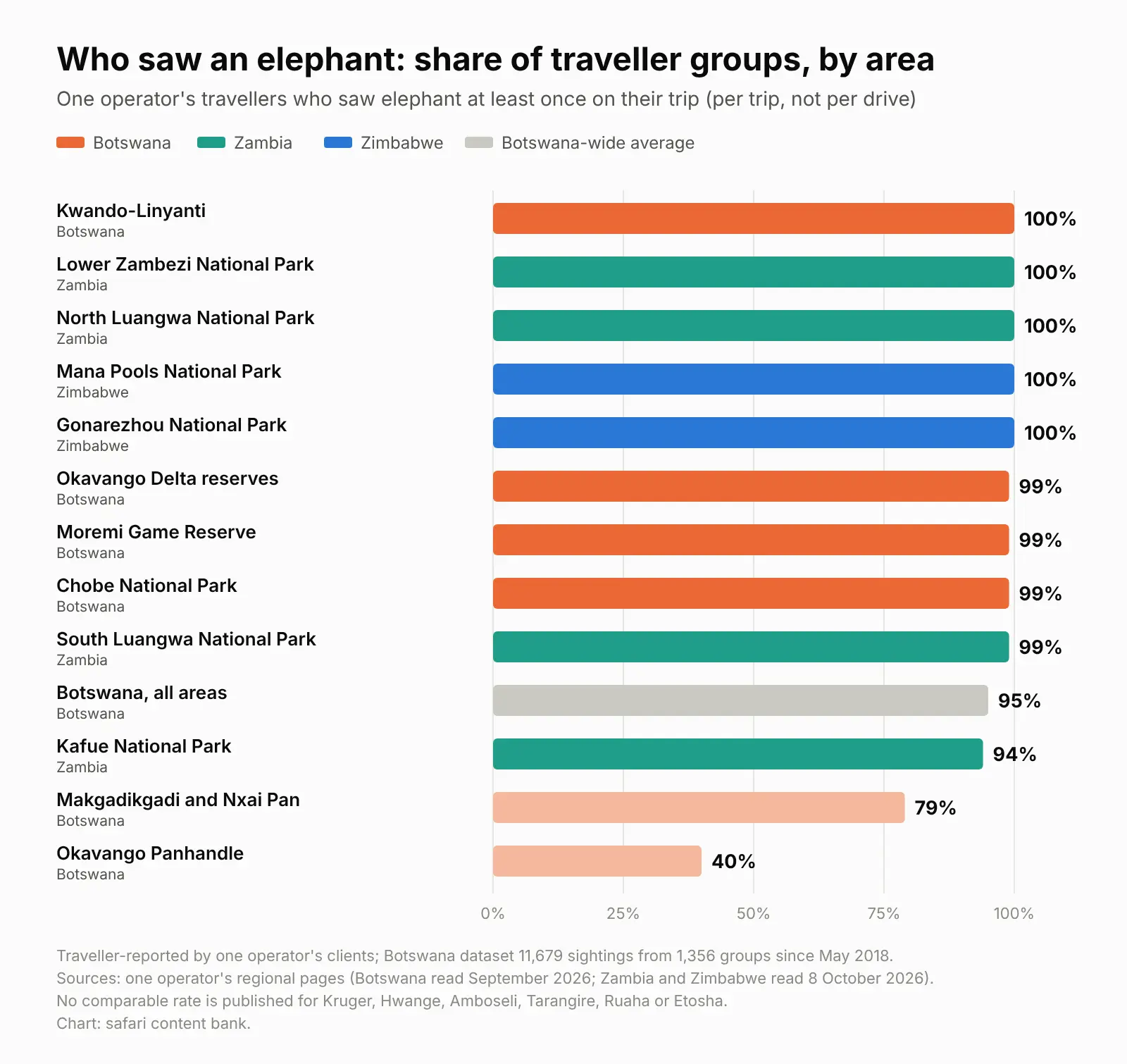 Traveller-reported, per trip, from one operator’s clients; Botswana dataset 11,679 sightings from 1,356 groups since May 2018. Sources: one operator’s regional pages, Botswana read September 2026, Zambia and Zimbabwe read 8 October 2026. Chart: safari content bank.
- Read these as best-case numbers. They come from one operator’s own clients, who tend to take longer, guided, dry-season trips, and the operator does not publish how many groups each regional figure rests on.
- Elephant is the most-seen of the Big Five in Botswana: 95% of the same operator’s groups saw elephant, 91% lion, 82% buffalo and 66% leopard (read September 2026; where to see the Big Five). The low elephant rate is the Okavango Panhandle, at 40%, where camps are oriented to boats rather than vehicles.
Botswana and the KAZA area: the largest numbers
KAZA, the transfrontier area shared by Angola, Botswana, Namibia, Zambia and Zimbabwe, holds more than half of Africa’s savanna elephants, according to its 2022 survey, and northern Botswana holds the largest share in our sources: 126,637 in 2022. KAZA has no fences between those countries, so a national total is a snapshot of where the elephants were in one dry season.
| Area | Elephants | Method and date | Source |
|---|---|---|---|
| KAZA, all five countries | About 227,900 (±7%); 216,970 in the 2014/15 comparison | Synchronised aerial survey, August–October 2022, more than 67,000 km of transects, CITES-MIKE standards | KAZA; communiqué (PDF) |
| Northern Botswana | 126,637 ± 5,856; 120,280 ± 4,820 in 2018 | Dry-season systematic transect aerial survey, 2022 | Elephants Without Borders, March 2024 (PDF) |
| Zimbabwe’s KAZA area (Hwange, Matetsi, Zambezi, Sebungwe) | 65,028; 57,398 in the IUCN’s 2016 status report | KAZA aerial survey, 2022 | KAZA |
| Namibia’s Zambezi–Kavango (incl. Khaudum–Nyae Nyae) | 21,090 ± 3,888; 20,007 in 2019, 19,549 in 2015 | KAZA aerial survey, 2022 | Conservation Namibia, 25 Oct 2023 |
Read 8–10 October 2026. The KAZA survey’s carcass ratio was 10.47%; Elephants Without Borders reports it up from 8% to 11% since the 2014–15 survey, a sign of rising deaths.
- The national count is the contested one. We print no Botswana-wide or Chobe-only figure: the Botswana total we hold from the KAZA survey is not confirmed against the survey report, and the Chobe figure most often quoted cites no survey (Chobe).
- Chobe’s riverfront is where most visitors see them. 99% of one operator’s Chobe travellers saw elephant and 91% buffalo; Moremi and the Okavango Delta reserves are level on elephant at 99% (Moremi or Chobe?).
- The official rule: Botswana Tourism states that in the national parks and reserves “off-roading and night driving [are] prohibited”, while private concessions allow both “in moderation” (Botswana Tourism). Chobe and Moremi are a park and a reserve; Kwando-Linyanti and the Delta concessions are not. See night drives, walking and off-road driving in Botswana.
- Mombo: our Botswana safari cost page places it in Moremi Game Reserve, where the official rule above applies. We make no claim about what the camp itself offers; ask it.
- Moremi and Chobe share one park-fee line: P270 per non-resident adult per day in the last published DWNP schedule (1 April 2022, via Tourism Update). In February 2026 the government news agency BOPA called the existing non-resident fee P380 (Botswana Daily News); a P500 rise was announced, then reported postponed (Gabz FM, 5 May 2026). No official current tariff is published; confirm with DWNP or your operator.
See also: Chobe vs Hwange.
The Chobe River by boat, and other water safaris
The Chobe riverfront is the place to watch elephants from a boat: Kasane operators sell three-hour river cruises, both Kasane lodges in our sources include a cruise in the rate, and forum regulars recommend the afternoon cruise, from about 15:00, when elephants come down to drink (TripAdvisor forum, traveller reports; Chobe).
| Option | What you get | Price per person | Source |
|---|---|---|---|
| Day trip from Victoria Falls | A game drive and a river cruise, transfers included; Sedudu Gate is 80 km from Victoria Falls | US$249 for the day (one booking agent, recorded 9 Oct 2026) | Chobe day trip from Victoria Falls |
| Kasane lodge | Meals, a game drive and a river cruise each day | US$273–294 a night (Chobe Mopani Forest Lodge, 2026–27); US$500–550 (Chobe Safari Lodge, 2026, park fees included) | Chobe safari cost |
| Budget Kasane lodge break | 4 days, two river cruises, a game drive and park fees included | US$225 a day (one operator’s published price, captured 9 Sep 2026) | Chobe safari cost |
| Houseboat | Boat game viewing, fishing and village visits; moors on the Namibian bank | Chobe Princess R10,896–13,432 a night (2026–27), plus a community levy of R150–165 a night | Zambezi Queen Collection; Chobe |
| Canoeing, Lower Zambezi (Zambia) | Guided two-person canoes on the Zambezi and side channels, dry season; no under-12s | DNPW activity fee US$20 a day for canoeing, US$20 for boating (2025 schedule, the last published), usually inside a camp’s levy | Zambia safari questions; Zambia safari cost |
Read 8–10 October 2026. Package prices are other operators’ published prices, shown without their names; lodge and houseboat rates are named.
- The busiest stretch is nearest Kasane. One operator says the riverfront close to town draws the most vehicles and boats; the lodges towards Ngoma are quieter (Moremi or Chobe?).
- Chobe’s houseboats are in Namibia. They moor on the far bank facing the park, and guests clear Botswana immigration at Kasane first (Chobe).
- A night in Kasane gives you two cruises. Forum advice favours two nights in Kasane over a day trip: an afternoon cruise, an early game drive and a second cruise (Chobe).
- Lower Zambezi faces Mana Pools across the Zambezi. One operator names hippo and crocodile as the real risk on a canoe trip, and says to follow the guide’s instructions (Zambia safari questions).
Zimbabwe and Zambia: Hwange, Mana Pools and the Luangwa
Mana Pools, Lower Zambezi and North Luangwa have published elephant rates of 100%, South Luangwa 99% and Kafue 94%; Hwange has no published rate, but its game viewing is waterhole viewing, with elephants concentrated at pumped pans in the dry season (Hwange).
- Hwange: natural water is limited to a few seeps and rain-filled pans, so most waterholes are pumped (Wikipedia, secondary). We print no Hwange-only count, because the figures in circulation disagree and cite no survey. The park fee is US$12 a day if you sleep inside and US$24 as a day visitor (ZimParks Tariff 2026).
- Mana Pools: the Middle Zambezi Valley elephant population fell from about 18,000 to about 11,500, roughly 40%, by the 2014 national aerial survey; the same source describes bulls that stand on their hind legs to reach albida pods (Zimbabwe Field Guide). 100% of one operator’s travellers saw elephant (Zimbabwe safari questions). The fee is US$24 a day (ZimParks Tariff 2026).
- Gonarezhou: every one of the same operator’s travellers saw elephant, and the operator warns that the elephants there are wary; keep well back (Zimbabwe safari questions).
- South Luangwa: 99% of one operator’s travellers saw elephant (South Luangwa). From late October to mid-December, elephants walk through Mfuwe Lodge’s reception (The Bushcamp Company).
- North Luangwa: the Frankfurt Zoological Society describes its elephants as Zambia’s “largest, most stable and only increasing” population, and gives no count (FZS). FZS recorded no poached elephants inside the park in 2018.
- Zambia’s gate fees: US$25 a day in South Luangwa and Lower Zambezi, US$20 in Kafue and North Luangwa (DNPW 2025 schedule, the last published); camps add US$90–110 per person per night in fees and levies (Zambia safari cost).
See also: Hwange vs Mana Pools and South Luangwa vs Lower Zambezi.
East Africa: Amboseli, Tarangire and Ruaha
Amboseli is the East African park with a current, dated elephant count: 2,065 at the end of 2025. Tarangire has no verified count in our sources, and Ruaha’s last park count, 15,836 in 2015, is more than ten years old. None of the three publishes a sighting rate.
- Amboseli (Kenya, 392 km²) is studied family by family: the Amboseli Trust for Elephants has followed more than 3,200 elephants born into 68 families since 1972, and over 220 calves were born in 2025 (Born Free, 23 May 2026; Amboseli). Kilimanjaro is often in cloud. Entry is US$90 per non-resident adult per 24 hours (child under 18, 5 and under free, US$45; KWS, LN 160/2025).
- Big tuskers: about 12 bulls whose tusks reach the ground are monitored in the Tsavo Conservation Area and another 9–10 live in the Amboseli ecosystem (Tsavo Trust, 3 Apr 2026). Amboseli’s best-known tusker, Craig, died of old age on 3 January 2026, aged 54 (Wikipedia, secondary). KWS sells a Tsavo West and Amboseli package ticket at US$150 per non-resident adult (LN 160/2025).
- Kenya counted 41,952 elephants in its 2024–25 national wildlife census, up from 36,280 in 2021 (Citizen Digital, 11 Dec 2025).
- Tarangire: World Travel Awards named it “Africa’s Leading Elephant Paradise National Park” in 2025 and 2026; that is an award, not a count. Game gathers at the Tarangire River in the dry season, June to October (Tarangire). Entry is US$59 per adult per day (US$53.10 from 15 March to 15 May), plus US$47.20 a night inside the park (last published tariff, 2023/24).
- Ruaha: 34,000 elephants in 2009 and 15,836 ± 4,759 in 2015 (Wikipedia, secondary); a 2019 survey estimated about 20,145 across the Ruaha-Rungwa and Katavi-Rukwa ecosystems combined (WCS). Entry is US$35.40 per adult per day (last published tariff, 2023/24; Ruaha).
More: Amboseli safari cost, Tarangire safari cost, Kenya safari questions, Tanzania safari cost.
See also: Amboseli vs Tsavo and Tarangire vs Lake Manyara.
South Africa and Namibia: Kruger, Etosha and the desert elephants
Kruger counted 13,750 elephants in 2011, the last census in our sources; no current official Etosha count is in our sources, and neither park publishes a sighting rate. Both are self-drive parks where you stay in your vehicle except at designated spots.
- Kruger: the 2009–2011 census figures are tabulated on Wikipedia, citing SANParks (Wikipedia, secondary); no newer count is in our sources. The north (Letaba, Mopani, Shimuwini) is mopane shrubveld with elephant and buffalo and fewer cars (Kruger). Tsavo Trust says Kruger has no confirmed super tusker today; its “Magnificent Seven” bulls of the 1980s are dead (Tsavo Trust).
- Kruger’s rules: stay in your vehicle except at designated spots, and private cars may not drive off-road or at night (Kruger self-drive). The fee is R692 per international adult per day from 1 November 2026 (R602 until 31 October 2026) (Kruger park fees).
- Etosha: no current official elephant count is in our sources. A safari booking site rates elephant as “abundant” there (an aggregator; Etosha). Visitors stay in their vehicle except in camps and at marked stops, with no off-road driving or walking, and no night driving except NWR’s guided night drives; guests who sleep inside can watch the floodlit camp waterholes after dark (Etosha).
- Desert-adapted elephants, north-west Namibia: they are savanna elephants adapted to dry riverbeds, not a separate subspecies. Community game guards’ knowledge put the Northern Highlands population at 128 (range 78–212) in 2022–23 (Wenborn, Svensson and Nijman, Biology, 2024); Elephant Human Relations Aid puts about 150 in the main ephemeral riverbeds, undated (EHRA). The two are different areas and do not add up to a north-west total.
- Namibia’s Zambezi Region holds the country’s largest surveyed group: 21,090 ± 3,888 in the Zambezi–Kavango in the 2022 KAZA survey (Conservation Namibia). Its parks, such as Bwabwata, Mudumu and Nkasa Rupara, charge N$200 per foreign adult (Government Notice 115 of 2026; Namibia safari cost).
Walking near elephants: where it is allowed, and the rules
Walking safaris are allowed in South Luangwa, Mana Pools, Botswana’s private concessions, Hwange’s camps and Kruger (with SANParks only), but not in Moremi, Chobe National Park or Etosha; the rule follows the land, not the price of the camp.
| Where | Walking | The rule | Source |
|---|---|---|---|
| South Luangwa NP (Zambia) | Yes | Every group has a guide and an armed scout; usual minimum age 12 | Walking safaris |
| Mana Pools NP (Zimbabwe) | Yes | Guided, or unguided with a permit; collect the entry permit at Marongora | Zimbabwe Field Guide; Zimbabwe safari questions |
| Hwange NP (Zimbabwe) | At camps with professional guides | One camp operator’s guides walk old elephant paths | A camp operator’s journal, July 2026 |
| Botswana private concessions (Khwai, Delta, Linyanti) | Yes | No specialist walking qualification is required by Botswana’s guiding regulations (one operator) | Botswana night drives and walking |
| Moremi Game Reserve | No | “Night drives and walking safaris are not permitted within the reserve” (one operator) | same |
| Chobe National Park | No | Walks are offered in the Forest Reserve west of Kasane, outside the park | same |
| Kruger National Park | SANParks walks and wilderness trails only | Otherwise stay in your vehicle except at designated spots | SANParks rules |
| Etosha NP | No | Stay in your vehicle except in camps and at marked stops | Etosha |
| Tarangire, Ruaha (TANAPA) | With a ranger | TANAPA charges a walking fee and a ranger fee on top of entry | Walking safaris |
Read 8–10 October 2026. “One operator” is a safari operator’s regional guide; names and links are in our editor notes.
- Elephants are a leading cause of wildlife deaths in Zimbabwe: about 32% of 322 confirmed wildlife-related human deaths in 2016–2022, behind Nile crocodiles at about 51% (Scientific Reports, 2025). Walk with a qualified guide unless you have the experience and the permit.
- Ask for the guide’s walking qualification and whether they are armed. A review of injuries to visitors in South Africa advises using only registered trail guides and not pressing guides to approach large animals (Leggat et al., 2001, PDF).
- In a car, give cows with calves room. A forum destination expert’s advice to a solo self-driver in Namibia is to stay in the vehicle except at designated points and keep away from elephant cows with calves (TripAdvisor, traveller report).
- Campsites are not fenced everywhere. The public campsites in Moremi, Chobe and Savuti are unfenced, and elephants move through them at night (forum reports, via Botswana safari questions).
When is the best time to see elephants?
In the dry season, when elephants gather at rivers, swamps and waterholes: roughly June to October in most of these parks, though no source in our bank gives elephant-specific months for every park. The months below are the sources’ general game-viewing seasons.
| Place | Best months in our sources | What the source says | Source |
|---|---|---|---|
| Chobe riverfront | April arrivals; August peak herds | Month guides list large elephant herds arriving in April and huge buffalo and elephant herds in August | A camp operator’s best-time guide for Botswana; Chobe |
| Moremi, Okavango Delta, Linyanti | June–October | Best game viewing “because animals gather at the remaining water” | A camp operator’s best-time guide for Botswana |
| Hwange | July–October | Game gathers at the pumped waterholes | Hwange |
| Mana Pools | June–October | Camps closed December–March | Zimbabwe safari questions |
| Lower Zambezi | About April to mid-November | Camps close from mid-November to April | Zambia safari cost |
| South Luangwa | Late May to mid-November | When most bush camps are open; elephants at Mfuwe Lodge late October to mid-December | South Luangwa |
| Amboseli | June–September | Driest months, 5–15 mm of rain a month | Amboseli |
| Tarangire | June–October | Peak season; forum regulars rate August–October best | Tarangire |
| Ruaha | June–October | Iringa averages 0–5 mm of rain a month | Ruaha |
| Kruger | April–September | Dry season, best for game viewing | Kruger |
| Etosha | May–October | Water is limited to a few waterholes and the grass is short | Etosha |
Read 8–10 October 2026. These are general game-viewing seasons, not elephant calendars, except the Chobe and Mfuwe lines.
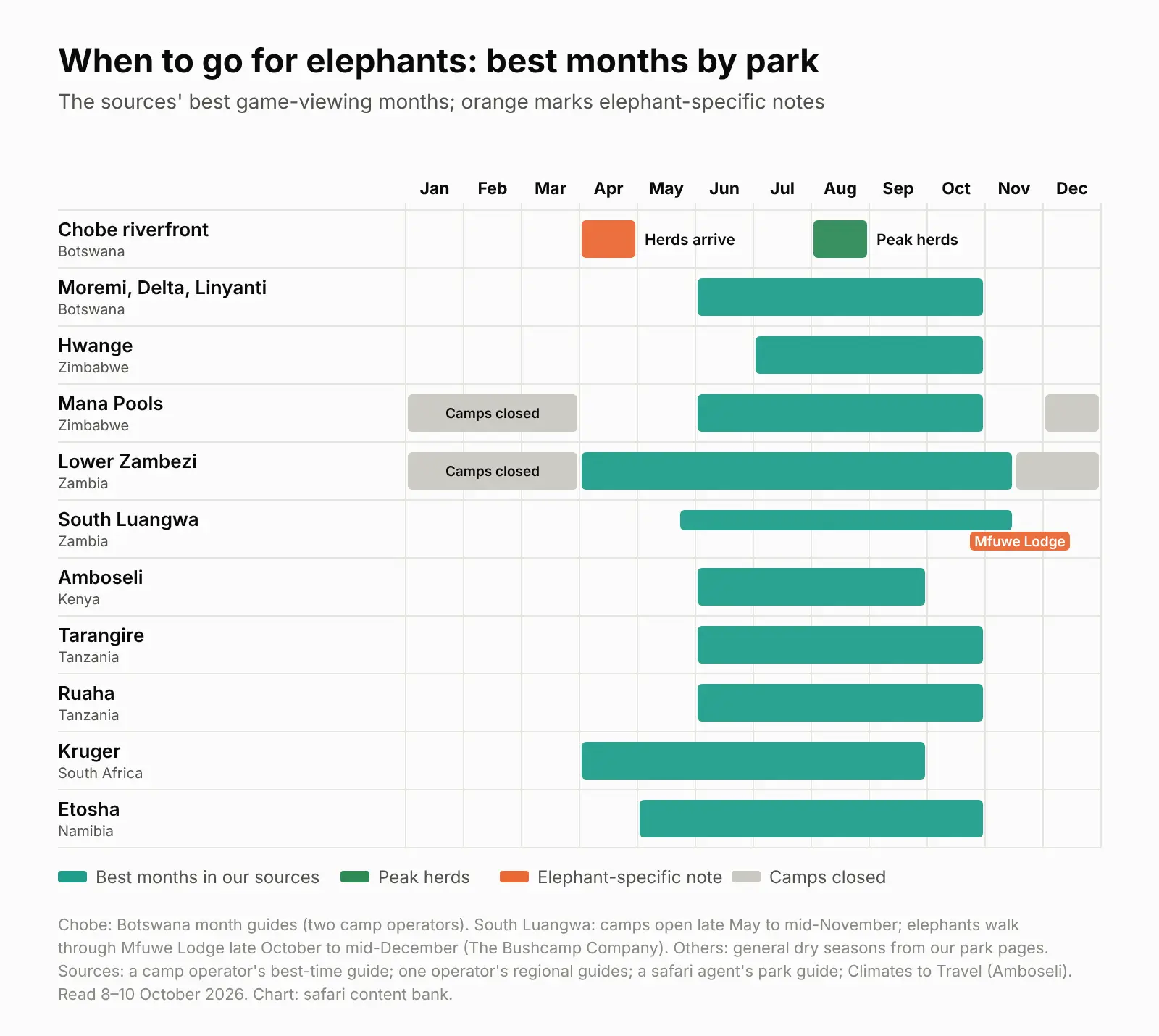 Sources: a camp operator’s best-time guide for Botswana; one operator’s regional guides; The Bushcamp Company; a safari agent’s park guide; Climates to Travel (Amboseli); our park pages, read 8–10 October 2026. General dry seasons except where marked. Chart: safari content bank.
- The dry months are the peak-price months. Every Tarangire camp in our sources charges its highest rate in June–September (Tarangire), and Botswana’s top rates begin in June (best time for a safari).
- Amboseli’s fee is the same all year, US$90 per adult per 24 hours, so the cheaper months there are about lodge rates, not the park fee (Amboseli).
What an elephant safari costs
Published prices run from about US$183–225 per person per day on a budget group safari that includes Amboseli and US$214–225 on a Chobe camping trip or Kasane lodge break, to US$1,064–1,576 a day on a fly-in package through Kasane, the Linyanti and the Okavango Delta. Package prices below are other operators’ published prices, shown without their names; camp and lodge rates are named.
| Where | Option | Price per person | Basis | Source |
|---|---|---|---|---|
| Chobe | Camping trip or lodge break from Kasane | US$214–225 a day | Park fees included; captured 9 Sep 2026 | Chobe safari cost |
| Chobe | Victoria Falls and Chobe packages, 4–5 days | US$311–619 a day | Four operators’ published prices; our per-day sums | same |
| Chobe and northern Botswana | 9-day fly-in, Kasane to Maun via the Linyanti and the Delta | US$1,064–1,576 a day | Light aircraft and park fees included; our per-day sums | same |
| Okavango and Moremi | Mobile safari through Moremi; top-tier fly-in package | US$450–593; US$3,220–4,989 a day | Captured Sept 2026; our per-day sums | Okavango Delta safari cost |
| Hwange | Budget and shared trips from Victoria Falls; published 6-day fly-in | US$211–422; US$733–1,070 a day | Read 8 Oct 2026; our per-day sums | Hwange safari cost |
| Hwange | Camps | US$445–1,250 a night | 2026 | same |
| South Luangwa | 7-day group camping trip; Mfuwe Lodge | US$275–306 a day; US$565–751 a night | 2026; plus US$90–110 fees and levies at the lodge | South Luangwa safari cost |
| Lower Zambezi | Published 4-day private trip with canoeing | US$1,053 (about US$263 a day; our sum) | Read 8 Oct 2026 | Zambia safari cost |
| Amboseli | Budget 6-day group safari including Amboseli; Ol Tukai Lodge; Porini Amboseli Camp | About US$183–225 a day; US$340–505; US$651–870 | Our sums of 2026 published prices with park or conservancy fees | Amboseli safari cost |
| Tarangire | Group trips; Tarangire Ndovu Tented Lodge; Lemala Mpingo Ridge | US$248–380 a day; US$450.30–716.20; US$785.30–1,714.20 | Park fees and a private vehicle counted; checked 10 Oct 2026 | Tarangire safari cost |
| Ruaha | Mid-range camp; luxury camp | US$420–490; US$690–1,670 a day | Camps’ published rates plus fees, our sums | Ruaha safari cost |
| Kruger | Shared Kruger tour; private safari | US$214–242; US$579–652 a day | Operators’ published “from” prices, read 8 Oct 2026 | Kruger safari cost |
| Etosha | Self-drive and camping inside the park, two people | N$2,225–2,810 a day | 2026; 4x4 and park fees included; our sum | Etosha safari cost |
Per person sharing unless stated. Package figures are copied from our cost pages, which keep the operators’ names and links; listing prices are usually based on two travellers, so ask what each includes. Before paying an agent, check the operator’s licence.
The official fee lines, with the date each took effect and the authority’s own source:
| Fee | Amount | In force from | Source |
|---|---|---|---|
| Chobe National Park and Moremi Game Reserve (DWNP), non-resident adult, per person per day | BWP 270 (SADC residents BWP 205; Botswana citizens and residents BWP 30) | Last published DWNP schedule, 1 April 2022 (via Tourism Update). In Feb 2026 the government news agency BOPA called the existing non-resident fee P380; a P500 rise was announced, then reported postponed. No official current tariff: confirm with DWNP or your operator | Tourism Update, 23 Feb 2022 (DWNP fee schedule) |
| Other DWNP parks and reserves (Central Kalahari Game Reserve, Khutse, Nxai Pan, Makgadikgadi Pans), non-resident adult, per person per day | BWP 190 (SADC residents BWP 145; Botswana citizens and residents BWP 20) | Last published DWNP schedule, 1 April 2022 (via Tourism Update). In Feb 2026 the government news agency BOPA called the existing non-resident fee P380; a P500 rise was announced, then reported postponed. No official current tariff: confirm with DWNP or your operator | Tourism Update, 23 Feb 2022 (DWNP fee schedule) |
| Hwange National Park, Main Camp (row as labelled in the ZimParks 2026 tariff), international adult, conservation fee per day | USD 24 day visitor; USD 12 if staying overnight in the park (SADC USD 18 / 10; local USD 5 / 3) | ZimParks Tariff 2026 (tariff year 2026, published February 2026); the conservation-fee table does not say whether VAT is included; Robins, Sinamatella and Kazuma Pan are not listed separately in our sources | ZimParks De-Gazetted Tariff 2026 |
| Mana Pools National Park, Sapi and Chewore, international adult, conservation fee per day | USD 24, day visitor or staying overnight (SADC USD 18; local USD 8) | ZimParks Tariff 2026 (tariff year 2026, published February 2026); the conservation-fee table does not say whether VAT is included | ZimParks De-Gazetted Tariff 2026 |
| South Luangwa and Lower Zambezi National Parks (DNPW Category A), international adult, entry per day (06:00–18:00) | USD 25 (SADC and resident USD 20; Zambian citizen ZMW 55.60); child 5–13 half price, under 5 free | DNPW 2025 schedule ("official 2025 rates"), the last published; page last modified 8 May 2025, still shown 9 Oct 2026 | DNPW 2025 fee schedule, as shown on a Zambia travel portal |
| Kafue and North Luangwa National Parks, international adult, entry per day | USD 20 (SADC and resident USD 15; Zambian citizen ZMW 44.80) | DNPW 2025 schedule, the last published; page last modified 8 May 2025, still shown 9 Oct 2026 | DNPW 2025 fee schedule, as shown on a Zambia travel portal |
| All national parks, non-resident activity fees, per person per day | Boating USD 20; canoeing or rafting USD 20; angling USD 30; camping USD 5 per person | DNPW 2025 schedule, the last published; page last modified 8 May 2025, still shown 9 Oct 2026 | DNPW 2025 fee schedule, as shown on a Zambia travel portal |
| Amboseli and Lake Nakuru National Parks (KWS), non-resident adult, per 24 hours | USD 90 (child under 18, 5 and under free, USD 45) | 1 Oct 2025 (Legal Notice 160 of 2025) | KWS Fees Regulations 2025 (LN 160/2025) |
| Tsavo West and Amboseli package ticket (KWS), non-resident adult | USD 150 (child USD 80) | Legal Notice 160 of 2025, gazetted 22 Sep 2025, which states no start date; in force 1 Oct 2025 per the KWS press release of 29 Sep 2025 | KWS Fees Regulations 2025 (LN 160/2025) |
| Tarangire, Lake Manyara and Arusha National Parks, non-East African adult, entry per day | Peak USD 50 + VAT = USD 59; low USD 45 + VAT = USD 53.10 | 1 Jul 2023 (2023/24 tariff, last published) | TANAPA Tariffs 2023/24 |
| Tarangire, Lake Manyara and Arusha, concession fee per person per night inside the park | USD 40 + 18% VAT = USD 47.20 | 1 Jul 2023 (2023/24 tariff, last published) | TANAPA Tariffs 2023/24 |
| Ruaha, Katavi, Mikumi, Saadani, Udzungwa, Mkomazi, Rubondo, Kitulo and the other parks in this group, non-East African adult, entry per day | USD 30 + 18% VAT = USD 35.40 | 1 Jul 2023 (2023/24 tariff, last published) | TANAPA Tariffs 2023/24 |
| Kruger National Park daily conservation fee, international adult (12+), per day | ZAR 602 | 1 Nov 2025 to 31 Oct 2026 (SANParks 2025/26 schedule) | SANParks daily conservation fees 2025/26 |
| Kruger National Park daily conservation fee, international adult (12+), per day | ZAR 692 | 1 Nov 2026 to 31 Oct 2027 (SANParks 2026/27 schedule, already published) | SANParks daily conservation fees 2026/27 |
| Tier 1 parks (Etosha, Namib-Naukluft including Sossusvlei, Skeleton Coast, Ai-Ais/Fish River Canyon, Waterberg Plateau, Cape Cross, Dorob, Tsau //Khaeb), foreign adult 16+, per person | NAD 280 (NAD 140 park entrance + NAD 140 conservation fee) | 1 Apr 2026 (Government Notice 115 of 2026; the notice prices fees per person with no period; MEFT's 2021 schedule made fees valid for 24 hours from entry); was NAD 150 under the 2021 schedule | Government Gazette 8877 (Government Notice 115 of 2026), hosted by the Legal Assistance Centre |
| Tier 2 parks (Bwabwata, Mudumu, Nkasa Rupara, Khaudum, Mangetti, Popa Falls, Daan Viljoen, Hardap, Naute, Von Bach, South West Nature Reserve), foreign adult 16+, per person | NAD 200 | 1 Apr 2026 (Government Notice 115 of 2026; the notice prices fees per person with no period; MEFT's 2021 schedule made fees valid for 24 hours from entry); was NAD 100 | Government Gazette 8877 (Government Notice 115 of 2026), hosted by the Legal Assistance Centre |
| Vehicle up to 10 seats, most national parks (N$50 at Sandwich Harbour), per vehicle | NAD 60 | 1 Apr 2026 (Government Notice 115 of 2026; the notice states no period; MEFT's 2021 schedule made fees valid for 24 hours from entry); was NAD 50 | Government Gazette 8877 (Government Notice 115 of 2026), hosted by the Legal Assistance Centre |
How many elephants are left in Africa?
The last continental status report estimated 415,428 ± 20,111 elephants in surveyed areas at the end of 2015, plus 117,127–135,384 guessed in unsurveyed range (IUCN African Elephant Status Report, PDF). New IUCN status reports were scheduled around CITES CoP20 in late 2025; we have not read their numbers.
| Measure | Figure | Method and year | Source |
|---|---|---|---|
| Africa, surveyed areas | 415,428 ± 20,111; about 118,000 fewer than in the 2007 report on comparable surveys | IUCN status report, data to end 2015 | IUCN (PDF) |
| Savanna elephants, 18 countries | 352,271 (95% CI 334,464–370,078); down about 30% (about 144,000) from 2007 to 2014 | Great Elephant Census, aerial, 2014–15 | Chase et al., PeerJ 2016 |
| Where they were | Botswana 37%, Zimbabwe 23%, Tanzania 12% of the census total; 84% inside protected areas | Same census | same |
| Southern Africa | 293,447 in surveyed areas, more than 70% of the total | IUCN status report, 2015 data | IUCN (PDF) |
| Poaching | Share of carcasses illegally killed (PIKE) 0.39 in 2023, down from 0.43 in 2019; Southern Africa 0.24, Eastern 0.27 | CITES MIKE, 60 sites in 30 range states | CITES SC78 (PDF) |
| Range | A little over 3.1 million km², 30% of it protected | IUCN status report | IUCN (PDF) |
Read 8–10 October 2026. National totals for Botswana, Zambia and Tanzania from the 2022 surveys are not confirmed in our sources.
- Eastern Africa lost roughly half its surveyed elephants between the 2007 and 2016 reports, and Tanzania more than 60% (IUCN). Ruaha’s fall from 34,000 (2009) to 15,836 (2015) is part of that.
- The KAZA area is the exception: its 2022 total of about 227,900 compares with 216,970 in 2014/15, and the survey calls it stable (KAZA).
- Elephant density brings visitors: a continental study links poaching to about US$25 million a year in lost tourism revenue (Nature Communications, 2016).
Common mistakes about seeing elephants
| What you’ll often read | What is correct |
|---|---|
| “Chobe has 120,000 elephants” | No survey in our sources gives a Chobe-only count. Northern Botswana held 126,637 ± 5,856 in 2022 (Elephants Without Borders). |
| “Botswana has 200,000 elephants” | Not supported by any survey we hold. The whole five-country KAZA area held about 227,900 in 2022. |
| “Hwange has 45,000–50,000 elephants” | Rounded figures from booking sites. Zimbabwe’s whole KAZA area held 65,028 in the 2022 survey; no Hwange-only count is in our sources. |
| “Amboseli has about 1,600 elephants” | 2,065 at the end of 2025, the Amboseli Trust for Elephants’ count. |
| “Only 150 desert elephants are left in Namibia” | That is the main riverbeds only (EHRA); the Northern Highlands held about 128 more in 2022–23. They are not a subspecies. |
| “Kruger has 30,000 elephants” | Not confirmed in our sources. The last census we hold is 13,750 in 2011. |
| “You can walk with elephants in Moremi or Chobe” | Walking is not permitted in Moremi, and Chobe National Park has no walks. Botswana’s private concessions allow walking. |
| “Kruger costs R602 a day” | That was the 2025/26 rate, which ended on 31 October 2026. Since 1 November 2026: R692 per international adult per day. |
| “Botswana’s park fee is P500” | The P500 rise was announced, then reported postponed. The last published DWNP schedule (1 April 2022) is P270; BOPA called the existing fee P380. No official current tariff is published. |
Frequently asked questions
Where is the best place in Africa to see elephants? On published figures, northern Botswana and its neighbours: 99–100% of one operator’s traveller groups saw elephant in Chobe, Moremi, the Okavango Delta reserves and Kwando-Linyanti, and 100% in Zambia’s Lower Zambezi and Zimbabwe’s Mana Pools (read September–October 2026). Northern Botswana held 126,637 elephants in the 2022 aerial survey, the largest number in our sources.
Is Chobe the best place to see elephants? For numbers and ease, it is one of the best documented: 99% of one operator’s Chobe travellers saw elephant, and the park is 80 km from Victoria Falls. Moremi and the Okavango Delta reserves are level at 99%. No survey in our sources gives a Chobe-only count, so treat “120,000 in Chobe” as unsupported.
Can you see elephants from a boat? Yes, on the Chobe River: Kasane operators sell three-hour cruises, Kasane lodges include one in the rate, and forum regulars recommend the afternoon cruise from about 15:00, when elephants come down to drink. In Zambia’s Lower Zambezi, camps run canoe and boat trips; DNPW charges US$20 a day for each (2025 schedule, the last published).
When is the best time to see elephants? The dry season, when they gather at water: June–October in Botswana, Hwange, Mana Pools, Tarangire and Ruaha, June–September in Amboseli, April–September in Kruger and May–October in Etosha. These are general game-viewing seasons from our sources, not elephant-specific calendars.
Is Amboseli or Tarangire better for elephants? Our sources cannot rank them: neither publishes a sighting rate. Amboseli has a current count, 2,065 at the end of 2025, and families followed since 1972; Tarangire has no verified count in our sources. Amboseli costs US$90 per adult per 24 hours (KWS) and Tarangire US$59 a day (last published tariff, 2023/24).
Can you go on a walking safari to see elephants? Yes, in South Luangwa, Mana Pools (guided, or unguided with a permit), Botswana’s private concessions and Hwange’s camps, and in Kruger on SANParks walks only. Not in Moremi, Chobe National Park or Etosha. Elephants caused about 32% of confirmed wildlife-related human deaths in Zimbabwe in 2016–2022, so walk with a qualified guide.
How many elephants are there in Africa? The last continental status report estimated 415,428 ± 20,111 in surveyed areas at the end of 2015, plus up to about 135,000 guessed in unsurveyed range (IUCN). The Great Elephant Census counted 352,271 savanna elephants in 18 countries in 2014–15. The KAZA area alone held about 227,900 in 2022.
Sources
- Sighting rates: one operator’s pages on Botswana wildlife, Moremi, the Okavango Delta reserves, Kwando-Linyanti, Chobe, the salt pans and the Okavango Panhandle (read September 2026); Lower Zambezi, South Luangwa, Kafue, North Luangwa, Mana Pools and Gonarezhou (read 8 October 2026) (names and links kept in our editor notes)
- KAZA and Botswana: KAZA, survey results, 31 Aug 2023; KAZA communiqué (PDF); Elephants Without Borders, March 2024 (PDF); Botswana Tourism, game viewing; DWNP schedule effective 1 April 2022 via Tourism Update, 23 Feb 2022; Botswana Daily News (BOPA), Feb 2026; Gabz FM, 5 May 2026; a camp operator’s best-time guide for Botswana
- Chobe River: Zambezi Queen Collection, Chobe Princess; traveller reports on TripAdvisor
- Zimbabwe and Zambia: ZimParks Tariff 2026 (PDF); Zimbabwe Field Guide, Mana Pools; Wikipedia, Hwange National Park (secondary); a camp operator’s journal on walking safaris, July 2026 (name and link kept in our editor notes); DNPW 2025 schedule, the last published, from a safari agent’s guide read 9 Oct 2026; FZS, North Luangwa; The Bushcamp Company
- Kenya and Tanzania: Born Free, 23 May 2026 (Amboseli Trust for Elephants); Tsavo Trust, 3 Apr 2026; Wikipedia, Craig (elephant) (secondary); Citizen Digital, 11 Dec 2025; KWS LN 160/2025 (PDF); World Travel Awards 2025 and 2026; Wikipedia, Ruaha National Park (secondary); WCS, 12 Nov 2019; TANAPA Tariffs 2023/24 (PDF), the last published tariff
- South Africa and Namibia: Wikipedia, Kruger National Park (secondary, citing SANParks); SANParks daily conservation fees 2025/26 and 2026/27; SANParks rules; Conservation Namibia, 25 Oct 2023; Wenborn, Svensson and Nijman, Biology 2024; EHRA; Government Notice 115 of 2026 (PDF); a safari booking site’s Etosha wildlife rating (an aggregator; name and link kept in our editor notes); traveller report on TripAdvisor
- Africa-wide: IUCN African Elephant Status Report 2016 (PDF); Chase et al., PeerJ 2016; CITES SC78 MIKE report (PDF); Nature Communications, 2016; Scientific Reports, 2025; Leggat et al., 2001 (PDF)
- Package prices: other operators’ published prices as printed on our Chobe, Okavango Delta, Hwange, South Luangwa, Zambia, Amboseli, Tarangire, Ruaha, Kruger and Etosha cost pages (names and links kept there)
More on where to see the other animals: lions, leopards, cheetahs, wild dogs and the Big Five.
Figures, rates and fees checked 10 October 2026; SANParks fees checked 1 November 2026. We will update this page when the operator’s sighting rates change, when SANParks’ 2026/27 fees take effect on 1 November 2026, when DNPW publishes a 2026 Zambia schedule or Botswana an official tariff, when TANAPA publishes a new tariff, and when the IUCN, KAZA, SANParks or any park authority publishes a new elephant count.