 Experience
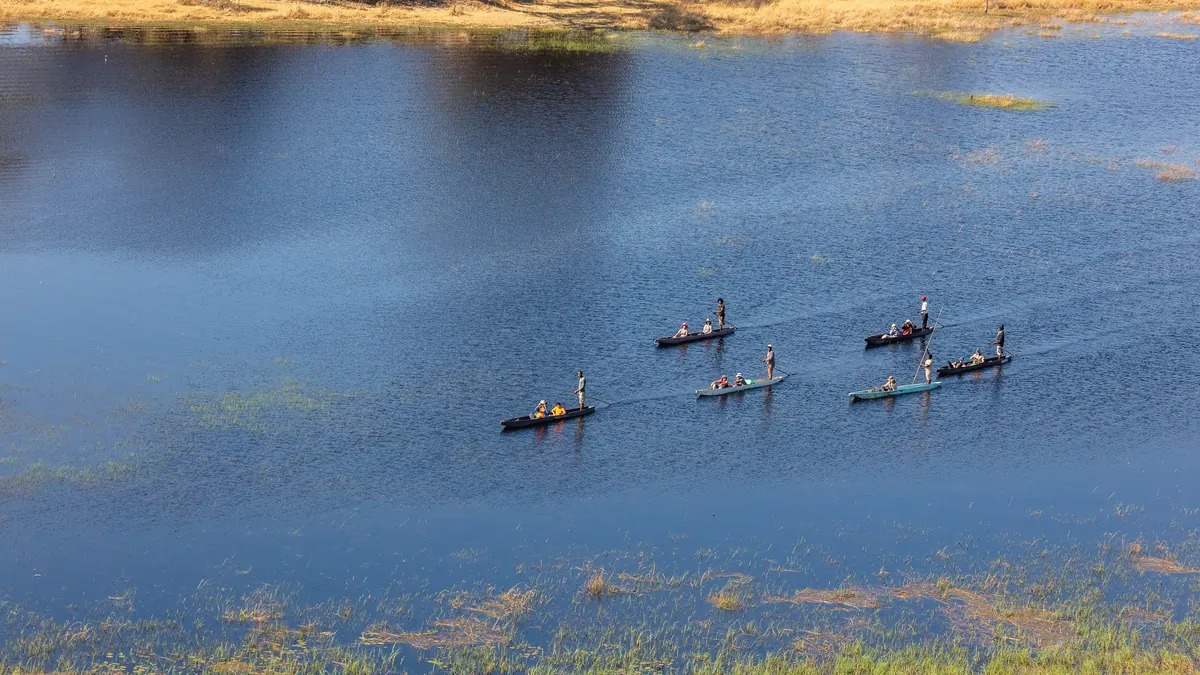

Last verified · Next check due
On this page
- The Okavango flood month by month
- Where the water comes from
- When the flood reaches Mohembo, Maun and the far edges
- Why the water is high in the dry season
- How big the flood is, and how much it changes
- What the flood means for mokoro, boats and game drives
- Water camps, land camps and the flood
- Self-drive: the flood and river crossings
- Rates by season at Delta camps
- Common mistakes about the Okavango flood
- Frequently asked questions
- Sources
Short answer: The Okavango flood is rain that falls on the Angolan highlands from October to April (a safari company’s guide). Its peak enters Botswana at Mohembo between mid-March and mid-May; water is highest in most of the Delta from about May to August and then falls until around February (a UK safari operator’s guide). The flood takes about 4 months to travel from Mohembo to Maun (IntechOpen review). No public gauge reading is in our sources.
Key facts
- The flood arrives in Botswana’s dry season. Botswana’s own rain falls from November to March (two camp operators’ seasonal guides), while the Delta’s water is highest from about May to August (a UK safari operator’s guide); UNESCO puts the peak around June–July (UNESCO).
- The water takes months to cross the Delta. “The annual flood takes 4 months to travel from the inlet at Mohembo, to the outlet at Maun”, and the largest flooded area comes in July–September (IntechOpen review).
- The flooded area roughly doubles each year, from 6,000–8,000 km² at low water to about 15,000 km² at high water (IntechOpen review).
- Water levels rise and fall by about 0.2 m a year in the permanent swamp and by more than 1.5 m in the seasonal swamp (IntechOpen review), so boats run all year on permanent water and only for part of the year on the floodplains.
- 1984 was the largest flood on record (a UK safari operator’s guide). Our sources hold no Mohembo flow figure for any year.
The Okavango flood month by month
The water is lowest from about November to February, rises from March, is highest from about May to August and falls from September. The table gives the typical year; the timing at any one camp depends on where it sits on the flood’s path.
| Month | Where the flood is | Delta water (seasonal guides) | Sources |
|---|---|---|---|
| January | Rain on the Angolan highlands is at its heaviest (about January) | Low; no boating at seasonal camps | Africa Geographic; two camp operators’ seasonal guides |
| February | Peak discharge into the river system begins (February–April); the first pulse, from the Cubango river, typically reaches Mohembo in February–March | Low; levels at the far edges stop falling around February | IntechOpen; a safari company’s guide; a UK safari operator’s guide |
| March | The flood peak enters Botswana at Mohembo from mid-March | Levels start rising | A UK safari operator’s guide; two camp operators’ seasonal guides |
| April | Peak at Mohembo continues; Angolan rain ends | Rising | A safari company’s guide; a UK safari operator’s guide |
| May | Peak at Mohembo ends by mid-May; the second pulse, from the Cuito river, arrives around mid-May | Rising fast; highest water in most of the Delta begins; boating resumes late May | A safari company’s guide; a UK safari operator’s guide; a Botswana camp operator’s seasonal guide |
| June | Highest water in most of the Delta continues (May–August) | Near peak | A UK safari operator’s guide; UNESCO (peak around June–July); two camp operators’ seasonal guides |
| July | Largest flooded area begins (July–September) | Peak floodwaters | IntechOpen; two camp operators’ seasonal guides |
| August | Last month of highest water in most areas | Waters begin receding | A UK safari operator’s guide; two camp operators’ seasonal guides |
| September | Largest flooded area ends; levels fall | Receding; boating often stops at seasonal camps | IntechOpen; two camp operators’ seasonal guides |
| October | Angolan rain begins again | Low and falling; “some water activities may no longer be possible”, depending on the area | A safari company’s guide; Africa Geographic |
| November | Botswana’s own rains start | Lowest | Two camp operators’ seasonal guides |
| December | Rain in both Angola and Botswana | Low; a slight drop as new rains arrive | Two camp operators’ seasonal guides |
Typical timing, not a forecast. Sources: a UK safari operator’s Okavango flood guide; IntechOpen review; a safari company’s guide; UNESCO; Africa Geographic; two camp operators’ seasonal guides. Read 10 October 2026.
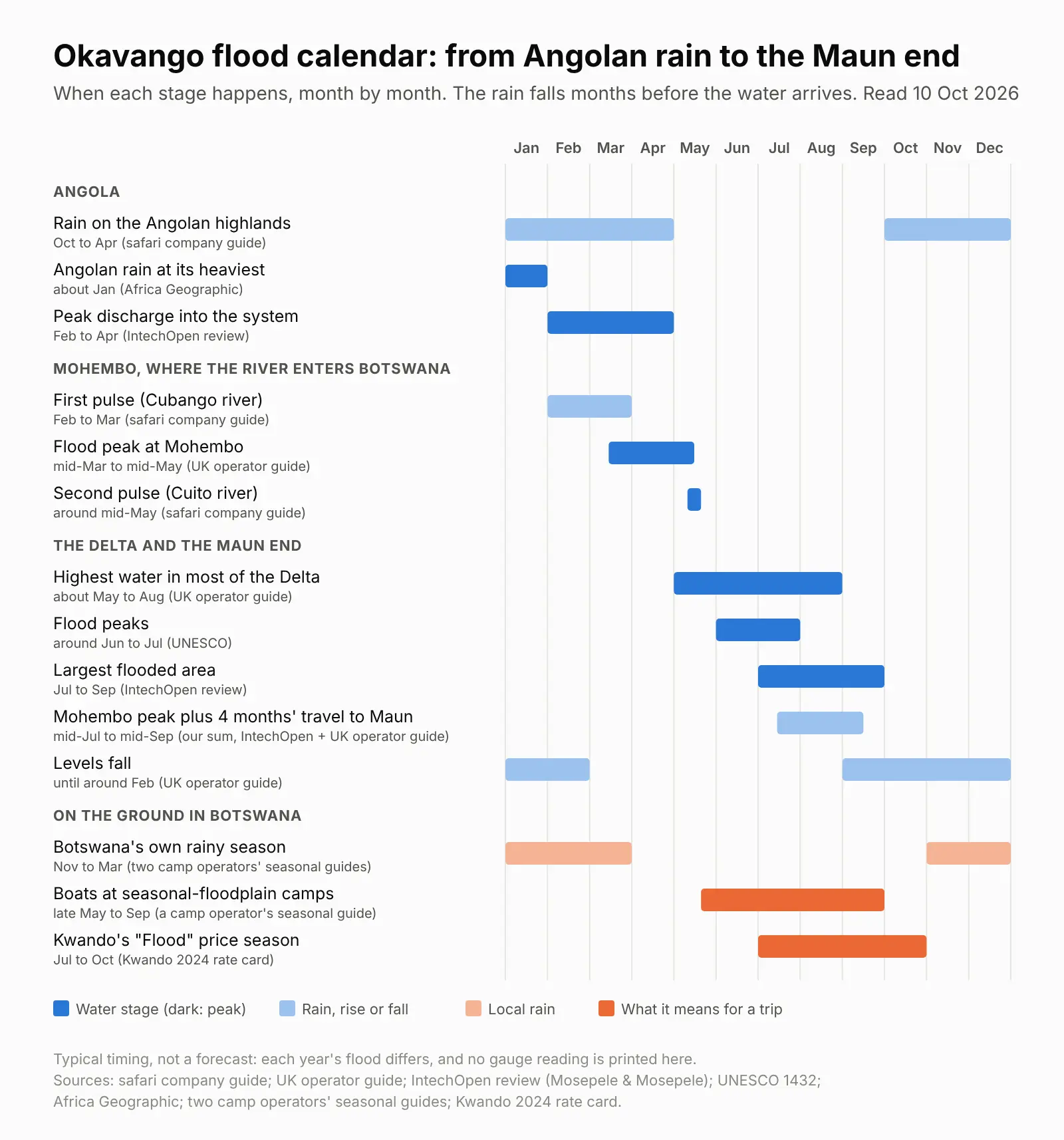 Typical timing, not a forecast. Sources: a safari company’s guide; a UK safari operator’s guide; IntechOpen review; UNESCO; Africa Geographic; two camp operators’ seasonal guides; Kwando 2024 rate card. Read 10 October 2026.
Where the water comes from
The flood is Angolan rain: it falls on the highlands of Angola from October to April and reaches Botswana months later. Botswana’s own rain is not what fills the Delta.
- Rain: storms fall on the Angolan highlands “between October and April each year” (a safari company’s guide), heaviest about January (Africa Geographic). The headwater catchments had a mean annual rainfall of 1,112 mm over 1981–2021 (Lourenco and Woodborne, 2023).
- Two rivers: the Cubango drains about 114,000 km² and the Cuito about 65,000 km² (a safari company’s guide). The river is the Cubango in Angola, the Kavango in Namibia and the Okavango in Botswana (OKACOM).
- Two pulses: “The first flood pulse, driven by the Cubango, typically arrives at Mohembo between February and March, with the Cuito’s second pulse following around mid-May” (a safari company’s guide).
- No outlet: 96% of the water that enters the Delta evaporates or is transpired by plants; 2% flows out and 2% soaks away (IntechOpen review). The surface outflow trickles out down the Boteti river (a safari company’s guide).
When the flood reaches Mohembo, Maun and the far edges
The peak passes Mohembo between mid-March and mid-May, takes about 4 months to reach Maun, and can take up to six months to reach the far edges of the Delta. That is why one camp’s high water can be two months later than another’s.
| Stage | Typical timing | Source |
|---|---|---|
| Peak discharge into the system | February–April | IntechOpen review |
| Flood peak at Mohembo, where the river enters Botswana | “generally between mid-March and mid-May” | A UK safari operator’s guide |
| Travel time, Mohembo to Maun | about 4 months | IntechOpen review |
| Peak discharge to largest flooded area | about 5 months | IntechOpen review |
| Panhandle to the “far extremities” | “up to six months” | A UK safari operator’s guide |
| Largest flooded area, Delta-wide | July–September | IntechOpen review |
| Water falls until | around February | A UK safari operator’s guide |
Sources as linked. Read 10 October 2026.
- Mohembo is the gauging station of record. Flow there is “monitored very carefully”, in cubic metres per second (a UK safari operator’s guide). We found no published Mohembo or Maun gauge reading for any year; the Okavango Research Institute and Botswana’s Department of Water Affairs hold the records.
- At the Maun end: adding IntechOpen’s 4 months of travel to the mid-March to mid-May peak at Mohembo in a UK safari operator’s guide gives mid-July to mid-September (our sum, not a measured date). It falls inside IntechOpen’s July–September window for the largest flooded area.
- Local rain and the flood are “out of sync by around two to six months, depending on exactly where you are within the Delta” (a UK safari operator’s guide). Ask the camp about its own water in your month.
Why the water is high in the dry season
Because the rain that makes the flood falls in Angola months earlier, the Delta is fullest from about May to August, when Botswana has had no rain since March. UNESCO describes the flood as arriving in the dry season and peaking around June–July (UNESCO).
- Local rain: November to March, when Delta water is low (two camp operators’ seasonal guides). Seasonal camps run no boats in January and February.
- Flood: highest in most of the Delta from about May to August (a UK safari operator’s guide).
- Price: Kwando’s 2024 rate card names July–October its “Flood” season, the camps’ top rate (see the rate table below).
- Game: two camp operators’ seasonal guides describe September as peak concentration of wildlife on the remaining water, and October as the hottest month, above 40°C at times.
How big the flood is, and how much it changes
The flooded area roughly doubles between low and high water, from 6,000–8,000 km² to about 15,000 km², and the size of the flood changes from year to year. 1984 was the largest flood on record (a UK safari operator’s guide).
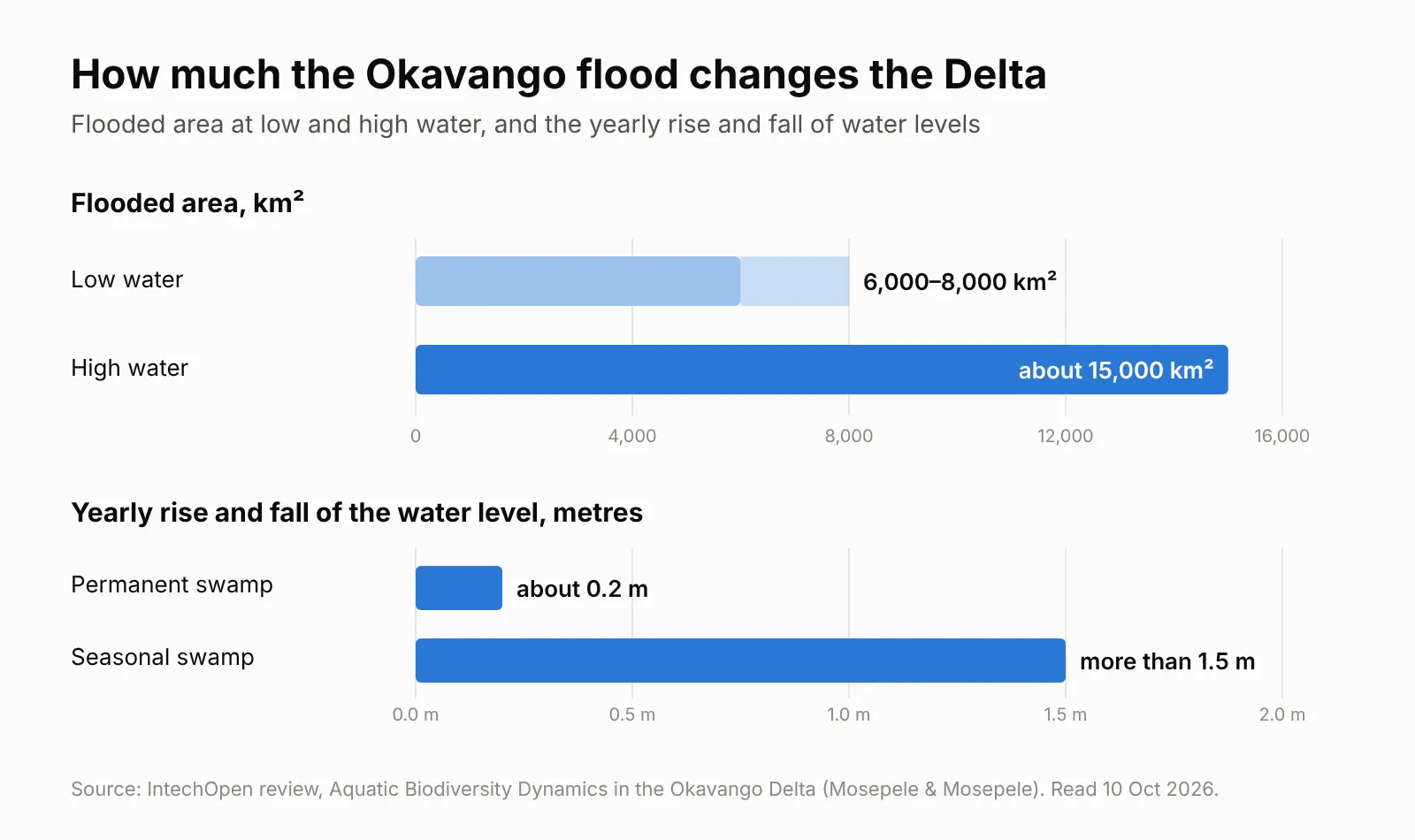 Source: IntechOpen review, Aquatic Biodiversity Dynamics in the Okavango Delta. Read 10 October 2026.
| Measure | Low water | High water | Source |
|---|---|---|---|
| Flooded area | 6,000–8,000 km² | about 15,000 km² | IntechOpen review |
| Yearly rise and fall, permanent swamp | about 0.2 m | IntechOpen review | |
| Yearly rise and fall, seasonal swamp | more than 1.5 m | IntechOpen review | |
| UNESCO World Heritage property, for scale | 2,023,590 ha (inscribed 2014) | UNESCO |
Read 10 October 2026.
- No year-by-year flood measurements are in our sources. We print no flow or level for 2024, 2025 or 2026; the reports of a big or small flood in those years that we found come from operators and trade sites, not from gauge data.
- What a big flood felt like in 2026, by traveller reports: a forum contributor reported GPS data showing under 5,000 hectares of driveable ground at 4 Rivers over three nights, Pom Pom’s floodplains “now filled with water”, and “areas in Moremi Game reserve closed for couple weeks” (TripAdvisor forum, 2026). These are one traveller’s reports, not official figures.
- The flood is measured, not booked. A camp on permanent water has water every year; a camp on the seasonal floodplain has it only in months and years when the flood reaches it.
What the flood means for mokoro, boats and game drives
Mokoro and boat trips need the flood; game drives on the floodplains lose ground to it. On permanent water boats run all year; on the seasonal floodplains, from about late May to September.
| Activity | When it works | Source |
|---|---|---|
| Mokoro and boats, seasonal floodplain | About late May to September; none in January–February | A Botswana camp operator’s seasonal guide; a camp operator’s best-time guide for Botswana |
| Mokoro at most camps | Seasonal; “reduced or stopped” when levels drop | A UK safari operator’s guide |
| Motorboats, wider Delta | Viable as water rises from May; by October some water activities may no longer be possible, depending on the area | Africa Geographic |
| Land activities | Best June–September | Africa Geographic |
| Game drives in a big flood | Less driveable ground on seasonal floodplains (traveller report, 2026) | TripAdvisor forum |
Read 10 October 2026.
- Mokoro trips are about quiet and birds, not big game: they focus on “silence and birdlife rather than large animals”, one forum regular says (TripAdvisor forum). See also: Birding safari.
- The game calendar runs with the dry season: June to October is best for game viewing because animals gather at the remaining water (a camp operator’s best-time guide for Botswana). Red lechwe rut in May, as the flood arrives (a Botswana camp operator’s seasonal guide).
- Minimum age for a mokoro: 12 at Kwando, 8 at Great Plains (their rate cards).
Water camps, land camps and the flood
If a mokoro or boat trip is the reason you are going, pick a camp on permanent water; if big cats are, make sure the camp drives on dry ground in your month. Camps do not price the size of the flood, and no camp can promise it.
- Permanent water moves little: about 0.2 m a year, against more than 1.5 m on the seasonal floodplain (IntechOpen review). Ask whether a camp is on permanent water or seasonal floodplain, and get any water activity confirmed in writing for your dates.
- Water-focused camps and big cats: forum respondents on one TripAdvisor thread doubted that a water-focused camp suited a traveller set on big cats (TripAdvisor forum). In the Panhandle, one UK safari operator’s travellers saw sitatunga on 31% of trips and leopard on 0% (that operator’s sighting statistics).
- A dry alternative in a big flood: forum regulars name the Linyanti, outside the Okavango flood (TripAdvisor forum).
- Ask the right question: how much of the camp’s area is dry in your month, not only whether it has water.
Camp areas, prices and park rules are on the Okavango Delta hub; Moremi vs Chobe compares the two DWNP areas.
Self-drive: the flood and river crossings
The flood sets the depth of the water crossings in Moremi and beyond, it is not posted anywhere official, and many rental contracts do not cover water damage. Check with your rental company and the campsite operators in the week before you drive.
- Third Bridge is reached over a narrow log bridge, after about 2 hours of thick sand from South Gate (Tracks4Africa).
- A dry week in Maun says nothing about the crossings: the water is highest from about May to August, months after the Angolan rain (a UK safari operator’s guide).
- Deep crossings happen. On one Tracks4Africa trip, after heavy rain in Angola three months earlier, the water at the Linyanti–Savuti canal crossing was over the Land Cruiser’s bonnet, the Selinda Spillway crossing took 7 minutes with water at door-handle height, and the party reached Shakawe three days behind schedule (Tracks4Africa, An epic adventure in the Okavango). That is one undated trip report, not a seasonal norm.
- Rental cover: Britz’s terms say “a vehicle may not go through water”, and exclude undercarriage and water damage under every cover level (Britz terms, PDF).
- Closures in a big flood year: travellers on a 2026 forum thread reported parts of Moremi and Khwai cut off for self-drivers and lodges alike, and a missed boat trip because a bridge route was under water (TripAdvisor forum).
- No official flood or track bulletin exists for the parks, according to German forum regulars, who send self-drivers to their rental company the week before they travel (TripAdvisor.de forum).
We found no sourced depth for any Moremi crossing in any month. Campsites, booking order, routes and 4x4 hire are on how to self-drive Moremi and Chobe.
Rates by season at Delta camps
Most Delta camps charge their top rate in some or all of the flood and dry-season months, June to October; Kwando calls July–October its “Flood” season. The rows below are copied from our Botswana safari cost page.
| Camp (group) | Area | Low → peak, per person per night | Season dates | Rate card |
|---|---|---|---|---|
| Moremi Crossing (Kwando) | Delta, NG 27B | US$530 → 850 | 5 Rivers 15 Nov–31 Mar → Flood Jul–Oct | Kwando 2024 |
| Lagoon, Lebala, Splash, 4 Rivers (Kwando) | Linyanti, Delta | US$690 → 1,750 | 15 Nov–31 Mar → Jul–Oct | Kwando 2024 |
| Machaba Camp (Machaba) | Khwai | US$718 → 882 → 1,315 | Secret 11 Jan–31 Mar → Shoulder Apr, 1 Nov–10 Jan → High 1 May–31 Oct | Machaba 2026 |
| Kwara (Kwando) | Delta | US$820 → 2,100 | 15 Nov–31 Mar → Jul–Oct | Kwando 2024 |
| Selinda Explorers, Okavango Explorers (Great Plains) | Selinda, Delta | US$1,105 → 1,330 → 1,915 | Green 11 Jan–31 Mar → Shoulder → Peak 15 Jun–31 Oct, 20 Dec–10 Jan | Great Plains 2025 |
| Vumbura Plains (Wilderness) | Delta, NG 22 | US$2,018 → 3,945 | Jan–Mar 2027 → Jun–Oct 2026, 20 Dec–5 Jan | Wilderness |
| Duba Plains (Great Plains) | Delta, NG 23 | US$2,150 → 2,733 → 3,950 | as Great Plains above | Great Plains 2025 |
| Mombo (Wilderness) | Moremi Game Reserve | US$3,062 → 5,345 | Jan–Mar → Jun–Oct, December holidays | Wilderness |
Per person per night sharing, fully inclusive of meals and activities, unless marked per unit. Natural Selection, Machaba and Wilderness rates are 2026 or 2026–27; Great Plains 2025; Kwando and Desert & Delta 2024, the latest cards in our sources. Great Plains rates include scheduled air from Maun or Kasane on stays of 2+ nights. Captured September 2026, checked 9 October 2026.
- Camps price the season, not the flood. None of these rate cards changes with the size of the year’s flood; a small-flood year costs the same as a big one.
- The cheapest months are the low-water months. Mombo is US$3,062 a night from January to March and US$5,345 from June to October; on the seasonal floodplains there are no boats in January and February.
- April and May are the rising-water months, priced as Shoulder at Machaba in April and as High from 1 May. Levies and flights come on top: see the Botswana safari cost page and bush flights and fares from Maun.
Common mistakes about the Okavango flood
| What you’ll often read | What is correct |
|---|---|
| “The Delta floods in the rainy season” | It floods in the dry season. Botswana’s rain falls November to March; the Delta’s water is highest from about May to August (a UK safari operator’s guide). |
| “February to April are the high-water months” | That is the Angolan rain and the peak discharge upstream. The peak only enters Botswana at Mohembo from mid-March to mid-May, and reaches Maun about 4 months later (a UK safari operator’s guide; IntechOpen review). |
| “The flood peaks on the same date across the Delta” | It moves through the Delta for months. Local rain and the flood are out of sync by two to six months depending on where you are (a UK safari operator’s guide). |
| “A high-water year is better for everything” | Not for game drives on the floodplains. In 2026 a traveller reported under 5,000 hectares of driveable ground at 4 Rivers over three nights (TripAdvisor forum). |
| “Peak price means peak water” | Camps price the season, not the flood. No rate card in our sources changes with the flood’s size. |
| “The flood can be forecast from published gauge readings” | We found no published Mohembo reading. The Okavango Research Institute and the Department of Water Affairs hold the records. |
Frequently asked questions
When does the Okavango flood arrive? The peak enters Botswana at Mohembo between mid-March and mid-May, and the water is highest in most of the Delta from about May to August (a UK safari operator’s guide). It then falls until around February. A camp’s exact timing depends on where it is on the flood’s path.
When does the flood reach Maun? About 4 months after it passes Mohembo: the IntechOpen review says the flood “takes 4 months to travel from the inlet at Mohembo, to the outlet at Maun”. Added to the mid-March to mid-May peak at Mohembo, that gives mid-July to mid-September (our sum). We found no published Maun gauge date.
When is the flood at its highest? From about May to August in most of the Delta (a UK safari operator’s guide), with UNESCO putting the peak around June–July. The flooded area is largest from July to September (IntechOpen review), when it reaches about 15,000 km².
When does the water recede? From about September, falling until around February (a UK safari operator’s guide). Seasonal camps often stop boating in September and run no boats in January and February (two camp operators’ seasonal guides).
What is the best month for a mokoro trip? June to August, when the flood is near its peak across the Delta, at a camp on seasonal floodplain; late May and September are the edges of the boating season there (a Botswana camp operator’s seasonal guide). Camps on permanent water can pole for longer, because their water level moves only about 0.2 m a year (IntechOpen review).
Is this a big flood year? We can’t tell you from measured data: our sources hold no Mohembo flow figure for 2024, 2025 or 2026, only operator and trade reports. 1984 was the largest flood on record (a UK safari operator’s guide). Ask your camp about its water in the weeks before you travel.
Can I self-drive Moremi at high water? Yes, but crossings deepen and some areas can close. Travellers reported parts of Moremi and Khwai cut off in 2026 (TripAdvisor forum), no official flood bulletin exists, and Britz’s rental terms say “a vehicle may not go through water”. Check with your rental company and the campsite operators the week before.
Does a bigger flood cost more? No. Camps set prices by season, and none of the rate cards in our sources changes with the size of the flood. Kwando calls July–October its “Flood” season, and charges its top rate then, whatever the water does.
Sources
- Flood timing and size: a UK safari operator’s Okavango flood guide; IntechOpen review, Aquatic Biodiversity Dynamics in the Okavango Delta; a safari company’s flood-cycle guide; UNESCO World Heritage Centre, property 1432; Africa Geographic, understanding the Okavango Delta; OKACOM; Lourenco and Woodborne, 2023, Environmental Monitoring and Assessment
- Seasons and activities: a camp operator’s best-time guide for Botswana; a Botswana camp operator’s seasonal guide (PDF); a UK safari operator’s Okavango reserves guide; the same operator’s Panhandle guide
- Self-drive: Tracks4Africa, self-drive in 10 days; Tracks4Africa, An epic adventure in the Okavango; Britz terms (PDF)
- Rates: Kwando 2024; Machaba 2026; Great Plains 2025; Wilderness Mombo and Vumbura Plains
- Traveller reports (TripAdvisor forums): 2026 rain and flood; self-drive, August 2026; mokoro; water camps; Linyanti in a flood year; flood bulletins (German)
More: the Okavango Delta hub, common Botswana safari questions answered, Moremi vs Chobe, how to self-drive Moremi and Chobe, bush flights from Maun and the Botswana safari cost page.
Flood timing and rates checked 10 October 2026. We will update this page when Mohembo or Maun gauge readings are published, when a post-season record of the 2026 flood exists, and when Kwando, Great Plains and the other camp groups publish newer rate cards.