 Experience

Last verified · Next check due
On this page
- Which parks have all five? (2026)
- South Africa: Kruger and the Greater Kruger private reserves
- Tanzania: Ngorongoro Crater has all five, the Serengeti lacks rhino
- Kenya: the Masai Mara plus a rhino sanctuary
- Namibia: Etosha has four, and buffalo are in the Zambezi Region
- Botswana: four reliably, rhino rarely
- What a Big Five day costs
- What changes your chances of seeing all five
- Common mistakes about the Big Five
- Frequently asked questions
- Sources
Short answer: All five (lion, leopard, elephant, buffalo and rhino) live in Kruger National Park and the Greater Kruger private reserves (South Africa) and in Ngorongoro Crater (Tanzania). Elsewhere one is missing or scarce: Etosha has no buffalo, rhino are hard to see in the Masai Mara and the Serengeti, and in Botswana only 10% of one operator’s traveller groups saw a white rhino (1% a black rhino). Kruger charges R692 per international adult a day from 1 November 2026 (R602 until 31 October 2026).
Key facts
- Rhino decides whether a park is a Big Five park. Africa had 6,788 black and 15,752 white rhino at the end of 2024, and South Africa held 14,389 of them (IUCN SSC African Rhino Specialist Group report to CITES, 2025).
- Etosha National Park (Namibia) has four of the five: no Cape buffalo. They are kept out to protect Namibia’s foot-and-mouth-free livestock exports (a safari agent’s Etosha guide, read September 2026).
- Botswana delivers four reliably: 95% of one operator’s traveller groups saw elephant, 91% lion, 82% buffalo and 66% leopard, against 10% white rhino and 1% black rhino (11,679 sightings from 1,356 groups since May 2018, read September 2026).
- No single Kenyan park in our sources reliably shows all five. Forum regulars report rhino are hard to see in the Masai Mara; Kenya’s rhino are seen at Ol Pejeta (US$110 per adult per day), Lake Nakuru (US$90) and Nairobi National Park (US$80).
- A Ngorongoro Crater day costs US$70.80 per adult plus US$295 per vehicle per descent; two people sharing a vehicle pay US$218.30 each (NCAA tariffs, undated page read 9 October 2026; our sum).
- Night drives are not allowed in the Serengeti, Ngorongoro or Botswana’s national parks. The private reserves bordering Kruger run guided drives off-road and at night as part of the lodge stay.
Which parks have all five? (2026)
Three places on our pages hold all five: Kruger National Park, the private reserves that share its open boundary, and Ngorongoro Crater. In every other park below one animal is missing or seen by a minority of visitors, and in almost every case it is the rhino.
| Park or reserve | Country | All five? | What is missing or scarce | Source |
|---|---|---|---|---|
| Kruger National Park | South Africa | Yes | Nothing missing; the rhino population is down about 60% since 2013 | Kruger (Wikipedia); Save the Rhino |
| Sabi Sand, Timbavati and other Greater Kruger reserves | South Africa | Yes | Nothing missing; no fence with Kruger since 1993 | Sabi Sand vs Timbavati; one seller’s Big Five guide |
| Ngorongoro Crater | Tanzania | Yes | Nothing missing | NCAA; another seller’s first-safari guide |
| Madikwe, Pilanesberg, Eastern Cape reserves | South Africa | Yes, malaria-free | Leopard “extremely elusive” in Madikwe and the Eastern Cape, says one seller | Malaria-free safaris; one seller’s Big Five guide |
| Serengeti National Park | Tanzania | Rhino scarce | Black rhino seen on TANAPA’s “special rhino viewing” at Moru, US$118 per trip | TANAPA 2023/24, last published |
| Masai Mara National Reserve | Kenya | Rhino scarce | Rhino hard to see, by forum regulars’ reports | TripAdvisor, Aug 2026 (traveller reports) |
| Ol Pejeta, Lake Nakuru, Nairobi NP | Kenya | Rhino: yes; all five not confirmed | Kenya’s rhino stops, added to a Mara trip | Where to see rhino |
| Etosha National Park | Namibia | No: four | No Cape buffalo; leopard “very rare” | A safari agent’s Etosha guide, read September 2026; a safari booking site’s wildlife ratings |
| Okavango Delta reserves | Botswana | Rhino scarce | 9% of travellers saw white rhino, 1% black | one operator’s sighting data |
| Moremi Game Reserve | Botswana | Rhino scarce | 4% saw black rhino | one operator’s sighting data |
| Chobe National Park | Botswana | Rhino not reported | The operator publishes no rhino figure for Chobe | one operator’s sighting data |
Checked 10 October 2026. Presence is as each source states it; sellers and aggregators are described as such. The operator’s figures are the share of its traveller groups who saw the animal at least once on their trip, read September 2026.
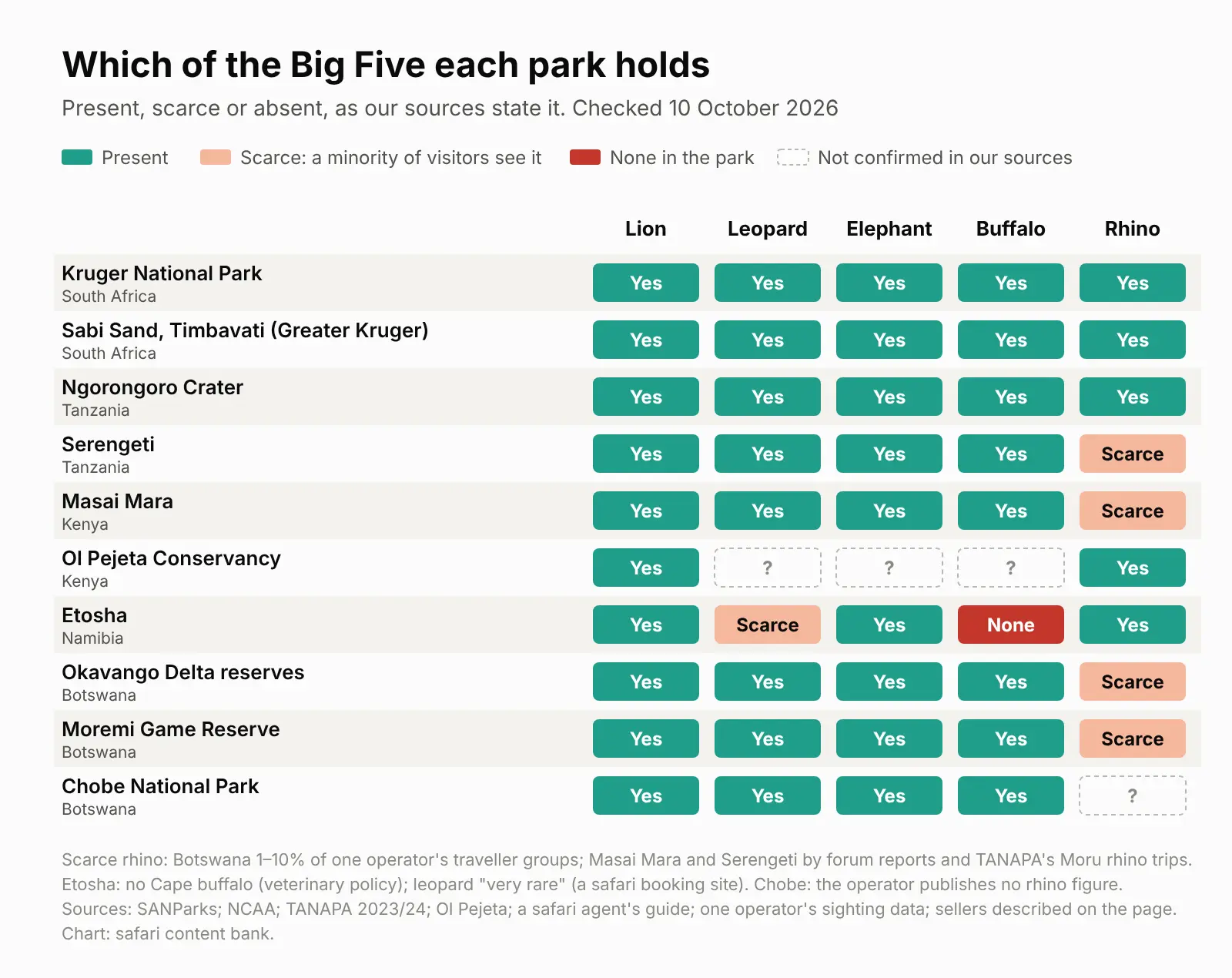 Sources: SANParks; NCAA; TANAPA Tariffs 2023/24 (last published); Ol Pejeta; a safari agent’s Etosha guide; a safari booking site; one operator’s sighting data (read September 2026); sellers described in the table. Chart: safari content bank.
South Africa: Kruger and the Greater Kruger private reserves
Kruger and the private reserves on its western side are the one area in our sources where all five are present and you can choose between a self-drive national park and a guided private lodge. Kruger charges R692 per international adult a day from 1 November 2026 (R602 until 31 October 2026) (Kruger park fees).
- Kruger has the Big Five plus cheetah and wild dog. The latest census in our sources is from 2009–2011 and counted 1,620–1,720 lions; no current count is in our sources, so we print none (Kruger).
- Kruger’s rhino are fewer than they were: the population is down about 60% since 2013 (Save the Rhino), and 175 rhinos were poached in Kruger in 2025, against 88 in 2024 (SANParks).
- Sabi Sand and Timbavati dropped their fences with Kruger in 1993, so the animals move between reserve and park; lodge vehicles do not (Sabi Sand vs Timbavati).
- Sellers rate these reserves highest for all five. One seller calls the reserves bordering Kruger “perhaps Africa’s most reliable Big 5 sightings” and says Sabi Sand “generally delivers all five within a couple of days” (its Big Five guide). These are a seller’s claims; we hold no sighting statistics for either reserve.
- The cheapest way in is a Kruger campsite: two adults pay R1,892 a night at Pretoriuskop with fees from 1 November 2026 (October 2026 site price; R1,712 in October 2026). SANParks had not published its 2026/27 accommodation tariff when we checked on 1 November 2026, so confirm the price when you book. The cheapest published 2026 private-reserve beds are R7,300 per person sharing at Elephant Plains (Sabi Sand) and R7,761 at Umlani (Timbavati) (Kruger).
Every South African fee: South Africa safari cost. If you want all five without malaria tablets, Madikwe, Pilanesberg, the Waterberg and the Eastern Cape reserves are outside the malaria area and Kruger is not: see malaria-free safaris in South Africa.
Tanzania: Ngorongoro Crater has all five, the Serengeti lacks rhino
Ngorongoro Crater is the northern Tanzania park with all five; in the Serengeti rhino are seen mainly on a paid add-on trip at Moru. Night drives are not permitted in either (Kenya vs Tanzania).
Ngorongoro Crater
Black rhino live on the crater floor, and a crater day costs US$70.80 per adult plus US$295 per vehicle per descent (NCAA tariffs, undated page, read 9 October 2026). Another safari seller rates Ngorongoro as one of the best chances of seeing the Big Five in a day (its first-safari guide).
- The crater fee is per vehicle, so sharing cuts it: two people pay US$218.30 each in entry and crater fees, four people US$144.55 each (our sums), before the vehicle permit.
- Descent gates close at 16:00 and all driving ends at 18:00 (NCAA visitor guidelines, via our Ngorongoro page).
- Rim lodges add a US$59 concession fee per person per night (NCAA). Full breakdown: Ngorongoro Crater fees.
Serengeti
The Serengeti has lion, leopard, elephant and buffalo; for rhino, TANAPA sells “special rhino viewing” at Moru for US$118 per trip with VAT, on top of entry of US$82.60 per adult per day (last published tariff, 2023/24). Sellers name the Seronera valley for leopard and the Serengeti’s large buffalo herds (a tour operator’s and one seller’s Big Five guides).
- Tanzania’s rhino are few: the IUCN specialist groups estimated 268 rhinos in Tanzania at the end of 2024, and Tanzania’s own 2025 national census counted 285 black rhinos in the whole country (The Star / Xinhua, 22 Sep 2026). The two figures come from different methods and years.
- We found no dated lion or leopard count for the Serengeti, so we print none (Serengeti).
- The usual northern-circuit plan is Serengeti for the cats and Ngorongoro for rhino. Serengeti fees by season: Serengeti park fees; every Tanzanian fee: Tanzania safari cost.
Kenya: the Masai Mara plus a rhino sanctuary
In Kenya you see four of the five in the Masai Mara and add rhino at Ol Pejeta, Lake Nakuru or Nairobi National Park. The Mara reserve costs US$100 per adult per day from 1 January to 30 June and US$200 from 1 July to 31 December (Narok County FY2025/26 schedule, the last published; Masai Mara park fees).
- The Mara’s lions, leopards and cheetahs are resident (Kenya safari questions). Rhino are hard to see there and absent from Amboseli, according to forum regulars (TripAdvisor, Aug 2026, traveller reports).
- Big-cat sightings in the Mara’s peak season are shared. Reviewers on a safari booking site describe “25 safari jeeps around one single leopard” (February 2026) (the site’s Kenya reviews, traveller reports).
- Off-road driving is prohibited in the reserve, except to approach big cats on nearby open ground and no closer than 25 m; the conservancies around it drive off-road and sell night drives (Masai Mara).
- Ol Pejeta Conservancy costs US$110 per adult per day, VAT included, and sells lion tracking and rhino experiences at US$70 per adult on top (OPC Tariff Guide 2026). Our sources do not confirm leopard, elephant and buffalo there, so we treat it as the rhino stop, not a complete Big Five park.
- Lake Nakuru costs US$90 and Nairobi National Park US$80 per adult per 24 hours (KWS, Legal Notice 160 of 2025). Both hold black and white rhino (Where to see rhino).
Kenya against Tanzania, park by park: Kenya vs Tanzania. All Kenyan fees: Kenya safari cost.
Namibia: Etosha has four, and buffalo are in the Zambezi Region
Etosha has lion, leopard, elephant and rhino but no Cape buffalo, so a Namibian trip completes the five only by adding the Zambezi Region. Buffalo are kept out of Etosha by veterinary policy to protect Namibia’s foot-and-mouth-free livestock exports (a safari agent’s Etosha guide).
- Etosha’s rhino is its strength: A safari booking site rates black rhino “occasional” and white rhino “very rare”; leopard is also “very rare” (its Etosha wildlife page, read September 2026).
- Only guests sleeping inside can watch the floodlit waterholes at Okaukuejo and Halali at night, and visitors may not drive after dark except on a guided NWR night drive (Etosha).
- Etosha costs N$280 per foreign adult plus N$60 per car since 1 April 2026 (Government Notice 115 of 2026). Camping inside costs N$460–560 a person a night (Etosha park fees).
- For buffalo, the same site rates them “common” in Nkasa Rupara and “occasional” in Bwabwata and Mudumu (its Nkasa Rupara, Bwabwata and Mudumu wildlife pages). These Tier 2 parks cost N$200 per foreign adult (Government Notice 115 of 2026).
More: Namibia safari questions, Namibia safari cost.
Botswana: four reliably, rhino rarely
Botswana is the one country with published sighting rates for each of the five, and they show four near-certain animals and a rare rhino. One operator publishes the share of its traveller groups who saw each animal at least once on their trip; its Botswana dataset holds 11,679 sightings from 1,356 groups since May 2018 (its Botswana wildlife page, read September 2026).
| Animal | Botswana-wide | Okavango Delta reserves | Moremi Game Reserve | Chobe National Park |
|---|---|---|---|---|
| Elephant | 95% | 99% | 99% | 99% |
| Lion | 91% | 93% | 91% | 91% |
| Buffalo | 82% | 85% | 78% | 91% |
| Leopard | 66% | 73% | 76% | 59% |
| White rhino | 10% | 9% | not published | not published |
| Black rhino | 1% | 1% | 4% | not published |
Source: one operator’s sighting pages for Botswana, the Okavango Delta reserves, Moremi and Chobe, read September 2026. Per trip, not per drive.
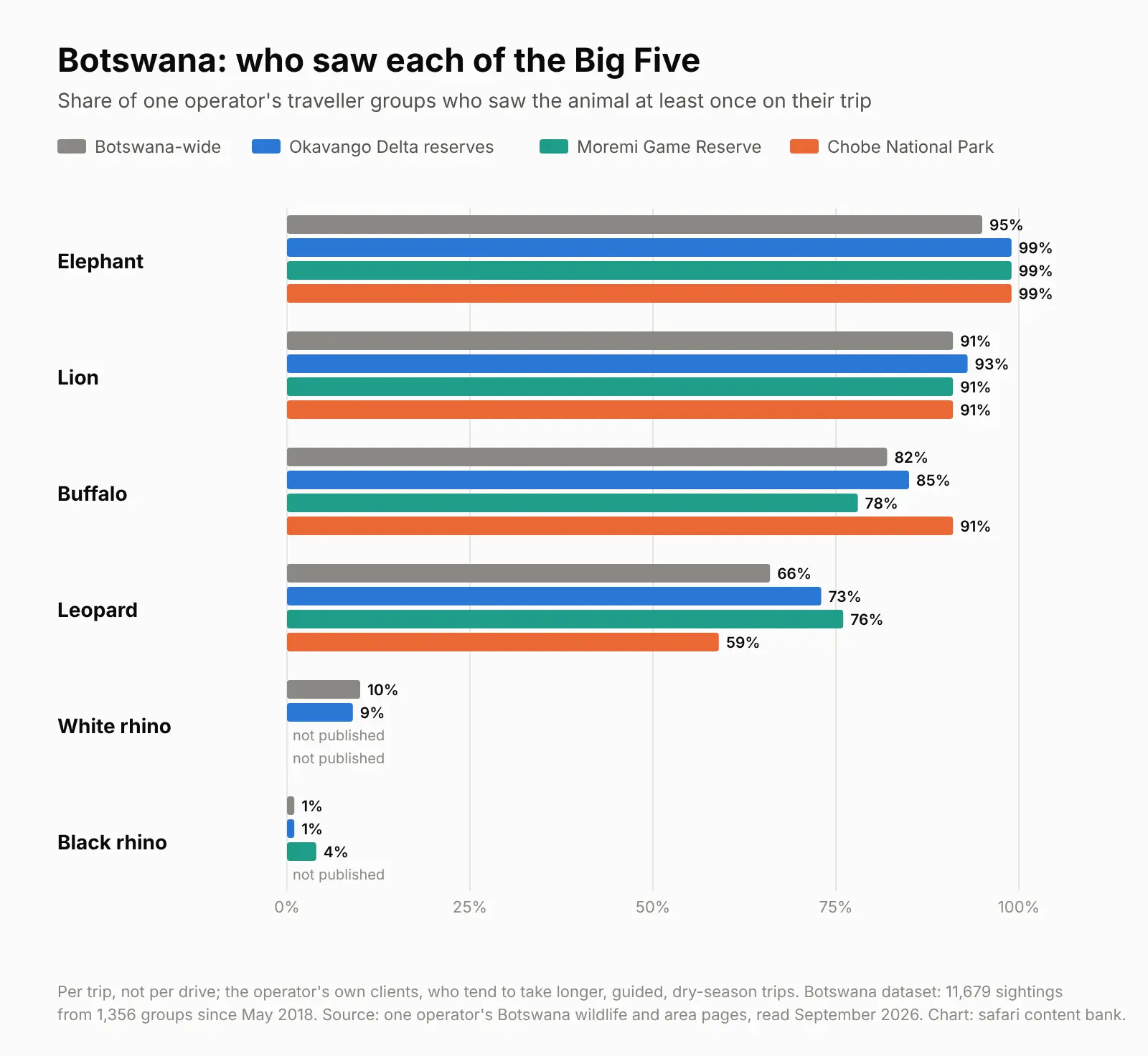 Traveller-reported, per trip. Source: one operator’s sighting data, read September 2026. Chart: safari content bank.
- Read these as best-case numbers. They come from one operator’s own clients, who tend to take longer, guided, dry-season trips, and the operator does not publish how many groups each regional figure rests on (Moremi vs Chobe).
- Moremi is the leopard pick, Chobe the buffalo pick: leopard 76% against 59%, buffalo 78% against 91%.
- One seller says rhino in Botswana are “rare or absent; you might well struggle to see one” (its Big Five guide). Botswana had 345 rhinos at the end of 2024 (IUCN, 2025).
- Khama Rhino Sanctuary near Serowe is the usual place to add rhino (Botswana safari questions).
- Chobe and Moremi share one park fee line: P270 per non-resident adult a day in the last published DWNP schedule (1 April 2022). In February 2026 BOPA called the existing fee P380; no official current tariff is published (Chobe park fees).
More: Okavango Delta, Chobe, Botswana safari cost.
What a Big Five day costs
In park fees alone, a Big Five day costs from R692 per adult in Kruger (R602 until 31 October 2026) to US$218.30 each for two people sharing a vehicle in Ngorongoro Crater (our sum). Beds, vehicle and guide are extra except where stated.
| Place | All five? | Fee per adult per day | Cheapest bed in our sources | Source |
|---|---|---|---|---|
| Kruger National Park | Yes | R692 (R602 until 31 Oct 2026) | Pretoriuskop campsite: R1,712 a night for two adults with fees (Oct 2026) | SANParks; Kruger |
| Sabi Sand | Yes | R170 per person + R370 per car, per entry | Elephant Plains R7,300 per person sharing (2026) | Sabi Sand access; Sabi Sand vs Timbavati |
| Timbavati | Yes | R660 levy per adult per night (catered lodges) | Umlani R7,761 per person sharing (2026) | Timbavati |
| Ngorongoro Crater | Yes | US$70.80 + US$295 per vehicle per descent | Rim lodges pay a US$59 concession per person per night | NCAA (undated, read 9 Oct 2026) |
| Serengeti + Moru rhino | Rhino on add-on | US$82.60 + US$118 per trip | Camps US$250–3,220 per person a night (2026) | TANAPA 2023/24, last published; Serengeti |
| Masai Mara | Rhino scarce | US$100 (Jan–Jun); US$200 (Jul–Dec) | Camps US$115–2,028 per person a night (2026) | Narok County FY2025/26, last published; Masai Mara |
| Ol Pejeta (rhino stop) | Rhino | US$110, VAT included | Not in our sources | OPC Tariff Guide 2026 |
| Lake Nakuru (rhino stop) | Rhino | US$90 per 24 h | Not in our sources | KWS LN 160/2025 |
| Etosha | No buffalo | N$280 + N$60 per car | Camping inside N$460–560 per person a night | GN 115 of 2026; Etosha |
| Chobe or Moremi | Rhino scarce | P270 (last published, 2022) | Kasane lodges US$273–550 a night (2026) | DWNP via Tourism Update; Moremi vs Chobe |
Non-resident or international adult. Fees copied from our cost and park-fee pages, read 8–10 October 2026. Lodge prices per person sharing unless stated.
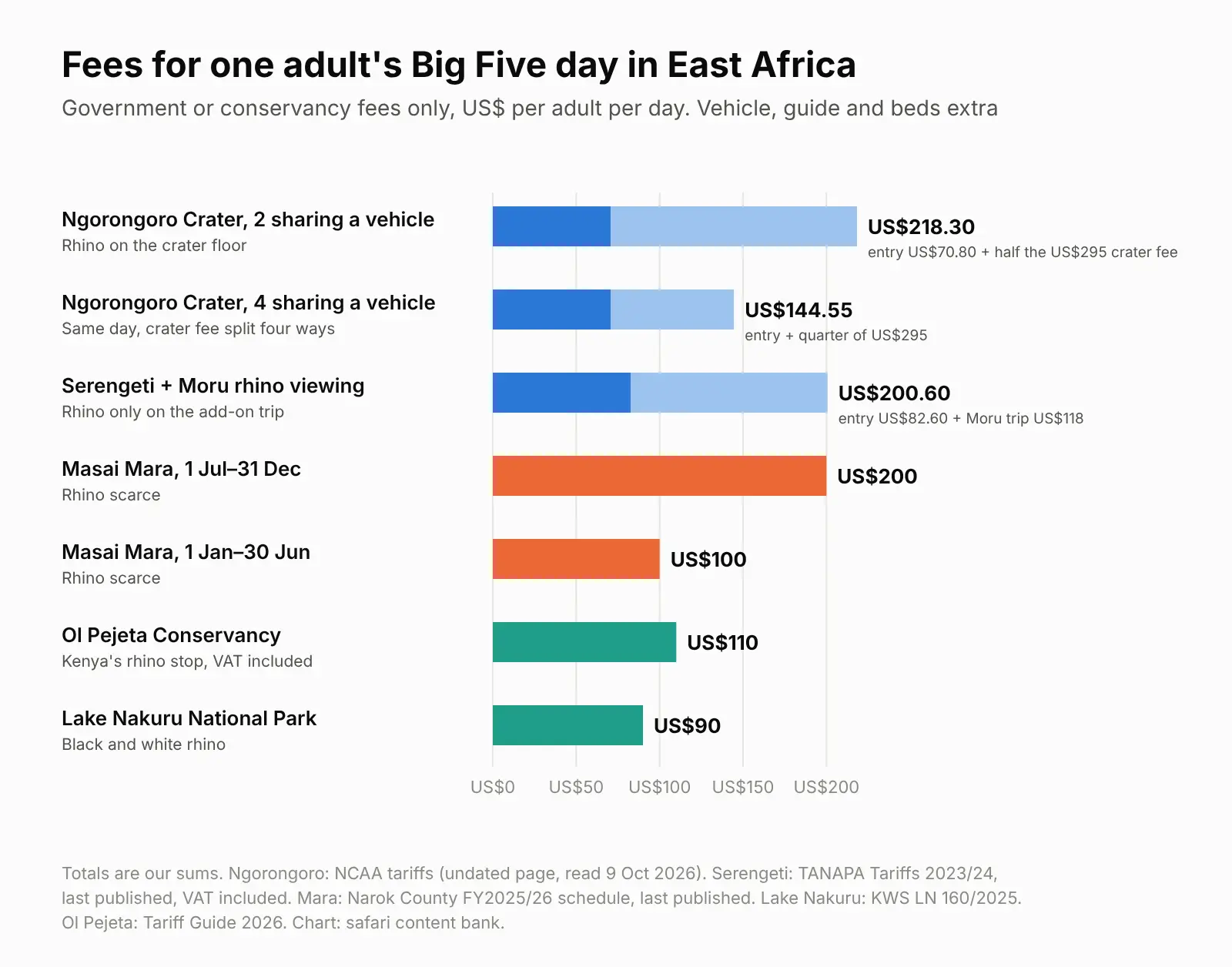 Totals are our sums. Sources: NCAA tariffs (undated, read 9 October 2026); TANAPA Tariffs 2023/24 (last published); Narok County FY2025/26 (last published); KWS LN 160/2025; OPC Tariff Guide 2026. Chart: safari content bank.
The official fee lines, with the date each took effect and the authority’s own source:
| Fee | Amount | In force from | Source |
|---|---|---|---|
| Kruger National Park daily conservation fee, international adult (12+), per day | ZAR 602 | 1 Nov 2025 to 31 Oct 2026 (SANParks 2025/26 schedule) | SANParks daily conservation fees 2025/26 |
| Kruger National Park daily conservation fee, international adult (12+), per day | ZAR 692 | 1 Nov 2026 to 31 Oct 2027 (SANParks 2026/27 schedule, already published) | SANParks daily conservation fees 2026/27 |
| Sabi Sand Nature Reserve gate fee, per person, per entry (VAT included) | ZAR 170 (ZAR 180 in 2027) | 1 Jan to 31 Dec 2026 | Sabi Sand Nature Reserve, access and gate fees |
| Sabi Sand Nature Reserve gate fee, light vehicle under 3,500 kg, per entry (VAT included) | ZAR 370 (ZAR 390 in 2027) | 1 Jan to 31 Dec 2026 | Sabi Sand Nature Reserve, access and gate fees |
| Timbavati Private Nature Reserve conservation levy, fully catered lodges, per adult (12+) per night | ZAR 660 (child ZAR 330) | 1 Jan to 31 Dec 2026 | Timbavati Private Nature Reserve, getting here |
| Ngorongoro Conservation Area, non-East African adult, entry per 24 h (single entry) | USD 70.80 (NCAA's page does not say whether VAT is included) | Undated official page, read 9 Oct 2026 | NCAA |
| Ngorongoro Crater descent (crater service fee), per vehicle | USD 295 (NCAA's page does not say whether VAT is included) | Undated official page, read 9 Oct 2026 | NCAA |
| Ngorongoro concession fee, rim and Ndutu lodges, per person per night | USD 59 (NCAA's page does not say whether VAT is included) | Undated official page, read 9 Oct 2026 | NCAA |
| Serengeti and Nyerere National Parks, non-East African adult, entry per day, 16 May–14 Mar | USD 70 + 18% VAT = USD 82.60 | 1 Jul 2023 (2023/24 tariff, last published) | TANAPA Tariffs 2023/24 |
| Maasai Mara National Reserve, non-resident adult, per day (12-hour ticket, 06:00–18:00), 1 Jan–30 Jun | USD 100 | Since 1 Jan 2024; Narok County FY2025/26 schedule, the last published | Narok County fee schedule FY2025/26 |
| Maasai Mara National Reserve, non-resident adult, per day (12-hour ticket, 06:00–18:00), 1 Jul–31 Dec | USD 200 | Since 1 Jul 2024; Narok County FY2025/26 schedule, the last published, expired 30 Jun 2026 (no 2026/27 schedule as of 9 Oct 2026); The Kenya Times (6 Aug 2026, secondary) reports US$200 still applies for Jul–Dec 2026 | Narok County fee schedule FY2025/26 |
| Amboseli and Lake Nakuru National Parks (KWS), non-resident adult, per 24 hours | USD 90 (child under 18, 5 and under free, USD 45) | 1 Oct 2025 (Legal Notice 160 of 2025) | KWS Fees Regulations 2025 (LN 160/2025) |
| Nairobi, Tsavo East and Tsavo West National Parks (KWS), non-resident adult, per 24 hours | USD 80 (child under 18, 5 and under free, USD 40) | 1 Oct 2025 (Legal Notice 160 of 2025) | KWS Fees Regulations 2025 (LN 160/2025) |
| Ol Pejeta Conservancy, non-resident adult, per day (24 hours for overnight guests) | USD 110, VAT included (child 3–11 USD 55) | 2026 tariff | Ol Pejeta Conservancy Tariff Guide 2026 |
| Tier 1 parks (Etosha, Namib-Naukluft including Sossusvlei, Skeleton Coast, Ai-Ais/Fish River Canyon, Waterberg Plateau, Cape Cross, Dorob, Tsau //Khaeb), foreign adult 16+, per person | NAD 280 (NAD 140 park entrance + NAD 140 conservation fee) | 1 Apr 2026 (Government Notice 115 of 2026; the notice prices fees per person with no period; MEFT's 2021 schedule made fees valid for 24 hours from entry); was NAD 150 under the 2021 schedule | Government Gazette 8877 (Government Notice 115 of 2026), hosted by the Legal Assistance Centre |
| Tier 2 parks (Bwabwata, Mudumu, Nkasa Rupara, Khaudum, Mangetti, Popa Falls, Daan Viljoen, Hardap, Naute, Von Bach, South West Nature Reserve), foreign adult 16+, per person | NAD 200 | 1 Apr 2026 (Government Notice 115 of 2026; the notice prices fees per person with no period; MEFT's 2021 schedule made fees valid for 24 hours from entry); was NAD 100 | Government Gazette 8877 (Government Notice 115 of 2026), hosted by the Legal Assistance Centre |
| Vehicle up to 10 seats, most national parks (N$50 at Sandwich Harbour), per vehicle | NAD 60 | 1 Apr 2026 (Government Notice 115 of 2026; the notice states no period; MEFT's 2021 schedule made fees valid for 24 hours from entry); was NAD 50 | Government Gazette 8877 (Government Notice 115 of 2026), hosted by the Legal Assistance Centre |
| Chobe National Park and Moremi Game Reserve (DWNP), non-resident adult, per person per day | BWP 270 (SADC residents BWP 205; Botswana citizens and residents BWP 30) | Last published DWNP schedule, 1 April 2022 (via Tourism Update). In Feb 2026 the government news agency BOPA called the existing non-resident fee P380; a P500 rise was announced, then reported postponed. No official current tariff: confirm with DWNP or your operator | Tourism Update, 23 Feb 2022 (DWNP fee schedule) |
What changes your chances of seeing all five
Time, night drives and off-road rules matter more than the park’s name, because leopard and rhino are the two you are most likely to miss. Leopards do most of their hunting between sunset and sunrise (Wikipedia, African leopard, citing Hamilton 1976; secondary).
| Where | Night drives | Off-road driving | Source |
|---|---|---|---|
| Greater Kruger private reserves (Sabi Sand, Timbavati) | Yes, guided, lodge guests | Yes | Kruger |
| Serengeti, Ngorongoro | No | No | Kenya vs Tanzania |
| Masai Mara reserve | No (sold in the conservancies) | No, except to approach big cats, no closer than 25 m | Masai Mara |
| Mara conservancies | Yes | Yes | Masai Mara |
| Chobe, Moremi | No | No | Botswana Tourism |
| Etosha | Only on a guided NWR night drive | No driving after dark otherwise | Etosha |
- Give it nights. The seller’s claim for Sabi Sand is all five “within a couple of days”; one operator’s Botswana rates count a whole trip, not one drive.
- Go in the dry season for waterhole parks. A safari booking site rates May–October as Etosha’s best months because water is limited to a few waterholes and the grass is short (Etosha).
- Do not expect rhino locations. Lodges rarely publicise where rhino are, for security, and we never publish them (Where to see rhino).
Common mistakes about the Big Five
| What you’ll often read | What is correct |
|---|---|
| “Etosha has the Big Five” | It has four. Cape buffalo are kept out by veterinary policy. |
| “Botswana is a Big Five destination” | Rhino is rare: 10% of one operator’s groups saw a white rhino and 1% a black rhino. |
| “You’ll see all five in the Masai Mara” | Rhino are hard to see in the Mara, by forum regulars’ reports. Add Ol Pejeta, Lake Nakuru or Nairobi National Park. |
| “The Serengeti is a Big Five park like Ngorongoro” | Rhino in the Serengeti are seen mainly on TANAPA’s Moru rhino trip (US$118 per trip, last published tariff, 2023/24). |
| “Kruger has 1,600 lions” | That is a 2009–2011 census figure (1,620–1,720); no current count is in our sources. |
| “The Ngorongoro crater fee is per person” | It is US$295 per vehicle per descent, on top of US$70.80 entry per adult. |
| “Malaria-free means no Big Five” | Madikwe, Pilanesberg and the Eastern Cape reserves are malaria-free Big Five reserves; Kruger is in a malaria risk area. |
| “The Big Five are Africa’s five biggest or rarest animals” | The name comes from big-game hunting, for the five prize trophies; it says nothing about size or rarity (one tour operator’s guide). Cheetah, wild dog, giraffe and hippo are not on it. |
Frequently asked questions
Which national park has all of the Big Five? Kruger National Park in South Africa and Ngorongoro Crater in Tanzania both hold all five, as do the private reserves on Kruger’s open western boundary such as Sabi Sand and Timbavati. Kruger charges R692 per international adult a day from 1 November 2026 (R602 until 31 October 2026); Ngorongoro charges US$70.80 per adult plus US$295 per vehicle for the crater.
Where is the best place to see the Big Five? Sellers name the private reserves bordering Kruger: one calls them “perhaps Africa’s most reliable Big 5 sightings” and says Sabi Sand “generally delivers all five within a couple of days”. These are a seller’s claims; no published sighting statistics for those reserves are in our sources.
Can you see the Big Five in Kenya? Yes, but usually in two places. The Masai Mara has lion, leopard, elephant and buffalo, but forum regulars report rhino are hard to see there; add Ol Pejeta (US$110 per adult per day), Lake Nakuru (US$90) or Nairobi National Park (US$80) for rhino.
Does Etosha have the Big Five? No, it has four: lion, leopard, elephant and rhino. Cape buffalo are kept out to protect Namibia’s foot-and-mouth-free livestock exports. In Namibia buffalo are found in the Zambezi Region parks, such as Nkasa Rupara.
Can you see the Big Five in Botswana? Four reliably, rhino rarely. Of one operator’s traveller groups in Botswana, 95% saw elephant, 91% lion, 82% buffalo and 66% leopard, but 10% saw a white rhino and 1% a black rhino. Khama Rhino Sanctuary near Serowe is the usual place to add rhino.
Which of the Big Five is hardest to see? Rhino, in most parks, and leopard where night drives are not allowed. Africa had 6,788 black and 15,752 white rhino at the end of 2024 (IUCN, 2025), most of them in South Africa, and leopards do most of their hunting at night.
How much does a Big Five day cost? In park fees, from R692 per adult in Kruger (R602 until 31 October 2026) to US$218.30 each for two sharing a vehicle in Ngorongoro Crater (our sum). Beds and guiding are extra: two adults camping at Kruger’s Pretoriuskop pay R1,892 a night with fees from 1 November 2026 (October 2026 site price), and the cheapest published 2026 Sabi Sand bed is R7,300 per person sharing.
Sources
- Rhino numbers: IUCN SSC African and Asian Rhino Specialist Groups and TRAFFIC, report to CITES CoP20 (PDF), 2025; Save the Rhino, poaching statistics; The Star / Xinhua, 22 Sep 2026
- South Africa: SANParks daily conservation fees 2025/26 and 2026/27; SANParks, rhino poaching statement; Sabi Sand access; Timbavati, getting here
- Tanzania: NCAA tariffs (undated, read 9 Oct 2026); TANAPA Tariffs 2023/24 (PDF), the last published tariff
- Kenya: Narok County fee schedule FY2025/26 (PDF), the last published; KWS Fees Regulations 2025, LN 160/2025 (PDF); Ol Pejeta Tariff Guide 2026 (PDF); traveller reports on TripAdvisor, Aug 2026 and a safari booking site (names and links kept in our editor notes)
- Namibia: Government Notice 115 of 2026 (PDF); a safari agent’s Etosha guide, read September 2026; a safari booking site’s wildlife pages for Etosha, Nkasa Rupara, Bwabwata and Mudumu (names and links kept in our editor notes)
- Botswana: one operator’s sighting pages for Botswana, the Okavango Delta reserves, Moremi and Chobe (read September 2026); Tourism Update, DWNP fees, 23 Feb 2022; Botswana Tourism, game drives (names and links kept in our editor notes)
- Sellers and secondary sources: one seller’s Big Five guide; another seller’s first-safari guide; a tour operator’s Big Five guide (undated); Wikipedia, African leopard (names and links kept in our editor notes)
More on where to see each animal: lions, leopards, cheetahs, elephants and wild dogs.
Fees and sighting rates checked 10 October 2026. We will update this page when SANParks’ 2026/27 fees take effect on 1 November 2026, when TANAPA or Narok County publish new fee schedules, when DWNP publishes a current Botswana tariff, and when the operator’s sighting rates change.