 Experience

Last verified · Next check due
On this page
- Where is the malaria risk on safari, country by country?
- Which months carry malaria risk on safari?
- East Africa: Kenya, Tanzania, Zanzibar, Rwanda and Uganda
- Southern Africa: Botswana, Namibia and South Africa
- Zambia and Zimbabwe: what we could not confirm
- Avoiding bites, and the tablets question
- Common mistakes about malaria on safari
- Frequently asked questions
- Sources
Short answer: Yes in most safari areas. WHO lists malaria risk all year in the whole of Kenya and Rwanda, and in Tanzania, Zanzibar included, below 1,800 m. In southern Africa it is regional and seasonal: northern Botswana October–May (TravelHealthPro), six northern Namibian regions November–June (WHO), Kruger November–April (SANParks). We hold no official malaria detail for Uganda, Zambia or Zimbabwe. Sources read 8–10 October 2026.
Key facts
- Kenya: “risk due predominantly to P. falciparum exists throughout the year in the entire country”, with low risk only in Nairobi and in highlands above 2,500 m (WHO country list, 2022, rev. 3 Jan 2023 (PDF)).
- Tanzania, Zanzibar included: risk “exists throughout the year in the entire country below 1800 m” (WHO). The Serengeti, Tarangire, Nyerere, Ruaha and Zanzibar are all below 1,800 m; the Ngorongoro crater rim is above it.
- Botswana is split by season and region: UK TravelHealthPro rates the northern half, including the Okavango Delta, high risk from October to May and low risk from June to September, and the southern half very low risk all year (TravelHealthPro, Botswana).
- No malaria vaccine is made for travellers. WHO’s two malaria vaccines, RTS,S (2021) and R21 (2023), are for children living in endemic areas (WHO malaria fact sheet).
- Uganda, Zambia and Zimbabwe: no official areas or months in our sources. The WHO list could not be read for them, and the CDC and TravelHealthPro pages could not be opened for this check.
- This page states where and when official sources place the risk. It gives no tablet or vaccine advice; yellow fever rules are on a separate page, yellow fever certificate by country.
Where is the malaria risk on safari, country by country?
In Kenya, Tanzania and Rwanda the official sources place risk across the safari areas all year; in Botswana, Namibia and South Africa they limit it to named regions and seasons. For Uganda, Zambia and Zimbabwe the table says what we could not confirm.
| Country | Where the risk is | When | Source (date) |
|---|---|---|---|
| Kenya | Entire country; low risk only in Nairobi and highlands above 2,500 m | All year; mainly P. falciparum | WHO list (PDF), 2022, rev. 3 Jan 2023; read 8 Oct 2026 |
| Tanzania (incl. Zanzibar) | Entire country below 1,800 m, Zanzibar included | All year; mainly P. falciparum | WHO list, Tanzania entry; read 9 Oct 2026 |
| Rwanda | Whole country | All year; mainly P. falciparum | WHO list; read 8 Oct 2026 |
| Uganda | Not in our sources | Not in our sources | WHO entry could not be read; CDC and TravelHealthPro not opened (Oct 2026) |
| Zambia | Not in our sources | Not in our sources | The US State Department’s Zambia page (dated 3 Sep 2025) recommends prophylaxis for all travellers, even short stays, but names no areas or months |
| Zimbabwe | Not in our sources | Not in our sources | The US State Department’s Zimbabwe page (dated 11 Apr 2022) advises prophylaxis but names no areas or months |
| Botswana | Northern half, including the Okavango Delta (TravelHealthPro); WHO names the districts of Bobirwa, Boteti, Chobe, Ngamiland, Okavango and Tutume. Southern half: very low risk all year | North: high October–May, low June–September (TravelHealthPro). WHO: November to May/June | TravelHealthPro, Botswana, read Sep–Oct 2026; WHO list, read 8 Oct 2026 |
| Namibia | Ohangwena, Omaheke, Omusati, Oshana, Oshikoto and Otjozondjupa regions; along the Kunene, Zambezi and Okavango rivers. Not listed for the coast, Sossusvlei or the south | Six regions November–June; river areas all year (WHO). Swiss TPH: advice extended to June–August in 2026 | WHO list, read 8 Oct 2026; HealthyTravel, Swiss TPH, read Sep 2026 |
| South Africa | Kruger and Mapungubwe are the only SANParks parks in malaria risk areas; the Greater Kruger private reserves share Kruger’s zone | Highest November–April, “generally low, even in summer” (SANParks); TravelHealthPro season September–May | SANParks, Kruger malaria; TravelHealthPro, South Africa; read 8–10 Oct 2026 |
Official health pages read 8–10 October 2026, except TravelHealthPro Botswana and Swiss TPH Namibia, first read in September 2026 and rechecked against our existing pages in October. WHO’s 2022 country list (revised 3 January 2023) is the latest edition on who.int; its entries for Uganda, Zambia, Zimbabwe and South Africa were cut off in the copy we read. The CDC Travelers’ Health pages could not be opened for this check. “Not in our sources” means we hold no official answer, not that there is no risk.
Which months carry malaria risk on safari?
Every month in Kenya, Tanzania and Rwanda; in southern Africa the named risk seasons start in October or November and end in April, May or June, depending on the area and the source. No official source in our bank calls any of the seasonal areas risk-free in the dry months.
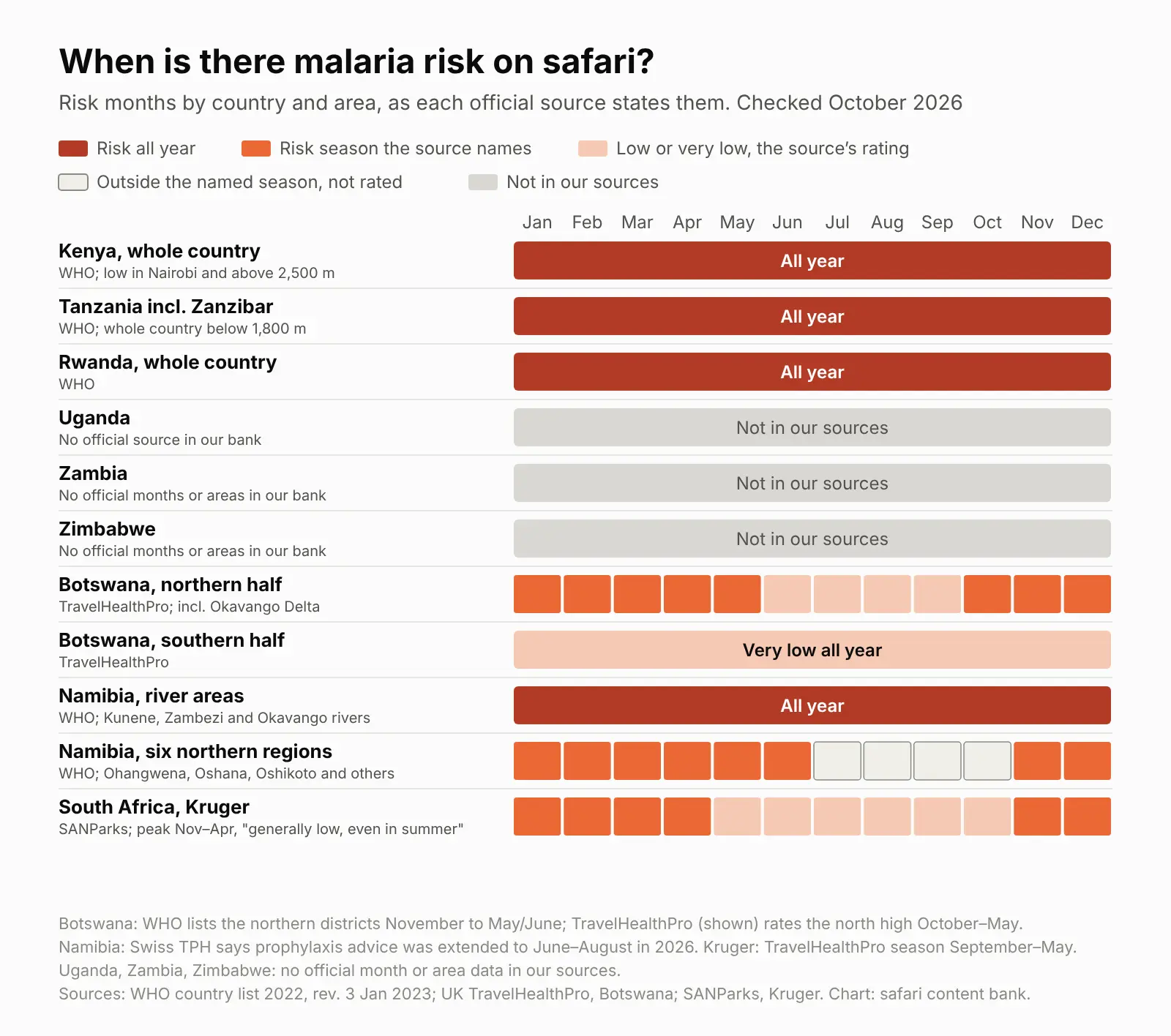 Sources: WHO country list 2022, rev. 3 Jan 2023; UK TravelHealthPro, Botswana; SANParks, Kruger malaria page; Swiss TPH HealthyTravel, Namibia. Checked October 2026. Chart: safari content bank.
- Botswana: the two official sources differ by a month at each end. TravelHealthPro rates the north high risk from October to May; WHO lists the northern districts from November to May/June.
- Namibia: WHO’s season for the six northern regions is November to June. Swiss TPH says that, because of increased rainfall and case numbers, prophylaxis advice in the seasonal-risk regions was temporarily extended to cover June–August 2026 (HealthyTravel, Swiss TPH). A dry-season trip in 2026 was not outside the advice.
- Kruger: SANParks puts the highest risk in November–April and says the risk is “generally low, even in summer”; it exempts no month (SANParks).
- Month by month: each of our month guides has a malaria row by area: January, February, March, April, May, June, July, August, September, October, November, December.
East Africa: Kenya, Tanzania, Zanzibar, Rwanda and Uganda
For Kenya, Tanzania and Rwanda, WHO places every safari area in the year-round risk zone; for Uganda we hold no official malaria source. The dominant parasite in all three WHO entries is P. falciparum.
- Kenya: risk all year across the country; WHO rates only Nairobi and highlands above 2,500 m as low risk. Every safari area and the coast are inside the risk zone. More on is a Kenya safari safe? and Kenya safari questions.
- Tanzania: risk all year below 1,800 m (WHO). That covers the Serengeti, Tarangire, Nyerere, Ruaha and Zanzibar; the Ngorongoro crater rim and upper Kilimanjaro are above 1,800 m. More on is a Tanzania safari safe? and Tanzania safari and Zanzibar.
- Rwanda: risk all year in the whole country, mainly P. falciparum (WHO). More on Rwanda safari questions.
- Uganda: not in our sources. The WHO entry could not be read, and neither CDC nor TravelHealthPro could be opened. Uganda safari questions says the same.
Southern Africa: Botswana, Namibia and South Africa
Botswana, Namibia and South Africa each have large areas with no listed or very low risk, and smaller northern or north-eastern zones with seasonal or year-round risk. These are the three countries where the itinerary changes the answer.
- Botswana: the Okavango Delta, Chobe and the rest of the north are high risk from October to May and low risk from June to September; the southern half is very low risk all year (TravelHealthPro). More on Botswana safari questions.
- Namibia: WHO lists risk from November to June in Ohangwena, Omaheke, Omusati, Oshana, Oshikoto and Otjozondjupa, and all year along the Kunene, Zambezi and Okavango rivers. It does not list the coast, Sossusvlei or the south. Swiss TPH names the Zambezi Region (Caprivi), eastern Kavango East, northern Kavango West and eastern Ohangwena as year-round high-risk zones. More on Namibia safari questions.
- South Africa: SANParks says Kruger and Mapungubwe are its only two parks in malaria risk areas. Reserves outside the risk area, with their fees and child rules, are on malaria-free safaris in South Africa; Kruger month by month is on South Africa safari questions.
Zambia and Zimbabwe: what we could not confirm
We hold no official source that names malaria areas or months for Zambia or Zimbabwe, so this page gives none. The only official lines in our bank are general.
- Zambia: the US State Department recommends prophylaxis for all travellers, even short stays (Zambia country information, dated 3 September 2025).
- Zimbabwe: the US State Department advises prophylaxis (Zimbabwe country information, dated 11 April 2022).
- Victoria Falls, the Zambezi Valley, South Luangwa and Hwange: no official area or season detail in our sources. Our Zambia safari questions and Zimbabwe safari questions pages report what an operator and a travel site say, labelled as such.
Avoiding bites, and the tablets question
This page is not medical advice: see a travel-health clinic or your doctor about which antimalarial and which vaccines to take. WHO advises seeing a doctor several weeks before you leave, because some preventive drugs start 2–3 weeks before travel and continue for 4 weeks after you leave (WHO malaria fact sheet).
- Bite prevention: WHO lists bed nets, repellents containing DEET, IR3535 or icaridin, and clothing that covers the skin (WHO fact sheet). UK TravelHealthPro makes avoiding bites “day and night” the core protection (TravelHealthPro, Kenya); what to pack for it is on our safari packing list.
- Vaccines: there is no malaria vaccine for travellers; RTS,S and R21 are for children living in endemic areas (WHO). Yellow fever is a separate disease with its own border rules: yellow fever certificate by country.
- Children: our family safari page sets out which reserves sit outside the risk areas and the camps’ age rules.
- Entry paperwork: visas and compulsory insurance are on the Kenya visa, Tanzania visa, Botswana visa and Namibia visa pages.
Common mistakes about malaria on safari
| What you’ll often read | What the sources say |
|---|---|
| “Malaria is only a rainy-season problem” | Not in East Africa. WHO lists risk all year in Kenya, Rwanda and Tanzania below 1,800 m. |
| “Zanzibar and the Kenya coast are malaria-free” | Both are in the risk zone. WHO’s Tanzania entry covers the whole country below 1,800 m, Zanzibar included; its Kenya entry rates only Nairobi and highlands above 2,500 m as low risk. |
| “The whole of Botswana is malarial all year” | The north is high risk October–May and low risk June–September; the south is very low risk all year (TravelHealthPro). |
| “Namibia’s winter is always outside the malaria season” | Not in 2026: Swiss TPH says advice was extended to June–August 2026, and WHO lists the river areas all year. |
| “Kruger is malaria-free in winter” | No source says so. SANParks calls the risk “generally low, even in summer”, with a November–April peak, and exempts no month. |
| “There’s a malaria vaccine for travellers” | No. WHO’s RTS,S and R21 vaccines are for children living in endemic areas. |
| “The yellow fever jab covers malaria” | They are different diseases. Yellow fever rules: yellow fever certificate by country. |
Frequently asked questions
Is there malaria on a Kenya safari? Yes. WHO says risk, mainly P. falciparum, exists all year in the entire country, with low risk only in Nairobi and highlands above 2,500 m. Every safari park and the coast are inside the risk zone.
Is there malaria in the Serengeti and on Zanzibar? Yes, all year. WHO lists risk throughout Tanzania below 1,800 m, and both the Serengeti and Zanzibar are below that height. Only high ground such as the Ngorongoro crater rim is above it.
Is there malaria in the Okavango Delta in the dry season? The risk is rated low, not nil. TravelHealthPro rates northern Botswana, including the Delta, high risk from October to May and low risk from June to September.
Which safari areas have no listed malaria risk? In our sources: SANParks parks other than Kruger and Mapungubwe, the South African reserves on our malaria-free safaris page, and Namibia’s coast, Sossusvlei and south, which WHO does not list. TravelHealthPro rates southern Botswana very low risk all year.
Is there malaria on a gorilla trek in Rwanda or Uganda? For Rwanda, WHO lists risk all year in the whole country. For Uganda, we hold no official malaria source, so this page gives no answer.
Is there malaria at Victoria Falls? Not in our sources: we hold no official page that names areas or months for Zambia or Zimbabwe. The US State Department recommends prophylaxis for travellers to Zambia and advises it for Zimbabwe.
Do I need malaria tablets for a safari? This page does not answer that, because it is a medical decision; the note under “Avoiding bites” says who to ask. WHO’s advice is to see a doctor several weeks before you leave, since some preventive drugs start 2–3 weeks before travel.
Sources
- WHO, Vaccination requirements and recommendations for international travellers, country list (PDF), 18 Nov 2022, revised 3 Jan 2023: Kenya, Tanzania, Rwanda, Botswana and Namibia entries
- WHO, Malaria fact sheet: travellers’ advice, bite prevention, vaccines
- UK NaTHNaC, TravelHealthPro: Botswana, South Africa, Kenya
- Swiss Tropical and Public Health Institute, HealthyTravel, Namibia
- SANParks, Kruger malaria
- US State Department, Zambia country information (dated 3 Sep 2025) and Zimbabwe country information (dated 11 Apr 2022)
Official pages read 8–10 October 2026; page checked against our content bank on 17 October 2026. The CDC Travelers’ Health pages could not be opened for this check. We will update this page when WHO publishes a new country list, when Swiss TPH ends or extends Namibia’s 2026 dry-season advice, and once we have read an official malaria source for Uganda, Zambia and Zimbabwe.