 Experience

Last verified · Next check due
On this page
- Where to see rhino: the places, species and fees (2026)
- Black rhino or white rhino: how to tell them apart
- How many rhinos are there, and where?
- East Africa: Ngorongoro, Ol Pejeta, Lewa and Lake Nakuru
- South Africa: Kruger and the private reserves
- Namibia: Etosha waterholes and rhino tracking on foot
- Botswana: the Okavango Delta and Khama Rhino Sanctuary
- Zimbabwe and Zambia: rhino on foot near Bulawayo and Victoria Falls
- What it costs to add rhino to a safari
- Why we never publish where a rhino is
- Common mistakes about seeing rhino
- Frequently asked questions
- Sources
Short answer: Africa had 6,788 black and 15,752 white rhino at the end of 2024 (IUCN SSC African Rhino Specialist Group report to CITES, 2025), and South Africa held 14,389 of them. Black rhino are seen in Ngorongoro Crater (Tanzania), at Ol Pejeta, Lake Nakuru and Nairobi National Park (Kenya) and at Etosha’s waterholes (Namibia). White rhino are seen in Kruger and its private reserves (South Africa). In Botswana’s Okavango Delta, only 9% of travellers saw a white rhino (one operator).
Key facts
- Africa’s rhino count at the end of 2024 was 6,788 black and 15,752 white, according to the IUCN SSC African and Asian Rhino Specialist Groups and TRAFFIC in their 2025 report to CITES; Save the Rhino and the International Rhino Foundation (IRF) give the same totals.
- Four countries hold 95% of Africa’s rhinos: South Africa 14,389, Namibia 3,598, Kenya 2,102 and Zimbabwe 1,320 at the end of 2024 (same report; 21,409 of 22,540 is our sum).
- White rhino are falling and black rhino are not: the white rhino count dropped from 17,464 at the end of 2023 to 15,752 at the end of 2024 (IRF, State of the Rhino 2026).
- Botswana is not a reliable rhino country: Botswana had 345 rhinos at the end of 2024 (IUCN), and 10% of one operator’s travelling groups there saw a white rhino and 1% a black rhino.
- Rhino tracking on foot is not allowed inside Etosha National Park; it is sold on private reserves on its boundary and in Namibia’s Kunene region, where guides track free-roaming black rhino.
- We do not publish where individual rhino are, and lodges do not either. Strip location data from rhino photos before you post them.
Where to see rhino: the places, species and fees (2026)
Black rhino are the harder species to see and are found mainly in Ngorongoro, Kenya’s rhino sanctuaries and Namibia; white rhino are concentrated in South Africa, which held 12,082 of Africa’s 15,752 at the end of 2024 (IUCN). The table lists the places our pages cover, what you see there and the fee that buys you a day.
| Place | Country | Rhino | How you see them | Fee to be there, per adult | Source |
|---|---|---|---|---|---|
| Ngorongoro Crater | Tanzania | Black | Game drive on the crater floor; no night drives | US$70.80 per 24 h + US$295 per vehicle per descent | NCAA tariffs, undated page, read 9 Oct 2026 |
| Moru Kopjes, Serengeti | Tanzania | Black | “Special rhino viewing”, sold by TANAPA | US$82.60 entry + US$118 per trip (last published tariff, 2023/24) | TANAPA Tariffs 2023/24 |
| Ol Pejeta Conservancy (Laikipia) | Kenya | Black, southern white and the last 2 northern white | Game drive; self-drive allowed | US$110 per day, VAT included | OPC Tariff Guide 2026; OPC FAQs |
| Lewa Wildlife Conservancy (Laikipia) | Kenya | Black and white | Not stated in our sources; ask your lodge | No published fee (see below) | Lewa |
| Lake Nakuru National Park | Kenya | Black and white | Game drive; Kenya’s first government rhino sanctuary (1987) | US$90 per 24 h | KWS LN 160/2025 |
| Nairobi National Park | Kenya | Black and white | Half- or full-day game drive from Nairobi | US$80 per 24 h | same |
| Kruger National Park | South Africa | White and black | Self-drive or guided | R692 (R602 until 31 Oct 2026) | SANParks 2025/26, 2026/27 |
| Sabi Sand (Greater Kruger) | South Africa | Shares Kruger’s animals; no fence since 1993 | Lodge game drives only; no day visitors | R170 per person + R370 per car per entry, plus lodge rates from R7,300 per person sharing | Sabi Sand access; Elephant Plains |
| Etosha National Park | Namibia | Black (“occasional”); white “very rare” | Waterholes by day; floodlit Okaukuejo and Halali waterholes at night for camp guests | N$280 + N$60 per car | GN 115 of 2026; a safari booking site’s Etosha page |
| Kunene / Damaraland (Palmwag) | Namibia | Black, desert-adapted, free-roaming | Tracking on foot with Save the Rhino Trust trackers | Camp rate; not in our sources | one operator’s Desert Rhino Camp page |
| Okavango Delta | Botswana | Rare: 9% of travellers saw white, 1% black | Game drive in the reserves | Not printed (no official Botswana fee document) | one operator’s traveller reports |
| Khama Rhino Sanctuary (near Serowe) | Botswana | White and black | Game drive or morning tracking with a sanctuary guide | Not printed (no current official fee in our sources) | Wikipedia (secondary); a safari seller’s Khama page |
| Matobo National Park | Zimbabwe | White and black | Tracking on foot | US$18 per day (day visitor); US$10 if staying overnight | ZimParks 2026 tariff (PDF) |
Fees per non-resident or international adult; read 8–10 October 2026. Rhino presence: NCAA and The Citizen (Ngorongoro), Ol Pejeta, Lewa and KWS sites, a safari booking site (Etosha), Save the Rhino Trust, one operator’s traveller reports, Wikipedia (Khama, Matobo; secondary). Sources are linked in each row.
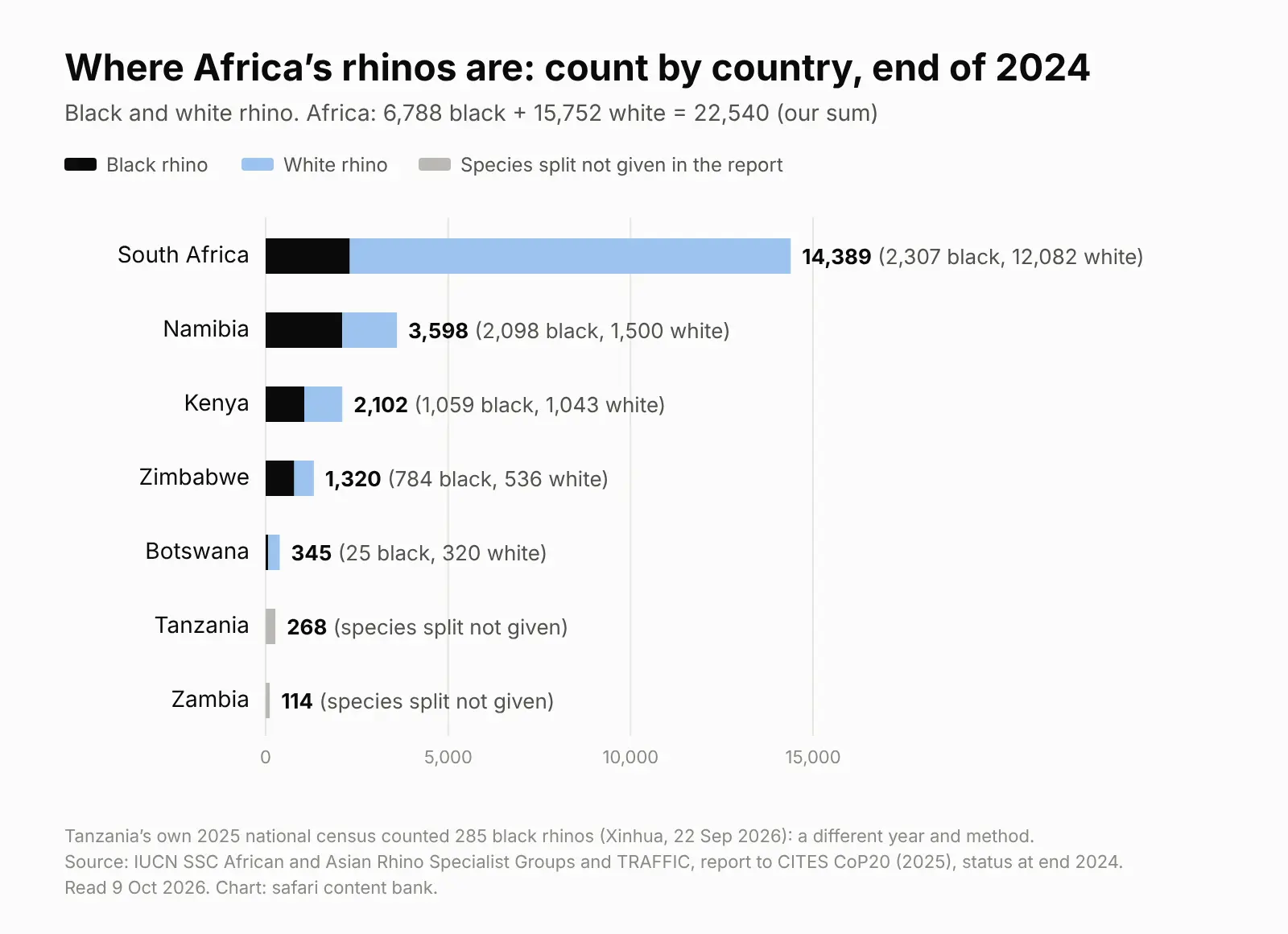 Status estimates at the end of 2024. Source: IUCN SSC African and Asian Rhino Specialist Groups and TRAFFIC, report to CITES CoP20 (2025). Chart: safari content bank.
Black rhino or white rhino: how to tell them apart
Both species are grey; the white rhino is the larger grass-eater with a square lip, and the black rhino is the smaller browser with a hooked lip. The origin of the name “white” is unknown; the story that it comes from the Dutch “wijd” (wide) is widely repeated but discredited (Wikipedia, White rhinoceros, citing Rookmaaker 2003).
| White rhino | Black rhino | |
|---|---|---|
| Lip and diet | Broad, flat upper lip; grazes short grass | Pointed, hooked upper lip; browses twigs and leaves |
| Weight | Bulls 2,000–2,300 kg; cows 1,600–1,700 kg | 800–1,400 kg |
| Head | Long, carried low; muscular hump on the neck | Shorter, held high; no neck hump |
| Social life | Groups of up to 14, mostly cows and calves | Solitary except a cow with her calf; quick to charge |
| IUCN status | Near Threatened | Critically Endangered |
| Africa, end 2024 | 15,752 (southern 15,750; northern 2) | 6,788 (south-central 2,720; south-western 2,597; eastern 1,471) |
Sources: Wikipedia, White rhinoceros and Black rhinoceros (secondary) for body and behaviour; Save the Rhino for IUCN status; IUCN SSC African Rhino Specialist Group and TRAFFIC, report to CITES CoP20 (PDF), 2025, for numbers. Read 9 October 2026.
- Each black rhino subspecies lives in a different region. The eastern black rhino is the one in Kenya and northern Tanzania; the south-western, desert-adapted one is Namibia’s; the south-central one lives in South Africa, Zimbabwe, Zambia and Malawi (Wikipedia, Black rhinoceros, secondary).
- The northern white rhino is functionally extinct: two females remain, both in Kenya (IUCN report, 2025), at Ol Pejeta (Ol Pejeta, rhinos).
- About 48% of Africa’s rhinos have been dehorned to deter poachers (IUCN report, 2025), so the rhino you see may have no horn.
How many rhinos are there, and where?
The only continent-wide count is the IUCN specialist groups’ status estimate: 22,540 rhinos at the end of 2024 (our sum of 6,788 black and 15,752 white). Parks and governments publish few counts of their own, and several withhold them for security, so we print a park figure only when it has a year and a named source.
| Country | Black rhino | White rhino | Total, end 2024 |
|---|---|---|---|
| South Africa | 2,307 | 12,082 | 14,389 |
| Namibia | 2,098 | 1,500 | 3,598 |
| Kenya | 1,059 | 1,043 | 2,102 |
| Zimbabwe | 784 | 536 | 1,320 |
| Botswana | 25 | 320 | 345 |
| Tanzania | not given | not given | 268 |
| Zambia | not given | not given | 114 |
| Africa | 6,788 | 15,752 | 22,540 (our sum) |
Source: IUCN SSC African and Asian Rhino Specialist Groups and TRAFFIC, African and Asian Rhinoceroses: Status, Conservation and Trade, report to CITES CoP20 (PDF), 2025. Continental totals confirmed on Save the Rhino and in IRF, State of the Rhino. Read 9 October 2026.
- Tanzania has two different figures, from different years and methods. The IUCN specialist groups’ estimate is 268 rhinos at the end of 2024. Tanzania’s own 2025 national census counted 285 black rhinos, as reported by Xinhua on 22 September 2026 (The Star / Xinhua).
- Namibia holds fewer black rhino than South Africa (2,098 against 2,307), but the largest free-roaming population, in the unfenced Kunene region (Save the Rhino Trust). No count for Etosha or the Kunene is published, so we print none.
- Kruger’s rhino population is down about 60% since 2013 (Save the Rhino). Rhino poaching in Kruger doubled in 2025, to 175 animals from 88 in 2024 (SANParks).
- 516 rhinos were poached in Africa in 2024, 81.4% of them in South Africa (IUCN report, 2025).
East Africa: Ngorongoro, Ol Pejeta, Lewa and Lake Nakuru
In East Africa you see rhino in Ngorongoro Crater and in Kenya’s fenced sanctuaries, not on the big migration plains. Forum regulars report that rhino are hard to see in the Masai Mara and absent from Amboseli (TripAdvisor, Aug 2026, traveller reports).
Ngorongoro Crater (Tanzania)
Black rhino live on the crater floor, and a crater day costs US$70.80 per adult plus US$295 per vehicle. Two people sharing a vehicle pay US$218.30 each in entry and crater fees, before the vehicle permit; six sharing pay US$49.17 each of the crater fee (NCAA tariffs, undated page, read 9 October 2026). Descent gates close at 16:00, all driving ends at 18:00 and there are no night drives (NCAA visitor guidelines, via our Ngorongoro page). Black rhino home ranges in Ngorongoro are 2.6–58 km², against 70–100 km² in the Serengeti (Wikipedia, secondary). Full fee breakdown: Ngorongoro Crater fees; park guide: Ngorongoro.
In the Serengeti, TANAPA sells special rhino viewing at Moru for US$118 per trip with VAT (last published tariff, 2023/24), on top of the park entry fee of US$82.60 per adult per day (US$70 + 18% VAT, 16 May–14 March). See Serengeti and, for every Tanzanian fee, Tanzania safari cost.
Ol Pejeta, Lewa and Lake Nakuru (Kenya)
Ol Pejeta is the one Kenyan rhino conservancy with a public tariff: US$110 per adult per day, VAT included. It calls itself “the largest black rhino sanctuary in East and Central Africa” and holds the last northern white rhinos (Ol Pejeta, rhinos).
- Ol Pejeta sells rhino experiences on top of entry: “Meet the Northern White Rhinos” and rhino monitoring cost US$70 per adult (OPC Tariff Guide 2026). Its gates (Rongai and Serat) are cashless and open 07:00–19:00, and leaving and re-entering needs a new entry fee.
- Lewa Wildlife Conservancy publishes no visitor fee. Its lodges charge a conservancy fee on top of the rate, but agents quote four different amounts, so we print none. Lewa says it holds black and white rhino (Lewa).
- Lake Nakuru National Park costs US$90 per adult per 24 hours (KWS, Legal Notice 160 of 2025, from 1 October 2025). KWS describes it as home to “one of the country’s largest populations of black rhinos, and white rhinos” (KWS, Lake Nakuru).
- Nairobi National Park costs US$80 per adult per 24 hours, and rhino are the main reason visitors add it to a longer safari, according to forum regulars. One guest who stayed two days inside the park saw 16 rhino (TripAdvisor, traveller report). See Nairobi National Park day trip.
All Kenyan fees and camp prices: Kenya safari cost; more on rhino in Kenya: Kenya safari questions.
See also: Laikipia vs Masai Mara.
South Africa: Kruger and the private reserves
South Africa held 14,389 rhinos at the end of 2024, 64% of Africa’s total (our sum), and Kruger with its private reserves is where most travellers look for them. Kruger charges R692 per international adult per day from 1 November 2026 (R602 until 31 October 2026) (SANParks).
- Kruger is a self-drive park; the private reserves are guided only. In a private reserve such as Sabi Sand you go out on guided drives in open vehicles, off-road and at night, as part of the lodge stay (Kruger).
- Sabi Sand and Kruger have had no fence between them since 1993, so animals cross freely. Sabi Sand charges R170 per person plus R370 per car at the gate in 2026, admits lodge guests only, and its cheapest published 2026 bed is R7,300 per person sharing at Elephant Plains (Sabi Sand vs Timbavati).
- Lodges rarely publicise rhino locations or numbers, for security. Ask a lodge whether its guides see rhino on its traversing area; do not expect a count.
Fees for every South African park: South Africa safari cost and Kruger park fees.
Namibia: Etosha waterholes and rhino tracking on foot
Namibia had 2,098 black and 1,500 white rhino at the end of 2024 (IUCN), and you see them at Etosha’s waterholes or by tracking them on foot outside the park. Etosha costs N$280 per foreign adult plus N$60 per car since 1 April 2026 (Government Notice 115 of 2026); see Etosha park fees.
- Etosha’s black rhino are an “occasional” sighting and white rhino “very rare”, on a safari booking site’s rating (its Etosha wildlife page, read September 2026).
- Only guests sleeping inside can watch the floodlit waterholes at Okaukuejo and Halali at night. Okaukuejo rooms cost N$1,900–2,380 per person a night with breakfast in 2026–27 (NWR rates from a booking agent’s listing, read September 2026). Visitors may not drive after dark except on a guided NWR night drive (Etosha).
- Rhino tracking on foot is not allowed inside Etosha. Private reserves on the boundary, such as Ongava and Onguma, offer it with night drives and guided walks (Namibia safari questions).
- In the Kunene (Damaraland), Desert Rhino Camp tracks free-roaming black rhino on foot with Save the Rhino Trust trackers. It is a joint venture of Save the Rhino Trust and Wilderness, founded in 2003, on the Palmwag Concession. Guides carry no rifles, under-16s cannot track on foot, and sightings are not guaranteed (one operator’s Desert Rhino Camp page). The camp’s rate is not in our sources.
- Okonjima, a fenced private reserve between Windhoek and Etosha, sells rhino tracking on foot for N$2,660–2,900 per person in 2026 (Okonjima 2026 rack rates, PDF).
More on Namibia’s costs: Namibia safari cost.
See also: Etosha vs Kruger.
Botswana: the Okavango Delta and Khama Rhino Sanctuary
Botswana had 345 rhinos at the end of 2024 (25 black, 320 white; IUCN), and few safari travellers see one in the Delta. On one operator’s traveller reports, 9% of Okavango Delta travellers saw a white rhino and 1% a black rhino; in Moremi Game Reserve 4% saw a black rhino (its Okavango Delta and Moremi pages, read September 2026).
- Khama Rhino Sanctuary near Serowe is the usual place to add rhino (Botswana safari questions). It is a community trust founded in 1989, about 25 km from Serowe, of about 8,585 ha, holding white rhino (from 1992) and black rhino (reintroduced in 2002) (Wikipedia, secondary).
- The sanctuary offers morning rhino tracking with a sanctuary guide and can be reached in a 2×4 (a safari seller’s Khama page). Johannesburg to the sanctuary is 650 km, about 9 hours by road including the border (Tracks4Africa, May 2018).
- Khama has been poached too: two white rhinos were killed in 2022 and four rhinos shot in April 2023, two fatally (Wikipedia, secondary).
- We print no Khama entry fee. The only figure in our sources comes from an undated third-party campsite list whose national-park fees are out of date.
More on Botswana: Okavango Delta, Botswana safari cost.
Zimbabwe and Zambia: rhino on foot near Bulawayo and Victoria Falls
Zimbabwe had 784 black and 536 white rhino at the end of 2024 (IUCN), and Matobo National Park near Bulawayo is where travellers track them on foot. Matobo’s conservation fee is US$18 per international adult per day for day visitors and US$10 for overnight visitors; the tariff’s fee table doesn’t state whether VAT is included (ZimParks 2026 tariff, PDF).
- Matobo’s game park is an Intensive Protection Zone for both species: white rhino were restocked from KwaZulu-Natal in the 1960s and black rhino from the Zambezi Valley in the 1990s (Wikipedia, Matobo National Park, secondary). The price of a guided rhino walk is not in our sources.
- Near Victoria Falls, Zambia’s Mosi-oa-Tunya National Park has white rhino under round-the-clock guard, and a morning walk to find them takes about four hours (one operator’s Livingstone guide).
- On the Zimbabwe side, the Victoria Falls Private Game Reserve holds black rhino and, since September 2026, white rhino. Tourism Update reports a US$600 “Rhino Guardian” drive there, of which US$340 is said to go to the reserve (Tourism Update, 30 Sep 2026). See Victoria Falls: Zimbabwe or Zambia.
What it costs to add rhino to a safari
Adding rhino usually costs one extra park day, US$80–110 per adult in Kenya’s rhino parks, or an add-on activity of US$70–118. Tracking on foot is priced by the camp or reserve, from N$2,660 per person at Okonjima (2026).
| Add-on | Price | Basis | Source |
|---|---|---|---|
| Nairobi National Park day | US$80 | Per adult per 24 h | KWS LN 160/2025 |
| Lake Nakuru day | US$90 | Per adult per 24 h | KWS LN 160/2025 |
| Ol Pejeta day | US$110, VAT included | Per adult per day (24 h for overnight guests) | OPC Tariff Guide 2026 |
| Ol Pejeta “Meet the Northern White Rhinos” or rhino monitoring | US$70 | Per adult, on top of entry | OPC Tariff Guide 2026 |
| Ngorongoro Crater day, 2 sharing a vehicle | US$218.30 each | US$70.80 entry + half of the US$295 crater fee; vehicle permit extra | NCAA, our sum |
| Serengeti special rhino viewing, Moru | US$118 | Per trip, with VAT, on top of entry (last published tariff, 2023/24) | TANAPA 2023/24 |
| Etosha day | N$280 + N$60 per car | Per foreign adult, since 1 April 2026 | GN 115 of 2026 |
| Rhino tracking on foot, Okonjima | N$2,660–2,900 | Per person, 2026, low to high season | Okonjima 2026 rack rates |
| Matobo National Park day | US$18 (US$10 overnight visitors) | Per international adult per day | ZimParks 2026 tariff |
| “Rhino Guardian” drive, Victoria Falls Private Game Reserve | US$600 | Reported price | Tourism Update, 30 Sep 2026 (trade press) |
| Kruger day | R692 (R602 until 31 Oct 2026) | Per international adult per day | SANParks |
Read 8–10 October 2026. Sources linked in the sections above. Fees only: vehicle, guide, beds and transfers are extra unless stated.
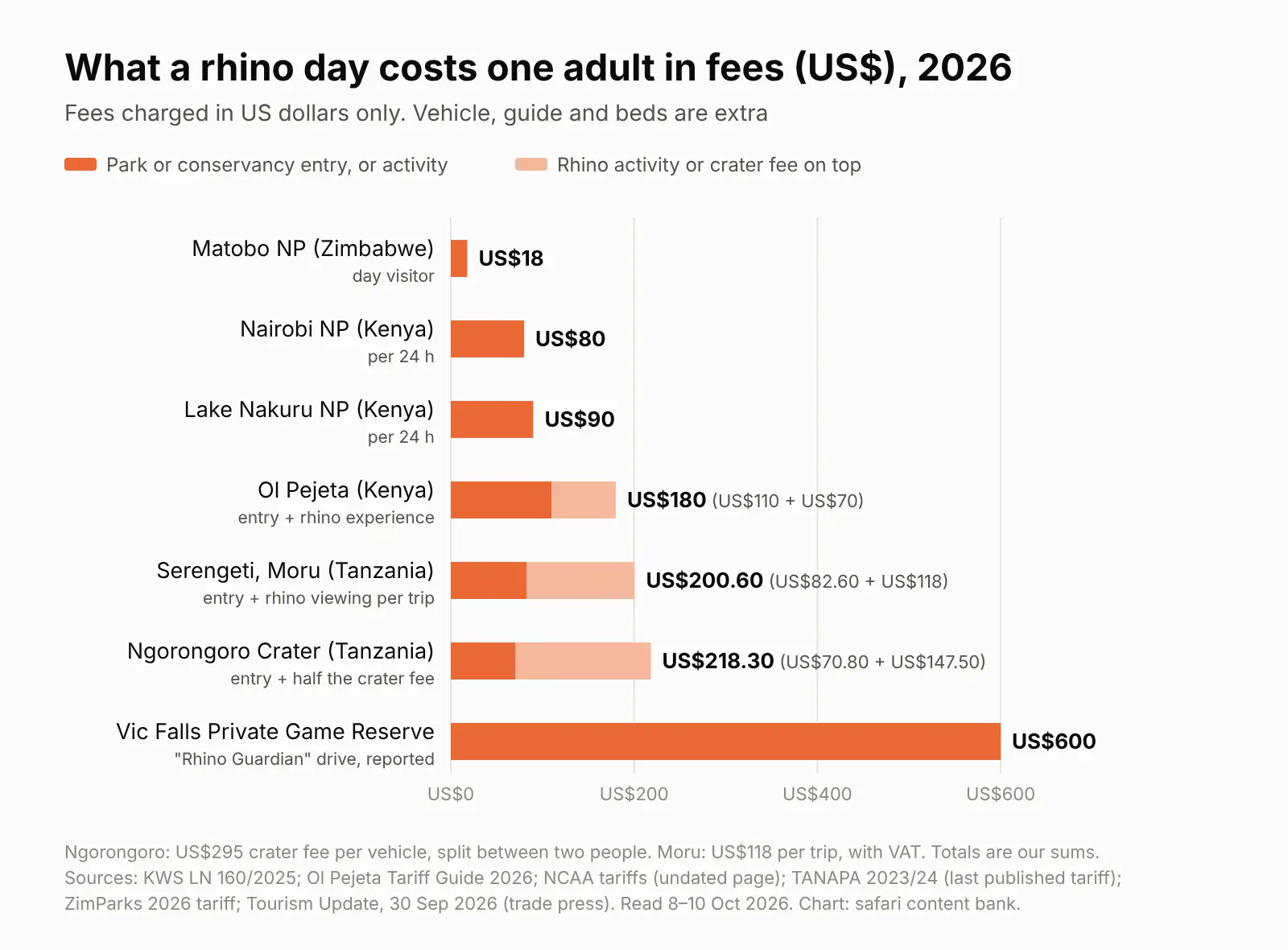 Totals are our sums. Fees charged in US dollars only; Kruger (rand) and Etosha and Okonjima (Namibian dollars) are in the table above. Sources: KWS LN 160/2025; OPC Tariff Guide 2026; NCAA tariffs (undated); TANAPA 2023/24, last published; ZimParks 2026; Tourism Update, 30 Sep 2026. Chart: safari content bank.
The official fee lines, with the date each took effect and the authority’s own source:
| Fee | Amount | In force from | Source |
|---|---|---|---|
| Ngorongoro Conservation Area, non-East African adult, entry per 24 h (single entry) | USD 70.80 (NCAA's page does not say whether VAT is included) | Undated official page, read 9 Oct 2026 | NCAA |
| Ngorongoro Crater descent (crater service fee), per vehicle | USD 295 (NCAA's page does not say whether VAT is included) | Undated official page, read 9 Oct 2026 | NCAA |
| Serengeti and Nyerere National Parks, non-East African adult, entry per day, 16 May–14 Mar | USD 70 + 18% VAT = USD 82.60 | 1 Jul 2023 (2023/24 tariff, last published) | TANAPA Tariffs 2023/24 |
| Amboseli and Lake Nakuru National Parks (KWS), non-resident adult, per 24 hours | USD 90 (child under 18, 5 and under free, USD 45) | 1 Oct 2025 (Legal Notice 160 of 2025) | KWS Fees Regulations 2025 (LN 160/2025) |
| Nairobi, Tsavo East and Tsavo West National Parks (KWS), non-resident adult, per 24 hours | USD 80 (child under 18, 5 and under free, USD 40) | 1 Oct 2025 (Legal Notice 160 of 2025) | KWS Fees Regulations 2025 (LN 160/2025) |
| Ol Pejeta Conservancy, non-resident adult, per day (24 hours for overnight guests) | USD 110, VAT included (child 3–11 USD 55) | 2026 tariff | Ol Pejeta Conservancy Tariff Guide 2026 |
| Kruger National Park daily conservation fee, international adult (12+), per day | ZAR 602 | 1 Nov 2025 to 31 Oct 2026 (SANParks 2025/26 schedule) | SANParks daily conservation fees 2025/26 |
| Kruger National Park daily conservation fee, international adult (12+), per day | ZAR 692 | 1 Nov 2026 to 31 Oct 2027 (SANParks 2026/27 schedule, already published) | SANParks daily conservation fees 2026/27 |
| Sabi Sand Nature Reserve gate fee, per person, per entry (VAT included) | ZAR 170 (ZAR 180 in 2027) | 1 Jan to 31 Dec 2026 | Sabi Sand Nature Reserve, access and gate fees |
| Sabi Sand Nature Reserve gate fee, light vehicle under 3,500 kg, per entry (VAT included) | ZAR 370 (ZAR 390 in 2027) | 1 Jan to 31 Dec 2026 | Sabi Sand Nature Reserve, access and gate fees |
| Tier 1 parks (Etosha, Namib-Naukluft including Sossusvlei, Skeleton Coast, Ai-Ais/Fish River Canyon, Waterberg Plateau, Cape Cross, Dorob, Tsau //Khaeb), foreign adult 16+, per person | NAD 280 (NAD 140 park entrance + NAD 140 conservation fee) | 1 Apr 2026 (Government Notice 115 of 2026; the notice prices fees per person with no period; MEFT's 2021 schedule made fees valid for 24 hours from entry); was NAD 150 under the 2021 schedule | Government Gazette 8877 (Government Notice 115 of 2026), hosted by the Legal Assistance Centre |
| Vehicle up to 10 seats, most national parks (N$50 at Sandwich Harbour), per vehicle | NAD 60 | 1 Apr 2026 (Government Notice 115 of 2026; the notice states no period; MEFT's 2021 schedule made fees valid for 24 hours from entry); was NAD 50 | Government Gazette 8877 (Government Notice 115 of 2026), hosted by the Legal Assistance Centre |
Why we never publish where a rhino is
We do not publish the location of individual rhino, and we do not ask guides or lodges for it. Poachers use the same information travellers share. Lodges rarely publicise rhino locations or numbers, for security, and no count is published for Etosha or Namibia’s Kunene rhino.
- Strip GPS, EXIF data and geotags before you post a rhino photo. Wildlife photographer Patrick Bentley gives this advice for rhino and other poached species (TravelAwaits, 20 Aug 2021).
- Do not name the waterhole, drainage or road in a caption of a rhino photo on social media. The parks named on this page are public; the position of a rhino within them is not.
- This page names parks and reserves, never sightings. Our own photos of rhino carry no location data.
Common mistakes about seeing rhino
| What you’ll often read | What is correct |
|---|---|
| “White rhino are white, from the Dutch word for wide” | Both species are grey. The “wide” story is discredited and the name’s origin is unknown (Wikipedia, citing Rookmaaker 2003). |
| “Namibia has the world’s largest black rhino population” | South Africa has more (2,307 against 2,098 at the end of 2024). Namibia has the largest free-roaming population. |
| “Rhino numbers are falling everywhere” | White rhino fell from 17,464 to 15,752 between the end of 2023 and the end of 2024; black rhino did not fall (IRF, State of the Rhino 2026). |
| “The Okavango Delta is a Big Five trip” | Rhino is rare there: 9% of one operator’s Delta travellers saw a white rhino and 1% a black rhino. |
| “You will see rhino in the Masai Mara” | Forum regulars report they are hard to see in the Mara and absent from Amboseli; Ol Pejeta, Lake Nakuru and Nairobi National Park are where Kenya’s rhino are seen. |
| “You can track rhino on foot in Etosha” | Walking and tracking are not allowed inside Etosha; they are sold on boundary reserves such as Ongava and Onguma. |
| “Ngorongoro Crater has [a current number] rhino” | We publish no crater figure, only national counts: Tanzania held 268 rhinos at the end of 2024 (IUCN report, 2025). |
| “Ask your guide for the GPS point” | Lodges and guides do not give out rhino locations, and you should not post them. |
Frequently asked questions
Where is the best place to see black rhino in Africa? Ngorongoro Crater (Tanzania), Ol Pejeta and Lake Nakuru (Kenya) and Etosha’s waterholes (Namibia) are the places on our pages where black rhino are seen on an ordinary safari. In Namibia’s Kunene you can track free-roaming black rhino on foot from Desert Rhino Camp. Africa had 6,788 black rhino at the end of 2024 (IUCN, 2025).
How many rhinos are left in Africa? 22,540 at the end of 2024: 6,788 black and 15,752 white (IUCN SSC African and Asian Rhino Specialist Groups and TRAFFIC, report to CITES, 2025; the total is our sum). South Africa held 14,389 of them. White rhino numbers fell from 17,464 at the end of 2023.
Can you see rhino in the Masai Mara? Rarely. Forum regulars report that rhino are hard to see in the Mara and absent from Amboseli (TripAdvisor, August 2026, traveller reports). Add Ol Pejeta (US$110 per adult per day), Lake Nakuru (US$90) or Nairobi National Park (US$80) for rhino; see Lake Nakuru vs Amboseli.
Can you see rhino in the Okavango Delta? Not reliably. On one operator’s traveller reports, 9% of Delta travellers saw a white rhino and 1% a black rhino. Botswana had 345 rhinos at the end of 2024 (IUCN), and Khama Rhino Sanctuary near Serowe is the usual place to add them.
How much does rhino tracking on foot cost? It depends on the place. Okonjima in Namibia charges N$2,660–2,900 per person in 2026; Ol Pejeta’s rhino experiences cost US$70 per adult on top of the US$110 entry fee. Prices for Desert Rhino Camp (Namibia), Matobo (Zimbabwe) and Khama (Botswana) tracking are not in our sources.
Is Kruger still good for rhino? Kruger has rhino, but its rhino population is down about 60% since 2013 (Save the Rhino), and 175 rhinos were poached there in 2025 (SANParks). South Africa as a whole held 14,389 rhinos at the end of 2024, most of Africa’s total. Kruger’s fee is R692 per international adult per day from 1 November 2026 (R602 until 31 October 2026).
Why won’t my guide tell me where the rhinos are? Because location information helps poachers. Lodges rarely publicise rhino locations or numbers, and Namibia’s Kunene and Etosha rhino counts are not published. Strip location data from rhino photos before you post them.
Sources
- IUCN SSC African and Asian Rhino Specialist Groups and TRAFFIC, African and Asian Rhinoceroses: Status, Conservation and Trade, report to CITES CoP20 (PDF), 2025; Save the Rhino, population figures and poaching statistics; IRF, State of the Rhino; read 9 Oct 2026
- Tanzania: NCAA tariffs (undated, read 9 Oct 2026); TANAPA Tariffs 2023/24 (PDF), the last published tariff; The Star / Xinhua, 22 Sep 2026
- Kenya: KWS Fees Regulations 2025, LN 160/2025 (PDF); KWS, Lake Nakuru; Ol Pejeta Tariff Guide 2026 (PDF) and rhinos page; Lewa, visit; TripAdvisor Nairobi forum, Aug 2026 (traveller reports)
- South Africa: SANParks daily conservation fees 2025/26 and 2026/27; SANParks, rhino poaching statement; Sabi Sand access; Elephant Plains rates
- Namibia: Government Notice 115 of 2026 (PDF); a safari booking site’s Etosha page; NWR Okaukuejo rates from a booking agent’s listing; Save the Rhino Trust; one operator’s Desert Rhino Camp page; Okonjima 2026 rack rates (PDF) (names and links kept in our editor notes)
- Botswana: one operator’s Okavango Delta and Moremi pages; Wikipedia, Khama Rhino Sanctuary (secondary); a safari seller’s Khama page; Tracks4Africa, May 2018 (names and links kept in our editor notes)
- Zimbabwe and Zambia: ZimParks 2026 tariff (PDF); Wikipedia, Matobo National Park (secondary); one operator’s Livingstone guide; Tourism Update, 30 Sep 2026 (names and links kept in our editor notes)
- Species: Wikipedia, White rhinoceros and Black rhinoceros (secondary); photo advice: TravelAwaits, 20 Aug 2021
More on where to see the other animals: lions, leopards, cheetahs, elephants, wild dogs and the Big Five.
Figures and fees checked 10 October 2026; SANParks fees checked 1 November 2026. We will update this page when the IUCN specialist groups publish their next continental estimate, when TANAPA publishes a new tariff, and when SANParks’ 2026/27 fees take effect on 1 November 2026.