 Experience

Last verified · Next check due
On this page
- Where walking is allowed and where it isn’t (2026)
- Botswana: concessions yes, Moremi and Chobe no
- Kruger: SANParks walks and wilderness trails
- Masai Mara: conservancies, not the reserve
- Serengeti and Tanzania: a park fee for every walk
- Zambia and Zimbabwe: South Luangwa and Mana Pools
- Minimum ages for walking
- Guide qualifications: what each country requires
- How safe is a walking safari?
- Common mistakes about walking safaris
- Frequently asked questions
- Sources
Short answer: You can walk with a guide in Zambia’s South Luangwa, Zimbabwe’s Mana Pools, Kruger National Park (SANParks walks only), the Mara conservancies, Botswana’s private concessions and Tanzania’s national parks. Walking safaris are not permitted in Moremi, and the Masai Mara reserve sells none. A Serengeti walk costs US$23.60–29.50 per person in park fees (last published tariff, 2023/24); a Kruger morning walk R726 (2024/25 tariff). Checked 10 October 2026.
Key facts
- The rule follows the land, not the price. Botswana’s private and community concessions allow walking; Moremi Game Reserve does not. One operator’s Moremi guide: “Night drives and walking safaris are not permitted within the reserve”.
- Kruger National Park allows walking only with SANParks. Visitors must stay in their vehicle except at designated spots (SANParks rules); SANParks sells guided walks from its camps and 3-night wilderness trails (SANParks activities).
- The Masai Mara National Reserve sells no walks; the conservancies around it do. Kicheche’s 2026 rates include walks at all three of its Mara camps, with a conservancy fee of US$130 per adult per night (Kicheche 2026).
- Tanzania charges a walking fee on top of park entry: US$20 for 1–4 hours or US$25 for longer, plus US$20 per group for the ranger, all plus 18% VAT (TANAPA, last published tariff, 2023/24).
- The usual minimum age is 12. Kwando, Time + Tide and Remote Africa’s trails camps set 12; Wilderness sets 13; Simbavati Trails Camp in the Timbavati takes guests from 16.
- Botswana does not require a specialist walking licence. Its national guiding regulations “don’t require specialist walking qualifications” (one operator’s Botswana walking guide).
Where walking is allowed and where it isn’t (2026)
Walking is a concession and private-land activity in Botswana and Kenya’s Mara, and a park activity with an official guide or ranger in Kruger, Tanzania, South Luangwa and Mana Pools. The table names each area as it appears on itineraries.
| Area | Country | Walking allowed? | Who leads the walk | Source |
|---|---|---|---|---|
| Moremi Game Reserve | Botswana | No | – | one operator’s Moremi guide |
| Chobe National Park, including Savuti | Botswana | No (walks are offered in the Forest Reserve outside the park) | – | one operator’s Chobe guide |
| Private and community concessions (Khwai, Selinda, Linyanti, Kwara, Vumbura) | Botswana | Yes | The camp’s guides, for camp guests | Botswana Tourism; a safari sales site’s Khwai page |
| Kruger National Park | South Africa | Yes, SANParks walks and trails only | SANParks guides; two armed rangers on the Mphongolo backpack trail | SANParks activities; SANParks tariffs 2024/25 (PDF) |
| Greater Kruger private reserves (Timbavati, Sabi Sand) | South Africa | Yes | The lodge’s guides | Elephant Plains rates; a safari booking site’s child-policy guide |
| Masai Mara National Reserve | Kenya | No: walks are not sold | – | Masai Mara |
| Mara conservancies (Mara North, Olare Motorogi, Naboisho) | Kenya | Yes | The camp’s guides | Kicheche 2026 |
| Serengeti National Park | Tanzania | Yes, with an armed ranger, in designated areas | TANAPA ranger (US$20 per group per day + VAT) | TANAPA Tariffs 2023/24 (PDF) |
| Ngorongoro Conservation Area | Tanzania | Yes, with an NCAA armed ranger | NCAA ranger | NCAA tariffs; a safari agent’s Ngorongoro guide |
| South Luangwa National Park | Zambia | Yes | Licensed guide plus armed scout | one operator’s South Luangwa guide |
| Mana Pools National Park | Zimbabwe | Yes; unguided walking with a permit | Zimbabwe professional guides, or yourself with a permit | Zimbabwe Field Guide, Mana Pools |
Rules as published by each park authority, tourism board or operator. “Yes” means walking is allowed on that land; whether your camp runs walks, and on which days, is the camp’s decision. Read 8–10 October 2026.
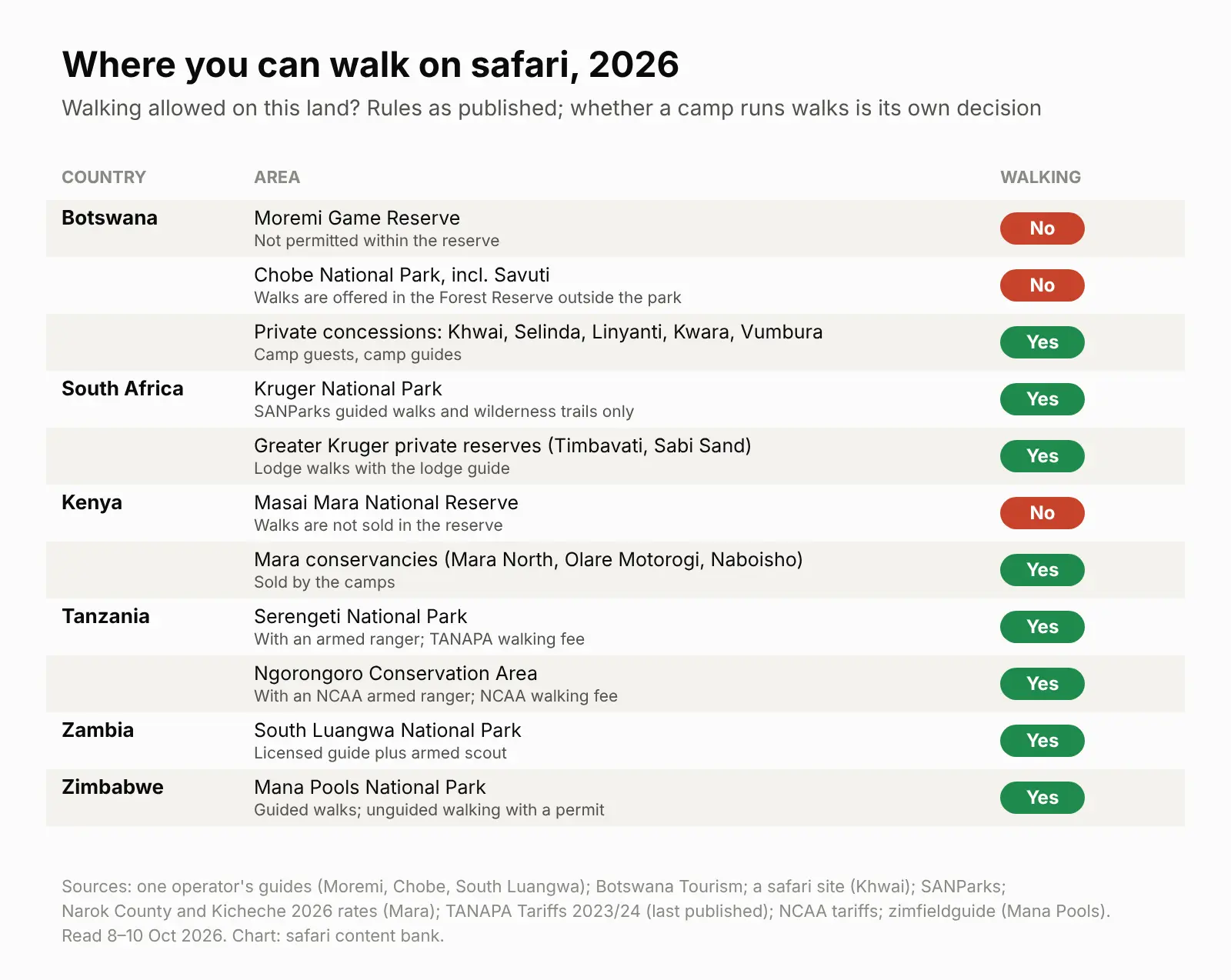 Sources: one operator’s guides; Botswana Tourism; a safari sales site; SANParks; Narok County and Kicheche 2026 rates; TANAPA Tariffs 2023/24 (last published); NCAA; Zimbabwe Field Guide. Read 8–10 October 2026. Chart: safari content bank.
Botswana: concessions yes, Moremi and Chobe no
Walking safaris are not permitted in Moremi, and they are allowed on private and community concessions outside the parks, such as Khwai, Selinda, Linyanti, Kwara and Vumbura, where camps offer them to their own guests. One operator’s Moremi guide: “Night drives and walking safaris are not permitted within the reserve”. Botswana Tourism adds that in the national parks and reserves “off-roading and night driving [are] prohibited” (Botswana Tourism).
- Camps inside Moremi follow park rules. A camp inside a park or reserve works under park rules whatever it charges; a camp on a concession can drive off-road, at night and walk.
- Chobe National Park, including Savuti, has no walks. One operator’s Chobe guide places walks and night drives at the Forest Reserve camps west of Kasane (Muchenje, Ngoma, Chobe Elephant Camp), not in the park.
- Both Khwai concessions next to Moremi’s North Gate offer “guided walking safaris” (a safari sales site’s Khwai page). Selinda Reserve adds canoeing on the Selinda Spillway from June to October (a Delta booking site’s Selinda page).
- “Walking available” means different things at different camps. Botswana’s national guiding regulations “don’t require specialist walking qualifications” (one operator’s Botswana walking guide), so ask for the guide, the length of the walk and whether the guide is armed.
Every area’s rules are on our page where night drives, walking and off-road driving are allowed in Botswana. How the two parks compare on everything else is on Moremi vs Chobe, and concession camp rates and levies on Botswana safari cost.
Kruger: SANParks walks and wilderness trails
In Kruger National Park you walk only with SANParks: a guided walk from a rest camp, or a 3-night wilderness or backpack trail. Visitors must stay in their vehicle except at designated spots (SANParks rules), and the park’s own walks are sold from its camps (SANParks activities).
| SANParks walk in Kruger, per person | Price (2024/25 tariff) | What it is |
|---|---|---|
| Olifants river walk | R424 | Guided walk from Olifants camp |
| Afternoon walk (Letaba, Skukuza) | R580 | Guided walk from camp |
| Morning walk | R726 (R848 from Crocodile Bridge gate) | Guided walk from camp |
| Mphongolo backpack trail, 3 nights | R3,460–4,018 per person | Shingwedzi area; two armed rangers; you carry your tent and food |
| Wilderness trail, 3 nights (Mathikithi, Napi, Bushman) | R11,162–13,840 per hut of 2 people | Base camp with huts; armed trails rangers |
Source: SANParks tariffs 2024/25 (PDF), the latest in our sources; the lower wilderness-trail price applies 1 November–28 February, the higher 1 March–31 October. Check current prices with SANParks.
- The daily conservation fee is extra: R692 per international adult per day from 1 November 2026 (R602 until 31 October 2026; SANParks). A morning walk plus the day’s fee comes to R1,418 per adult from 1 November 2026 (R1,328 at the previous R602 fee; our sums, with the 2024/25 walk price).
- A wilderness trail costs R5,581–6,920 per person for 3 nights (our sum: half the per-hut price), guided on foot with armed rangers.
- The Greater Kruger private reserves walk with lodge guides. Elephant Plains in the Sabi Sand lists a bush walk in its 2026 rate (Elephant Plains), and the Timbavati has a walking-only lodge, Simbavati Trails Camp, for guests aged 16 and over (a safari booking site’s child-policy guide).
Gate times, road rules and fees for a self-drive trip are on Kruger self-drive; lodge and tour prices are on South Africa safari cost.
Masai Mara: conservancies, not the reserve
The Masai Mara National Reserve sells no walks; the Maasai-owned conservancies around it are where camps sell walks and night drives. Most Mara conservancy camps include day and night drives and bush walks in their rate (Kenya safari cost).
| Masai Mara National Reserve | Mara conservancies | |
|---|---|---|
| Walks | Not sold | Sold by camps: Kicheche’s 2026 rates include walks at all three of its camps |
| Fee per adult | US$100 (1 Jan–30 Jun) or US$200 (1 Jul–31 Dec) per day | US$130 per night on Kicheche and Hemingways 2026 sheets |
| A day in the reserve | – | Payable “if required”, for a day trip to the Mara River (Kicheche) |
Sources: Narok County fee schedule FY2025/26 (last published, expired 30 June 2026; July–December 2026 per The Kenya Times, 6 August 2026, secondary); Kicheche 2026 rate sheet; camps’ 2026 rate sheets. Read 9 October 2026.
- From July to December a conservancy night costs less in fees than a reserve day: US$130 against US$200 per adult. The full comparison is on our Masai Mara page and Masai Mara park fees.
- Kicheche’s Mara camps cost US$625–1,095 per person per night in 2026, before the conservancy fee (Kicheche 2026).
- Elsewhere in Kenya, walking is a Laikipia speciality. Karisia Walking Safaris in Laikipia is a 2026-season winner of The Safari Awards (The Safari Awards).
Serengeti and Tanzania: a park fee for every walk
Walking is allowed inside Tanzania’s national parks with an armed ranger, and TANAPA charges for it: US$20 per person for 1–4 hours, US$25 for longer, plus US$20 per group for the ranger, all plus 18% VAT (last published tariff, 2023/24). With VAT that is US$23.60 or US$29.50 per person and US$23.60 for the ranger (TANAPA Tariffs 2023/24).
The walking fees and the park entry fee, with the date each took effect and the source:
| Fee | Amount | In force from | Source |
|---|---|---|---|
| Serengeti walking safari, per person, plus ranger fee per group per day | Short (1–4 h) USD 20, long (over 4 h) USD 25; ranger USD 20; all + 18% VAT | 1 Jul 2023 (2023/24 tariff, last published) | TANAPA Tariffs 2023/24 |
| Ngorongoro walking safari guide fee, non-East African adult | USD 23.60 for a 1–4 h walk; USD 29.50 over 4 h | Undated official page, read 9 Oct 2026 | NCAA |
| Serengeti and Nyerere National Parks, non-East African adult, entry per day, 16 May–14 Mar | USD 70 + 18% VAT = USD 82.60 | 1 Jul 2023 (2023/24 tariff, last published) | TANAPA Tariffs 2023/24 |
| Kruger National Park daily conservation fee, international adult (12+), per day | ZAR 602 | 1 Nov 2025 to 31 Oct 2026 (SANParks 2025/26 schedule) | SANParks daily conservation fees 2025/26 |
| Kruger National Park daily conservation fee, international adult (12+), per day | ZAR 692 | 1 Nov 2026 to 31 Oct 2027 (SANParks 2026/27 schedule, already published) | SANParks daily conservation fees 2026/27 |
| Maasai Mara National Reserve, non-resident adult, per day (12-hour ticket, 06:00–18:00), 1 Jan–30 Jun | USD 100 | Since 1 Jan 2024; Narok County FY2025/26 schedule, the last published | Narok County fee schedule FY2025/26 |
| Maasai Mara National Reserve, non-resident adult, per day (12-hour ticket, 06:00–18:00), 1 Jul–31 Dec | USD 200 | Since 1 Jul 2024; Narok County FY2025/26 schedule, the last published, expired 30 Jun 2026 (no 2026/27 schedule as of 9 Oct 2026); The Kenya Times (6 Aug 2026, secondary) reports US$200 still applies for Jul–Dec 2026 | Narok County fee schedule FY2025/26 |
- Two adults on a short Serengeti walk pay US$70.80 in walking fees (2 × US$23.60 plus US$23.60 for the ranger; our sum), on top of US$82.60 each for park entry (last published tariff, 2023/24).
- Ngorongoro charges its own walking fee: US$23.60 for a 1–4 hour walk and US$29.50 for longer, per non-East African adult (NCAA). Walks need an NCAA armed ranger; routes include Empakaai, Olmoti and Nasera Rock (a safari agent’s Ngorongoro guide).
- Outside the Serengeti the rules differ. Klein’s Camp, outside Klein’s Gate, says that because it is outside the national park “there are no restrictions prohibiting night drives and guided game walks” (a tour operator’s Klein’s Camp page).
- The same TANAPA walking fee applies in Tanzania’s other national parks, including Ruaha, Nyerere and Tarangire. Park fees and lodge prices are on Tanzania safari cost and Serengeti park fees.
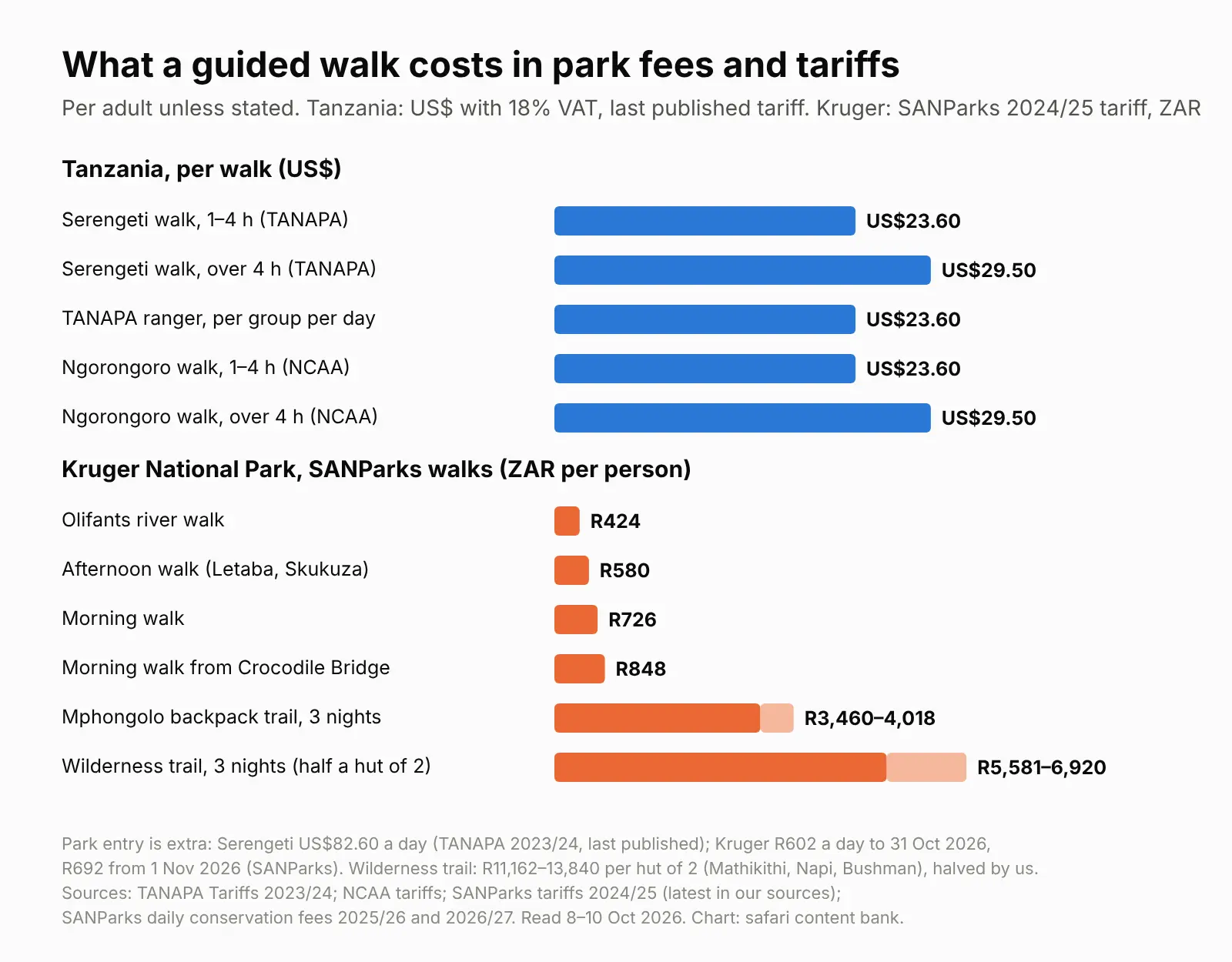 Sources: TANAPA Tariffs 2023/24 (last published); NCAA tariffs; SANParks tariffs 2024/25 (latest in our sources). Park entry is extra. Read 8–10 October 2026. Chart: safari content bank.
Zambia and Zimbabwe: South Luangwa and Mana Pools
South Luangwa (Zambia) and Mana Pools (Zimbabwe) are two of the few national parks where walking is the main activity. In South Luangwa walks are led by a licensed guide with an armed scout (one operator’s South Luangwa guide); in Mana Pools guided walks are led by Zimbabwe professional guides, and unguided walking is allowed with a permit (Zimbabwe Field Guide).
- South Luangwa is where the commercial walking safari started. Norman Carr opened Zambia’s first safari camp there in 1950 and promoted walking as an alternative to hunting (one operator’s walking-safari guide).
- Some South Luangwa camps are walking-only. Three of Remote Africa’s five Luangwa camps are walking-only (Fortune, April 2024); Remote Africa’s trails camps open from 25 May or 1 June to 31 October (Remote Africa).
- North Luangwa is walking-first too: Mwaleshi camp is walking-only, one operator notes.
- The season is June to October in both parks. In South Luangwa all lodges and bush camps are open from June, and seasonal bush camps close in November with the rains (one operator’s South Luangwa guide). Mana Pools’ camps open roughly April to November and close December to March (one operator’s Mana Pools guide).
- Zimbabwe’s other walking parks include Hwange, where Wilderness’s professional guides walk old elephant paths (Wilderness journal, July 2026), and Gonarezhou (one operator’s walking-safari guide).
Park fees and camp prices for Zambia and Zimbabwe are not on this page.
Minimum ages for walking
The usual minimum age for a walking safari is 12, and some camps set 13 or 16. A safari sales site’s age-limits guide puts it at typically 12, rising to 16 at some Big Five lodges.
| Operator or camp | Where | Minimum age for walks | Source |
|---|---|---|---|
| Kwando Safaris | Botswana concessions (Kwara and others) | 12 (walking and mokoro); private vehicle required for under-12s | Kwando 2024 rate sheet |
| Time + Tide | Zambia (South Luangwa, Lower Zambezi) | 12 (walking, canoeing, sleep-outs) | Time + Tide 2027 rates (PDF) |
| Remote Africa | Zambia, trails camps and North Luangwa | 12 (8 at Tafika) | Remote Africa |
| South Luangwa in general | Zambia | 12 | one operator’s South Luangwa guide |
| Wilderness | All its camps | 13; maximum 8 guests per walk, 6 preferred | Wilderness journal, 23 Sep 2026 |
| Simbavati Trails Camp | Timbavati, Greater Kruger | 16 (minimum age to stay at this walking camp) | a safari booking site’s child-policy guide, May 2026 |
Ages as each operator publishes them, read 8–9 October 2026. Our sources give no published minimum age for SANParks walks or wilderness trails, TANAPA walks or Mara conservancy walks: ask before you book.
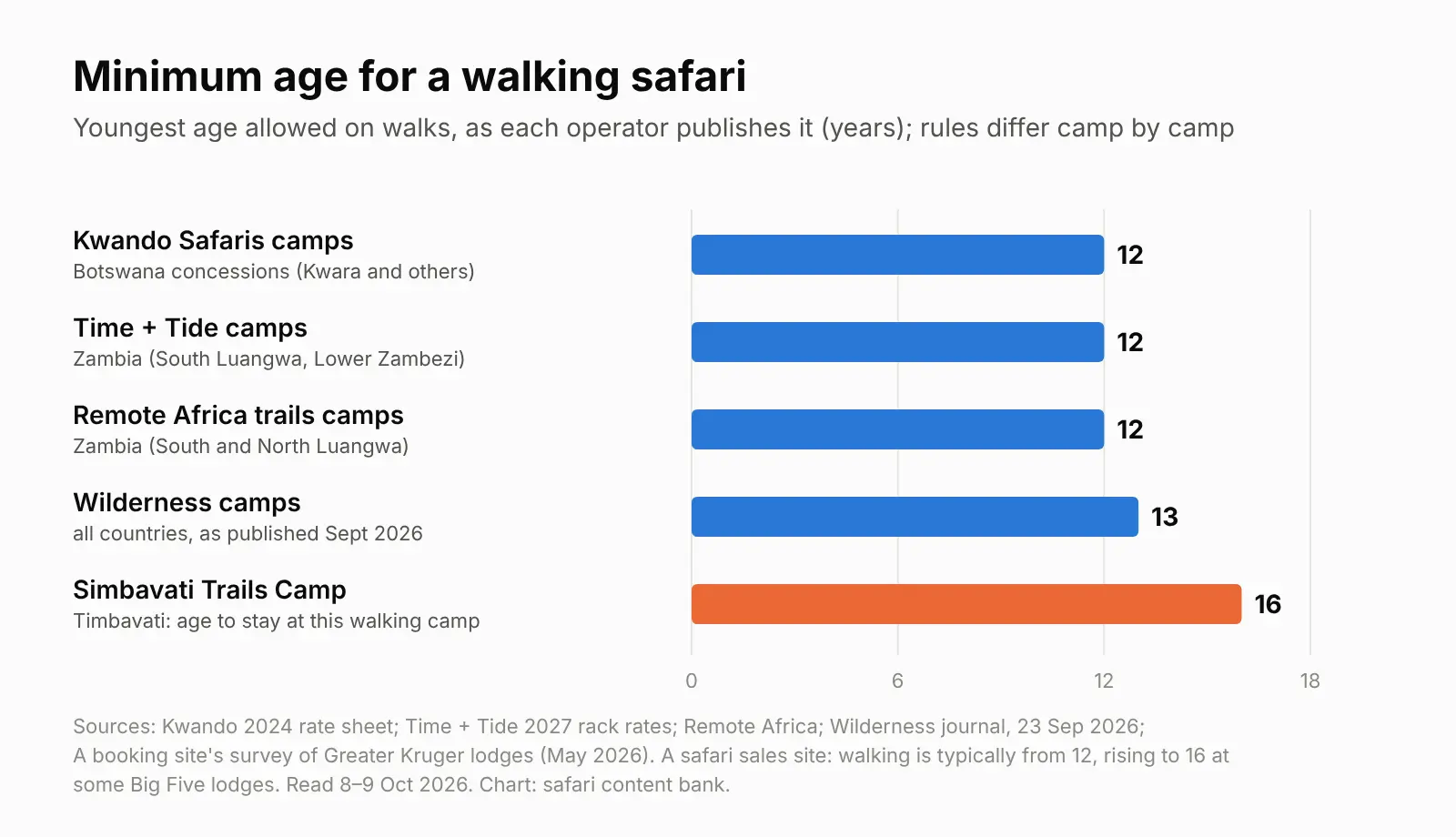 Sources: Kwando 2024 rate sheet; Time + Tide 2027 rack rates; Remote Africa; Wilderness journal, 23 September 2026; a safari booking site (May 2026); a safari sales site. Chart: safari content bank.
Child rates and age rules for lodges and drives are on single supplements and child rates.
Guide qualifications: what each country requires
The qualification behind “walking available” depends on the country: South Africa has a graded trails-guide ladder, while Botswana’s regulations require no specialist walking qualification.
| Country | What our sources say | Source |
|---|---|---|
| South Africa | FGASA ladder: Apprentice Field Guide (NQF2), Field Guide (NQF4, 260 logged field days), Professional Field Guide, then Trails Guide, which carries the rifle-handling and dangerous-game component. The minimum registration is NQF2 with CATHSSETA | one tour operator’s guide-qualifications article, 2026 |
| South Africa | FGASA Scout pairs Senior Tracker status with advanced dangerous-game guiding on foot | PK Podcast 61, Aug 2025 |
| Kenya | KPSGA bronze, silver and gold, with six months, three years and six-plus years of experience behind each | one tour operator’s guide-qualifications article |
| Botswana | National guiding regulations “don’t require specialist walking qualifications” | one operator’s Botswana walking guide |
| Zambia | Walking only with a licensed guide and an armed scout (South Luangwa) | one operator’s South Luangwa guide |
| Zimbabwe | Walks are led by Zimbabwe professional guides; Wilderness’s Hwange head guide, Peter Gava, earned his walking certificate in 1998 | rule: one camp operator’s walking-guides article, July 2026; head guide: Wilderness journal, July 2026 |
| Namibia | “Namibia doesn’t have strong national standards for walking safari guides” | one operator’s Namibia walking guide |
| Tanzania | Walks inside national parks go with an armed park ranger, paid per group | TANAPA Tariffs 2023/24 |
Read 8–10 October 2026. We print no grade for Zimbabwe’s professional guide licence because our sources hold no official description of it.
- Ask for the guide by name and their walking qualification. A review of injuries to visitors in South Africa advises using only registered trail guides of the appropriate grade and not pressing guides to approach large animals (Leggat et al., Journal of Travel Medicine 2001, PDF).
- Before booking any operator, check its licence.
How safe is a walking safari?
No public dataset of incidents on guided walks exists in our sources, so we print no accident rate for walking safaris. The nearest data is general: a 10-year review in South Africa counted 7 tourist deaths and 14 non-fatal injuries from wild mammals, across all activities: rare relative to visitor numbers, the review concludes (Leggat et al. 2001, PDF).
- Field staff carry more risk than guests: the same review cites 13 fatal and 14 non-fatal incidents among staff over a comparable 10 years.
- Walks are run in single file behind the guide with hand signals agreed before the start, Africa on Foot’s guides in the Klaserie explain (Sun Destinations, 2015). In South Luangwa every group has a guide and an armed scout (Christian Science Monitor, 2008).
- Wilderness caps walks at eight guests, six preferred, and takes walkers from 13 (Wilderness journal, Sept 2026).
Common mistakes about walking safaris
| What you’ll often read | What is correct |
|---|---|
| “You can walk anywhere in the Okavango Delta” | Not in Moremi Game Reserve, where walking safaris are not permitted. Walks happen on the private and community concessions. |
| “Savuti is a private area, so walks are possible” | Savuti is inside Chobe National Park, which has no walks. Chobe-area walks are in the Forest Reserve outside the park. |
| “You can take a walk in Kruger on your own” | No. Visitors must stay in their vehicle except at designated spots; walks go with SANParks only. |
| “Walks are included in a Masai Mara reserve stay” | The reserve sells no walks. They are sold by camps in the conservancies. |
| “Walking in the Serengeti is free with your park ticket” | TANAPA charges US$20–25 per person plus US$20 per group for the ranger, all plus 18% VAT (last published tariff, 2023/24). |
| “Every walking guide holds a specialist licence” | Not in Botswana, where the regulations require no specialist walking qualification. |
| “Children can walk from 8 or 10” | Usually 12, and 13 at Wilderness or 16 at Simbavati Trails Camp. |
Frequently asked questions
Where is the best place in Africa for a walking safari? South Luangwa in Zambia and Mana Pools in Zimbabwe are the parks where walking is the main activity, and South Luangwa is where the commercial walking safari began. Kruger’s SANParks wilderness trails, the Mara conservancies and Botswana’s private concessions also offer walks.
Can you do a walking safari in Moremi Game Reserve? No. One operator’s Moremi guide: “Night drives and walking safaris are not permitted within the reserve.” Walks are offered on the concessions next to Moremi, such as Khwai, and in the private Delta concessions.
How much does a walking safari cost in Kruger? Under the 2024/25 SANParks tariff, the latest in our sources, a morning walk costs R726 per adult and a 3-night wilderness trail R11,162–13,840 per hut of 2 people. The daily conservation fee is extra: R692 (R602 until 31 October 2026).
Can you walk in the Masai Mara? Not in the Masai Mara National Reserve, which sells no walks. Camps in the Mara conservancies around it sell walks; Kicheche’s 2026 rates include them, with a conservancy fee of US$130 per adult per night.
Is there a fee for walking in the Serengeti? Yes. TANAPA charges US$20 per person for a 1–4 hour walk and US$25 for longer, plus US$20 per group for the ranger, all plus 18% VAT (last published tariff, 2023/24). Park entry of US$82.60 per adult per day is on top.
What is the minimum age for a walking safari? Usually 12. Kwando, Time + Tide and Remote Africa’s trails camps set 12, Wilderness sets 13, and Simbavati Trails Camp in the Timbavati takes guests from 16.
Are walking safari guides armed? In the parks, yes: South Luangwa walks go with an armed scout, Tanzanian park walks with an armed ranger, and Kruger’s backpack trail with two armed rangers. On Botswana’s concessions it depends on the camp, so ask whether the guide is armed.
Sources
- Rules: Botswana Tourism, game viewing; one operator’s guides to Moremi, Chobe, South Luangwa, Mana Pools and walking safaris in Botswana and Namibia; a safari sales site’s Khwai page; a Delta booking site’s Selinda page; SANParks rules and activities; Zimbabwe Field Guide, Mana Pools; a safari agent’s Ngorongoro guide; a tour operator’s Klein’s Camp page (names and links kept in our editor notes)
- Fees and tariffs: TANAPA Tariffs 2023/24 (PDF); NCAA tariffs; SANParks tariffs 2024/25 (PDF), daily conservation fees 2025/26 (PDF) and 2026/27 (PDF); Narok County fee schedule FY2025/26 (PDF)
- Operators: Kicheche 2026; Kwando 2024; Time + Tide 2027 (PDF); Remote Africa; Wilderness journal, walking safaris questions answered and walking in the wild; Elephant Plains; a safari booking site’s child-policy guide; The Safari Awards (names and links kept in our editor notes)
- Background: one operator’s walking-safari guide; a safari sales site’s age-limits guide; one tour operator’s guide-qualifications article; PK Podcast 61; Fortune, “The No-Jeep Safari”, 2024; Sun Destinations, 2015; Christian Science Monitor, 2008 (names and links kept in our editor notes)
- Safety: Leggat et al., Journal of Travel Medicine 2001 (PDF)
- More: Botswana night drives and walking, Moremi vs Chobe, Kruger self-drive, Kruger park fees, Botswana safari cost, South Africa safari cost, Kenya safari cost, Tanzania safari cost
Rules and fees checked against the content bank on 10 October 2026; SANParks fees checked 1 November 2026. We will recheck this page by 31 December 2026, and sooner when SANParks publishes a newer activity tariff, TANAPA a tariff after 2023/24, Narok County a 2026/27 Mara schedule, or when any park changes its walking rules.
What visitors say
Tripadvisor travel forums · read
What visitors praise
- A completely different, back-to-nature feel from a vehicle, learning tracks, plants and birds
- Seeing an elephant or giraffe on foot feels far more special
- Walking into elephant, lion and even the Big Five on Kruger wilderness trails
- Skilled, armed guides and rangers
- At Mana Pools you can leave the vehicle and approach animals on foot for ground-level photos
- South Luangwa called the classic place to walk
What visitors criticise
- You see less game and cannot get as close as in a vehicle
- Some walks felt tame, very slow and full of stops
- Very early starts, reporting at 4 to 5 am
- Kruger camp walks and wilderness trails book out far ahead
- Afternoon walks are shorter and less rewarding
Tips visitors repeat
- Mix walks with game drives rather than walking only, unless you are set on a walking-only camp
- Book Kruger walks and trails well ahead, but still ask at the camp or phone it if the website shows them full
- Wear muted colours, avoiding white, black and bright shades
- Take a warm layer, as nights can turn cold even in September
- Remember buffalo and hippo are as dangerous as cats on foot
What surprised visitors
- Mana Pools lets visitors walk unguided anywhere in the park
- On Kruger trails the nights in camp, with lions roaring and elephants close by, were as memorable as the walks
- The website can show walks as full when the camp still has places
August and September praised in South Luangwa, Mana Pools and Kruger; October visits to South Luangwa went well; early June can mean long grass in Luangwa, depending on the rains.