 Experience

Last verified · Next check due
On this page
- Malaria risk in South Africa’s safari areas
- Malaria-free reserves in South Africa, and what they cost
- Is a malaria-free safari cheaper than Kruger?
- Malaria-free safaris with children
- Self-drive or lodge-only?
- The trade-offs of a malaria-free reserve
- Common mistakes about malaria-free safaris
- Frequently asked questions
- Sources
Short answer: South Africa has malaria-free Big Five reserves in North West province (Madikwe, Pilanesberg), the Waterberg and the Eastern Cape (Addo, Amakhala, Kwandwe, Shamwari). Kruger is not malaria-free: UK TravelHealthPro puts it in a malaria risk area where tablets are recommended from September to May, and the US CDC also recommends them there (checked 10 October 2026). Malaria-free is not cheaper: Pilanesberg charges R748 per foreign adult a day, against Kruger’s R692 (R602 until 31 October 2026).
Key facts
- Kruger National Park is in a malaria risk area. UK TravelHealthPro recommends antimalarial tablets there from September to May, the US CDC recommends them for Kruger, and SANParks advises tablets after you see a doctor.
- TravelHealthPro rates most of South Africa as no risk. Only the low-lying north-east (Kruger and the land bordering Mozambique, Eswatini and Zimbabwe) is a risk area, and far north-east KwaZulu-Natal is low risk. It still advises avoiding bites everywhere.
- SANParks says Kruger and Mapungubwe are its only two parks in malaria risk areas. Addo, Marakele, Mountain Zebra and Kgalagadi are SANParks parks outside them.
- Malaria-free is not cheaper at the gate: Pilanesberg charges R748 per foreign adult per day plus R168 per vehicle (from 1 December 2025), more than Kruger’s R692 (R602 until 31 October 2026).
- Madikwe and Welgevonden take no day visitors and allow no self-drive game viewing. Pilanesberg and Addo can be driven in an ordinary car.
- Published malaria-free lodge rates run from R5,290 to R55,800 per person sharing per night (Amakhala, May–July 2027, to Tswalu’s Loapi, 2026), with meals and game drives. Levies are often extra.
Malaria risk in South Africa’s safari areas
Only the north-east of South Africa carries malaria risk, and Kruger is inside it; the North West, Waterberg, Eastern Cape, Northern Cape and Western Cape reserves are outside it. UK TravelHealthPro (the UK government’s National Travel Health Network and Centre, NaTHNaC) describes the risk area as the low-altitude parts of Mpumalanga and Limpopo, “particularly those bordering Mozambique, Eswatini and Zimbabwe”, including Kruger National Park, and says “There is no risk in the rest of South Africa” (TravelHealthPro, South Africa).
| Area | Malaria status | What the official source advises | Source (checked 10 Oct 2026) |
|---|---|---|---|
| Kruger National Park | Risk area; season September to May | Antimalarial tablets recommended September–May (TravelHealthPro); CDC recommends tablets for Kruger; SANParks advises tablets after seeing a doctor, risk highest November–April | TravelHealthPro; CDC; SANParks |
| Greater Kruger private reserves (Sabi Sand, Timbavati, Klaserie, Balule, Thornybush) | Same Lowveld zone as Kruger, same November–April peak | As for Kruger | SANParks Kruger malaria guidance |
| Mapungubwe National Park (Limpopo) | Risk area; one of SANParks’ two malaria parks | Malaria precautions | SANParks |
| Far north-east KwaZulu-Natal | Low risk September–May; very low in designated areas | Awareness and bite avoidance | TravelHealthPro |
| Rest of South Africa: North West, Eastern Cape, Northern Cape, Western Cape | No risk | Bite avoidance only | TravelHealthPro |
Health sources as named; South Africa’s own Department of Health map was not checked for this page. A 2013 study in the South African Medical Journal draws the same line: transmission limited to north-eastern Limpopo and Mpumalanga and the extreme north of KwaZulu-Natal (Morris et al. 2013). This is what the sources say, not medical advice: whether you need tablets, and which, is a question for a travel clinic.
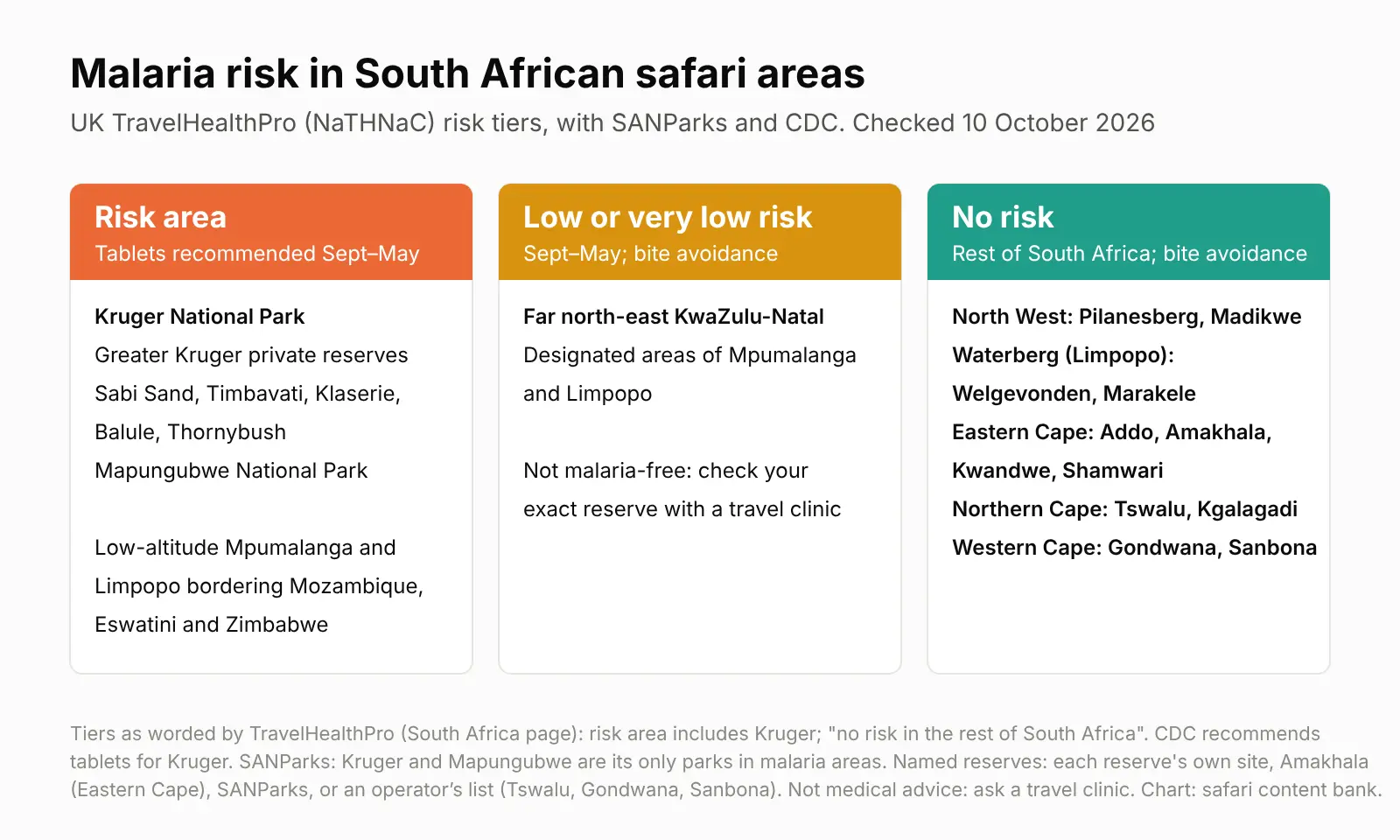 Risk tiers: UK TravelHealthPro, with CDC and SANParks, checked 10 October 2026. Reserves named from each reserve’s own site, SANParks, Amakhala or one tour operator’s malaria-free list. Chart: safari content bank.
- Kruger’s risk is seasonal, and no source calls winter malaria-free. TravelHealthPro’s transmission season in the north-east is September to May; SANParks puts Kruger’s peak at November to April and calls the risk “generally low, even in summer”, but does not exempt any month.
- “Malaria-free” does not mean “no mosquitoes”. TravelHealthPro still recommends bite avoidance in the no-risk areas.
Malaria-free reserves in South Africa, and what they cost
There are four clusters: Pilanesberg and Madikwe north-west of Johannesburg, the Waterberg north of it, the Eastern Cape reserves near Gqeberha, and a few reserves in the Kalahari and near Cape Town. Each row below is named as malaria-free by the source shown; prices are as each operator publishes them.
| Reserve (province) | Malaria-free per | Big Five? | Self-drive? | Getting there | Published price (per person unless stated) |
|---|---|---|---|---|---|
| Pilanesberg (North West) | A safari agent’s guide, read 8 October 2026 | Yes | Yes, in a sedan, on tar and good gravel | About 220 km from Johannesburg O.R. Tambo | 3-day Bakubung Bush Lodge tour US$867–990 (one operator’s listing); 4-day Ivory Tree tour US$3,040–3,152 (one operator’s listing) |
| Madikwe (North West) | A safari agent’s guide, read 8 October 2026 | Yes; wild dog too | No: lodge guests only, lodge vehicles only | About 4.5 hours by road from Johannesburg, or a light-aircraft flight | Madikwe River Lodge from US$291, Jamala Madikwe from US$873, sharing, 2026 (a safari travel agent’s listing) |
| Welgevonden (Waterberg, Limpopo) | welgevonden.org | Yes | No: cars stay at the gate; no day visitors | 2.5–3.5 hours north of Johannesburg | 28 lodges, each sets its own rate; none in our sources |
| Marakele National Park (Waterberg, Limpopo) | SANParks (not one of its malaria parks) | Yes | Yes, but only about 80 km of road is open to ordinary cars | Near Thabazimbi | SANParks Bontle campsite from R459 and Tlopi safari tent from R2,309 per unit per night (stays 9–18 Oct 2026, SANParks); Marataba from US$991 sharing, 2026 (a safari travel agent’s listing) |
| Addo Elephant National Park (Eastern Cape) | SANParks; Eastern Cape per Amakhala | Yes | Yes, tarred loops | Matyholweni Gate about 30 minutes from Gqeberha | 3-day tour US$974–994 (one operator’s listing); SANParks safari tent R1,096–1,241 per unit (2024/25 tariff) |
| Amakhala (Eastern Cape) | Amakhala | Yes | No; guided drives, day safaris sold | Fly to Gqeberha | R5,290 (1 May–31 Jul 2027) to R14,010 (Bush Lodge, 1 Aug–19 Dec 2027) sharing per night, + R425 levy (Amakhala rates) |
| Kwandwe (Eastern Cape) | Eastern Cape per Amakhala | Yes | No | Road transfer from Gqeberha about 2 hours, R6,980 per vehicle each way (1–3 people) | R17,930 (1 May–30 Sep 2026) to R26,180 (1 Oct 2026–30 Apr 2027) sharing per night, + R1,500 levy (Kwandwe 2026–27, PDF) |
| Shamwari (Eastern Cape) | shamwari.com | Yes | No | 75 km from Gqeberha | Rates only through its booking engine; none in our sources |
| Tswalu Kalahari (Northern Cape) | One tour operator’s malaria-free list | No elephant | No; private vehicle and guide with every booking | Flights to the reserve airstrip, not in the rate | Motse R46,400, Loapi R55,800 per adult sharing per night, 2026, drinks and activities included (Tswalu rates) |
| Gondwana, Sanbona (Western Cape) | One tour operator’s malaria-free list | Gondwana yes; Sanbona not stated | No | “A short trip from Cape Town” (one tour operator); no distance in our sources | Gondwana Family Lodge from US$532 sharing, 2026 (a safari travel agent’s listing) |
Sources as linked, read 8 October 2026. Tour prices are operators’ listings on a safari booking site, usually based on two travellers, inclusions not itemised. The travel agent’s prices are its 2026 “from” prices per person sharing. SANParks unit prices are per unit, not per person, and the daily conservation fee is extra. Distances: Pilanesberg and Madikwe from their sites; Waterberg and Shamwari from Wikipedia; Addo from SANParks; Kwandwe from its rate sheet.
Near Johannesburg: Pilanesberg, Madikwe and the Waterberg
Pilanesberg is the closest malaria-free Big Five park to Johannesburg and the only one of the three you can drive yourself. It sits in an extinct volcanic crater next to Sun City, about 220 km from O.R. Tambo, with three tarred main drives (a safari agent’s guide, read 10 October 2026).
- Madikwe is lodge-only. You cannot visit for the day or drive yourself; all game viewing is on lodge vehicles with a guide. It covers 750 km² on the Botswana border (Wikipedia) and has three wild dog packs (a safari agent’s guide, read 10 October 2026). The two side by side: Madikwe vs Pilanesberg.
- Madikwe has more elephants than it can carry: over 1,600 in 2025, from about 220 in the 1990s, and a culling plan drew criticism (Wikipedia, citing Mongabay).
- Welgevonden works the same way as Madikwe: no day visitors, no self-driving, and a field guide collects you at the gate (welgevonden.org). The Waterberg is a UNESCO Biosphere Reserve 2.5–3.5 hours north of Johannesburg.
Near Gqeberha: Addo and the Eastern Cape private reserves
The Eastern Cape suits a Garden Route or Cape Town trip: fly out of Gqeberha, or drive in from the coast. Addo is the self-drive option on tarred loops; Amakhala, Kwandwe and Shamwari are private reserves with guided drives only. Addo against Kruger: Addo vs Kruger.
- Amakhala is the cheapest Eastern Cape private reserve in our sources: from R5,290 per person sharing in May–July 2027, with all meals, selected house drinks and two drives a day, plus a R425 levy per adult per night (1 March 2026 – 28 February 2027) (Amakhala).
- Kwandwe is priced like Sabi Sand: R26,180 per person sharing from 1 October 2026, plus R1,500 levy per adult per night. Drinks, walks, laundry and emergency evacuation cover are included (Kwandwe 2026–27, PDF).
- Winter is the cheap season here. June to August is cold and can be wet and windy. Kwandwe’s lowest rates run 1 May–30 September 2026, and Amakhala’s 1 May–31 July 2027 (rate sheets).
Is a malaria-free safari cheaper than Kruger?
No. Pilanesberg’s gate fee is higher than Kruger’s, and Amakhala and Kwandwe in the Eastern Cape add nightly levies of R425 and R1,500 per adult. Only Addo, a SANParks park, charges less per day than Kruger.
| Park or reserve | Fee per international adult | Period | Source |
|---|---|---|---|
| Pilanesberg (malaria-free) | R748 per day + R168 per vehicle | From 1 Dec 2025 | A safari agent’s guide, read 8–9 October 2026 (quoting the park tariff) |
| Kruger (malaria risk area) | R602 per day | 1 Nov 2025 – 31 Oct 2026 | SANParks 2025/26 (PDF) |
| Kruger (malaria risk area) | R692 per day | 1 Nov 2026 – 31 Oct 2027 | SANParks 2026/27 (PDF) |
| Addo (malaria-free) | R565 per day (R492 until 31 Oct 2026) | 1 Nov 2026 – 31 Oct 2027 (2026/27 schedule) | SANParks, as above |
| Kwandwe levy (malaria-free) | R1,500 per night | 2026–27 rate sheet | Kwandwe (PDF) |
| Amakhala levy (malaria-free) | R425 per night (R460 from 1 Mar 2027) | 1 Mar 2026 – 28 Feb 2027 | Amakhala levy |
| Madikwe | Gate fee not found in our sources |
Fees as printed on our South Africa safari cost page, read 8–9 October 2026. For every Kruger fee tier, see Kruger park fees.
- A foreign couple in one car pays 2 × R748 + R168 = R1,664 a day in Pilanesberg, against 2 × R692 = R1,384 in Kruger from 1 November 2026 (2 × R602 = R1,204 until 31 October 2026; our sums).
- Kwandwe’s levy is not in the lodge rate. For two people over 3 nights it adds 2 × 3 × R1,500 = R9,000 (our sum).
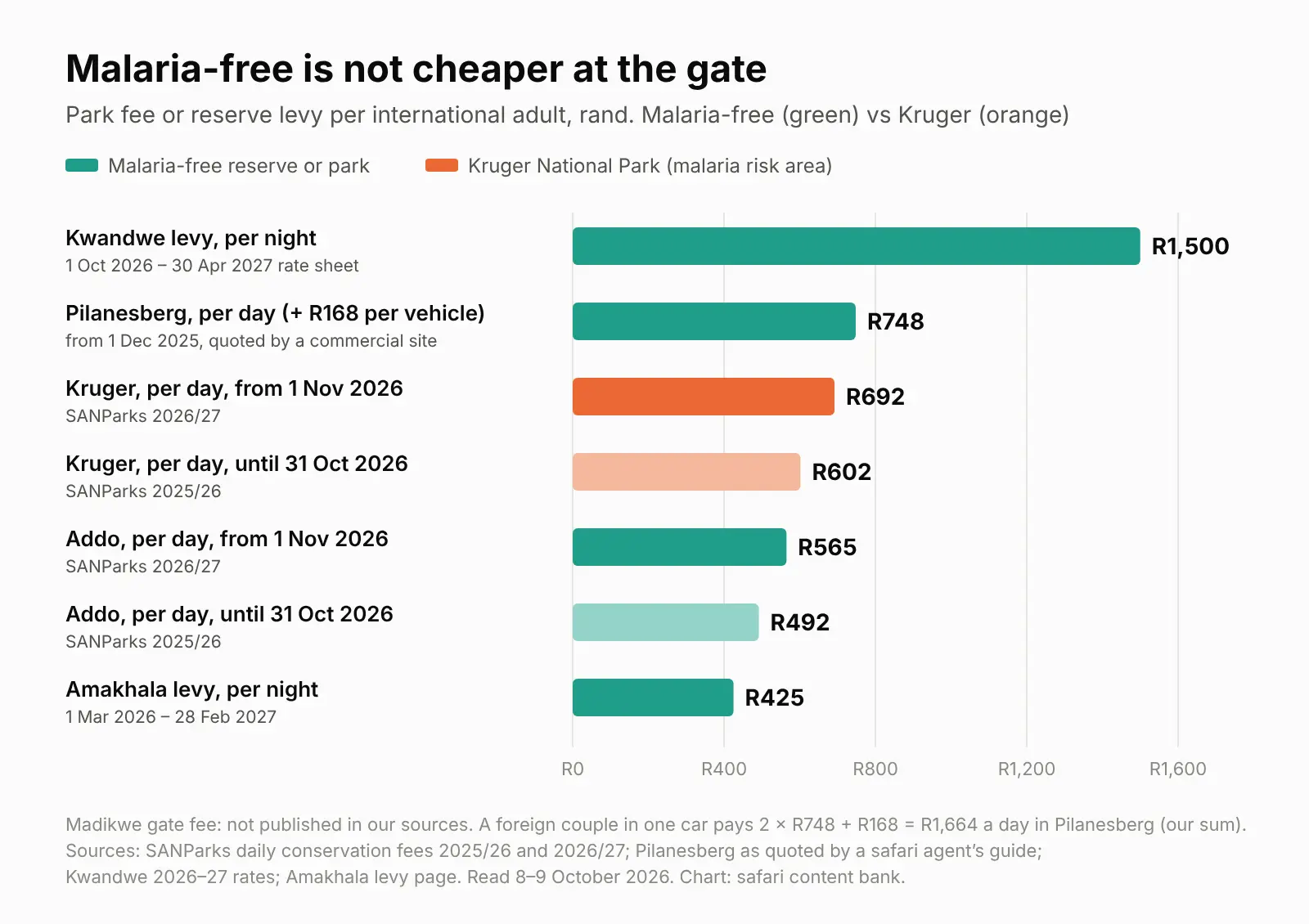 SANParks fee schedules 2025/26 and 2026/27; Pilanesberg as quoted by a safari agent’s guide; Kwandwe and Amakhala rate and levy pages. Read 8–9 October 2026. Chart: safari content bank.
The official fee lines, with the date each took effect and the authority’s own source:
| Fee | Amount | In force from | Source |
|---|---|---|---|
| Kruger National Park daily conservation fee, international adult (12+), per day | ZAR 602 | 1 Nov 2025 to 31 Oct 2026 (SANParks 2025/26 schedule) | SANParks daily conservation fees 2025/26 |
| Kruger National Park daily conservation fee, international adult (12+), per day | ZAR 692 | 1 Nov 2026 to 31 Oct 2027 (SANParks 2026/27 schedule, already published) | SANParks daily conservation fees 2026/27 |
| Addo Elephant National Park daily conservation fee, international adult, per day | ZAR 492 (child ZAR 246) | 1 Nov 2025 to 31 Oct 2026 (SANParks 2025/26 schedule) | SANParks daily conservation fees 2025/26 |
| Addo Elephant National Park daily conservation fee, international adult, per day | ZAR 565 (child ZAR 283) | 1 Nov 2026 to 31 Oct 2027 (SANParks 2026/27 schedule) | SANParks daily conservation fees 2026/27 |
Lodge prices: malaria-free vs Greater Kruger
Malaria-free private lodges cost about the same as Greater Kruger lodges at each tier. Amakhala’s cheapest rooms (R6,340 per person sharing, August–December 2026) sit just below Elephant Plains in Sabi Sand (R7,300, 2026); Kwandwe (R26,180) sits between Thornybush Game Lodge (R19,800) and Sabi Sabi Bush Lodge (R29,600).
| Lodge (reserve) | Malaria | Per person sharing per night | Levy on top | Source |
|---|---|---|---|---|
| Leeuwenbosch (Amakhala) | Malaria-free | R6,340 (1 Aug–19 Dec 2026); R5,290 (1 May–31 Jul 2027) | R425 | Amakhala |
| Bush Lodge (Amakhala) | Malaria-free | R12,180 (1 Aug–19 Dec 2026) | R425 | Amakhala |
| Great Fish River Lodge (Kwandwe) | Malaria-free | R26,180 (1 Oct 2026–30 Apr 2027) | R1,500 | Kwandwe (PDF) |
| Motse (Tswalu) | Malaria-free (per one tour operator’s list) | R46,400 (2026) | None stated | Tswalu |
| Elephant Plains (Sabi Sand) | Risk area | R7,300 (2026) | Conservation contribution, amount not published; Sabi Sand gate fees | Elephant Plains |
| Thornybush Game Lodge (Thornybush) | Risk area | R19,800 (2026) | R650 | Thornybush 2026 (PDF) |
| Sabi Sabi Bush Lodge (Sabi Sand) | Risk area | R29,600 (1 Mar 2026–28 Feb 2027) | R450 | Sabi Sabi |
Published rack rates in rand, read 8 October 2026, with meals and game drives. Drinks: included at Kwandwe, Tswalu and Sabi Sabi; selected house drinks at Amakhala; extra at Elephant Plains.
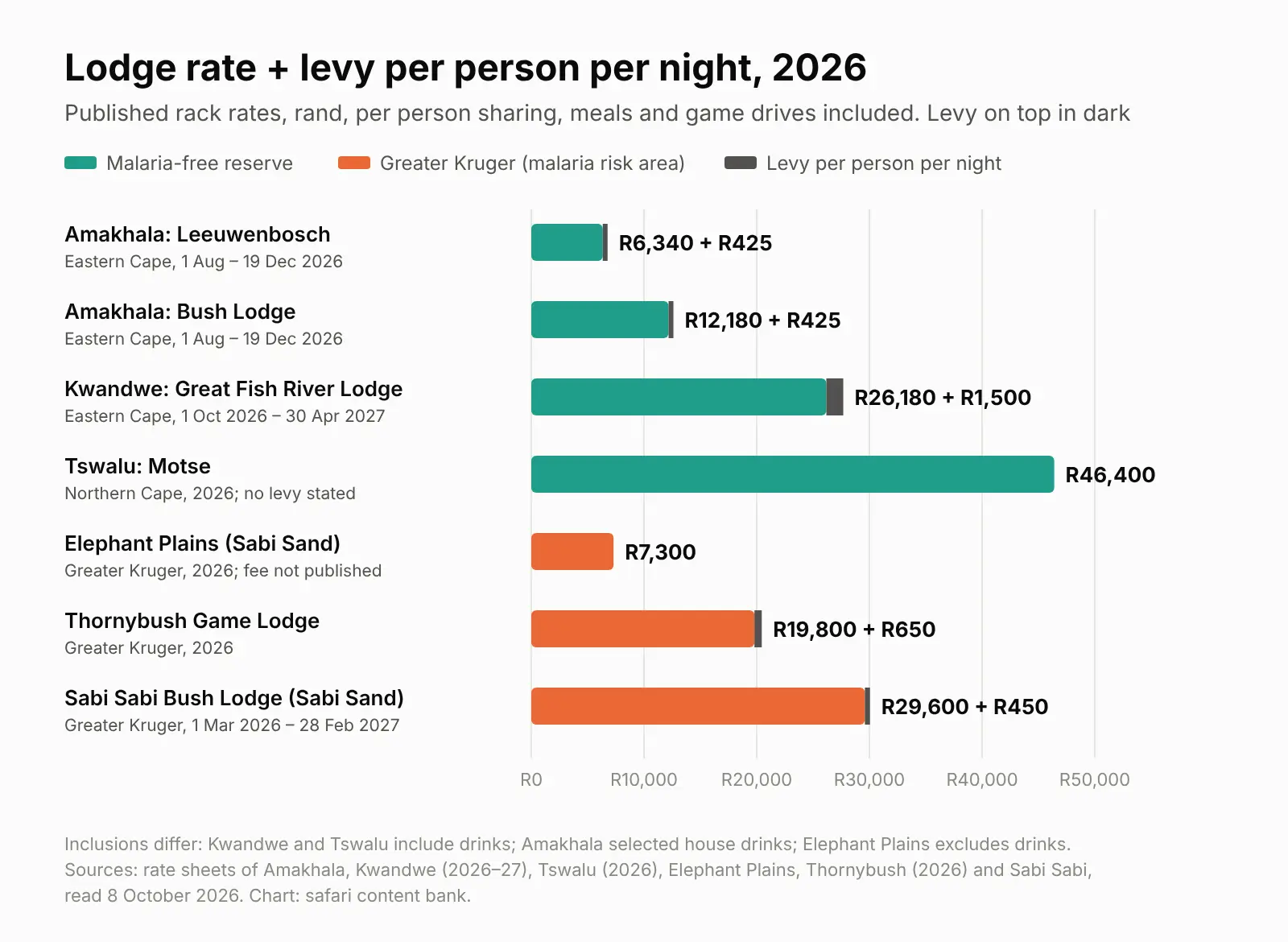 Published lodge rate sheets, read 8 October 2026. Chart: safari content bank.
Malaria-free safaris with children
Families with young children are the main reason people choose a malaria-free reserve, and the reserves’ child rules differ more than their malaria status. Check the minimum age for shared game drives before you book.
| Lodge or reserve | Child rule or rate | Source |
|---|---|---|
| Kwandwe | Ages 12+ at Great Fish River Lodge and the Ecca suites; all ages in the villas and Ecca private-vehicle suites | Kwandwe |
| Tswalu | Children 0–11 sharing stay free; ages 12–17 R10,900 per night (2026). A family legae costs R107,400 a night for 2 adults + 2 children | Tswalu rates |
| Amakhala | “Kids under 12 stay free” offers in the 1 May–31 Jul 2027 season; Hlosi Game Lodge is listed as a family lodge | Amakhala rates |
| Madikwe | Morukuru Family is one of the reserve’s top-end lodges; Madikwe is lodge-only, so no long self-drive days | A safari agent’s guide, read 10 October 2026 |
| For comparison: Thornybush (Greater Kruger, risk area) | Under-6s cannot join shared drives; a private vehicle costs R17,500 a day | Thornybush 2026 (PDF) |
- Antimalarial tablets for children and in pregnancy are a decision for a travel clinic, not for this page. Book the appointment before you choose between Kruger and a malaria-free reserve.
- Traveller reports on TripAdvisor’s Kruger forum advise against long Kruger self-drive days with toddlers (“I would advise NOT going to KNP with toddler”) and suggest a malaria-free reserve with babysitting instead (TripAdvisor Kruger guide thread). These are one forum’s opinions, not a rule.
Self-drive or lodge-only?
Pilanesberg and Addo are the malaria-free parks you can drive yourself; Madikwe, Welgevonden and the Eastern Cape private reserves are lodge-only. If you want Kruger-style self-driving without malaria, choose Pilanesberg from Johannesburg or Addo from Gqeberha.
| Self-drive | Lodge vehicles only | |
|---|---|---|
| Malaria-free | Pilanesberg (sedan on tar and gravel); Addo (tarred loops; gates cashless except Darlington); Marakele (about 80 km of 2WD road) | Madikwe; Welgevonden; Amakhala, Kwandwe, Shamwari; Tswalu |
| Malaria risk area | Kruger National Park (see Kruger self-drive) | Greater Kruger private reserves (Sabi Sand, Timbavati and others) |
Sources: a safari agent’s guide; SANParks Addo and Marakele pages; a safari agent’s guide; welgevonden.org; reserve rate sheets; read 8 October 2026.
The trade-offs of a malaria-free reserve
Malaria-free reserves are fenced and smaller than Greater Kruger. The Eastern Cape reserves cover 9,000–30,000 ha (Amakhala about 9,000 ha, Kwandwe 30,000 ha), against 55,000–65,000 ha for Timbavati or Sabi Sand, which are themselves open to Kruger’s nearly 2 million ha.
- Rhino poaching reaches them too: the Eastern Cape lost 17 rhinos in 2023, 4 in 2024 and 5 in 2025 (DFFE figures), and a syndicate convicted in 2025 had killed 2 rhinos in Madikwe in 2021 (SANParks/DFFE statement).
- Tswalu has no elephant, so it is not a Big Five reserve; it is known for Kalahari species such as meerkat, pangolin and desert black rhino (Wikipedia; tswalu.com).
- Pilanesberg is small and busy: it fills at weekends and in school holidays, and gate times shift by 30 minutes four times a year.
Common mistakes about malaria-free safaris
| What you’ll often read | What is correct |
|---|---|
| “Kruger is malaria-free in winter” | No source says so. TravelHealthPro’s season is September to May; SANParks’ peak is November–April and it does not exempt winter. |
| “Sabi Sand and Timbavati are outside the malaria area” | The Greater Kruger private reserves are in the same Lowveld zone as Kruger. |
| “All of KwaZulu-Natal is malaria-free” | TravelHealthPro rates far north-east KwaZulu-Natal low risk from September to May. |
| “Malaria-free reserves are the cheap alternative to Kruger” | Pilanesberg charges R748 per foreign adult a day plus R168 per vehicle, more than Kruger’s R692 (R602 until 31 Oct 2026). |
| “Malaria-free means no need for repellent” | TravelHealthPro still recommends bite avoidance in the no-risk areas. |
| “You can visit Madikwe for the day” | Madikwe takes no day visitors; you must stay at a lodge. |
| “The lodge rate is the total” | Levies are extra: Kwandwe R1,500 and Amakhala R425 per adult per night. |
| “Tswalu is a Big Five reserve” | Tswalu has no elephant. |
Frequently asked questions
Is Kruger National Park malaria-free? No. UK TravelHealthPro puts Kruger in a malaria risk area and recommends antimalarial tablets from September to May, and the US CDC recommends them for Kruger too. SANParks rates the risk “generally low, even in summer”, with a November–April peak.
Which malaria-free safari is closest to Johannesburg? Pilanesberg, about 220 km from O.R. Tambo airport, which you can drive yourself in an ordinary car. The Waterberg reserves are 2.5–3.5 hours north of Johannesburg, and Madikwe is about 4.5 hours by road.
Which malaria-free safari is closest to Cape Town? One tour operator names Gondwana (Garden Route) and Sanbona as short trips from Cape Town; our sources give no distances. For more Big Five choice, fly from Cape Town to Gqeberha for Addo, Amakhala, Kwandwe or Shamwari.
Do I need malaria tablets for Madikwe or Pilanesberg? TravelHealthPro lists North West province as no risk and advises bite avoidance only. Confirm with a travel clinic before you travel, especially if your trip also includes Kruger or northern KwaZulu-Natal.
Is a malaria-free safari cheaper than Kruger? No. Pilanesberg’s foreign adult fee is R748 a day plus R168 per vehicle, above Kruger’s R692 (R602 until 31 October 2026). Eastern Cape lodges add levies of R425 (Amakhala) to R1,500 (Kwandwe) per adult per night.
How much does a malaria-free safari lodge cost? Published rates run from R5,290 per person sharing per night at Amakhala (May–July 2027) to R26,180 at Kwandwe (from 1 October 2026) and R46,400–55,800 at Tswalu (2026), with meals and game drives. A 3-day Pilanesberg tour from Johannesburg is listed at US$867–990 per person.
Can I self-drive a malaria-free safari? Yes, in Pilanesberg and Addo, both on tarred roads suitable for a sedan. Madikwe, Welgevonden and the Eastern Cape private reserves allow game viewing on lodge vehicles only.
What is the best malaria-free safari for young children? Look for a reserve where children can join drives at their age: Kwandwe takes all ages in its villas and private-vehicle suites, and Tswalu lets children up to 11 stay free when sharing (2026). Ask a travel clinic about your children’s health needs for the trip.
Sources
- Health: UK NaTHNaC, TravelHealthPro, South Africa; US CDC, Travelers’ Health, South Africa; SANParks, Kruger malaria and Mapungubwe; Morris et al., South African Medical Journal 2013, abstract. Checked 9–10 Oct 2026
- Fees: SANParks daily conservation fees 2025/26 (PDF) and 2026/27 (PDF); Pilanesberg tariffs as quoted by a safari agent’s guide, read 10 October 2026; Amakhala levy
- Reserves: a safari agent’s guide; welgevonden.org; SANParks Marakele and Addo; Amakhala; Shamwari; one tour operator’s malaria-free list; Wikipedia (Madikwe, Welgevonden, Shamwari, Tswalu). Read 8 Oct 2026
- Rate sheets: Amakhala, Kwandwe 2026–27 (PDF), Tswalu, Elephant Plains, Thornybush 2026 (PDF), Sabi Sabi. Read 8 Oct 2026
- Tours: three operators’ listings on a safari booking site (names and links kept in our editor notes), read 8 Oct 2026
- Traveller reports: TripAdvisor Kruger forum
- More: South Africa safaris, South Africa safari cost, Kruger National Park, Kruger park fees, Kruger self-drive
Malaria areas checked 10 October 2026; prices and fees read 8–9 October 2026; SANParks fees checked 1 November 2026. We will recheck this page by 10 January 2027, and sooner if TravelHealthPro or CDC change their South Africa malaria advice, or when Pilanesberg, Madikwe or SANParks publish new fees.