 Experience

Last verified · Next check due
On this page
- Where to see wild dogs: places, odds and fees (2026)
- How many African wild dogs are left?
- Botswana: Moremi, Khwai, the Delta and the Linyanti
- Zimbabwe: Mana Pools and Hwange
- Tanzania: Nyerere (Selous), not the Serengeti
- South Africa: Kruger, Sabi Sand and Madikwe
- Kenya: Laikipia
- When is denning season?
- What it costs to look for wild dogs
- Why we never publish den locations
- Common mistakes about seeing wild dogs
- Frequently asked questions
- Sources
Short answer: Northern Botswana gives the best published odds: 65% of one operator’s travellers in Moremi saw wild dog, 61% in the Okavango Delta and 49% in Kwando-Linyanti, against 23% in Chobe (read September 2026). Mana Pools in Zimbabwe reaches 58% (read October 2026). Hwange, Nyerere, Kruger, Sabi Sand and Madikwe hold packs but publish no rate. Africa has about 6,600 adult wild dogs, about 1,400 of them breeding animals (IUCN Red List assessment, 2012, amended 2020).
Key facts
- The African wild dog (Lycaon pictus), also called the painted dog or painted wolf, is Endangered on the IUCN Red List, listed so since 1990, with a decreasing trend (IUCN SSC Canid Specialist Group).
- Africa’s wild dogs number about 6,600 adults in 39 subpopulations, and only about 1,400 are mature, breeding animals, according to the IUCN Red List assessment (2012, amended 2020); each subpopulation holds 2–276 mature animals.
- Moremi Game Reserve has the highest rate in our sources: 65% of one operator’s traveller groups there saw wild dog, against 23% in Chobe National Park and 50% across Botswana (read September 2026). These are per-trip rates over a whole stay, not the chance on one drive.
- Pups first leave the den at about three weeks and abandon it at 8–10 weeks, and while denning a pack stays in one area (Wikipedia, citing Estes 1992). In Botswana, pups emerge around June (one operator’s month-by-month guide) and a Botswana camp operator’s seasonal guide lists dogs denning in August and September.
- No national count for Botswana or a current count for Kruger is published in our sources. The latest Kruger census in our sources dates from 2009–2011.
- We do not publish den locations, and this page names parks and concessions only.
Where to see wild dogs: places, odds and fees (2026)
Botswana’s Moremi, Okavango Delta and Kwando-Linyanti areas and Zimbabwe’s Mana Pools are the only places in our sources with a published wild dog sighting rate of about one in two or better. The other places below hold wild dogs, but no comparable rate is published for them, so we print none.
| Place | Country | Wild dog evidence | Seen by (per trip) | Fee to be there, per adult | Source |
|---|---|---|---|---|---|
| Moremi Game Reserve (incl. Khwai) | Botswana | One operator’s most dependable area; wild dogs collared for research since 1989 | 65% | P270 a day (last published DWNP schedule, 1 April 2022) | one operator’s Moremi page; Wikipedia |
| Okavango Delta reserves | Botswana | Private concessions and Moremi | 61% | In the camp rate at many camps; levies US$20–100 a night | one operator’s Okavango Delta page |
| Kwando-Linyanti and Selinda | Botswana | Selinda has “its resident pack of wild dog” | 49% | Camp rate plus levy (US$20 Kwando; US$100 Great Plains) | one operator’s Kwando-Linyanti page; a Delta booking site’s Selinda page |
| Chobe National Park (incl. Savuti) | Botswana | Present; below the Botswana average | 23% | P270 a day (same DWNP line as Moremi) | one operator’s Chobe page |
| Mana Pools National Park | Zimbabwe | Packs present; guided walks | 58% | Not printed (no ZimParks fee on our cost pages) | one operator’s Mana Pools page |
| Hwange National Park | Zimbabwe | “One of the larger surviving populations”; Painted Dog Conservation at Dete | Not published | Not printed | Wikipedia; one operator’s Hwange page |
| Nyerere National Park (Selous) | Tanzania | About 800 dogs in the Selous (IUCN assessment) | Not published | US$82.60 a day, 16 May–14 March (last published tariff, 2023/24) | IUCN assessment via CMS (PDF); TANAPA 2023/24 |
| Kruger National Park | South Africa | Present; latest census in our sources 2009–2011 | Not published | R692 (R602 until 31 Oct 2026) | Wikipedia; SANParks 2025/26 |
| Sabi Sand (Greater Kruger) | South Africa | Wild dog listed among its species | Not published | R170 per person + R370 per car per entry, plus lodge rates from R7,300 per person sharing (2026) | Wikipedia; Sabi Sand access; Elephant Plains |
| Madikwe Game Reserve | South Africa | Six dogs reintroduced in 1994, now three packs | Not published | Gate fee not found in our sources; Madikwe River Lodge from US$291 per person sharing (2026) | A booking agent’s site, read 10 October 2026; a safari seller’s page |
| Laikipia (western ranches) | Kenya | Described as wild dog country (Laikipia Wilderness, Sosian) | Not published | Not in our sources | one operator’s Laikipia page |
| Serengeti National Park | Tanzania | No dated count or sighting rate in our sources | Not published | US$82.60 a day (last published tariff, 2023/24) | TANAPA 2023/24 |
Sighting rates: one operator’s traveller reports, share of groups who saw wild dog at least once on their trip; Botswana pages read September 2026, Mana Pools read 8 October 2026. Fees per non-resident or international adult, copied from our Botswana, Tanzania and South Africa cost pages, read 8–10 October 2026. Botswana’s fee line is the last published DWNP schedule; no official current tariff is published.
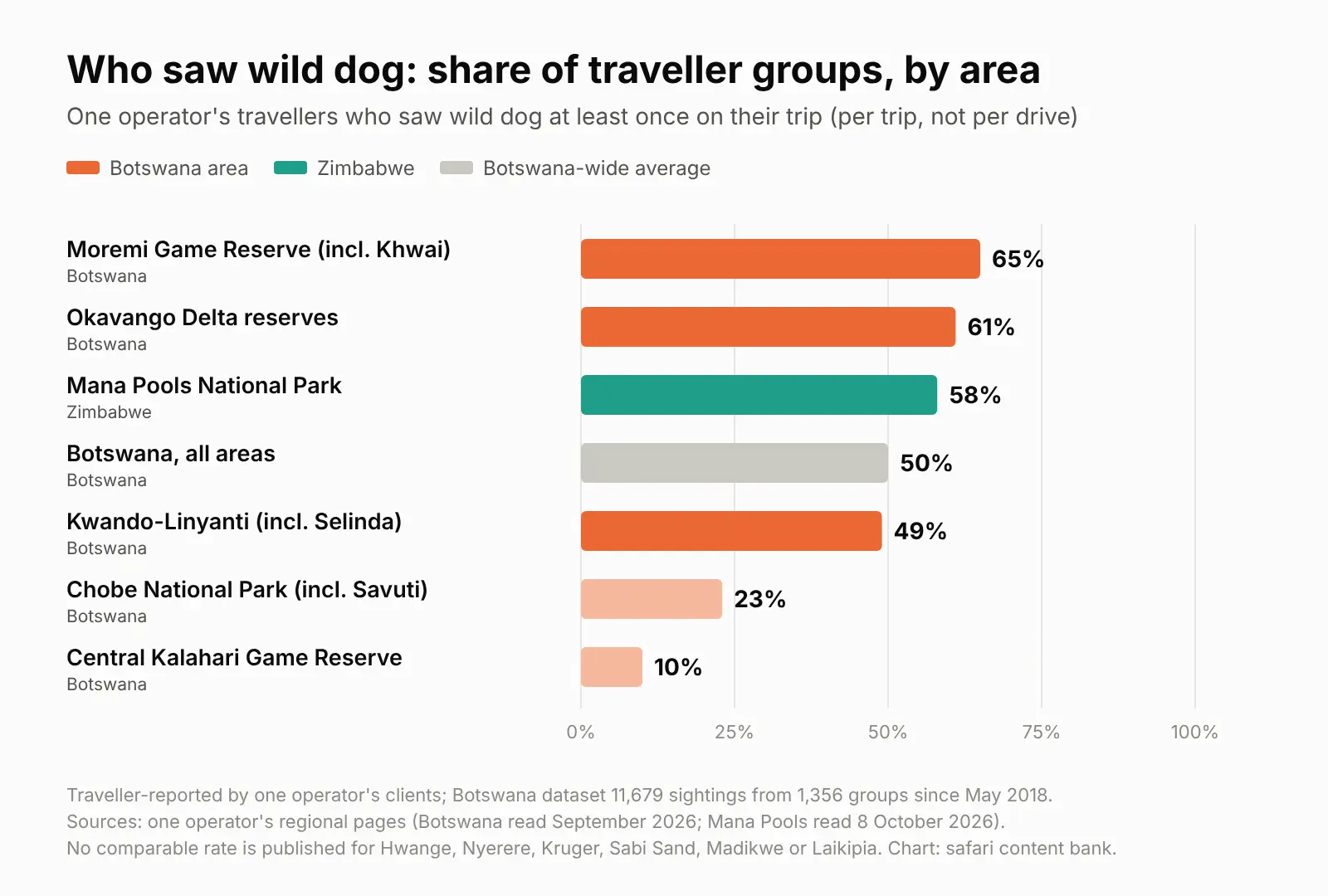 Traveller-reported, per trip, from one operator’s clients; Botswana dataset 11,679 sightings from 1,356 groups since May 2018. Sources: one operator’s regional pages, Botswana read September 2026, Mana Pools read 8 October 2026. Chart: safari content bank.
- Read these as best-case numbers. They come from one operator’s own clients, who tend to take longer, guided, dry-season trips, and the operator does not publish how many groups each regional figure rests on.
- Outside the places our pages cover, one operator’s rates are 46% in Zambia’s Lower Zambezi, 45% in South Luangwa and 22% in Zimbabwe’s Gonarezhou (its Lower Zambezi, South Luangwa and Gonarezhou pages, read 8 October 2026).
How many African wild dogs are left?
About 6,600 adults, of which about 1,400 are mature, breeding animals, in 39 subpopulations (IUCN Red List assessment, 2012, amended 2020). Say which figure you mean: the 6,600 counts all adults, the 1,400 only the animals that breed.
| Measure | Figure | Method and year | Source |
|---|---|---|---|
| Adults, Africa | About 6,600 | IUCN Red List assessment, 2012, amended 2020 | IUCN assessment via CMS (PDF); IUCN SSC Canid Specialist Group |
| Mature (breeding) individuals | About 1,409 (the specialist group rounds to 1,400) | Same assessment | same |
| Subpopulations | 39, of 2–276 mature animals each | Same assessment | same |
| Countries with resident dogs | 19; virtually gone from North and West Africa | Same assessment | IUCN assessment via CMS (PDF) |
| Selous (now Nyerere), Tanzania | About 800 dogs | Same assessment, listing the strongholds | same |
| Status | Endangered, trend decreasing | Red List category since 1990 | IUCN SSC Canid Specialist Group |
Read 9 October 2026. The assessment names the strongholds as northern Botswana, western Zimbabwe, eastern Namibia, western Zambia, Tanzania (Selous/Nyerere) and northern Mozambique.
- Botswana publishes no national wild dog count in our sources, and we found no survey behind the Botswana figures that circulate in trade material. Botswana Predator Conservation (Wild Entrust) has studied dogs in and around Moremi since 1989 (Wild Entrust).
- Kruger’s latest census in our sources is from 2009–2011, so we print no current Kruger count, as on our Kruger page.
- Packs are larger in Moremi and the Selous than in Kruger: typical packs are 8–9 adults in Moremi and Selous, against 4–5 in Kruger and the Maasai Mara (Wikipedia, citing Kingdon 1988).
- Losses are local and sudden. Twenty-one wild dogs were poisoned near Nxaraga in Botswana’s North West District, in a retaliatory killing reported on 7 September 2026; seven vultures died after feeding on the carcasses (The Ngami Times).
Botswana: Moremi, Khwai, the Delta and the Linyanti
Botswana is the one country in our sources with area-by-area sighting rates, and they are highest in Moremi (65%), the Okavango Delta (61%) and Kwando-Linyanti (49%). One operator names Moremi and Khwai as the most dependable areas, then the Kwando–Linyanti and Selinda concessions and Savuti, with dogs occasional in the Central Kalahari, Nxai Pan and the Makgadikgadi (one operator’s wild dog page).
- Moremi or Chobe: 76% of one operator’s travellers saw leopard and 65% wild dog in Moremi, against 59% and 23% in Chobe National Park (read September 2026). Full comparison: Moremi or Chobe?
- The rules differ between parks and concessions. Off-road and night driving are prohibited in Moremi, Chobe and Botswana’s other parks and reserves, and allowed on private concessions (Botswana Tourism). On a concession a guide can follow a pack off the track; inside Moremi the vehicle stays on the road. See night drives, walking and off-road driving in Botswana.
- Selinda, in the Linyanti, has “its resident pack of wild dog; they love the open grasslands” (a Delta booking site’s Selinda page).
- Linyanti camps are reached by light aircraft. Moremi Air charges US$350 a seat from Maun to Lebala or Lagoon (Kwando, 2024); see Botswana bush flights.
- Moremi and Chobe share one park-fee line: P270 per non-resident adult per day in the last published DWNP schedule (1 April 2022, via Tourism Update). In February 2026 the government news agency BOPA called the existing non-resident fee P380; a P500 rise was announced, then reported postponed. No official current tariff is published; confirm with DWNP or your operator.
More on Botswana’s wildlife odds: Botswana safari questions and the Okavango Delta page.
Zimbabwe: Mana Pools and Hwange
Mana Pools is the one Zimbabwean park in our sources with a published rate: 58% of one operator’s travellers there saw wild dog (one operator’s Mana Pools page, read 8 October 2026). Hwange has a large population but no published rate.
- Mana Pools is a dry-season park. One operator rates June to October best; camps open roughly April to November and all close from December to March. Guided walks with Zimbabwean professional guides are the park’s signature activity.
- Hwange holds “one of the larger surviving populations” of wild dog in Africa (Wikipedia). Its best months are July to October, when game gathers at the pumped waterholes (one operator’s Hwange page; a safari booking site’s Hwange page).
- Night drives in Hwange are allowed only on private concessions (a safari booking site’s Hwange page).
- Painted Dog Conservation has a visitor centre at Dete, beside Hwange’s Main Camp gate, open to visitors with advance notice (one operator’s Hwange page).
- We print no ZimParks fee for Mana Pools or Hwange: no Zimbabwe cost page on this site carries one yet. Victoria Falls, the usual gateway, is covered on Victoria Falls: Zimbabwe or Zambia.
See also: Hwange vs Mana Pools.
Tanzania: Nyerere (Selous), not the Serengeti
Nyerere National Park, the former Selous, is Tanzania’s wild dog park: the IUCN assessment lists the Selous as a stronghold with about 800 dogs. Packs there typically hold 8–9 adults (Wikipedia, citing Kingdon 1988). Nyerere against Ruaha: Ruaha vs Nyerere.
- Nyerere costs US$82.60 per non-East African adult per day (US$70 + 18% VAT, 16 May–14 March; US$70.80 from 15 March to 15 May), plus a concession fee of US$70.80 a night from July to September and US$59 from October to June if you sleep inside (last published tariff, 2023/24). See Tanzania safari cost.
- Night drives are allowed in Nyerere. The TANAPA night-drive fee names Nyerere among its parks, at US$50 per adult plus VAT (last published tariff, 2023/24), while night drives are not permitted in the Serengeti (Tanzania safari questions).
- Parts of Nyerere close to game drives from March to May (a safari agent’s Nyerere guide), and one operator says many camps close in April and May. See green-season safaris.
- Our sources hold no dated wild dog count or sighting rate for the Serengeti, so we do not list it as a place to go for wild dog. Typical packs in the neighbouring Maasai Mara are 4–5 adults (Wikipedia, citing Kingdon 1988).
South Africa: Kruger, Sabi Sand and Madikwe
South Africa’s wild dogs are seen in Kruger, the Greater Kruger private reserves and malaria-free Madikwe, but none of them publishes a sighting rate in our sources. Kruger charges R692 per international adult per day from 1 November 2026 (R602 until 31 October 2026) (Kruger park fees).
- Kruger has the Big Five plus cheetah and wild dog; the latest census in our sources dates from 2009–2011 (Kruger). Kruger is a self-drive park.
- Sabi Sand lists wild dog among its species (Wikipedia) and admits lodge guests only. Its 2026 gate fee is R170 per person plus R370 per car, and its cheapest published 2026 bed is R7,300 per person sharing at Elephant Plains (South Africa safari cost; Sabi Sand vs Timbavati).
- Madikwe has three wild dog packs, from six dogs reintroduced in 1994 (a booking agent’s site, read 10 October 2026). It is malaria-free, lodge-only and about 4.5 hours by road from Johannesburg; Madikwe River Lodge starts at US$291 per person sharing (a safari seller, 2026). See malaria-free safaris in South Africa and Madikwe vs Pilanesberg.
Kenya: Laikipia
In Kenya, the ranches of western Laikipia are where operators send wild dog watchers; one operator describes Laikipia Wilderness and Sosian as wild dog country (one operator’s Laikipia page). No Kenyan sighting rate or wild dog count is in our sources, and neither ranch’s conservancy fee is.
- Laikipia is a patchwork of ranches and conservancies, so the choice is the conservancy, not the region (one operator).
- Ol Pejeta Conservancy, in Laikipia, charges US$110 per non-resident adult per day, VAT included (Ol Pejeta Tariff Guide 2026), but our sources do not describe it as a wild dog area; for its rhino, see where to see rhino and Kenya safari cost.
See also: Laikipia vs Masai Mara.
When is denning season?
In Botswana, the sources in our bank put wild dog pups emerging from their dens around June and packs denning in August and September; a denning pack stays in one area for weeks, then moves on. Wild dogs den in the dry season in southern Africa, for about three months (Wikipedia, citing Estes 1992).
| What | When | Where | Source |
|---|---|---|---|
| “Wild dog pups emerge from their dens” | June | Botswana | one operator’s Botswana month-by-month guide |
| Painted dogs denning | August–September | Botswana | A Botswana camp operator’s seasonal guide (PDF) |
| Pups first out of the den; weaned; leave the den for good | About 3 weeks; 5 weeks; 8–10 weeks old | All populations | Wikipedia, citing Estes 1992 |
| Litter size | 6–16 pups, 10 on average | All populations | same |
| Best game viewing | June–October | Botswana | A camp operator’s best-time guide for Botswana |
| Best months | June–October; camps closed December–March | Mana Pools | one operator’s guide |
Read September–October 2026. No source in our bank publishes a denning calendar for Hwange, Nyerere, Kruger or Laikipia.
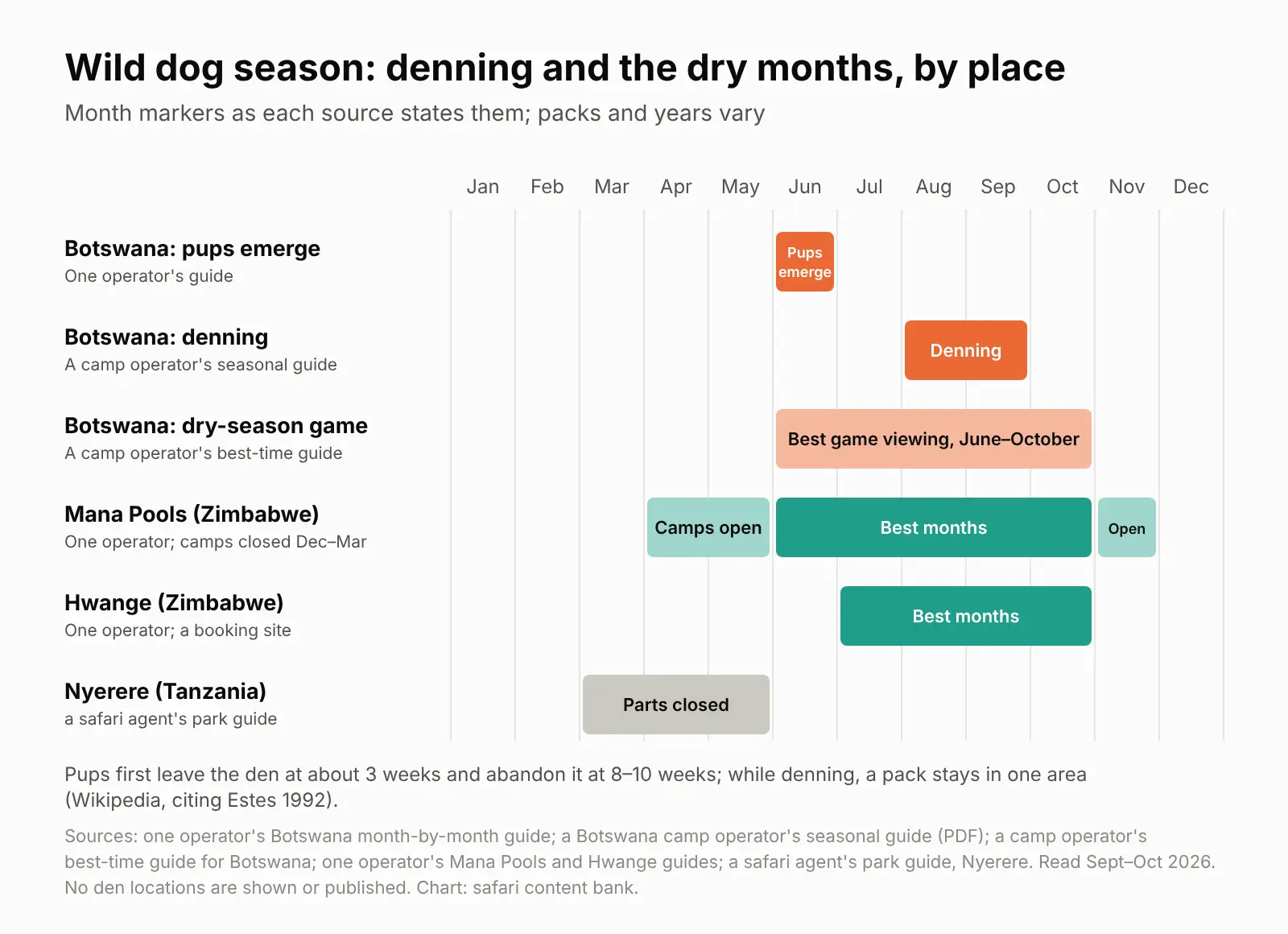 Month markers as each source states them; packs and years vary. Sources: one operator’s month-by-month guide; a Botswana camp operator’s seasonal guide; a camp operator’s best-time guide for Botswana; one operator’s guides (Mana Pools, Hwange); a safari agent’s park guide. Chart: safari content bank.
- The denning months fall in the Okavango’s high-water season. Water is highest in most of the Delta from about May to August (Okavango flood calendar).
- They are also the peak-price months. Mombo costs US$3,062 a night from January to March and US$5,345 from June to October (2026–27); Kwando calls July–October its “Flood” season (Botswana safari cost).
- No source can promise a den in a given year. Ask a camp whether a pack is denning on its land this season; do not expect it to say where.
What it costs to look for wild dogs
In Botswana’s wild dog areas, published camp rates run from US$645 to US$5,345 per person a night (2024–2027 rate cards), and a public campsite in Moremi costs US$40–50 plus the park fee. Rates below are copied from our cost pages, with each rate card’s year.
| Where | Option | Price per person | Basis | Source |
|---|---|---|---|---|
| Moremi | Public campsite (Xakanaxa, South Gate, North Gate) | US$40–50 a night | Plus park fee (P270, last published) and a P10 levy | A safari operator’s public campsite sheet (PDF) |
| Moremi | Camp Moremi, Camp Xakanaxa (Desert & Delta) | US$645–1,160 a night | 2024, 1–4 nights | Desert & Delta 2024 |
| Moremi | Mombo (Wilderness) | US$3,062–5,345 a night | 2026–27, park fees included | Wilderness, Mombo |
| Khwai | Machaba Camp | US$718–1,315 a night | 2026; levy US$35 | Machaba 2026 |
| Khwai Private Reserve | Sable Alley, Mbamba (Natural Selection) | US$995–1,995 a night | 2026, park fees included; levy US$60 | Natural Selection 2026 |
| Okavango Delta | Kwara (Kwando) | US$820–2,100 a night | 2024; levy US$20 | Kwando 2024 |
| Linyanti | Lagoon, Lebala (Kwando) | US$690–1,750 a night | 2024; levy US$20; flights extra | same |
| Selinda | Selinda Explorers (Great Plains) | US$1,105–1,915 a night | 2025; levy US$100; air included on 2+ nights | Great Plains 2025 |
| Selinda | Selinda Camp, Zarafa (Great Plains) | US$1,935–3,665 a night | 2025; as above | same |
| Nyerere | Park entry | US$82.60 a day | 16 May–14 March (last published tariff, 2023/24) | TANAPA 2023/24 |
| Kruger | Park entry | R692 a day (R602 until 31 Oct 2026) | Per international adult | SANParks |
| Sabi Sand | Elephant Plains | R7,300 / R9,300 a night | Rondavel / luxury suite, 2026; plus R170 per person + R370 per car at the gate | Elephant Plains; Sabi Sand access |
| Madikwe | Madikwe River Lodge | From US$291 a night | Per person sharing, 2026 “from” price | a safari seller |
Per person sharing, lowest to highest season unless marked; camp rates captured September 2026 and checked 9–10 October 2026, as printed on our Botswana safari cost, Chobe, Moremi or Chobe?, South Africa safari cost and malaria-free safari pages. No published rate is in our sources for Mana Pools, Hwange or Nyerere camps, or for Laikipia’s western ranches.
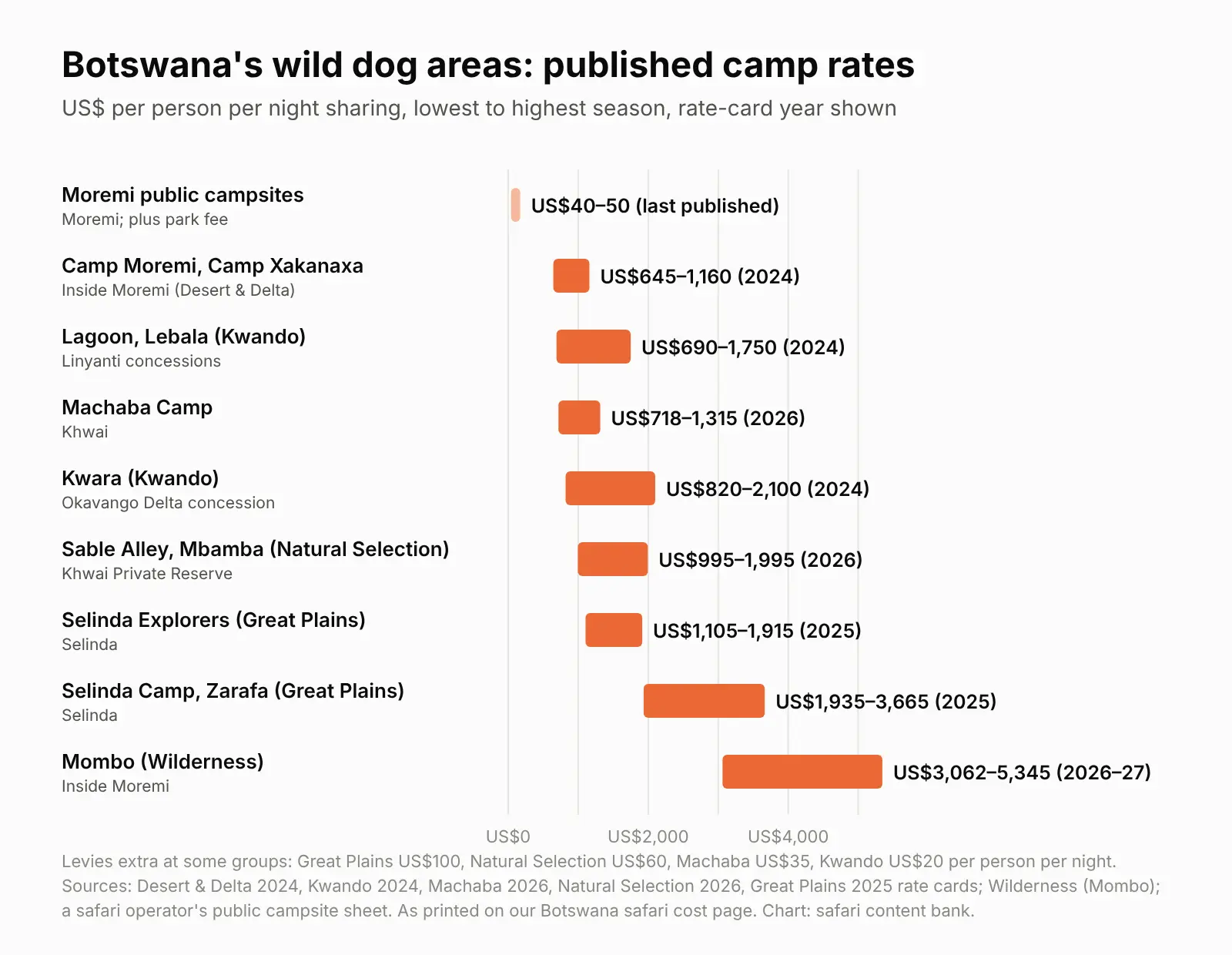 Levies extra at some groups: Great Plains US$100, Natural Selection US$60, Machaba US$35, Kwando US$20 per person per night. Sources: operators’ rate cards as in the table above. Chart: safari content bank.
The official fee lines, with the date each took effect and the authority’s own source:
| Fee | Amount | In force from | Source |
|---|---|---|---|
| Chobe National Park and Moremi Game Reserve (DWNP), non-resident adult, per person per day | BWP 270 (SADC residents BWP 205; Botswana citizens and residents BWP 30) | Last published DWNP schedule, 1 April 2022 (via Tourism Update). In Feb 2026 the government news agency BOPA called the existing non-resident fee P380; a P500 rise was announced, then reported postponed. No official current tariff: confirm with DWNP or your operator | Tourism Update, 23 Feb 2022 (DWNP fee schedule) |
| Serengeti and Nyerere National Parks, non-East African adult, entry per day, 16 May–14 Mar | USD 70 + 18% VAT = USD 82.60 | 1 Jul 2023 (2023/24 tariff, last published) | TANAPA Tariffs 2023/24 |
| Serengeti and Nyerere National Parks, non-East African adult, entry per day, 15 Mar–15 May | USD 60 + 18% VAT = USD 70.80 | 1 Jul 2023 (2023/24 tariff, last published) | TANAPA Tariffs 2023/24 |
| Serengeti and Nyerere, concession fee per person per night inside the park | Jul–Sep USD 60 + VAT = USD 70.80; Oct–Jun USD 50 + VAT = USD 59 | 1 Jul 2023 (2023/24 tariff, last published) | TANAPA Tariffs 2023/24 |
| Kruger National Park daily conservation fee, international adult (12+), per day | ZAR 602 | 1 Nov 2025 to 31 Oct 2026 (SANParks 2025/26 schedule) | SANParks daily conservation fees 2025/26 |
| Kruger National Park daily conservation fee, international adult (12+), per day | ZAR 692 | 1 Nov 2026 to 31 Oct 2027 (SANParks 2026/27 schedule, already published) | SANParks daily conservation fees 2026/27 |
| Sabi Sand Nature Reserve gate fee, per person, per entry (VAT included) | ZAR 170 (ZAR 180 in 2027) | 1 Jan to 31 Dec 2026 | Sabi Sand Nature Reserve, access and gate fees |
| Sabi Sand Nature Reserve gate fee, light vehicle under 3,500 kg, per entry (VAT included) | ZAR 370 (ZAR 390 in 2027) | 1 Jan to 31 Dec 2026 | Sabi Sand Nature Reserve, access and gate fees |
Why we never publish den locations
We do not publish where a wild dog den is, and we do not ask guides or lodges for it. A den holds a litter of 6–16 pups for weeks (Wikipedia), and wild dogs are killed in conflict with livestock owners, as at Nxaraga in September 2026.
- This page names parks, reserves and concessions, never sightings or dens.
- Strip GPS and location data from wild dog photos before you post them, and do not name the den area, road or waterhole in a caption.
- Our own wild dog photos carry no location data.
Common mistakes about seeing wild dogs
| What you’ll often read | What is correct |
|---|---|
| “There are 6,600 wild dogs left” | About 6,600 adults, but only about 1,400 mature, breeding animals (IUCN Red List assessment, 2012, amended 2020). Say which you mean. |
| “Chobe is good for wild dog” | 23% of one operator’s Chobe travellers saw them, below the Botswana-wide 50% and Moremi’s 65%. |
| “A Moremi camp lets you follow the dogs off-road” | Off-road driving is prohibited in Moremi and Botswana’s other parks and reserves; it is allowed on private concessions (Botswana Tourism). |
| “Denning season guarantees a sighting” | No source in our bank promises a den. Pups emerge around June in Botswana (one operator’s month-by-month guide) and a Botswana camp operator’s seasonal guide lists denning in August–September. |
| “Kruger has [a current number] wild dogs” | The latest Kruger census in our sources is from 2009–2011; we print no current count. |
| “The Serengeti is a wild dog destination” | Our sources hold no dated wild dog count or sighting rate for the Serengeti. Nyerere is Tanzania’s stronghold, with about 800 dogs in the Selous (IUCN). |
| “Botswana’s park fee is P500 from April 2026” | The P500 rise was announced, then reported postponed. The last published DWNP schedule (1 April 2022) is P270; BOPA called the existing fee P380. No official current tariff is published. |
Frequently asked questions
Where is the best place to see African wild dogs? Northern Botswana, on the published figures. 65% of one operator’s travellers in Moremi Game Reserve saw wild dog, 61% in the Okavango Delta and 49% in Kwando-Linyanti (read September 2026). Zimbabwe’s Mana Pools is close behind at 58%.
How many African wild dogs are left in the wild? About 6,600 adults, of which about 1,400 are mature, breeding animals, in 39 subpopulations (IUCN Red List assessment, 2012, amended 2020). The species has been listed as Endangered since 1990, and its trend is decreasing.
When is wild dog denning season? In Botswana, pups emerge from their dens around June (one operator’s month-by-month guide), and a Botswana camp operator’s seasonal guide lists dogs denning in August and September. Pups first leave the den at about three weeks and abandon it at 8–10 weeks (Wikipedia, citing Estes 1992). No source can promise a den on a given concession in a given year.
Is Moremi or Chobe better for wild dog? Moremi. 65% of one operator’s Moremi travellers saw wild dog, against 23% in Chobe (read September 2026). Both charge P270 a day in the last published DWNP schedule (1 April 2022); no official current tariff is published.
Can you see wild dogs in the Serengeti or the Masai Mara? Not reliably, on our sources. They hold no dated wild dog count or sighting rate for the Serengeti or the Mara. In Tanzania, Nyerere National Park (the Selous) is the stronghold, with about 800 dogs in the IUCN assessment.
Can you see wild dogs in Kruger? Yes, Kruger has wild dog, but no sighting rate or current count is published in our sources; the latest census dates from 2009–2011. Kruger charges R692 per international adult per day from 1 November 2026 (R602 until 31 October 2026).
What is the difference between a wild dog, a painted dog and a painted wolf? None: all three names mean the same animal, Lycaon pictus. A Botswana camp operator’s seasonal guide and Painted Dog Conservation in Hwange use “painted dog”.
Sources
- Population and status: IUCN Red List assessment of Lycaon pictus (2012, amended 2020), CITES-CMS ACI2 Inf. 11 (PDF); IUCN SSC Canid Specialist Group, African wild dog, read 9 Oct 2026; Wikipedia, African wild dog (secondary; citing Estes 1992 and Kingdon 1988)
- Sighting rates: one operator’s pages on Botswana wildlife, wild dog in Botswana, Moremi, Okavango Delta, Kwando-Linyanti, Chobe, Central Kalahari (read September 2026); Mana Pools, Hwange, Gonarezhou, Lower Zambezi, South Luangwa and Laikipia (read October 2026) (names and links kept in our editor notes)
- Botswana: Botswana Tourism, game viewing; a Delta booking site’s Selinda page; Wikipedia, Moremi Game Reserve; Wild Entrust; The Ngami Times, 7 Sep 2026; DWNP schedule effective 1 April 2022 via Tourism Update, 23 Feb 2022; Botswana Daily News (BOPA), 24 Feb 2026; Gabz FM, 5 May 2026 (names and links kept in our editor notes)
- Seasons: one operator’s Botswana month-by-month guide; a Botswana camp operator’s seasonal guide (PDF); a camp operator’s best-time guide for Botswana; a safari agent’s Nyerere guide (names and links kept in our editor notes)
- Zimbabwe: Wikipedia, Hwange National Park (secondary); a safari booking site’s Hwange page (names and links kept in our editor notes)
- Tanzania: TANAPA Tariffs 2023/24 (PDF), the last published tariff
- South Africa: SANParks daily conservation fees 2025/26 and 2026/27; Sabi Sand access; Elephant Plains rates; Wikipedia, Kruger National Park and Sabi Sand Game Reserve (secondary); a booking agent’s Madikwe site; a safari seller’s page (names and links kept in our editor notes)
- Camp rates: Desert & Delta 2024; Kwando 2024; Machaba 2026; Natural Selection 2026; Great Plains 2025; Wilderness, Mombo; a safari operator’s public campsite sheet (PDF)
More on where to see the other animals: lions, leopards, cheetahs, elephants and the Big Five.
Figures, rates and fees checked 10 October 2026; SANParks fees checked 1 November 2026. We will update this page when the IUCN publishes a new wild dog assessment, when one operator’s sighting rates change, when DWNP publishes an official Botswana tariff, when TANAPA publishes a new tariff and when SANParks’ 2026/27 fees take effect on 1 November 2026.