 Experience

Last verified · Next check due
On this page
- Which safari countries ask for a yellow fever certificate?
- Which countries count as “risk countries” for these rules?
- Common safari routes: do you need the card?
- Kenya to Tanzania: road, air and Zanzibar
- Transit rules: when does a stopover count?
- Gorilla trips: Uganda and Rwanda
- Southern Africa: Botswana, Namibia, Zambia, Zimbabwe and South Africa
- Vaccine recommended vs certificate required
- Common mistakes about yellow fever on safari
- Frequently asked questions
- Sources
Short answer: Not to enter any of the nine countries straight from Europe or North America. Eight of them ask for a yellow fever certificate only from travellers arriving from a yellow fever risk country, mostly from age 1; Uganda has not asked for one since 2 October 2026. Kenya and Uganda are risk countries, so Kenya then Tanzania or Uganda then Rwanda needs the card. Tanzania and Namibia also count transits of more than 12 hours. Checked 10 October 2026.
Key facts
- No country on this list requires the certificate from everyone. Kenya, Tanzania, Rwanda, Botswana, Namibia, Zambia, Zimbabwe and South Africa ask for it only from travellers arriving from a country with yellow fever risk (WHO country list, 2022, rev. 3 Jan 2023 (PDF); UK FCDO country pages).
- Uganda dropped its requirement on 2 October 2026: “A Yellow Fever Vaccination certificate is no longer a mandatory requirement for entry into Uganda” (Uganda Directorate of Citizenship and Immigration Control). Uganda is still a yellow fever risk country, so the next country on your route may ask for the card.
- Tanzania asks travellers aged 1 and over arriving from Kenya for the certificate, by road or by air, and also after a transit of more than 12 hours through an airport in a risk country (WHO, Tanzania entry).
- Namibia counts transits of more than 12 hours in a risk country, from age 9 months (WHO). Botswana’s rule covers arrivals from or transits through a risk country, from age 1 (WHO).
- A yellow fever certificate is valid for life under WHO rules in force since 11 July 2016 (TravelHealthPro, Kenya).
- This page covers entry rules, not medical advice. Whether you should have the vaccine depends on where you go and your health; a travel clinic decides that, not a border rule. For the other vaccines advised for a safari, see safari vaccinations.
Which safari countries ask for a yellow fever certificate?
All nine let you in without one if you arrive directly from Europe or North America; eight ask for it when you arrive from a yellow fever risk country, and Uganda asks for it from no one. The rules differ on transits and on the minimum age.
| Country | Certificate required? | Transit rule | From age | Source (date) |
|---|---|---|---|---|
| Kenya | Only if arriving from a risk country; without it you “may be denied entry” (US State Department) | None stated in WHO’s Kenya entry | 1 year | WHO list (PDF), rev. 3 Jan 2023; UK FCDO, updated 4 Sep 2026 |
| Tanzania (incl. Zanzibar) | Only if arriving from a risk country, Kenya included | More than 12 hours through an airport in a risk country (WHO); “12 hours or more” (US State Department) | 1 year | WHO list (Tanzania entry); UK FCDO, updated 6 Oct 2026 |
| Uganda | No, since 2 October 2026 | — | — | Uganda Immigration notice, 2 Oct 2026; UK FCDO, updated 8 Oct 2026 |
| Rwanda | Only if arriving from a risk country, Uganda included | Not stated in our sources | 1 year | WHO list; UK FCDO, updated 4 Sep 2026 |
| Botswana | Only if arriving from, or transiting through, a risk country | Transit counts; no minimum hours in our sources | 1 year | WHO list; TravelHealthPro, Botswana; UK FCDO |
| Namibia | Only if arriving from a risk country | More than 12 hours in a risk country | 9 months | WHO list; UK FCDO, updated 10 Dec 2025 |
| Zambia | Only if arriving from a risk country | Not stated in our sources | Not stated | UK FCDO, updated 1 Jun 2026 |
| Zimbabwe | Only if arriving from a risk country | Not stated in our sources | Not stated | UK FCDO, updated 15 Jul 2026 |
| South Africa | Only if arriving from a risk country; the vaccination must date from at least 10 days before arrival | Not stated in our sources | Not stated | US State Department, 11 Aug 2025; UK FCDO, updated 8 Jul 2026 |
Official pages read 8–10 October 2026. WHO’s 2022 country list (revised 3 January 2023) is the latest edition on who.int. We could not open the CDC destination pages or the CDC Yellow Book tool for this check, and the WHO entries for Zambia, Zimbabwe and South Africa could not be read, so those three rows rest on the UK FCDO and US State Department. Rules can change at short notice: check the official page of each country on your route the week you travel.
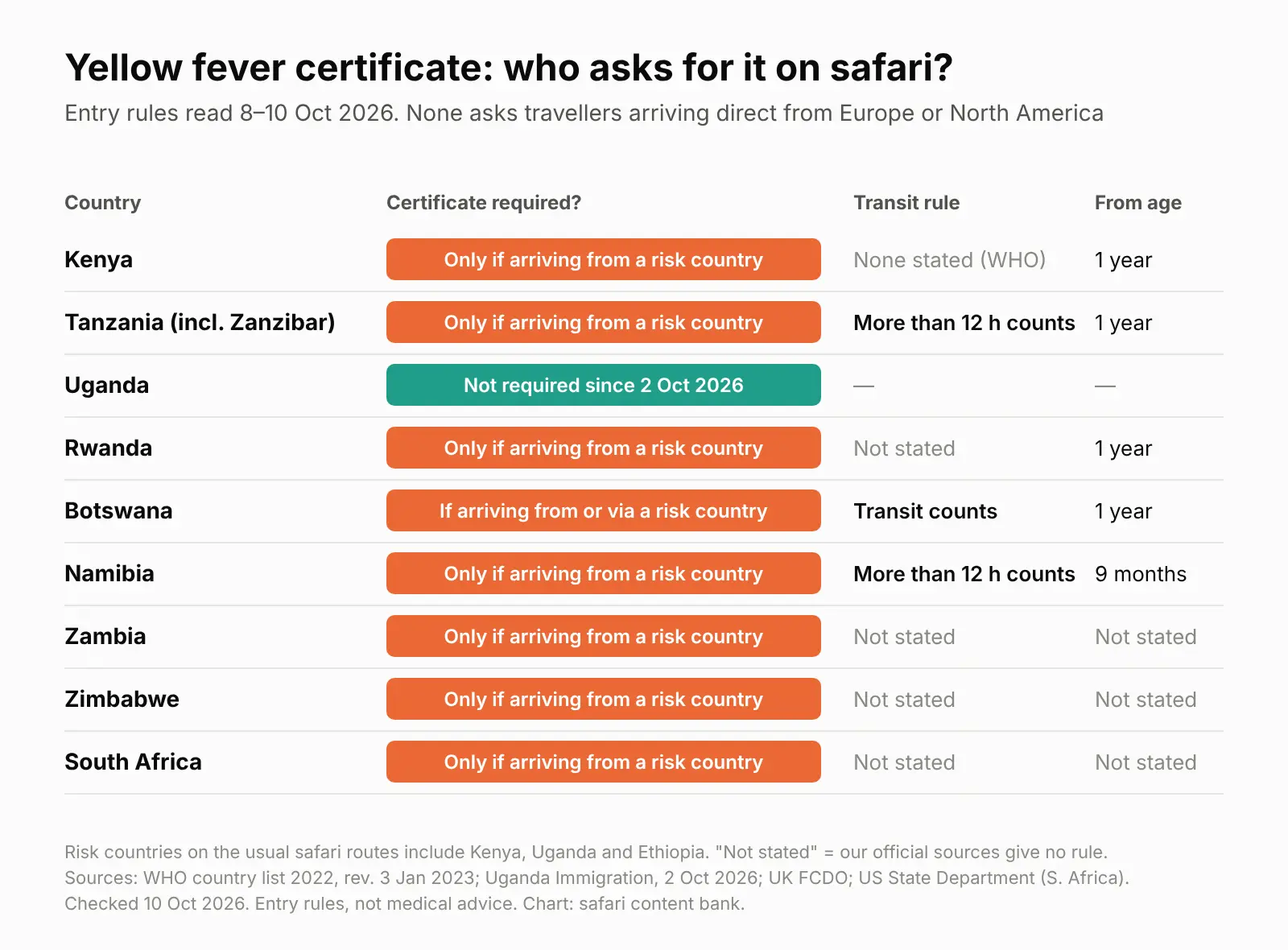 Sources: WHO country list 2022, rev. 3 Jan 2023; Uganda Immigration notice, 2 Oct 2026; UK FCDO entry pages (updated 10 Dec 2025 – 8 Oct 2026); US State Department, South Africa. Checked 10 October 2026. Chart: safari content bank.
Which countries count as “risk countries” for these rules?
Kenya and Uganda, the two East African safari countries on this list that our official sources name as yellow fever risk countries, are the ones that trigger the check on most safari routes; Ethiopia, home of the Addis Ababa airline hub, is a third. Each country applies its own list, so check where every leg of your trip starts.
- Kenya: a risk country; WHO recommends the vaccine for most of it (WHO; UK FCDO).
- Uganda: a risk country, even though it no longer asks visitors for the card (Uganda Immigration notice, 2 Oct 2026).
- Ethiopia: a risk country; WHO recommends the vaccine for all areas except the Afar and Somali regions (WHO; UK FCDO, updated 25 Sep 2026). Check any routing through Addis Ababa.
- Tanzania, Rwanda and Zambia: we did not open an official list that says whether other countries treat them as risk countries. WHO does not recommend the vaccine for a trip to Tanzania alone or to Rwanda itself, but that is a vaccine recommendation, not the border list.
- Botswana: “There is no risk of yellow fever in Botswana, however, there is a certificate requirement” (TravelHealthPro).
Common safari routes: do you need the card?
You need it whenever a leg of your trip starts in Kenya or Uganda and ends in another country on this list, except Uganda. Flying in from Europe or North America, you do not.
| Route | Certificate needed? | Why | Source |
|---|---|---|---|
| Europe or North America → any of the nine, direct | No | None of the nine asks for it from these arrivals | WHO; UK FCDO |
| Masai Mara or Nairobi → Serengeti or Arusha, road or air | Yes, aged 1 and over | Kenya is a risk country; Tanzania checks at Namanga, Isebania–Sirari and on arrival by air | WHO, Tanzania entry |
| Masai Mara or Nairobi → Zanzibar | Yes | Zanzibar is part of the United Republic of Tanzania, which the WHO entry covers | WHO, Tanzania entry |
| Long-haul flight connecting in Nairobi, then on to Tanzania | Yes if the transit is more than 12 hours (WHO) or 12 hours or more (US State Department) | Tanzania’s transit rule | WHO; US State Department |
| Uganda → Rwanda (gorilla trips) | Yes | Rwanda asks arrivals from risk countries; Uganda is one | WHO; UK FCDO Rwanda |
| Uganda → Kenya or Tanzania | Yes | Both ask arrivals from Uganda, although Uganda itself stopped asking on 2 Oct 2026 | WHO; Uganda Immigration notice |
| Kenya → Victoria Falls (Zimbabwe or Zambia), Botswana, Namibia or South Africa | Yes | All five ask arrivals from risk countries | UK FCDO; WHO; US State Department |
| Connection in Addis Ababa → Namibia or Tanzania | Yes if the transit is more than 12 hours | Ethiopia is a risk country | WHO |
| Any arrival in Uganda | No, since 2 Oct 2026 | Requirement dropped | Uganda Immigration notice |
| Tanzania → Kenya | Not confirmed | No official source we read says whether Kenya checks arrivals from Tanzania | — |
| Rwanda → Tanzania; Zambia → Zimbabwe or Botswana | Not confirmed | No official source we read says whether these countries treat Rwanda or Zambia as risk countries | — |
Read 8–10 October 2026. “Not confirmed” means our official sources do not answer the question; it does not mean the card is not needed.
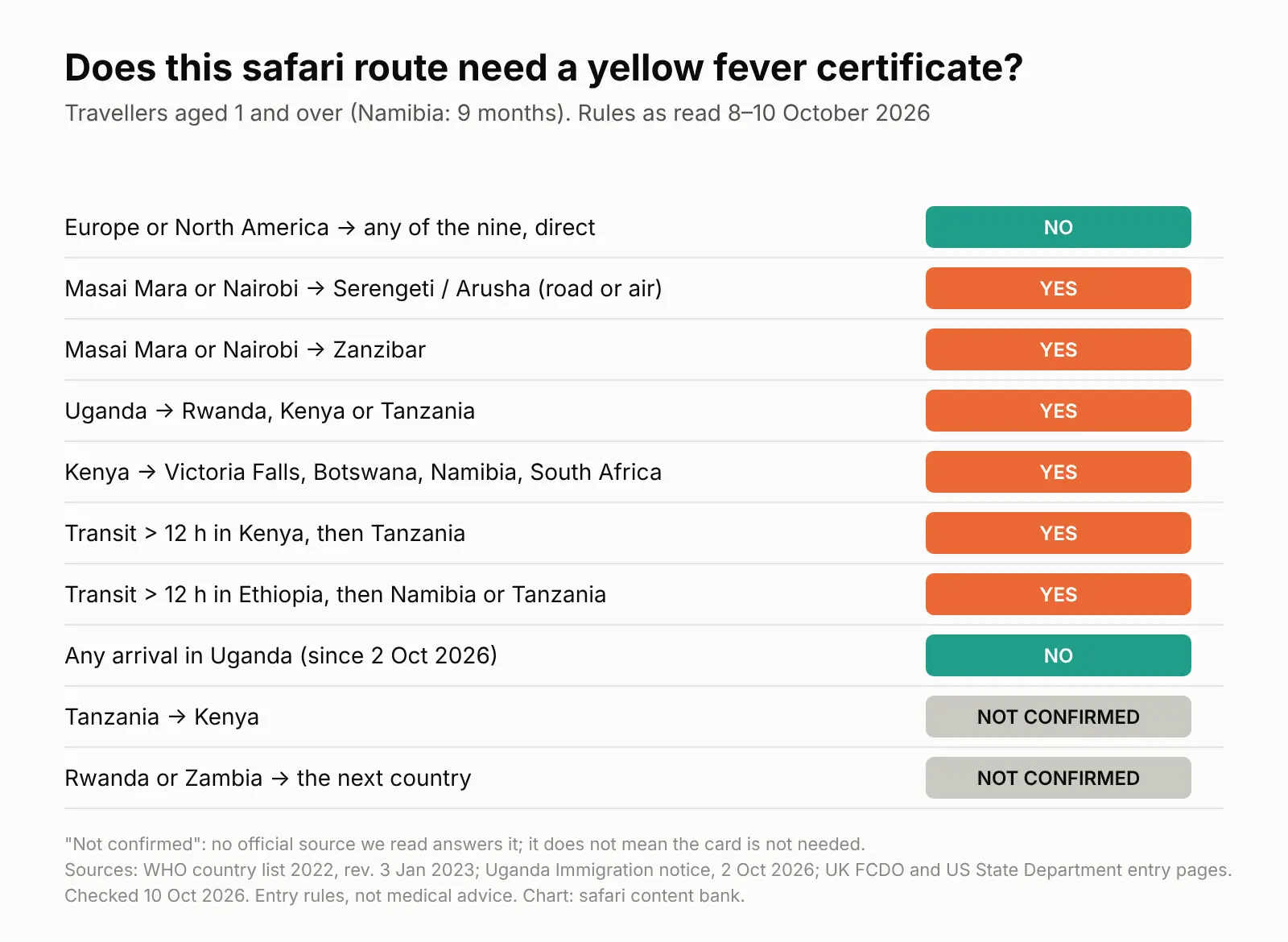 Sources: WHO country list 2022, rev. 3 Jan 2023; Uganda Immigration notice, 2 Oct 2026; UK FCDO and US State Department entry pages. Checked 10 October 2026. Chart: safari content bank.
Kenya to Tanzania: road, air and Zanzibar
Tanzania asks for the certificate from travellers aged 1 and over who arrive from Kenya, whether you cross at a road border or land at an airport. The answer is the same for the Masai Mara–Serengeti link, Nairobi–Arusha and Nairobi–Zanzibar.
- By road: Tanzanian officials can ask for the card at Namanga, Isebania–Sirari, Taveta–Holili and Lunga Lunga–Horohoro (WHO rule). Keep it in your hand luggage with your passport. Border posts and paperwork: Kenya–Tanzania border crossings.
- By air: Safarilink requires a yellow fever card on its Masai Mara–Serengeti connection via Migori and Tarime (Safarilink, read 9 October 2026). Routes and timings: Masai Mara to the Serengeti.
- To Zanzibar: a direct flight from Nairobi or the Masai Mara needs the card and a Tanzanian visa; see Tanzania safari and Zanzibar.
- Kenya’s eTA application asks for it too: the documents list includes a “yellow-fever certificate if from an endemic country” (Kenya Embassy Bangkok).
- Going north, Tanzania to Kenya: no official source we read says whether Kenya asks travellers arriving from Tanzania for the certificate. Carry it if you have one.
The full two-country paperwork (eTA, visa, both insurance policies) is in Kenya vs Tanzania.
Transit rules: when does a stopover count?
Tanzania and Namibia count a transit of more than 12 hours in a risk country; Botswana counts a transit through one without stating a minimum time; for Kenya, Rwanda, Zambia, Zimbabwe and South Africa our sources state no transit rule.
- Tanzania: “travellers having transited for more than 12 hours” through an airport in a risk country need the certificate (WHO). The US State Department words it as “12 hours or more”.
- Namibia: a transit of more than 12 hours in a risk country counts, from age 9 months (WHO).
- Botswana: the rule names arrivals from, or transits through, a risk country (WHO). Check routings via Nairobi, Addis Ababa or Entebbe.
- Kenya: WHO’s Kenya entry states no transit-hours rule.
- Rwanda, Zambia, Zimbabwe, South Africa: our sources (WHO, UK FCDO, US State Department) give the risk-country rule without transit detail.
Gorilla trips: Uganda and Rwanda
You do not need the certificate to enter Uganda, but you do need it to go from Uganda into Rwanda, Kenya or Tanzania. Uganda’s immigration notice of 2 October 2026 ended its own requirement; the UK FCDO updated its Uganda page on 8 October 2026 and no longer lists one.
- Rwanda asks for the certificate from travellers aged 1 and over arriving from a risk country, and Uganda is one (WHO; UK FCDO). WHO does not recommend the vaccine for Rwanda itself.
- Older pages still say Uganda requires it. The Uganda High Commission in Pretoria’s visa page still asks fee-exempt nationals to show yellow fever vaccination (pretoria.mofa.go.ug, read 9 October 2026); the immigration notice of 2 October 2026 is the later document.
- Permits and visas for both countries: gorilla permit prices and Uganda vs Rwanda for gorillas.
Southern Africa: Botswana, Namibia, Zambia, Zimbabwe and South Africa
None of the five asks for the certificate from travellers flying in from Europe or North America; all five ask for it from travellers arriving from a risk country such as Kenya. The common trap is an East Africa safari followed by Victoria Falls, the Okavango or Cape Town.
- Botswana: no yellow fever risk in the country, but a certificate requirement for arrivals from risk countries, from age 1 (TravelHealthPro). More on Botswana safari questions.
- Namibia: certificate from age 9 months if arriving from a risk country or after more than 12 hours’ transit in one (WHO). More on Namibia safari questions.
- Zambia and Zimbabwe: certificate if arriving from a risk country (UK FCDO Zambia, 1 Jun 2026; UK FCDO Zimbabwe, 15 Jul 2026). Victoria Falls day trips and the KAZA Univisa: Chobe day trip from Victoria Falls.
- South Africa: certificate if arriving from a risk country, with the vaccination at least 10 days before arrival (US State Department).
- Kenya then Victoria Falls: a traveller on the TripAdvisor Zimbabwe forum warns that without the card “you dont get to board the plane” (TripAdvisor, traveller report).
Yellow fever and malaria are separate questions: for reserves outside the malaria area, see malaria-free safaris in South Africa.
Vaccine recommended vs certificate required
The certificate is a border rule about where you arrive from; the vaccine recommendation is WHO’s health advice about where you are going. The two often point in different directions.
| Country | Certificate at the border | WHO vaccine recommendation for the country itself | Source |
|---|---|---|---|
| Kenya | Only if arriving from a risk country | Recommended from 9 months for most of the country; “generally not recommended” for trips limited to Nairobi, Mombasa, the former North Eastern Province and Kilifi, Kwale, Lamu, Malindi and Tana River | WHO list |
| Tanzania | Only if arriving from a risk country | No | WHO list |
| Uganda | No, since 2 Oct 2026 | WHO entry not read; Uganda’s neighbours treat it as a risk country | Uganda Immigration notice; UK FCDO Rwanda |
| Rwanda | Only if arriving from a risk country | No | WHO list |
| Botswana | Only if arriving from or via a risk country | No; no yellow fever risk in Botswana | WHO list; TravelHealthPro |
Read 8–9 October 2026. We hold no checked WHO vaccine recommendation for Namibia, Zambia, Zimbabwe or South Africa, so they are left out of this table.
- The Kenyan safari areas fall inside WHO’s “recommended” zone. TravelHealthPro names the Maasai Mara, Lake Nakuru and Tsavo East and West as areas with transmission risk (TravelHealthPro, Kenya).
- This is not medical advice and gives no dosing. Ask a travel clinic whether the vaccine is right for you, including for children, older travellers and anyone with a medical condition. Family questions: family safari.
- Wider health and safety questions: is a Kenya safari safe? and is a Tanzania safari safe?.
Common mistakes about yellow fever on safari
| What you’ll often read | What is correct |
|---|---|
| “You need a yellow fever vaccine to enter Kenya” | Only if you arrive from a risk country (WHO). WHO recommends the vaccine for most of Kenya, but it is not an entry condition from Europe or North America. |
| “No yellow fever card is needed for Tanzania” | Needed when you arrive from Kenya or another risk country, or after more than 12 hours in transit in one (WHO). |
| “Uganda requires a yellow fever certificate” | Not since 2 October 2026 (Uganda Immigration notice). Rwanda, Kenya and Tanzania still ask travellers coming from Uganda. |
| “Uganda dropped it, so a Uganda–Rwanda trip needs no card” | Rwanda still asks arrivals from Uganda, a risk country. |
| “Botswana has no yellow fever, so no certificate is ever needed” | No risk, but a certificate requirement for arrivals from or via risk countries (TravelHealthPro). |
| “The certificate expires after 10 years” | Valid for life under WHO rules since 11 July 2016 (TravelHealthPro). |
| “Zanzibar is separate, so the Kenya rule doesn’t apply” | Zanzibar is part of Tanzania; a direct flight from Nairobi or the Mara needs the card. |
| “A short airport connection anywhere triggers it” | Tanzania and Namibia count transits of more than 12 hours (WHO); Botswana counts transits without stating a minimum time. |
Frequently asked questions
Do I need a yellow fever vaccine for a safari in Kenya? Not to enter from Europe or North America: Kenya asks for the certificate only from travellers aged 1 and over arriving from a risk country (WHO). WHO does recommend the vaccine for most of Kenya, including the safari areas. More on Kenya safari questions.
Do I need a yellow fever certificate for Tanzania after a Kenya safari? Yes, if you are aged 1 or over. Kenya is a yellow fever risk country, and Tanzania requires the certificate from travellers arriving from one, by road or by air, or after more than 12 hours in transit there (WHO). More on Tanzania safari questions.
Does Uganda still require a yellow fever certificate? No. Uganda’s immigration notice of 2 October 2026 says the certificate “is no longer a mandatory requirement for entry into Uganda”, and the UK FCDO page updated on 8 October 2026 no longer lists it. Rwanda, Kenya and Tanzania still ask for it from travellers coming from Uganda.
Do I need a yellow fever certificate for a gorilla trek in Rwanda? Only if you arrive from a risk country, which includes Uganda (WHO; UK FCDO). Flying into Kigali from Europe or North America, you do not need one.
Do I need one for Botswana, Namibia or South Africa? Not if you fly in from Europe or North America. All three ask for it from travellers arriving from a risk country; Botswana also counts transits through one, and Namibia counts transits of more than 12 hours (WHO).
Do I need a yellow fever certificate for Victoria Falls? Only if you arrive from a risk country: Zimbabwe and Zambia both ask such arrivals for the certificate (UK FCDO, 2026). Coming from a Kenya safari, carry it.
How long is a yellow fever certificate valid? For life. WHO rules in force since 11 July 2016 made the certificate valid for the lifetime of the traveller (TravelHealthPro). South Africa accepts it only if the vaccination was at least 10 days before arrival (US State Department).
Does a connection in Nairobi or Addis Ababa count? For Tanzania and Namibia, only if the transit is more than 12 hours (WHO). Botswana’s rule covers transits through a risk country without a stated minimum, and our sources give no transit rule for the other countries.
Sources
- WHO, Vaccination requirements and recommendations for international travellers, country list (PDF), 18 Nov 2022, revised 3 Jan 2023: Kenya, Tanzania, Rwanda, Botswana, Namibia and Ethiopia entries
- National: Uganda Directorate of Citizenship and Immigration Control, yellow fever notice, 2 Oct 2026; Uganda High Commission Pretoria, visa page; Kenya Embassy Bangkok, eTA
- UK FCDO entry requirements: Kenya (4 Sep 2026), Tanzania (6 Oct 2026), Uganda (8 Oct 2026), Rwanda (4 Sep 2026), Botswana (1 Jun 2026), Namibia (10 Dec 2025), Zambia (1 Jun 2026), Zimbabwe (15 Jul 2026), South Africa (8 Jul 2026), Ethiopia (25 Sep 2026)
- US State Department, South Africa country information (11 Aug 2025); Tanzania country information (21 Jan 2025)
- NaTHNaC TravelHealthPro: Kenya, Botswana
- Carrier: Safarilink, Masai Mara to Serengeti
- Traveller report: TripAdvisor Zimbabwe forum, yellow fever coming from Kenya
Official pages read 8–10 October 2026; page checked 10 October 2026. The CDC destination pages and Yellow Book tool could not be read for this check. We will update this page when WHO publishes a new country list, when any of the nine countries changes its rule, and when an official source settles whether Kenya checks arrivals from Tanzania.