 Experience

Last verified
On this page
Short answer: With a week or less, go to Kenya’s Masai Mara or South Africa’s Kruger: published trips to each have a median of 4 days (our count, September–October 2026). Choose Tanzania for a week-long circuit or February calving, Botswana for 7–10 days of fly-in camps, Namibia for a two-week self-drive, and Uganda or Rwanda for a 3-day gorilla trek. Kruger charges R692 per international adult a day from 1 November 2026 (R602 until 31 October 2026).
Key facts
- The shortest sensible trips are one park near an airport: published Masai Mara-only and Kruger itineraries both have a median of 4 days, and gorilla trips in Uganda and Rwanda a median of 3 (our count of operators’ itineraries, captured September–October 2026).
- No Botswana-only itinerary in our dataset combines the Okavango Delta and Chobe in under 7 days, and packaged Namibia self-drives run 9–23 days, median 15.
- Kenya and Tanzania now sell a government visitor insurance policy on top of your own. Tanzania’s costs US$44 per adult as of October 2026; Kenya’s has been required for arrivals since 5 October 2026, at up to US$44 (eCitizen). Our sources show no such rule for Botswana, Namibia or Rwanda.
- Malaria risk runs all year in Kenya, in Tanzania below 1,800 m and in Rwanda (WHO). Kruger is a malaria risk area; South Africa’s Madikwe, Pilanesberg and Eastern Cape reserves are malaria-free.
- A UK passport needs no visa for South Africa, Botswana or Zambia, and Rwanda’s visa is free for Commonwealth citizens. Namibia has charged UK, US and German visitors N$1,600 on arrival since 1 April 2025.
- You can self-drive Kruger in an ordinary hire car; forum regulars advise first-timers against self-driving in Kenya and Tanzania.
First safari options at a glance (2026)
For a first safari, the choice comes down to time and budget first, then the animal you most want to see. The table compares the seven usual first-safari destinations on the facts that decide it.
| Option | Wildlife pull | Shortest sensible trip | Cheapest published price, per person per day | Best months | Self-drive? |
|---|---|---|---|---|---|
| Kenya (Masai Mara) | Wildebeest herds in the Mara about July–October; Mara game is resident all year; night drives and walks in the Mara conservancies | 3–4 days for the Mara alone; 10 of 13 Mara-only itineraries last 3 or 4 days; by road, at least 2 nights | US$57–60, budget group safari, before the Mara fee of US$100–200 a day | July–October for the herds | Legal, but forum regulars advise first-timers against it |
| Tanzania (Serengeti, Ngorongoro) | Herds in Tanzania the rest of the year; calving in the southern Serengeti January–March, peaking in February; Ngorongoro Crater | About a week: northern-circuit itineraries have a median of 7–8 days | US$220–300, group camping from Arusha, park fees included | January–March (calving); June–October (dry season) | Possible, but forum experts advise first-timers against it |
| South Africa (Kruger) | Game viewing from your own car on tar roads; the Greater Kruger private reserves add guided off-road and night drives | 3–5 days: 41 of 42 published Kruger itineraries last 3–6 days, median 4 | US$214–242, shared Kruger tour | April–September (dry season) | Yes, in an ordinary hire car |
| Botswana (Okavango Delta, Chobe) | Elephant seen by 95% of one operator’s traveller groups, lion 91%, buffalo 82%, leopard 66%; private concessions allow off-road driving, night drives and walking | 7–10 days: none under 7 days for the Delta and Chobe; median 10 | US$265–710 a night on a mobile safari; fly-in camps US$530–5,345 a night | June–October; December–March on the Kalahari pans | Yes, in a high-clearance 4x4 |
| Namibia (Etosha, Sossusvlei) | Game at Etosha’s waterholes (no buffalo); the Sossusvlei dunes | About two weeks: packaged self-drives run 9–23 days, median 15 | US$138–153, budget camping group tour | May–October; September–October at Etosha | Yes, the usual way to travel |
| Zambia / Zimbabwe (South Luangwa, Hwange, Victoria Falls) | Walking safaris and leopard in South Luangwa (seen by 83% of one operator’s traveller groups); canoeing in Lower Zambezi and Mana Pools; elephant at Hwange’s pumped waterholes | About a week: Zambia packages cluster at 7–11 days (commonest 8); Zimbabwe trips at 3–9 days | Zambia US$234–331, group camping; Zimbabwe US$150–570 by road | June–October; Hwange July–October | Yes, with a 4x4 for Lower Zambezi and Mana Pools |
| Uganda / Rwanda (gorillas) | Mountain gorillas in Bwindi, Mgahinga and Volcanoes National Park; chimpanzees in Kibale and Nyungwe | 3 days for one gorilla trek; 6–8 days in Rwanda for gorillas, Akagera and Nyungwe | Uganda US$275–373, group overland with gorilla trekking; Rwanda US$194–587 without gorillas, US$603–1,393 mid-range with a trek | Drier months about June–September and December–February; treks run all year | Uganda: yes, rooftop-tent 4x4s; Rwanda: in Akagera |
Prices: operators’ published prices as on our Kenya, Tanzania, South Africa, Botswana, Namibia, Zambia, Zimbabwe, Uganda and Rwanda cost pages, read 3 September–9 October 2026; the budget Botswana trip does not say whether its price is per person. Trip lengths: our count of operators’ published itineraries on how many days for a safari (captured 3 September–8 October 2026) and the Zambia and Zimbabwe question pages (read 8 October 2026). Months: best time for a safari. Sighting shares are one operator’s traveller surveys, not population data.
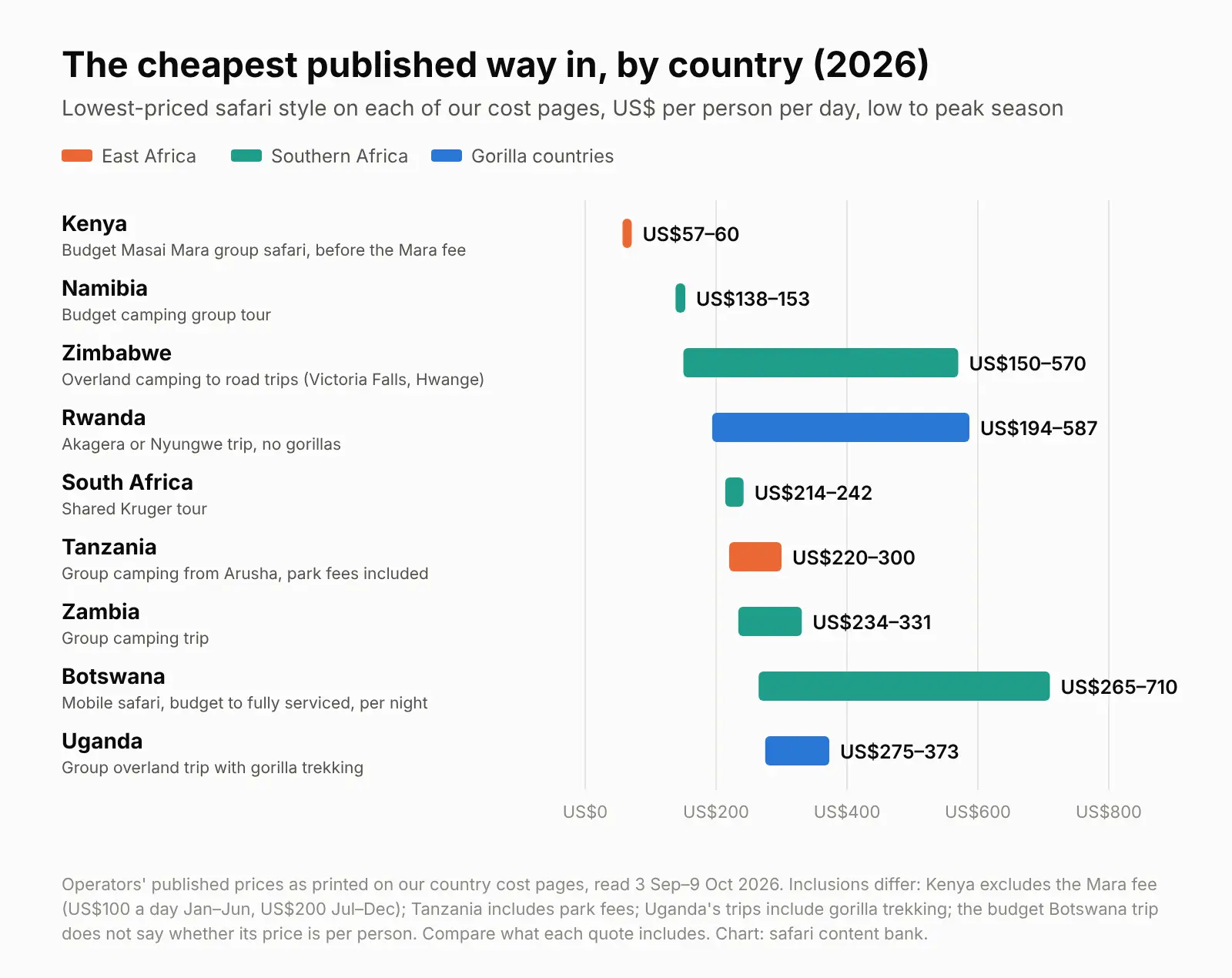 Operators’ published prices as printed on our country cost pages, read 3 September–9 October 2026. Inclusions differ, so compare what each quote includes. Chart: safari content bank.
Why the cheapest price is not the cheapest trip
Kenya’s US$57–60 a day becomes about US$157–160 from January to June and US$257–260 from July to December once the Masai Mara reserve fee is added (our sum: price per day + US$100 or US$200). The budget Mara safari behind that price says “park fees NOT included”. Tanzania’s US$220–300 already includes park fees. Ask every operator what “park fees” covers before you compare quotes; more on safari cost per day by country and the cheapest safari in Africa.
Park fees for a first safari, country by country
Park fees range from US$12 a day in Hwange (staying inside) to US$1,500 for one gorilla visit in Rwanda; Kenya’s Masai Mara doubles to US$200 a day on 1 July. Every figure below is copied from our country cost pages.
| Option | Headline fee, adult | Basis and date | Source |
|---|---|---|---|
| Kenya | Maasai Mara National Reserve US$100 per day 1 Jan–30 Jun, US$200 1 Jul–31 Dec (12-hour ticket, 06:00–18:00); Amboseli and Lake Nakuru US$90 per 24 hours (child under 18, 5 and under free, US$45) | Narok County FY2025/26 schedule, the last published (no 2026/27 schedule as of 9 Oct 2026); KWS Legal Notice 160 of 2025 | Kenya safari cost |
| Tanzania | Serengeti entry US$70 + 18% VAT = US$82.60 per day (16 May–14 Mar), US$60 + 18% VAT = US$70.80 (15 Mar–15 May); concession fee per night inside the park US$70.80 (Jul–Sep) or US$59 (Oct–Jun); Ngorongoro Crater descent US$295 per vehicle | TANAPA, last published tariff, 2023/24; NCAA, undated official page read 9 Oct 2026 | Tanzania safari cost |
| South Africa | Kruger daily conservation fee, international adult (12+): R692 (R602 until 31 Oct 2026) | SANParks 2025/26 and 2026/27 schedules | South Africa safari cost |
| Botswana | Chobe National Park and Moremi Game Reserve: P270 per non-resident adult per day (SADC residents P205; Botswana citizens and residents P30) | Last published DWNP schedule, 1 April 2022 (via Tourism Update). In Feb 2026 the government news agency BOPA called the existing non-resident fee P380; a P500 rise was announced, then reported postponed. No official current tariff: confirm with DWNP or your operator | Botswana safari cost |
| Namibia | Etosha, Sossusvlei and the other Tier 1 parks: N$280 per foreign adult 16+ (N$140 park entrance + N$140 conservation fee), plus N$60 per vehicle up to 10 seats | 1 Apr 2026 (Government Notice 115 of 2026); the notice states no period, and MEFT’s 2021 schedule made fees valid for 24 hours from entry | Namibia safari cost |
| Zambia / Zimbabwe | South Luangwa and Lower Zambezi US$25 per international adult per day; Hwange US$24 as a day visitor, US$12 if staying overnight in the park; Mana Pools US$24; Victoria Falls rainforest (Zimbabwe) US$58 per entry | DNPW 2025 schedule, the last published; ZimParks Tariff 2026 | Zambia and Zimbabwe safari cost |
| Uganda / Rwanda | Uganda gorilla permit US$800 (US$600 in April, May and November); Uganda park entry US$40 per 24 hours (Queen Elizabeth, Bwindi, Kibale and others); Rwanda gorilla permit US$1,500; Akagera US$100 for one night or day | UWA letter TDO 93/04, 26 Feb 2026; UWA Conservation Tariff July 2024–June 2026, the last published park-entry rates; RDB, checked 9 Oct 2026; African Parks, Akagera 2024 price list, the latest found | Uganda and Rwanda safari cost |
Non-resident, non-East African or international adult, as each authority words it. Copied from our cost pages, checked 9–10 October 2026.
- A Mara ticket lasts 12 hours, 06:00–18:00, and does not carry overnight, so a 2-night stay inside the reserve spans 3 calendar days and up to 3 tickets (Mara Conservancy).
- Kruger’s fee rose by R90 per international adult per day on 1 November 2026, to R692 (R602 until 31 October 2026). Two adults spending 3 days in Kruger in December 2026 pay R4,152 (2 × 3 × R692; our sum, as on the South Africa cost page).
- The gate fee is not the fee your camp bills in Zambia: camps in South Luangwa, Lower Zambezi and Kafue charge US$90–110 per person per night for park fees and levies, against the US$25 gate fee.
- Many Botswana fly-in camps include park fees in the rate; Natural Selection, Wilderness and Desert & Delta say so on their rate cards. Camp levies of US$20–100 a night are often extra.
- Rwanda takes 30% off the US$1,500 gorilla permit from November to May if you also stay two nights in Akagera or Nyungwe: US$1,050 (our sum; RDB prints no dollar figure).
The official fee lines, with the date each took effect and the authority’s own source:
| Fee | Amount | In force from | Source |
|---|---|---|---|
| Maasai Mara National Reserve, non-resident adult, per day (12-hour ticket, 06:00–18:00), 1 Jan–30 Jun | USD 100 | Since 1 Jan 2024; Narok County FY2025/26 schedule, the last published | Narok County fee schedule FY2025/26 |
| Maasai Mara National Reserve, non-resident adult, per day (12-hour ticket, 06:00–18:00), 1 Jul–31 Dec | USD 200 | Since 1 Jul 2024; Narok County FY2025/26 schedule, the last published, expired 30 Jun 2026 (no 2026/27 schedule as of 9 Oct 2026); The Kenya Times (6 Aug 2026, secondary) reports US$200 still applies for Jul–Dec 2026 | Narok County fee schedule FY2025/26 |
| Amboseli and Lake Nakuru National Parks (KWS), non-resident adult, per 24 hours | USD 90 (child under 18, 5 and under free, USD 45) | Legal Notice 160 of 2025, gazetted 22 Sep 2025, which states no start date; in force 1 Oct 2025 per the KWS press release of 29 Sep 2025 | KWS Fees Regulations 2025 (LN 160/2025) |
| Serengeti and Nyerere National Parks, non-East African adult, entry per day, 16 May–14 Mar | USD 70 + 18% VAT = USD 82.60 | 1 Jul 2023 (2023/24 tariff, last published) | TANAPA Tariffs 2023/24 |
| Serengeti and Nyerere National Parks, non-East African adult, entry per day, 15 Mar–15 May | USD 60 + 18% VAT = USD 70.80 | 1 Jul 2023 (2023/24 tariff, last published) | TANAPA Tariffs 2023/24 |
| Serengeti and Nyerere, concession fee per person per night inside the park | Jul–Sep USD 60 + VAT = USD 70.80; Oct–Jun USD 50 + VAT = USD 59 | 1 Jul 2023 (2023/24 tariff, last published) | TANAPA Tariffs 2023/24 |
| Ngorongoro Crater descent (crater service fee), per vehicle | USD 295 (NCAA's page does not say whether VAT is included) | Undated official page, read 9 Oct 2026 | NCAA |
| Kruger National Park daily conservation fee, international adult (12+), per day | ZAR 602 | 1 Nov 2025 to 31 Oct 2026 (SANParks 2025/26 schedule) | SANParks daily conservation fees 2025/26 |
| Kruger National Park daily conservation fee, international adult (12+), per day | ZAR 692 | 1 Nov 2026 to 31 Oct 2027 (SANParks 2026/27 schedule, already published) | SANParks daily conservation fees 2026/27 |
| Chobe National Park and Moremi Game Reserve (DWNP), non-resident adult, per person per day | BWP 270 (SADC residents BWP 205; Botswana citizens and residents BWP 30) | Last published DWNP schedule, 1 April 2022 (via Tourism Update). In Feb 2026 the government news agency BOPA called the existing non-resident fee P380; a P500 rise was announced, then reported postponed. No official current tariff: confirm with DWNP or your operator | Tourism Update, 23 Feb 2022 (DWNP fee schedule) |
| Tier 1 parks (Etosha, Namib-Naukluft including Sossusvlei, Skeleton Coast, Ai-Ais/Fish River Canyon, Waterberg Plateau, Cape Cross, Dorob, Tsau //Khaeb), foreign adult 16+, per person | NAD 280 (NAD 140 park entrance + NAD 140 conservation fee) | 1 Apr 2026 (Government Notice 115 of 2026; the notice prices fees per person with no period; MEFT's 2021 schedule made fees valid for 24 hours from entry); was NAD 150 under the 2021 schedule | Government Gazette 8877 (Government Notice 115 of 2026), hosted by the Legal Assistance Centre |
| Vehicle up to 10 seats, most national parks (N$50 at Sandwich Harbour), per vehicle | NAD 60 | 1 Apr 2026 (Government Notice 115 of 2026; the notice states no period; MEFT's 2021 schedule made fees valid for 24 hours from entry); was NAD 50 | Government Gazette 8877 (Government Notice 115 of 2026), hosted by the Legal Assistance Centre |
| South Luangwa and Lower Zambezi National Parks (DNPW Category A), international adult, entry per day (06:00–18:00) | USD 25 (SADC and resident USD 20; Zambian citizen ZMW 55.60); child 5–13 half price, under 5 free | DNPW 2025 schedule ("official 2025 rates"), the last published; page last modified 8 May 2025, still shown 9 Oct 2026 | DNPW 2025 fee schedule, as shown on a Zambia travel portal |
| Hwange National Park, Main Camp (row as labelled in the ZimParks 2026 tariff), international adult, conservation fee per day | USD 24 day visitor; USD 12 if staying overnight in the park (SADC USD 18 / 10; local USD 5 / 3) | ZimParks Tariff 2026 (tariff year 2026, published February 2026); the conservation-fee table does not say whether VAT is included; Robins, Sinamatella and Kazuma Pan are not listed separately in our sources | ZimParks De-Gazetted Tariff 2026 |
| Mana Pools National Park, Sapi and Chewore, international adult, conservation fee per day | USD 24, day visitor or staying overnight (SADC USD 18; local USD 8) | ZimParks Tariff 2026 (tariff year 2026, published February 2026); the conservation-fee table does not say whether VAT is included | ZimParks De-Gazetted Tariff 2026 |
| Victoria Falls Rainforest (Zimbabwe), main gate, international adult, per entry | USD 58 (SADC USD 35; local USD 7) | ZimParks Tariff 2026 (tariff year 2026, published February 2026); the fee table does not say whether VAT is included | ZimParks De-Gazetted Tariff 2026 |
| Uganda: gorilla tracking permit, Bwindi Impenetrable and Mgahinga Gorilla NPs, foreign non-resident, per person per trek (guide and that day's park entry included) | USD 800 (foreign resident USD 700; rest of Africa USD 500; East African citizens UGX 300,000) | Since 1 Jul 2024 (UWA tariff 2024–26); confirmed unchanged from 1 Jan 2027 by UWA letter TDO 93/04 of 26 Feb 2026 | UWA letter TDO 93/04, 26 Feb 2026 |
| Uganda: gorilla tracking permit in April, May and November (low season), foreign non-resident, per person per trek; cannot be rescheduled | USD 600 (foreign resident USD 500) | Immediate effect from the UWA letter of 26 Feb 2026 | UWA letter TDO 93/04, 26 Feb 2026 |
| Uganda: park entry, Queen Elizabeth, Bwindi, Mgahinga, Kibale, Kidepo Valley and Lake Mburo NPs, foreign non-resident adult, per 24 hours | USD 40 (child USD 20) | 1 Jul 2024 (UWA Conservation Tariff July 2024–June 2026, the last published park-entry rates; the 2026/27 letter does not cover park entry) | UWA Conservation Tariff July 2024–June 2026 |
| Rwanda: mountain gorilla tracking permit, Volcanoes NP, international visitor, per person per day | USD 1,500 | Current RDB price, checked 9 Oct 2026 | Visit Rwanda (Rwanda Development Board) |
| Akagera National Park, international adult, park entry per person | USD 100 for one night or day; USD 150 for two nights; USD 200 for three (child 6–12: USD 50 / 75 / 100; under 6 free) | 2025 price list, the latest we found (checked 8 Oct 2026) | African Parks, Akagera NP price list 2024 |
Malaria, visas and compulsory insurance
Entry paperwork is simplest in South Africa, Botswana and Zambia for a UK passport; Kenya and Tanzania each add an online document and a government insurance policy. The malaria-free choices in our sources are South Africa’s Madikwe, Pilanesberg and Eastern Cape reserves, and Namibia’s coast, Sossusvlei and south.
| Option | Malaria | Visa or entry document (UK passport unless stated) | Compulsory visitor insurance |
|---|---|---|---|
| Kenya | Risk all year in the entire country; low only in Nairobi and above 2,500 m (WHO) | eTA US$30, plus payment charges, before you fly; no visa since January 2024 | Required for arrivals since 5 October 2026 (U.S. Embassy Nairobi), up to US$44 (eCitizen) |
| Tanzania | Risk all year below 1,800 m, including the Serengeti, Tarangire and Zanzibar (WHO) | Visa US$50; US citizens US$100 | US$44 per adult, 92 days, as of October 2026, for foreign visitors except EAC and SADC residents (Government Notice 256 of 2026); your own policy does not replace it |
| South Africa (Kruger) | Kruger is a risk area: UK TravelHealthPro recommends tablets September–May; SANParks puts the highest risk at November–April. Madikwe, Pilanesberg and the Eastern Cape reserves are malaria-free | No visa for UK and US passports for up to 90 days; online traveller declaration for all arrivals since 1 July 2026 | No requirement in our sources |
| Botswana | North, including the Okavango Delta and Chobe: high risk October–May, low June–September; the south very low all year (TravelHealthPro) | No visa for most European and Commonwealth passports; UK visa-free for up to 90 days | None listed by the UK FCDO |
| Namibia | Year-round high risk in the Zambezi Region; low but not zero in Etosha; none listed by WHO for the coast, Sossusvlei or the south | Visa needed since 1 April 2025 for 33 previously exempt nationalities, including the UK, US and Germany: N$1,600 on arrival per adult | None in our Namibia sources |
| Zambia / Zimbabwe | No official source read for either. One UK safari operator says malaria is present across Zambia, all year in the valleys; a Zimbabwe travel site names Victoria Falls, Kariba and the Zambezi Valley, highest November–May | Zambia: no visa for UK and US passports (US$50 where required). Zimbabwe: visa on arrival or e-visa, fee not confirmed by an official 2026 source. KAZA Univisa US$50, 30 days, covers both | No requirement in our sources |
| Uganda / Rwanda | Rwanda: risk all year countrywide (WHO). Uganda: no official source read; ask a travel clinic | Uganda: US$50 e-visa, applied for before you fly. Rwanda: visa on arrival, up to US$50, free for 30 days for Commonwealth citizens. East Africa Tourist Visa US$100 covers Uganda, Rwanda and Kenya, not Tanzania | Rwanda: none in official sources; Nyungwe makes travel and medical insurance a booking condition. Uganda: no requirement in our sources |
Sources as on our country pages, checked 9–10 October 2026: WHO country list 2022 (PDF); TravelHealthPro, South Africa and Botswana; SANParks malaria; KCAA AIC 14/25 (PDF); Tanzania e-visa guidelines; Clyde & Co, 16 Sep 2026; VisasNews, 7 Oct 2026; UK FCDO entry pages for South Africa, Zambia, Zimbabwe and Uganda; Botswana Tourism; Namibian Mission in Switzerland; Tourism Update; Uganda Immigration; Rwanda immigration. Operator and travel-site malaria lines are not health advice; see a travel clinic.
- Which tablets to take, if any, is a decision for a travel clinic, not for this page. Book the appointment before you choose between Kruger and a malaria-free reserve: see malaria-free safaris in South Africa.
- Buy Kenya’s and Tanzania’s documents only on the official portals, not on look-alike sites. Full rules: Kenya visa, Kenya visitor insurance, Tanzania visa, Tanzania visitor insurance, Botswana visa and Namibia visa.
- A Kenya–Tanzania trip needs both countries’ documents. The East Africa Tourist Visa does not cover Tanzania; the crossings are on Kenya–Tanzania border crossings.
Can you self-drive your first safari?
Yes in Kruger and Namibia, which suit a first-time self-driver; Botswana, Zambia and Zimbabwe need a 4x4 and more planning; Kenya and Tanzania are usually done with a driver-guide.
| Option | Self-drive | What to know |
|---|---|---|
| South Africa (Kruger) | Yes, in an ordinary hire car | Tar and graded gravel roads; 50 km/h on tar. Gates close as early as 17:30 from May to July and late arrivals are turned away. No night or off-road driving in private cars (Kruger self-drive) |
| Namibia | Yes, the usual way | A 4x4 is not needed on the standard circuit in the dry season; a rooftop-tent 4x4 rents for N$2,619–3,880 a day (2026). Plan every drive to end before sunset (Namibia self-drive distances) |
| Botswana | Yes, high-clearance 4x4 | 4x4s from about US$170 a day in Maun. Book every campsite first, then pay DWNP; “Bookings should be done a year in advance” (Tracks4Africa) (Botswana self-drive) |
| Zambia / Zimbabwe | Yes, with limits | Zambia: Kafue and South Luangwa’s loops near Mfuwe; self-drivers pay US$30 a day in South Luangwa and Lower Zambezi. Zimbabwe: Hwange’s main roads take a normal car, Mana Pools needs a 4x4, and the UK FCDO advises against driving at night |
| Uganda / Rwanda | Yes, with limits | Uganda: rooftop-tent 4x4 rentals; the UK FCDO advises against driving outside towns after dark. Rwanda: self-drivers enter Akagera by the southern gate only |
| Kenya | Legal; advised against for first-timers | Never drive at night, forum regulars say; KWS park fees are booked on KWSPay before arrival |
| Tanzania | Possible; advised against for first-timers | Ngorongoro Crater needs a licensed or NCAA guide in the vehicle; a foreign-plated car pays US$150 + VAT per park entry (last published tariff, 2023/24) |
Sources as on our South Africa, Namibia, Botswana, Zambia, Zimbabwe, Uganda, Rwanda, Kenya and Tanzania question pages, read 8–10 October 2026. Forum advice is traveller reports, not fact.
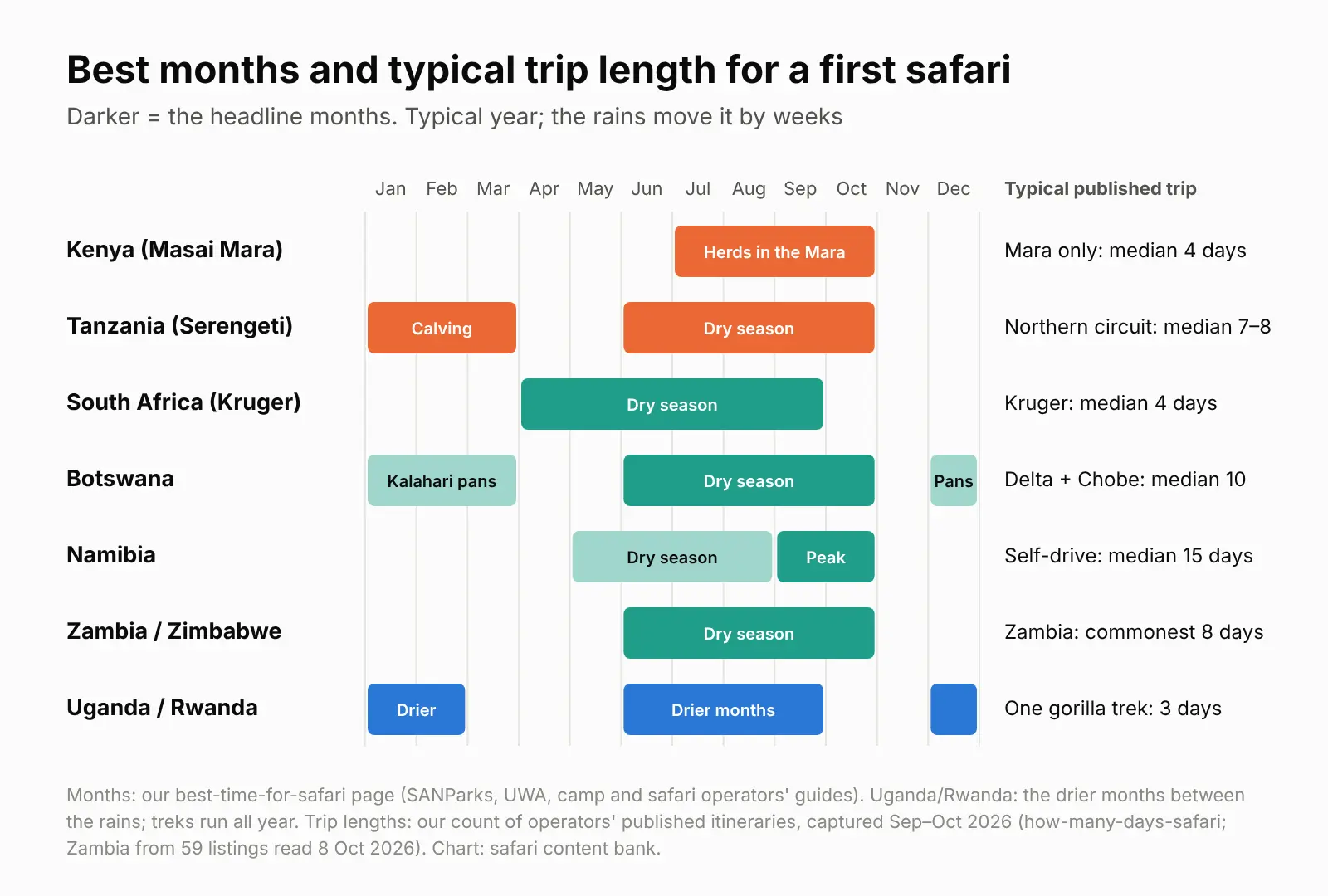 Typical year. Months from our best-time-for-safari page; trip lengths are our count of operators’ published itineraries, captured September–October 2026. Chart: safari content bank.
Which should you choose?
Pick by the time you have, then by the one thing you most want to see: a week or less points to Kenya or Kruger, gorillas to Uganda or Rwanda, and a self-drive to Kruger or Namibia.
| If you… | Go to | Why |
|---|---|---|
| Have a week or less | Kenya (Masai Mara) or Kruger | Median published trips of 4 days; Nairobi to the Mara is 5.5–6 h on tarmac or about 1 h by air |
| Want to drive yourself | Kruger, or Namibia with two weeks | An ordinary hire car works in Kruger; Namibia’s standard circuit needs no 4x4 in the dry season |
| Travel with young children, or want to avoid malaria tablets | South Africa’s malaria-free reserves | Madikwe, Pilanesberg and the Eastern Cape reserves are malaria-free; see family safari |
| Travel in February | Tanzania | Wildebeest calving peaks in the southern Serengeti and Ndutu |
| Travel July–October for the herds | Kenya or northern Tanzania | River crossings on the Mara River happen on both sides of the border |
| Want gorillas | Uganda (cheaper permit) or Rwanda (shorter transfer) | Permit US$800 against US$1,500; Kigali to Volcanoes National Park is 2–3 h by road, Kampala to Bwindi 8–10 h |
| Want to walk | Zambia (South Luangwa) or a Botswana concession | Walking is the main activity at South Luangwa’s bush camps; Botswana’s concessions usually offer it, Moremi does not (one operator’s guide) |
| Want few other vehicles and can pay for it | Botswana | On a private concession only that lease’s guests drive the land |
| Want the lowest cash outlay | Kenya from January to June, or a Namibia camping tour | About US$157–160 a day with the US$100 Mara fee (our sum), or US$138–153 a day camping |
Compare two options head to head: Kenya or Tanzania, Kenya or South Africa, Kenya or Botswana, Tanzania or South Africa, Tanzania or Botswana, Botswana or South Africa, Namibia or Botswana, Namibia or South Africa, Botswana or Zambia, Zambia or Zimbabwe, Uganda or Rwanda for gorillas, Serengeti or Masai Mara, Serengeti or Kruger, Okavango Delta or Kruger, Masai Mara or Amboseli and Kruger or a private reserve. Destination hubs: Kenya, Tanzania, South Africa, Kruger, Botswana, Okavango Delta, Namibia, Etosha, South Luangwa, Hwange and Victoria Falls.
See also: Solo safari and Accessible safari.
Common first-timer mistakes
| What first-timers often assume | What is correct |
|---|---|
| “Three days is enough anywhere” | It is enough for one park near an airport. No Botswana-only itinerary in our dataset does the Delta and Chobe in under 7 days, and Namibia’s packaged self-drives have a median of 15. |
| “Fit in as many parks as possible” | Kenya forum regulars advise 2–3 nights per park and fewer parks; Botswana regulars reckon a 2-2-2-1 camp plan loses about a third of game-viewing time to transfers (traveller reports). |
| “The budget price includes park fees” | Kenya’s cheapest published Mara safari, US$170–180 for 3 days, says “park fees NOT included”; from July to December the Mara fee (US$200 a day) is larger than the trip’s price per day. |
| “Kruger costs R602 a day” (with no date) | That was the 2025/26 rate, which ended on 31 October 2026. Since 1 November 2026: R692 per international adult per day. |
| “My own travel insurance covers the entry rules” | Tanzania requires its US$44 government policy as of October 2026, and Kenya has required a government policy, up to US$44, for arrivals since 5 October 2026. |
| “The East Africa Tourist Visa covers Tanzania” | It covers Kenya, Uganda and Rwanda only. |
| “You can drive from the Masai Mara into the Serengeti” | The Bologonja–Sand River border post has been closed since 1977; fly via Migori and Tarime or drive round (Mara to Serengeti). |
| “Botswana’s park fee is now P500” | The P500 rise was announced, then reported postponed. The last published schedule (1 April 2022) gives P270 in Chobe and Moremi, and BOPA called the existing non-resident fee P380 in February 2026. Confirm with DWNP or your operator. |
| “Namibia needs no visa for UK or US visitors” | Required since 1 April 2025: N$1,600 on arrival per adult. |
| “Kruger is malaria-free in winter” | No source says so: TravelHealthPro recommends tablets September to May. |
| “Gorilla permits can be bought a few months out for August” | One operator advises 6+ months ahead for July–August; a traveller who tried four months out was told peak permits were probably gone (traveller report). |
What to book first
Book the things with a fixed number of places first (gorilla permits, peak-season camps and public campsites), then flights, then the entry paperwork.
- Gorilla permits. In Uganda a permit has been held only against full payment since 1 March 2026 (UWA letter TDO 93/04); one operator advises 6+ months ahead for July–August. In Rwanda’s low season a traveller reply on the forum gave 4–6 weeks (gorilla permit prices).
- Peak-season camps in the migration areas. Forum regulars book camps inside the Mara reserve near the river for mid-July to early September up to a year ahead; conservancy camps still had space three months out. For the northern Serengeti in July–September, plan about a year (traveller and operator reports on our Kenya and Tanzania question pages). Where the herds are each month: Great Migration month by month.
- Public campsites and rest camps. SANParks opens Kruger bookings about 11–12 months ahead, in tranches: stays to 31 October 2027 have been bookable since 13 October 2026. In Botswana, book every campsite first and pay DWNP park fees last; Tracks4Africa advises a year ahead. ZimParks takes bookings 12 months ahead.
- Flights that fit the daylight rules. Tourists are not driven outside towns after dark in Tanzania, so a same-day transfer needs a flight landing before about 13:00; in Botswana, light aircraft do not fly at night and Maun’s port hours end at 16:30 (Botswana bush flights).
- Entry documents and insurance, on the official portals: Kenya’s eTA and health policy, Tanzania’s visa and US$44 policy, Namibia’s visa, Uganda’s e-visa.
Before you pay a deposit, check that the operator is licensed: see how to check a safari operator is licensed.
Frequently asked questions
Which country is best for a first safari? With a week or less, Kenya’s Masai Mara or South Africa’s Kruger: published trips to each have a median of 4 days in our count. Kruger suits a self-drive in an ordinary hire car, and the Mara has the wildebeest herds from about July to October. With more time, Tanzania’s northern circuit takes about a week and Botswana’s Delta and Chobe 7–10 days.
How many days do you need for a first safari? Three to four days for one park near an airport, about a week for a circuit. Published Mara-only and Kruger itineraries have a median of 4 days, Tanzania’s northern circuit 7–8, Botswana’s Delta and Chobe 10 and a Namibia self-drive 15 (our count, September–October 2026). One gorilla trek takes 3 days.
What is the cheapest country for a first safari? At the budget end, Kenya and Namibia publish the lowest daily prices: US$57–60 for a budget Mara group safari before the Mara fee, and US$138–153 for a Namibia camping tour. With the Mara fee added, a Kenya day costs about US$157–160 from January to June and US$257–260 from July to December (our sums). Tanzania’s group camping costs US$220–300 a day with park fees included.
Where can I go on safari without malaria? South Africa’s Madikwe, Pilanesberg and Eastern Cape reserves are malaria-free, and WHO lists no malaria for Namibia’s coast, Sossusvlei or the south. Kruger is a malaria risk area, and malaria risk runs all year in Kenya, in Tanzania below 1,800 m and in Rwanda. Tablets are a decision for a travel clinic.
Can I self-drive on my first safari? Yes in Kruger, in an ordinary hire car, and in Namibia, where self-driving is the usual way to travel. Botswana needs a high-clearance 4x4 and campsites booked about a year ahead. Forum regulars advise first-timers against self-driving in Kenya and Tanzania.
Do I need special insurance for a safari? For Tanzania, yes: as of October 2026 foreign visitors except EAC and SADC residents must buy the government’s US$44 policy per adult, valid 92 days. Kenya has required a government health policy, up to US$44 (eCitizen), for arrivals since 5 October 2026 (U.S. Embassy Nairobi). Our sources show no such rule for Botswana, Namibia or Rwanda.
Is Botswana a good choice for a first safari? Yes, if you have 7–10 days and the budget: no Botswana-only itinerary in our dataset combines the Okavango Delta and Chobe in under 7 days, and fly-in camps publish US$530–5,345 per person a night. Mobile safaris run about US$265–710 a night. The last published park fee is P270 a day in Chobe and Moremi; confirm the current fee with DWNP or your operator.
Sources
- Park fees, copied from our cost pages: Narok County, Maasai Mara fee schedule FY2025/26 (PDF), the last published; Mara Conservancy, conservation fees; KWS, Legal Notice 160 of 2025 (PDF); TANAPA, Tariffs 2023/24 (PDF), the last published tariff; NCAA, tariffs; SANParks, daily conservation fees 2025/26 (PDF) and 2026/27 (PDF); Tourism Update, Botswana DWNP schedule, 23 Feb 2022; Botswana Daily News (BOPA), 24 Feb 2026; Government Gazette 8877 (Namibia GN 115 of 2026); a safari agent’s guide to DNPW fees, read 9 October 2026; ZimParks, Tariff 2026 (PDF); UWA, letter TDO 93/04 (PDF) and Conservation Tariff July 2024–June 2026 (PDF); Visit Rwanda (RDB); African Parks, Akagera price list 2024 (PDF)
- Health and entry: WHO, International Travel and Health country list 2022 (PDF); UK TravelHealthPro, South Africa and Botswana; SANParks, malaria; entry sources as listed under the entry table
- Trip lengths: the content bank’s itinerary datasets, our count of operators’ published day counts, as on how many days for a safari (captured 3 September–8 October 2026) and the Zambia and Zimbabwe question pages (listings read 8 October 2026)
- Best months: our best time for a safari page (SANParks, UWA, camp operators’ and other operators’ guides and a safari booking site), read 8–10 October 2026
- Prices: tour operators’ and listing sites’ published 2026 package prices as on our country cost pages, read 3 September–9 October 2026 (names and links kept in our editor notes); lodge and camp rate cards as linked on those pages
- Booking lead times: SANParks, booking periods; Tracks4Africa; Wild Zambezi (first published 2017); UWA letter TDO 93/04
- Traveller reports (not fact): TripAdvisor and Routard forums, as linked on our country question pages
Fees and prices checked against our cost pages 9–10 October 2026; SANParks fees checked 1 November 2026. We will update this page after Kruger’s fee change on 1 November 2026, when Narok County publishes a 2026/27 Mara schedule, when TANAPA publishes a new tariff, when DWNP publishes an official current Botswana tariff, and when Kenya publishes an official insurance price.