 Experience

Last verified
On this page
- Kenya vs Tanzania at a glance (2026)
- Which is cheaper, Kenya or Tanzania?
- Park fees: Masai Mara vs Serengeti, month by month
- Where is the Great Migration: Kenya or Tanzania?
- Getting there and moving between the two
- Entry costs for Kenya and Tanzania
- Which should you choose?
- Common mistakes in Kenya vs Tanzania comparisons
- Frequently asked questions
- Sources
Short answer: Kenya is the cheaper, quicker safari at the budget end; Tanzania the bigger one, with wildebeest herds most of the year. A 3-day budget Masai Mara group safari costs US$57–60 per person per day before park fees, against US$220–300 a day including fees for group camping in Tanzania (operators’ 2026 prices, read 9 October 2026). In fees alone, a Masai Mara reserve day costs US$200 per adult in July–December, more than a Serengeti night, US$153.40 (last published tariff, 2023/24).
Key facts
- From 1 July to 31 December, the Masai Mara reserve fee (US$200 per adult per day) is higher than Serengeti entry plus a night’s concession fee (US$153.40), under Narok County’s last published schedule (FY2025/26) and TANAPA’s last published tariff (2023/24).
- From 1 January to 30 June the order flips: the Mara is US$100 a day and a night inside the Serengeti is US$129.80–141.60.
- The wildebeest herds are in Kenya for about four months, July to October, and in Tanzania for the rest of the year, including the January–March calving in the southern Serengeti (a camp operator’s migration guide; Wikipedia).
- You cannot drive straight from the Masai Mara into the Serengeti. The Bologonja–Sand River border post between the two parks has been closed since 1977 (The EastAfrican, 4 Apr 2017).
- The Serengeti is about ten times the size of the Masai Mara reserve: 14,763 km² against about 1,500 km² (a safari agent’s guide, read 10 October 2026; Mara Conservancy).
- Each country needs its own entry document. Kenya’s eTA costs US$30; Tanzania’s tourist visa costs US$50 (US$100 for US citizens). The East African Tourist Visa does not cover Tanzania.
Kenya vs Tanzania at a glance (2026)
The two countries share one ecosystem, the Serengeti–Mara, but sell different trips: Kenya compact and road-based, Tanzania larger and mostly private-vehicle.
| Kenya | Tanzania | Source | |
|---|---|---|---|
| Flagship park | Maasai Mara National Reserve, about 1,500 km² | Serengeti National Park, 14,763 km² | Mara Conservancy; a safari agent’s guide, read 10 October 2026 |
| Flagship park fee, adult | US$100 per day (1 Jan–30 Jun); US$200 (1 Jul–31 Dec) | US$82.60 per day with VAT; US$70.80 15 Mar–15 May (last published tariff, 2023/24) | Narok County FY2025/26; TANAPA 2023/24 |
| Extra fee for sleeping inside | None in the reserve itself; Mara conservancies charge US$130 per adult per night | Concession fee US$70.80 (Jul–Sep) or US$59 (Oct–Jun) per night | Kicheche and Porini 2026 rate sheets; TANAPA 2023/24 |
| Migration herds | About July–October | About November–June, plus the northern Serengeti July–September | A camp operator’s migration guide; Wikipedia |
| Calving season | None | January–March, southern Serengeti and Ndutu | A camp operator’s migration guide |
| Main international airport | Nairobi (NBO) | Kilimanjaro (JRO); Dar es Salaam (DAR) | A Tanzanian safari operator’s guide |
| Capital to flagship park by road | Nairobi → Sekenani Gate, 5.5–6 h, tarmac all the way | Arusha → Seronera, 7–7.5 h, gravel after the Ngorongoro gate | The Kenya Times, 20 Aug 2026; a Tanzanian operator’s Serengeti guide |
| Entry document | eTA US$30 | Visa US$50 (US citizens US$100) | KCAA AIC 14/25; Tanzania e-visa |
| Night drives and walks | Sold in Mara conservancies; not inside the Mara reserve | Ngorongoro Conservation Area walks only with an NCAA armed ranger, off the crater floor; for Serengeti night drives and walks, see the park page | Kenya and Tanzania cost pages |
| Black rhino in the flagship park | 25–30 in the Mara (2023) | Fewer than 70 in the Serengeti | Wikipedia: Maasai Mara; Wikipedia: Serengeti |
| Beach add-on | Diani, Lamu | Zanzibar, Pemba, Mafia | A Tanzanian safari operator’s guide |
Fees as on our Kenya safari cost and Tanzania safari cost pages, checked 9 October 2026. Non-resident or non-East African adult.
Which is cheaper, Kenya or Tanzania?
Kenya is cheaper at the budget and mid-range level, and Tanzania’s top camps charge more: up to US$2,250 a night against US$1,305 at a Kenyan luxury conservancy camp. The exception is the Mara reserve fee from July to December, which is higher than the Serengeti’s.
| What you’re comparing | Kenya | Tanzania | Source (read 9 Oct 2026) |
|---|---|---|---|
| Typical daily range, one source for both | US$336–600 per person per day (Masai Mara) | US$400–740 per person per day (Serengeti) | A safari operator’s guide |
| Budget group safari | US$57–60 per day before fees (one operator’s 3-day Mara trip, US$170–180, “park fees NOT included”) | US$220–300 per day with park fees (two operators’ group camping trips from Arusha) | Three tour operators’ published prices |
| Mid-range lodge or camp, per night | Ol Tukai Lodge, Amboseli: US$190–325 | Serengeti Wilderness Camp: US$250–400; Lemala Ewanjan US$305–595 | Ol Tukai rack rates; a safari agent’s listing; Lemala |
| Luxury camp, per night | Kicheche Mara North: US$625–995 (game drives included); Hemingways Ol Seki US$810–1,305 | Namiri Plains: US$740–2,250; Sayari US$980–2,250 | Kicheche 2026; Hemingways 2026; a safari agent’s listing |
| Private vehicle and guide | Governors’ Camp exclusive-use vehicle: US$385–512 per vehicle per day | Land Cruiser with driver-guide: US$200–300 per vehicle per day | Governors’ 2026; a Tanzanian operator’s published price guide |
| Flight, capital to flagship park | Nairobi Wilson → Masai Mara: US$200 + US$20 fuel surcharge one way | Lake Manyara → Seronera about US$200; Seronera → Arusha about US$280 (Auric Air) | Mombasa Air Safari 2026; a safari travel company’s bush-flight guide |
Per person, sharing, without international flights. Low season to peak season. The Governors’ vehicle is an in-camp game-drive vehicle; the Tanzanian price is a vehicle for the whole circuit, so they are not like for like.
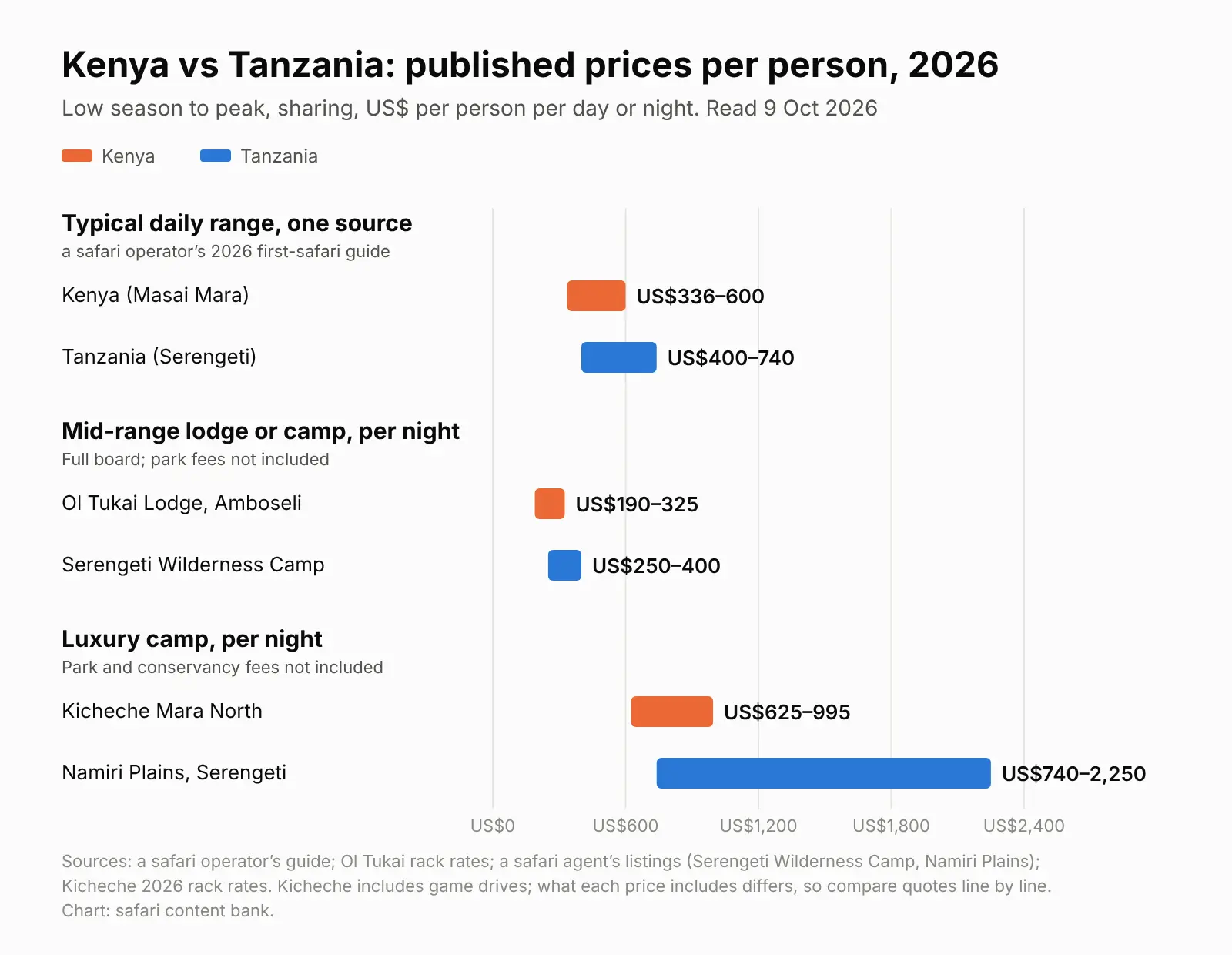 Published 2026 prices per person, sharing, read 9 October 2026. Sources: a safari operator’s guide; Ol Tukai; a safari agent’s listings; Kicheche. Chart: safari content bank.
The budget gap shrinks in the Mara’s high season
A budget Mara group safari’s US$57–60 a day becomes about US$257–260 once the July–December reserve fee is added (our sum: price per day + US$200). That is within the US$220–300 a day that Tanzanian group camping safaris charge with park fees already included. From January to June the same Mara day is about US$157–160 with the US$100 fee, still well below Tanzania.
Why Tanzania costs more at the top end
Three things stack up in Tanzania: higher per-night government fees inside the parks, private vehicles as the norm, and longer distances.
- Fees per night. A night inside the Serengeti costs US$129.80–153.40 per adult in entry and concession fees with VAT (last published tariff, 2023/24). The Ngorongoro Crater adds US$295 per vehicle for each descent (NCAA).
- Private vehicles. Tanzanian safaris are mostly sold as private-vehicle trips; Kenya has a large shared-departure market (a Tanzanian safari operator’s guide).
- Distance. Arusha to Seronera is a 7–7.5 hour drive; Nairobi to the Mara’s Sekenani Gate is 5.5–6 hours on tarmac.
Park fees: Masai Mara vs Serengeti, month by month
The cheaper park in fees depends on the month: the Mara is cheaper from January to June, and the Serengeti is cheaper from July to December.
| Period (2026) | Masai Mara reserve, per adult per day | Serengeti, entry only (sleeping outside) | Serengeti, entry + concession (sleeping inside) |
|---|---|---|---|
| 1 Jan – 14 Mar | US$100 | US$82.60 | US$141.60 |
| 15 Mar – 15 May | US$100 | US$70.80 | US$129.80 |
| 16 May – 30 Jun | US$100 | US$82.60 | US$141.60 |
| 1 Jul – 30 Sep | US$200 | US$82.60 | US$153.40 |
| 1 Oct – 31 Dec | US$200 | US$82.60 | US$141.60 |
Non-resident (Kenya) or non-East African (Tanzania) adult. Mara: Narok County fee schedule FY2025/26 (PDF), the last published schedule. Serengeti: TANAPA Tariffs 2023/24 (PDF), the last published tariff, with 18% VAT added. Checked 9 October 2026.
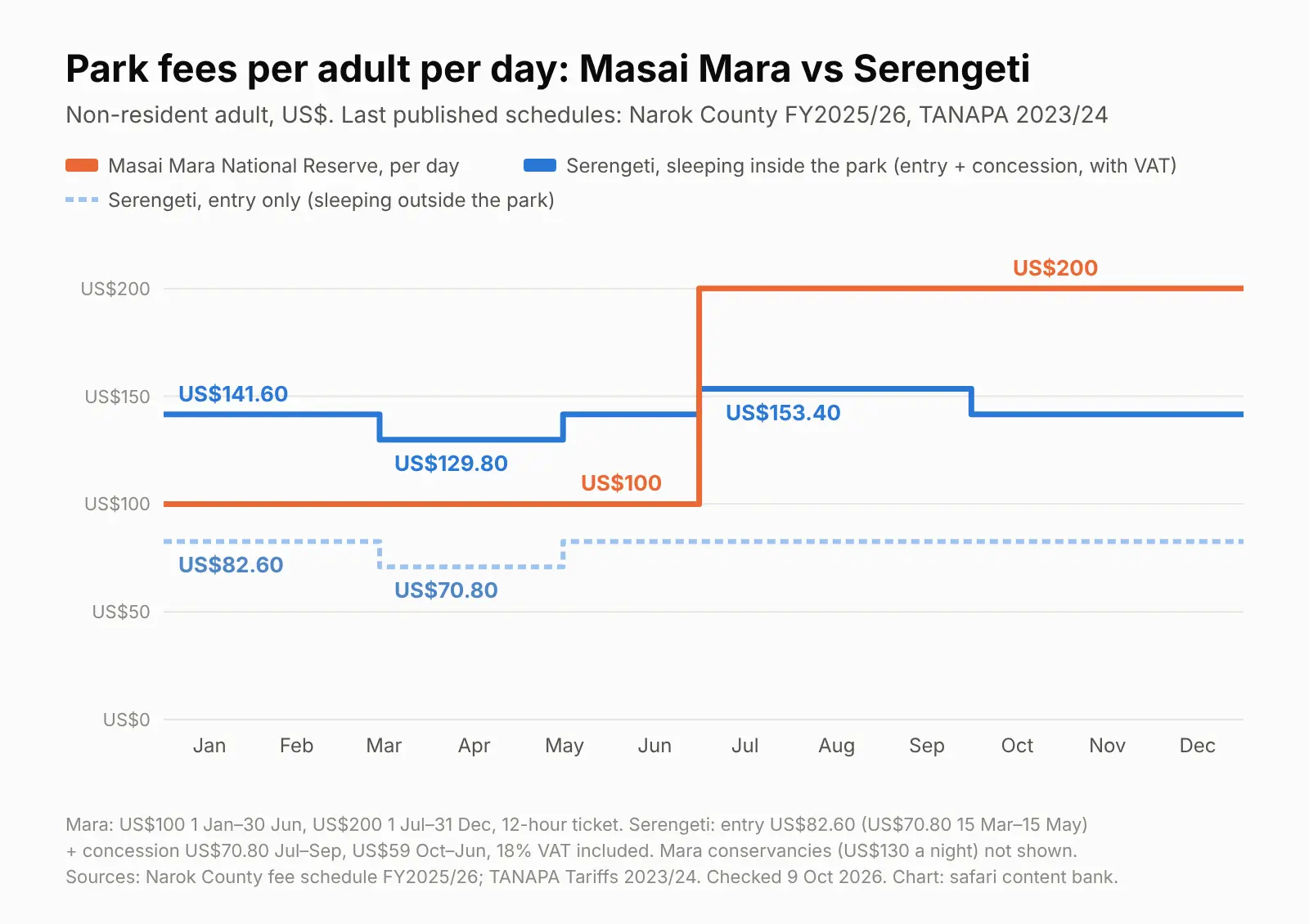 Government fees only, per non-resident adult. Sources: Narok County fee schedule FY2025/26; TANAPA Tariffs 2023/24 (both the last published). Chart: safari content bank.
- A Mara ticket lasts 12 hours, 06:00–18:00, and does not carry overnight; you pay for every calendar day you are in the reserve, wherever you sleep (Mara Conservancy).
- A Serengeti day permit is valid for 12 daylight hours; a sleep-over permit for 24 hours. The concession fee applies only if you sleep inside the park.
- No TANAPA tariff newer than 2023/24 has been published, and no Narok County schedule for 2026/27. Operators in both countries still charge these amounts in October 2026.
- Mara conservancies are the Kenyan alternative to the reserve fee. They charge US$130 per adult per night (Kicheche and Porini 2026 rate sheets); you pay the reserve fee as well only on days you drive into the reserve.
The official fee lines, with the date each took effect and the authority’s own source:
| Fee | Amount | In force from | Source |
|---|---|---|---|
| Maasai Mara National Reserve (Kenya), non-resident adult, per day (12-hour ticket, 06:00–18:00), 1 Jan–30 Jun | USD 100 | Since 1 Jan 2024; Narok County FY2025/26 schedule, the last published | Narok County fee schedule FY2025/26 |
| Maasai Mara National Reserve (Kenya), non-resident adult, per day (12-hour ticket, 06:00–18:00), 1 Jul–31 Dec | USD 200 | Since 1 Jul 2024; Narok County FY2025/26 schedule, the last published (no 2026/27 schedule as of 9 Oct 2026) | Narok County fee schedule FY2025/26 |
| Amboseli and Lake Nakuru National Parks (KWS, Kenya), non-resident adult, per 24 hours | USD 90 (child under 18, 5 and under free, USD 45) | 1 Oct 2025 (Legal Notice 160 of 2025) | KWS Fees Regulations 2025 (LN 160/2025) |
| Serengeti National Park (Tanzania), non-East African adult, entry per day, 16 May–14 Mar | USD 70 + 18% VAT = USD 82.60 | 1 Jul 2023 (2023/24 tariff, last published) | TANAPA Tariffs 2023/24 |
| Serengeti National Park (Tanzania), non-East African adult, entry per day, 15 Mar–15 May | USD 60 + 18% VAT = USD 70.80 | 1 Jul 2023 (2023/24 tariff, last published) | TANAPA Tariffs 2023/24 |
| Serengeti, concession fee per person per night inside the park | Jul–Sep USD 60 + VAT = USD 70.80; Oct–Jun USD 50 + VAT = USD 59 | 1 Jul 2023 (2023/24 tariff, last published) | TANAPA Tariffs 2023/24 |
| Ngorongoro Crater descent (crater service fee), per vehicle | USD 295 (NCAA's page does not say whether VAT is included) | Undated official page, read 9 Oct 2026 | NCAA |
Where is the Great Migration: Kenya or Tanzania?
The wildebeest herds spend about July to October in Kenya’s Masai Mara and the rest of the year in Tanzania’s Serengeti. The pattern is historical: “timing all depends on the rains” (a camp operator’s migration guide).
| Month | Where the herds usually are | Country |
|---|---|---|
| January–March | Southern Serengeti (Ndutu, Naabi, Moru, Kusini). Calving peaks in February: about 500,000 calves in a two-to-three-week window | Tanzania |
| April–May | Still in the south in April; moving north via Moru Kopjes towards the Western Corridor in May | Tanzania |
| June | Western Corridor; Grumeti River crossings in the first half of June | Tanzania |
| July | Lead herds reach Kogatende, northern Serengeti; herds arrive in the Mara about July | Both |
| August–September | Mara River crossings in both directions; herds in the Lamai Wedge and the Masai Mara | Both |
| October | The tail end crosses back into Tanzania; herds leave the Mara about October | Both |
| November–December | Through Lobo to the central Serengeti and back south | Tanzania |
Sources: a camp operator’s migration guide; Wikipedia, Maasai Mara. Typical pattern; it shifts by weeks from year to year.
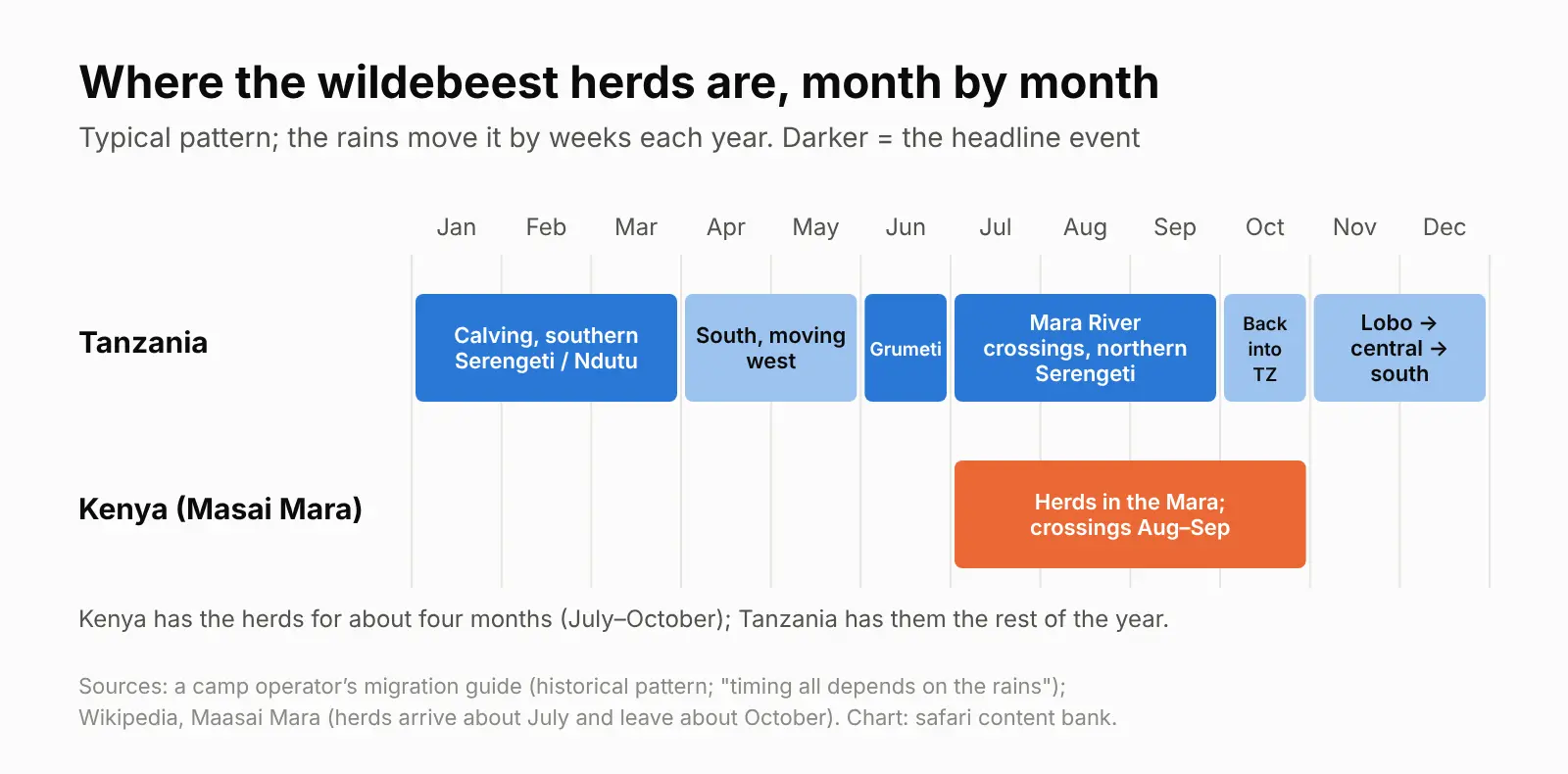 Typical pattern. Sources: a camp operator’s migration guide; Wikipedia (Maasai Mara). Chart: safari content bank.
River crossings happen on both sides of the border. From July to September you can watch them from the northern Serengeti (Kogatende) or from the Masai Mara. The Mara can be crowded with vehicles in migration season; Tanzania has fewer vehicles overall (a Tanzanian safari operator’s guide).
Getting there and moving between the two
Kenya is faster to reach and faster to get around; combining both countries means flying, or a long road detour with a change of vehicle at the border. Every leg, border post and published drive time is on our Mara to Serengeti routing page; the paperwork and crossings at Namanga and the other posts are on Kenya–Tanzania border crossings.
| Route | Time | Surface or carrier | Source |
|---|---|---|---|
| Nairobi → Masai Mara, Sekenani Gate | 5.5–6 h | Tarmac all the way since 2021 | The Kenya Times, 20 Aug 2026; Mara Conservancy |
| Nairobi Wilson → Masai Mara by air | 45–60 min | Light aircraft | A tour operator’s guide |
| Arusha → Seronera (central Serengeti) | 7–7.5 h | Tarmac to Ngorongoro’s gate, then gravel | A Tanzanian operator’s Serengeti guide |
| Arusha or Kilimanjaro → Serengeti airstrips | 1–2 h | Light aircraft | A tour operator’s guide |
| Nairobi → Arusha by shuttle | 5–6 h, including the Namanga border | Tarmac | A self-drive operator’s guide |
| Masai Mara → Serengeti by air | Safarilink leaves the Mara 11:30, Migori 12:00; road across the Isebania–Sirari border; Coastal Aviation leaves Tarime 14:00 | Air, road, air | Safarilink |
- The direct road border between the Mara and the Serengeti, Bologonja–Sand River, closed in 1977 after the first East African Community broke up. Kenya tried to reopen it in 2017; Tanzania refused (The EastAfrican, 4 Apr 2017). No reopening had been announced on 9 October 2026.
- Safari vehicles change at the border. Tanzanian-plated safari vehicles are “currently banned” in Kenyan parks such as the Mara (a self-drive operator’s guide), so a Nairobi–Arusha trip swaps vehicle and guide at Namanga.
- The Mara–Serengeti air link needs a yellow fever card and allows 15 kg of baggage (Safarilink).
- Tourists may not drive outside cities after dark in Tanzania, so a same-day transfer to a park needs a flight landing at Kilimanjaro, Arusha or Dar es Salaam before 13:00 (a Tanzanian operator’s travel-times table).
Entry costs for Kenya and Tanzania
A UK or EU traveller visiting both countries pays US$30 for Kenya’s eTA and US$50 for Tanzania’s visa, plus compulsory travel insurance in Tanzania (US$44) and in Kenya (up to US$44, since 5 October 2026). Checked 9 October 2026.
| Item | Kenya | Tanzania | Source |
|---|---|---|---|
| Entry document | eTA US$30, plus payment charges; every child needs one | Tourist visa, single entry, US$50; US citizens US$100 | KCAA AIC 14/25 (PDF); Tanzania e-visa guidelines |
| Compulsory travel insurance | Required for arrivals since 5 October 2026 (U.S. Embassy Nairobi), up to US$44 (eCitizen) | US$44 per adult, 92 days, under Government Notice 256 of 2026 | VisasNews, 7 Oct 2026; Clyde & Co, 16 Sep 2026 |
| East African Tourist Visa (US$100) | Covers Kenya, Uganda and Rwanda | Does not cover Tanzania | KCAA AIC 14/25 |
Your own travel insurance does not replace either country’s scheme. Check the official Kenya eTA portal and Tanzania e-visa site the week you travel.
Which should you choose?
Choose Kenya for a short first safari, a tighter budget or night drives; choose Tanzania for the calving season, more space and Zanzibar.
| If you… | Pick | Why |
|---|---|---|
| Have a week or less | Kenya | Nairobi → Mara is 5.5–6 h on tarmac or under an hour by air |
| Travel January–March | Tanzania | Calving happens only in the southern Serengeti and Ndutu |
| Travel July–October for river crossings | Either | Crossings on the Mara River in the northern Serengeti and the Masai Mara |
| Travel January–June on a budget | Kenya | The Mara fee is US$100 a day, and a 3-day budget group safari is US$170–180 before fees |
| Want night drives or bush walks | Kenya (Mara conservancies) | Walks in the Ngorongoro Conservation Area need an NCAA armed ranger and stay off the crater floor; the Mara conservancies sell both night drives and walks |
| Want space and fewer vehicles | Tanzania | The Serengeti is about ten times the Mara reserve |
| Want rhino | Kenya | Ol Pejeta and Lake Nakuru are the easier sites (a Tanzanian safari operator’s guide) |
| Want chimpanzees | Tanzania | Mahale and Gombe |
| Want a beach finish | Tanzania for Zanzibar; Kenya for Diani or Lamu |
Whichever you choose, check that the operator holds a current licence: see how to check a safari operator is licensed.
See also: Serengeti vs Ngorongoro, Amboseli vs Tsavo, Laikipia vs Masai Mara, Masai Mara vs Amboseli, Samburu vs Masai Mara and Tarangire vs Lake Manyara.
Common mistakes in Kenya vs Tanzania comparisons
| What you’ll often read | What is correct |
|---|---|
| “The Masai Mara is always cheaper than the Serengeti in park fees” | Only from January to June. From July to December the Mara reserve charges US$200 per adult per day; a night inside the Serengeti costs US$153.40 at most (last published tariff, 2023/24). |
| “Serengeti entry is US$70” | US$70 is before VAT. The visitor pays US$82.60, and it is the 2023/24 figure, the last published. |
| “You can drive from the Mara into the Serengeti” | The direct border has been closed since 1977. Fly via Migori and Tarime, or drive round via Isebania–Sirari or Namanga. |
| “The Great Migration is in Kenya” | The herds are in Kenya for about four months (July–October) and in Tanzania for the rest of the year. |
| “The East African Tourist Visa covers both” | It covers Kenya, Uganda and Rwanda, not Tanzania. |
| “Kenya visa on arrival, US$50” | Kenya has had no visa since January 2024; the eTA costs US$30, applied for before travel. |
| “The Ngorongoro crater fee is per person” | It is US$295 per vehicle per descent. |
Frequently asked questions
Is Kenya or Tanzania cheaper for a safari? Kenya, at the budget and mid-range level. In one 2026 source covering both, a Masai Mara safari costs US$336–600 per person per day and a Serengeti safari US$400–740 (a safari operator’s guide). From July to December, though, the Mara reserve fee (US$200 a day) is higher than the Serengeti’s.
Which is better for the Great Migration, Kenya or Tanzania? It depends on the month. The herds are in Kenya’s Masai Mara from about July to October, and in Tanzania the rest of the year, with calving in the southern Serengeti from January to March. River crossings on the Mara River happen on both sides of the border, mostly in August and September.
Can I do Kenya and Tanzania on one trip? Yes. Fly between the Masai Mara and the Serengeti via Migori and Tarime (Safarilink and Coastal Aviation), or travel Nairobi–Arusha by road in 5–6 hours via Namanga. You need Kenya’s eTA (US$30) and Tanzania’s visa (US$50, US$100 for US citizens).
Can you drive from the Masai Mara to the Serengeti? Not directly. The Bologonja–Sand River border post between the two parks has been closed since 1977. Tanzanian-plated safari vehicles are also barred from Kenyan parks such as the Mara, so trips change vehicle and guide at the border.
How much are the park fees in the Masai Mara and the Serengeti? The Masai Mara reserve charges US$100 per adult per day from January to June and US$200 from July to December (Narok County’s last published schedule, FY2025/26). Serengeti entry is US$82.60 per day with VAT, or US$70.80 from 15 March to 15 May, plus US$59–70.80 per night if you sleep inside the park (last published tariff, 2023/24).
Is the Masai Mara more crowded than the Serengeti? Usually, yes, in migration season. The Mara reserve is about 1,500 km² (Mara Conservancy) against the Serengeti’s 14,763 km² (a safari agent’s guide, read 10 October 2026), and the number of Mara lodges grew from fewer than 10 in the late 1970s to nearly 200 in 2016 (Wikipedia).
Which country is better for a first safari? Kenya suits a first safari of a week or less: the Mara is 5.5–6 hours from Nairobi on tarmac or under an hour by air, and shared group departures keep the price down. A Tanzanian safari operator’s guide suggests 4–6 days for Kenya and 7–10 or more for Tanzania, where distances are longer.
Sources
- Narok County, Maasai Mara fee schedule FY2025/26 (PDF), the last published schedule; Mara Conservancy, conservation fees
- TANAPA, Tariffs 2023/24 (PDF), the last published tariff; NCAA, tariffs
- Kenya Wildlife Service, Fees Regulations 2025, Legal Notice 160 of 2025 (PDF)
- Kenya Civil Aviation Authority, AIC 14/25 (PDF); Tanzania Immigration, e-visa guidelines; Clyde & Co, inbound travel insurance, 16 Sep 2026; VisasNews, 7 Oct 2026
- A camp operator’s migration guide; Wikipedia, Maasai Mara and Serengeti National Park
- The EastAfrican, Bologonja border, 4 Apr 2017; Safarilink, Masai Mara to Serengeti; The Kenya Times, Nairobi to the Mara, 20 Aug 2026; a Tanzanian operator’s Serengeti guide; a self-drive operator’s guide; a Tanzanian operator’s travel-times table
- Comparison and pricing: a Tanzanian safari operator’s Kenya vs Tanzania guide; a tour operator’s guide (revised 26 May 2026); a safari operator’s guide; operator and lodge rate sheets as linked in each table, read 9 Oct 2026
Prices and fees checked 9–10 October 2026. We will update this page when Narok County publishes a 2026/27 Mara schedule, when TANAPA publishes a new tariff, and when Kenya publishes an official insurance price.
Ask for a quote
Tell us your dates and we send you a priced itinerary. Free, no obligation.
- Free quote, no obligation
- Trips run by licensed local operators