 Experience

Last verified · Next check due
On this page
- Month by month: where to go on safari
- Country by country: the best months at a glance
- East Africa: Kenya and Tanzania
- Uganda and Rwanda: gorillas between the rains
- Southern Africa: Botswana, Namibia, South Africa, Zambia, Zimbabwe
- How much rain falls, place by place
- Wildlife calendar: calving, crossings, flood, denning
- Price seasons: what the rate cards say, with dates
- Park fees by season
- Park closures, roads and camps shut by the rains
- Common mistakes about when to go on safari
- Frequently asked questions
- Sources
Short answer: For most first safaris, go in the dry season: about June to October in Kenya, Tanzania, Botswana, Zambia and Zimbabwe, May to October in Namibia and April to September in Kruger. That is also peak price: Mombo in Botswana charges US$5,345 a night from June to October against US$3,062 from January to March (Wilderness). The exceptions are wildebeest calving at Ndutu, which peaks in February, and gorilla trekking, rated best in January–February and June–July. Checked 10 October 2026.
Key facts
- Africa’s safari countries have two rain calendars. Southern Africa has one rainy season, about November to March or April; East Africa has long rains about March–May and short rains about November–December (green-season safari).
- July to September is peak season in eight of the nine countries. The exception is South Africa: the Kruger fee is the same all year and SANParks’ high season is the December holiday, 13 December–15 January in its 2024/25 tariff (SANParks Tariffs 2024/25, PDF).
- The Mara River crossings run from about July to October, and no one can date or guarantee one. The Masai Mara reserve fee doubles on 1 July, from US$100 to US$200 per adult per day (Narok County FY2025/26 schedule, the last published).
- The Okavango Delta floods in the dry season, with water highest in most of the Delta from about May to August (one operator’s flood guide), months after Botswana’s own rains of November to March.
- Many camps close in the rains. Time + Tide’s South Luangwa bush camps open only 20 May–15 November (Time + Tide); most Mana Pools camps close December–March (one operator’s Mana Pools guide); Kicheche Mara North and Kicheche Bush closed 1 April–22 May 2026 (Kicheche 2026, PDF).
- No national weather-service rainfall normals are in our sources. The monthly rain figures below come from an aggregator, Climates to Travel, unless marked otherwise.
Month by month: where to go on safari
Each month has somewhere at its best: East Africa’s migration and gorilla parks peak in the two dry seasons, southern Africa from May or June to October, and Botswana’s pans and the Serengeti’s calving plains in the rains. The table is a typical year; rain shifts every date.
| Month | Kenya and Tanzania | Uganda and Rwanda (gorillas) | Botswana and Namibia | South Africa, Zambia and Zimbabwe |
|---|---|---|---|---|
| January | Herds on the southern Serengeti plains; first calves. Mara: resident game, Loita herd moves into Ol Kinyei; reserve fee US$100 | Bwindi rated “Excellent”; Rwanda’s 30% permit discount (with an Akagera or Nyungwe stay) | Rains; zebra at Nxai Pan; green rates from about 10–11 January; Etosha’s poorest month for game | Kruger wet; South Luangwa bush camps and most Mana Pools camps closed; Camp Hwange’s lowest rate, US$550 |
| February | Peak calving at Ndutu; Loita herd calves in the Mara conservancies | Bwindi “Excellent” | Rains; low Delta water, no boats at seasonal camps; Tsumeb (Etosha) 140 mm | Victoria Falls flood begins (February–May) |
| March | Last calves; herds leaving Ndutu by late March; long rains start; Serengeti entry falls to US$70.80 from 15 March | Rains begin; lodge low season from 1 March | Zebra mass at the pans for the return; flood peak enters Botswana at Mohembo from mid-March; green rates end 31 March | Kruger’s last wet month |
| April | Wettest month: Masai Mara 210 mm, Serengeti 155 mm, Amboseli 155 mm; many Mara conservancy camps closed | Uganda gorilla permit US$600; Bwindi rated “Poor” | Shoulder rates (Machaba); San Camp (Makgadikgadi) opens 1 April | Kruger’s dry season starts; Victoria Falls at peak flow, about 3,000 m³/s |
| May | Herds move north through Moru and Seronera; long rains continue (Mara 155 mm); Serengeti low fee ends 15 May | Uganda permit US$600 | Highest Delta water begins; boating resumes late May; Machaba High season from 1 May; Etosha dry season starts | South Luangwa bush camps open from 20 May |
| June | Grumeti River crossings, about the first half of June; Serengeti dry season | Bwindi “Excellent”; Rwanda park-lodge high season from 1 June | Botswana top rates begin (Mombo, Great Plains from 15 June); wild dog pups emerge around June | All South Luangwa camps open; Mana Pools’ best months start |
| July | Mara River crossings begin; Mara fee US$200 from 1 July; driest month (Mara 60 mm, Serengeti 15 mm, Amboseli 5 mm) | Bwindi “Excellent” | Flood near peak; Kwando’s “Flood” season (July–October); Etosha 0 mm | Hwange’s best months start; Camp Hwange US$1,080 |
| August | Crossings mostly south to north; the one month every calendar agrees on | Between the rains (June–September) | Last month of highest water; wild dog denning (August–September) | Carmine bee-eaters arrive in South Luangwa |
| September | Crossings in both directions; most animals in the Mara | Kibale’s second rains start | Peak game concentration on the remaining water; boating often stops at seasonal camps | Bee-eaters nesting; Victoria Falls low-water season starts (September–January) |
| October | Tail of the herds crosses back into Tanzania; short rains start | Rwanda lodge low season from 1 October; Bwindi “Poor” | Hottest month in Botswana, above 40°C at times; Etosha peak, 33 °C highs at Tsumeb | Kruger’s wet season starts; Zambian side of Victoria Falls can be bare rock; Liuwa wildebeest from late October |
| November | Short rains (Mara 155 mm, Serengeti 115 mm, Amboseli 115 mm); Mara fee still US$200 | Uganda permit US$600; Rwanda discount starts | Rains start; shoulder rates from 1 November; NWR low season (November–June) | Lowest Victoria Falls flow, about 300 m³/s; South Luangwa bush camps close 15 November |
| December | Herds spread south toward Ndutu; holiday rates from 20–21 December in the Mara | Rwanda high season from 15 December | Zebra head south to Nxai Pan from early December; holiday rates from 20 December | SANParks high season from 13 December; Mana Pools camps close |
Typical year, not a forecast. Herds: a camp operator’s migration guide and one operator’s migration guide, as on our Great Migration month by month; Loita herd: a Kenyan camp operator’s Loita migration page. Rain: Climates to Travel (Masai Mara, Amboseli) and Tanzania (Serengeti), Namibia (Tsumeb), an aggregator. Gorillas: a safari booking site’s Uganda page; UWA letter TDO 93/04, PDF; RDB; Akagera and Nyungwe rate sheets. Botswana: two camp operators’ seasonal guides; Africa Geographic. Zambia and Zimbabwe: one operator’s South Luangwa guide; Time + Tide; Wikipedia, Victoria Falls. Fees: Narok County FY2025/26 and TANAPA 2023/24, both the last published. Read 8–10 October 2026.
Country by country: the best months at a glance
For game, the dry months win in every country; for price, the rainy months do, by up to 55% at the camps we checked; in South Africa the Kruger fee and many lodge rates do not change with the season.
| Country | Best months for game | Rainy months | Cheapest window (example) | Top-rate season (example, per person per night) |
|---|---|---|---|---|
| Kenya (Masai Mara) | July–October for the herds; Mara game is resident all year | Long rains March–May, short rains November–December; no month dry (July 60 mm) | April–May: Governors’ Camp US$453 (2026) | July–October: Governors’ Camp US$998 (2026) |
| Tanzania (Serengeti) | January–March for calving; June–October dry season; July–October crossings | Long rains March–May (April 155 mm); short rains November (115 mm) | 6 January–15 May: Singita Grumeti US$2,210 (2026) | 16 May–30 September: Singita Grumeti US$3,220 (2026) |
| Uganda (Bwindi, Kibale) | Bwindi “Excellent” January, February, June and July | Kibale: March–May and September–November, up to 1,700 mm a year | April, May, November: permit US$600, Buhoma Lodge US$380 (2026) | January, February, July–September, December: Buhoma Lodge US$535 (2026) |
| Rwanda (Volcanoes) | June–September and December–February, between the rains | Long rains March–May, short rains October–November | November–May: permit 30% off with an Akagera or Nyungwe stay; park lodges low 1 March–31 May, 1 October–14 December | 1 June–31 October: Singita Kwitonda US$3,630 (2026) |
| Botswana (Okavango, Chobe) | June–October; December–March on the Kalahari pans | November–March | January–March: Mombo US$3,062; Machaba US$718 (11 January–31 March 2026) | June–October: Mombo US$5,345; Machaba US$1,315 (1 May–31 October 2026) |
| Namibia (Etosha) | May–October; peak September–October | About November–April; Tsumeb 80–140 mm a month January–March | November–June: NWR Sossus Dune Lodge N$4,030 | July–October: NWR Sossus Dune Lodge N$7,000 |
| South Africa (Kruger) | April–September, the dry season | October–March; Skukuza 635 mm a year | Kruger fee the same all year; Eastern Cape cheapest in winter: Kwandwe R17,930 (1 May–30 September 2026) | SANParks high season 13 December–15 January (2024/25); Kwandwe R26,180 from 1 October 2026 |
| Zambia (South Luangwa) | June–October; Time + Tide’s bush camps open 20 May–15 November | “Emerald season” December–March | Emerald season around Mfuwe: Nsefu Camp US$735; Chinzombo US$1,330 | July–September: Nsefu US$1,150; July–October: Chinzombo US$1,840 |
| Zimbabwe (Hwange, Mana Pools) | July–October in Hwange; June–October in Mana Pools | November–March | January–March: Camp Hwange US$550 (2026) | July–October: Camp Hwange US$1,080 (2026) |
Rates per person sharing per night as printed on our Kenya, Tanzania, Uganda, Rwanda, Botswana, Namibia, South Africa, Zambia and Zimbabwe cost pages and the green-season page; each rate card is linked in the price-season table below. Rain sources as in the rainfall table below. Read 8–10 October 2026.
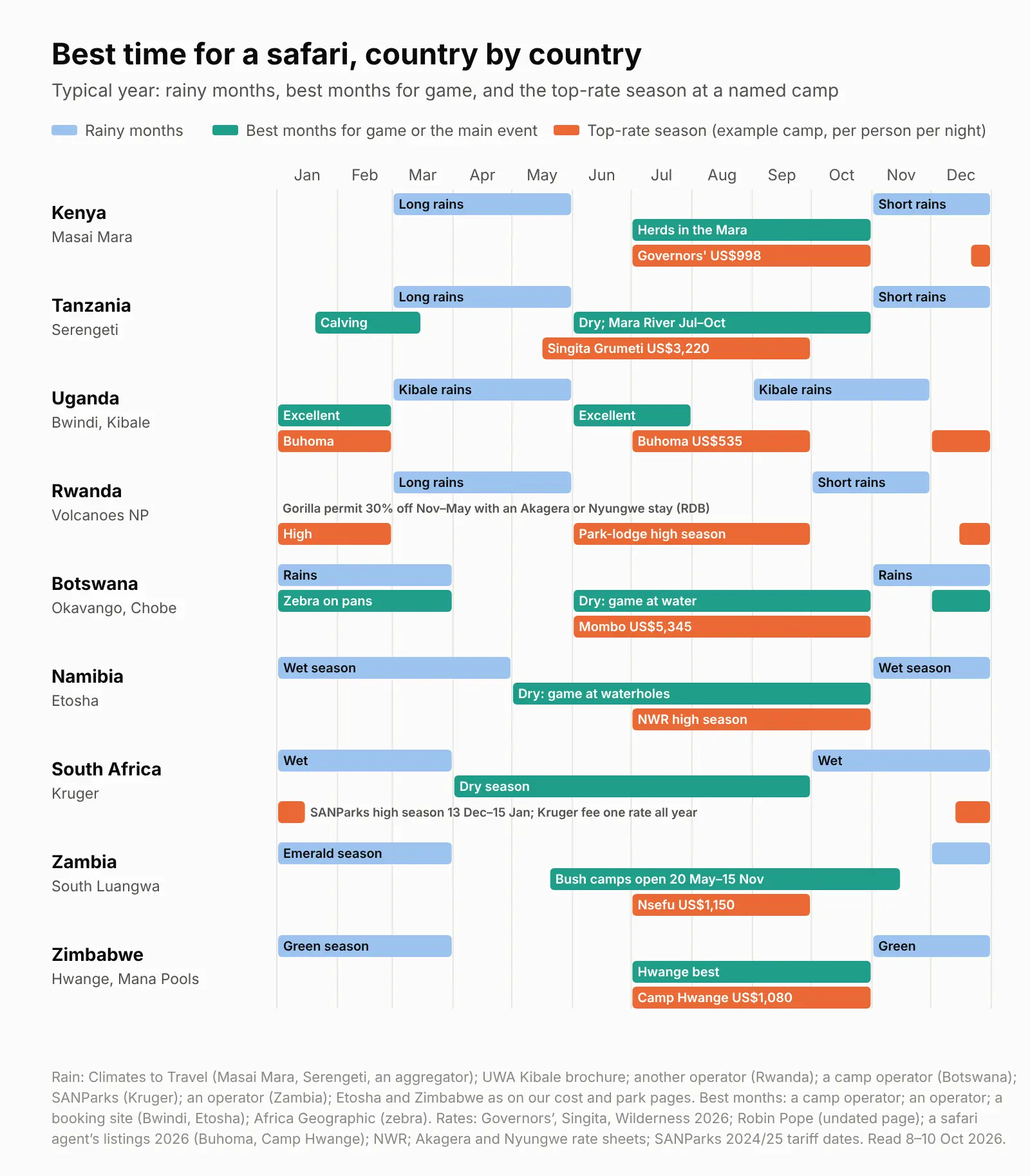 Typical year. Sources: Climates to Travel (an aggregator); UWA; SANParks; two camp operators’ guides (Botswana seasons, the migration); two other operators’ guides and a safari booking site; Africa Geographic; camps’ 2026 rate sheets and a safari agent’s listings; SANParks 2024/25 tariff. Read 8–10 October 2026. Chart: safari content bank.
East Africa: Kenya and Tanzania
Go from July to October for the Mara River crossings, in February for calving at Ndutu, or from June to October for the dry season in every park; April and May are the cheapest and the wettest. Where the herds are each month, with the fees that apply, is on our Great Migration month by month.
- Kenya: the Masai Mara reserve charges US$100 per adult per day from January to June and US$200 from July to December (Narok County FY2025/26, the last published schedule). No month in the Mara is dry: July, the driest, still averages 60 mm (Kenya safari questions). Amboseli is driest in June–September, with 5–15 mm a month (Amboseli). Month tables: Masai Mara.
- Tanzania: in early and mid-July most of the herds are usually still in the northern Serengeti, not the Mara. Serengeti entry is US$70.80 instead of US$82.60 from 15 March to 15 May, the long rains (last published tariff, 2023/24). In March 2026 a traveller in the southern Serengeti wrote “We were stuck 11 times in 7 days” (TripAdvisor forum, traveller report). Month tables: Serengeti, Ngorongoro, Tanzania safari questions.
- Both: the road border between the Mara and the Serengeti has been closed since 1977, so combining the two sides of the crossings costs a day; see Mara to Serengeti and Kenya vs Tanzania.
Uganda and Rwanda: gorillas between the rains
Gorilla trekking runs all year; the drier months are about June–September and December–February, and the cheaper permits fall in the rains. Treks go ahead in rain, with no refund for weather in Bwindi (a safari booking site’s Uganda page).
- Uganda’s gorilla permit costs US$800, or US$600 in April, May and November, and the low-season permits cannot be rescheduled (UWA letter TDO 93/04, 26 Feb 2026, PDF). A safari booking site rates Bwindi “Poor” in April, May, October and November and “Excellent” in January, February, June and July.
- Rwanda takes 30% off its US$1,500 permit from November to May only with two nights in Akagera or Nyungwe (RDB, checked 9 October 2026); 30% off is US$1,050 (our sum). Rwanda’s long rains fall in March–May and its short rains in October–November (one operator’s guide).
- Kibale’s rain falls mostly in March–May and September–November, up to 1,700 mm a year (UWA Kibale brochure, PDF). Chimp months are on chimpanzee trekking permits; permit rules on gorilla permit prices and Uganda or Rwanda for gorillas.
Southern Africa: Botswana, Namibia, South Africa, Zambia, Zimbabwe
Southern Africa’s safari season is the dry winter, from about May or June to October; the rains from about November to March bring the lowest rates, closed bush camps and the Kalahari pans’ best months. October is the hottest month.
- Botswana: June to October for game, “because animals gather at the remaining water” (a camp operator’s best-time guide for Botswana). The Delta’s water is highest from about May to August and boats run at seasonal camps from about late May to September (Okavango flood calendar). Zebra gather at Nxai Pan and the Makgadikgadi from December to March (Botswana safari questions). Hubs: Okavango Delta, Chobe.
- Namibia: May to October; September and October bring the highest concentration of animals at Etosha’s waterholes, and January to March rank as the poorest months (Namibia safari questions). In July Windhoek averages 7.2 °C at night (Climates to Travel). Hubs: Etosha, Sossusvlei.
- South Africa: in Kruger, April to September is the dry season and the easiest time to see animals; malaria risk peaks from November to April (SANParks climate; SANParks malaria). Gates open 05:30–18:30 from November to February against 06:00–17:30 from May to July (SANParks gates). Hub: Kruger; for winter-cheap, malaria-free reserves see malaria-free safaris.
- Zambia: One safari operator’s season table runs the rains (“emerald” season) from December to March, a cool dry season from June to August and a hot dry season from September to November, with October above 40 °C in the Luangwa and Zambezi valleys (its Zambia weather page). Most bush camps close for the rains: South Luangwa from mid-November to late May, Lower Zambezi from mid-November to April (Zambia safari cost).
- Zimbabwe: Hwange’s best months are July to October, when game gathers at the pumped waterholes (one operator’s Hwange guide); Mana Pools is best June to October and most camps close December to March (one operator’s Mana Pools guide). Victoria Falls month by month is on Victoria Falls: Zimbabwe or Zambia.
How much rain falls, place by place
The wettest safari month in East Africa is April and the driest is July; in southern Africa almost no rain falls from about May to September. No figure below comes from a national weather service: the bank holds none, so we print an aggregator’s averages and say so.
| Place | Wettest month | Driest month or months | Year | Source |
|---|---|---|---|---|
| Masai Mara (Kenya), 1,600 m | April, 210 mm | July, 60 mm | – | Climates to Travel (aggregator) |
| Amboseli (Kenya) | April, 155 mm | July, 5 mm; June–September 5–15 mm | about 695 mm (our sum) | Climates to Travel, as on our Amboseli page |
| Serengeti station (Tanzania), 1,400 m | April, 155 mm | July, 15 mm | – | Climates to Travel (aggregator) |
| Kibale (Uganda) | March–May and September–November | – | up to 1,700 mm | UWA Kibale brochure (PDF) |
| Tsumeb, near Etosha (Namibia) | February, 140 mm | 0 mm, June–September | – | Climates to Travel (aggregator) |
| Namibia, national | February, 80 mm | 0–5 mm a month, May–September | – | A safari travel company’s climate guide |
| Skukuza, Kruger (South Africa) | – | – | 635 mm (1991–2020) | Wikipedia, as on our Kruger page |
| Phalaborwa, northern Kruger | – | – | 529 mm | Wikipedia, as on our Kruger page |
| Okavango headwaters (Angola), feeding Botswana’s flood | about January, heaviest Angolan rain | – | 1,112 mm (1981–2021 mean) | Lourenco and Woodborne, 2023; Africa Geographic |
| Botswana, Zambia, Zimbabwe, Rwanda | – | – | – | No monthly figures in our sources |
Climates to Travel and the safari travel company’s climate guide are aggregators; read September–October 2026.
- Victoria Falls is measured in flow, not rain: the Zambezi carries a mean of about 3,000 m³ a second in April against about 300 in November, about ten times more (Wikipedia; our sum).
- Nights are cold in the dry season. Masai Mara lows are 11–13 °C in every month (Climates to Travel), and Etosha’s lows reach 8 °C in June and July (Etosha).
Wildlife calendar: calving, crossings, flood, denning
The big events are fixed by rain, not date: calving peaks in February, the Mara River crossings run from about July to October, the Okavango is highest from about May to August, and Botswana’s wild dogs den from about June to September.
| Event | Where | When (typical) | Source |
|---|---|---|---|
| Wildebeest calving | Ndutu and the southern Serengeti (Tanzania) | Late January to mid-March; peak February | A camp operator’s migration guide; one operator’s migration guide |
| Grumeti River crossings | Western Corridor, Serengeti | About the first half of June | A camp operator’s migration guide |
| Mara River crossings | Northern Serengeti and Masai Mara | July–October; August–September busiest | Mara Conservancy; a Mara camp operator’s migration page |
| Loita herd calving | Ol Kinyei and Naboisho conservancies (Kenya) | February–March | A Kenyan camp operator’s Loita migration page |
| Okavango flood | Okavango Delta (Botswana) | Peak enters at Mohembo mid-March to mid-May; highest in most of the Delta about May–August | One operator’s flood guide |
| Zebra migration | Nxai Pan and Makgadikgadi; Chobe and Zambezi floodplains (Botswana) | Pans December–March; floodplains June to early November | Africa Geographic |
| Wild dog pups and denning | Botswana | Pups emerge around June; denning August–September | One operator’s Botswana guide; a Botswana camp operator’s seasonal guide (PDF) |
| Wild dogs denning | Liuwa Plain (Zambia) | From June | One operator’s Liuwa Plain guide |
| Wildebeest gathering | Liuwa Plain (Zambia) | Late October–December | One operator’s Liuwa Plain guide |
| Carmine bee-eaters | South Luangwa (Zambia) | Arrive August–September, nest September–October | One operator’s South Luangwa guide |
| Victoria Falls in flood | Zambia and Zimbabwe | February–May, peak about April | Wikipedia |
| Migrant birds | Namibia | November–April | A safari booking site’s Namibia birding page |
Typical timing, not a forecast. Read 9–10 October 2026.
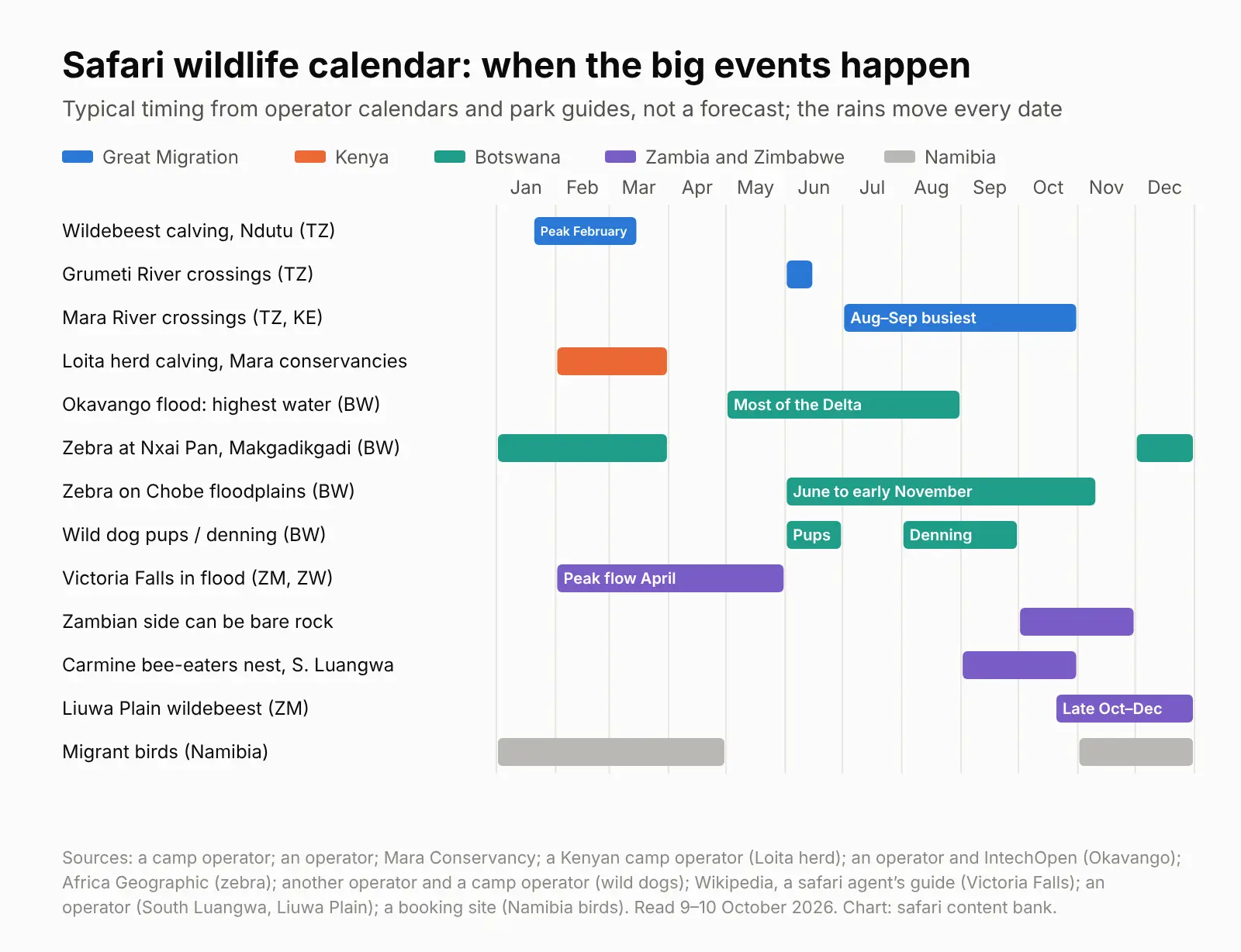 Sources: a camp operator’s migration guide; one safari operator; Mara Conservancy; a Kenyan camp operator’s Loita migration page; IntechOpen review; Africa Geographic; another operator; a Botswana camp operator’s seasonal guide; Wikipedia; a safari agent’s guide to the Falls; a safari booking site. Read 9–10 October 2026. Chart: safari content bank.
- No source publishes the odds of a river crossing or a den. The Mara Conservancy calls crossings “difficult to predict”; see Great Migration month by month and where to see wild dogs.
- Botswana’s denning months are its high-water and peak-price months. The Okavango detail is on the Okavango flood calendar.
Price seasons: what the rate cards say, with dates
Every camp draws its own season lines, so read the dates on the rate card, not the label: “green”, “emerald”, “secret” and “low” all mean the rainy months, and “peak” is usually July to September or October plus Christmas. How much each saves is on our green-season page.
| Camp (country) | Lowest season | Middle season | Top season | Rate card, year |
|---|---|---|---|---|
| Governors’ Camp, Masai Mara (Kenya) | US$453 April–May | US$623 January–March, June, November to 20 December | US$998 July–October; from 21 December | Governors’ 2026 (PDF) |
| Kicheche Mara North (Kenya) | Closed 1 April–22 May; US$625 March, 23 May–30 June, November–19 December | US$730 January–February | US$995 July–October; 20 December–2 January | Kicheche 2026 (PDF) |
| Ol Tukai Lodge, Amboseli (Kenya) | US$190 April–May | US$290 January–March, November–December | US$325 June–October | Ol Tukai rack rates (PDF) |
| Singita Faru Faru, Sabora, Explore (Tanzania) | US$2,210 6 January–15 May | – | US$3,220 16 May–30 September | Singita Serengeti 2026 (PDF) |
| Buhoma Lodge, Bwindi (Uganda) | US$380 April, May, November | US$455 March, June, October | US$535 January, February, July–September, December | A safari agent’s listing (2026) |
| Ruzizi Tented Lodge, Akagera (Rwanda) | US$227 1 March–31 May, 1 October–14 December | – | US$258 1 June–30 September, 15 December–28 February | Ruzizi 2026–2027 (PDF) |
| Singita Kwitonda, Volcanoes (Rwanda) | US$2,720 6 January–31 May 2026 | – | US$3,630 1 June–31 October 2026 | Singita 2026 (PDF) |
| Machaba Camp, Khwai (Botswana) | US$718 Secret, 11 January–31 March | US$882 Shoulder, April and 1 November–10 January | US$1,315 High, 1 May–31 October | Machaba 2026 |
| Mombo, Moremi (Botswana) | US$3,062 January–March | – | US$5,345 June–October | Wilderness |
| Duba Plains (Botswana) | US$2,150 Green, 11 January–31 March | US$2,733 Shoulder | US$3,950 Peak, 15 June–31 October; 20 December–10 January | Great Plains 2025 (PDF) |
| Kwara (Botswana) | US$820 5 Rivers, 15 November–31 March | – | US$2,100 Flood, July–October | Kwando 2024 (PDF) |
| NWR Sossus Dune Lodge (Namibia), dinner, bed and breakfast | N$4,030 November–June | – | N$7,000 July–October | NWR rates from a booking agent’s listing |
| Wolwedans Dune Camp (Namibia) | N$13,550 green, 11 January–31 March 2026 | – | N$14,900 | Wolwedans 2026 (PDF) |
| Sabi Sabi Bush Lodge, Sabi Sand (South Africa) | R29,600, one rate 1 March 2026–28 February 2027 | – | +15% for arrivals 20 December–5 January | Sabi Sabi |
| Kwandwe, Eastern Cape (South Africa) | R17,930 1 May–30 September 2026 | – | R26,180 1 October 2026–30 April 2027 | Kwandwe 2026–27 (PDF) |
| Nsefu Camp, South Luangwa (Zambia) | US$735 Emerald (February, March, November) | US$885 Shoulder (late May, June, October) | US$1,150 July–September | Robin Pope Safaris (page undated) |
| Chinzombo, South Luangwa (Zambia) | US$1,330 Green, January–June and November–December | – | US$1,840 Safari, July–October | Time + Tide (2026 and 2027) |
| Camp Hwange (Zimbabwe) | US$550 January–March | US$724 April–June | US$1,080 July–October | A safari agent’s listing (2026) |
Per person sharing per night. What a rate includes differs by camp (park and conservancy fees are extra in Kenya and at Namibia’s NWR lodges, for example); the inclusions are on our cost pages. Rates as printed on our cost and green-season pages, read 3 September–10 October 2026.
- South Africa’s cheap season is winter in the Eastern Cape, the opposite of the rest of the region; Kruger’s SANParks camps are cheapest from 16 January to 19 March (low season, 2024/25 tariff), when a Skukuza campsite cost R368 a night against R480 in high season (SANParks Tariffs 2024/25, PDF).
- Holiday rates cover Christmas almost everywhere: Governors’ from 21 December, Kicheche from 20 December, Great Plains from 20 December to 10 January, Sabi Sabi +15% from 20 December, and Kwando adds a US$150 festive surcharge (Okavango Delta).
- Book early for the peak. One operator advises 12–18 months ahead for July–October on the migration route; costs are on Great Migration safari cost.
Park fees by season
Only a few government fees change with the season: the Masai Mara reserve, Tanzania’s national parks from 15 March to 15 May, and the gorilla permits in Uganda and Rwanda. Kenya’s KWS parks, Ngorongoro, Namibia’s parks and Kruger charge the same all year.
| Park or permit | Lower fee, per adult | Rest of the year | Source |
|---|---|---|---|
| Maasai Mara National Reserve (Kenya), per day | US$100, 1 January–30 June | US$200, 1 July–31 December | Narok County FY2025/26, the last published |
| Serengeti (Tanzania), entry + concession, a night inside | US$129.80, 15 March–15 May | US$141.60; US$153.40 July–September | Last published tariff, 2023/24, with 18% VAT |
| Tarangire, Lake Manyara, Arusha (Tanzania), entry per day | US$53.10, 15 March–15 May | US$59 | Last published tariff, 2023/24 |
| Uganda gorilla permit | US$600, April, May, November | US$800 | UWA letter TDO 93/04, 26 February 2026 |
| Rwanda gorilla permit | US$1,050 (our sum), November–May, with an Akagera or Nyungwe stay | US$1,500 | RDB, checked 9 October 2026 |
| Ngorongoro (incl. Ndutu); KWS parks; Etosha, Sossusvlei; Kruger | No seasonal fee | US$70.80; US$90 (Amboseli, Nakuru); N$280; R692 (R602 until 31 October 2026) | NCAA; KWS LN 160/2025; GN 115 of 2026; SANParks |
Fees copied from our cost pages and green-season page, read 9–10 October 2026. Botswana has no official current park-fee tariff; see Botswana safari cost.
The official fee lines, with the date each took effect and the authority’s own source:
| Fee | Amount | In force from | Source |
|---|---|---|---|
| Maasai Mara National Reserve, non-resident adult, per day (12-hour ticket, 06:00–18:00), 1 Jan–30 Jun | USD 100 | Since 1 Jan 2024; Narok County FY2025/26 schedule, the last published | Narok County fee schedule FY2025/26 |
| Maasai Mara National Reserve, non-resident adult, per day (12-hour ticket, 06:00–18:00), 1 Jul–31 Dec | USD 200 | Since 1 Jul 2024; Narok County FY2025/26 schedule, the last published, expired 30 Jun 2026 (no 2026/27 schedule as of 9 Oct 2026); The Kenya Times (6 Aug 2026, secondary) reports US$200 still applies for Jul–Dec 2026 | Narok County fee schedule FY2025/26 |
| Amboseli and Lake Nakuru National Parks (KWS), non-resident adult, per 24 hours | USD 90 (child under 18, 5 and under free, USD 45) | 1 Oct 2025 (Legal Notice 160 of 2025) | KWS Fees Regulations 2025 (LN 160/2025) |
| Serengeti and Nyerere National Parks, non-East African adult, entry per day, 16 May–14 Mar | USD 70 + 18% VAT = USD 82.60 | 1 Jul 2023 (2023/24 tariff, last published) | TANAPA Tariffs 2023/24 |
| Serengeti and Nyerere National Parks, non-East African adult, entry per day, 15 Mar–15 May | USD 60 + 18% VAT = USD 70.80 | 1 Jul 2023 (2023/24 tariff, last published) | TANAPA Tariffs 2023/24 |
| Serengeti and Nyerere, concession fee per person per night inside the park | Jul–Sep USD 60 + VAT = USD 70.80; Oct–Jun USD 50 + VAT = USD 59 | 1 Jul 2023 (2023/24 tariff, last published) | TANAPA Tariffs 2023/24 |
| Tarangire, Lake Manyara and Arusha National Parks, non-East African adult, entry per day | Peak USD 50 + VAT = USD 59; low USD 45 + VAT = USD 53.10 | 1 Jul 2023 (2023/24 tariff, last published) | TANAPA Tariffs 2023/24 |
| Ngorongoro Conservation Area, non-East African adult, entry per 24 h (single entry) | USD 70.80 (NCAA's page does not say whether VAT is included) | Undated official page, read 9 Oct 2026 | NCAA |
| Tier 1 parks (Etosha, Namib-Naukluft including Sossusvlei, Skeleton Coast, Ai-Ais/Fish River Canyon, Waterberg Plateau, Cape Cross, Dorob, Tsau //Khaeb), foreign adult 16+, per person | NAD 280 (NAD 140 park entrance + NAD 140 conservation fee) | 1 Apr 2026 (Government Notice 115 of 2026; the notice prices fees per person with no period; MEFT's 2021 schedule made fees valid for 24 hours from entry); was NAD 150 under the 2021 schedule | Government Gazette 8877 (Government Notice 115 of 2026), hosted by the Legal Assistance Centre |
| Kruger National Park daily conservation fee, international adult (12+), per day | ZAR 602 | 1 Nov 2025 to 31 Oct 2026 (SANParks 2025/26 schedule) | SANParks daily conservation fees 2025/26 |
| Kruger National Park daily conservation fee, international adult (12+), per day | ZAR 692 | 1 Nov 2026 to 31 Oct 2027 (SANParks 2026/27 schedule, already published) | SANParks daily conservation fees 2026/27 |
| Uganda: gorilla tracking permit, Bwindi Impenetrable and Mgahinga Gorilla NPs, foreign non-resident, per person per trek (guide and that day's park entry included) | USD 800 (foreign resident USD 700; rest of Africa USD 500; East African citizens UGX 300,000) | Since 1 Jul 2024 (UWA tariff 2024–26); confirmed unchanged from 1 Jan 2027 by UWA letter TDO 93/04 of 26 Feb 2026 | UWA letter TDO 93/04, 26 Feb 2026 |
| Uganda: gorilla tracking permit in April, May and November (low season), foreign non-resident, per person per trek; cannot be rescheduled | USD 600 (foreign resident USD 500) | Immediate effect from the UWA letter of 26 Feb 2026 | UWA letter TDO 93/04, 26 Feb 2026 |
| Rwanda: mountain gorilla tracking permit, Volcanoes NP, international visitor, per person per day | USD 1,500 | Current RDB price, checked 9 Oct 2026 | Visit Rwanda (Rwanda Development Board) |
| Rwanda: gorilla permit low-season discount, November–May, with two nights in Akagera or Nyungwe (paid hotel receipt and one paid activity) or one night in each | 30% off (USD 1,050, our sum); one discounted permit per person per 3-day/2-night stay | November–May; conditions checked 9 Oct 2026 | RDB booking portal, low-season discount |
Park closures, roads and camps shut by the rains
The rains close camps and roads in most countries: check that your camp is open in your month before comparing prices. The table lists closures our sources date; other camps in the same area may stay open.
| Park or area | What closes or becomes hard | When | Source |
|---|---|---|---|
| Masai Mara conservancies (Kenya) | Kicheche Mara North and Bush closed; Kicheche Valley closed | 1 April–22 May 2026; 10 April–31 May 2026 | Kicheche 2026 (PDF) |
| Amboseli (Kenya) | Porini Amboseli Camp closed | 16 April–31 May 2026 | Porini 2026 (PDF) |
| Northern Serengeti (Tanzania) | Singita Mara River Tented Camp closed; Singita Explore closed | 15 January–31 May 2026; 15 March–15 May 2026 | Singita 2026 (PDF) |
| Serengeti, Seronera → Lobo road | “accessible only in the dry season” | Rains | One operator’s Serengeti travel notes |
| Nyerere National Park (Tanzania) | “Some parts of the park are temporarily closed for game drives” | March–May | A safari agent’s Nyerere guide |
| Moremi and Khwai (Botswana) | Parts cut off for self-drivers and lodges in a big flood year (traveller reports) | 2026 flood | TripAdvisor forum |
| Makgadikgadi (Botswana) | San Camp open only 1 April–15 October | 16 October–31 March | Natural Selection 2026 (PDF) |
| Nkasa Rupara and Khaudum (Namibia) | Roads can be impassable | November–April | A safari booking site’s Nkasa Rupara page; its Khaudum page |
| NamibRand (Namibia) | Wolwedans Desert Lodge closed | 11 January–31 March 2026 | Wolwedans 2026 (PDF) |
| Sossusvlei (Namibia) | No balloon flights | 15 January–15 February | A Namibia travel-booking site’s ballooning page |
| South Luangwa (Zambia) | Time + Tide bush camps open only 20 May–15 November; Nsefu opens 22 May | Mid-November to late May | Time + Tide; Robin Pope Safaris |
| Lower Zambezi (Zambia) | Chiawa and Old Mondoro closed; Time + Tide’s Chongwe open 1 April–15 November | Mid-November to April | Chiawa; Time + Tide |
| Kafue, Busanga Plains (Zambia) | Most camps open June to end October | November–May | One operator’s Kafue guide; Visit Kafue |
| Mana Pools (Zimbabwe) | Most camps closed; black-cotton soil impassable | December–March | One operator’s Mana Pools guide |
| Hwange (Zimbabwe) | Deeper camps need 4x4 | Especially November–March | A safari booking site’s Hwange page |
| Victoria Falls, Zambian side | Devil’s Pool closed at high water; rafting restricted at very high water | High water, about February–May | Victoria Falls: Zimbabwe or Zambia |
Read 8–10 October 2026. Closure dates are each operator’s 2026 rate sheet unless marked. Mara–Serengeti: the Bologonja / Sand River border has been closed all year since 1977 (The EastAfrican, 4 Apr 2017).
Common mistakes about when to go on safari
| What you’ll often read | What is correct |
|---|---|
| “The dry season is the best time everywhere” | Not for every event. Calving at Ndutu peaks in February, Botswana’s zebra are on the pans December–March and Liuwa’s wildebeest gather from late October to December, all in the rains. |
| “The migration is in the Masai Mara from July” | In early to mid-July most of the herds are usually still in the northern Serengeti; the Mara usually fills in August–September (Great Migration month by month). |
| “The Okavango floods in the rainy season” | It floods in the dry season. Botswana’s rain falls November–March; the Delta’s water is highest from about May to August. |
| “Green season is 30–50% cheaper everywhere” | It depends on the camp. On the rate cards we checked the saving runs from 0% to 55% (our sums); Sabi Sabi charges one rate all year. |
| “Park fees are lower in the low season” | Only some are: the Mara reserve, Tanzania’s parks from 15 March to 15 May, and gorilla permits. KWS parks, Ngorongoro, Namibia’s parks and Kruger charge the same all year. |
| “Winter is the expensive season in South Africa” | Not in the Eastern Cape: Kwandwe charges R17,930 from 1 May to 30 September 2026 and R26,180 from 1 October. |
| “Kenya’s short rains are a cheap time for the Mara” | November–December falls in the Mara’s US$200 half; the cheaper fee runs January–June. |
| “The Mara is dry in July” | No month in the Mara is dry: July, the driest, still averages 60 mm (Climates to Travel). |
| “Victoria Falls is at its best in April” | April is peak flow, but the view is “often obscured by spray”; in October and November the Zambian side can be bare rock (Victoria Falls: Zimbabwe or Zambia). |
Frequently asked questions
What is the best month for an African safari? There is no single best month: for game, the dry season is best, about June to October in Kenya, Tanzania, Botswana, Zambia and Zimbabwe, May to October in Namibia and April to September in Kruger. August is the one month every Mara River calendar agrees on, and February is the peak of calving at Ndutu. July to September is also peak price in eight of the nine countries.
When is the cheapest time to go on safari? In the rainy months: about January to March in Botswana and Namibia, and April–May in Kenya and Tanzania. Governors’ Camp in the Masai Mara charges US$453 a night in April–May against US$998 in July–October, and Mombo US$3,062 from January to March against US$5,345 from June to October. Many bush camps close in those months, so check that yours is open.
When is the rainy season in East and southern Africa? Southern Africa has one rainy season, about November to March or April. East Africa has long rains about March–May and short rains about November–December; April is the wettest month in the Masai Mara (210 mm) and the Serengeti (155 mm), per Climates to Travel, an aggregator.
When is the best time to see the Great Migration? It depends on what you want: calving at Ndutu peaks in February, Grumeti River crossings are usually in the first half of June, and Mara River crossings run from about July to October, busiest in August–September. No one can date or guarantee a crossing. Month by month: Great Migration month by month.
When is the best time for gorilla trekking? The drier months, about June–September and December–February; a safari booking site rates Bwindi “Excellent” in January, February, June and July. Uganda’s permit costs US$600 instead of US$800 in April, May and November, the rainy months, and those permits cannot be rescheduled (UWA, 26 February 2026).
When is the best time for a Botswana safari? June to October for game, when animals gather at the remaining water, with the Okavango’s water highest from about May to August. December to March suits the Kalahari pans and lower rates. See the Okavango flood calendar.
Is December a good month for a safari? For some places: the herds spread south toward Ndutu ahead of calving, zebra head to Botswana’s Nxai Pan, and Rwanda’s high season starts on 15 December. It is also holiday-rate time: Governors’ Camp charges US$998 from 21 December, and SANParks’ high season starts on 13 December. Most Mana Pools and South Luangwa bush camps are closed.
Which months should you avoid? Avoid April–May for a first trip to the Masai Mara or Nyerere, when Mara conservancy camps close and parts of Nyerere close to game drives, and December–March for Mana Pools and South Luangwa’s bush camps, which are shut. In Botswana and Namibia, January–March is the poorest time for waterhole game but the best for the pans and birds.
Sources
- Seasons and events: a camp operator’s migration guide; one safari operator’s guides (Serengeti migration, Okavango flood, Zambia weather, South Luangwa, Kafue, Liuwa Plain, Hwange, Mana Pools); Mara Conservancy; a Mara camp operator’s migration page; a Kenyan camp operator’s Loita migration page; Africa Geographic, zebra migrations and Okavango; a camp operator’s best-time guide for Botswana; a Botswana camp operator’s seasonal guide (PDF); two other operators’ guides (Botswana, Rwanda vs Uganda); a safari booking site’s Uganda, Namibia birds, Nkasa Rupara, Khaudum and Hwange pages (names and links kept in our editor notes)
- Climate: Climates to Travel (Kenya, Tanzania, Namibia; an aggregator); a safari travel company’s climate guide; UWA Kibale brochure (PDF); SANParks climate, gates and malaria; Lourenco and Woodborne, 2023; Wikipedia, Victoria Falls
- Fees and permits: Narok County, Maasai Mara fee schedule FY2025/26 (PDF), the last published; TANAPA, Tariffs 2023/24 (PDF), the last published tariff; NCAA tariffs; UWA letter TDO 93/04 (PDF); RDB low-season discount; SANParks Tariffs 2024/25 (PDF)
- Rate cards: as linked in the price-season and closures tables (Governors’, Kicheche, Ol Tukai, Porini, Singita, Machaba, Wilderness, Great Plains, Kwando, Natural Selection, Wolwedans, NWR rates from a booking agent’s listing, read September 2026, Sabi Sabi, Kwandwe, Robin Pope Safaris, Time + Tide, Chiawa, Akagera, a safari agent’s listings)
- Roads and closures: a safari agent’s Nyerere guide; one operator’s Serengeti travel notes; a Namibia travel-booking site’s ballooning page; Visit Kafue; The EastAfrican, 4 Apr 2017; one operator’s migration booking advice (names and links kept in our editor notes)
- Traveller reports: TripAdvisor Tanzania and Okavango forums, threads linked in the text
- More on this site: Great Migration month by month, green-season safari, Okavango flood calendar, where to see wild dogs, safari cost per day by country, and the Kenya, Tanzania, Botswana and Namibia question pages
Calendars, rates and fees checked 8–10 October 2026; SANParks fees checked 1 November 2026. We will update this page by 31 December 2026, when the 2027 rate cards are published, and when Narok County, TANAPA, SANParks or UWA publish a new fee schedule.