 Experience

Last verified · Next check due
On this page
- What a safari policy needs to cover
- Medical evacuation from remote camps
- Which countries make insurance compulsory?
- Cancellation: high deposits and non-refundable permits
- Activities: walking, canoeing, riding and ballooning
- Light-aircraft baggage limits
- Evacuation memberships vs travel insurance
- What does safari insurance cost?
- Which cover fits which trip?
- Common mistakes about safari insurance
- Frequently asked questions
- Sources
Short answer: Check four things: medical cover that includes air evacuation from a remote airstrip, cancellation cover from the day you pay the deposit, the activities you will do (walking, canoeing, riding, ballooning), and baggage terms that fit 15–20 kg bush-flight bags. Tanzania (US$44 per adult) and Kenya (up to US$44) also require their own government policies, which do not replace yours. Comprehensive cover usually costs 4–8% of the trip price (NAIC). Checked October 2026.
Key facts
- An air-ambulance flight home costs US$20,000–200,000, depending on where you are and your condition, and most plans do not pay for that flight; Medicare does not cover care outside the United States (US State Department, Medicine and Health, read 24 Oct 2026).
- The UK government says emergency transport is often charged separately from other medical costs, emergency travel home “can be very expensive”, and some activities need specialist cover or an add-on (GOV.UK, Foreign travel insurance, read 24 Oct 2026).
- Two safari countries make insurance compulsory: Tanzania and Kenya. Tanzania’s policy costs US$44 per adult for 92 days, and the UK FCDO says you need it “even if” you already have your own policy (updated 20 Oct 2026). Kenya has required a government policy for arrivals since 5 October 2026 (U.S. Embassy Nairobi), up to US$44 (eCitizen). See Tanzania visitor insurance and Kenya visitor insurance.
- Gorilla permits are effectively non-refundable. Rwanda’s US$1,500 permit is refunded only if gorilla movement stops tracking or you track all day without seeing them; nothing for “any other cancellation” (RDB booking portal, checked 9 Oct 2026).
- Bush flights take 15 kg per person in Kenya and 20 kg in Botswana, hand luggage included, in a soft bag (carriers’ baggage pages, read 9 Oct 2026).
- This page sets out what to check, not which policy to buy. We name no insurer and recommend none; health questions go to a travel clinic, and the policy wording is what counts.
What a safari policy needs to cover
Five parts of an ordinary travel policy matter more on safari than on a city trip: evacuation, cancellation, activities, baggage and the dates. The table sets out what to look for in the wording; it is a checklist, not advice on any one policy.
| Cover | Why it matters on safari | What to check in the wording | Source |
|---|---|---|---|
| Medical treatment | Camps are hours from a hospital; you will often have to pay upfront even if insured | The medical limit; whether it pays a hospital directly | GOV.UK, in hospital abroad |
| Emergency evacuation and repatriation | Air ambulance home: US$20,000–200,000; transport is often billed separately | That evacuation by air from a remote airstrip, and the flight home, are both covered, with limits | US State Department; GOV.UK |
| Cancellation and curtailment | Deposits of 25–30%; up to 100% lost inside 30 days (one operator’s scale) | The cancellation limit covers the full trip price, including flights and permits | Our cancellation table below |
| Activities | Walking with an armed guide, canoeing among hippos, riding, ballooning | Each activity is named or covered in writing; some need an add-on (GOV.UK) | GOV.UK |
| Baggage | 15–20 kg soft bags on light aircraft; cameras and binoculars are the costly items | Single-item limits against your camera; cover for gear left in storage | Carriers’ baggage pages |
| Pre-existing conditions | Remote camps, long transfers, altitude on some routes | Every condition declared; “failing to declare something may invalidate your travel insurance” (GOV.UK) | GOV.UK |
| Travel advice | Policies may not cover areas where your government advises against travel | Your government’s advice for every country and region on the route | GOV.UK; FCDO travel advice |
Government guidance read through web searches on 24 October 2026; GOV.UK and travel.state.gov could not be opened directly from our tools, so check the live pages. Carrier and cancellation figures as on our linked pages.
Medical evacuation from remote camps
The bill that ruins a safari is the flight, not the hospital night: the US State Department puts an air-ambulance flight home at US$20,000 to US$200,000, and says most plans do not pay for one. The UK government adds that emergency transport is often charged separately from other medical costs (GOV.UK).
- An evacuation from a camp usually has two legs: a light aircraft from the bush airstrip to a city hospital, then, if needed, a medical flight home. Check that your cover pays for both, and up to what limit.
- The US government does not pay medical bills abroad, and Medicare does not cover care outside the United States (State Department). Its travel insurance page strongly recommends evacuation cover for areas with limited medical care, bought separately or as an add-on.
- Kenya’s government policy gives a benchmark: trade press reports a minimum cover of US$50,000: US$20,000 medical, US$25,000 emergency medical transport and US$5,000 repatriation of remains (Kenya visitor insurance). That is well below the top of the State Department’s range for a flight home.
- Tanzania’s government policy covers emergency treatment, evacuation, repatriation and lost luggage, but no benefit limits have been published in any source we read (Tanzania visitor insurance).
- Pay attention to the hour. Botswana’s bush flights do not fly at night (Botswana bush flights), so an evening emergency at a fly-in camp may wait for first light. That is a reason to know your insurer’s emergency number before you need it.
Which countries make insurance compulsory?
Tanzania and Kenya do; none of the other safari countries on our pages has a visitor-insurance rule in our sources. Both government policies sit on top of your own cover: neither pays for cancellation, and neither country accepts your own policy in place of its own.
| Country | Compulsory insurance? | Price | Your own policy accepted instead? | Full rules |
|---|---|---|---|---|
| Tanzania (mainland and Zanzibar) | Yes, for all foreign visitors, under Government Notice 256 of 2026 (mainland) and Zanzibar’s own scheme; the EAC and SADC exemption applies to the mainland and is not automatic for Zanzibar (ZIC, 7 Oct 2026) | US$44 per adult, 92 days, multiple entries; one policy for your first port of entry | No: needed “even if” you have your own policy (UK FCDO, 20 Oct 2026) | Tanzania visitor insurance |
| Kenya | Yes, for arrivals since 5 Oct 2026 (Gazette Notice No. 11492; U.S. Embassy Nairobi) | Up to US$44 (eCitizen); 90 days, multiple entries | No, under the current guidance (Malaysian High Commission, Nairobi; KCAA circular) | Kenya visitor insurance |
| Rwanda | None in official sources | — | — | Nyungwe makes travel and medical insurance a booking condition |
| Uganda | No requirement in our sources | — | — | Uganda visa |
| Botswana | None listed by the UK FCDO | — | — | Botswana visa |
| Namibia | None in our Namibia sources | — | — | Namibia visa |
| South Africa, Zambia, Zimbabwe | No requirement in our sources | — | — | First safari: entry rules |
Kenya and Tanzania as on our visitor-insurance pages, status 10 October 2026; other countries as on our first-safari page, sources checked 9–10 October 2026. Both rules are new and changing: check the official portal for each before you travel.
- A Serengeti and Masai Mara trip needs both policies: about US$96 per person (our sum), before payment charges and before your own travel insurance.
- Buy them only on the official portals: inbound.nicinsurance.co.tz (mainland Tanzania), inbound.visitzanzibar.go.tz (Zanzibar) and the eTA flow at etakenya.go.ke (Kenya).
Cancellation: high deposits and non-refundable permits
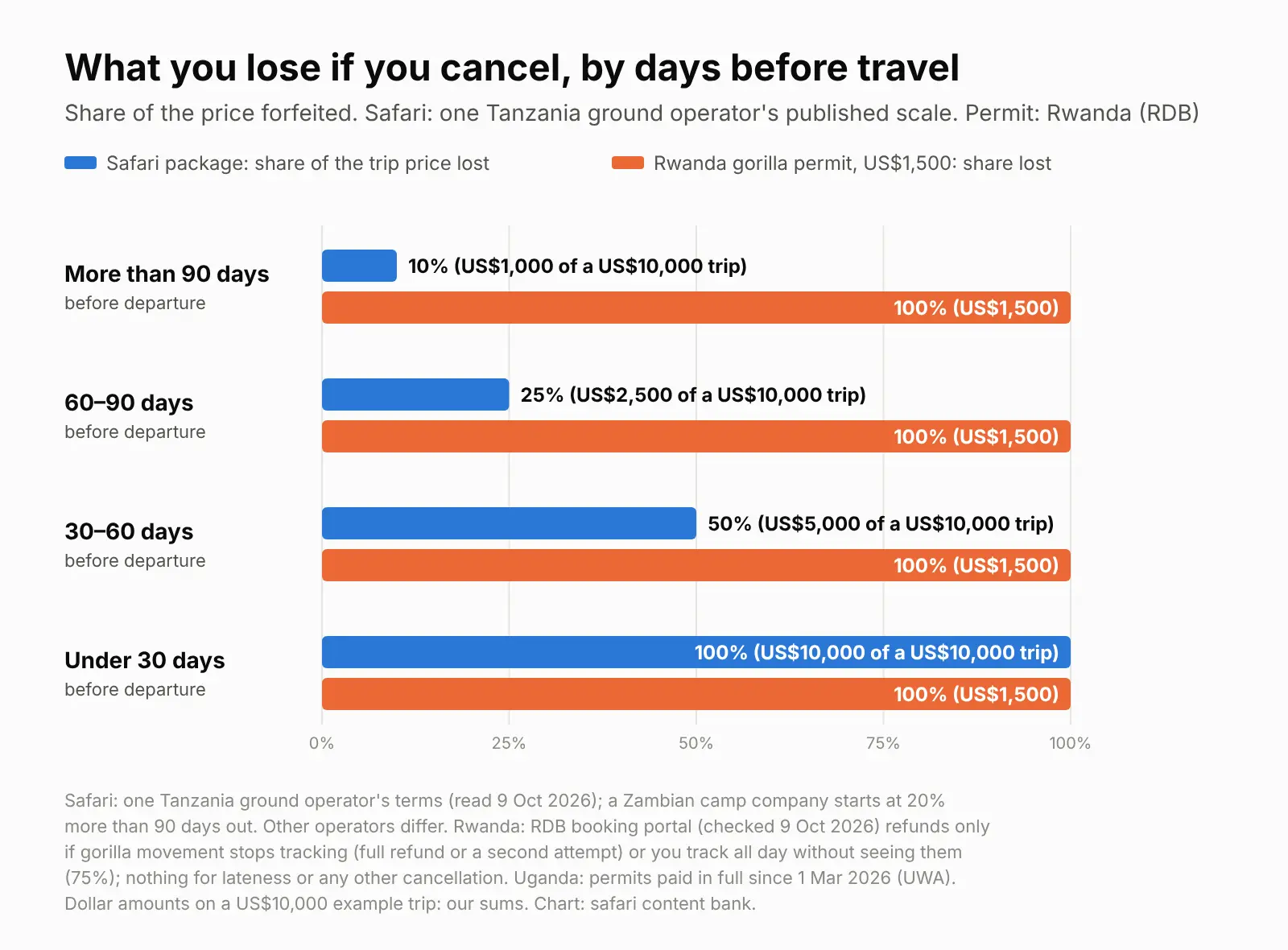
A safari is paid early and lost fast: deposits of 25–30% are typical, and one Tanzania ground operator keeps 100% of the trip price inside 30 days. Cancellation cover only helps if it starts when you pay, and if its limit matches what you stand to lose.
| Days before departure | Share of the trip price lost (one Tanzania ground operator) | On a US$10,000 trip (our sums) |
|---|---|---|
| More than 90 | 10% | US$1,000 |
| 60–90 | 25% | US$2,500 |
| 30–60 | 50% | US$5,000 |
| Under 30 | 100% | US$10,000 |
Published terms of one Tanzania ground operator, read 9 October 2026; a Zambian camp company’s scale starts at 20% more than 90 days out and reaches 100% within 30 days. Read your own operator’s scale.
- The UK government says to get travel insurance as soon as you book and to check that it covers your destinations, trip length and planned activities (GOV.UK, foreign travel checklist).
- Migration-season camps sell out 12–18 months ahead (one safari operator), so the money is at risk for longer than on most holidays.
- The same operator’s terms keep the right to pass on new park fees, taxes or exchange-rate changes, and give no refunds for services missed during the trip. Read your operator’s terms for these clauses; they are not insurance questions.
 Sources: one Tanzania ground operator’s terms (read 9 Oct 2026); RDB booking portal (checked 9 Oct 2026); UWA letter of 26 Feb 2026. Dollar amounts: our sums. Chart: safari content bank.
Gorilla permits
A gorilla permit is the single most expensive non-refundable item on most East African trips: US$1,500 in Rwanda, US$800 in Uganda (US$600 in April, May and November). Check that your cancellation cover names permits, or pre-paid excursions, and covers their full price. Prices and rules: gorilla permit prices.
| Permit | Price (foreign non-resident) | Refund or change rules | Source |
|---|---|---|---|
| Rwanda, Volcanoes NP | US$1,500 | Full refund or a second attempt if gorilla movement prevents tracking all day; 75% if you track all day without seeing them; nothing for lateness or any other cancellation | RDB booking portal, checked 9 Oct 2026 |
| Uganda, Bwindi and Mgahinga | US$800; US$600 in April, May and November | Held only against full payment since 1 Mar 2026; late rescheduling costs 25%; tracking in a different sector costs 50%; low-season permits cannot be rescheduled | UWA tariff 2024–26; UWA letter TDO 93/04, 26 Feb 2026 |
As on our gorilla permit page, checked 9–10 October 2026.
- The minimum trekking age is 15 in both countries, so a booking for a younger child cannot be used (gorilla permit prices).
- In Uganda the permit is usually bought through a licensed tour company, so the refund chain runs through it. Check the company first: how to check a safari operator’s licence.
Activities: walking, canoeing, riding and ballooning
The UK government says to check that a policy covers every activity you may do, and that some need specialist insurance or an add-on. Safari activities are not on most lists of excluded sports, but they are not ordinary sightseeing either: ask the insurer in writing, naming the activity.
| Activity | What it involves (our pages) | Ask the insurer |
|---|---|---|
| Walking safari | On foot behind a guide; in the Serengeti and Ngorongoro with an armed ranger, in South Luangwa with an armed scout | Is a guided walk among big game, with an armed ranger, covered? |
| Canoe safari | Zambezi canoeing at Mana Pools and Lower Zambezi, mokoro in the Okavango; hippo and crocodile are the real risk; usually 12+ | Is guided canoeing on a river with hippos covered, including multi-day trips? |
| Horseback safari | Riding among big game in the Okavango and the Mara; weight caps of 90–95 kg, usually 12–14+ | Is riding covered, and at what level of experience? Is a helmet a condition? |
| Balloon flight | Dawn flight over the Serengeti or Masai Mara; weather cancels flights | Are you covered as a passenger on a commercial balloon flight? |
| Gorilla and chimpanzee trekking | Hours on steep forest trails | Is trekking covered, and at what altitude? |
| Light-aircraft transfers | Scheduled and charter bush flights to camp airstrips | Are scheduled and charter light-aircraft flights both covered? |
Activity details as on our linked pages, checked October 2026. GOV.UK names bungee jumping, jet skiing, winter sports and skydiving as activities not usually included in standard policies; it gives no list for safari activities.
Light-aircraft baggage limits
Your baggage is limited by the smallest aircraft on the route: 15 kg per person on most Kenyan bush flights and 20 kg in Botswana, hand luggage included, in a soft bag. That changes what you carry, and so what you might claim for.
| Carrier or region | Allowance per person | Bag | Source |
|---|---|---|---|
| Safarilink (Kenya) | 15 kg incl. hand baggage; 20 kg on coast and Zanzibar routes | Soft bags requested | Safari packing list |
| AirKenya | 15 kg incl. 5 kg hand luggage | Soft-sided required | Safari packing list |
| Botswana camp airlines (Mack Air, Moremi Air, Wilderness Air and others) | 20 kg incl. hand luggage | Soft; Moremi Air refuses hard cases | Botswana bush flights |
Carriers’ baggage pages, read 9 October 2026, as on our linked pages.
- Camera gear counts towards the limit at Ker & Downey and Kwando in Botswana, so the valuable items travel in the soft bag or on your lap. Check your policy’s single-item limit against the camera and lenses.
- A bag that is refused stays behind. In Botswana, “a refused bag stays in Maun” (Botswana bush flights); Kwando charges 50% of the seat rate for up to 15 kg extra.
- Bush flights have their own cancellation charges: Moremi Air charges 25% within 7 days of the flight, 50% within 48 hours and 100% within 24 hours (Kwando 2024). Check that cancellation cover includes separately booked flights.
Evacuation memberships vs travel insurance
An evacuation membership pays for the flight, not the treatment or the cancelled trip; travel insurance pays for treatment, cancellation and baggage, and may or may not include the flight. Read what each layer does before you assume one replaces another.
| Layer | What it pays for | What it does not | Typical price per person |
|---|---|---|---|
| Government policy (Tanzania, Kenya) | Emergency treatment, evacuation, repatriation; Tanzania adds lost luggage | Cancellation; your own policy is not accepted in its place | Tanzania US$44; Kenya up to US$44 (eCitizen) |
| Regional flying-doctor membership (East Africa) | Evacuation flights to Nairobi during the cover period, a medical helpline, ground ambulance in Kenya (one service’s tourist plan) | Hospital bills, unless you buy a higher tier; the flight home; cancellation | US$16–80 for 15–30 days |
| Global evacuation membership | Medical transport, in some plans to a hospital at home; some add field rescue or security | Hospital bills and cancellation; some plans start only after you are admitted to hospital | US$99–255 short-term; US$249–349 a year |
| Comprehensive travel insurance | Treatment, evacuation (check the limit), cancellation, baggage | Exclusions in the wording: undeclared conditions, unlisted activities, travel against official advice | 4–8% of the trip price (NAIC) |
Membership prices: published prices of one East African flying-doctor service (May 2026) and of four global evacuation companies (read 24 October 2026); company names in our editor notes. Travel-insurance range: National Association of Insurance Commissioners (NAIC), US. We do not recommend any company.
- Kenya’s government policy is not replaced by a flying-doctor membership, and the membership is not replaced by it: they cover different things (Kenya visitor insurance).
- The East African flying-doctor service sells a cheaper rate to members of Kenya’s, Tanzania’s and Uganda’s operator associations (KATO, TATO and AUTO). Ask your operator whether a membership is already in the trip price, which countries it covers and to which hospital it flies.
What does safari insurance cost?
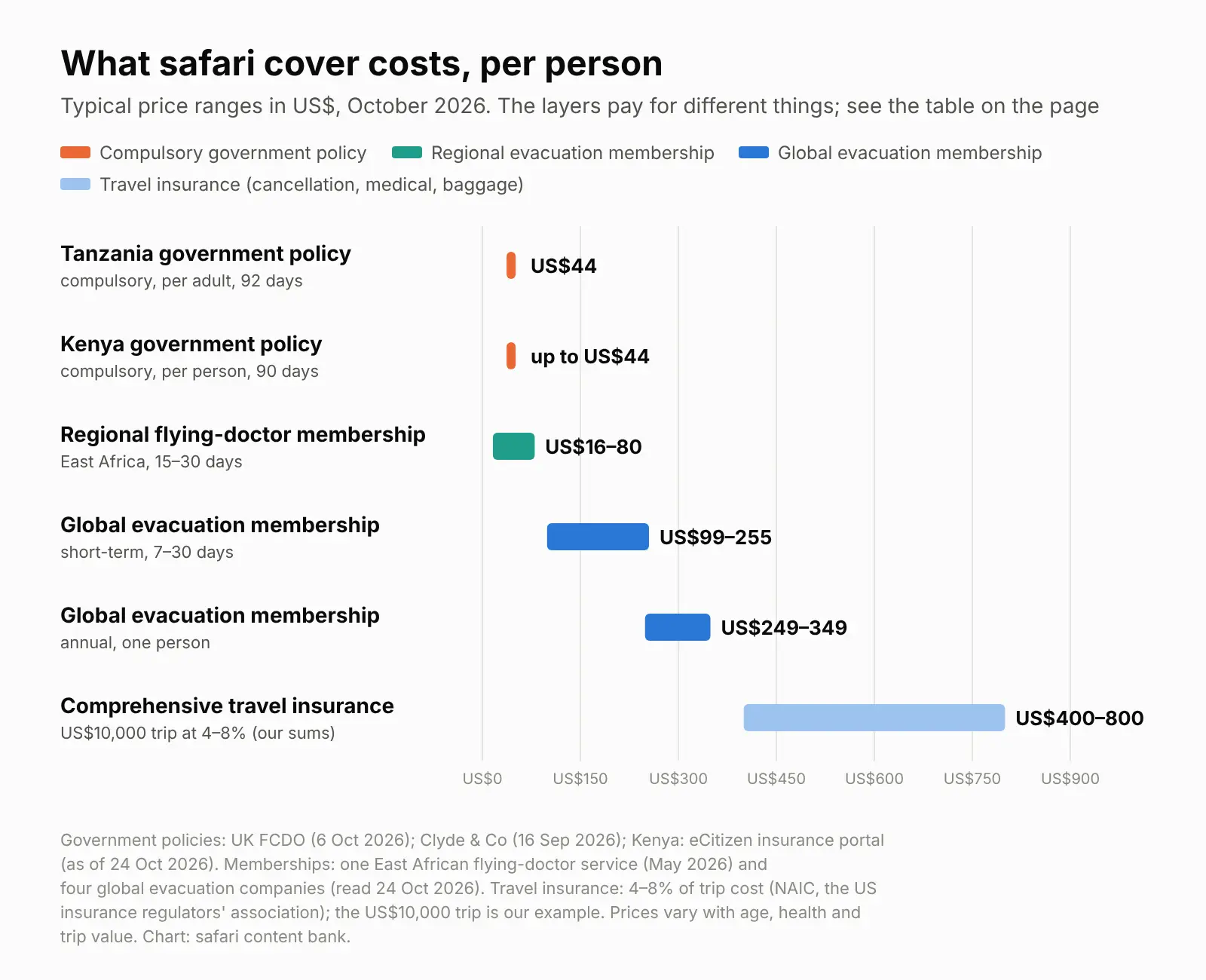
The compulsory policies are cheap (US$44 in Tanzania, up to US$44 in Kenya); the cover that protects the trip price is not. The US insurance regulators’ association, NAIC, says travel insurance usually costs 4–8% of the total trip price, so US$400–800 on a US$10,000 safari (our sums).
| Item | Typical price | Source |
|---|---|---|
| Tanzania government policy | US$44 per adult, 92 days | UK FCDO; Clyde & Co |
| Kenya government policy | Up to US$44 premium; trade test purchases came to about US$48 with a US$1 access fee and a payment fee (as of 24 Oct 2026) | eCitizen; trade reports |
| Both, for a Kenya and Tanzania trip | Up to US$88 per person, plus fees (our sum) | Our Kenya and Tanzania pages |
| Regional flying-doctor membership | US$16–80, 15–30 days | One service’s published prices, May 2026 |
| Global evacuation membership | US$99–255 short-term; US$249–349 a year | Four companies’ published prices, read 24 Oct 2026 |
| Comprehensive travel insurance | 4–8% of the trip price | NAIC |
Price ranges are unnamed; we name no insurer or membership company. The price you are quoted depends on age, health, home country, trip value and the cover chosen. UK consumer research by Which? found that declaring a medical condition can raise a premium sharply (2025–26).
 Sources: UK FCDO (6 Oct 2026); Clyde & Co (16 Sep 2026); Kenya’s eCitizen insurance portal (as of 24 Oct 2026); one East African flying-doctor service (May 2026); four global evacuation companies (read 24 Oct 2026); NAIC. Chart: safari content bank.
For the whole trip budget, insurance included, see safari cost per day by country.
Which cover fits which trip?
What to check depends on how remote the trip is, how much is paid in advance and what you will do. This is a checklist by trip type, not a recommendation of any policy.
| Your trip | Check first | Also check |
|---|---|---|
| Kenya and Tanzania road safari | Both government policies, bought on the official portals | Your own medical and evacuation limits; cancellation for the deposit |
| Fly-in safari (Botswana, Zambia, Kenya conservancies) | Evacuation by air from a remote airstrip, and the flight home | Separately booked bush flights in the cancellation cover; 15–20 kg bags |
| Gorilla trekking (Rwanda, Uganda) | Cancellation cover that names permits, for their full price | Trekking and altitude; the operator who holds a Uganda permit |
| Walking, canoe or riding safari | The activity named in writing | Weight and age limits set by the camp; evacuation from the bush |
| Migration season, booked a year ahead | Cover bought when you pay the deposit | The operator’s cancellation scale against the cancellation limit |
| Older travellers or a medical condition | Every condition declared | Specialist insurers; a travel clinic for the health questions |
Common mistakes about safari insurance
| What you’ll often read | What is correct |
|---|---|
| “Tanzania’s US$44 policy is all the insurance you need” | It is a minimum: no cancellation cover and no published benefit limits (Tanzania visitor insurance). |
| “My own travel insurance covers Kenya’s and Tanzania’s rules” | Neither country accepts it in place of its own policy as of October 2026. |
| “An evacuation membership is the same as travel insurance” | A membership pays for the flight; it does not pay hospital bills or a cancelled trip, and some plans start only after admission to hospital. |
| “Evacuation is included, so I’m covered home” | Check both legs (airstrip to hospital, hospital to home) and the limit: a flight home can cost US$20,000–200,000 (US State Department). |
| “A gorilla permit is refunded if I cancel” | Rwanda refunds nothing for any other cancellation; Uganda’s low-season permits cannot be rescheduled. |
| “Buy insurance a week before you fly” | Cancellation cover starts when you buy it; GOV.UK says to get insurance as soon as you book. |
| “Every activity on safari is covered” | GOV.UK says some activities need an add-on; ask about walking, canoeing, riding and ballooning by name. |
| “My 23 kg airline allowance applies all the way to camp” | Bush flights allow 15 kg in Kenya and 20 kg in Botswana, hand luggage included. |
Frequently asked questions
Do I need travel insurance for a safari? For Tanzania and Kenya, the government policies are compulsory: US$44 per adult in Tanzania, and up to US$44 in Kenya (eCitizen), as of October 2026. No other safari country on our pages requires insurance, but the US State Department strongly recommends evacuation cover where medical care is limited, and an air-ambulance flight home costs US$20,000–200,000.
Is my own travel insurance accepted for Tanzania or Kenya? No. The UK FCDO says Tanzania’s policy is needed “even if” you already have your own (updated 20 Oct 2026), and Kenya does not accept your own policy in place of its government one under the current guidance. Keep your own policy as well, for cancellation and for anything above the government policies’ cover. Details: Tanzania visitor insurance and Kenya visitor insurance.
Does travel insurance cover medical evacuation from a safari camp? Many policies include it, but check the wording: whether it covers an air evacuation from a remote airstrip, the flight home, and the limit. The UK government says emergency transport is often charged separately from other medical costs, and the US State Department says most plans do not pay for an air ambulance home.
What is the difference between an evacuation membership and travel insurance? A membership pays for medical transport: in East Africa, regional flying-doctor plans fly you to Nairobi for US$16–80 per 15–30 days. It does not pay hospital bills (except on higher tiers) or a cancelled trip. Travel insurance covers treatment, cancellation and baggage, and may include evacuation up to a limit.
Are gorilla permits covered by cancellation insurance? Only if your policy covers pre-paid, non-refundable items for their full price, so check. Rwanda’s US$1,500 permit is refunded only if gorilla movement stops tracking or you see no gorillas after tracking all day; Uganda’s US$800 permit is paid in full at booking, and low-season permits cannot be rescheduled. See gorilla permit prices.
Does travel insurance cover walking, canoe or horseback safaris? Ask the insurer in writing, naming the activity. The UK government says to check that a policy covers every activity you plan, and that some need specialist cover or an add-on. Walks in the Serengeti go with an armed ranger, Zambezi canoe trips pass hippos, and riding camps cap riders at 90–95 kg.
How much does safari travel insurance cost? NAIC, the US insurance regulators’ association, puts travel insurance at 4–8% of the trip price, so US$400–800 on a US$10,000 safari (our sums). Add US$44 for Tanzania’s government policy and up to US$44 for Kenya’s. Global evacuation memberships run US$99–255 short-term or US$249–349 a year.
When should I buy safari insurance? When you pay the deposit. GOV.UK says to get travel insurance as soon as you book, and cancellation cover only protects money paid after the policy starts. Buy Tanzania’s and Kenya’s government policies before you fly, on the official portals.
Sources
- US State Department: Medicine and Health (air ambulance US$20,000–200,000; Medicare abroad) and Travel Insurance, read through web searches 24 Oct 2026
- UK government: Foreign travel insurance, Foreign travel checklist and In hospital abroad, read through web searches 24 Oct 2026
- National Association of Insurance Commissioners (NAIC), Travel insurance (4–8% of trip cost), read 24 Oct 2026
- Compulsory insurance, as on our pages (status 10 Oct 2026): UK FCDO, Tanzania entry requirements (6 Oct 2026; updated 20 Oct 2026); Clyde & Co, Introduction of inbound travel insurance (16 Sep 2026); U.S. Embassy Nairobi, Kenya health insurance notice; Kenya’s eCitizen insurance portal; VisasNews, 7 Oct 2026 (trade report); TravelDailyNews, 5 Aug 2026 (Kenya minimum cover, trade press)
- Gorilla permits, as on our gorilla permit page: RDB booking portal (checked 9 Oct 2026); Visit Rwanda; UWA letter TDO 93/04 (PDF), 26 Feb 2026
- Bush-flight baggage: Safarilink and AirKenya, read 9 Oct 2026; Botswana carriers as on our Botswana bush flights page
- Membership prices and cancellation scales: published prices of one East African flying-doctor service (May 2026) and four global evacuation companies (read 24 Oct 2026); one Tanzania ground operator’s and one Zambian camp company’s published terms (read 9 Oct 2026). Names and links in our editor notes.
- Which?, consumer research on travel insurance and medical conditions (2025–26)
Compulsory-insurance and permit rules checked 10 October 2026; government guidance and price ranges read 24 October 2026. This page is not financial or medical advice. We will update it when Kenya publishes an official insurance price, when Tanzania publishes benefit limits or a mainland child rate, and when either rule changes.
| Fee | Amount | In force from | Source |
|---|---|---|---|
| Uganda: gorilla tracking permit, Bwindi Impenetrable and Mgahinga Gorilla NPs, foreign non-resident, per person per trek (guide and that day's park entry included) | USD 800 (foreign resident USD 700; rest of Africa USD 500; East African citizens UGX 300,000) | Since 1 Jul 2024 (UWA tariff 2024–26); confirmed unchanged from 1 Jan 2027 by UWA letter TDO 93/04 of 26 Feb 2026 | UWA letter TDO 93/04, 26 Feb 2026 |
| Uganda: gorilla tracking permit in April, May and November (low season), foreign non-resident, per person per trek; cannot be rescheduled | USD 600 (foreign resident USD 500) | Immediate effect from the UWA letter of 26 Feb 2026 | UWA letter TDO 93/04, 26 Feb 2026 |
| Rwanda: mountain gorilla tracking permit, Volcanoes NP, international visitor, per person per day | USD 1,500 | Current RDB price, checked 9 Oct 2026 | Visit Rwanda (Rwanda Development Board) |