 Experience

Last verified · Next check due
On this page
- Etosha vs Kruger at a glance (2026)
- Park fees: Etosha vs Kruger
- Gate times: how long you can drive each day
- Rest camps and booking windows
- Roads, car hire and distances
- Waterholes vs the road network: how you find game
- When to go: seasons in each park
- Malaria: neither park is malaria-free
- Entry, flights and combining the two
- Which should you choose?
- Common mistakes in Etosha vs Kruger comparisons
- Frequently asked questions
- Sources
Short answer: Both parks can be self-driven in an ordinary car in the dry season. Choose Kruger (South Africa) for all of the Big Five and a short drive from Johannesburg (411–600 km to the gates); it charges R692 per international adult a day from 1 November 2026 (R602 until 31 October 2026). Choose Etosha (Namibia) for game gathered at waterholes from May to October; it charges N$280 per foreign adult plus N$60 per car since 1 April 2026.
Key facts
- For two foreign adults in one car, Etosha’s fees come to N$620 per park day and Kruger’s to R1,384 a day from 1 November 2026 (R1,204 until 31 October 2026) (our sums). Government Notice 115 of 2026 states no time period for the Etosha fee, so we count one fee per park day, as MEFT’s 2021 schedule did. The Namibian dollar (N$) is pegged 1:1 to the rand (one safari operator’s money FAQ).
- Neither park needs a 4x4 in the dry season. All access roads to Kruger’s 9 entrance gates are tarred (SANParks). Windhoek to Etosha’s Okaukuejo camp is 414–435 km on tar; inside, Etosha’s main roads are gravel, fine in a 2WD car in the dry season, with a 4x4 recommended in the wet season and needed for Dolomite Camp (a safari agent’s Etosha self-drive guide).
- Etosha has four of the Big Five; Kruger has all five. Cape buffalo are kept out of Etosha by veterinary policy (a safari agent’s guide, read 17 October 2026).
- You may not drive yourself after dark in either park. Etosha’s gates follow sunrise and sunset, and you must be in a camp or out of the park by sunset; Kruger’s entrance gates close at 17:30–18:30, by month, and private cars may not drive at night (SANParks).
- Neither park is malaria-free. SANParks puts Kruger’s highest risk in November–April; for Etosha, Swiss TPH says not to treat it as malaria-free, and in 2026 extended its advice to cover June–August in Namibia’s seasonal-risk regions.
- SANParks opens Kruger’s camps 11–12 months ahead; forum regulars advise booking Etosha’s state camps 6–12 months ahead for July–September. Day entry to Etosha needs no booking; you pay at the gate.
Etosha vs Kruger at a glance (2026)
Kruger is the Big Five park with tarred access, a large camp network and a short drive from Johannesburg; Etosha is the waterhole park, cheaper at the gate for a couple with a car, at the end of a 414–435 km drive from Windhoek.
| Etosha National Park (Namibia) | Kruger National Park (South Africa) | Source | |
|---|---|---|---|
| Run by | Ministry of Environment, Forestry and Tourism (MEFT); camps by Namibia Wildlife Resorts (NWR), the state company | South African National Parks (SANParks) | Etosha; Kruger |
| Park fee, foreign adult | N$280 per person since 1 Apr 2026, plus N$60 per car; no time period stated | R692 per day (R602 until 31 Oct 2026); no car fee in the schedules | GN 115 of 2026 (PDF); SANParks 2026/27 (PDF) |
| Two adults and a car, one day | N$620, one fee per park day (our sum) | R1,384 (R1,204 until 31 Oct 2026; our sums) | Etosha park fees; Kruger park fees |
| Gates | Sunrise to sunset; Okaukuejo opens 06:10–07:30 and closes 18:25–19:40, by month | Entrance gates open 05:30 or 06:00 and close 17:30–18:30, by month | A safari agent’s guide, read 9 October 2026; SANParks gates |
| Drive from the gateway city | Windhoek → Okaukuejo 414–435 km, tar, 4–6 h | Johannesburg → 411 km (Numbi Gate) to 600 km (Pafuri Gate) | Namibia self-drive distances; Kruger self-drive |
| Roads inside | Gravel; 60 km/h, 40 km/h near waterholes | Tar and gravel; 50 km/h on tar, 40 km/h on gravel | A safari agent’s Etosha self-drive guide; SANParks rules |
| Camps inside | 6 NWR camps: Okaukuejo, Halali, Namutoni, Onkoshi, Dolomite, Olifantsrus | 12 main rest camps, 4 satellite camps, 5 bushveld camps | Etosha; SANParks camps |
| Cheapest bed inside | Camping N$460–560 per person a night (NWR 2026–27) | Campsite R484–508 per site a night (Oct 2026) | NWR rates via a booking agent’s listing, read 9 October 2026; SANParks Kruger |
| How you find game | Wait at waterholes, most perennial ones fed by boreholes | Drive the road network across nearly 2 million hectares | MEFT, Etosha Management Plan (PDF); Kruger |
| Big Five | Four (no buffalo) | All five | A safari agent’s guide, read 9 October 2026; Kruger |
| Best months | May–October; peak September–October | April–September, the dry season | Etosha; SANParks climate |
| Malaria | Not malaria-free (Swiss TPH) | Risk area; highest November–April (SANParks) | Safari malaria risk |
| Rhino in the country, end of 2024 | Namibia 3,598 | South Africa 14,389 | IUCN SSC African Rhino Specialist Group report to CITES, 2025 |
Fees as on our Etosha park fees and Kruger park fees pages: Government Notice 115 of 2026 re-read 9 October 2026, SANParks schedules read 9 October 2026. Camp rates and gate times as on our Etosha and Kruger self-drive pages, read September–October 2026; NWR rates are published by booking agents, not by NWR itself. Checked against those pages 17 October 2026. We print each price in its own currency; N$ and rand are pegged 1:1, and we convert neither into US dollars or euros.
Park fees: Etosha vs Kruger
At the gate Etosha costs a couple with a car about half what Kruger does: N$620 a park day against R1,384 a day from 1 November 2026 (R1,204 until 31 October 2026) (our sums). Etosha charges per person and per car; Kruger charges per person per day and nothing for the car.
| Etosha (MEFT, Government Notice 115 of 2026) | Kruger (SANParks) | |
|---|---|---|
| Foreign adult | N$280 (N$140 park entrance + N$140 conservation fee), since 1 Apr 2026; was N$150 | R692 per day (1 Nov 2026–31 Oct 2027; R602 until 31 Oct 2026) |
| Foreign child | N$180 aged 9–15; under 9 free | R345 aged 2–11 (R300 until 31 Oct 2026); under 2 free |
| Car | N$60 per vehicle up to 10 seats | No vehicle charge in the schedules |
| Period | The notice prices fees per person and states no period; MEFT’s 2021 schedule charged per park day | Per person per day |
| In the camp rate? | No: NWR rates exclude park fees, paid at the gate | No: charged on top of SANParks accommodation, plus a 1% community fund |
| Multi-day pass | None in our sources | International Wild Card: previous price R7,310 a couple (cards bought 1 Nov 2025–31 Oct 2026); at last season’s prices it paid off after about 6 days for two at R602; 2026/27 price not published when we checked on 1 November 2026 |
| 2 adults + car, 3 days | N$1,860 | R4,152 (R3,612 until 31 Oct 2026) |
Sources: Government Gazette 8877 (Government Notice 115 of 2026), PDF, hosted by the Legal Assistance Centre; SANParks daily conservation fees 2025/26 (PDF) and 2026/27 (PDF); SANParks Wild Card. Read 9 October 2026; Kruger fees and the Wild Card checked 1 November 2026. The 3-day rows are our arithmetic.
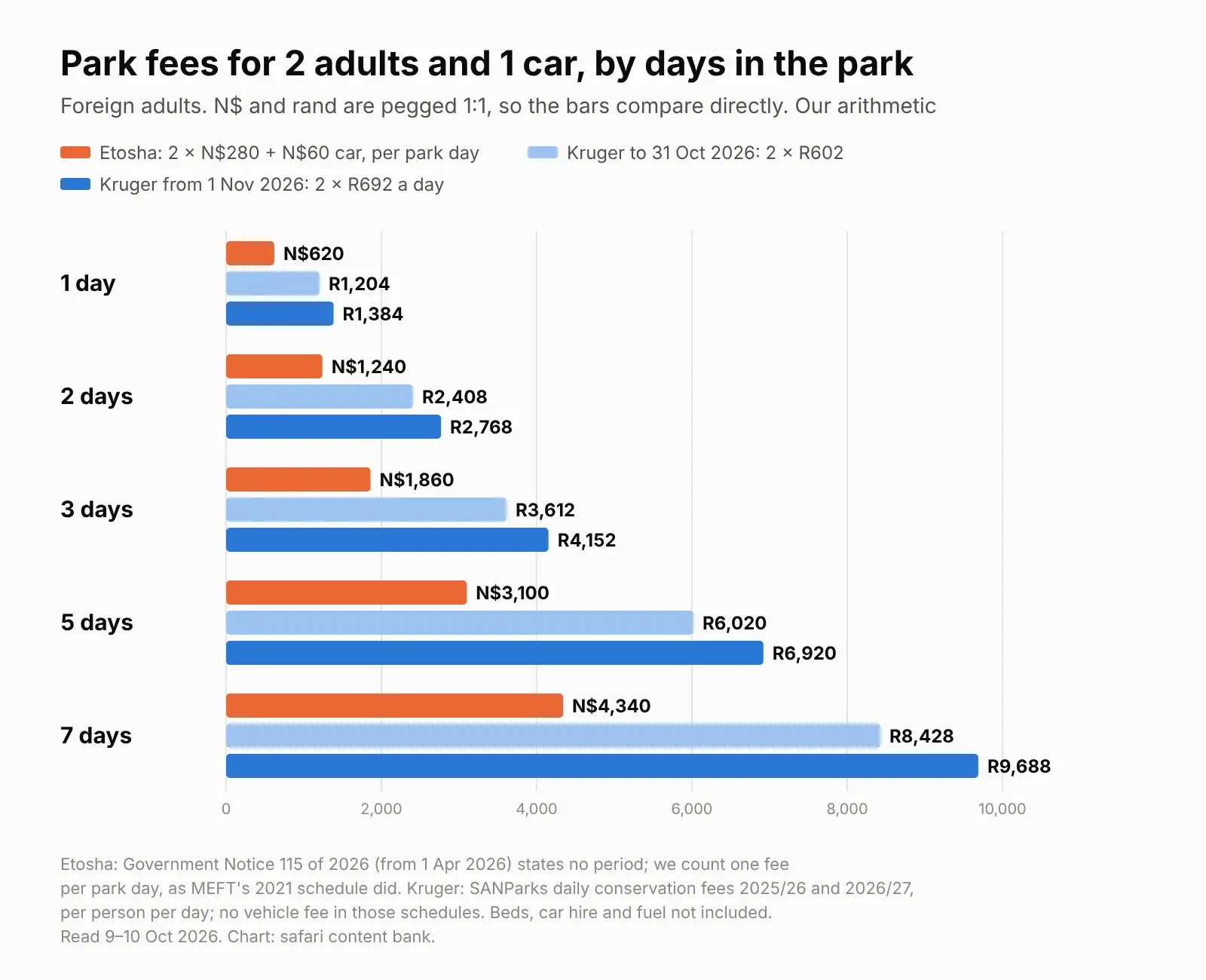 Our arithmetic. Sources: Government Notice 115 of 2026 (Etosha, from 1 April 2026; one fee per park day, as MEFT’s 2021 schedule did); SANParks daily conservation fees 2025/26 and 2026/27. Read 9–10 October 2026. Chart: safari content bank.
- Kruger’s fee changed on 1 November 2026; Etosha’s changed on 1 April 2026. Our sources don’t show how SANParks charges a stay that spans 1 November, so ask when you book.
- Fees are a small part of an Etosha self-drive and a large part of a Kruger one. At July–October prices, park fees are 6–11% of a self-driver’s Etosha day (Etosha safari cost); in our 7-day Kruger camping sum they are about 40% at R692 a day per adult (self-drive safari cost).
- Sleeping outside either park does not save the fee. Etosha’s day visitors pay the same N$280 and N$60 at the gate, and Kruger charges each day you enter.
The official fee lines, with the date each took effect and the source:
| Fee | Amount | In force from | Source |
|---|---|---|---|
| Tier 1 parks (Etosha, Namib-Naukluft including Sossusvlei, Skeleton Coast, Ai-Ais/Fish River Canyon, Waterberg Plateau, Cape Cross, Dorob, Tsau //Khaeb), foreign adult 16+, per person | NAD 280 (NAD 140 park entrance + NAD 140 conservation fee) | 1 Apr 2026 (Government Notice 115 of 2026; the notice prices fees per person with no period; MEFT's 2021 schedule made fees valid for 24 hours from entry); was NAD 150 under the 2021 schedule | Government Gazette 8877 (Government Notice 115 of 2026), hosted by the Legal Assistance Centre |
| Tier 1 parks, foreign child 9–15, per person (under 9 free) | NAD 180 | 1 Apr 2026 (Government Notice 115 of 2026; the notice prices fees per person with no period; MEFT's 2021 schedule made fees valid for 24 hours from entry); was NAD 100 for foreign children up to 16 under the 2021 schedule | Government Gazette 8877 (Government Notice 115 of 2026), hosted by the Legal Assistance Centre |
| Vehicle up to 10 seats, most national parks (N$50 at Sandwich Harbour), per vehicle | NAD 60 | 1 Apr 2026 (Government Notice 115 of 2026; the notice states no period; MEFT's 2021 schedule made fees valid for 24 hours from entry); was NAD 50 | Government Gazette 8877 (Government Notice 115 of 2026), hosted by the Legal Assistance Centre |
| Kruger National Park daily conservation fee, international adult (12+), per day | ZAR 602 | 1 Nov 2025 to 31 Oct 2026 (SANParks 2025/26 schedule) | SANParks daily conservation fees 2025/26 |
| Kruger National Park daily conservation fee, international adult (12+), per day | ZAR 692 | 1 Nov 2026 to 31 Oct 2027 (SANParks 2026/27 schedule, already published) | SANParks daily conservation fees 2026/27 |
| Kruger National Park daily conservation fee, international child (2–11), per day (under 2 free) | ZAR 300 | 1 Nov 2025 to 31 Oct 2026 (SANParks 2025/26 schedule) | SANParks daily conservation fees 2025/26 |
| Kruger National Park daily conservation fee, international child (2–11), per day (under 2 free) | ZAR 345 | 1 Nov 2026 to 31 Oct 2027 (SANParks 2026/27 schedule) | SANParks daily conservation fees 2026/27 |
Gate times: how long you can drive each day
Kruger’s gates open earlier, Etosha’s close later, and in mid-winter both give you about 11 to 11.5 hours in the park. Etosha’s gates follow sunrise and sunset; Kruger’s entrance gates keep fixed times that change a few times a year.
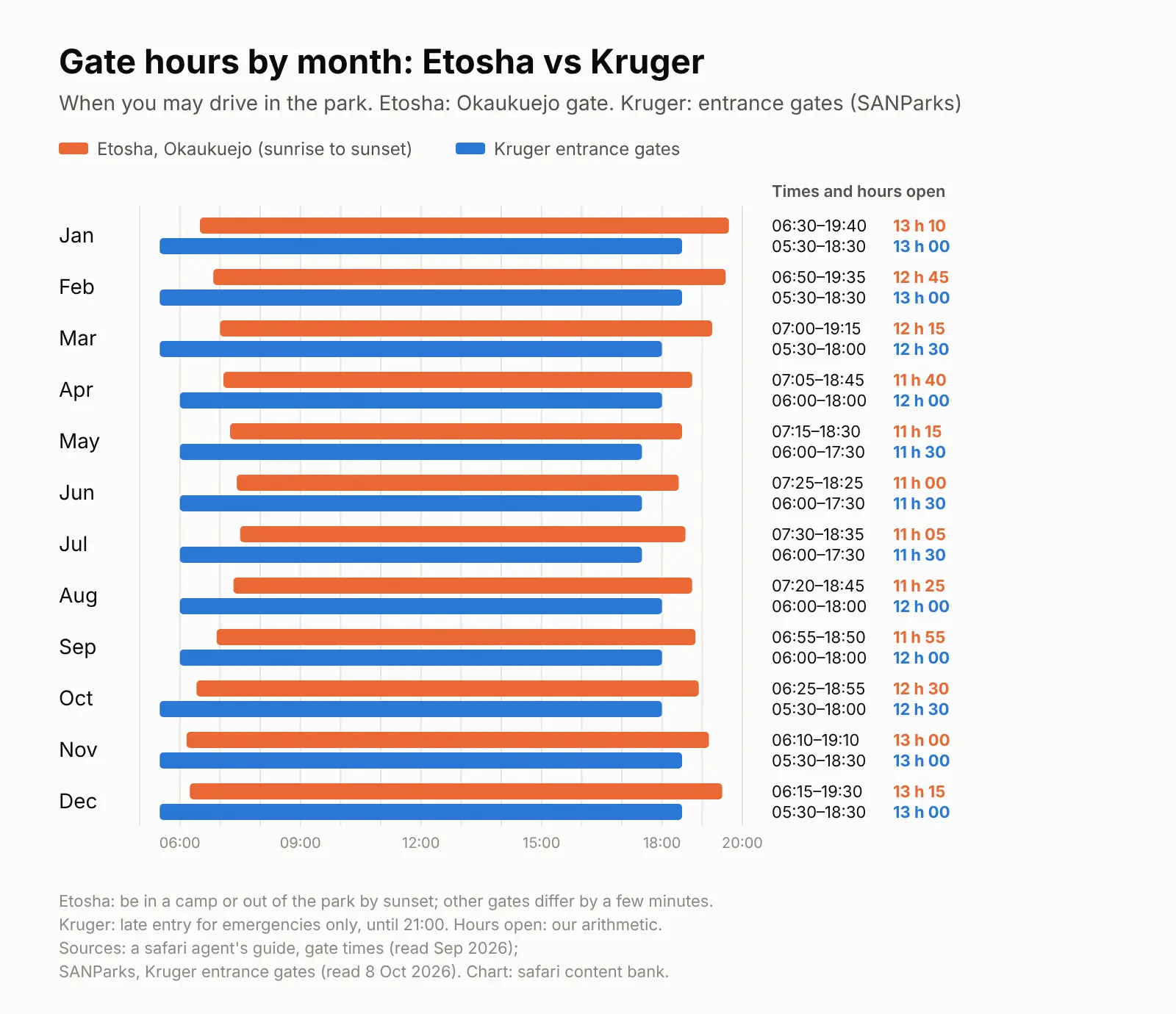 Hours open: our arithmetic. Sources: a safari agent’s guide gate times, read September 2026; SANParks, Kruger entrance gates (read 8 October 2026). Chart: safari content bank.
| Etosha | Kruger | |
|---|---|---|
| Opening | 06:10 (November) to 07:30 (July) at Okaukuejo | 05:30 (October–March) or 06:00 (April–September) |
| Closing | 18:25 (June) to 19:40 (January) at Okaukuejo | 17:30 (May–July) to 18:30 (November–February) |
| Arriving late | You must be in a camp or out of the park by sunset | Late entry for emergencies only, with proof, until 21:00; Phabeni, Phalaborwa and Pafuri admit no late arrivals |
| After dark | Only on NWR’s guided night drives, about N$620 per person; floodlit waterholes at Okaukuejo and Halali for camp guests | Only on SANParks’ guided night drives; no night driving in private cars |
Sources: a safari agent’s guide to gate times and night drives, read September 2026; SANParks entrance gates and vital information, read 8 October 2026.
- Other Etosha gates differ from Okaukuejo by a few minutes; times are posted at each gate (Etosha).
- SANParks lists “Gate Security transport currently R500 per vehicle” for permitted late arrivals (no date given) (Kruger self-drive).
Rest camps and booking windows
Book early for both: SANParks opens Kruger’s camps 11–12 months ahead, and forum regulars advise booking Etosha’s NWR camps 6–12 months ahead for July–September. Kruger has far more camps; Etosha’s are priced per person, Kruger’s per unit.
| Etosha (NWR) | Kruger (SANParks) | |
|---|---|---|
| Camps inside the park | 6: Okaukuejo, Halali and Namutoni (camping and rooms), Onkoshi and Dolomite (chalets), Olifantsrus (camping only) | 12 main rest camps, 4 satellite camps, 5 bushveld camps |
| How beds are priced | Per person, sharing | Per unit, self-catering |
| Camping | N$460–560 per person a night (Olifantsrus N$510, flat) | R484 (Punda Maria) or R508 (Pretoriuskop) per site a night (Oct 2026) |
| Room or cottage | Halali N$1,400–1,690, Okaukuejo N$1,900–2,380 per person, bed and breakfast | Skukuza 2-bed bungalow R1,964 per unit (2024/25 tariff); Mopani 6-bed cottage R3,433 per unit (Oct 2026) |
| Season | High season July–October | SANParks high season 13 Dec–15 Jan (2024/25 tariff dates) |
| When to book | 6–12 months ahead for July–September (forum regulars’ advice) | Stays to 31 Oct 2027 bookable since 13 Oct 2026 at SANParks offices and 14 Oct online; stays to 30 Nov 2027 open 1 Dec 2026 (offices) and 2 Dec 2026 (online) |
| Day visits | No booking; pay at the gate | Can be pre-booked; on busy days Kruger stops admitting day visitors once its daily limit is reached |
| Fuel and shops | Pumps and shops at Okaukuejo, Halali and Namutoni; travellers report stock-outs | All 12 main rest camps have fuel, a shop and a restaurant or cafeteria |
Sources: NWR 2026–27 rates via a booking agent’s listing (Halali, Olifantsrus), read September 2026; SANParks Kruger (live prices, 8 Oct 2026), camps, booking periods, day visits and tariffs 2024/25 (PDF); booking advice and stock-outs: TripAdvisor Etosha forum (traveller reports).
- For two people camping one night, the bed and the fees now cost a little more in Kruger: N$1,540–1,740 in Etosha (2 × N$460–560 plus N$620) and R1,892 at Kruger’s Pretoriuskop campsite (R508, the October 2026 site price, plus 2 × R692; R1,712 at the previous R602 fee), R152–352 more than in Etosha (our sums). SANParks had not published its 2026/27 accommodation tariff when we checked on 1 November 2026, so confirm the price when you book. Kruger’s per-site price favours groups; Etosha’s per-person price does not.
- Kruger’s 5 bushveld camps have no shop or restaurant (SANParks camps).
- Expect a scramble when a SANParks window opens. One TripAdvisor poster (thread to 15 July 2026) got through on the phone line after about five hours; that is a traveller report, not a SANParks figure (Kruger self-drive).
- Etosha’s camps sit about 70 km apart: Okaukuejo to Halali takes about 1 h 45 and Halali to Namutoni about 2 h at game-viewing pace (Namibia self-drive distances).
Roads, car hire and distances
Kruger is the shorter, simpler drive: tar to every gate, 411–600 km from Johannesburg, and an ordinary car is enough. Etosha is 414–435 km of tar from Windhoek, then gravel park roads that a 2WD car handles in the dry season.
| Etosha | Kruger | Source | |
|---|---|---|---|
| From the gateway city | Windhoek → Okaukuejo (Andersson Gate) 414–435 km, 4–6 h; Windhoek → Namutoni (east) 533 km | Johannesburg → Numbi 411 km, Malelane 428 km, Paul Kruger 460–470 km, Orpen 490 km, Pafuri 600 km | Namibia self-drive distances; SANParks gates |
| Road to the park | Tar the whole way | All access roads to the 9 entrance gates tarred | same; SANParks vital information |
| Roads inside | Gravel; 60 km/h on main roads, 40 km/h near waterholes | Tar and gravel; 50 km/h on tar, 40 km/h on gravel | A safari agent’s Etosha self-drive guide; SANParks |
| Size of the drive | Okaukuejo → Namutoni about 140 km, about 3 h 15 | About 360 km north to south: at least 7 h 12 at 50 km/h with no stops (our arithmetic) | A safari agent’s Etosha map; Wikipedia |
| Vehicle needed | 2WD on the main roads in the dry season; 4x4 recommended in the wet season and needed for Dolomite Camp | 2WD; a 4x4 only for SANParks’ own 4x4 trails | A safari agent’s Etosha self-drive guide; Kruger self-drive |
| Published car hire, per vehicle per day | Rooftop-tent 4x4 N$2,910–3,880 (Namibia2Go, 2026, zero excess included); 4x4 without camping kit N$1,475–2,200 (a Namibia travel company’s 2026 guide) | Britz 4x4 from ZAR 1,360; camp-ready from ZAR 1,610, minimum 5 days (rate year not shown); no 2WD rate in our sources | Namibia2Go; Britz terms (PDF) |
| Fuel | Diesel N$27.86 a litre at Walvis Bay from 2 Sep 2026; inland pumps charge more | No published price in our sources | The Brief |
Distances read 3 September–9 October 2026 from SANParks, Stingy Nomads, a safari booking site, uyaphi and the Etosha map, as listed on our distances and Kruger self-drive pages. Rental prices read September–October 2026, as on our self-drive safari cost page.
- Namibia’s car hire is the big line. A rooftop-tent 4x4 costs N$2,910 a day from November to June and N$3,880 from July to October (Namibia2Go 2026), and the standard rental excess is N$40,000–55,000 unless you pay to reduce it (Namibia safari cost).
- Diesel from Windhoek to Okaukuejo costs about N$1,269–1,333 one way at 11 litres per 100 km (our sum, as on Etosha safari cost).
- No 2WD hire rate for South Africa, and no South African fuel or toll price, is published in our sources. We print none. The N4 to Kruger’s southern gates is a toll road.
- Allow for the drive out. Kruger’s gates are 411–600 km from Johannesburg, so don’t book a tight international flight on the day you leave.
Waterholes vs the road network: how you find game
In Etosha you park at a waterhole and wait; in Kruger you drive a road network through a park nearly 2 million hectares in size, and you get all of the Big Five.
| Etosha | Kruger | Source | |
|---|---|---|---|
| Where the game is | At waterholes along the southern and eastern edge of the Etosha Pan, a 4,760 km² salt flat; most perennial waterholes are fed by boreholes | Along the road network of a park about 360 km long and nearly 2 million hectares in size | Etosha; MEFT, Etosha Management Plan, 2007 (PDF); Kruger |
| How you watch | Park at a waterhole; wildlife typically arrives after 20–40 minutes (one tour seller’s waterhole guide) | Drive slowly at 40–50 km/h; leave the car only at designated spots | Etosha; SANParks rules |
| Big Five | Four: lion, leopard, elephant, rhino; no Cape buffalo | All five | A safari agent’s guide, read September 2026 |
| Sighting ratings | Elephant, zebra, wildebeest abundant; lion occasional; leopard and cheetah very rare (a safari booking site’s ratings) | No sighting statistics in our sources | Etosha |
| Rhino in the country, end of 2024 | Namibia 3,598 (2,098 black, 1,500 white) | South Africa 14,389 (2,307 black, 12,082 white) | IUCN SSC African Rhino Specialist Group report to CITES, 2025 |
| At night | Floodlit waterholes at Okaukuejo and Halali for guests sleeping inside; a two-storey hide at Olifantsrus | SANParks guided night drives from the camps | Etosha; SANParks activities |
| On foot | No walking inside the park | Only with SANParks: a morning walk was R726 per adult (2024/25 tariff) | Etosha; Kruger vs private reserves |
| Visitors | Not published for the park in our sources | A record 1.7 million in 2025 | EB News Daily, 3 Apr 2026 |
Etosha sighting ratings read September 2026. Rhino counts as on our Namibia or South Africa page. We publish national rhino counts only, never where individual rhino are.
- Etosha’s waterholes are named by camp: Okondeka, Nebrownii and Olifantsbad near Okaukuejo; Goas and Salvadora near Halali; Chudob and Klein Namutoni near Namutoni (a safari agent’s Etosha map).
- Etosha is fully fenced and has no migration (a safari agent’s guide, read 17 October 2026).
- Both parks have private land next door with different rules. Reserves on Etosha’s boundary, such as Ongava and Onguma, offer night drives, guided walks and rhino tracking (one operator’s Etosha guide); Kruger’s western private reserves take lodge guests on lodge vehicles only, with no self-drive game viewing (Kruger vs private reserves).
When to go: seasons in each park
Both are dry-season parks, but the months differ: May–October in Etosha, peaking in September and October, and April–September in Kruger. Etosha’s camps charge high-season rates from July to October; Kruger’s fee has no seasons.
| Etosha | Kruger | Source | |
|---|---|---|---|
| Rains | About November–April; 80–140 mm a month at Tsumeb in January–March | About October–March | Etosha; Kruger |
| Best months for game | May–October; peak September–October, when game gathers at the waterholes | April–September, the dry season | Etosha; SANParks climate |
| Poorest months | November–April, when game disperses to temporary pans | Not stated by SANParks; October–March is hot, wet and green | Etosha; SANParks |
| Heat and cold | Tsumeb averages 33 °C highs in October and 8 °C lows in June–July | Safari tents at about 5 °C on winter nights (a July 2026 traveller report) | Climates to Travel; TripAdvisor |
| Price season | NWR high season July–October: Okaukuejo room N$1,900 low against N$2,380 high | SANParks high season 13 Dec–15 Jan (2024/25 tariff); the fee rises by date (1 Nov), not by season | NWR via a booking agent’s listing, read September–October 2026; Kruger safari cost |
| Busiest | Not published for the park in our sources | South African school holidays fill the southern camps (traveller reports) | Kruger self-drive |
Typical year, not a forecast. Read September–October 2026.
- May and June are Etosha’s value months: NWR and the rental firms are still on low-season rates, and game is already returning to the waterholes (Etosha safari cost).
- Most of Kruger’s dry season falls outside SANParks’ November–April malaria peak, though April is inside it and SANParks exempts no month.
Malaria: neither park is malaria-free
Both parks lie in malaria-risk areas; the malaria-free alternatives are Namibia’s coast, Sossusvlei and south, and South Africa’s North West and Eastern Cape reserves.
| Area | What the source says | Source (read 8–10 Oct 2026) |
|---|---|---|
| Etosha | At the edge of the seasonal zone; do not treat it as malaria-free. In 2026 advice was extended to cover June–August in Namibia’s seasonal-risk regions | HealthyTravel / Swiss TPH, Namibia |
| Northern Namibia | Six regions, Oshikoto and Otjozondjupa among them, November–June; along the Kunene, Zambezi and Okavango rivers all year | WHO country list 2022 (PDF) |
| Kruger | Risk area; highest November–April, “generally low, even in summer”; tablets advised after you see a doctor. UK TravelHealthPro recommends tablets September–May | SANParks, Kruger malaria; TravelHealthPro, South Africa |
| Malaria-free alternatives | Namibia: no risk listed for the coast, Sossusvlei or the south (WHO). South Africa: Madikwe, Pilanesberg, the Waterberg and the Eastern Cape reserves rated no risk (TravelHealthPro) | Safari malaria risk; Malaria-free safaris |
This is what the sources say, not medical advice: whether you need tablets, and which, is a question for a travel clinic.
- A dry-season trip to Etosha in 2026 was not outside the advice, because Swiss TPH extended its seasonal advice to June–August 2026 (Safari malaria risk).
- Malaria-free is not cheaper at the gate in South Africa: Pilanesberg charges R748 per foreign adult a day plus R168 per vehicle, more than Kruger (Malaria-free safaris).
Entry, flights and combining the two
Namibia needs a visa from UK, US and German visitors and South Africa does not, and the two parks are linked by several daily Johannesburg–Windhoek flights.
| Etosha (Namibia) | Kruger (South Africa) | Source | |
|---|---|---|---|
| Visa, UK, US and German citizens | Required since 1 April 2025: N$1,600 on arrival for travellers 12 and over, N$800 aged 6–11 | None for UK and US passports for up to 90 days; online traveller declaration for every arrival since 1 July 2026 | Namibia visa; UK FCDO, South Africa |
| Airport | Windhoek Hosea Kutako, 40–45 km east of Windhoek | Johannesburg O.R. Tambo for the drive; Skukuza airport inside the park | Etosha; Kruger vs private reserves |
| Between the two | Airlink and SAA fly Johannesburg–Windhoek several times a day | same | Namibian flights sheet, May/June 2026 (PDF) |
| Rental car across the border | A Namibian rental needs the company’s cross-border letter: N$0 to ZAR 1,000 by company | A South African or other foreign car entering Namibia pays N$534 (Road Fund Administration, from 1 August 2026) | Namibian rental car across borders |
| Guided alternative, 3 days | Shuttle safari from Windhoek US$615–633 per person (one operator’s published price) | Shared tours from Johannesburg US$642–727 per person (operators’ published prices, 2 listings) | Etosha safari cost; Kruger safari cost |
Read September–October 2026. Package prices are operators’ published “from” prices, read 3 September (Etosha) and 8 October 2026 (Kruger); inclusions are not itemised. Airline schedules change by season.
- No road distance from Windhoek to Kruger, and no one-way cross-border drop fee, is published in our sources. The route our sources support is by air: fly Johannesburg–Windhoek and hire a car in each country.
- Passports for Namibia need 6 months’ validity and 3 blank pages (UK FCDO, as on our Namibia visa page).
Which should you choose?
Choose Kruger for the Big Five, a short trip, a first self-drive or a group sharing a cottage; choose Etosha for waterhole viewing, lower gate fees for a couple, and as part of a longer Namibian road trip.
| If you… | Pick | Why |
|---|---|---|
| Want all of the Big Five | Kruger | Etosha has no buffalo |
| Have a long weekend or a week | Kruger | Its gates are 411–600 km from Johannesburg, on tar |
| Want to sit and watch at waterholes | Etosha | Game gathers at a few waterholes from May to October; floodlit waterholes at night for camp guests |
| Are a couple watching the budget at the gate | Etosha | N$620 a park day for two and a car, against R1,384 a day in Kruger (R1,204 until 31 Oct 2026) |
| Are a group of four to six | Kruger | SANParks prices per unit: Mopani’s 6-bed cottage is from R3,433 a night (Oct 2026); NWR charges per person |
| Want a long road trip with desert and coast | Etosha | Combine it with Sossusvlei and Swakopmund on Namibia’s classic loop; see Namibia or South Africa |
| Want guided night drives, walks or off-road | Private land next to either park | Neither park allows them in your own car; see Kruger vs private reserves |
| Must avoid malaria areas | Neither | Look at South Africa’s malaria-free reserves |
| Need no visa (UK or US passport) | Kruger | Namibia charges N$1,600 per adult on arrival |
More on each park: Etosha National Park, Kruger National Park and Kruger self-drive.
Common mistakes in Etosha vs Kruger comparisons
| What you’ll often read | What is correct |
|---|---|
| “Etosha has the Big Five” | Four. Cape buffalo are kept out of Etosha by veterinary policy. |
| “Etosha costs N$150 a day” | N$280 per foreign adult since 1 April 2026, plus N$60 per car. Government Notice 115 of 2026 states no time period. |
| “Kruger costs R602 a day” (with no date) | That was the 2025/26 rate, which ended on 31 October 2026. Since 1 November 2026: R692 per international adult per day. |
| “You need a 4x4 for Etosha” | Not on the main gravel roads in the dry season. A 4x4 is recommended in the wet season and needed for Dolomite Camp. Kruger needs none. |
| “Etosha is malaria-free in the dry season” | Not in 2026: Swiss TPH says not to treat Etosha as malaria-free and extended its advice to June–August 2026. |
| “Kruger is malaria-free in winter” | No source says so. SANParks puts the peak at November–April and exempts no month. |
| “The park fee is in my camp booking” | In neither park. NWR rates exclude park fees; SANParks charges the fee per person per day on top. |
| “Kruger campsites cost R508 per person” | SANParks prices per site; NWR’s Etosha campsites charge per person (N$460–560). |
| “Staying inside lets you drive after dark” | No. In Etosha you must be in camp by sunset; Kruger bans night driving in private cars. Both sell guided night drives. |
| “You have to convert N$ to rand to compare” | The Namibian dollar is pegged 1:1 to the rand. |
Frequently asked questions
Is Etosha or Kruger better for a first self-drive safari? Kruger, for most first-timers. It has all of the Big Five, tarred access roads to all 9 entrance gates, 12 main rest camps with fuel and shops, and gates 411–600 km from Johannesburg. Etosha is also easy to drive in the dry season, and its waterholes make game easy to find, but it has no buffalo and starts with a 414–435 km drive from Windhoek.
Which is cheaper to self-drive, Etosha or Kruger? At the gate, Etosha: two foreign adults and a car pay N$620 a park day, against R1,384 a day in Kruger from 1 November 2026 (R1,204 until 31 October 2026; our sums; N$ and rand are pegged 1:1). For two people camping one night, bed plus fees come to N$1,540–1,740 in Etosha and R1,892 at Kruger’s Pretoriuskop campsite (October 2026 site price, fees from 1 November 2026). The car tips the balance: a Namibian rooftop-tent 4x4 rents for N$2,910–3,880 a day (Namibia2Go, 2026), and no South African 2WD rate is in our sources.
What are the Etosha and Kruger park fees in 2026? Etosha charges N$280 per foreign adult and N$60 per car since 1 April 2026 (Government Notice 115 of 2026); children aged 9–15 pay N$180 and under-9s nothing. The notice states no time period, so we count one fee per park day. Kruger charges R692 per international adult per day from 1 November 2026 (R602 until 31 October 2026); children aged 2–11 pay R345 (R300 until 31 October 2026; SANParks).
Do I need a 4x4 for Etosha or Kruger? Not for Kruger: all access roads to its gates are tarred and an ordinary car is enough. Not for Etosha’s main gravel roads in the dry season either, but a 4x4 is recommended in the wet season and needed for Dolomite Camp. You also need one if you want to camp in a rooftop tent.
What time do the gates open and close? Etosha’s gates follow the sun: at Okaukuejo they open between 06:10 and 07:30 and close between 18:25 and 19:40, by month. Kruger’s entrance gates open at 05:30 or 06:00 and close at 17:30 from May to July and 18:30 from November to February. In both you must be in camp or out of the park by closing time.
How far ahead should I book Etosha or Kruger camps? For Kruger, as soon as your dates open, 11–12 months ahead: stays to 31 October 2027 have been bookable since 13 October 2026 at SANParks offices and since 14 October online. For Etosha’s NWR camps, forum regulars advise 6–12 months ahead for July–September. Day entry to Etosha needs no booking.
Do I need malaria tablets for Etosha or Kruger? Neither park is malaria-free, so ask a travel clinic. SANParks advises tablets for Kruger after you see a doctor, with the highest risk from November to April, and UK TravelHealthPro recommends them from September to May. Swiss TPH says not to treat Etosha as malaria-free and extended its 2026 advice to June–August.
Can I combine Etosha and Kruger on one trip? Yes, by air: Airlink and SAA fly Johannesburg–Windhoek several times a day (May/June 2026 schedule). A Namibian rental needs the company’s cross-border letter to enter South Africa, and UK, US and German travellers pay N$1,600 for a Namibian visa on arrival. No one-way cross-border drop fee is published in our sources.
Sources
- Fees: Government Gazette 8877 (Government Notice 115 of 2026), PDF, hosted by the Legal Assistance Centre; MEFT, Park Entrance and Conservation Fees, 2021 schedule (PDF); SANParks daily conservation fees 2025/26 (PDF) and 2026/27 (PDF); SANParks Wild Card
- Camps and rates: NWR 2026–27 rates via a booking agent’s listing, read 17 October 2026; SANParks Kruger (live prices, 8 Oct 2026), camps, booking periods, day visits and tariffs 2024/25 (PDF)
- Gates, roads and rules: a safari agent’s guide, read 17 October 2026: gate times, self-drive guide, map, wildlife, park guide, night drives; SANParks entrance gates, vital information, rules and regulations, activities and climate; MEFT, Etosha Management Plan, 2007 (PDF); Wikipedia, Kruger National Park
- Distances, car hire and fuel: as on our Namibia self-drive distances and Kruger self-drive pages; Namibia2Go 2026 rack rates; Britz rental terms (PDF); The Brief, fuel prices from 2 Sep 2026; Road Fund Administration
- Health: HealthyTravel / Swiss TPH, Namibia; WHO country list 2022 (PDF); TravelHealthPro, South Africa; SANParks, Kruger malaria
- Wildlife and visitors: IUCN SSC African Rhino Specialist Group report to CITES, 2025, as on our Namibia or South Africa page; EB News Daily, 3 Apr 2026; Climates to Travel, Namibia
- Entry and flights: UK FCDO, South Africa entry requirements; UK FCDO, Namibia entry requirements; Namibian flights sheet, May/June 2026 (PDF)
- Tour operators’ and listing sites’ published 2026 package prices, sighting ratings, waterhole guide, money FAQ and self-drive cost guide (names and links kept in our editor notes)
- Traveller reports: TripAdvisor Etosha forum and Kruger booking thread
Fees and prices checked on 17 October 2026 against our Etosha and Kruger fee and cost pages, whose official sources were read 9–10 October 2026; Kruger fees checked 1 November 2026. We will recheck this page by 30 November 2026, after Kruger’s fee changes to R692 on 1 November, and again when MEFT publishes a new fee notice or NWR and SANParks publish new rates.