 Experience

Last verified
On this page
- Namibia vs South Africa at a glance (2026)
- Which is cheaper, Namibia or South Africa?
- Park fees: MEFT vs SANParks
- Self-drive: Namibia’s gravel loop vs Kruger’s tar
- Malaria: where each country is free of it
- Wildlife: the Big Five against rhino and desert species
- When to go: seasons in each country
- Getting there and combining the two
- Families: ages, distances and malaria
- Crowds and game-drive rules
- Which should you choose?
- Common mistakes in Namibia vs South Africa comparisons
- Frequently asked questions
- Sources
Short answer: Choose South Africa for all of the Big Five, rhino, a short trip or a safari without malaria tablets: Kruger can be driven in an ordinary hire car and charges R692 per adult a day (R602 until 31 October 2026). Choose Namibia for desert, dunes and a long self-drive: a rooftop-tent 4x4 rents for N$2,619–3,880 a day (2026) and Etosha charges N$280 per foreign adult since 1 April 2026. The Namibian dollar is pegged 1:1 to the rand.
Key facts
- South Africa held 14,389 rhinos at the end of 2024 and Namibia 3,598 (IUCN SSC African Rhino Specialist Group report to CITES, 2025). Etosha has four of the Big Five, not five: Cape buffalo are kept out by veterinary policy.
- Kruger’s fee rose on 1 November 2026, from R602 to R692 per international adult per day (SANParks, checked 1 November 2026). Namibia’s Tier 1 parks, Etosha and Sossusvlei among them, have charged N$280 per foreign adult plus N$60 per vehicle since 1 April 2026; Government Notice 115 of 2026 states no time period.
- The Namibian dollar (N$) is pegged 1:1 to the South African rand (R), and both circulate in Namibia (one safari operator’s money FAQ). So the N$ and rand prices on this page can be read side by side; we convert neither into US dollars or euros.
- Neither country needs a 4x4 for its standard route in the dry season, but Namibia’s is gravel and long: Windhoek to Sesriem is 310 km and Sesriem to Swakopmund 340–350 km, at an 80 km/h gravel limit. All access roads to Kruger’s 9 entrance gates are tarred (SANParks).
- South Africa’s malaria-free reserves have the Big Five; Namibia’s malaria-free areas are desert and coast. UK TravelHealthPro rates North West province and the Eastern Cape (Madikwe, Pilanesberg, Addo) no risk. In Namibia the WHO lists no risk for the coast, Sossusvlei or the south, but Etosha is not malaria-free (HealthyTravel / Swiss TPH).
- UK, US and German visitors need a visa for Namibia (N$1,600 on arrival, since 1 April 2025) but not for South Africa (UK and US passports, up to 90 days), where every arrival must complete an online traveller declaration since 1 July 2026 (UK FCDO).
Namibia vs South Africa at a glance (2026)
South Africa is the Big Five, rhino and short-trip option, with malaria-free reserves; Namibia is the landscape and long self-drive option, with Etosha’s waterholes as its game park and no buffalo there.
| Namibia | South Africa | Source | |
|---|---|---|---|
| Main safari areas | Etosha National Park; Sossusvlei (Namib-Naukluft); the Skeleton Coast and Damaraland; the Zambezi Region | Kruger National Park and the Greater Kruger private reserves; malaria-free reserves in North West, the Waterberg and the Eastern Cape | Namibia; South Africa |
| How most people travel | Self-drive in a hired car or 4x4, a loop of about 2,170–2,200 km from Windhoek | Self-drive in Kruger, or a lodge in a private reserve with guided drives | Namibia self-drive distances; Kruger vs private reserves |
| Cheapest bed in the flagship park | NWR camping inside Etosha N$460–560 per person a night (2026–27) | SANParks campsite in Kruger R484–508 per site (stays 9–18 Oct 2026) | NWR rates via a booking agent’s listing, read 10 October 2026; SANParks Kruger |
| Flagship park fee, foreign adult | N$280 (Etosha, Sossusvlei) plus N$60 per vehicle, since 1 Apr 2026; no time period stated | R692 per day in Kruger (R602 until 31 Oct 2026) | GN 115 of 2026 (PDF); SANParks 2026/27 (PDF) |
| Top lodges, per person sharing per night | Wolwedans N$13,550–14,900 plus N$1,600 levy (2026); Wilderness Little Kulala R16,846–30,223 | Sabi Sabi R29,600–44,000 (2026/27); Singita Ebony R51,665–60,470 (page undated) | Namibia safari cost; South Africa safari cost |
| 4x4 needed? | Not for the standard circuit in the dry season; yes for the last 5–6 km to Sossusvlei (or the shuttle), the far north-west, Khaudum and Nkasa Rupara | No; all access roads to Kruger’s gates are tarred | Namibia safari questions; Kruger self-drive |
| Malaria | Year-round high risk in the Zambezi Region; Etosha not malaria-free; none listed for the coast, Sossusvlei or the south | Kruger a risk area, tablets recommended September–May; North West and Eastern Cape no risk | HealthyTravel / Swiss TPH; WHO 2022; TravelHealthPro, South Africa |
| Big Five | Four in Etosha (no buffalo) | All five in Kruger and the Greater Kruger reserves | A safari agent’s guide, read 10 October 2026; Where to see the Big Five |
| Rhino, end of 2024 | 3,598 (2,098 black, 1,500 white) | 14,389 (2,307 black, 12,082 white) | IUCN SSC African Rhino Specialist Group report to CITES, 2025 |
| Visa, UK citizens | Required since 1 April 2025: N$1,600 on arrival | None for up to 90 days; online traveller declaration since 1 July 2026 | Namibia visa; UK FCDO, South Africa |
| Currency | Namibian dollar, pegged 1:1 to the rand; rand accepted | Rand | One safari operator’s money FAQ |
Fees and prices as on our Namibia safari cost and South Africa safari cost pages, checked 9–10 October 2026. Foreign or international adult. We print each price in the currency it is published in; N$ and rand are pegged 1:1, and we do not convert either into US dollars or euros.
Which is cheaper, Namibia or South Africa?
For a self-drive a night in the flagship park now costs a little more in South Africa; on guided trips Namibia’s cheapest camping tour lists lower than South Africa’s cheapest Kruger tour; at the top end South Africa’s Sabi Sand lodges cost more. Two adults camping one night in Kruger pay R508 for a Pretoriuskop site (October 2026 price) plus 2 × R692 in fees, R1,892 (R1,712 at the previous R602 fee). SANParks had not published its 2026/27 accommodation tariff when we checked on 1 November 2026, so confirm the price when you book. Two adults camping in Etosha pay 2 × N$460–560 for the pitch plus one entry at N$620 for themselves and their car, N$1,540–1,740 (our sums). So the Kruger night costs R152–352 more (our sums).
| Tier | Namibia, per person unless stated | South Africa, per person unless stated | Source |
|---|---|---|---|
| Self-drive vehicle | 4x4 with rooftop tent and zero-excess cover N$2,619–3,880 a day per vehicle (Namibia2Go, 2026) | Ordinary hire car; no car-hire price in our sources | Namibia2Go 2026 rack rates; Kruger self-drive |
| Campsite | Gondwana N$341; NWR in Etosha N$460–560; NWR Sesriem N$670 per person a night (January–October 2026) | Kruger R484–508 per site (stays 9–18 Oct 2026) | Namibia safari cost; SANParks Kruger |
| Room in a park camp | NWR Okaukuejo, Etosha: N$1,900–2,380 per person, B&B (2026–27) | SANParks bungalow for 2, Skukuza: R1,964 per unit (2024/25 tariff, the latest in our sources) | NWR rates via a booking agent’s listing, read 10 October 2026; SANParks tariffs 2024/25 (PDF) |
| Budget guided | 14-day camping tour: about US$138–153 a day | Shared Kruger tours, 3–4 days: US$214–242 a day | One operator’s published price; operators’ published prices (3 listings) |
| Lodge tour or private guide | Small-group lodge tours, 10–13 days: US$387–405 a day | Private Kruger safari, 3 days: US$371–405 a day | Operators’ published prices (2 listings); one operator’s published price |
| Mid-range lodge | Gondwana lodges N$1,980–3,383, B&B (valid 1 Nov 2026–31 Oct 2027) | Elephant Plains, Sabi Sand R7,300–9,300, meals and game drives (2026) | Gondwana Collection; Elephant Plains |
| Top end | Wolwedans Dune Camp N$13,550–14,900 plus N$1,600 levy (2026); Wilderness Little Kulala R16,846–30,223 (agent’s rates) | Sabi Sabi R29,600–44,000 (1 Mar 2026–28 Feb 2027); Singita Ebony R51,665–60,470 (undated) | Wolwedans 2026 (PDF); Sabi Sabi; Singita |
| Fly-in | Fly-in safaris, 6–9 nights: about US$1,407–1,590 a night | Sabi Sand luxury fly-in, 4 days: US$1,792–1,980 a day | One operator’s published prices (3 listings); one operator’s published price |
Published rates and prices, captured September–October 2026 and checked 9–10 October 2026; operator prices are as published and usually based on two travellers sharing. Inclusions differ: NWR and Gondwana rates are bed and breakfast with park fees extra, while Greater Kruger lodge rates include meals and game drives, with reserve levies extra. Namibian campsites charge per person and Kruger’s per site, so the more people share a pitch, the more the per-site price favours Kruger.
- Namibia’s self-drive is priced per vehicle, then per person. A rooftop-tent 4x4 costs most from July to October: Namibia2Go’s camping double cab is N$2,910 a day in low season and N$3,880 in high season (1–14 days, 2026). We hold no South African car-hire or fuel price.
- Fuel is a large Namibian line. Diesel cost N$27.86 a litre at Walvis Bay from 2 September 2026 (The Brief), and the classic loop needs about N$6,650–6,740 of diesel at 11 litres per 100 km (Namibia self-drive distances).
- Namibia’s rental excess is high. The standard excess is N$40,000–55,000, and Britz’s conditions say “roll-overs are not covered in any liability cover options” (Namibia safari cost).
- The top of South Africa’s market sits above Namibia’s. Namibia has few places priced between about N$5,500 and N$9,000 a night, and its top published rate in our sources is Little Kulala at R30,223; Sabi Sand runs to R60,470 at Singita Ebony.
Park fees: MEFT vs SANParks
Park fees are a small part of either bill. Kruger’s fee is per person per day and changes every 1 November; Namibia’s rose on 1 April 2026, and its notice states no time period. Because the currencies are pegged 1:1, a foreign adult’s N$280 at Etosha and R692 a day in Kruger are directly comparable numbers.
| Namibia (MEFT, Government Notice 115 of 2026) | South Africa (SANParks, Kruger) | |
|---|---|---|
| Flagship parks, foreign adult | N$280 per person: Etosha, Sossusvlei (Namib-Naukluft), Skeleton Coast, Fish River Canyon and other Tier 1 parks | R692 per day (1 Nov 2026–31 Oct 2027; R602 until 31 Oct 2026) |
| Other parks, foreign adult | N$200: Bwabwata, Mudumu, Nkasa Rupara, Khaudum and other Tier 2 parks | Addo Elephant National Park R565 a day (R492 until 31 Oct 2026) |
| Vehicle | N$60 per vehicle up to 10 seats, most national parks (N$50 at Sandwich Harbour) | No vehicle charge in the Kruger schedules we cite; Pilanesberg (not SANParks) charges R168 per vehicle |
| Children | Ages 9–15: N$180; under 9 free | Ages 2–11: R345 (R300 until 31 Oct 2026); under 2 free |
| Period | The notice prices fees per person and states no time period | Per person per day |
| In the accommodation rate? | No: NWR rates exclude park fees, paid at the gate | No: charged on top of SANParks accommodation, plus a 1% community fund |
| Private reserves | Wolwedans N$1,600 per adult per night, including the NamibRand Nature Reserve fee; Natural Selection camps N$650 reserve fee per person | Timbavati R660 per adult per night; Sabi Sand R170 per person plus R370 per vehicle, per entry (2026) |
Sources: Government Gazette 8877 (Government Notice 115 of 2026), PDF, hosted by the Legal Assistance Centre; SANParks 2025/26 (PDF) and 2026/27 (PDF) schedules; Pilanesberg as quoted by a safari agent’s guide, read 10 October 2026; Wolwedans 2026 (PDF); Natural Selection 2026 (PDF); Timbavati; Sabi Sand access. Checked 9–10 October 2026.
- Two adults in a rental car pay N$620 to enter Etosha (2 × N$280 + N$60). In Kruger two international adults pay R1,384 a day from 1 November 2026 (R1,204 until 31 October 2026; our sums).
- Two international adults spending 3 days in Kruger in December 2026 pay R4,152 in conservation fees (2 × 3 × R692), as on our South Africa safari cost page.
- Malaria-free South Africa costs more at the gate, not less. A foreign couple in one car pays 2 × R748 + R168 = R1,664 a day in Pilanesberg (malaria-free safaris).
- Every tier is on the fee pages: Namibia park fees, Etosha park fees and Kruger park fees.
The official fee lines, with the date each took effect and the source:
| Fee | Amount | In force from | Source |
|---|---|---|---|
| Tier 1 parks (Etosha, Namib-Naukluft including Sossusvlei, Skeleton Coast, Ai-Ais/Fish River Canyon, Waterberg Plateau, Cape Cross, Dorob, Tsau //Khaeb), foreign adult 16+, per person | NAD 280 (NAD 140 park entrance + NAD 140 conservation fee) | 1 Apr 2026 (Government Notice 115 of 2026; the notice prices fees per person with no period; MEFT's 2021 schedule made fees valid for 24 hours from entry); was NAD 150 under the 2021 schedule | Government Gazette 8877 (Government Notice 115 of 2026), hosted by the Legal Assistance Centre |
| Tier 2 parks (Bwabwata, Mudumu, Nkasa Rupara, Khaudum, Mangetti, Popa Falls, Daan Viljoen, Hardap, Naute, Von Bach, South West Nature Reserve), foreign adult 16+, per person | NAD 200 | 1 Apr 2026 (Government Notice 115 of 2026; the notice prices fees per person with no period; MEFT's 2021 schedule made fees valid for 24 hours from entry); was NAD 100 | Government Gazette 8877 (Government Notice 115 of 2026), hosted by the Legal Assistance Centre |
| Vehicle up to 10 seats, most national parks (N$50 at Sandwich Harbour), per vehicle | NAD 60 | 1 Apr 2026 (Government Notice 115 of 2026; the notice states no period; MEFT's 2021 schedule made fees valid for 24 hours from entry); was NAD 50 | Government Gazette 8877 (Government Notice 115 of 2026), hosted by the Legal Assistance Centre |
| Kruger National Park daily conservation fee, international adult (12+), per day | ZAR 602 | 1 Nov 2025 to 31 Oct 2026 (SANParks 2025/26 schedule) | SANParks daily conservation fees 2025/26 |
| Kruger National Park daily conservation fee, international adult (12+), per day | ZAR 692 | 1 Nov 2026 to 31 Oct 2027 (SANParks 2026/27 schedule, already published) | SANParks daily conservation fees 2026/27 |
| Kruger National Park daily conservation fee, international child (2–11), per day (under 2 free) | ZAR 300 | 1 Nov 2025 to 31 Oct 2026 (SANParks 2025/26 schedule) | SANParks daily conservation fees 2025/26 |
| Kruger National Park daily conservation fee, international child (2–11), per day (under 2 free) | ZAR 345 | 1 Nov 2026 to 31 Oct 2027 (SANParks 2026/27 schedule) | SANParks daily conservation fees 2026/27 |
Self-drive: Namibia’s gravel loop vs Kruger’s tar
Both countries are built for self-drive, but they ask different things of the driver: Namibia asks for long gravel days between stops, Kruger for slow driving inside one park at 40–50 km/h.
| Namibia | South Africa (Kruger) | Source | |
|---|---|---|---|
| Vehicle | 2WD for the standard circuit in the dry season; a 4x4 for the last 5–6 km to Sossusvlei (or the N$250 shuttle), the far north-west, Khaudum and Nkasa Rupara, and for a rooftop tent | Ordinary two-wheel-drive hire car; all access roads to the gates are tarred | Namibia safari questions; SANParks vital information |
| Speed limits | 120 km/h on tar, 80 km/h on gravel; in Etosha 60 km/h, 40 km/h near waterholes | 50 km/h on tar, 40 km/h on gravel | Namibia self-drive distances; SANParks |
| Typical legs | Windhoek → Sesriem 310 km, 4–4.5 h; Sesriem → Swakopmund 340–350 km, 4–6 h; Windhoek → Okaukuejo (Etosha) 414–435 km, 4–6 h | Johannesburg → Kruger’s gates 411 km (Numbi) to 600 km (Pafuri); Skukuza → Punda Maria a full day’s drive | Namibia self-drive distances; SANParks gates |
| Whole trip | Classic loop Windhoek – Sossusvlei – Swakopmund – Etosha – Windhoek: 2,169–2,199 km (our sum of the legs) | Kruger is about 360 km from north to south (Wikipedia) | same; South Africa safari questions |
| After dark | Inside Etosha you must be in a camp or out of the park by sunset; rental contracts commonly forbid night driving (traveller reports) | Entrance gates close at 17:30–18:30 by month; late entry for emergencies only, until 21:00 | A safari agent’s guide, read 10 October 2026; SANParks gates |
| Booking | NWR’s Etosha camps 6–12 months ahead for July–September (forum regulars’ advice) | SANParks opens camps 11–12 months ahead; stays to 31 October 2027 have been bookable since 13 October 2026 at SANParks offices and since 14 October online | Namibia safari questions; SANParks booking periods |
Read 3 September–10 October 2026. Namibian distances and times come from a safari booking site, Stingy Nomads, one operator’s FAQ and the Etosha map, as listed on our distances page; sources differ by up to 2 hours on the same leg.
- Google Maps underestimates Namibian gravel. One operator’s road guide says to double its estimate on C roads, and one 2WD driver reported journeys taking up to three times the GPS time (Namibia self-drive distances).
- In Kruger the limit is the clock, not the road. At 50 km/h with no stops, Kruger’s 360 km north to south takes at least 7 hours 12 minutes (South Africa safari questions).
- Namibia’s state camps and Kruger’s are both priced at the gate on top: NWR rates exclude park fees, and SANParks charges the conservation fee per person per day on top of the camp. Step by step: Kruger self-drive.
See also: Etosha vs Kruger.
Malaria: where each country is free of it
Both countries have malaria-free areas, but South Africa’s include Big Five reserves and Namibia’s are its desert, coast and south; Etosha, Namibia’s main game park, is not malaria-free.
| Area | What the source says | Source (checked 10 Oct 2026) |
|---|---|---|
| Zambezi Region (Caprivi), parts of Kavango and Ohangwena, Namibia | Year-round high risk | HealthyTravel / Swiss TPH, Namibia |
| Etosha, Namibia | At the edge of the seasonal zone; do not treat it as malaria-free. In 2026 advice was extended to cover June–August in the seasonal-risk regions | same |
| Coast, Sossusvlei and the south, Namibia | No malaria risk listed | WHO country list 2022 (PDF) |
| Kruger and the Greater Kruger private reserves | Risk area; tablets recommended September–May. SANParks puts the peak at November–April | TravelHealthPro, South Africa; SANParks |
| Madikwe, Pilanesberg (North West), the Waterberg, Addo, Amakhala, Kwandwe, Shamwari (Eastern Cape) | No risk; bite avoidance only | TravelHealthPro, South Africa; Malaria-free safaris |
The two countries are rated by different bodies in our sources (Swiss TPH and WHO for Namibia, UK TravelHealthPro for South Africa). This is what the sources say, not medical advice: whether you need tablets, and which, is a question for a travel clinic.
- On a Namibian loop, the risk sits in the north. The WHO lists no risk for Sossusvlei, the coast or the south; Etosha and the north-east are where the risk is.
- No source exempts Kruger’s winter. TravelHealthPro’s Kruger season runs September to May, and SANParks exempts no month (South Africa safari questions).
Wildlife: the Big Five against rhino and desert species
South Africa is the Big Five country; Namibia’s strengths are black rhino, desert-adapted wildlife and game gathered at Etosha’s waterholes in the dry season.
| Namibia | South Africa | Source | |
|---|---|---|---|
| Big Five | Four in Etosha: lion, leopard, elephant, rhino; Cape buffalo are kept out by veterinary policy. Waterberg Plateau Park is one of the few places in Namibia with buffalo (another safari operator) | All five in Kruger and the Greater Kruger reserves; no sighting statistics in our sources | A safari agent’s guide, read September 2026; Where to see the Big Five |
| Rhino, end of 2024 | 3,598: 2,098 black, 1,500 white; the largest free-roaming black rhino population, in the unfenced Kunene region | 14,389: 2,307 black, 12,082 white | IUCN SSC African Rhino Specialist Group report to CITES, 2025; Save the Rhino Trust |
| Rhino in the flagship park | Etosha: black rhino an “occasional” sighting, white rhino “very rare” (a safari booking site’s rating) | Kruger’s rhino population is down about 60% since 2013; 175 were poached there in 2025, against 88 in 2024 | Where to see rhino; SANParks |
| Leopard and cheetah | Both rated “very rare” in Etosha (the same booking site) | No leopard statistics in our sources; one seller calls the reserves bordering Kruger “perhaps Africa’s most reliable Big 5 sightings” | Etosha; a seller’s Big Five page |
| Rhino tracking on foot | Not allowed inside Etosha; sold on private reserves such as Okonjima (N$2,660–2,900 per person, 2026) and in the Kunene | Walks only with SANParks in Kruger, or with lodge guides in the reserves | Okonjima 2026 (PDF); South Africa safari questions |
Etosha ratings read September 2026, from one booking site’s Etosha wildlife page. Rhino counts as on our rhino page.
- South Africa has more black rhino than Namibia (2,307 against 2,098); Namibia’s claim is the largest free-roaming population (Where to see rhino). We do not publish where individual rhino are.
- About 48% of Africa’s rhinos have been dehorned to deter poachers, according to the IUCN specialist groups’ 2025 report to CITES, so a rhino you see in either country may have no horn.
When to go: seasons in each country
Both are dry-season destinations, but the months differ: May–October in Namibia, with Etosha’s best game in September and October, and April–September in Kruger. Namibia’s state camps charge high-season rates from July to October; Kruger’s fee is the same all year except for the 1 November change.
| Namibia (Etosha) | South Africa (Kruger) | Source | |
|---|---|---|---|
| Rains | About November–April | About October–March | Best time for a safari |
| Best months for game | May–October; highest concentration at Etosha’s waterholes in September–October | April–September, the dry season | Namibia safari questions; SANParks climate |
| Poorest months | January–March at Etosha, when animals spread out to temporary pans | Not stated by SANParks; October–March is hot, wet and green | A safari agent’s Etosha month by month; SANParks |
| Price season | NWR high season July–October: Sossus Dune Lodge N$4,030 (November–June) against N$7,000; Namibia2Go 4x4 N$2,910 against N$3,880 a day | SANParks high season 13 December–15 January (2024/25 tariff); Sabi Sabi +15% for arrivals 20 Dec–5 Jan | NWR via a booking agent’s listing, read 8–10 October 2026; SANParks 2024/25 (PDF); Sabi Sabi |
| Cold | Windhoek averages 7.2 °C on July nights; Swakopmund’s average high is 16–21 °C in every month | Safari tents at about 5 °C on winter nights (a July 2026 traveller report) | Climates to Travel; TripAdvisor |
| Holiday crowds | The coast and Sesriem fill with Namibian families from mid-December (forum regulars) | South African school holidays fill the southern camps (traveller reports) | Namibia safari questions; South Africa safari questions |
Typical year, not a forecast. Read 3 September–10 October 2026.
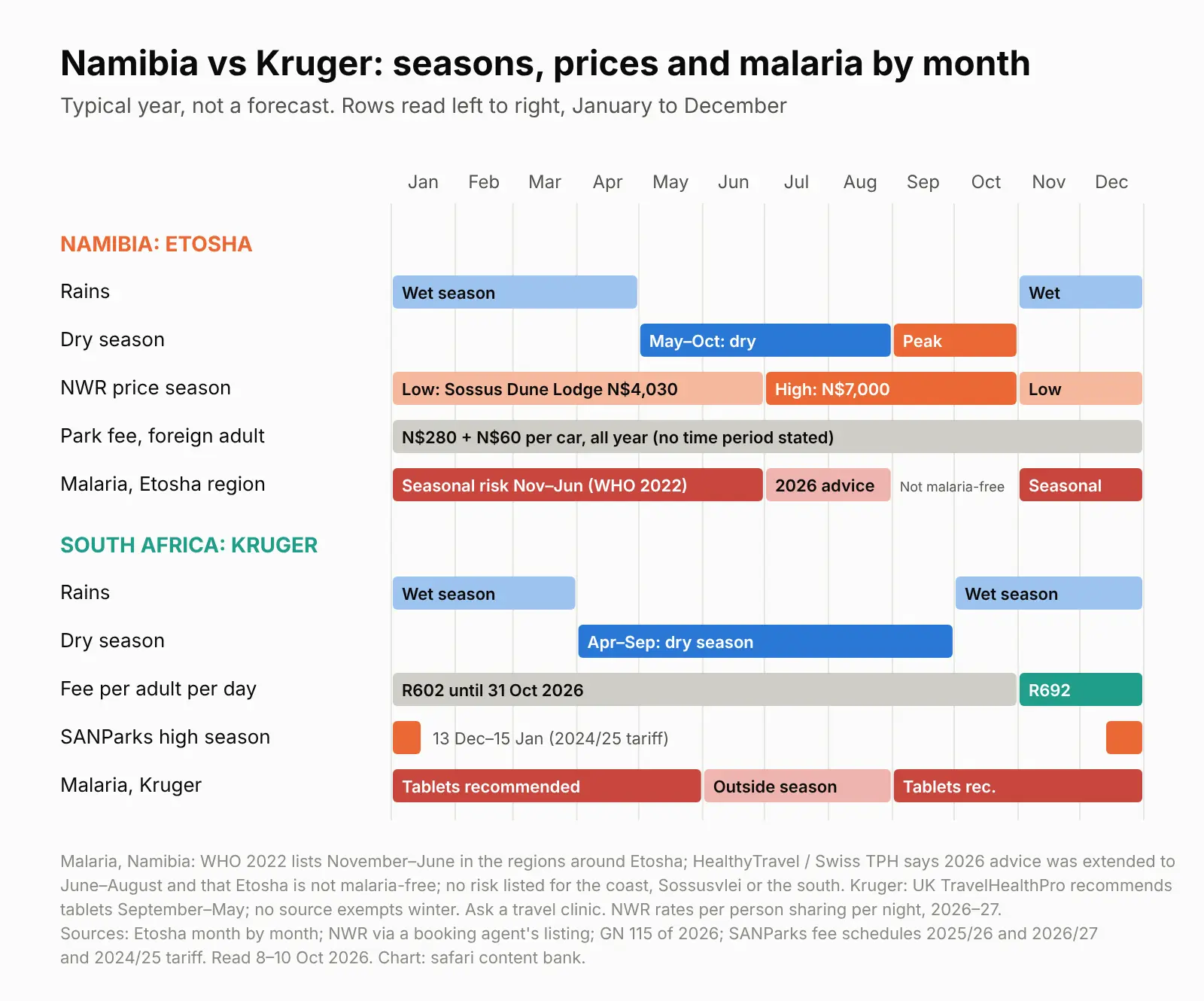 Typical year. Sources: Etosha month by month; NWR rates via a booking agent’s listing; Government Notice 115 of 2026; SANParks fee schedules and 2024/25 tariff; WHO 2022 and HealthyTravel / Swiss TPH (Namibia malaria); UK TravelHealthPro (Kruger malaria). Read 8–10 October 2026. Chart: safari content bank.
- Etosha’s gates follow sunrise and sunset, at Okaukuejo about 07:25–18:25 in June and 06:30–19:40 in January (a safari agent’s guide, read 10 October 2026). Kruger’s entrance gates close at 17:30 from May to July (SANParks gates).
- February is Namibia’s wettest month, at 80 mm nationally (one safari operator’s climate guide, as on our best time for a safari page).
Getting there and combining the two
The two combine easily: Johannesburg–Windhoek is flown several times a day, three airlines fly Cape Town–Windhoek, and the road crosses at two border posts listed as open 24 hours. South Africa is also Namibia’s largest visitor market: 484,054 of 1,257,093 tourist arrivals in 2024 (MEFT, Tourist Statistical Report 2024 (PDF)).
| Namibia | South Africa | Source | |
|---|---|---|---|
| International gateway | Windhoek Hosea Kutako. Discover Airlines flies non-stop from Frankfurt daily | Johannesburg O.R. Tambo for Kruger by road; FedAir shuttles to lodge airstrips; Skukuza, Hoedspruit and Kruger Mpumalanga International airports | Namibian flights sheet, May/June 2026 (PDF); South Africa safari questions |
| Between the two by air | Airlink and SAA fly Johannesburg–Windhoek several times a day; Airlink, FlyNamibia and FlySafair fly Cape Town–Windhoek | same | Namibian flights sheet, May/June 2026 (PDF) |
| By road | Noordoewer (Vioolsdrif) and Ariamsvlei, both listed as open 24 hours; Windhoek → Keetmanshoop 482 km on tar | same border posts | A Namibia booking site (undated); a travel booking site’s distance table |
| Hire car across the border | A Namibian rental needs the company’s cross-border letter: N$0 to ZAR 1,000 by company (Britz ZAR 1,000 per rental); no South African charge published | A South African or other foreign car entering Namibia pays N$534 (Road Fund Administration, from 1 August 2026) | Taking a Namibian rental car across borders; RFA |
| Packaged | Small-group tours from Cape Town into Namibia: 12 days US$2,249 (25% off US$2,999) to 14 days US$5,248 (was US$6,560); a 19-night Cape Town–Windhoek self-drive US$5,450 per person sharing, park fees included | — | Operators’ published prices, captured September 2026 |
Airline schedules change by season; check the live timetable before you book. Read 3 September–10 October 2026.
- Namibia’s main risk for visitors is the road, not crime or wildlife. Most visitor accidents there involve no other car, according to one safari operator (Namibia safari questions).
- Britz motorhomes may enter Namibia only on sealed roads, for a ZAR 5,000 surcharge (Taking a Namibian rental car across borders).
- Botswana sits between the two by road; both of our other comparisons cover it: Namibia or Botswana and Botswana or South Africa. Namibia against Kenya: Kenya vs Namibia.
See also: Cape Town and safari.
Families: ages, distances and malaria
South Africa is the easier family safari: malaria-free Big Five reserves and short transfers; Namibia suits older children who can sit through 4–6-hour gravel drives.
| Namibia | South Africa | Source | |
|---|---|---|---|
| Malaria-free game viewing | None at Etosha; the coast, Sossusvlei and the south have no risk listed | Madikwe, Pilanesberg, the Waterberg, Addo and the Eastern Cape reserves | WHO 2022; Malaria-free safaris |
| Child park fee | Ages 9–15 N$180; under 9 free | Kruger: ages 2–11 R345 (R300 until 31 Oct 2026); under 2 free | Namibia park fees; SANParks |
| Child rates in state camps | NWR: under 6 stay free, 6–12 pay 50% when sharing with two adults | SANParks units are priced per unit, not per person | Namibia safari cost; SANParks Kruger |
| Visa for children | N$800 for ages 6–11; free under 6 | None for UK and US passport holders | Namibia visa; UK FCDO |
| Children’s documents | A full (unabridged) birth certificate, plus a notarised consent letter if both parents are not travelling | Special documents for under-18s | Namibia safari questions; Department of Home Affairs |
| Drive to the main park | Windhoek → Etosha 414–435 km, 4–6 h | Johannesburg O.R. Tambo → Pilanesberg about 220 km; Johannesburg → Kruger’s gates 411–600 km | Namibia self-drive distances; Malaria-free safaris |
Read 3 September–10 October 2026. Ages and rules change; confirm in writing before you book. More: family safari.
Crowds and game-drive rules
Kruger is the busier park by far, and in both countries the national park is where the rules are tightest: no night driving in your own car, and no walking except with SANParks in Kruger; Etosha allows no walks at all. Kruger took a record 1.7 million visitors in 2025 (EB News Daily, 3 Apr 2026); all of Namibia received 1,257,093 tourist arrivals in 2024 (MEFT). On busy days Kruger stops admitting day visitors once its daily limit is reached (SANParks day visits).
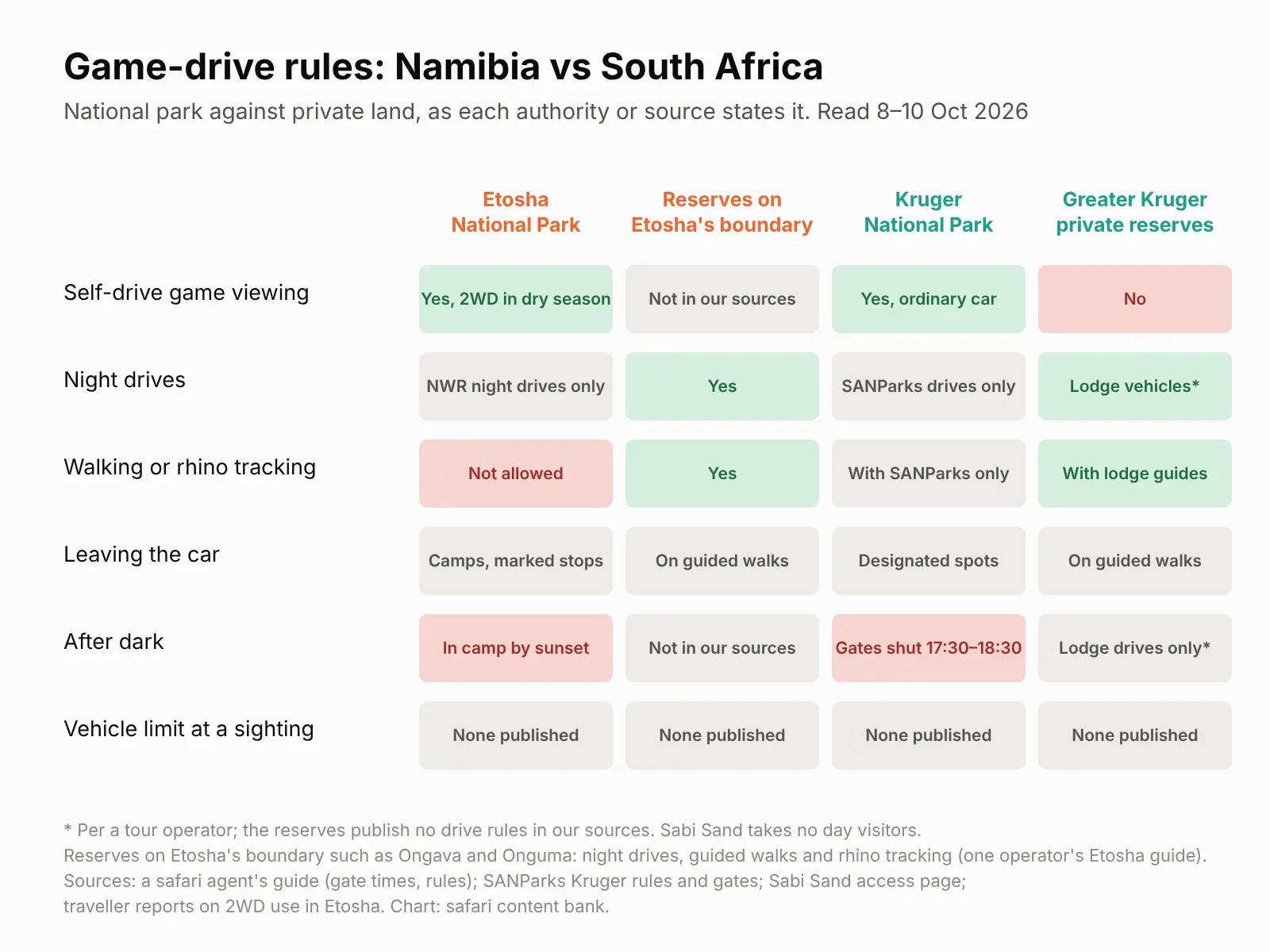 Sources: a safari agent’s guide; one operator’s Etosha guide; SANParks Kruger rules and gates; Sabi Sand access page; another tour operator; traveller reports. Read 8–10 October 2026. Chart: safari content bank.
- Private land is where the rules change in both countries. Reserves on Etosha’s boundary, such as Ongava and Onguma, offer night drives, guided walks and rhino tracking, which are not allowed inside the national park (one operator’s Etosha guide). In the Greater Kruger reserves, off-road and night drives are part of the lodge stay, according to a tour operator; Sabi Sand takes no day visitors (Kruger vs private reserves).
- No vehicle limit at a sighting is published for Etosha, Kruger or the Greater Kruger reserves in our sources. Ask the lodge.
Which should you choose?
Choose South Africa for a first safari, the Big Five, rhino, young children, a short trip or no malaria; choose Namibia for landscapes, a long self-drive, desert-adapted wildlife and Etosha’s waterholes.
| If you… | Pick | Why |
|---|---|---|
| Want all of the Big Five | South Africa | Etosha has no buffalo; Kruger has all five |
| Want the best odds of rhino | South Africa | 14,389 rhinos against Namibia’s 3,598 (end 2024) |
| Can’t or won’t take malaria tablets but want big game | South Africa (malaria-free reserves) | Madikwe, Pilanesberg and the Eastern Cape are rated no risk; Etosha is not malaria-free |
| Have a week or less | South Africa | Kruger’s gates are 411–600 km from Johannesburg; Namibia’s classic loop is 2,169–2,199 km |
| Want dunes, desert and coast | Namibia | Sossusvlei, the Skeleton Coast and Swakopmund |
| Want a long self-drive road trip | Namibia | Rooftop-tent 4x4 N$2,619–3,880 a day; campsites N$341–670 per person |
| Want to track rhino on foot | Namibia (private reserves, the Kunene) | Okonjima N$2,660–2,900 per person (2026); not allowed inside Etosha |
| Want both | Combine them | Johannesburg and Cape Town fly to Windhoek; 24-hour road borders at Noordoewer and Ariamsvlei |
Whichever you choose, check that the operator holds a current licence: see how to check a safari operator is licensed.
See also: Etosha vs Sossusvlei.
Common mistakes in Namibia vs South Africa comparisons
| What you’ll often read | What is correct |
|---|---|
| “Namibia is a malaria-free safari destination” | Etosha is not malaria-free, and the Zambezi Region carries year-round high risk. No risk is listed for the coast, Sossusvlei or the south. |
| “Etosha has the Big Five” | Four. Cape buffalo are kept out of Etosha by veterinary policy. |
| “Kruger costs R602 a day” (with no date) | That was the 2025/26 rate, which ended on 31 October 2026. Since 1 November 2026: R692 per international adult per day. |
| “Etosha costs N$150 a day” | N$280 per foreign adult since 1 April 2026, plus N$60 per vehicle. Government Notice 115 of 2026 states no time period. |
| “You need a 4x4 for Namibia” | Not for the standard circuit in the dry season. You need one for the last 5–6 km to Sossusvlei (or the shuttle), the far north-west, Khaudum and Nkasa Rupara. Kruger needs no 4x4 at all. |
| “No visa needed for Namibia, as for South Africa” | UK, US and German visitors have needed a Namibian visa since 1 April 2025, N$1,600 on arrival. South Africa needs none for UK and US passports for up to 90 days. |
| “You have to convert rand to Namibian dollars to compare” | The Namibian dollar is pegged 1:1 to the rand and the rand is accepted in Namibia. |
| “Namibia has the most black rhino” | South Africa has more (2,307 against 2,098 at the end of 2024). Namibia has the largest free-roaming population. |
| “Malaria-free reserves are the cheap option” | Pilanesberg charges R748 per foreign adult a day plus R168 per vehicle, more than Kruger. |
Frequently asked questions
Is Namibia or South Africa better for a first safari? South Africa, for most first-timers. Kruger has all of the Big Five, can be self-driven in an ordinary hire car on tarred access roads, and its gates are 411–600 km from Johannesburg. Namibia suits a first safari built around landscape and a long self-drive, but its classic loop is 2,169–2,199 km and Etosha has no buffalo.
Is Namibia cheaper than South Africa for a safari? At the guided budget end, yes: a 14-day Namibia camping tour lists at about US$138–153 a day, against US$214–242 for shared Kruger tours (operators’ published prices, 2026). For a couple camping, one night in the flagship park now costs a little more in South Africa: R1,892 in Kruger (site at the October 2026 price and fees from 1 November 2026; R1,712 until 31 October 2026) against N$1,540–1,740 in Etosha (pitch and one entry); the two currencies are pegged 1:1, so that is R152–352 more in Kruger (our sums). At the top end South Africa costs more, up to R60,470 a night at Singita Ebony.
What are the park fees in Namibia and South Africa in 2026? Kruger charges R692 per international adult per day from 1 November 2026 (R602 until 31 October 2026; SANParks). Namibia’s Tier 1 parks, including Etosha and Sossusvlei, charge N$280 per foreign adult plus N$60 per vehicle since 1 April 2026 (Government Notice 115 of 2026); the notice states no time period. Tier 2 parks charge N$200.
Which country has malaria-free safaris? Both have malaria-free areas, but only South Africa has malaria-free Big Five reserves: UK TravelHealthPro rates North West province and the Eastern Cape (Madikwe, Pilanesberg, Addo) no risk. In Namibia the WHO lists no risk for the coast, Sossusvlei and the south, but Etosha is not malaria-free and the Zambezi Region has year-round high risk. Kruger is a risk area, with tablets recommended September to May.
Do I need a 4x4 in Namibia or for Kruger? Not for Kruger: all access roads to its gates are tarred and an ordinary hire car is enough. Not for Namibia’s standard dry-season circuit either, but you need one for the last 5–6 km to Sossusvlei (or the N$250 shuttle), the far north-west, Khaudum and Nkasa Rupara, and for rooftop-tent camping. A Namibian rooftop-tent 4x4 rents for N$2,619–3,880 a day (Namibia2Go, 2026).
Which is better for the Big Five and rhino, Namibia or South Africa? South Africa. Kruger and the Greater Kruger reserves have all five, while Etosha has no buffalo. South Africa held 14,389 rhinos at the end of 2024 against Namibia’s 3,598 (IUCN); Namibia’s draw is black rhino, including the largest free-roaming population, and tracking on foot outside Etosha.
Do I need a visa for Namibia or South Africa? For Namibia, yes, if you hold a UK, US or German passport: the visa on arrival has cost N$1,600 per adult since 1 April 2025, N$800 for children aged 6–11. For South Africa, UK and US passport holders need no visa for up to 90 days, but every arrival has completed an online traveller declaration since 1 July 2026 (UK FCDO).
Can you combine Namibia and South Africa on one trip? Yes. Airlink and SAA fly Johannesburg–Windhoek several times a day, and Airlink, FlyNamibia and FlySafair fly Cape Town–Windhoek (May/June 2026 schedule). By road, Noordoewer and Ariamsvlei are listed as open 24 hours; a Namibian rental needs the company’s cross-border letter, and a South African car entering Namibia pays N$534 (from 1 August 2026).
Sources
- Fees: Government Gazette 8877 (Government Notice 115 of 2026), PDF, hosted by the Legal Assistance Centre; SANParks daily conservation fees 2025/26 (PDF) and 2026/27 (PDF); SANParks tariffs 2024/25 (PDF); Sabi Sand access; Timbavati; Pilanesberg as quoted by a safari agent’s guide, read 10 October 2026
- Namibia rates: NWR 2026–27 rates via a booking agent’s listing, read 10 October 2026; Gondwana Collection; Wolwedans 2026 (PDF); Natural Selection 2026 (PDF); Okonjima 2026 (PDF); Wilderness rates via an agent, as on our Namibia safari cost page; Namibia2Go 2026 rack rates; diesel: The Brief
- South Africa rates: SANParks Kruger (live prices, Oct 2026); Elephant Plains; Sabi Sabi; Singita Ebony
- Tour prices: tour operators’ published 2026 package prices, as on our Namibia and South Africa cost pages (names and links kept in our editor notes)
- Roads and rules: SANParks vital information, entrance gates, booking periods, day visits and climate; a safari agent’s guides to gate times, wildlife and Etosha month by month, read 10 October 2026; Namibian distances as on our self-drive distances page; one operator’s Etosha guide and another tour operator’s page (names and links kept in our editor notes)
- Health: HealthyTravel / Swiss TPH, Namibia; WHO country list 2022 (PDF); UK TravelHealthPro, South Africa; SANParks, Kruger malaria. Checked 10 Oct 2026
- Wildlife: IUCN SSC African Rhino Specialist Group report to CITES, 2025, as on our rhino page; Save the Rhino Trust; SANParks rhino statement; one booking site’s Etosha wildlife ratings and another seller’s Big Five page (names and links kept in our editor notes)
- Access and entry: Namibian flights sheet, May/June 2026 (PDF); a Namibia booking site; Road Fund Administration; MEFT, Tourist Statistical Report 2024 (PDF); EB News Daily, 3 Apr 2026; UK FCDO, South Africa and Namibia entry requirements; Namibian Mission in Switzerland (visa fees); Department of Home Affairs
- Money: one safari operator’s money FAQ (Namibian dollar pegged 1:1 to the rand; name and link kept in our editor notes)
- Traveller reports: TripAdvisor Namibia, Etosha and Kruger forums, as linked on our Namibia and South Africa question pages
Prices and fees checked 9–10 October 2026; Kruger fees checked 1 November 2026. We will recheck this page on 2 November 2026, after Kruger’s fee changes on 1 November, and when MEFT changes Namibia’s park-fee schedule, Namibia changes its visa fees, or the 2027 rate sheets take effect.