 Experience

Last verified · Next check due
On this page
- Kilimanjaro climb plus safari at a glance (2026)
- Climb first or safari first?
- Logistics: Kilimanjaro airport, Moshi and Arusha
- How many days for Kilimanjaro and a safari?
- Best months for the climb and the safari together
- Park fees: Kilimanjaro and the northern circuit
- Costed example: what a climb plus safari costs per person
- Common mistakes when combining Kilimanjaro with a safari
- Frequently asked questions
- Sources
Short answer: Climb first, rest a night, then go on safari. Fly into Kilimanjaro airport (JRO): Moshi, the climbing base, is 50 km away, and Arusha, the safari base, 100 km from Moshi. Plan 13–18 days for a 6–8-day climb and a 4–7-day safari (our sums). Go June–October or January–February. Kilimanjaro’s park fee is US$82.60 a day (last published tariff, 2023/24). Our costed example: US$2,640–5,077 per person before flights and tips.
Key facts
- Kilimanjaro National Park charges a non-East African adult US$70 + 18% VAT = US$82.60 a day in TANAPA’s last published tariff, 2023/24, the same as Serengeti entry. No later tariff had been published by 9 October 2026 (Tanzania park fees).
- One airport serves both halves. Kilimanjaro International Airport (JRO) is 50 km, about 1 hour from Moshi and 55 km, about 1 h 20 from Arusha; Moshi to Arusha is 100 km, about 2.5 hours (one Tanzanian operator’s travel-times table, modified 1 July 2026).
- One visa and one insurance policy cover the climb and the safari: a US$50 visa (US$100 for US citizens) and the compulsory US$44 inbound policy, valid 92 days (Tanzania safari cost, checked 9 October 2026).
- Published climbs in our bank run 6 to 8 days: a 6-day Marangu-route group departure at US$1,556 per person (one Moshi-based climbing operator) and an 8-day Rongai-route group trip at GBP 3,119, excluding flights (a UK adventure operator), captured October 2026.
- Our costed example comes to US$2,640 per person for 13 days (6-day group climb and 4-day group camping safari) and US$4,493–5,077 for 16 days with a 7-day private mid-range safari, before international flights, hotel nights between the two and tips (our sums).
Kilimanjaro climb plus safari at a glance (2026)
The climb and the safari share an airport, a visa, an insurance policy and a park-fee authority, but start from two towns 100 km apart. Figures are per adult as printed on our Tanzania pages, read 8–10 October 2026.
| Kilimanjaro climb | Northern circuit safari | Source | |
|---|---|---|---|
| Base town | Moshi, 50 km, about 1 h from JRO | Arusha, 55 km, about 1 h 20 from JRO | One operator’s travel-times table |
| Typical length | 6–8 days on published climbs; one forum climb took 9 days | 4 days (group camping) to 7 days (private) on our cost page | Bank operator listings; TripAdvisor; Tanzania safari cost |
| Park authority | TANAPA | TANAPA; Ngorongoro is run by the NCAA | Tanzania park fees |
| Main park fee, adult | US$82.60 a day (last published tariff, 2023/24) | Serengeti US$82.60 a day (US$70.80 15 Mar–15 May); Tarangire US$59 (US$53.10); Ngorongoro US$70.80 per 24 h and US$295 per vehicle per crater descent | TANAPA Tariffs 2023/24; NCAA, read 9 Oct 2026 |
| Published price per person | US$1,556 (6 days, group) to GBP 3,119 (8 days, group, excluding flights) | US$990 (4 days, group camping) to US$2,843–3,427 (7 days, private mid-range for two) | Bank operator listings, Oct 2026; Tanzania safari cost |
| Best months | No climb weather data in our sources; we use the region’s dry months | June–October dry season; January–February calving | Tanzania |
| Tips | About US$300–350 per climber over 7 days, at porter-association rates (one operator) | US$20–30 per person per day (one operator) | Safari tipping; Tanzania safari cost |
The climb prices are not on our cost pages: they come from operators’ sites recorded in our content bank in October 2026, and the bank does not say whether park fees are included. Operators are unnamed (names in our editor notes).
Climb first or safari first?
Climb first, then go on safari. No itinerary in our 157-trip Tanzania dataset is sold as a climb plus safari, so this is our reading of the logistics rather than a count of what operators sell.
| If you… | Choose | Why |
|---|---|---|
| Fly in and out of Kilimanjaro airport | Climb first | Moshi is the closer base (50 km); the safari then ends at Arusha, 55 km from JRO, or in the Serengeti |
| Want to finish on Zanzibar | Climb first | Kilimanjaro–Zanzibar is from US$200 one way, 13:00 → 14:00 (Flightlink, October 2026), and Serengeti airstrips also fly to Zanzibar; see Tanzania safari and Zanzibar |
| Have a fixed group climbing date | Climb first | Group climbs leave on set dates; a safari is easier to shorten or lengthen around them |
| Come overland from Kenya via Namanga | Safari first | Namanga leads to Arusha; you climb from Moshi afterwards and fly out of JRO, 50 km away |
| Come from Amboseli or Tsavo in Kenya | Climb first | Taveta–Holili, open 24 hours, is the shortest crossing to Moshi (Kenya–Tanzania border crossings) |
| Want a buffer for a slow descent or bad weather | Climb first, plus one spare night | A night in Moshi or Arusha between the two keeps a late descent from eating into the safari (our advice) |
Distances: one Tanzanian operator’s travel-times table, modified 1 July 2026; border hours: WFP Logistics Cluster, as on our border page. Our reasoning, not an operator survey.
The usual routing, climb first (our content bank’s sample routing):
- Fly into Kilimanjaro (JRO) and drive to Moshi, 50 km, about 1 hour.
- Climb, usually 6–8 days on the published trips in our bank.
- Moshi to Arusha, 100 km, about 2.5 hours, and sleep there.
- Drive the northern circuit: Arusha–Tarangire 109 km, about 2 h; Lake Manyara–Ngorongoro 56 km, about 1 h; Ngorongoro–Seronera (central Serengeti) 135 km, about 3.5 h.
- Fly home from Kilimanjaro, or fly on to Zanzibar.
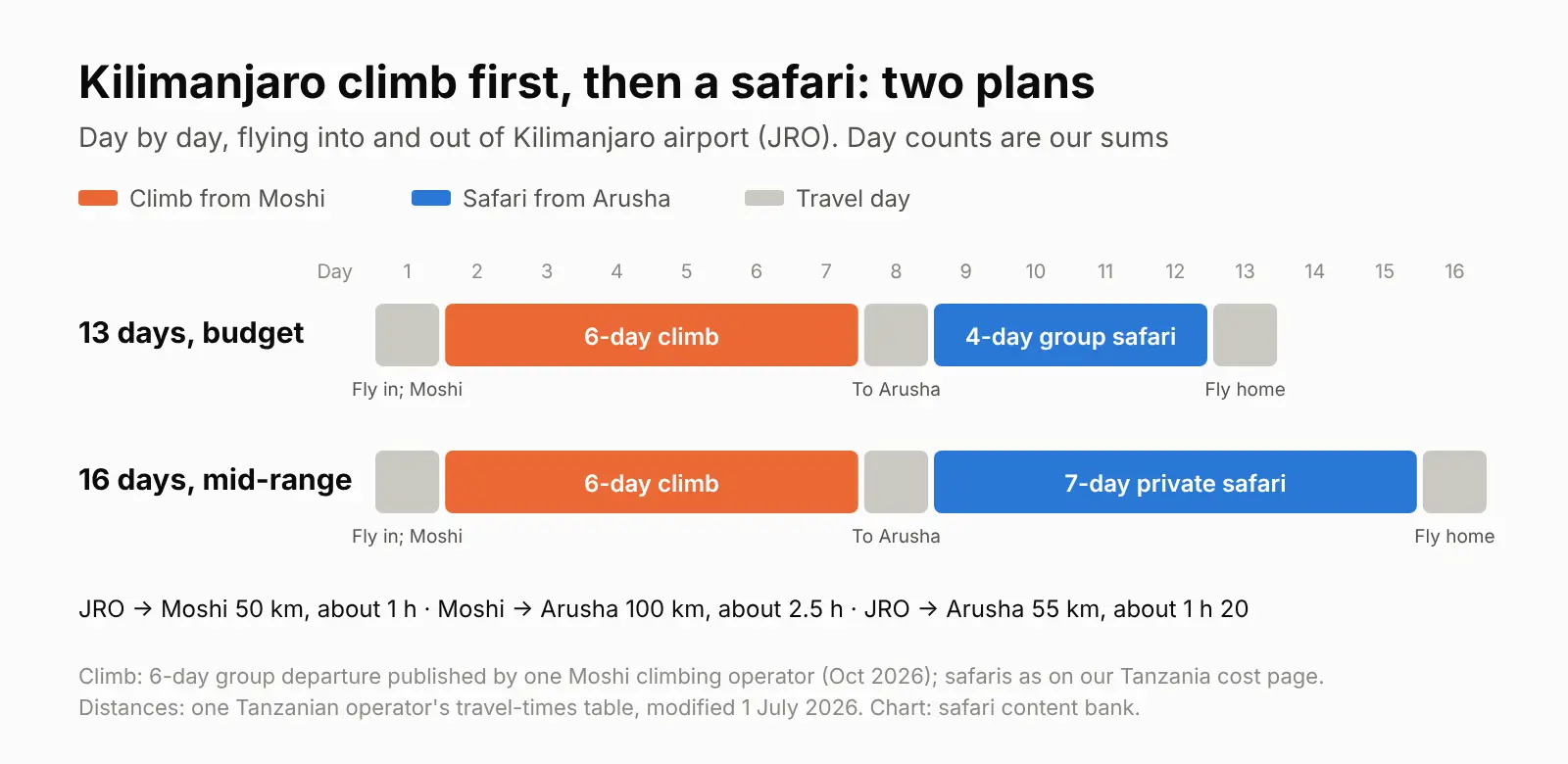 Our sums of day counts; climb lengths from operators’ published trips, safari lengths from our Tanzania cost page. Distances: one Tanzanian operator’s travel-times table. Chart: safari content bank.
Logistics: Kilimanjaro airport, Moshi and Arusha
Fly into Kilimanjaro airport; Moshi and Arusha are each about an hour away, and 100 km apart. Tanzania’s northern circuit is driven from Arusha; for the southern parks you would start from Dar es Salaam instead (northern vs southern circuit).
| Route | Distance and time | Note | Source |
|---|---|---|---|
| Kilimanjaro airport (JRO) → Moshi | 50 km, about 1 h | Several Kilimanjaro climbing operators are based here | One operator’s travel-times table, 1 Jul 2026 |
| Kilimanjaro airport (JRO) → Arusha | 55 km, about 1 h 20 | A rain-damaged stretch turned 45 minutes into about 1.5 hours for one traveller (Aug 2025) | Same table; TripAdvisor |
| Moshi → Arusha | 100 km, about 2.5 h | The link between climb and safari | Same table |
| Arusha → Tarangire | 109 km, about 2 h | First park on most northern circuits | Same table |
| Ngorongoro → Seronera | 135 km, about 3.5 h | Travellers report 4 h 30–5 h (Tanzania) | Same table |
| Tarangire → Kilimanjaro airport | 3–4 hours (forum consensus) | Too tight for an evening flight after a morning game drive | TripAdvisor, traveller reports |
| Kilimanjaro → Zanzibar, air | 1 h, 13:00 → 14:00 | From US$200 one way | Flightlink, read 9 Oct 2026 |
Read 8–10 October 2026. Our sources hold no published price for a Moshi–Arusha transfer on its own.
- Land before 13:00 for a same-day transfer to a park: tourists are not driven outside towns after dark (one operator’s travel-times page, as on how many days for a safari).
- New and seasonal flights to Kilimanjaro: British Airways flies London Gatwick–Kilimanjaro–Zanzibar three times a week from 29 May 2027 (Wanderlust), which allows flying in to Kilimanjaro and home from Zanzibar; Neos flies Milan Malpensa–Kilimanjaro–Zanzibar in summer (Travel Tomorrow).
- From Kenya: a yellow fever certificate is needed for anyone aged 1 or over arriving from Kenya, by road or air (Yellow fever and safaris).
Visa and insurance: one of each
One Tanzanian visa and one inbound insurance policy cover the climb and the safari. A visitor from the UK or most EU countries pays US$94 before the first day (US$50 visa + US$44 insurance); a US visitor pays US$144 (Tanzania visa; Tanzania safari cost).
- The insurance is compulsory: US$44 per adult, valid 92 days, under Government Notice 256 of 2026, for foreign visitors except residents of East African Community (EAC) and SADC countries; your own travel insurance does not replace it (Tanzania visitor insurance).
- Its minimum cover is emergency medical treatment, emergency medical evacuation, emergency repatriation and loss of luggage; no source we read gives the benefit limits.
- Check your own policy for the climb. In a Kilimanjaro forum thread, a trekking company says the climb’s “rescue fees” cover ground evacuation only, and replies advise a policy that names Kilimanjaro, its altitude and helicopter evacuation (TripAdvisor, traveller reports).
How many days for Kilimanjaro and a safari?
Plan 13–18 days: a day to arrive, a 6–8-day climb, a night between, a 4–7-day safari and a day to fly home (our sums). The longer climbs give more time to acclimatise.
| Part | Days | Source |
|---|---|---|
| Arrive at JRO, drive to Moshi | 1 | Travel-times table (50 km, about 1 h) |
| Climb | 6–8 on published trips (6-day Marangu, 8-day Rongai); one forum group of climbers in their mid-60s took 9 days on Lemosho | Bank operator listings, Oct 2026; TripAdvisor |
| Moshi → Arusha, rest | 1 | Travel-times table (100 km, about 2.5 h) |
| Safari | 4–7: published northern-circuit trips run 7–8 days | How many days for a safari; Tanzania safari cost |
| Fly home | 1 | — |
| Total | 13 days (6 + 4) to 18 days (8 + 7) | Our sums |
- Why the longer climbs: the UK’s TravelHealthPro advises that altitude risk begins at 2,500 m, that above 3,000 m you should not raise your sleeping altitude by more than 500 m a day, and that you take a rest day every 3–4 days (TravelHealthPro, altitude advice on its Kenya page).
- A shorter safari after a climb still covers the main parks. A 4-day group camping safari from Arusha is listed at US$990; a 7-day private northern circuit takes in Tarangire, Ngorongoro and the Serengeti (Tanzania safari cost).
- Adding Zanzibar adds about 3–5 beach nights (Tanzania safari and Zanzibar).
Best months for the climb and the safari together
June–October and January–February suit both; March–May (the long rains) and November (the short rains) suit neither. Our sources hold no weather statistics for the mountain itself, so the climb column follows the region’s rains and is our reading, not a measured climb season.
| Month | Safari: Serengeti and Ngorongoro | Rain (Serengeti) | Climb (our reading) | Both together? |
|---|---|---|---|---|
| January | Herds on the southern plains around Ndutu | — | Outside the long and short rains | Yes |
| February | Calving, mostly “in a short window around February” | — | Outside the long and short rains | Yes |
| March | Long rains; herds start to leave Ndutu | Long rains | Wet | Weak; Serengeti entry drops to US$70.80 from 15 March |
| April | Wettest month; cheapest camps | 155 mm | Wet | No |
| May | Herds pass Seronera, heading west | Long rains | Wet | No; entry back to US$82.60 from 16 May |
| June | Western Corridor; Grumeti River crossings, first half of June | Dry season | Dry | Yes |
| July | Mara River crossings begin | 15 mm, the driest month | Dry | Yes |
| August | Mara River crossings | Dry season | Dry | Yes |
| September | Mara River crossings | Dry season | Dry | Yes |
| October | Herds head south through Lobo and Loliondo | Dry season | Dry | Yes |
| November | Short rains | 115 mm | Short rains | Weak |
| December | Herds back around Ndutu | — | After the short rains | Possible |
Safari and rain columns as on our Tanzania hub: rain from Climates to Travel (Serengeti station); herds from a safari operator’s and a camp company’s migration guides. Serengeti fees: TANAPA Tariffs 2023/24, the last published tariff. Read 8–10 October 2026. Herd timing “is entirely dependent upon the rainfall patterns each year”.
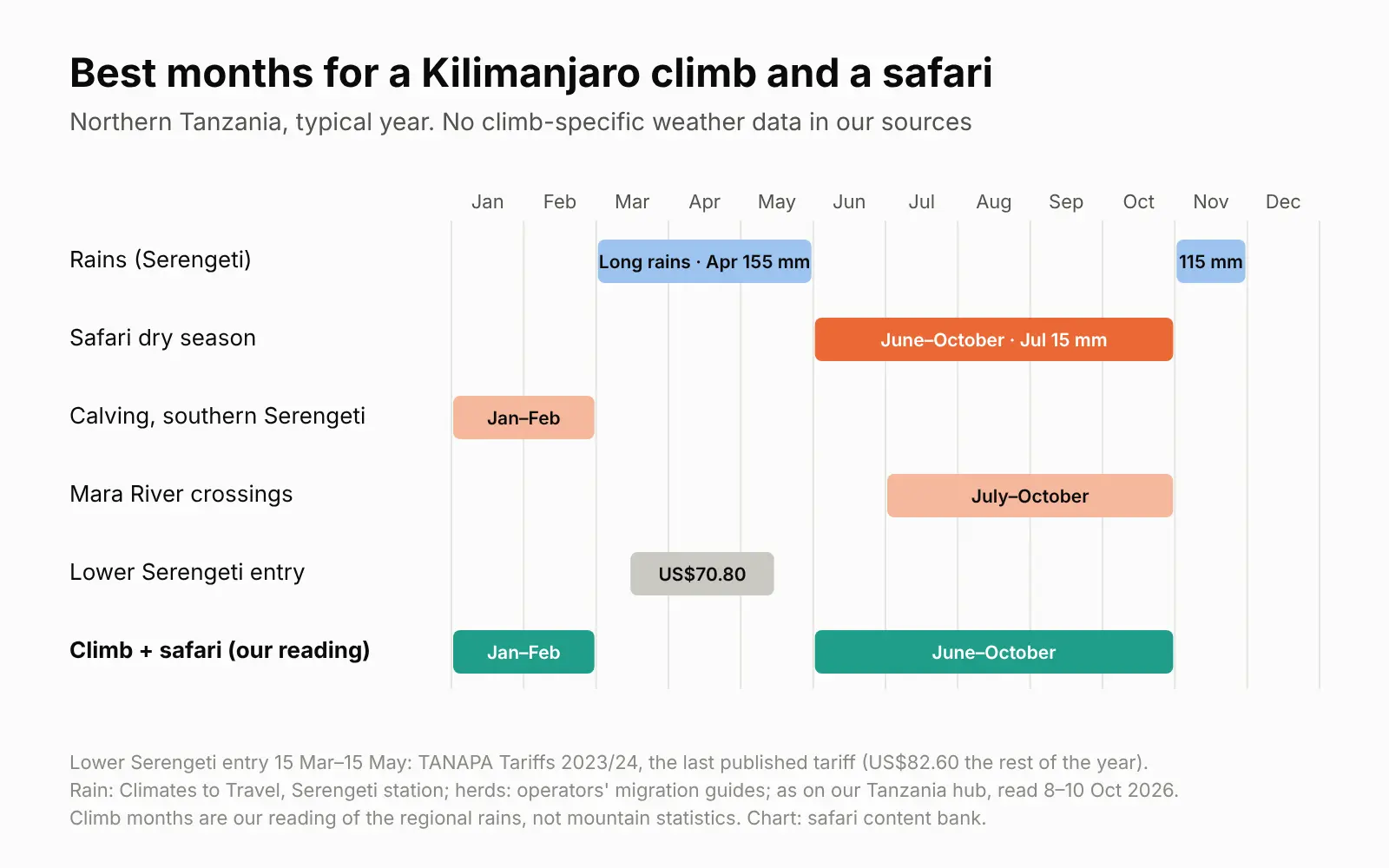 Typical year, not a forecast. Sources: our Tanzania hub (Climates to Travel, Serengeti station; operators’ migration guides); TANAPA Tariffs 2023/24. Climb months are our reading of the regional rains. Chart: safari content bank.
- July–September is the costliest safari window: inside the Serengeti, park fees reach US$153.40 per person per night (entry plus the US$70.80 concession; last published tariff, 2023/24), and luxury camps charge up to three times their April–May rate (Tanzania safari cost).
- Herd positions month by month: Great Migration month by month.
Park fees: Kilimanjaro and the northern circuit
Kilimanjaro’s conservation fee is US$70 + 18% VAT = US$82.60 per adult per day, from TANAPA’s last published tariff, 2023/24 (effective 1 July 2023). That is the dated official source in our bank; the schedule expired on 30 June 2024 and no successor had been published by 9 October 2026, so treat it as the last known fee, not a current one.
| Fee, non-East African adult | Amount | Source |
|---|---|---|
| Kilimanjaro conservation fee, per day | US$70 + VAT = US$82.60 (child 5–15: US$20 + VAT = US$23.60) | TANAPA Tariffs 2023/24, last published |
| 6-day climb, conservation fee only | 6 × US$82.60 = US$495.60 | Our sum |
| 8-day climb, conservation fee only | 8 × US$82.60 = US$660.80 | Our sum |
| Kilimanjaro campsite, per climber per night | US$50 + VAT = US$59 | TANAPA Tariffs 2023/24, last published |
| Kilimanjaro huts (Marangu route), per climber per night | US$60 + VAT = US$70.80 | TANAPA Tariffs 2023/24, last published |
| Kilimanjaro rescue fee, per climber per climb | US$20 + VAT = US$23.60 | TANAPA Tariffs 2023/24, last published |
| 6-day Marangu climb, 5 hut nights, with rescue fee | US$495.60 + 5 × US$70.80 + US$23.60 = US$873.20 | Our sums |
| 8-day Rongai climb, 7 campsite nights, with rescue fee | US$660.80 + 7 × US$59 + US$23.60 = US$1,097.40 | Our sums |
| Serengeti entry, per day | US$70 + VAT = US$82.60; 15 Mar–15 May US$70.80 | TANAPA Tariffs 2023/24, last published |
| Tarangire and Lake Manyara entry, per day | US$59; 15 Mar–15 May US$53.10 | TANAPA Tariffs 2023/24, last published |
| Ngorongoro Conservation Area, per 24 h | US$70.80, single entry (NCAA’s page does not say whether VAT is included) | NCAA, undated, read 9 Oct 2026 |
| Ngorongoro Crater descent | US$295 per vehicle (NCAA’s page does not say whether VAT is included) | NCAA, undated, read 9 Oct 2026 |
Sources: TANAPA Tariffs 2023/24 (PDF), the last published tariff (TANAPA site checked 9 October 2026); NCAA tariffs. Full tables: Tanzania park fees and Ngorongoro park fees.
The official fee lines, with the date each took effect:
| Fee | Amount | In force from | Source |
|---|---|---|---|
| Kilimanjaro National Park, non-East African adult, conservation fee per day | USD 70 + 18% VAT = USD 82.60 | 1 Jul 2023 (2023/24 tariff, last published) | TANAPA Tariffs 2023/24 |
| Kilimanjaro National Park, campsite, per climber per night | USD 50 + 18% VAT = USD 59 | 1 Jul 2023 (2023/24 tariff, last published) | TANAPA Tariffs 2023/24 |
| Kilimanjaro National Park, hut (Marangu route), per climber per night | USD 60 + 18% VAT = USD 70.80 | 1 Jul 2023 (2023/24 tariff, last published) | TANAPA Tariffs 2023/24 |
| Kilimanjaro National Park, rescue fee, per climber per climb | USD 20 + 18% VAT = USD 23.60 | 1 Jul 2023 (2023/24 tariff, last published) | TANAPA Tariffs 2023/24 |
| Serengeti and Nyerere National Parks, non-East African adult, entry per day, 16 May–14 Mar | USD 70 + 18% VAT = USD 82.60 | 1 Jul 2023 (2023/24 tariff, last published) | TANAPA Tariffs 2023/24 |
| Serengeti and Nyerere National Parks, non-East African adult, entry per day, 15 Mar–15 May | USD 60 + 18% VAT = USD 70.80 | 1 Jul 2023 (2023/24 tariff, last published) | TANAPA Tariffs 2023/24 |
| Serengeti and Nyerere, concession fee per person per night inside the park | Jul–Sep USD 60 + VAT = USD 70.80; Oct–Jun USD 50 + VAT = USD 59 | 1 Jul 2023 (2023/24 tariff, last published) | TANAPA Tariffs 2023/24 |
| Tarangire, Lake Manyara and Arusha National Parks, non-East African adult, entry per day | Peak USD 50 + VAT = USD 59; low USD 45 + VAT = USD 53.10 | 1 Jul 2023 (2023/24 tariff, last published) | TANAPA Tariffs 2023/24 |
| Ngorongoro Conservation Area, non-East African adult, entry per 24 h (single entry) | USD 70.80 (NCAA's page does not say whether VAT is included) | Undated official page, read 9 Oct 2026 | NCAA |
| Ngorongoro Crater descent (crater service fee), per vehicle | USD 295 (NCAA's page does not say whether VAT is included) | Undated official page, read 9 Oct 2026 | NCAA |
- Ask whether a climb price includes the park fees: the two published climbs in our bank do not say. On a 6-day climb the conservation fee alone, US$495.60, is about a third of the US$1,556 group price (our sum).
- On the safari, two adults sharing a vehicle pay US$1,463.20–1,616.60 in entry, concession and crater fees for six days through Tarangire, the Serengeti and Ngorongoro Crater, depending on the month (Tanzania park fees).
- Fees are paid electronically through the government payment gateway (GePG); there is no cash payment at the gate (Tanzania safari cost).
- Fee freeze: TANAPA and TAWA froze fee increases for 12 months on 24 March 2025, and in May 2025 the government promised “a minimum of 12 months’ notice before any future changes” (Tourism Update).
Costed example: what a climb plus safari costs per person
A 6-day group climb and a 4-day group camping safari come to US$2,640 per person; with a 7-day private mid-range safari the total is US$4,493–5,077 (our sums). Each line is a published price on our Tanzania cost page, except the climb, which comes from an operator’s site recorded in our content bank.
| Item, per adult sharing | Budget, 13 days | Mid-range, 16 days, low season | Mid-range, 16 days, peak | Source |
|---|---|---|---|---|
| Climb: 6-day Marangu-route group departure | US$1,556 | US$1,556 | US$1,556 | One Moshi-based climbing operator, October 2026 (bank) |
| Safari | US$990: 4-day group camping from Arusha, “all meals & park fees included” | US$2,843: 7-day private northern circuit for two, standard tier | US$3,427: same trip, peak | Tanzania safari cost, operators’ prices read 9 Oct 2026 |
| Visa | US$50 | US$50 | US$50 | Tanzania visa |
| Inbound insurance | US$44 | US$44 | US$44 | Tanzania visitor insurance |
| Total | US$2,640 | US$4,493 | US$5,077 | Our sums |
US citizens add US$50 (their visa is US$100). Not included: international flights, a hotel night in Moshi before the climb and in Arusha after it, the Moshi–Arusha transfer and tips, for which our pages hold no sourced figure; whether the climb price includes Kilimanjaro’s park fees is not stated in our record. The 7-day private safari price assumes two travellers sharing a vehicle.
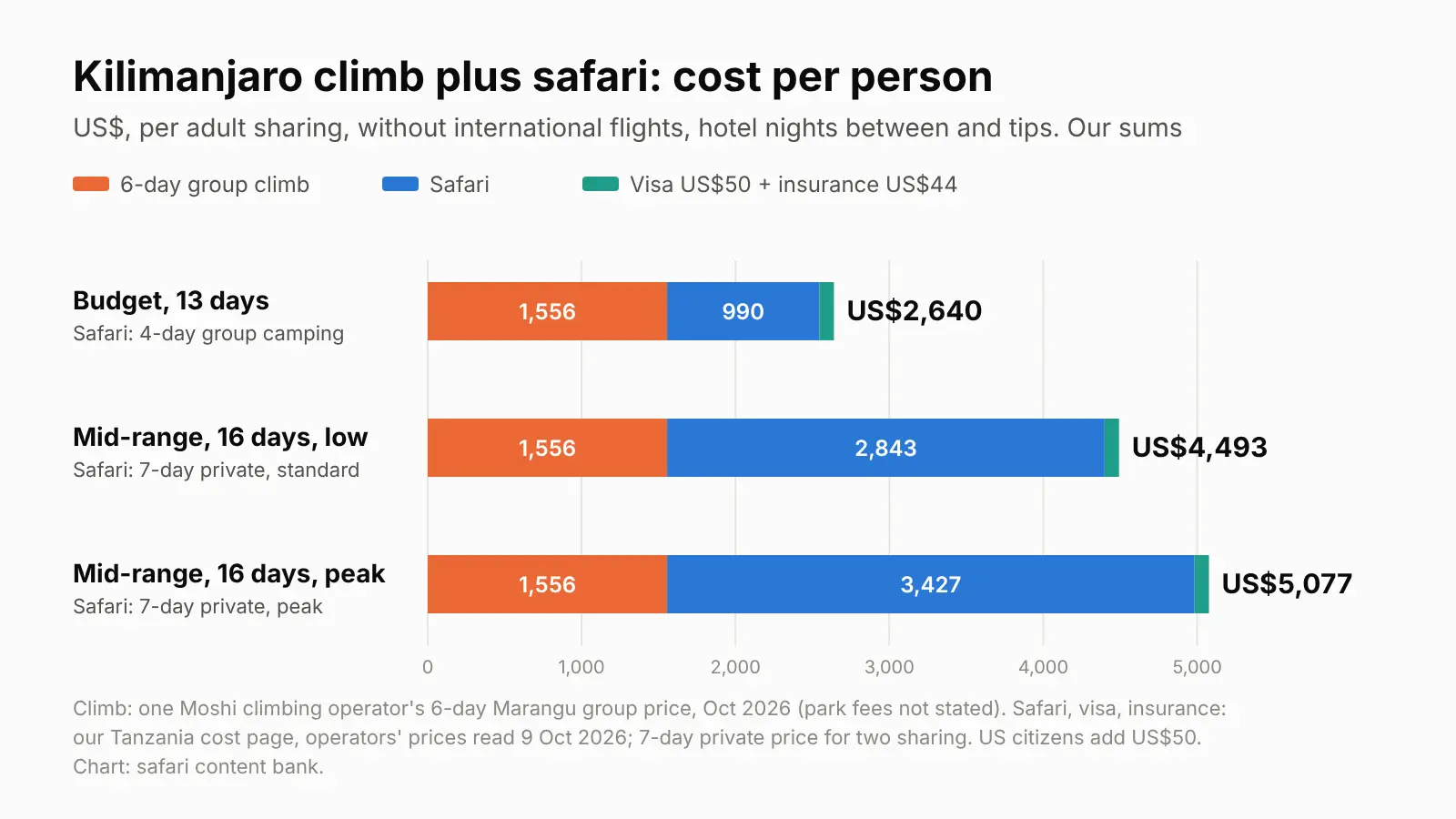 Published prices, per person sharing, without international flights or tips. Sources: our Tanzania cost page (safari, visa, insurance; read 9 October 2026); one climbing operator’s published group price (October 2026). Chart: safari content bank.
Tips on top: about US$300–350 per climber for a 7-day climb at the porter-association rates one operator quotes (lead guide US$20, porter US$6 per day), and US$20–30 per person per day on safari (Safari tipping). On a 4-day safari that is US$80–120, on 7 days US$140–210 (our sums).
Before you pay a deposit: check the safari operator’s Tanzanian licence (how to check an operator’s licence). For the climb, forum regulars split on whether partner status with the Kilimanjaro Porters Assistance Project (KPAP), a porter-welfare monitor, matters; one 2026 thread shows that membership lists do not guarantee conduct (TripAdvisor, traveller reports).
Common mistakes when combining Kilimanjaro with a safari
| What you’ll often read | What is correct |
|---|---|
| “Kilimanjaro park fees are US$70 a day” | US$82.60 with 18% VAT: the last published tariff (2023/24) is VAT-exclusive. |
| “There is a 2026 Kilimanjaro fee schedule” | No TANAPA tariff newer than 2023/24 had been published by 9 October 2026; it expired on 30 June 2024. |
| “Moshi and Arusha are next to each other” | They are 100 km, about 2.5 hours apart. |
| “The climb and the safari need separate visas or policies” | One visa (US$50; US$100 for US citizens) and one US$44 insurance policy cover the whole trip in Tanzania. |
| “The climb’s rescue fee covers a helicopter” | A trekking company in a forum thread says it covers ground evacuation only; check your own policy. |
| “Go on safari the morning after you come down” | Leave a night in Moshi or Arusha: the transfer alone is about 2.5 hours, and a late descent can eat the day (our advice). |
| “A 5-day climb is enough if you are fit” | The published climbs in our bank run 6–8 days, and TravelHealthPro advises a gradual ascent: above 3,000 m, sleep no more than 500 m higher each day, with a rest day every 3–4 days. |
| “Catch an evening flight home after a morning in Tarangire” | Tarangire to Kilimanjaro airport takes 3–4 hours in forum reports; leave the gate by noon or fly the next day. |
Frequently asked questions
Should I climb Kilimanjaro before or after the safari? Before, in most cases. Fly into Kilimanjaro airport, climb from Moshi (50 km away), then drive 100 km to Arusha for the safari and end in the Serengeti or Arusha, or fly on to Zanzibar. Do the safari first only if you arrive overland from Kenya via Namanga, which leads to Arusha.
How many days do I need for Kilimanjaro and a safari? About 13–18 days (our sums): a day to arrive, a 6–8-day climb, a night between, a 4–7-day safari and a day to fly home. A 9-day Lemosho climb or a longer safari takes it to 18 days or more.
How much are Kilimanjaro park fees? The conservation fee is US$70 + 18% VAT = US$82.60 per adult per day in TANAPA’s last published tariff, 2023/24; no later tariff had been published by 9 October 2026. On a 6-day climb that is US$495.60; add US$70.80 per hut night (Marangu route) or US$59 per campsite night, and the US$23.60 rescue fee: US$873.20 for a 6-day Marangu climb (our sums).
What is the best time to climb Kilimanjaro and go on safari? June–October or January–February, outside the long rains (March–May) and the short rains (November). Our sources hold no weather statistics for the mountain itself, so this follows the region’s rains; on safari, June–October is the dry season and January–February the calving season in the southern Serengeti.
How much does a Kilimanjaro climb plus safari cost? Our costed example comes to US$2,640 per person for 13 days with a group climb and a group camping safari, and US$4,493–5,077 for 16 days with a private mid-range safari (our sums), before international flights, hotel nights between the two and tips.
Which airport is best for Kilimanjaro and a safari? Kilimanjaro International Airport (JRO): 50 km, about 1 hour, from Moshi and 55 km, about 1 h 20, from Arusha. From 29 May 2027 British Airways flies London Gatwick–Kilimanjaro–Zanzibar three times a week.
Do I need one visa or two for the climb and the safari? One. A single-entry Tanzanian visa costs US$50 (US$100 for US citizens), and one US$44 inbound insurance policy, valid 92 days, covers the climb, the safari and Zanzibar (Tanzania visa).
Do I need a yellow fever vaccination? Not if you fly straight from Europe or North America. Tanzania asks for a certificate from travellers aged 1 or over arriving from a risk country, Kenya included, so you need one if you come from Amboseli or Nairobi (Yellow fever and safaris).
Sources
- TANAPA, Tariffs 2023/24 (PDF), effective 1 July 2023, the last published tariff (site checked 9 Oct 2026); NCAA, tariffs, undated, read 9 Oct 2026; Tourism Update, Tanzania freezes fees, May 2025; all as printed on our Tanzania park fees and Tanzania safari cost pages
- Visa and insurance: Tanzania Immigration, e-visa guidelines, checked 9 Oct 2026; UK FCDO, Tanzania entry requirements, updated 6 Oct 2026; Clyde & Co, Introduction of inbound travel insurance, 16 Sep 2026
- Health: TravelHealthPro, Kenya country page (altitude advice), read Oct 2026; WHO, vaccination requirements, country list (PDF), 2022, revised Jan 2023
- Distances: one Tanzanian operator’s travel-times table, modified 1 July 2026, read 9 Oct 2026 (name and link kept in our editor notes); WFP Logistics Cluster, Taveta/Holili, as on our Kenya–Tanzania border crossings page
- Flights: Flightlink, read 9 Oct 2026; Wanderlust, British Airways to Kilimanjaro and Zanzibar; Travel Tomorrow, more direct flights to Kilimanjaro
- Seasons: Climates to Travel, Tanzania (Serengeti station), and operators’ migration guides, as on our Tanzania hub, read 8–10 Oct 2026
- Prices: operators’ published safari prices on our Tanzania safari cost page, read 9 Oct 2026; two climbing operators’ published group prices recorded in the safari content bank, October 2026 (names and links kept in our editor notes); tips from one operator’s guidance on our Safari tipping page
- Traveller reports (forum posts, not fact): TripAdvisor, Which one to choose for the Kilimanjaro trek? (closed Aug 2025); Trip insurance; Operator shortlist for Kilimanjaro (Oct 2025); Tarangire to Kilimanjaro airport (Aug 2025)
Fees, prices and entry rules checked 8–10 October 2026. We will update this page when TANAPA publishes a tariff newer than 2023/24 and when we hold climb prices that state whether park fees are included.