 Experience

Last verified · Next check due
On this page
- Where the herds are, month by month (typical pattern)
- Calving season: late January to mid-March at Ndutu
- River crossings by month, and why there are no published odds
- Serengeti or Masai Mara: which side in which month
- Park fees by month on the migration route
- Where to base yourself: areas and camps by season
- Common mistakes about the migration calendar
- Frequently asked questions
- Sources
Short answer: In a typical year the wildebeest herds calve on the southern Serengeti plains around Ndutu from late January to mid-March (peak February), move north through the central Serengeti in April–May, reach the Western Corridor and Grumeti River in June, and cross the Mara River between the northern Serengeti and Kenya’s Masai Mara from July to October, before heading south in November–December. Rains shift every date. No source publishes odds of seeing a river crossing. Calendars checked 10 October 2026.
Key facts
- The herds are in Tanzania for most of the year. Kenya’s Masai Mara usually sees them from July, with crossings July–October and August–September the busiest (Mara Conservancy; a Mara camp operator’s migration page, read 9 Oct 2026).
- In mid-July the herds are usually in the northern Serengeti, not yet in the Mara in numbers. A camp operator’s calendar has only the lead herds at Kogatende in July (a camp operator’s migration guide).
- Calving peaks in February at Ndutu, which is in the Ngorongoro Conservation Area (NCA), not the national park. NCA fees apply there: US$70.80 entry per adult per 24 hours, single entry, and US$59 per person per night concession at Ndutu lodges (NCAA tariffs, read 9 Oct 2026).
- No authority or operator publishes the odds of seeing a crossing. The Mara Conservancy says crossings “happen frequently during the migration but are difficult to predict”; one Mara camp operator says “we cannot guarantee the timing”.
- The Masai Mara reserve fee doubles on 1 July, as crossing season starts: US$100 per non-resident adult per day from January to June, US$200 from July to December (Narok County FY2025/26 schedule, the last published).
- You cannot drive from the Masai Mara straight into the Serengeti. The Bologonja / Sand River crossing “was closed in 1977” (The EastAfrican, 4 Apr 2017); no reopening was found as of 9 October 2026.
Where the herds are, month by month (typical pattern)
The table gives the usual position of the herds in each month, what happens there, where to base yourself and the government fee that applies that month. Every row is a historical pattern from operator calendars, not a forecast. A camp operator’s migration guide: “timing all depends on the rains”, and rainfall “is becoming more unpredictable”. One safari operator’s guide: the precise timing “is entirely dependent upon the rainfall patterns each year”.
| Month | Where the herds usually are | What happens | Where to base | Fee that applies (non-resident adult) |
|---|---|---|---|---|
| January | Southern plains: Ndutu (NCA) and the Serengeti’s Naabi, Kusini and Moru plains | First calves; thunderstorms | Ndutu area (NCA) or a mobile camp’s southern site | Ndutu: US$70.80 entry per 24 h + US$59 concession per night. Serengeti, inside the park: US$141.60 per night. Mara: US$100 per day |
| February | Ndutu–Kusini, toward the Ngorongoro highlands | Peak calving, in two to three weeks; lions, cheetahs and hyenas on the plains | Ndutu area | Same as January |
| March | Still Ndutu–Kusini, spreading to the Maswa and Namiri Plains | Last calves; long rains start late in the month; herds may already be leaving Ndutu by the end of March | Ndutu early in the month; southern and central Serengeti later | Serengeti: US$141.60 per night to 14 Mar, US$129.80 from 15 Mar. Ndutu as January. Mara: US$100 |
| April | Southern and central Serengeti, starting to move north | Long rains; some camps close | Central Serengeti (Seronera, Moru) | Serengeti: US$129.80 per night. Mara: US$100 |
| May | North through Moru Kopjes and Seronera toward the Western Corridor | Long columns on the move | Central Serengeti; Western Corridor late in the month | Serengeti: US$129.80 per night to 15 May, US$141.60 from 16 May. Mara: US$100 |
| June | Western Corridor and the Grumeti River | Grumeti River crossings, about the first half of June | Western Corridor | Serengeti: US$141.60 per night. Mara: US$100 |
| July | Lead herds reach Kogatende in the far north of the Serengeti; first arrivals in the Mara | Mara River and Sand River crossings begin | Northern Serengeti (Kogatende, Lamai) in the first half; Mara from later in the month | Serengeti: US$153.40 per night. Mara: US$200 per day |
| August | Northern Serengeti (Lamai Wedge, Kogatende) and the Masai Mara | Mara River crossings, mostly south to north. The one month every calendar agrees on | Either bank of the Mara River | Serengeti: US$153.40. Mara: US$200 |
| September | Most animals in the Mara, many still in the northern Serengeti | Crossings in both directions | Either bank of the Mara River | Serengeti: US$153.40. Mara: US$200 |
| October | Tail end crosses back into Tanzania toward Lobo | Crossings can run into early October; short rains start | Northern Serengeti early in the month; Lobo | Serengeti: US$141.60. Mara: US$200 |
| November | Moving south through the eastern and central Serengeti | Short rains; herds move fast | Lobo, central Serengeti | Serengeti: US$141.60. Mara: US$200 |
| December | Spreading from Lobo south toward Ndutu | Herds settle on the short-grass plains ahead of calving | Southern plains, Ndutu | Serengeti: US$141.60. Ndutu as January. Mara: US$200 |
Herd positions: a camp operator’s migration guide and one safari operator’s migration guide; Mara arrivals: Mara Conservancy and a Mara camp operator’s migration page; end-of-March position: TAWIRI 2023 wildebeest census (PDF); all read 9–10 Oct 2026. Fees per non-resident adult: Serengeti entry + concession with 18% VAT, TANAPA Tariffs 2023/24, the last published tariff; Ndutu, NCAA tariffs, read 9 Oct 2026; Mara, Narok County fee schedule FY2025/26, the last published.
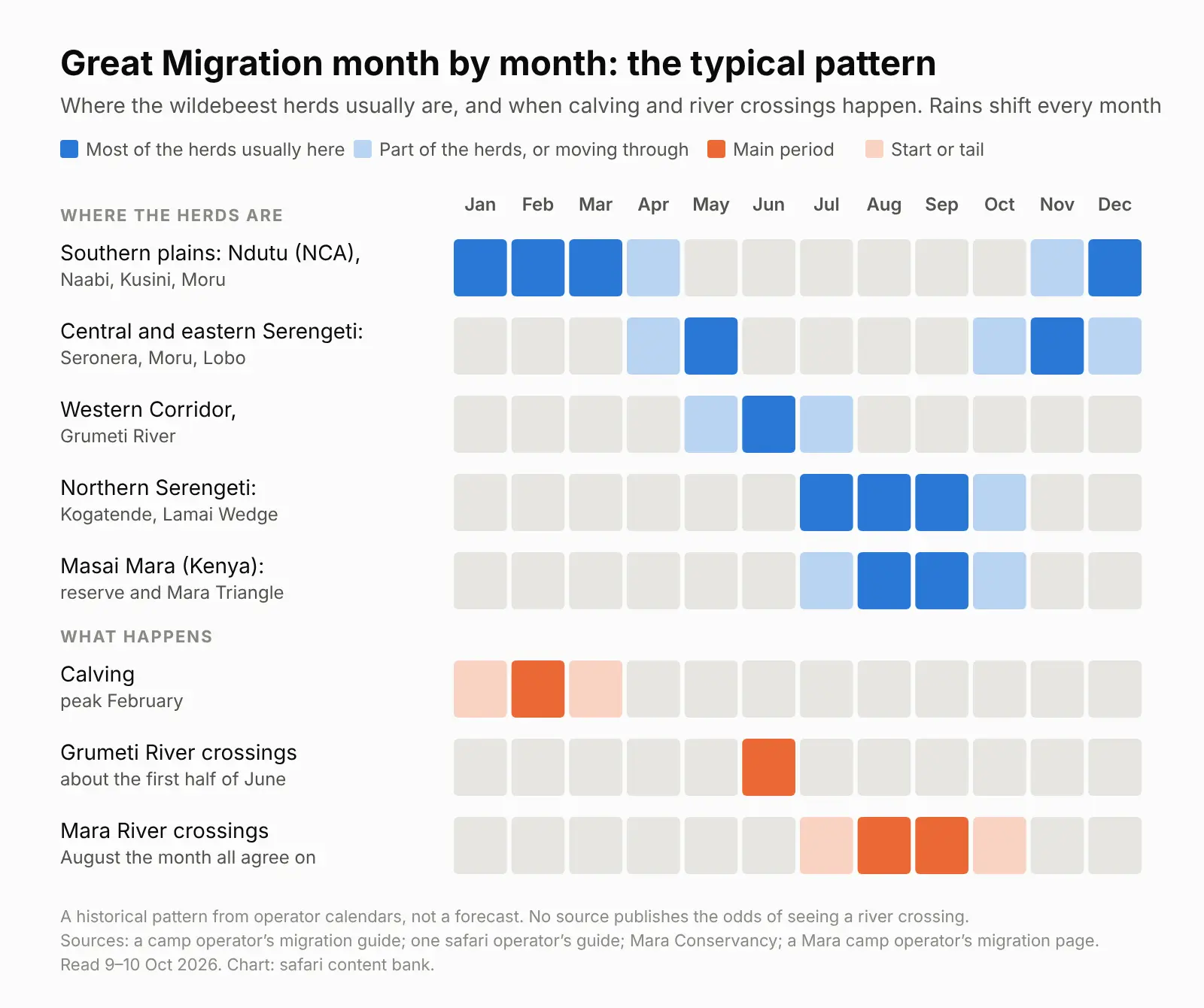 Typical pattern from operator calendars, not a forecast. Sources: a camp operator’s migration guide; one safari operator’s guide; Mara Conservancy; a Mara camp operator’s migration page. Read 9–10 October 2026. Chart: safari content bank.
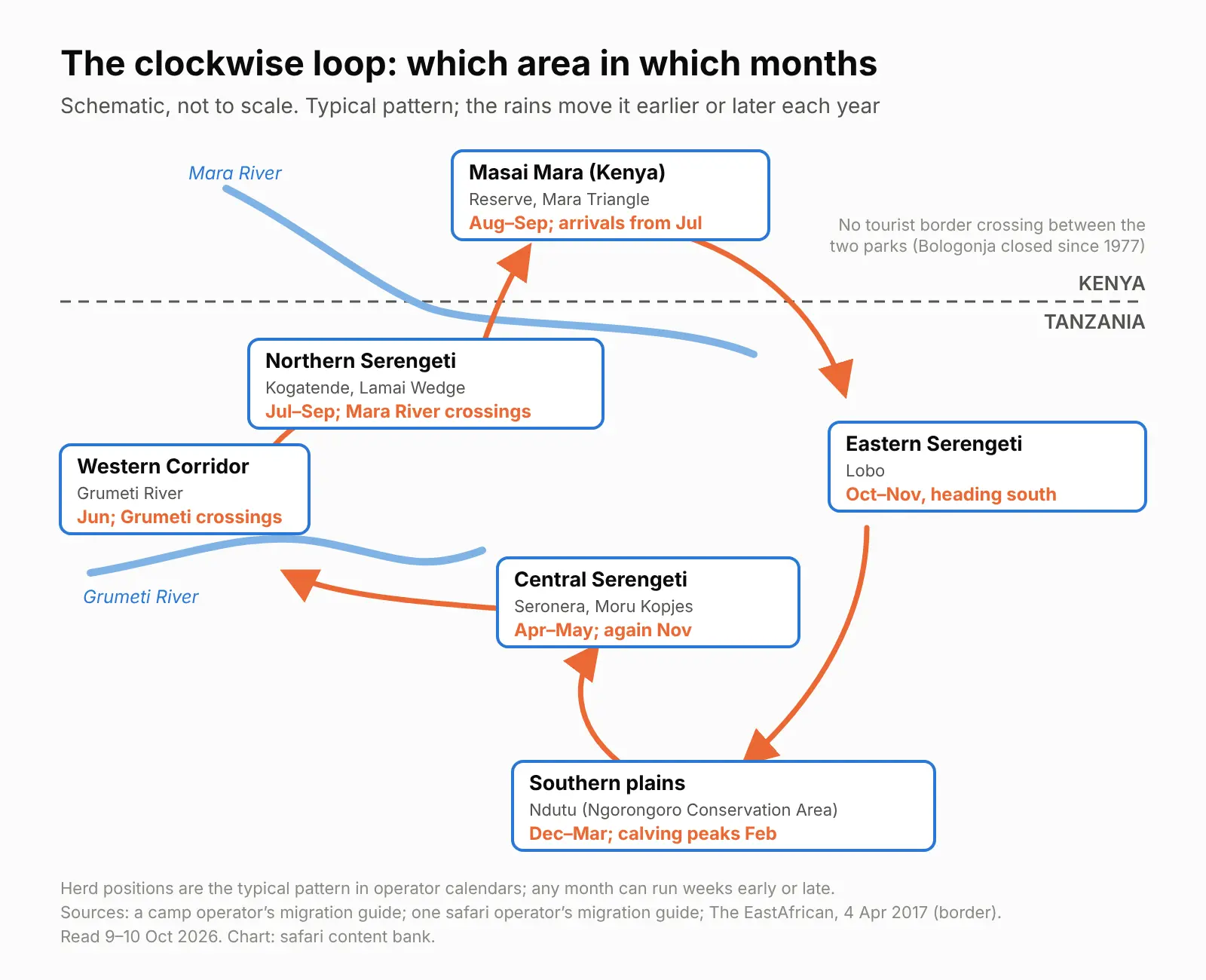 The herds move clockwise through one unfenced ecosystem; UNESCO describes “a 1,000 km long annual circular trek” (UNESCO World Heritage List). Schematic only. Sources: a camp operator’s migration guide; one safari operator’s guide; The EastAfrican, 4 April 2017.
Calving season: late January to mid-March at Ndutu
Calving peaks in February on the southern plains around Ndutu, compressed into two to three weeks (a camp operator’s migration guide; one tour operator’s guide, Nov 2021). Another safari operator’s guide says most calves are born “in a short window around February”. Camps, fees and dates: Serengeti calving season.
- Calving happens only in Tanzania. The Masai Mara has resident game in January–March, not the migrating herds (a camp operator’s Mara vs Serengeti guide).
- Late February is still calving. Experienced forum posters say the herds “usually stay till the middle of March” (TripAdvisor Serengeti forum).
- Late March is the edge of the window. The Tanzania Wildlife Research Institute (TAWIRI) survey at the end of March 2023 found the lowest wildebeest density on the south-east Ndutu plains and the highest on the plains running north and north-west (TAWIRI 2023 census, §3.2 (PDF)).
- February is the driest month of the wet season on the southern plains (a camp operator’s migration guide).
Ndutu has its own fees, because it is in the NCA. Entry is US$70.80 per adult per 24 hours, single entry, and lodges at Ndutu add US$59 per person per night concession (NCAA, read 9 Oct 2026). The Naabi and Kusini plains are inside the national park, where Serengeti entry applies: US$82.60 per adult per day to 14 March, US$70.80 from 15 March (last published tariff, 2023/24). The usual road from Arusha crosses the NCA, and NCA entry is single-entry, so a vehicle that drives in and back out the same way pays it twice.
River crossings by month, and why there are no published odds
Grumeti River crossings happen in about the first half of June, and Mara River crossings typically from July to October, with August the month all calendars agree on. We found no published probability or odds figure for seeing a crossing in any month, from an authority, a researcher or an operator. Anyone quoting a percentage is guessing. Banks, camps and costs: Great Migration river crossings.
| Month | Grumeti River (Western Corridor, Tanzania) | Mara River, Tanzanian bank (Kogatende, Lamai) | Mara River, Kenyan bank (reserve, Mara Triangle) | Published odds |
|---|---|---|---|---|
| January–May | No crossings | No crossings | No crossings | None |
| June | Crossings, about the first half of June | No crossings | Usually none yet | None |
| July | – | Crossings begin; lead herds at Kogatende | First arrivals; first 2026 crossings reported in the second week of July | None |
| August | – | Crossings, mostly south to north | Crossings | None |
| September | – | Crossings in both directions | Crossings in both directions | None |
| October | – | Tail end; crossings can run into early October | Herds leave during the month | None |
| November–December | No crossings | No crossings | No crossings | None |
Sources: a camp operator’s migration guide; one tour operator’s guide, Nov 2021; Mara Conservancy; a Mara camp operator’s migration page; 2026 first crossings: TripAdvisor Masai Mara forum. Read 9–10 Oct 2026.
What a crossing day is like
Seeing a crossing usually means waiting at the river for hours, with other vehicles, and giving up other game drives.
- “Hours and days and even weeks can go by between crossings”, and “it is not uncommon for fifty or more trucks to be parked” at a crossing point, according to a regular on the Serengeti forum (TripAdvisor).
- Herds may wait on the bank for days or cross at once (one tour operator’s guide).
- The Grumeti is a smaller river with a shorter window than the Mara, and harder to time (a camp operator’s migration guide; one tour operator’s guide).
- Mara conservancy camps are away from the crossing points. Conservancy guests drive into the reserve for a crossing day and pay the reserve fee for that day: US$200 per adult from July to December, on top of the conservancy’s US$130 per adult per night (Kicheche 2026 rack rates).
Book river-front camps early. One safari operator advises 12–18 months ahead for July–October and 6–12 months off-peak (page modified 6 Oct 2026). Forum regulars say 9–12 months, and call planning in March for the same July “very late” (TripAdvisor Masai Mara forum).
Serengeti or Masai Mara: which side in which month
From December to June the herds are only in Tanzania; from July to October they are on both sides of the Mara River, and the date decides which side is better.
| You can travel in | Go to | Why | Source |
|---|---|---|---|
| January–March | Ndutu and the southern Serengeti | Calving and predators; Tanzania only | A camp operator’s migration guide |
| April–May | Central Serengeti (Seronera, Moru), and accept rain | Columns on the move; long rains | A camp operator’s migration guide; one safari operator’s guide |
| June | Western Corridor, Grumeti | Grumeti crossings, before July–September fees | A camp operator’s migration guide |
| Early to mid-July | Northern Serengeti (Kogatende) rather than the Mara | Lead herds reach northern Tanzania first. A destination expert: “Most years you would not find the migration in the Masai Mara as early as July 11-15” | TripAdvisor |
| August–September | Either bank of the Mara River | Choose by the rest of the trip and by budget. Kogatende and Lamai lie across the river from the Mara Triangle | A camp operator’s Mara vs Serengeti guide |
| October | Northern Serengeti early in the month; Lobo later | Tail end crosses back south | A camp operator’s migration guide; one tour operator’s guide |
| November–December | Eastern and central Serengeti, then south | Herds in transit; short rains | A camp operator’s migration guide |
Moving between the two sides takes a day. The Bologonja / Sand River crossing between the parks has been closed since 1977 (The EastAfrican, 4 Apr 2017). The options are a flight via Migori and Tarime, the road round through Isebania–Sirari, or Nairobi–Namanga–Arusha. Inside Tanzania, Seronera to Kogatende is published as 4–5 hours by road (one operator’s airstrip page); most travellers fly it.
The Mara has a smaller migration of its own. The resident Loita herd moves into Ol Kinyei Conservancy “usually by January”, calves in February–March, then moves through Naboisho into Olare Motorogi (a Kenyan camp operator’s Loita migration page). It is not the Serengeti migration, and it has shrunk from 122,790 wildebeest in 1977 to 23,510 in 2016 (Narok County GMME Management Plan 2023–2032 (PDF)).
Park fees by month on the migration route
The Serengeti costs US$129.80–153.40 per adult per night sleeping inside the park, depending on the date (last published tariff, 2023/24); the Masai Mara reserve costs US$100 per adult per day from January to June and US$200 from July to December. Both peaks fall in July–September, the Mara River crossing months.
| Dates | Serengeti entry, per day (with 18% VAT) | Serengeti concession, per night inside the park | Serengeti total per night inside | Masai Mara reserve, per 12-hour day |
|---|---|---|---|---|
| 1 Jan–14 Mar | US$82.60 | US$59 | US$141.60 | US$100 |
| 15 Mar–15 May | US$70.80 | US$59 | US$129.80 | US$100 |
| 16 May–30 Jun | US$82.60 | US$59 | US$141.60 | US$100 |
| 1 Jul–30 Sep | US$82.60 | US$70.80 | US$153.40 | US$200 |
| 1 Oct–31 Dec | US$82.60 | US$59 | US$141.60 | US$200 |
Non-East African / non-resident adult. Sources: TANAPA Tariffs 2023/24 (PDF), the last published tariff (no newer TANAPA tariff had been published on 9 Oct 2026); Narok County fee schedule FY2025/26 (PDF), the last published (no 2026/27 schedule as of 9 Oct 2026).
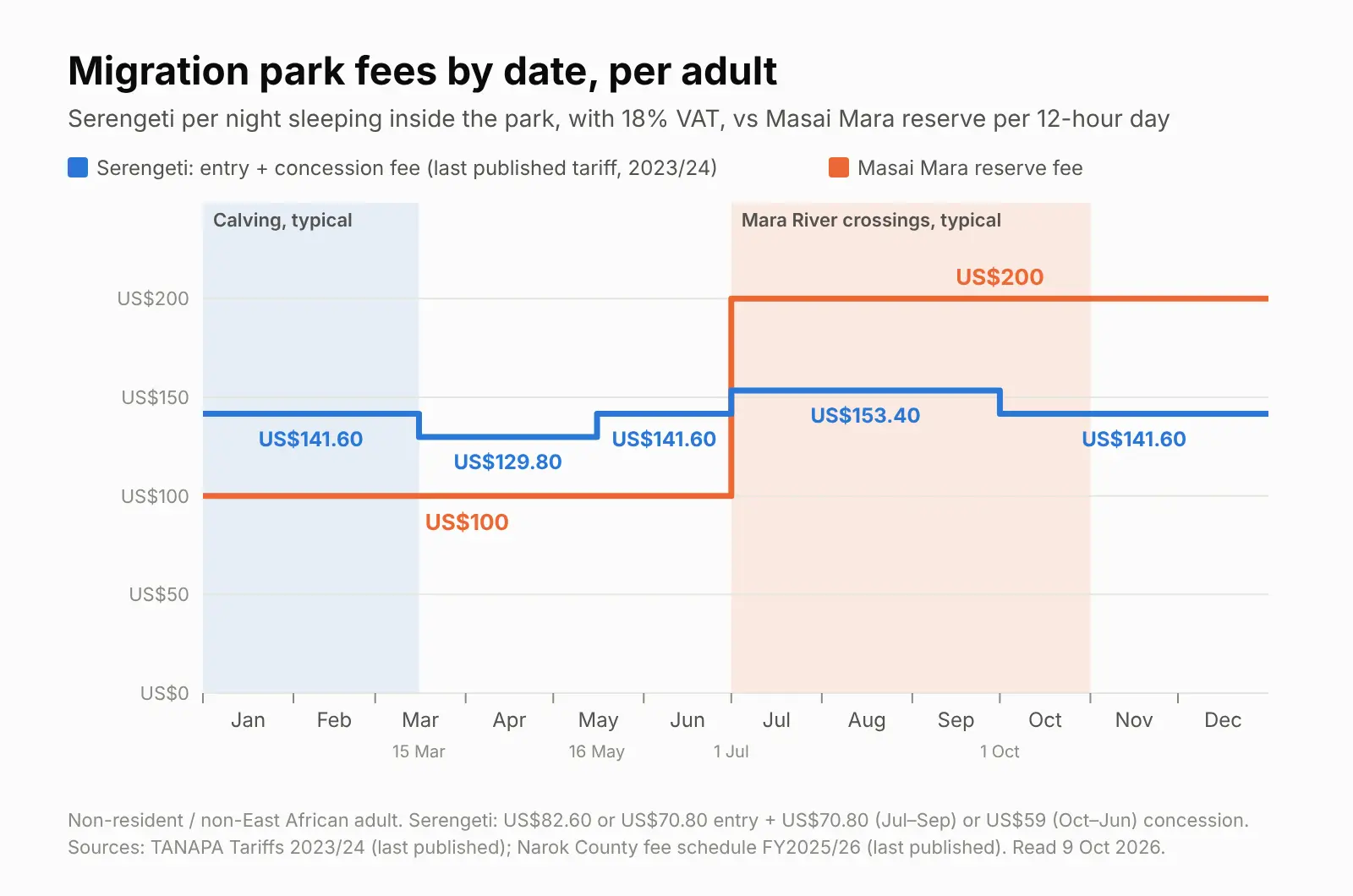 Serengeti: TANAPA Tariffs 2023/24, the last published tariff. Masai Mara: Narok County fee schedule FY2025/26, the last published. Read 9 October 2026.
- The Serengeti’s cheapest dates (15 March–15 May) are the long rains, when the herds are moving through the south and centre of the park.
- The Mara’s cheaper half (January–June) has no migrating herds in it. Its fee doubles on 1 July, as the first arrivals come.
- A Mara ticket lasts 12 hours, 06:00–18:00, and you need one for every calendar day in the reserve, whether you sleep inside or outside it (Narok County FY2025/26 schedule).
- Ngorongoro Crater adds US$295 per vehicle per descent if you combine a calving safari with the crater (NCAA, read 9 Oct 2026).
The official fee lines, with the date each took effect and the authority’s own source:
| Fee | Amount | In force from | Source |
|---|---|---|---|
| Serengeti and Nyerere National Parks, non-East African adult, entry per day, 16 May–14 Mar | USD 70 + 18% VAT = USD 82.60 | 1 Jul 2023 (2023/24 tariff, last published) | TANAPA Tariffs 2023/24 |
| Serengeti and Nyerere National Parks, non-East African adult, entry per day, 15 Mar–15 May | USD 60 + 18% VAT = USD 70.80 | 1 Jul 2023 (2023/24 tariff, last published) | TANAPA Tariffs 2023/24 |
| Serengeti and Nyerere, concession fee per person per night inside the park | Jul–Sep USD 60 + VAT = USD 70.80; Oct–Jun USD 50 + VAT = USD 59 | 1 Jul 2023 (2023/24 tariff, last published) | TANAPA Tariffs 2023/24 |
| Ngorongoro Conservation Area, non-East African adult, entry per 24 h (single entry) | USD 70.80 (NCAA's page does not say whether VAT is included) | Undated official page, read 9 Oct 2026 | NCAA |
| Ngorongoro concession fee, rim and Ndutu lodges, per person per night | USD 59 (NCAA's page does not say whether VAT is included) | Undated official page, read 9 Oct 2026 | NCAA |
| Maasai Mara National Reserve, non-resident adult, per day (12-hour ticket, 06:00–18:00), 1 Jan–30 Jun | USD 100 | Since 1 Jan 2024; Narok County FY2025/26 schedule, the last published | Narok County fee schedule FY2025/26 |
| Maasai Mara National Reserve, non-resident adult, per day (12-hour ticket, 06:00–18:00), 1 Jul–31 Dec | USD 200 | Since 1 Jul 2024; Narok County FY2025/26 schedule, the last published (no 2026/27 schedule as of 9 Oct 2026) | Narok County fee schedule FY2025/26 |
Where to base yourself: areas and camps by season
Base in the area the herds usually occupy that month, or in a mobile camp that moves with them. One safari operator’s area guide: southern plains and Ndutu for December–March, the Western Corridor for May–July, the northern Serengeti and Mara River for July–October, and Seronera for resident big cats all year but “always busy”.
| Area | Best months for the herds | Examples (agent and operator pages) | Source |
|---|---|---|---|
| Ndutu and the southern plains (NCA and southern Serengeti) | December–March | Lake Masek Tented Camp (“ideal Dec–Apr”); Ndutu Safari Lodge (“books early for calving”) | One operator’s area guide |
| Central Serengeti (Seronera, Moru) | April–May, November | Resident cats all year; busy | One operator’s area guide |
| Western Corridor (Grumeti) | May–July | Mbalageti Lodge (“best Apr–Jun migration”); Grumeti River Lodge | One operator’s area guide |
| Northern Serengeti (Kogatende, Lamai Wedge) | July–October | Lamai Serengeti and Sayari Camp, both near the Mara River | One operator’s area guide |
| Masai Mara reserve, riverside (Mara Triangle, Musiara) | Mid-July to mid-October | Riverside camps suit crossing-watchers but get busy in peak season | One operator’s area guide |
| Mara conservancies | July–October (crossings next door); January–March (Loita calving) | Fewer vehicles; reaching the river takes longer. Kicheche’s three Mara camps close for about April to late May | One operator’s area guide; Kicheche 2026 |
- Mobile camps “move with the herds and offer the closest access” (one tour operator’s guide). Lemala Mara-Ndutu, for example, runs its northern (Mara River) site June–October and its Ndutu site December–March (Lemala rates).
- A camp’s name is not its location. Forum regulars warn that camps with “Mara” in the name can be far from the river, and chain-brand camps can be outside the park (TripAdvisor). Check the camp’s sector on a map against the month.
Common mistakes about the migration calendar
| What you’ll often read | What is correct |
|---|---|
| “The migration is in the Masai Mara from July” | In early to mid-July most of the herds are usually still in the northern Serengeti. The Mara usually fills in August–September. |
| “See the migration in the Mara in June” | Usually not. In June the herds are typically in the Western Corridor, in Tanzania (a camp operator’s migration guide). |
| “Calving is in the Serengeti National Park” | The calving plains around Ndutu are in the Ngorongoro Conservation Area, with NCA fees (US$70.80 entry per 24 h). |
| “Calving runs through March” | By the end of March 2023 the herds were already leaving Ndutu (TAWIRI). Late March is the edge of the window. |
| “A river crossing is guaranteed in August” or “an X% chance of a crossing” | No source guarantees a crossing or publishes odds. The Mara Conservancy calls crossings “difficult to predict”. |
| “2 million wildebeest” | TAWIRI’s end-of-March 2023 aerial count was 1,366,109 wildebeest (± 231,741 SE). Quote a count with its method and year. |
| “The Loita herd in the conservancies is the Great Migration” | It is a separate Kenyan herd, down to 23,510 animals in 2016 (Narok County plan). |
| “Drive from the Mara into the Serengeti” | The border crossing between the parks has been closed since 1977. |
Frequently asked questions
What is the best month to see the Great Migration? It depends on what you want to see. February is the peak of calving at Ndutu, June is the usual month for Grumeti River crossings, and August is the one month every Mara River calendar agrees on (a camp operator’s migration guide). The rains can shift any of these by weeks.
When are the Mara River crossings? Typically from July to October, with August–September the busiest, on both the Tanzanian bank (Kogatende, Lamai) and the Kenyan bank (Masai Mara). In 2026 the first crossings were reported in the second week of July (TripAdvisor). No one can date a crossing in advance.
What are the odds of seeing a river crossing? No reliable figure exists. We found no authority, researcher or operator that publishes a probability of seeing a crossing in a given month, and the Mara Conservancy says crossings are “difficult to predict”. Waiting for hours at the river is normal; more days near the river in August–September is the only lever.
Where is the migration in December? Usually spreading from Lobo in the eastern Serengeti south toward Ndutu, where the herds settle ahead of calving (a camp operator’s migration guide). One safari operator’s guide has them arriving on the short-grass plains around Ndutu in late November and December.
Is the migration in Kenya or Tanzania? Both, but mostly Tanzania. The herds are somewhere in the Serengeti ecosystem for most of the year and in Kenya’s Masai Mara usually from July to October. Calving happens only in Tanzania.
Can I see the migration in the Masai Mara in June? Usually not. In June the herds are typically in the Serengeti’s Western Corridor around the Grumeti River (a camp operator’s migration guide). The Mara Conservancy says the migration “usually starts somewhere in June-July”, so a very early year is possible but not the norm.
How many wildebeest are in the migration? TAWIRI’s aerial count at the end of March 2023 was 1,366,109 wildebeest, ± 231,741 standard error (TAWIRI 2023 census, Table 3.2). A 2025 satellite study counted “fewer than 600,000” in the area it imaged, and the two methods have not been reconciled (Mongabay, 3 Oct 2025).
Which month has the lowest park fees on the migration route? In the Serengeti, 15 March–15 May: US$129.80 per adult per night sleeping inside the park, with VAT (last published tariff, 2023/24). In the Masai Mara, January–June: US$100 per adult per day instead of US$200 (Narok County FY2025/26 schedule, the last published). Neither cheap period has the river crossings.
Sources
- A camp operator’s migration and Mara vs Serengeti guides, read 9 Oct 2026
- One safari operator’s guides to the Serengeti migration, the Serengeti migration area, the Masai Mara reserve and the Mara conservancies (names and links kept in our editor notes), read 9 Oct 2026
- Mara Conservancy, wildebeest migration; a Mara camp operator’s migration page, read 9 Oct 2026
- One tour operator’s migration guide, dated 9 Nov 2021; another operator’s Great Migration page, modified 6 Oct 2026 (names and links kept in our editor notes)
- TAWIRI, Wildebeest census 2023 (PDF); Mongabay, satellite counts, 3 Oct 2025; UNESCO, Serengeti National Park
- Narok County, GMME Management Plan 2023–2032 (PDF); a Kenyan camp operator’s Loita migration page
- TANAPA, Tariffs 2023/24 (PDF), the last published national parks tariff; NCAA, Tariffs, read 9 Oct 2026; Narok County, Maasai Mara fee schedule FY2025/26 (PDF), the last published
- The EastAfrican, Bologonja border, 4 Apr 2017; one operator’s Kogatende airstrip page (name and link kept in our editor notes)
- Camp pages: Lemala rates; Kicheche 2026 rack rates (PDF)
- Traveller reports: TripAdvisor Serengeti and Masai Mara forums, threads linked in the text, read 9 Oct 2026
Calendars and fees checked 10 October 2026. We will update this page when Narok County publishes a 2026/27 Mara fee schedule, when TANAPA publishes a new tariff, and after the 2027 calving season (March 2027) if the herds’ timing departs from this pattern.