 Experience

Last verified · Next check due
On this page
- What each camp type offers: activities compared (2026)
- How the flood changes activities by month
- Published camp rates by camp type (2024–2026 rate cards)
- Moremi Game Reserve: what the reserve’s rules mean for your camp
- Water plus land: what a combined stay costs
- Getting between a water camp and a land camp: bush flights and boats
- Which should you choose?
- Common mistakes when choosing an Okavango camp
- Frequently asked questions
- Sources
Short answer: Choose a water camp for mokoro, boats and birds, a land camp for big cats and game drives, or split your nights between one of each. Boats run all year on permanent water but only from about late May to September on the seasonal floodplains (a Botswana camp operator’s seasonal guide). Published rates run from US$645–1,160 per person a night at water-first Xugana (Desert & Delta, 2024) to US$2,150–3,950 at dry-land Duba Plains (Great Plains, 2025).
Key facts
- The two camp types sell different trips. One UK safari operator describes the Delta’s water-first camps (Jacana, Setari, Pelo, Sitatunga, Xugana) as trading big game for mokoro and birding, and its dry-land camps (Chitabe, Duba Plains, Tubu Tree) as suiting predator viewing and off-road drives (a UK safari operator’s guide).
- Mokoro and boat trips need the flood. Water levels rise and fall by about 0.2 m a year in the permanent swamp and by more than 1.5 m in the seasonal swamp (IntechOpen review); seasonal camps run no boats in January and February (a Botswana camp operator’s seasonal guide).
- Night drives depend on the land, not the camp type. Botswana Tourism says “off-roading and night driving [are] prohibited” in the national parks and reserves, including Moremi Game Reserve, and that private concessions “provide opportunities for off-road driving and night drives” (Botswana Tourism).
- A water camp is a poor bet for big cats. In the Okavango Panhandle, one UK safari operator’s travellers saw sitatunga on 31% of trips and leopard on 0%; across the Delta’s reserves 73% saw leopard (that operator’s sighting statistics).
- One of each is the usual answer. Forum regulars pair a water camp with a dry-land camp, because at wet camps the time goes on water rather than drives (TripAdvisor forum); a light-aircraft seat costs US$250–594 one way before tax (Kwando and Desert & Delta, 2024).
What each camp type offers: activities compared (2026)
A water camp’s day is spent in a mokoro or boat, a land camp’s in a vehicle, and a camp inside Moremi Game Reserve drives only on its tracks and in daylight. The table sets out what each type of camp can offer, by activity. “Allowed” means the land permits it; whether your camp runs it, and in which month, is the camp’s decision.
| Activity | Water-first camp (private concession) | Land-and-water camp (private concession) | Dry-land camp (private concession) | Camp inside Moremi Game Reserve |
|---|---|---|---|---|
| Mokoro | The camp’s main activity (a UK safari operator’s guide) | On the seasonal floodplains, about late May to September (a Botswana camp operator’s seasonal guide) | Not what the operator sells these camps on; ask the camp | Not stated in our sources; ask the camp |
| Motorboat | Yes: the operator says water camps suit mokoro and boat fans | Seasonal; viable as water rises from May (Africa Geographic) | Ask the camp | Boats reach the Xakanaxa area: Kwando sells a boat transfer from Splash or Kwara to Xakanaxa, Camp Moremi or Okuti (2024) |
| Game drives | Few: these camps trade big game for mokoro and birding (a UK safari operator’s guide) | Yes, but less driveable ground in a big flood (traveller report, 2026) | The camp’s main activity: predator viewing and off-road drives (a UK safari operator’s guide) | Yes, on the tracks |
| Night drives | Allowed on concession land (Botswana Tourism) | Allowed on concession land | Allowed on concession land | No: “night driving [is] prohibited” in the parks and reserves (Botswana Tourism) |
| Off-road driving to a sighting | Allowed on concession land, “in moderation” (Botswana Tourism) | Allowed, “in moderation” | Allowed, “in moderation” | No (Botswana Tourism) |
| Walking | Usually offered on concessions | Usually offered on concessions | Usually offered on concessions | No: the operator says walking safaris are not permitted within the reserve |
| Example camps | Xugana, Sitatunga; Jacana, Pelo, Setari | Kwara, Splash, Okavango Explorers | Duba Plains; Chitabe, Tubu Tree | Camp Moremi, Camp Xakanaxa, Okuti; Mombo, Chief’s Island |
Camp types as one UK safari operator describes each camp on its Okavango Delta reserves pages (read September 2026; name and links in our editor notes). Rules: Botswana Tourism; walking in Moremi: the same operator’s Moremi page. Seasons: a Botswana camp operator’s seasonal guide; Africa Geographic. Boat transfer: Kwando 2024. Big-flood report: TripAdvisor forum, 2026. Read 10 October 2026.
- Mokoro trips are about quiet and birds, not big game: they focus on “silence and birdlife rather than large animals”, one forum regular says (TripAdvisor forum).
- Minimum age for a mokoro: 12 at Kwando, 8 at Great Plains (their rate cards). Kwando applies the same age 12 to walking (Kwando 2024).
- A big flood shrinks a land camp’s drives. A forum contributor reported GPS data showing under 5,000 hectares of driveable ground at Kwando’s 4 Rivers over three nights in 2026 (TripAdvisor forum). That is one traveller’s report, not an official figure.
- Which areas allow what is set out area by area on our page on where night drives, walking and off-road driving are allowed in Botswana.
How the flood changes activities by month
Mokoro and boat trips need the flood; game drives on the floodplains lose ground to it. On permanent water boats run all year; on the seasonal floodplains, from about late May to September. The table below is copied from our Okavango flood calendar, which explains where the water comes from and when it reaches each part of the Delta.
| Month | Where the flood is | Delta water (seasonal guides) | Sources |
|---|---|---|---|
| January | Rain on the Angolan highlands is at its heaviest (about January) | Low; no boating at seasonal camps | Africa Geographic; two camp operators’ seasonal guides |
| February | Peak discharge into the river system begins (February–April); the first pulse, from the Cubango river, typically reaches Mohembo in February–March | Low; levels at the far edges stop falling around February | IntechOpen; a safari company’s guide; a UK safari operator’s guide |
| March | The flood peak enters Botswana at Mohembo from mid-March | Levels start rising | A UK safari operator’s guide; two camp operators’ seasonal guides |
| April | Peak at Mohembo continues; Angolan rain ends | Rising | A safari company’s guide; a UK safari operator’s guide |
| May | Peak at Mohembo ends by mid-May; the second pulse, from the Cuito river, arrives around mid-May | Rising fast; highest water in most of the Delta begins; boating resumes late May | A safari company’s guide; a UK safari operator’s guide; a Botswana camp operator’s seasonal guide |
| June | Highest water in most of the Delta continues (May–August) | Near peak | A UK safari operator’s guide; UNESCO (peak around June–July); two camp operators’ seasonal guides |
| July | Largest flooded area begins (July–September) | Peak floodwaters | IntechOpen; two camp operators’ seasonal guides |
| August | Last month of highest water in most areas | Waters begin receding | A UK safari operator’s guide; two camp operators’ seasonal guides |
| September | Largest flooded area ends; levels fall | Receding; boating often stops at seasonal camps | IntechOpen; two camp operators’ seasonal guides |
| October | Angolan rain begins again | Low and falling; “some water activities may no longer be possible”, depending on the area | A safari company’s guide; Africa Geographic |
| November | Botswana’s own rains start | Lowest | Two camp operators’ seasonal guides |
| December | Rain in both Angola and Botswana | Low; a slight drop as new rains arrive | Two camp operators’ seasonal guides |
Typical timing, not a forecast. Sources: a UK safari operator’s Okavango flood guide; IntechOpen review; a safari company’s guide; UNESCO; Africa Geographic; two camp operators’ seasonal guides. Read 10 October 2026.
What the flood means for each activity, also from the flood calendar:
| Activity | When it works | Source |
|---|---|---|
| Mokoro and boats, seasonal floodplain | About late May to September; none in January–February | A Botswana camp operator’s seasonal guide; a camp operator’s best-time guide for Botswana |
| Mokoro at most camps | Seasonal; “reduced or stopped” when levels drop | A UK safari operator’s guide |
| Motorboats, wider Delta | Viable as water rises from May; by October some water activities may no longer be possible, depending on the area | Africa Geographic |
| Land activities | Best June–September | Africa Geographic |
| Game drives in a big flood | Less driveable ground on seasonal floodplains (traveller report, 2026) | TripAdvisor forum |
Read 10 October 2026.
What that means for the camp you pick, by season:
- January to March: water is low and seasonal camps run no boats in January and February. If a mokoro matters, only a camp on permanent water is a safe choice: camps on permanent water can pole for longer, because their water level moves only about 0.2 m a year (IntechOpen review). Each group’s lowest season falls in these months (rate table below).
- April and May: the water rises; boating at seasonal camps resumes in late May (a Botswana camp operator’s seasonal guide). Red lechwe rut in May, as the flood arrives (a Botswana camp operator’s seasonal guide).
- June to September: the one stretch when both camp types work: land activities are best June–September (Africa Geographic) and the seasonal floodplains have boats until about September. Every group in our sources charges its top rate in some or all of these months.
- October: game viewing stays strong, but October is the hottest month, above 40°C at times (two camp operators’ seasonal guides), and “some water activities may no longer be possible” in some areas (Africa Geographic). On one forum thread, regulars warned a family that by October the flood has receded, so a water camp may be poorer value (TripAdvisor forum).
- Any month: if a mokoro or boat trip is the reason you are going, pick a camp on permanent water; if big cats are, make sure the camp drives on dry ground in your month. Camps do not price the size of the flood, and no camp can promise it.
Published camp rates by camp type (2024–2026 rate cards)
Water-first camps publish US$645–2,935 per person a night, land-and-water camps US$690–2,100, the dry-land Duba Plains US$2,150–3,950, and camps inside Moremi US$645–5,345, lowest to highest season. Camp type does not set the price: the group, the concession and the season do. Figures match our Botswana safari cost page where a camp appears there.
| Camp type | Camp (group), area | Low → peak, per person per night | Season dates | Rate card |
|---|---|---|---|---|
| Water-first | Xugana Island Lodge (Desert & Delta), Delta | US$645 → 895 → 1,160 (1–4 nights) | Green Jan–Mar, Dec → Shoulder Apr, May, Nov → Peak Jun–Oct | Desert & Delta 2024 |
| Water-first | Sitatunga Private Island (Great Plains), Sitatunga Private Reserve | US$1,550 → 1,965 → 2,935 | Green 11 Jan–31 Mar → Shoulder → Peak 15 Jun–31 Oct, 20 Dec–10 Jan | Great Plains 2025 |
| Water-first | Jacana, Pelo, Setari | No published rate in our sources | ||
| Seasonal mokoro | Pom Pom (Kwando), central Delta | US$690 → 1,750 | 5 Rivers 15 Nov–31 Mar → Flood Jul–Oct | Kwando 2024 |
| Land and water | Splash (Kwando), Kwara concession | US$690 → 1,750 | 5 Rivers 15 Nov–31 Mar → Flood Jul–Oct | Kwando 2024 |
| Land and water | Kwara (Kwando), Kwara concession | US$820 → 2,100 | 15 Nov–31 Mar → Jul–Oct | Kwando 2024 |
| Land and water | Okavango Explorers (Great Plains) | US$1,105 → 1,330 → 1,915 | Green 11 Jan–31 Mar → Shoulder → Peak 15 Jun–31 Oct, 20 Dec–10 Jan | Great Plains 2025 |
| Dry land | Duba Plains (Great Plains), Delta, NG 23 | US$2,150 → 2,733 → 3,950 | as Great Plains above | Great Plains 2025 |
| Dry land | Chitabe, Tubu Tree | No published rate in our sources | ||
| Inside Moremi | Camp Moremi, Camp Xakanaxa (Desert & Delta) | US$645 → 895 → 1,160 (1–4 nights) | Green Jan–Mar, Dec → Shoulder Apr, May, Nov → Peak Jun–Oct | Desert & Delta 2024 |
| Inside Moremi | Mombo (Wilderness), Chief’s Island | US$3,062 → 5,345 | Jan–Mar → Jun–Oct, December holidays | Wilderness |
| No camp: guided mokoro trip from Maun | 3-day private mokoro overnight, US$641–664; 2-day mokoro trip, US$557–613 | US$214–307 per person per day (our sum) | Operators’ published prices (2 listings) |
Per person per night sharing, fully inclusive of meals and activities. Camp types as one UK safari operator describes each camp (its Okavango Delta reserves pages, read September 2026); “Inside Moremi” is the land, not a type. Levies on top: Great Plains US$100 per person per night plus a separate conservation levy, Kwando US$20; Desert & Delta includes park fees, levies and 14% VAT; Wilderness includes park fees at Mombo. Great Plains includes scheduled air from Maun or Kasane on stays of 2+ nights. Rate cards: Kwando and Desert & Delta 2024, Great Plains 2025, Wilderness 2026–27, the latest from those groups in our sources. Mokoro trips: operators’ listings captured 9 September 2026, divided by days (our sum). Checked 10 October 2026.
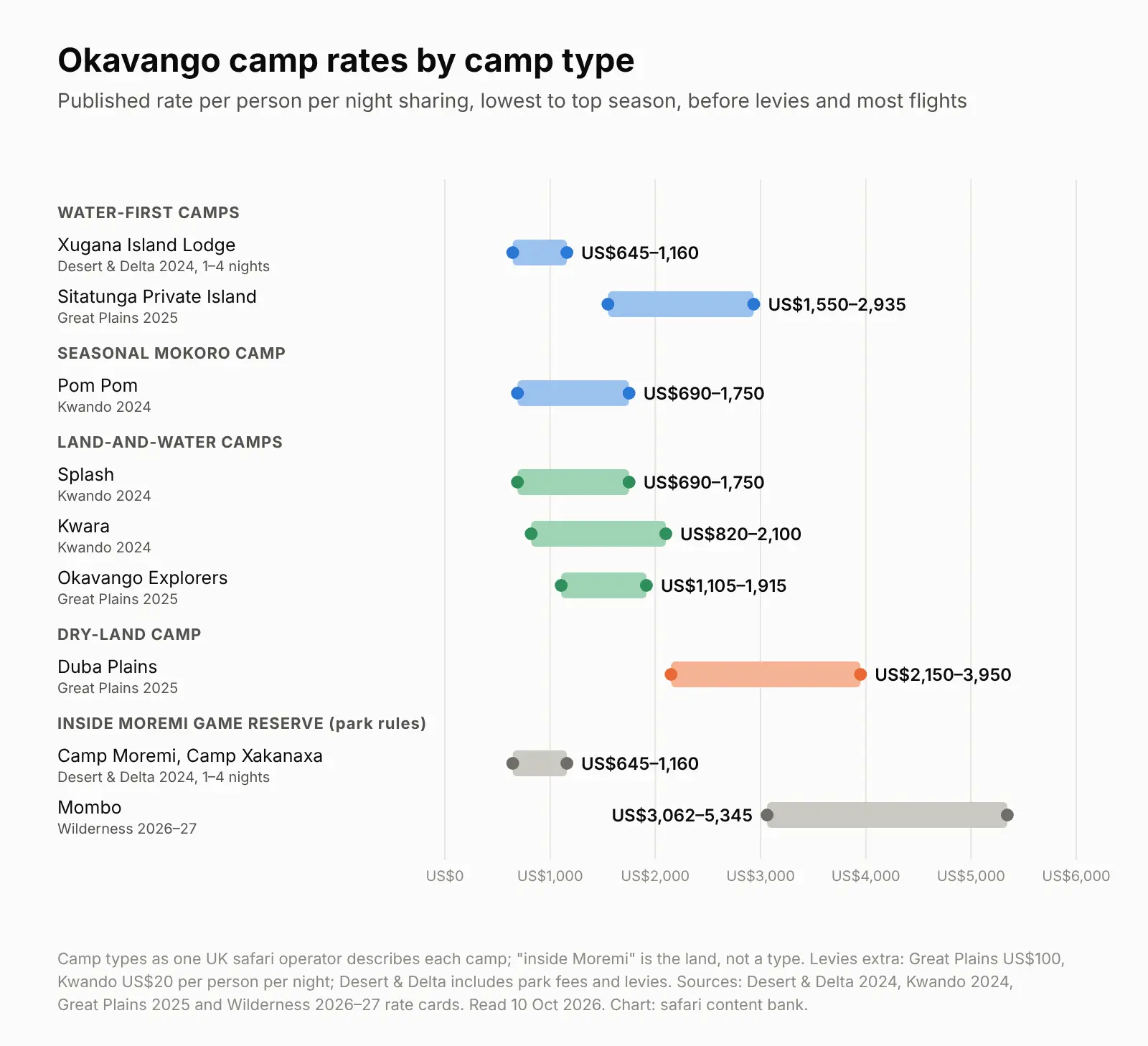 Per person sharing, before levies and most flights. Camp types as described by one UK safari operator. Sources: operators’ rate cards as in the table. Read 10 October 2026. Chart: safari content bank.
- The same rate buys either type inside one group. Kwando charges Pom Pom, a seasonal mokoro camp, and Splash, a land-and-water camp, the same US$690–1,750; Desert & Delta charges water-first Xugana and Camp Moremi inside the reserve the same US$645–1,160 (2024 cards).
- No Wilderness water camp publishes a rate. Wilderness published rates for only Mombo and Vumbura Plains when we checked, so Jacana, Pelo, Chitabe and Tubu Tree are sold on quotation (Botswana safari cost page).
- Every group charges its top rate in the high-water, dry-season months. Kwando calls July–October its “Flood” season; Desert & Delta’s Peak is June–October; Great Plains’ Peak runs 15 June–31 October.
- Longer stays cost less inside one group. Desert & Delta’s standard camps fall from US$645 (1–4 nights) to US$581 (5–6 nights) and US$561 (7+ nights) in Green season (2024 card).
Moremi Game Reserve: what the reserve’s rules mean for your camp
Moremi Game Reserve is the one part of the Delta where the rules, not the camp, take night drives off the list. Botswana Tourism states that in the national parks and reserves “off-roading and night driving [are] prohibited”, while “private concession areas outside the parks and reserves provide opportunities for off-road driving and night drives” (Botswana Tourism). Moremi is a game reserve run by the Department of Wildlife and National Parks (DWNP).
- Walking: one UK safari operator’s Moremi guide says walking safaris are not permitted within the reserve.
- Water inside Moremi: Kwando sells a boat transfer from Splash or Kwara to Xakanaxa, Camp Moremi or Okuti at US$120 per person one way, minimum 2 (Kwando 2024), and one UK safari operator describes Okuti, in the Xakanaxa area, as offering boating all year.
- Mombo is inside Moremi, on Chief’s Island. Its rate is in the table above; we make no claim about which activities it runs. Ask the camp what it offers on your dates.
- The game is strong despite the rules: 76% of one UK safari operator’s travellers in Moremi saw a leopard and 65% wild dog (that operator’s sighting statistics). The rules limit how you approach animals, not which animals are there.
- For night drives next to Moremi, the Khwai concessions by North Gate allow night drives, off-road driving and guided walks (a safari sales site’s Khwai guide). Each area’s rules are on night drives and walking in Botswana; Moremi against Chobe is on Moremi vs Chobe.
Moremi park fees
The last published DWNP schedule charges non-residents P270 per person per day in Moremi Game Reserve; no official current tariff is published. In February 2026 the government news agency BOPA described the existing non-resident fee as P380 and reported a rise to P500 from 1 April 2026 (Botswana Daily News, 24 Feb 2026). The rise was then reported postponed; on 5 May 2026 Gabz FM reported the delay as two years (Gabz FM). Confirm the fee with DWNP or your operator before you travel.
The fee line with its date and source:
| Fee | Amount | In force from | Source |
|---|---|---|---|
| Chobe National Park and Moremi Game Reserve (DWNP), non-resident adult, per person per day | BWP 270 (SADC residents BWP 205; Botswana citizens and residents BWP 30) | Last published DWNP schedule, 1 April 2022 (via Tourism Update). In Feb 2026 the government news agency BOPA called the existing non-resident fee P380; a P500 rise was announced, then reported postponed. No official current tariff: confirm with DWNP or your operator | Tourism Update, 23 Feb 2022 (DWNP fee schedule) |
- Camps inside Moremi include the fee in the rate. Desert & Delta (Camp Moremi, Camp Xakanaxa) and Wilderness (Mombo) include park fees in their rates (Botswana safari cost page).
- On a private concession the fee is usually bundled into the rate, plus a camp levy: US$20 per person per night at Kwando (2024) and US$100 at Great Plains (2025). Children’s rates and payment rules are on Botswana park fees.
Water plus land: what a combined stay costs
Three nights in a water camp and three in a land camp cost US$3,870–6,960 per person inside Desert & Delta, US$4,650–11,670 inside Kwando and US$11,700–21,255 inside Great Plains, rate plus levy, lowest to top season (our sums from the 2024–2025 rate cards). Staying inside one group keeps the rate structure and, at Great Plains, the flights in one place.
| Combination (group) | Water nights | Land nights | 6 nights per person, rate + levy, low → top (our sum) | Flights |
|---|---|---|---|---|
| Desert & Delta (2024) | 3 at Xugana Island Lodge, US$645–1,160 | 3 at Camp Moremi or Camp Xakanaxa, inside Moremi, US$645–1,160 | US$3,870 → 6,960 (park fees, levies, VAT included) | US$284–594 a seat per sector, plus US$20 departure tax on legs from Maun |
| Kwando (2024) | 3 at Pom Pom, US$690–1,750 | 3 at Kwara, US$820–2,100 | US$4,650 → 11,670 (incl. US$20 levy × 6) | Maun–Pom Pom and Kwara–Maun US$250 each, plus US$25 Maun departure tax; no Pom Pom–Kwara fare published |
| Great Plains (2025) | 3 at Sitatunga Private Island, US$1,550–2,935 | 3 at Duba Plains, US$2,150–3,950 | US$11,700 → 21,255 (incl. US$100 levy × 6; separate conservation levy not priced) | Scheduled air from Maun or Kasane included on 2+ nights; helicopter transfer to Sitatunga from the Duba reserve included |
| Budget, no fly-in camp | Mokoro in the Delta | Camping in Moremi | US$1,350 for 5 days, park fees included (one operator’s published price, about US$270 a day) | Transport from Maun included |
Our sums: 3 × lowest + 3 × lowest rate, and 3 × top + 3 × top rate, plus each group’s per-night levy × 6. Desert & Delta: 6 × US$645 = US$3,870 and 6 × US$1,160 = US$6,960, at the 1–4-night rate for each stay. Kwando: 3 × US$690 + 3 × US$820 + US$120 = US$4,650; 3 × US$1,750 + 3 × US$2,100 + US$120 = US$11,670. Great Plains: 3 × US$1,550 + 3 × US$2,150 + US$600 = US$11,700; 3 × US$2,935 + 3 × US$3,950 + US$600 = US$21,255. Sources: Desert & Delta 2024, Kwando 2024, Great Plains 2025, one operator’s published price (captured 9 September 2026). Read 10 October 2026.
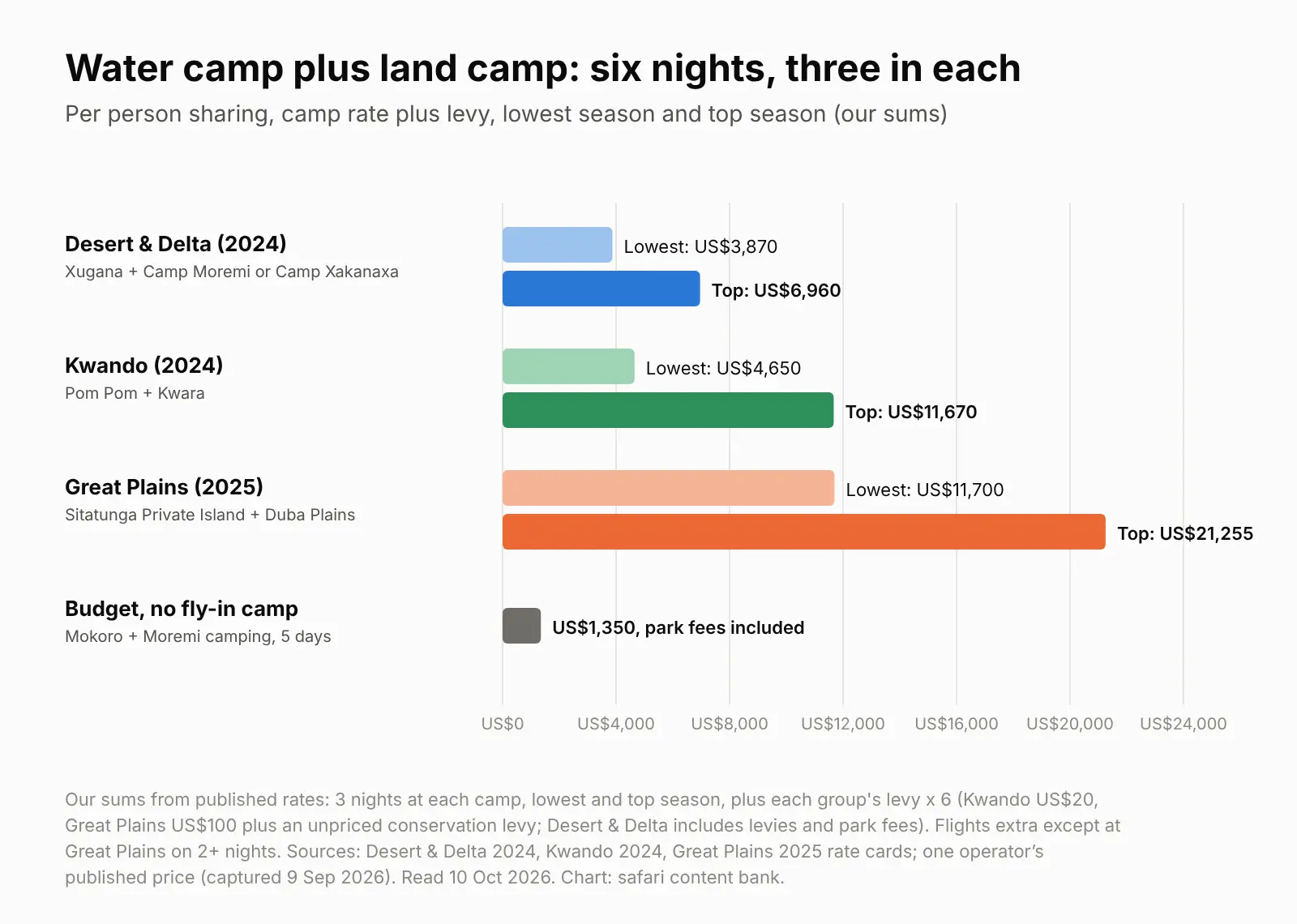 Our sums from operators’ rate cards (Desert & Delta 2024, Kwando 2024, Great Plains 2025) and one operator’s published price, before most flights and tips. Read 10 October 2026. Chart: safari content bank.
- The pairings forum regulars name are Chitabe with Vumbura, Chitabe with DumaTau, Pom Pom with Kwara, and Lagoon or Lebala with Pom Pom (TripAdvisor forum). These are traveller suggestions, not operator packages.
- Check the closures in low season. Desert & Delta’s 2024 card closed Camp Xakanaxa from 31 January to 14 February, Camp Moremi and Xugana from 15 February to 1 March (Desert & Delta 2024).
- Six nights in one group may fall into a cheaper band. Desert & Delta’s 5–6-night rate is US$581–1,044 a night (2024); ask whether it applies across two of its camps.
- Put the water camp in the right month. From November to April, only a camp on permanent water is a safe mokoro choice; from late May to September a seasonal-floodplain camp has boats too (a Botswana camp operator’s seasonal guide).
Getting between a water camp and a land camp: bush flights and boats
Most camp-to-camp moves are by light aircraft, at US$250–594 per person per sector before tax unless the camp includes the flight; a few camps are linked by boat. Airlines, schedules and luggage limits are on bush flights from Maun and Kasane.
| Transfer | Price per person, one way | Source |
|---|---|---|
| Moremi Air, Maun → Kwara, Splash, 4 Rivers, Pom Pom, Dinare | US$250 | Kwando 2024 |
| Desert & Delta, seat between camps | US$284–594 | Desert & Delta 2024 |
| Departure tax, Maun or Kasane | US$20–25 per departing leg | both rate cards |
| Great Plains camps, stays of 2+ nights | Scheduled air from Maun or Kasane included | Great Plains 2025 |
| Boat: Splash or Kwara → Xakanaxa, Camp Moremi or Okuti | US$120 (minimum 2) | Kwando 2024 |
2024 and 2025 rate cards, the latest in our sources. Moremi Air fares exclude CAAB, security and departure taxes. Read 10 October 2026.
- The luggage limit is 20 kg per person, including hand luggage, in a soft bag (Ker & Downey, Mack Air, Great Plains, Kwando; see bush flights).
- A transfer day costs game-viewing time. Forum regulars report that light-aircraft transfers cluster around midday, and reckon a 2-2-2-1 itinerary loses about a third of its game-viewing time to logistics (TripAdvisor forum). These are traveller reports, not an operator rule.
- Light aircraft do not fly at night, and Botswana Tourism lists Maun’s port hours as 07:30–16:30 (Botswana Tourism, Ports of Entry). A late regional arrival means a night in Maun.
Which should you choose?
Pick by the one thing you most want to do, then check the month.
| If you want… | Choose | Why |
|---|---|---|
| A mokoro trip, whatever the month | Water camp on permanent water | Permanent water moves about 0.2 m a year (IntechOpen review); seasonal camps run no boats in January–February |
| Big cats and wild dog | Dry-land or land-and-water camp on a concession, or Moremi | One UK safari operator sells dry-land camps on predator viewing; in the Panhandle its travellers saw leopard on 0% of trips |
| Night drives or walking | A concession camp, not a camp inside Moremi | Botswana Tourism says night driving is prohibited in the parks and reserves |
| Both, on one trip | One water camp and one land camp, June–September | Land activities are best June–September and seasonal camps have boats until about September |
| The lowest fly-in rate | Desert & Delta or Kwando in low season | US$645 (Xugana, Camp Moremi) and US$690 (Pom Pom, Splash) a night, 2024 cards |
| Water without a fly-in camp | A guided mokoro trip from Maun | US$214–307 per person per day (operators’ listings, our sum) |
| A family with children under 12 | Check each camp’s age rules first | Kwando’s minimum age for mokoro is 12, Great Plains’ is 8 |
Sources as in the sections above. Read 10 October 2026.
See also: Okavango Delta vs Serengeti and Okavango Delta vs Kruger.
Common mistakes when choosing an Okavango camp
| What you’ll often read | What is correct |
|---|---|
| “Every Okavango camp offers mokoro trips” | Mokoro needs water. Seasonal camps run no boats in January and February, and mokoro is “reduced or stopped” at most camps when levels drop (a Botswana camp operator’s seasonal guide; a UK safari operator’s guide). |
| “A water camp is a good base for big cats” | One UK safari operator says water-first camps trade big game for mokoro and birding. In the Panhandle its travellers saw leopard on 0% of trips. |
| “A high-water year is better for everything” | Not for game drives on the floodplains. In 2026 a traveller reported under 5,000 hectares of driveable ground at 4 Rivers over three nights (TripAdvisor forum). |
| “A luxury camp in Moremi includes night drives” | Botswana Tourism says night driving is prohibited in the parks and reserves. Night drives happen on the concessions. |
| “Water camps cost more (or less) than land camps” | Type does not set the price. Kwando charges Pom Pom and Splash the same US$690–1,750; Desert & Delta charges Xugana and Camp Moremi the same US$645–1,160 (2024). |
| “Peak price means peak water” | Camps price the season, not the flood. No rate card in our sources changes with the flood’s size. |
| “Botswana park fees are now P500” | The P500 rise was announced, then reported postponed. The last published DWNP schedule (1 April 2022) gives P270 for Moremi, and BOPA called the existing non-resident fee P380 in February 2026. No official current tariff is published. |
Frequently asked questions
Is a water camp or a land camp better for a first Okavango safari? For most first-timers who want big game, a land camp, or a land camp plus one water camp. One UK safari operator describes water-first camps as trading big game for mokoro and birding, and forum regulars pair a water camp with a dry-land camp for that reason. A water camp alone suits birders and travellers who want quiet.
Can I do a mokoro trip in January? Only at a camp on permanent water. Seasonal camps run no boats in January and February (two camp operators’ seasonal guides), and boating resumes there in late May. On permanent water the level moves only about 0.2 m a year, so camps there can pole for longer (IntechOpen review).
Do water camps run game drives? Some do, but they are not what water-first camps are for: one UK safari operator says they trade big game for mokoro and birding. The same operator describes Kwara and Splash as mixing land and water, though a big flood can shrink the driveable area. Ask the camp how much of its land is dry in your month.
Can I do a night drive in Moremi Game Reserve? No. Botswana Tourism states that “off-roading and night driving [are] prohibited” in the national parks and reserves, and Moremi is a DWNP game reserve. Night drives are offered on the private and community concessions, such as the Khwai concessions next to Moremi’s North Gate.
How much does a water camp plus a land camp cost? Six nights, three at each, cost US$3,870–6,960 per person at Desert & Delta (Xugana plus Camp Moremi or Camp Xakanaxa, 2024), US$4,650–11,670 at Kwando (Pom Pom plus Kwara, 2024) and US$11,700–21,255 at Great Plains (Sitatunga Private Island plus Duba Plains, 2025), rate plus levy (our sums). Flights are extra except at Great Plains on stays of 2+ nights.
How do I get from a water camp to a land camp? Usually by light aircraft: Moremi Air charged US$250 one way from Maun to Kwara, Splash, 4 Rivers or Pom Pom, and Desert & Delta US$284–594 a seat between camps (2024), plus US$20–25 departure tax on legs from Maun or Kasane. Kwando also sells a boat transfer from Splash or Kwara to Xakanaxa, Camp Moremi or Okuti for US$120 per person (minimum 2).
Which months suit both a water camp and a land camp? June to September. Land activities are best June–September (Africa Geographic), and seasonal-floodplain camps have boats from about late May to September (a Botswana camp operator’s seasonal guide). Every group in our sources charges its top rate in some or all of these months.
What is the Moremi park fee, and is it in the camp rate? The last published DWNP schedule (1 April 2022) charges non-residents P270 per person per day; in February 2026 BOPA called the existing non-resident fee P380, and a P500 rise was announced, then reported postponed. No official current tariff is published, so confirm with DWNP or your operator. Desert & Delta and Wilderness include park fees in their Moremi camp rates.
Sources
- Camp types and wildlife: a UK safari operator’s pages on the Okavango Delta reserves, Moremi and the Panhandle (name and links kept in our editor notes)
- Rules: Botswana Tourism, game viewing; a safari sales site’s Khwai guide
- Flood and seasons: a UK safari operator’s Okavango flood guide; IntechOpen review; a safari company’s guide; UNESCO; Africa Geographic; two camp operators’ seasonal guides
- Rates, levies and transfers: Desert & Delta 2024; Kwando 2024; Great Plains 2025; Wilderness, Mombo; tour operators’ published prices for mokoro and camping trips (names and links kept in our editor notes); Botswana Tourism, Ports of Entry
- Park fees: Tourism Update, 23 Feb 2022 (last published DWNP schedule); Botswana Daily News (BOPA), 24 Feb 2026; Gabz FM, 5 May 2026
- Traveller reports (TripAdvisor forums): area combinations; 2026 rain and flood; mokoro; mobile vs fly-in; October with a family
More: the Okavango Delta hub, the Okavango flood calendar, Moremi vs Chobe, night drives and walking in Botswana, bush flights from Maun and Kasane, the Okavango Delta safari cost page and the Botswana safari cost page.
Activities, rates and fees checked 10 October 2026. We will update this page when Kwando, Desert & Delta and Great Plains publish newer rate cards, when Wilderness publishes rates for its water camps, and when DWNP publishes a new fee schedule or an official current tariff.