 Experience
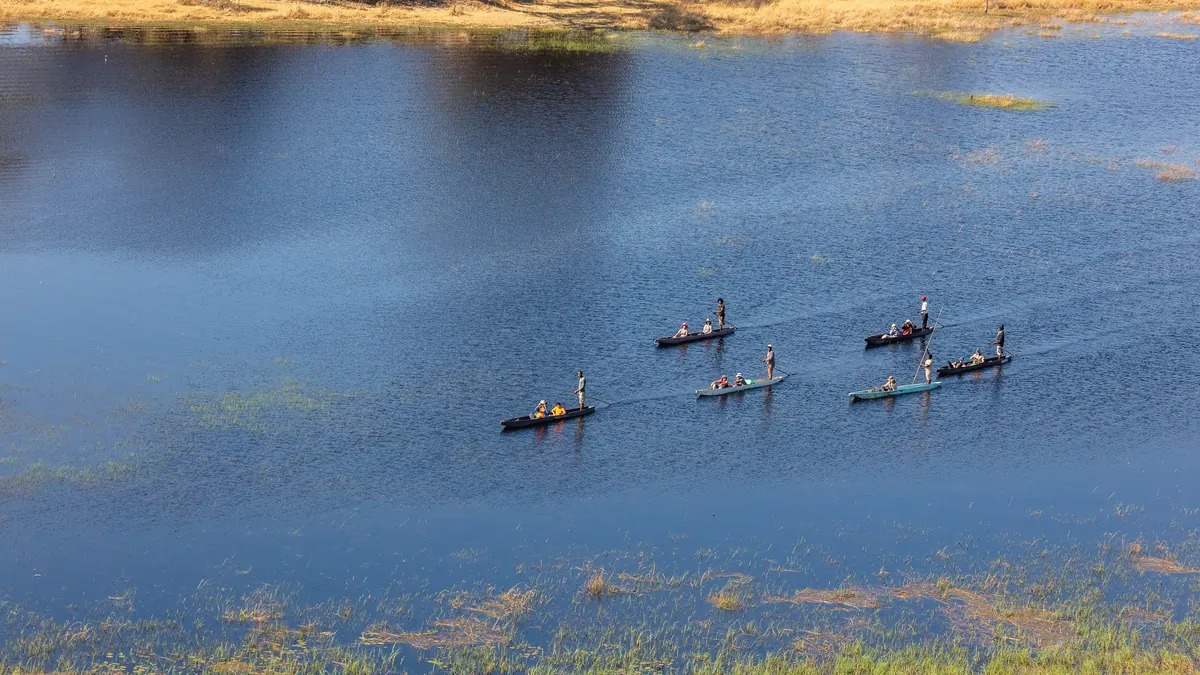

Last verified · Next check due
On this page
- Which activities are allowed in each area (2026)
- National parks vs private concessions: the rule and what it costs
- Moremi Game Reserve: no night drives, no walking, no off-road
- Chobe National Park and Savuti
- Khwai: two concessions next to Moremi
- Selinda, Linyanti, Kwara and Vumbura: private concessions
- Makgadikgadi, Nxai Pan and the Central Kalahari
- Self-drive and mobile safaris: what you can do
- Walking safaris and night drives: what to check
- The US$30 tourism levy: withdrawn in 2017, never charged
- Common mistakes about Botswana’s activity rules
- Frequently asked questions
- Sources
Short answer: Off-road driving and night drives are prohibited in Botswana’s national parks and game reserves: Chobe National Park (including Savuti), Moremi Game Reserve, the Central Kalahari, and the Makgadikgadi and Nxai Pan parks. Walking safaris are not permitted in Moremi. All three are allowed on private and community concessions outside the parks, such as Khwai, Selinda, Linyanti, Kwara and Vumbura, where camps offer them to their own guests. Checked 10 October 2026.
Key facts
- Botswana Tourism states the rule outright: in the national parks and reserves, “off-roading and night driving [are] prohibited”, while “private concession areas outside the parks and reserves provide opportunities for off-road driving and night drives”, done “in moderation” (Botswana Tourism).
- Moremi Game Reserve allows neither night drives nor walking. One safari operator’s Moremi guide: “Night drives and walking safaris are not permitted within the reserve” (read 10 October 2026).
- The rule follows the land, not the price. A camp inside a park or reserve works under park rules whatever it charges; a camp on a concession can drive off-road, at night and walk.
- “Khwai” covers two concessions with different access. The Khwai community concession admits self-drivers and mobile safaris; the Khwai Private Reserve says “No self-drivers or day visitors are permitted” (a safari travel company’s Khwai page, read 10 October 2026).
- Botswana does not require a specialist walking licence. Its national guiding regulations “don’t require specialist walking qualifications”, one safari operator notes (its Botswana walking-safari guide, read 10 October 2026).
- There is no US$30 tourism levy at the border. The Bill was withdrawn on 11 December 2017 and the levy was never charged.
Which activities are allowed in each area (2026)
Inside a DWNP national park or game reserve the answer is no to off-road driving and night drives; on a concession the camp can offer all three. The table names each area as it appears on itineraries.
| Area | What the land is | Off-road driving | Night drives | Walking | Who can drive in | Source |
|---|---|---|---|---|---|---|
| Moremi Game Reserve | DWNP game reserve | No | No | No | Anyone with a park ticket (P270 a day, last published) | Botswana Tourism; one safari operator’s Moremi guide |
| Chobe National Park, riverfront | DWNP national park | No | No | No (walks are offered in the Forest Reserve outside the park) | Anyone with a park ticket (P270 a day, last published) | Botswana Tourism; one safari operator’s Chobe guide |
| Savuti | Inside Chobe National Park | No | No | No | Anyone with a park ticket (P270 a day, last published) | same as Chobe |
| Chobe Forest Reserve, west of Kasane (Muchenje, Ngoma, Chobe Elephant Camp) | Outside the national park | Not stated | Yes | Yes | Not stated | One safari operator’s Chobe guide |
| Khwai community concession | Community concession, Khwai Development Trust | Yes | Yes | Yes | Self-drivers and mobile safaris | A safari travel company’s Khwai page |
| Khwai Private Reserve | Private concession on community land; Natural Selection camps | Yes | Yes | Yes | Camp guests only: “No self-drivers or day visitors” | A safari travel company’s Khwai page; Natural Selection |
| Selinda Reserve | Private reserve, NG16, 130,000 ha; Great Plains camps | Yes | Yes | Yes, plus canoeing on the Selinda Spillway, June–October | Camp guests only | Botswana Tourism; a Delta booking site’s Selinda page |
| Linyanti (private concessions) | Private concessions; Wilderness camps and African Bush Camps’ Linyanti Wildlife Reserve | Yes | Yes | Yes | Camp guests only | Botswana Tourism; one safari operator’s Kwando-Linyanti guide; African Bush Camps |
| Kwara | Private concession; Kwando Safaris camps (Kwara, Splash, 4 Rivers) | Yes | Yes | Yes, from age 12 | Camp guests only | Kwando; Kwando 2024 rate sheet |
| Vumbura | 60,000 ha private area bordering Moremi, run with the Okavango Community Trust; Wilderness camps | Yes | Yes | Yes | Camp guests only | Wilderness, Vumbura Plains; one safari operator’s Okavango Delta guide |
| Makgadikgadi Pans and Nxai Pan national parks | DWNP national parks | No | No | Not stated in our sources | Anyone with a park ticket (P190 a day, last published) | Botswana Tourism |
| Private land on the Makgadikgadi edge (Jack’s Camp, San Camp, Camp Kalahari) | Outside the national parks | Quad bikes on the pan surface, dry season only (about May–November) | Not confirmed in our sources | Yes: San-guided walks | Camp guests | One safari operator’s salt pans guide |
| Central Kalahari Game Reserve (CKGR) | DWNP game reserve | No | No | Not listed as a reserve activity | Anyone with a park ticket (P190 a day, last published) | Botswana Tourism; one safari operator’s CKGR guide |
| Private reserves on the CKGR’s northern boundary | Private land outside the reserve | Not stated | Yes | Yes | Lodge guests | One safari operator’s CKGR guide |
Rules as published by Botswana Tourism for parks and concessions in general, and for each area by one safari operator’s area guides, a safari travel company’s Khwai page, a Delta booking site’s Selinda page and the camp operators. “Yes” means the activity is allowed on that land; whether your camp runs it, and on which days, is the camp’s decision. Read 10 October 2026.
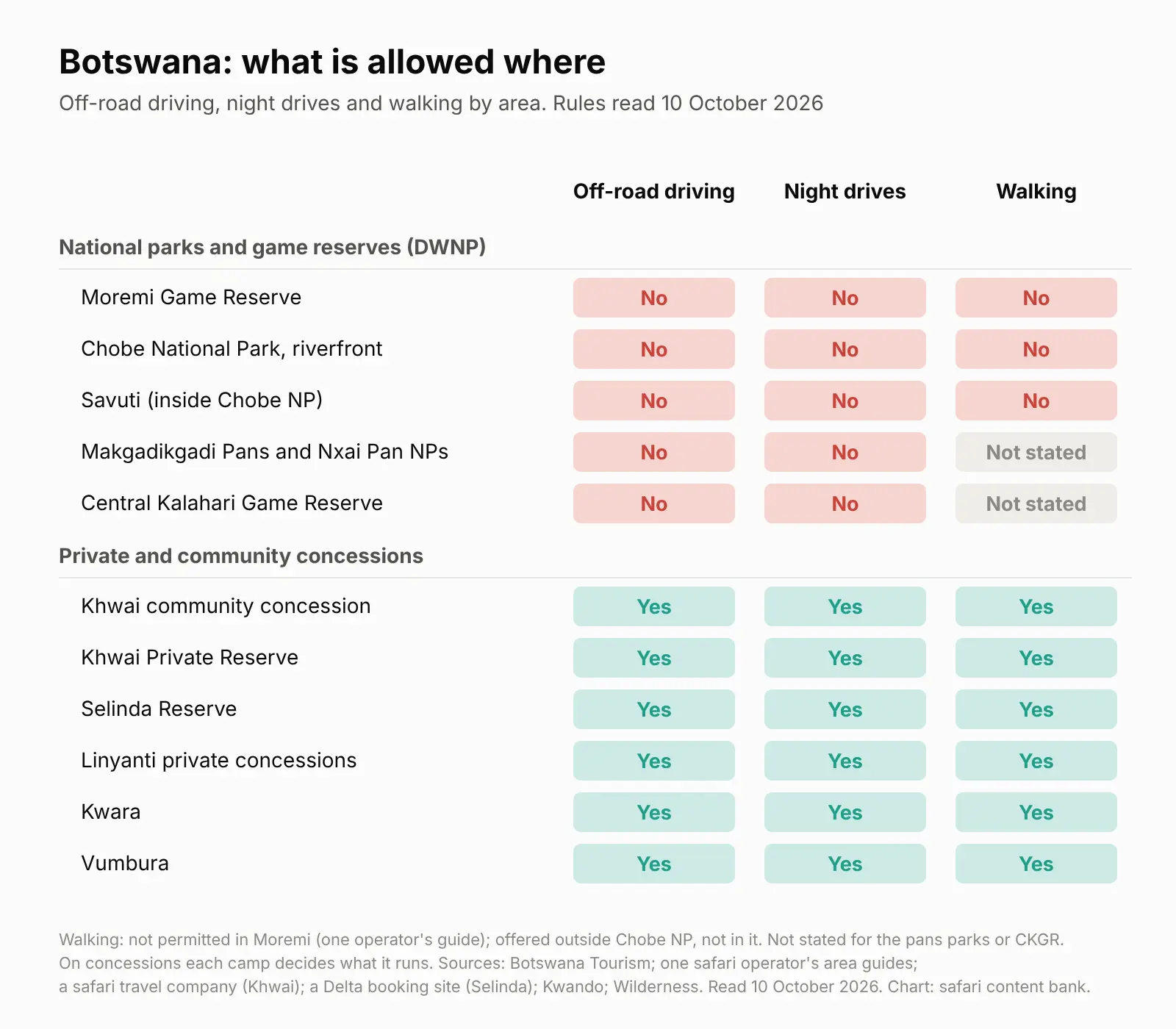 Sources: Botswana Tourism (parks and concessions); one safari operator’s area guides (Moremi, Chobe, Okavango Delta, Kwando-Linyanti, CKGR); a safari travel company (Khwai); a Delta booking site (Selinda); operators’ pages. Read 10 October 2026. Chart: safari content bank.
National parks vs private concessions: the rule and what it costs
A concession camp costs more because it buys rules a national park does not allow: off-road driving, night drives, walking and no other vehicles. Botswana Tourism states that “off-roading and night driving [are] prohibited” in the national parks and reserves, while “private concession areas outside the parks and reserves provide opportunities for off-road driving and night drives” (Botswana Tourism).
| National park or game reserve | Private or community concession | |
|---|---|---|
| Fee | DWNP fee per day (last published schedule: P270 Chobe and Moremi, P190 others; confirm with DWNP) | Usually bundled into the rate, plus a camp levy of US$20–100 a night |
| Off-road driving to a sighting | Not allowed | Allowed, “in moderation” |
| Night drives | Not allowed | Allowed |
| Walking | Not in Moremi (one safari operator’s Moremi guide) | Usually offered |
| Other vehicles | Anyone with a park ticket: self-drivers, mobile safaris, day visitors | Guests of camps on that lease only |
| Cheapest way in | Self-drive or mobile safari | A camp booking; there is no other way in |
Sources: Botswana Tourism; one safari operator’s Moremi guide; a safari booking site’s guide to public and private concessions (names and links in our editor notes). Read 9 Oct 2026.
The park fees in the table, with the date each took effect and the source:
| Fee | Amount | In force from | Source |
|---|---|---|---|
| Chobe National Park and Moremi Game Reserve (DWNP), non-resident adult, per person per day | BWP 270 (SADC residents BWP 205; Botswana citizens and residents BWP 30) | Last published DWNP schedule, 1 April 2022 (via Tourism Update). In Feb 2026 the government news agency BOPA called the existing non-resident fee P380; a P500 rise was announced, then reported postponed. No official current tariff: confirm with DWNP or your operator | Tourism Update, 23 Feb 2022 (DWNP fee schedule) |
| Other DWNP parks and reserves (Central Kalahari Game Reserve, Khutse, Nxai Pan, Makgadikgadi Pans), non-resident adult, per person per day | BWP 190 (SADC residents BWP 145; Botswana citizens and residents BWP 20) | Last published DWNP schedule, 1 April 2022 (via Tourism Update). In Feb 2026 the government news agency BOPA called the existing non-resident fee P380; a P500 rise was announced, then reported postponed. No official current tariff: confirm with DWNP or your operator | Tourism Update, 23 Feb 2022 (DWNP fee schedule) |
- Price and land are separate questions. Kwando’s Moremi Crossing (US$530–850, 2024) sits on NG 27B Xaxaba, a concession shared by several operators, and has the lowest fly-in rate on our Botswana safari cost page. Camp rates, levies and flights are set out there.
- On a concession the camp, not the state, decides the programme. Botswana Tourism’s “in moderation” means each concession holder sets its own off-road practice; ask how it is applied.
Moremi Game Reserve: no night drives, no walking, no off-road
Moremi is a state game reserve, so none of the three activities is allowed on its land, at any camp. One safari operator’s Moremi guide: “Night drives and walking safaris are not permitted within the reserve” (read 10 October 2026). Botswana Tourism adds the ban on off-roading and night driving in all national parks and reserves (Botswana Tourism).
- Camps inside Moremi follow park rules. The same operator’s Moremi guide names the Xakanaxa area, Xigera and Chief’s Island camps as unable to do night drives or off-road driving. Desert & Delta’s Camp Moremi and Camp Xakanaxa are among them.
- Moremi is not the whole Okavango Delta. It is one state reserve in the eastern Delta; most of the rest is private and community concessions with concession rules. Our Botswana safari questions page explains the difference.
- Moremi still has some of the Delta’s best daytime game. 76% of one safari operator’s travellers there saw a leopard and 65% saw wild dog (its Moremi page). The rules limit how you approach animals, not which animals are there.
Chobe National Park and Savuti
Chobe National Park, including the riverfront and Savuti, is a national park: no off-road driving and no night drives. Botswana Tourism’s ban covers all national parks and reserves (Botswana Tourism). One safari operator’s Chobe guide places walks and night drives at the Forest Reserve camps west of Kasane, not in the park (read 10 October 2026).
- Savuti is inside Chobe National Park, so it is not a concession. Lodges and the public campsite at Savuti work under park rules. If an itinerary lists walking or night drives at a Savuti camp, ask the camp to confirm in writing where they take place.
- The Linyanti campsite (run by SKL Camps) is inside Chobe National Park too, while the Linyanti camps of Wilderness and African Bush Camps are on private concessions next to it. The same name covers both rule sets.
- The Forest Reserve is the Chobe-area option for walks and night drives. That operator’s Chobe guide lists Muchenje, Ngoma and Chobe Elephant Camp there.
Khwai: two concessions next to Moremi
Both Khwai concessions allow night drives, off-road driving and guided walks; they differ in who may drive in. A safari travel company’s Khwai page describes them as offering “night drives and off-road driving, activities restricted in the neighbouring national parks”, plus “guided walking safaris” (read 10 October 2026).
| Khwai community concession | Khwai Private Reserve | |
|---|---|---|
| Who holds the land | “Owned and managed by Khwai village” through the Khwai Development Trust | Private concession on community land; Natural Selection camps (Sable Alley, Little Sable, Tuludi, Mbamba, Duke’s, Mokolwane) |
| Size | About 30,000 ha | About 200,000 ha |
| Self-drivers and mobile safaris | Allowed | Not allowed: “No self-drivers or day visitors are permitted” |
| Night drives, off-road, walking | Allowed | Allowed |
Sources: a safari travel company’s Khwai page; Natural Selection; African Bush Camps, Khwai Community Concession. Read 10 Oct 2026.
- Moremi’s North Gate is at Khwai, so a Khwai stay often mixes concession drives with drives into the reserve, where park rules apply. Ask which drives happen on which side.
- The community concession is the busier of the two. It carries more lodges and campsites and is open to self-drivers. Khwai community campsites are listed at BWP 300 per person per night (a safari operator’s campsite sheet, PDF).
- Sources disagree on the NG number for each Khwai concession, so we print none. Ask your camp for the concession by name.
Selinda, Linyanti, Kwara and Vumbura: private concessions
The private concessions of the northern Delta and the Linyanti allow off-road driving, night drives and walking, and only the camps’ guests drive there. That is the concession side of Botswana Tourism’s rule (Botswana Tourism); each area’s own page or operator confirms the activities below.
- Selinda Reserve (NG16, 130,000 ha, Great Plains Conservation) offers walking safaris and canoeing expeditions down the Selinda Spillway from June to October (a Delta booking site’s Selinda page, read 10 October 2026).
- Linyanti: one safari operator’s Kwando-Linyanti guide points walkers to the Linyanti Enclave camps of African Bush Camps, and African Bush Camps calls its Linyanti Wildlife Reserve a “private concession” (African Bush Camps). Botswana Tourism says the concession camps here host “approximately twenty guests at a time” (Botswana Tourism, Savuti and Linyanti).
- Kwara (Kwando Safaris) is one of Kwando’s private concessions, sold on off-road and night driving (Kwando). Kwando sets a minimum age of 12 for mokoro and walking safaris and requires a private vehicle for children under 12 (Kwando 2024 rate sheet).
- Vumbura (Wilderness) is a “60,000-hectare private wilderness area bordering the Moremi Game Reserve”, run in partnership with the Okavango Community Trust and its five villages (Wilderness, Vumbura Plains). One safari operator’s Okavango Delta pages place Vumbura, Jao, Kwara, Chitabe and Duba on private concessions that allow off-road driving, night drives and walking, unlike Moremi (read 10 October 2026).
A water camp on a concession may still run few drives. The same operator’s Okavango Delta pages note that the Delta’s water-first camps (Jacana, Setari, Pelo, Sitatunga, Xugana) trade big game for mokoro and birding, so check that the camp runs land activities in your month, not only that the concession allows them.
Makgadikgadi, Nxai Pan and the Central Kalahari
The Makgadikgadi Pans and Nxai Pan national parks and the Central Kalahari Game Reserve follow park rules; the private land around them is where the extra activities are. Botswana Tourism’s ban on off-roading and night driving covers all three (Botswana Tourism), and their non-resident fee is P190 per person per day under the last published DWNP schedule (1 April 2022); confirm the current fee with DWNP or your operator.
- Two Kwando camps sit inside these parks: Nxai Pan Camp in Nxai Pan National Park and Tau Pan in the CKGR (Kwando 2024 rate sheet). Park rules apply to their drives.
- The private camps on the Makgadikgadi edge (Jack’s Camp, San Camp, Camp Kalahari) offer meerkats, quad biking and San-guided walks (one safari operator’s salt pans guide, read 10 October 2026). Quad biking runs only in the dry season, roughly May to November, “when the salt flats are firm and dry” (same guide).
- The CKGR’s private neighbours add night drives and walks, one safari operator’s CKGR guide says of the private reserves on its northern boundary (read 10 October 2026).
Self-drive and mobile safaris: what you can do
A self-driver in a Botswana park stays on the tracks and drives in daylight only; the one concession that admits self-drivers is the Khwai community concession. Off-roading and night driving are prohibited in the parks and reserves for everyone, including private vehicles (Botswana Tourism).
- Private concessions are closed to self-drivers. Only guests of the camps on that lease drive there (a safari booking site’s guide to public and private concessions, read 9 October 2026); the Khwai Private Reserve says “No self-drivers or day visitors are permitted” (a safari travel company’s Khwai page).
- A mobile safari’s activity list depends on the land each night. One Maun mobile-safari operator’s 9-night trip through northern Botswana lists game drives, night drives, walks, mokoro excursions and boat trips among its activities (its trip page, read 9 September 2026); inside Chobe and Moremi the night drives and walks cannot happen, so ask which nights are on concession land.
- On the private concessions the only way in is a camp booking. Our Namibia vs Botswana comparison shows what that does to the cost of a self-drive trip.
Walking safaris and night drives: what to check
Walking and night drives are camp activities on concession land, and the camp sets the terms: guide, age limit, duration and season.
- Ask who guides the walk. Botswana’s national guiding regulations “don’t require specialist walking qualifications” (one safari operator’s walking-safari guide), so “walking available” can mean different things at different camps. Ask for the guide, the length of the walk and whether the guide is armed.
- Check the age limit. Kwando allows walking and mokoro from age 12 (Kwando 2024 rate sheet); Great Plains takes guests from age 8 on canoe and mokoro activities (Great Plains 2025).
- A night drive shows different animals. Khwai’s night drives turn up “serval, honey badger, aardwolf, porcupine, and springhare” (a safari travel company’s Khwai page). Nocturnal species are rare even so: 18% of one safari operator’s travelling groups in Botswana saw a brown hyena and 2% an aardvark (its Botswana wildlife page, read 10 October 2026).
- An itinerary of in-park camps only has no night drives. If you want one, put at least one concession camp on the trip.
Five questions to ask before you book:
- Is the camp inside a national park or game reserve, or on a concession? Which concession, by name?
- Are night drives run from this camp, on this land, in my dates?
- Are walks offered, for how long, by which guide, and from what age?
- Is off-road driving to sightings practised here?
- Who else drives this land: self-drivers, mobile safaris, other camps?
The US$30 tourism levy: withdrawn in 2017, never charged
Botswana charges no tourism levy at the border. A US$30 Tourism Development Levy was announced for 1 June 2017 for non-SADC visitors (BTO notice, 2017, PDF), postponed, and the Bill was withdrawn on 11 December 2017 (Inside Travel, Dec 2017).
| Date | What happened | Source |
|---|---|---|
| 2017 | Botswana Tourism Organisation notice: US$30 levy for non-SADC visitors from 1 June 2017 | BTO notice (PDF) |
| 2017 | Implementation postponed before the levy was collected | Inside Travel |
| 11 December 2017 | Bill withdrawn. Permanent Secretary Jimmy Opelo: “This withdrawal is to enable the Ministry and Botswana Tourism Organisation to conduct further engagement with various stakeholders.” | Inside Travel |
| 2026 | Not charged. Botswana Tourism’s entry page covers visas and passports and lists no levy (read September 2026) | Botswana Tourism, Entry Formalities |
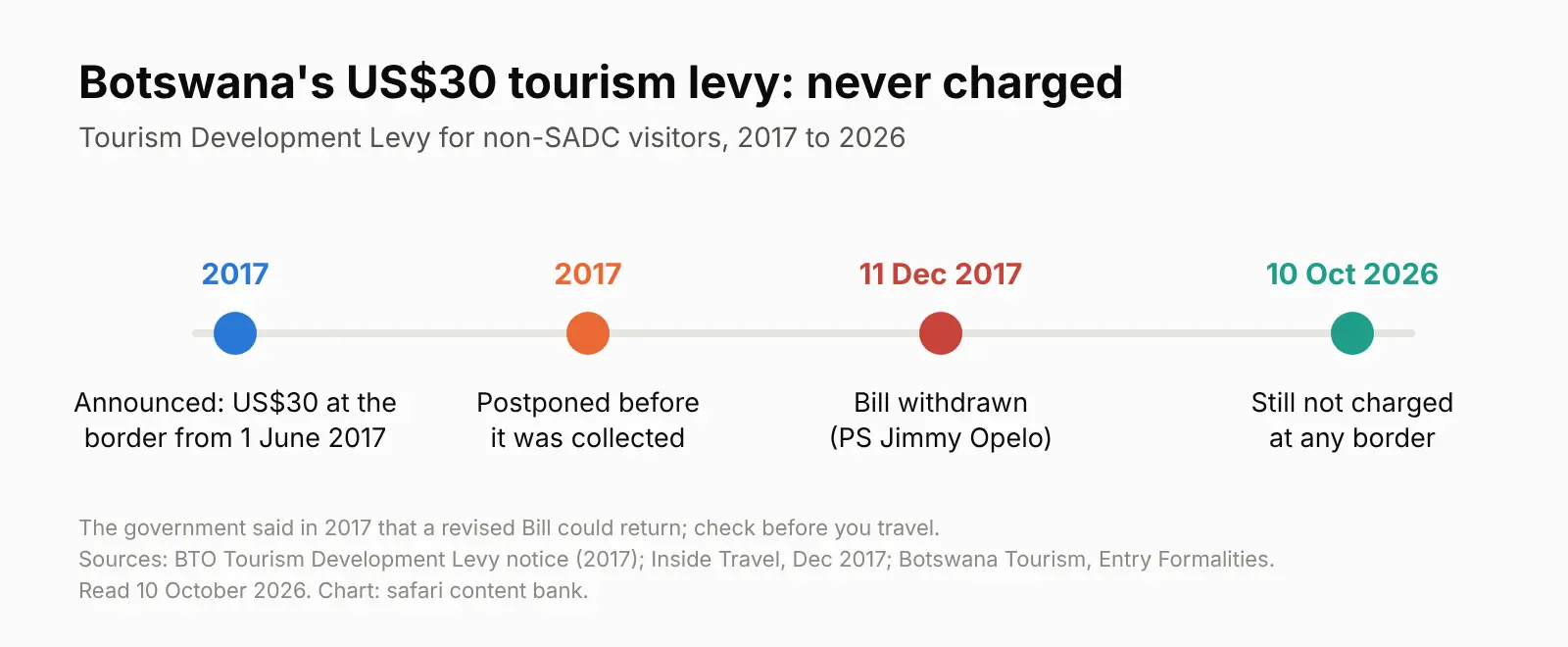 Sources: BTO Tourism Development Levy notice (2017); Inside Travel, December 2017; Botswana Tourism, Entry Formalities. Read 10 October 2026. Chart: safari content bank.
Botswana has no tourist arrival tax. The levies a visitor actually pays are the park fee and the camp groups’ own levies, set out on our Botswana safari cost page. Pages that still show the US$30 levy are repeating the 2017 notice, and the government said in 2017 that a revised Bill could return, so check before you travel.
Common mistakes about Botswana’s activity rules
| What you’ll often read | What is correct |
|---|---|
| “Night drives are part of every Botswana safari” | Not in Chobe or Moremi, where night drives and off-road driving are prohibited. They happen on concessions. |
| “An expensive camp offers everything” | The rule follows the land. A camp inside a park or reserve works under park rules whatever its rate. |
| “Moremi and the Okavango Delta are the same thing” | Moremi is one state reserve in the eastern Delta; most of the Delta is private and community concessions with different rules. |
| “Savuti is a private area” | Savuti is inside Chobe National Park. No off-road driving or night drives. |
| “Khwai is one area” | Two concessions with different access, the community concession (self-drivers allowed) and the Khwai Private Reserve (camp guests only), next to Moremi. |
| “A self-drive can do its own night drive” | Not in the parks and reserves, where night driving is prohibited, and not on the private concessions, which self-drivers cannot enter. |
| “Walking guides in Botswana hold a specialist licence” | Not required. The national guiding regulations “don’t require specialist walking qualifications” (one safari operator). |
| “Pay a US$30 tourism levy at the border” | No levy is charged. The Bill was withdrawn on 11 December 2017. |
Frequently asked questions
Can you do a night drive in Chobe National Park? No. Botswana Tourism states that night driving is prohibited in the national parks and reserves, and Chobe is a national park. Night drives in the Chobe area take place outside the park, for example at the Forest Reserve camps west of Kasane or on the Linyanti concessions.
Are walking safaris allowed in Moremi Game Reserve? No. One safari operator’s Moremi guide: “Night drives and walking safaris are not permitted within the reserve.” Walks are offered on the concessions next to Moremi, such as Khwai, and in the private Delta concessions.
Where can I do a night drive near Moremi? In the Khwai community concession or the Khwai Private Reserve, both next to Moremi’s North Gate, or on a private Delta concession such as Vumbura or Kwara. Both Khwai concessions allow night drives, off-road driving and guided walks (a safari travel company’s Khwai page).
Can self-drivers go off-road in Botswana’s national parks? No. Off-roading and night driving are prohibited in all national parks and reserves, for every vehicle. Self-drivers can enter the Khwai community concession, but not the private concessions, which only camp guests may drive.
Do mobile safaris include night drives and walks? Only on the nights spent on concession land. Some operators list night drives and walks among their activities, but these cannot take place inside Chobe or Moremi, so ask which nights are on a concession.
Is there a US$30 tourism levy in Botswana? No. The Tourism Development Levy was announced for 1 June 2017, postponed, and the Bill was withdrawn on 11 December 2017. No border levy is charged.
How old do children have to be for a walking safari? Each camp group sets its own age. Kwando allows walking and mokoro from age 12 and requires a private vehicle for under-12s; Great Plains takes guests from 8 on canoe and mokoro activities.
Sources
- Rules for parks and concessions: Botswana Tourism, game viewing; Botswana Tourism, Savuti and Linyanti; a safari booking site’s guide to public and private concessions (read 9 October 2026)
- Areas: one safari operator’s guides to Moremi, Chobe, the Okavango Delta, Kwando-Linyanti, the Central Kalahari, the salt pans, walking safaris and Botswana wildlife; a safari travel company’s Khwai page; a Delta booking site’s Selinda page (all read 10 October 2026)
- Operators: Natural Selection; Kwando and its 2024 rate sheet; Wilderness, Vumbura Plains; African Bush Camps, Linyanti and Khwai; Great Plains 2025; one Maun mobile-safari operator’s trip page (read 9 September 2026)
- Park fees: Tourism Update, 23 Feb 2022 (DWNP schedule effective 1 April 2022); campsites: a safari operator’s campsite sheet (PDF)
- Levy: BTO Tourism Development Levy notice, 2017 (PDF); Inside Travel, Dec 2017; Botswana Tourism, Entry Formalities
Rules checked against the content bank on 10 October 2026. We will update this page if DWNP or the Ministry publishes a change to the activity rules in any park or reserve, when DWNP publishes a new fee schedule or a start date for the increase reported postponed, and if a tourism levy Bill is reintroduced.
More photos from Botswana
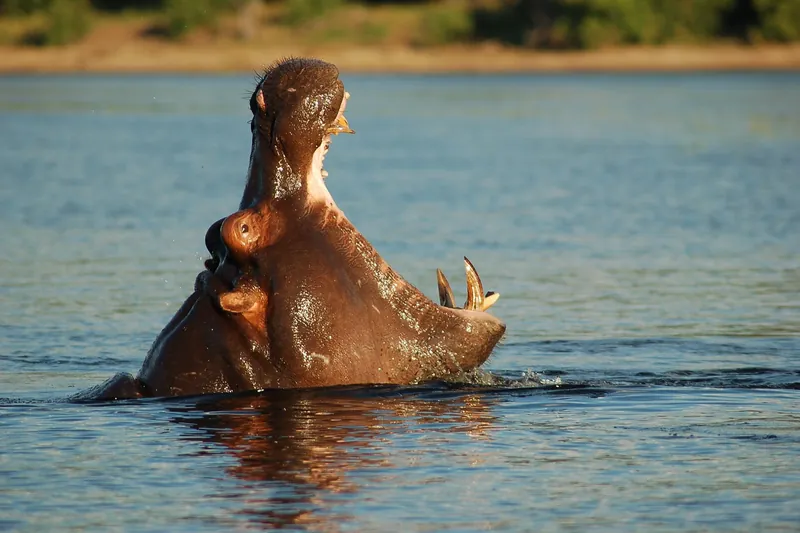
Hippo yawning on the Chobe river front. Joachim Huber, Wikimedia Commons, CC BY-SA 2.0, cropped 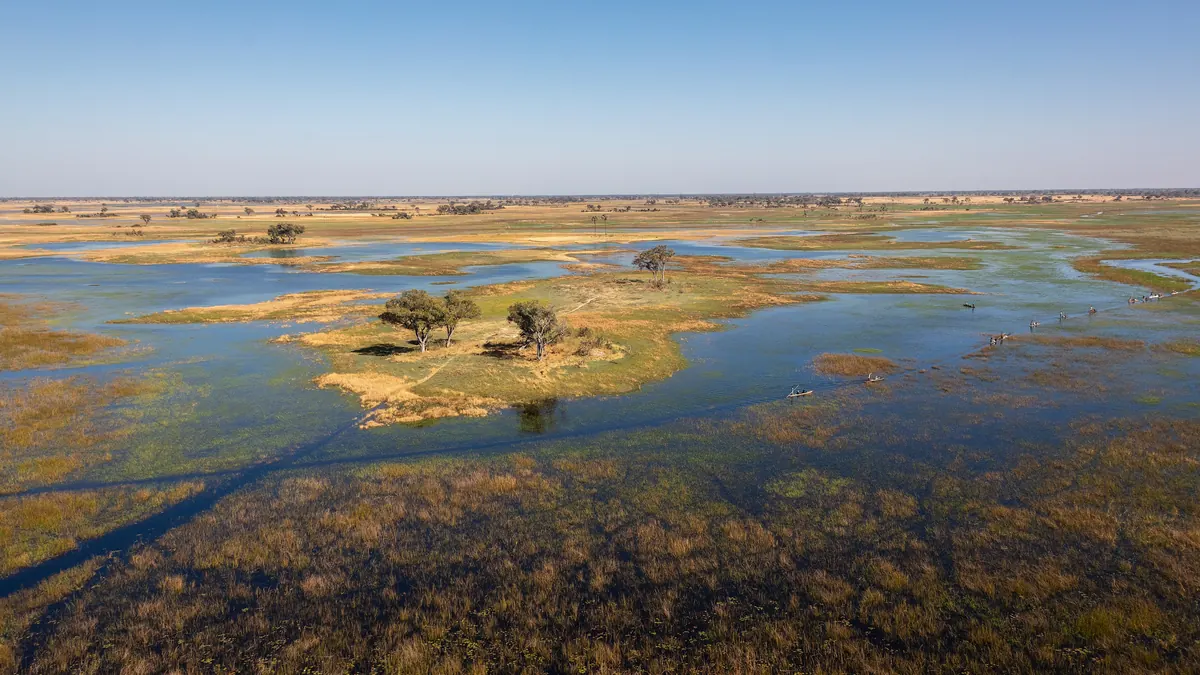
Aerial view of islands and water channels in the Okavango Delta. Diego Delso, Wikimedia Commons, CC BY-SA 4.0, cropped 
Southern carmine bee-eater in Chobe, Botswana. Robert Webster, iNaturalist, CC BY-SA 4.0, cropped


Photos by visitors and photographers, used under their free licences. Click a name to see the original.