 Experience

Last verified · Next check due
On this page
- Serengeti vs Ngorongoro at a glance (2026)
- What each one is: the park, the conservation area and the crater floor
- Park fees per day: Serengeti vs Ngorongoro
- Crater floor rules and time limits
- Wildlife: what each is best for
- Seasons and the Migration
- Drive times between the crater and the Serengeti
- How many days each needs
- Which to choose, by traveller type
- Common mistakes about the Serengeti and Ngorongoro
- Frequently asked questions
- Sources
Short answer: Most road safaris do both: the Arusha–Serengeti road crosses the Ngorongoro Conservation Area, so its US$70.80 entry per adult is paid anyway, and the crater adds US$295 per vehicle for one descent (NCAA, read 9 October 2026). Plan one crater day and 2–3 nights per Serengeti area. A night inside the Serengeti costs US$129.80–153.40 per adult in park fees (last published tariff, 2023/24).
Key facts
- Serengeti National Park and the Ngorongoro Conservation Area (NCA) are run by different authorities and charged separately. The park (14,763 km²) is run by Tanzania National Parks (TANAPA); the NCA (8,292 km²) by the Ngorongoro Conservation Area Authority (NCAA). A Serengeti fee does not cover Ngorongoro.
- Ngorongoro Crater is one part of the NCA. The NCA also holds Olduvai Gorge, the Empakaai and Olmoti craters and the Ndutu calving plains, so a Ndutu stay pays NCAA fees, not Serengeti ones.
- The crater fee is US$295 per vehicle per descent, not per person. With the US$70.80 entry, two people sharing pay US$218.30 each for a crater day and six pay US$119.97 each (our sums from the NCAA tariff page, read 9 October 2026).
- The NCAA’s visitor guidelines state no time limit on the crater floor. The descent closes at 16:00 and all driving ends at 18:00. Neither the crater nor the Serengeti allows night drives.
- The crater to Seronera, in the central Serengeti, is 135 km: 3.5 hours as published, 4.5–5 hours in traveller reports.
- In 2025 Ngorongoro was the attraction most visited by Tanzania’s international visitors (14.2%), ahead of the Serengeti (13.1%) (Bank of Tanzania exit survey, PDF).
Serengeti vs Ngorongoro at a glance (2026)
The Serengeti is a national park you sleep in for several nights; the crater is a single game drive inside a larger conservation area that people also live in.
| Serengeti National Park | Ngorongoro Conservation Area and Crater | Source | |
|---|---|---|---|
| Run by | Tanzania National Parks (TANAPA) | Ngorongoro Conservation Area Authority (NCAA); split from Serengeti National Park in 1959 | Serengeti; Ngorongoro; Wikipedia |
| Area | 14,763 km² | 8,292 km² for the whole conservation area | A safari agent’s guide, read 9 October 2026; NCAA |
| What it is | National park | Multiple-use area: wildlife, archaeology and 93,136 Maasai residents (2017) | Wikipedia |
| Entry, adult | US$82.60 a day with VAT; US$70.80 from 15 March to 15 May (last published tariff, 2023/24) | US$70.80 per 24 h, one entry | TANAPA 2023/24; NCAA |
| Crater fee | None | US$295 per vehicle per descent | NCAA |
| A night inside, adult | Concession US$59 (October–June) or US$70.80 (July–September) on top of entry | Concession US$59 at rim and Ndutu lodges | TANAPA 2023/24; NCAA |
| Permit clock | 12-hour day permit or 24-hour sleep-over permit, multiple entries | “One entry within 24 hours only” | TANAPA 2023/24; NCAA |
| Night drives | No | No; driving 06:00–18:00 | TANAPA 2023/24 (PDF); NCAA guidelines |
| Best known for | The wildebeest herds, most of the year | Black rhino on the crater floor; calving at Ndutu around February | Sections below |
| Time most trips give it | 2–3 nights per area | One crater day | Section “How many days” |
| Visitors | 491,398 in the 2024/25 financial year; 13.1% of international visitors in 2025 | 14.2% of international visitors in 2025 | The Citizen, 18 Dec 2025; Bank of Tanzania 2025 |
Fees: TANAPA Tariffs 2023/24 (PDF), the last published tariff, and NCAA tariffs, an undated page that does not say whether VAT is included; both read 9 October 2026. Non-East African adults.
What each one is: the park, the conservation area and the crater floor
Serengeti National Park is the plains park run by TANAPA; the Ngorongoro Conservation Area is a separate NCAA area that meets it at Naabi Hill Gate, and Ngorongoro Crater is one part of it.
- Serengeti National Park covers 14,763 km² (a safari agent’s guide, read 10 October 2026). A night in a lodge or camp inside the park adds the TANAPA concession fee. Its areas are the southern plains, Seronera in the centre, the Western Corridor, the north at the Mara River, and the east (Serengeti).
- The Ngorongoro Conservation Area covers 8,292 km² (NCAA). It was split from Serengeti National Park in 1959 and became a UNESCO World Heritage site in 1979 (Wikipedia). It is not a national park: 93,136 Maasai lived in it in 2017, and since 2021 residents have been moved to Msomera under a scheme the government calls voluntary, with coercion concerns documented by Human Rights Watch (same source).
- Ngorongoro Crater is the part of the NCA where game drives go down to the crater floor. The crater service fee buys one descent; the NCA entry permit is what every visitor pays, including those who only cross the NCA on the way to the Serengeti.
- Ndutu, the calving-season base on the south-western plains, is NCA land. Its lodges charge the NCAA concession, and a Ndutu stay does not include Serengeti entry (Ngorongoro).
Park fees per day: Serengeti vs Ngorongoro
A night inside the Serengeti costs an adult US$129.80–153.40 in park fees (last published tariff, 2023/24); a crater day costs US$119.97–365.80 per adult, depending on how many share the vehicle (NCAA, read 9 October 2026).
| Fee | Amount | In force from | Source |
|---|---|---|---|
| Serengeti and Nyerere National Parks, non-East African adult, entry per day, 16 May–14 Mar | USD 70 + 18% VAT = USD 82.60 | 1 Jul 2023 (2023/24 tariff, last published) | TANAPA Tariffs 2023/24 |
| Serengeti and Nyerere National Parks, non-East African adult, entry per day, 15 Mar–15 May | USD 60 + 18% VAT = USD 70.80 | 1 Jul 2023 (2023/24 tariff, last published) | TANAPA Tariffs 2023/24 |
| Serengeti and Nyerere, concession fee per person per night inside the park | Jul–Sep USD 60 + VAT = USD 70.80; Oct–Jun USD 50 + VAT = USD 59 | 1 Jul 2023 (2023/24 tariff, last published) | TANAPA Tariffs 2023/24 |
| Ngorongoro Conservation Area, non-East African adult, entry per 24 h (single entry) | USD 70.80 (NCAA's page does not say whether VAT is included) | Undated official page, read 9 Oct 2026 | NCAA |
| Ngorongoro Crater descent (crater service fee), per vehicle | USD 295 (NCAA's page does not say whether VAT is included) | Undated official page, read 9 Oct 2026 | NCAA |
| Ngorongoro concession fee, rim and Ndutu lodges, per person per night | USD 59 (NCAA's page does not say whether VAT is included) | Undated official page, read 9 Oct 2026 | NCAA |
| One day or night, per non-East African adult | Fees | Built from |
|---|---|---|
| Serengeti, a night inside, 15 March–15 May | US$129.80 | US$70.80 entry + US$59 concession |
| Serengeti, a night inside, 16 May–30 June and 1 October–14 March | US$141.60 | US$82.60 entry + US$59 concession |
| Serengeti, a night inside, 1 July–30 September | US$153.40 | US$82.60 entry + US$70.80 concession |
| Crater day from Karatu, 6 in the vehicle | US$119.97 | US$70.80 entry + US$49.17 share of the crater fee |
| Crater day from Karatu, 2 in the vehicle | US$218.30 | US$70.80 entry + US$147.50 share |
| Crater day + a night on the rim, 2 in the vehicle | US$277.30 | US$218.30 + US$59 concession |
| Crater day from Karatu, 1 in the vehicle | US$365.80 | US$70.80 entry + US$295 |
| Crossing the NCA to the Serengeti without going down | US$70.80 | Entry only, plus the vehicle permit |
Our sums from TANAPA Tariffs 2023/24 (PDF), the last published tariff (18% VAT included), and the NCAA tariffs page, undated, read 9 October 2026, which does not say whether VAT is included. Before the NCA vehicle permit (from TZS 23,600 for a Tanzanian-registered vehicle), guide, vehicle and beds.
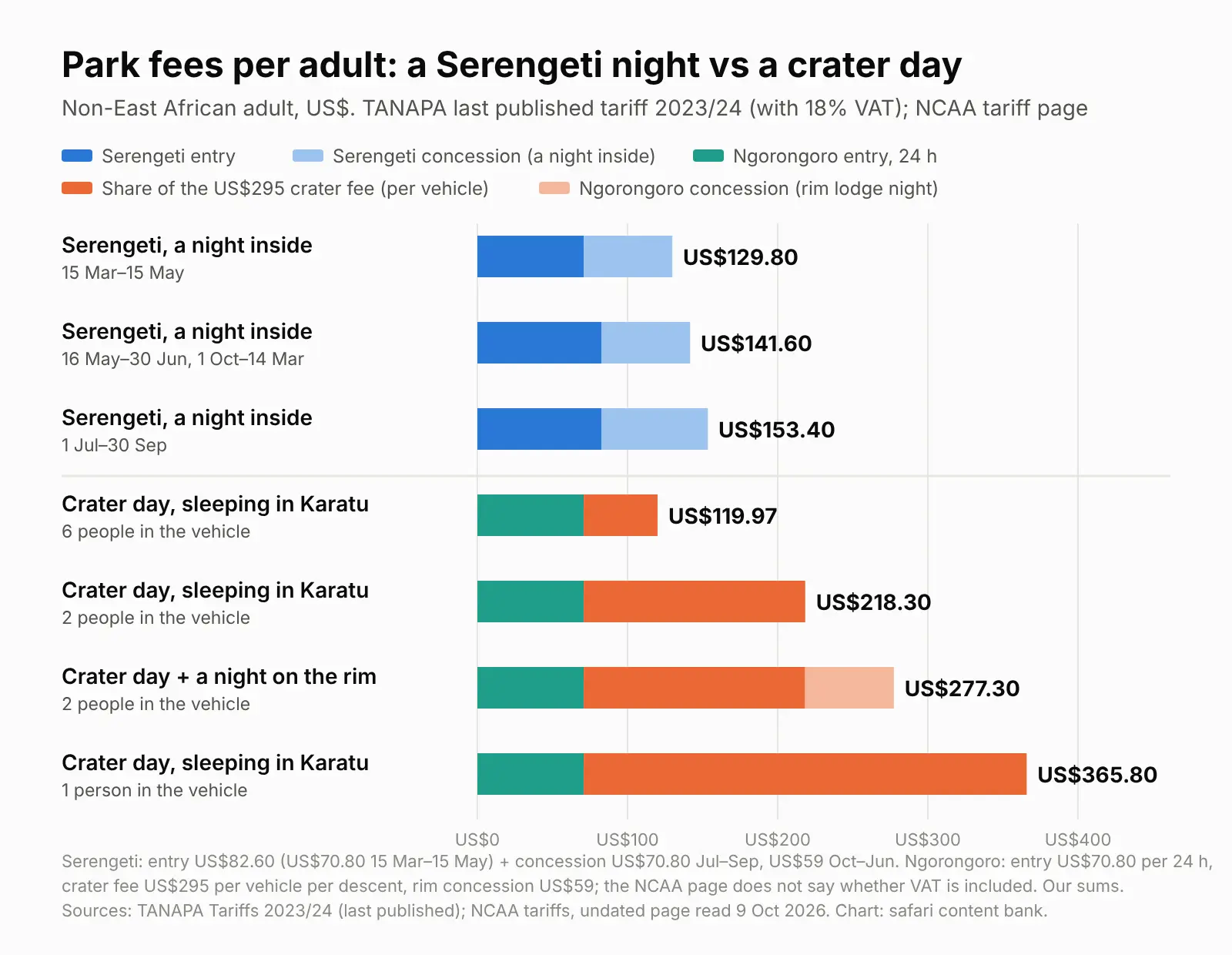 Entry plus concession for the Serengeti; entry plus a share of the US$295 crater fee for Ngorongoro. Sources: TANAPA Tariffs 2023/24, the last published tariff; NCAA tariffs, read 9 October 2026. Our sums.
- No TANAPA tariff newer than 2023/24 has been published. Operators still charge those amounts in October 2026 (Tanzania safari cost).
- The NCAA tariff page lists one amount all year. Serengeti entry and concession change with the season; Ngorongoro fees do not.
- The NCA permit is single entry. Driving into the NCA and back out the same way pays entry twice. Children aged 5–15 pay US$23.60 entry at both (Serengeti with VAT, last published tariff, 2023/24; NCAA).
Crater floor rules and time limits
The NCAA’s visitor guidelines set no time limit on the crater floor; the descent closes at 16:00 and all driving in the NCA ends at 18:00. The “six hours on the floor” rule quoted on many pages is not in the guidelines.
| Rule | What the NCAA says |
|---|---|
| Hours | Driving from 06:00 to 18:00; “beyond these hours, permission must be obtained”. The crater descent closes at 16:00 |
| Time on the floor | No limit stated; the crater service fee covers one descent |
| Vehicles | “Only 4×4 vehicles up to 3,500 Kgs of tare weight are allowed in the Ngorongoro Crater floor” |
| Guide | “A licensed guide or an official NCAA guide must accompany all crater visitors” |
| Off-road | Not permitted unless the Conservation Commissioner authorises it |
| Picnics | Free at designated sites; a bush lunch permit is US$23.60 per vehicle |
| Walking | Only with an NCAA armed ranger, outside the crater floor (Empakaai, Olmoti, the rim): US$23.60 per adult for 1–4 hours, US$29.50 for longer |
| Photographing residents | Prohibited except in designated cultural bomas |
Sources: NCAA visitor guidelines and NCAA tariffs, read 8–9 October 2026; walking routes: a safari agent’s guide.
The Serengeti has no descent cut-off and no 4×4 rule in our sources. A day permit runs for 12 daylight hours with multiple entries, a sleep-over permit for 24 hours, and there are no night drives inside the park (TANAPA 2023/24, PDF). The crater’s 4×4 rule is the only one our Ngorongoro page found in Tanzania’s park regulations.
Wildlife: what each is best for
Choose the Serengeti for the wildebeest herds; choose the crater for black rhino, hyena and lions on one crater floor in a single day’s drive. Neither authority publishes a sighting rate.
| Serengeti | Ngorongoro Crater | |
|---|---|---|
| The draw | The migration herds: calving on the southern plains around February, Mara River crossings in the north from July to October | Resident animals on the crater floor, seen in one descent |
| Wildebeest count | 1,366,109 (aerial count, end of March 2023, TAWIRI, PDF); “fewer than 600,000” (satellite study, August 2022 and 2023, Mongabay). Different methods and months | Not a migration site; the calving plains around Ndutu are in the NCA, outside the crater |
| Black rhino | Not covered here | Known for black rhino. No count newer than June 2018 has been published, and we give no locations |
| Lions | A 1,000-plus lion stronghold in a researcher’s 2012 list (PBS, Craig Packer); no dated count | Recorded; no current count published |
| Spotted hyena | Present | Territories in the crater are under 40 km², against more than 1,000 km² in the Kalahari (Wikipedia) |
| Sighting rate published | No | No |
Read 8–10 October 2026. More on each species: where to see rhino; park detail on Serengeti and Ngorongoro.
Both are crowded in places, by traveller reports. On a safari booking site’s reviews of the crater, travellers wrote “Too many vehicles no bush vibe” (August 2025) and “it feels like a zoo… If you have been on other safaris, I would recommend skipping it and just do the lookout at the rim” (March 2024); the crater still rates 4.8 out of 5 on 638 reviews there. In the central Serengeti a reviewer counted “easily 70 other cars” (June 2024, same site), and at Ndutu a March 2026 visitor reported “15–20 vehicles at a single sighting” (TripAdvisor). These are traveller reports, not counts. Neither TANAPA nor the NCAA publishes a vehicle limit at sightings in our sources.
Seasons and the Migration
The Serengeti’s best area moves with the herds month by month; the NCAA lists one set of crater fees for every month. Herd timing “is entirely dependent upon the rainfall patterns each year”, in one safari operator’s migration guide.
| Months | Serengeti: where the herds usually are | Ngorongoro |
|---|---|---|
| December–March | Southern plains and Ndutu; most calves born “in a short window around February” | Ndutu is NCA land: US$70.80 entry and US$59 concession at its lodges |
| April–May | Passing Seronera; long rains, April the wettest month (155 mm at the Serengeti station). Entry drops to US$70.80 from 15 March to 15 May | Crater fees unchanged. Sanctuary Ngorongoro Crater Camp closes in April and May; Lemala Ngorongoro publishes no April–May rate |
| May–July | Western Corridor; Grumeti River crossings in the first half of June | Lower-rated crater reviews mention cold or overcast days in June and August |
| July–October | North: Kogatende, Lamai and the Mara River; concession US$70.80 in July–September | Lemala Ngorongoro Tented Camp charges its peak US$720 per person per night in June–September |
| October–November | Lobo, then back south | Crater fees unchanged |
Herds: one safari operator’s and one camp operator’s migration guides, read 9 October 2026. Rain: Climates to Travel, Serengeti station (1,400 m); the source has no station in the crater. Fees: TANAPA 2023/24 (last published); NCAA. Camp rates: Lemala 2026/27 and the Ngorongoro hub, read 9 October 2026.
- Calving and the crater are a short drive apart. Ngorongoro Crater to Ndutu is 106 km, 2.5 hours in a Tanzanian operator’s travel-times table (modified 1 July 2026).
- No one can date a river crossing. For each month on both sides of the border, see the Great Migration month by month. For the Serengeti against Kenya’s reserve, see Serengeti vs Masai Mara.
Drive times between the crater and the Serengeti
From the crater rim it is 85 km and 2–3 hours to the Serengeti’s Naabi Hill Gate, and 135 km to Seronera: 3.5 hours as published, 4.5–5 hours in traveller reports. Tourists are not driven outside towns after dark, so a long transfer takes most of a day.
| Route | Distance | Published time | Source (read 9 Oct 2026) |
|---|---|---|---|
| Karatu → Loduare Gate (NCA) | 15 km | 30 min | A self-drive operator’s guide |
| Loduare Gate → crater rim | 15 km | About 1 h | Same |
| Crater rim → Naabi Hill Gate (Serengeti) | 85 km | 2–3 h | Same |
| Ngorongoro Crater → Ndutu | 106 km | 2.5 h | A Tanzanian operator’s travel-times table, modified 1 Jul 2026 |
| Ngorongoro Crater → Seronera | 135 km | 3.5 h; travellers report 4.5–5 h | Same; TripAdvisor and Fodor’s forum posts |
| Seronera → Kogatende (north) via Lobo | 154 km | 5 h as a game drive | A Tanzanian operator’s travel-times table |
| Karatu → Seronera | 200 km | 6–7.5 h | A self-drive operator’s guide |
| Arusha → Seronera | By road | 7–7.5 h | A Tanzanian operator’s Serengeti guide |
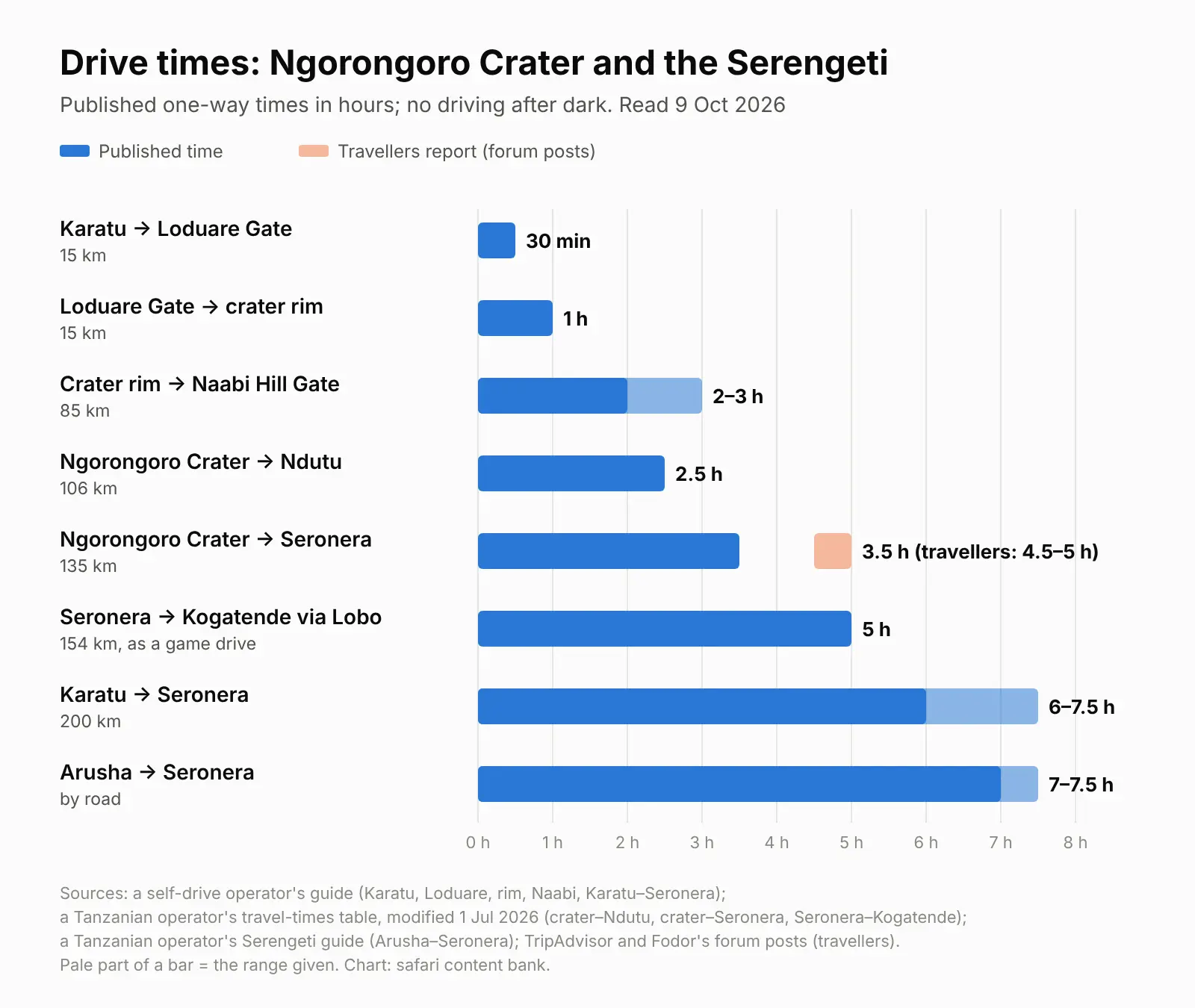 Published one-way times, read 9 October 2026; traveller reports from TripAdvisor and Fodor’s forum posts. Chart: safari content bank.
- Going back for the crater from the north costs a day. A forum regular called a northern Serengeti to crater rim road leg “an all day drive and not worth it” (TripAdvisor, August 2026, traveller report).
- By air, the crater is not on the way. Flights land at Serengeti airstrips such as Seronera; Lake Manyara airstrip (LKY), which Flightlink labels Ngorongoro/Manyara, serves Karatu and the highland lodges (Flightlink, PDF). A same-day transfer from a flight needs it to land before 13:00 (a Tanzanian operator’s travel-times table).
How many days each needs
Give the Serengeti 2–3 nights per area and the crater one day; published northern-circuit trips that include both have a median length of 7–8 days.
- Serengeti: 2–3 nights per area. Moving between areas takes most of a day: Seronera to Kogatende is 154 km, published as a 5-hour game drive. A TripAdvisor destination expert suggests two nights in the centre and “2 or preferably 3 nights Northern Serengeti” (TripAdvisor, traveller report).
- Crater: one day. Each US$295 fee covers one descent, the descent closes at 16:00, and the published packages and the worked examples on our Ngorongoro safari cost page include one descent. We found no published minimum or maximum time.
- Rim or Karatu. A rim lodge gives the earliest start in the crater and adds the US$59 concession per adult per night; Karatu, outside Loduare Gate, adds no NCA fee for the night but is 30 km by road from the rim (Ngorongoro).
- Both together. In our count of 70 published Tanzania northern-circuit itineraries (Serengeti and Ngorongoro, no Zanzibar), the median is 7–8 days (how many days for a safari). The shortest published trips are 3 days: two operators publish 3-day group safaris to the Serengeti and Ngorongoro at US$900–1,220 per person, park fees included (read 9 October 2026).
Worked example: park fees on a 5-day road trip, per adult
Two adults sharing a private vehicle in July, by road from Arusha, with one crater day and two nights inside the Serengeti, pay US$666.70 each in park fees; without the crater day they pay US$448.40 (our sums).
| Day | What happens | Park fees per adult |
|---|---|---|
| 1 | Arusha → Karatu; night in Karatu | US$0 (outside the NCA) |
| 2 | Crater day from Karatu; night in Karatu | US$218.30 (entry + half the crater fee) |
| 3 | Across the NCA to the Serengeti (a new 24-hour NCA permit); night inside the park | US$70.80 + US$153.40 |
| 4 | Serengeti; night inside the park | US$153.40 |
| 5 | Back across the NCA (another NCA permit) | US$70.80 |
| Total | US$666.70 |
Our sums from the TANAPA 2023/24 tariff (last published; July–September rates) and the NCAA tariff page (read 9 October 2026). Before vehicle permits, guide, vehicle, beds, visa and the US$44 inbound insurance. Without day 2 the total is US$448.40, so the crater day adds US$218.30 per adult.
- Descending on the way through can save one NCA permit. If the crater descent and the crossing to Naabi Hill Gate fall inside one 24-hour NCA permit, the crater adds only the crater fee: US$147.50 each for two (our sum). No NCAA document says this in so many words, so confirm it with your operator before you plan around it. The drive from the crater to Seronera is 3.5 hours published and 4.5–5 hours in traveller reports, and driving ends at 18:00.
- Flying into the Serengeti and out again avoids the NCA road crossings; adding the crater then means a road leg through the NCA.
Which to choose, by traveller type
Choose both for a first road safari of a week; the Serengeti alone for a fly-in trip or if crowded sightings put you off; the crater alone only when you have one or two days from Arusha.
| If you are… | Choose | Why, with the number |
|---|---|---|
| On a first safari, 7–8 days by road | Both | The road to the Serengeti crosses the NCA anyway (US$70.80 entry); the crater adds US$295 per vehicle. Median published northern circuit: 7–8 days |
| Short of time: 1–2 days from Arusha | Crater | Karatu is 15 km from Loduare Gate; Arusha to Seronera is 7–7.5 hours each way |
| Coming for calving (December–March) | Serengeti’s southern plains and Ndutu, plus the crater | Ndutu is in the NCA, 106 km (2.5 h) from the crater; calving peaks around February |
| Coming for river crossings (July–October) | Northern Serengeti | Crossings at Kogatende and Lamai; the crater rim from the north is “an all day drive” (traveller report) |
| Keen to see black rhino | Crater | The crater is known for black rhino; one descent costs US$295 per vehicle |
| On a fly-in safari | Serengeti | The crater needs a road leg through the NCA; Lake Manyara airstrip (LKY) serves Karatu and the highland lodges |
| A group of 6 sharing a vehicle | Both | The crater fee falls to US$49.17 each; a crater day costs US$119.97 per adult in fees |
| A couple in a private vehicle | Both, or Serengeti only | A crater day costs US$218.30 each in fees; two Serengeti nights in July cost US$306.80 each |
| A family with children 5–15 | Both, with short legs | Child entry is US$23.60 at both; Karatu → Seronera is 200 km, 6–7.5 hours |
| Travelling 15 March–15 May | Serengeti, with the crater as a day | Serengeti entry falls to US$70.80 (last published tariff, 2023/24); NCAA fees do not change; April is the wettest month |
| Put off by crowded sightings | Serengeti away from Seronera; crater from the rim only | Travellers describe the crater floor as “a zoo”; no vehicle limit is published for either |
| Wanting night drives | Neither | Not allowed in the Serengeti or the NCA; TANAPA sells them in Tarangire and Lake Manyara (northern vs southern circuit) |
Fees: TANAPA 2023/24 (last published) and NCAA (read 9 October 2026); our sums where marked in the sections above. Drive times: published figures, read 9 October 2026. Itinerary median: our count, captured September–October 2026.
Common mistakes about the Serengeti and Ngorongoro
| What you’ll often read | What is correct |
|---|---|
| “Ngorongoro is part of the Serengeti” | It is a separate conservation area run by the NCAA, split from the park in 1959. Serengeti fees do not cover it. |
| “Ngorongoro entry is US$82.60” | US$70.80 per adult per 24 h (NCAA). US$82.60 is peak Serengeti entry with VAT (last published tariff, 2023/24). |
| “The crater fee is per person” | US$295 per vehicle per descent. |
| “You get six hours on the crater floor” | The NCAA guidelines state no time limit; the descent closes at 16:00 and driving ends at 18:00. |
| “Ndutu is in the Serengeti National Park” | Ndutu is in the NCA, with NCAA fees. |
| “Skipping the crater avoids Ngorongoro fees” | Not by road: the Arusha–Serengeti road crosses the NCA, at US$70.80 per adult each crossing. |
| “Ngorongoro to the Serengeti is a short hop” | Crater to Seronera is 135 km: 3.5 h published, 4.5–5 h in traveller reports. |
| “Add a night drive in either” | Not allowed in the Serengeti or the NCA. |
Frequently asked questions
Do I need to visit both the Serengeti and Ngorongoro Crater? No, but most road safaris do. The Arusha–Serengeti road crosses the Ngorongoro Conservation Area, so you pay its US$70.80 entry per adult anyway, and a crater descent adds US$295 per vehicle (NCAA, read 9 October 2026). On a fly-in safari to the Serengeti, the crater is a separate road leg.
Which is better, the Serengeti or Ngorongoro Crater? It depends on what you want. The Serengeti has the wildebeest herds most of the year and needs 2–3 nights per area; the crater is a one-day drive known for black rhino. Neither authority publishes a sighting rate.
Is one day enough for Ngorongoro Crater? For the crater floor, yes: each US$295 crater fee covers one descent, the descent closes at 16:00 and driving ends at 18:00 (NCAA). The NCAA’s guidelines state no time limit on the floor. A second crater day needs another crater fee and, if you leave the NCA, another US$70.80 entry.
Is the crater fee per person or per vehicle? Per vehicle: US$295 per descent. Two people sharing pay US$147.50 each and six pay US$49.17 each, before the US$70.80 entry per adult (our sums from the NCAA tariff page, read 9 October 2026).
How long is the drive from Ngorongoro Crater to the Serengeti? From the crater rim to Naabi Hill Gate is 85 km and 2–3 hours. From the crater to Seronera, in the central Serengeti, is 135 km: 3.5 hours as published, 4.5–5 hours in traveller reports. There is no driving after dark.
Can I see the Great Migration in Ngorongoro Crater? Not on the crater floor. The herds calve on the plains around Ndutu, which is in the Ngorongoro Conservation Area, around February, and spend most of the rest of the year in the Serengeti. Ndutu is 106 km and 2.5 hours from the crater.
Are Serengeti and Ngorongoro fees going up in 2026? No new TANAPA tariff has been published: Serengeti fees are still those of the last published tariff, 2023/24, US$82.60 entry with VAT (US$70.80 from 15 March to 15 May). The NCAA tariff page is undated and says tariffs may change without notice.
Sources
- TANAPA, Tariffs 2023/24 (PDF), the last published national parks tariff, checked 9 Oct 2026
- NCAA, tariffs (undated; read 9 Oct 2026), visitor guidelines and home page (read 8 Oct 2026)
- A safari agent’s guides to Serengeti and Ngorongoro, read 10 October 2026; Wikipedia, Ngorongoro Conservation Area and spotted hyena
- Bank of Tanzania, 2025 exit survey (PDF); The Citizen, 18 Dec 2025
- TAWIRI wildebeest census 2023 (PDF); Mongabay, 3 Oct 2025; PBS, Craig Packer interview, 2012
- Seasons: one safari operator’s and one camp operator’s migration guides; Climates to Travel (an aggregator); camp rates: Lemala
- Travel: a self-drive operator’s guide; a Tanzanian operator’s travel-times table (modified 1 Jul 2026); a Tanzanian operator’s Serengeti guide; Flightlink fares (PDF); package prices: two tour operators’ published prices, read 9 Oct 2026
- Traveller reports: a safari booking site’s Ngorongoro and Serengeti reviews; TripAdvisor and Fodor’s forum threads as linked in the text
- Our pages: Serengeti, Ngorongoro, Tanzania safari cost, the Great Migration month by month, Serengeti vs Masai Mara, Tanzania northern vs southern circuit
Fees checked 9 October 2026; page reviewed 21 October 2026. We will update this page when TANAPA publishes a new tariff or the NCAA publishes a dated one.