 Experience

Last verified · Next check due
On this page
Short answer: For the night sky, go to Namibia’s NamibRand Nature Reserve, Africa’s first International Dark Sky Reserve (2012). Wolwedans there includes a star bed at Dune Camp and sells desert sleep-outs at N$2,150–2,500 per person (2026–27 sheet). Elsewhere you buy a sleep-out, not a designated sky: US$275 per person with Time + Tide in Zambia, or Natural Selection’s Skybeds in the Okavango at US$895–1,295 a night. Our sources hold no sky-quality readings anywhere.
Key facts
- NamibRand Nature Reserve, in southern Namibia, was designated Africa’s first International Dark Sky Reserve by the International Dark-Sky Association in 2012 (Wikipedia; SpaceNews; confirmed by TIME, 13 March 2025).
- !Ae!Hai Kalahari Heritage Park, on the South African side of the Kgalagadi, is Africa’s first International Dark Sky Sanctuary; on the same side of the park, 580 km² was restored to the ‡Khomani San and Mier communities in 2002 (Wikipedia).
- We found no other dark-sky designation on a safari route in our sources, and no sky-brightness reading for any park, reserve or lodge, NamibRand included. We print none.
- Star beds are part of the room at some Namibian camps: Wolwedans Dune Camp and Mountain View Suite include one in the rate (Wolwedans activity sheet 2025–27, PDF), and Kwessi Dunes has a skybed off each room.
- A sleep-out is sold as an extra night’s activity: N$2,150–2,500 per person at Wolwedans (minimum 2 guests and a 3-night stay) and US$275 per person with Time + Tide in Zambia (2027 rack rates, PDF).
- Sleep-outs are seasonal: Wolwedans runs its desert sleep-out from September, in the warmer months, and Natural Selection’s Skybeds open only from 1 April to 31 October.
Where the sky is designated dark: what our sources hold
Only two places on or near a safari route hold a dark-sky designation in our sources, both in the Kalahari and Namib: NamibRand (a Reserve) and !Ae!Hai Kalahari Heritage Park (a Sanctuary). We hold no measurement of how dark either sky is, so we do not rank them.
| Place | Country | Status, as our sources give it | Source |
|---|---|---|---|
| NamibRand Nature Reserve (near Sossusvlei) | Namibia | International Dark Sky Reserve, 2012, Africa’s first; also Africa’s first Wilderness Quiet Park (Quiet Parks International) | Wikipedia; SpaceNews; TIME, 13 Mar 2025; National Geographic, 2 Jul 2025; Quiet Parks International |
| !Ae!Hai Kalahari Heritage Park (Kgalagadi, South African side) | South Africa | International Dark Sky Sanctuary, Africa’s first. Separately, 580 km² of the park’s South African side was restored to the ‡Khomani San and Mier communities in 2002 | Wikipedia, Kgalagadi Transfrontier Park |
| Spitzkoppe | Namibia | No designation and no sky-brightness reading found | Our Spitzkoppe page |
| Every other park on this site (Kenya, Tanzania, Uganda, Rwanda, Botswana’s delta and pans, Zambia, Zimbabwe, Kruger) | — | No dark-sky designation in our sources. That is not proof of a bright sky; it means nobody we read has measured or certified it | — |
Designations as published by the sources linked; read 3 September–9 October 2026. We could not open the International Dark-Sky Association’s own listing pages for this page.
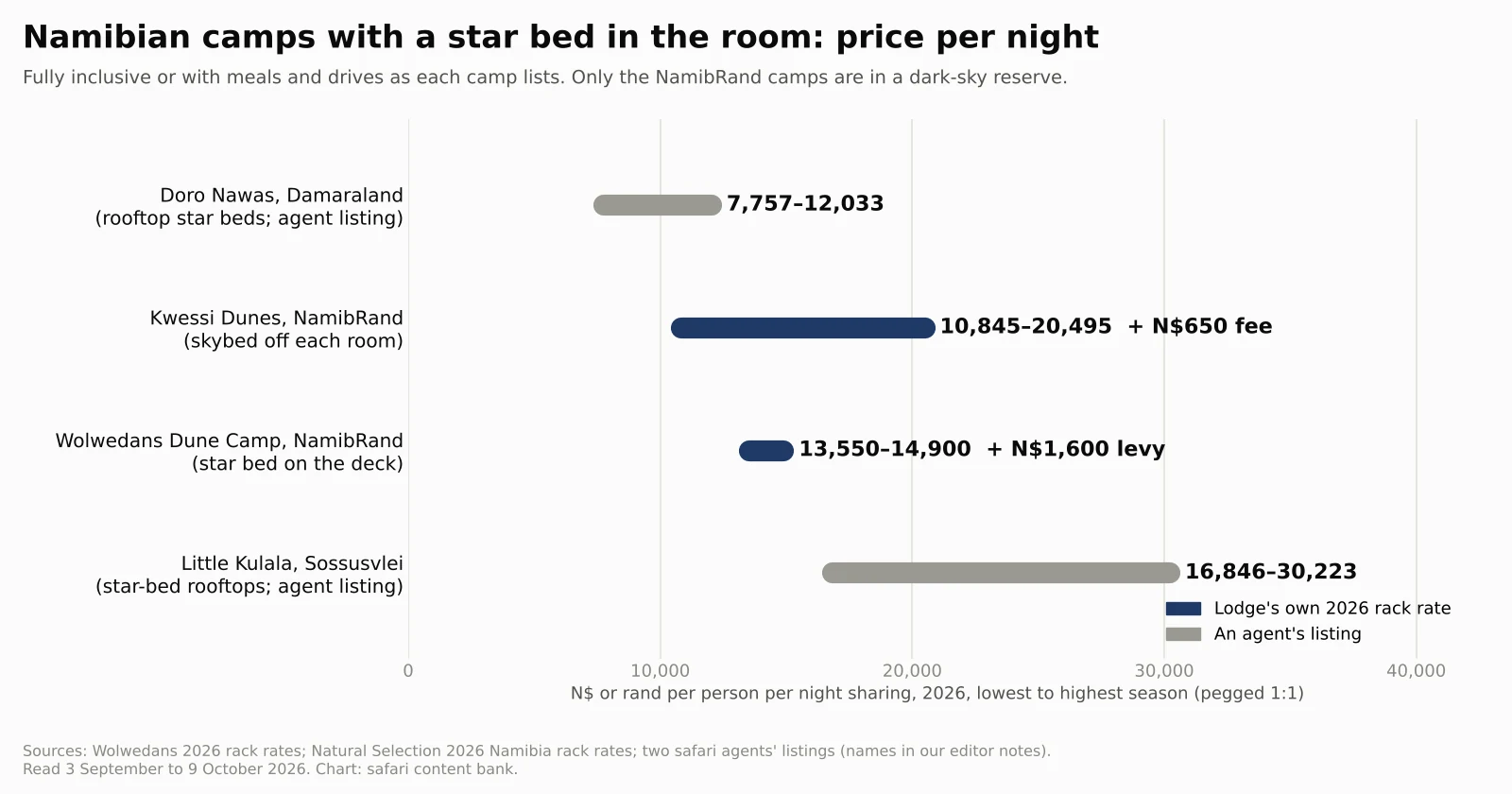 Sources: Wolwedans 2026 rack rates; Natural Selection 2026 Namibia rack rates; two safari agents’ listings (Doro Nawas, Little Kulala). Read 3 September–9 October 2026. Chart: safari content bank.
NamibRand is a landscape and sky reserve, not a game reserve. Its fauna list names oryx, springbok, giraffe, zebra, leopard and aardwolf (TIME), and no elephant, buffalo or lion. It caps tourism at one guest bed per 1,000 hectares and 25 beds in any one location, funded by a daily park fee the lodges collect (NamibRand tourism).
- The park fee is in the lodge levy. Wolwedans adds N$1,600 per adult per night, which includes the NamibRand Nature Reserve park fee; Kwessi Dunes adds N$650 per person per night (Namibia safari cost; Sossusvlei safari cost).
- NamibRand is not a base for Sossusvlei. Wolwedans is over 2 hours from the Sesriem gate on gravel and runs no Sossusvlei trips; it recommends a separate night near Sesriem (Sossusvlei).
Star beds and sleep-outs: what they cost (2026–27)
A star bed on your own deck comes with the room at a few Namibian camps; a sleep-out away from camp is a priced extra, from US$275 per person in Zambia to N$2,150–2,500 per person at Wolwedans.
| Where | Country | What it is | Price | Source |
|---|---|---|---|---|
| Wolwedans Dune Camp and Mountain View Suite, NamibRand | Namibia | Star bed on the room deck, set up on request | Included; Dune Camp N$13,550–14,900 per person sharing a night, plus N$1,600 levy | Wolwedans activity sheet 2025–27; 2026 rack rates |
| Wolwedans desert sleep-out, from Dune Camp or Mountain View Suite | Namibia | A night in the dunes with a guide nearby, sunrise coffee | N$2,500 per person with a dinner hamper; N$2,150 with dinner in camp; minimum 2, maximum 10 | Wolwedans activity sheet, valid 11 Jan 2026–31 Mar 2027 |
| Kwessi Dunes (Natural Selection), NamibRand | Namibia | Star-gazing skybed off each room | N$10,845–20,495 per person sharing a night, fully inclusive, plus N$650 | Natural Selection 2026 (PDF) |
| Little Kulala (Wilderness), Sossusvlei | Namibia | Star-bed rooftops | R16,846 (November–19 December 2026) to R26,747–30,223 (June–October), fully inclusive | An agent’s listing |
| Doro Nawas (Wilderness), Damaraland | Namibia | Rooftop star beds | R7,757–12,033 per person a night, fully inclusive | An agent’s listing, as on Damaraland safari cost |
| Namib Dune Star Camp (Gondwana), near Solitaire | Namibia | Beds that roll out onto the deck on rails | Not printed: the page shows no validity dates | Gondwana Collection |
| Skybeds (Natural Selection), Okavango Delta | Botswana | Star-bed platforms; open 1 April–31 October; guests 16 and over | US$895–1,295 per person sharing a night, plus US$60 CCR fee | Natural Selection 2026 (PDF) |
| Pan-edge camps, Makgadikgadi | Botswana | A night sleeping out on the dry pan | No price in our sources | Our Makgadikgadi page |
| Time + Tide, South Luangwa and Lower Zambezi | Zambia | Sleep-out under the stars; from age 12 | US$275 per person | Time + Tide 2027 rack rates (PDF) |
| Loisaba Star Beds, Laikipia | Kenya | Star-bed rooms | From US$494 a night | An agent’s listing (secondary) |
| &Beyond Ngala Treehouse, Timbavati | South Africa | Treehouse sleep-out | No price in our sources | One safari company’s guide |
Lodges’ own rate cards where linked; agent listings named in our editor notes. Read 3 September–9 October 2026. Rand and Namibian dollar are pegged 1:1.
- Check what the room rate already covers. At Wolwedans the star bed is in the rate but the sleep-out is not; the 2026 rack rates list “star beds at Dune Camp and Mountain View Suite” as included and “the desert sleepout” as extra (Namibia safari cost).
- Wolwedans’ sleep-out needs a 3-night stay and pre-booking at reservation, and it is not offered from Boulders Camp (activity sheet).
- Age limits are higher than for game drives: 16 on Skybeds and 12 with Time + Tide (safari age limits).
- Wolwedans also sells “Dinner Under the Stars” at N$1,850 for the first 2 guests and N$350 per person after that: a private dinner, not a night out.
- One new sleep-out is coming: Xigera’s “Ancestral Passage” mokoro sleep-out in the Okavango is sold only with 4 or more nights, from May 2027 (how many days on safari).
More on sleep-outs as a room type: safari lodge vs tented camp and honeymoon safari.
When to go: what our sources say about season and sky
The sources we hold give seasons for the sleep-outs and the rain, not for the sky itself: Wolwedans sleeps out in the warmer months from September, Skybeds open April–October, and the Kalahari’s rain falls mostly January–April.
| Place | Sleep-out or star-bed season | Weather notes in our sources | Source |
|---|---|---|---|
| NamibRand (Wolwedans) | Desert sleep-out “September–May” in the activity description, “September–April” in the terms; star beds all year, weather permitting | Star beds and sleep-outs are “particularly weather-sensitive”; Wolwedans Desert Lodge is closed 11 January–31 March | Wolwedans activity sheet; Namibia safari cost |
| Sossusvlei | — | Forum regulars say February brings “dramatic cloud” | Sossusvlei |
| Okavango Delta (Skybeds) | 1 April–31 October | Closed in the rains | Green-season safari |
| Makgadikgadi | Dry season; our sources give no months | Rains December–March | Makgadikgadi |
| Kgalagadi (!Ae!Hai) | — | Most of Twee Rivieren’s 222 mm of rain falls January–April; July’s mean minimum is 0.9 °C | Kgalagadi |
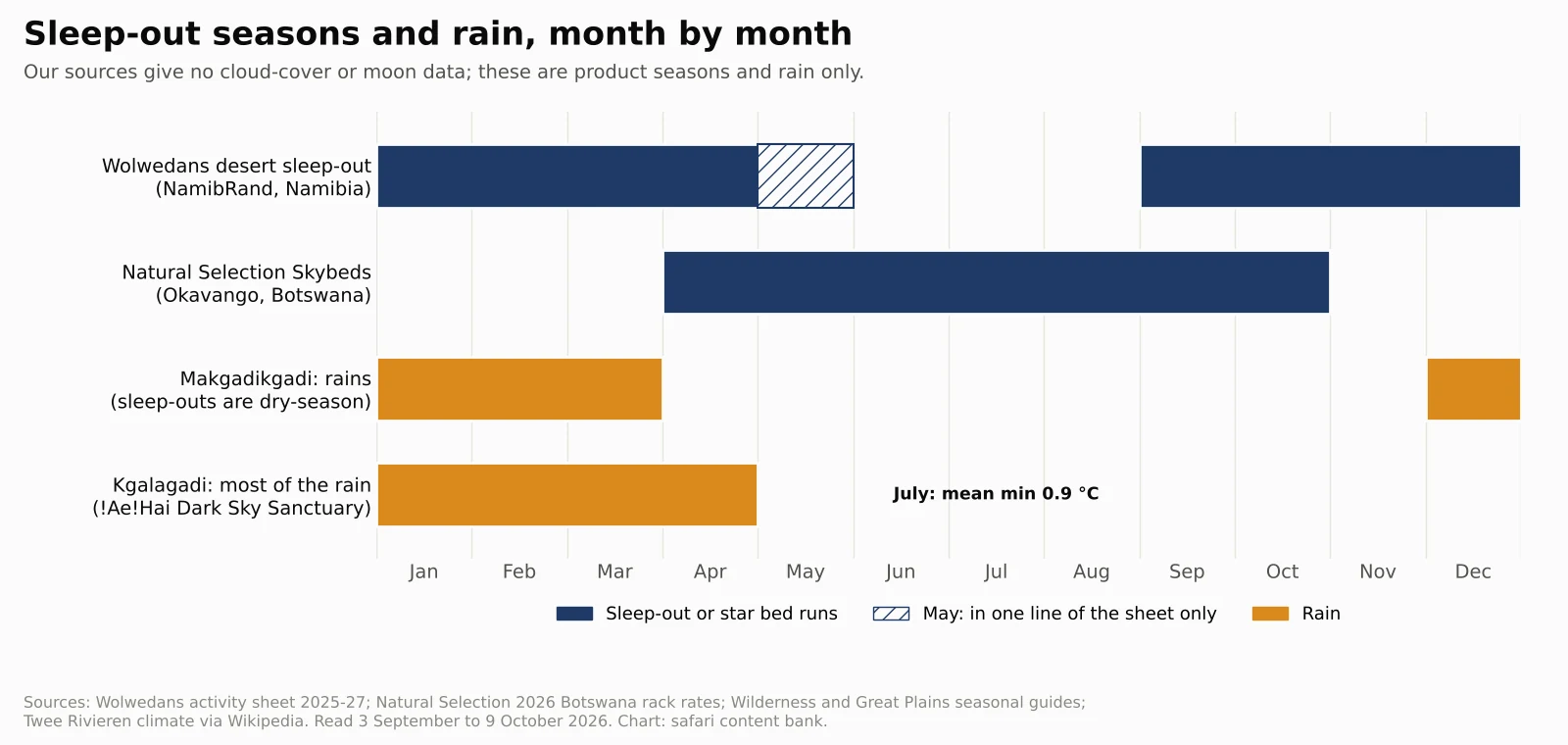 Sources: Wolwedans activity sheet 2025–27; Natural Selection 2026 Botswana rack rates; two camp operators’ seasonal guides (Makgadikgadi rains); Twee Rivieren climate via Wikipedia. Chart: safari content bank.
- Our sources hold no moon-phase, cloud-cover or seeing data for any park. Check a moon calendar for your dates yourself, and ask the camp how it schedules sleep-outs around the moon.
- Winter nights in the Kalahari are cold. Twee Rivieren’s July mean minimum is 0.9 °C, and its recorded low is −10.3 °C (Kgalagadi); bring layers for a night outside.
What you will see, and what our sources do not cover
Our sources hold no astronomy content: no guide to the southern-hemisphere sky, no observatory programme and no sky-quality measurement for any lodge. We do not fill that gap from memory.
| Question | What our sources hold |
|---|---|
| How dark is the sky (a sky-quality reading)? | Nothing, for NamibRand, !Ae!Hai or anywhere else |
| Is there an observatory or astronomer? | One agent describes Sossusvlei Desert Lodge, on the Sossusvlei Desert Reserve next to NamibRand, as having an observatory and a resident astronomer; we found no programme or price |
| Which stars and objects can I see from southern Africa? | Nothing in our sources |
| Which month has the clearest skies? | Nothing on cloud; only the rain seasons in the table above |
| Do I need a telescope? | Nothing in our sources; ask the lodge what it provides |
- Ask the lodge three things before you book a night for the sky: whether there is a telescope, who guides the session, and whether outside lights are switched off after dinner.
- A designation is not a guarantee of a clear night. Cloud and the moon still decide what you see.
Which choice fits
| If you… | Then | Why |
|---|---|---|
| Want the best-documented dark sky in our sources | NamibRand, 2–3 nights at Wolwedans or Kwessi Dunes | Africa’s first International Dark Sky Reserve (2012); star bed or skybed in the room |
| Want a star bed with big game the same day | Skybeds in the Okavango (April–October) or a Time + Tide sleep-out in Zambia | NamibRand has no elephant, buffalo or lion |
| Are combining with Sossusvlei | Little Kulala near the dunes, or NamibRand plus a night near Sesriem | Wolwedans runs no Sossusvlei trips (Sossusvlei) |
| Are driving yourself in the Kgalagadi | Look at the !Ae!Hai Kalahari Heritage Park on the South African side | Africa’s first International Dark Sky Sanctuary |
| Are travelling with children under 12 | A Wolwedans family sleep-out | Wolwedans lists the desert sleep-out as “suitable for all ages”; Skybeds take 16+, Time + Tide 12+ |
| Are on a honeymoon | A star-bed room or one sleep-out night | Honeymoon safari |
| Travel December–March | NamibRand’s star beds (weather permitting), not Skybeds | Skybeds close 1 November–31 March; the Botswana pans are in the rains |
Common mistakes
| Mistake | Reality |
|---|---|
| “Any desert camp sits in a dark-sky reserve” | Only NamibRand holds the Reserve designation in our sources. Sossusvlei, Spitzkoppe and Damaraland camps do not. |
| “A dark-sky park guarantees the Milky Way” | Cloud and the moon still decide it. We found no cloud or sky-quality data for any of these places. |
| “A star bed and a sleep-out are the same” | A star bed is on your room’s deck; a sleep-out takes you away from camp. Wolwedans includes the first and charges N$2,150–2,500 per person for the second. |
| “Sleep-outs run all year” | They are seasonal: Wolwedans’ from September, Skybeds 1 April–31 October, the Makgadikgadi’s in the dry season. |
| “NamibRand is a game-drive reserve” | It is a landscape and sky reserve; our sources list no elephant, buffalo or lion there. |
| “Kids can do any sleep-out” | Skybeds take 16 and over; Time + Tide 12 and over. Wolwedans’ desert sleep-out is listed as suitable for all ages. |
Frequently asked questions
Where is the best place in Africa to see the stars on safari? In our sources, NamibRand Nature Reserve in Namibia: Africa’s first International Dark Sky Reserve, designated in 2012. We hold no sky-quality readings, so we cannot rank it against other places by measurement. !Ae!Hai Kalahari Heritage Park in the Kgalagadi is Africa’s first International Dark Sky Sanctuary.
How much does a star bed or sleep-out cost? At Wolwedans in NamibRand the star bed is included at Dune Camp and Mountain View Suite, and a desert sleep-out costs N$2,150–2,500 per person (minimum 2). Time + Tide charges US$275 per person in Zambia. Natural Selection’s Skybeds in the Okavango cost US$895–1,295 per person a night in 2026, plus US$60.
What is the difference between a star bed and a sleep-out? A star bed is an open-air bed on your own room’s deck or roof. A sleep-out is a night away from the main camp, on a platform or in the dunes, with a guide nearby, usually sold as an extra.
When is the best time for stargazing on safari? Our sources give no month for clearest skies. They give seasons for the products: Wolwedans’ desert sleep-out from September (to April or May), Skybeds 1 April–31 October, Makgadikgadi sleep-outs in the dry season. Check the moon phase for your dates.
Can I see big game and dark skies on the same trip? Not in NamibRand, which has no elephant, buffalo or lion. Combine NamibRand with Etosha or Botswana, or sleep out at Skybeds in the Okavango or with Time + Tide in Zambia.
Is there an observatory on safari? One agent describes Sossusvlei Desert Lodge, next to NamibRand, as having an observatory and a resident astronomer. We found no programme or price; ask the lodge directly.
Are sleep-outs safe and suitable for children? Age limits apply: Skybeds take guests 16 and over and Time + Tide 12 and over. Wolwedans lists its desert sleep-out as suitable for all ages and places a guide nearby. Our sources hold no incident data for sleep-outs.
Sources
- Designations: Wikipedia, NamibRand Nature Reserve; SpaceNews, NamibRand becomes Africa’s first International Dark Sky Reserve (2012); TIME, World’s Greatest Places 2025: NamibRand (13 March 2025); National Geographic, things to do in Namibia (2 July 2025); Quiet Parks International; Wikipedia, Kgalagadi Transfrontier Park (!Ae!Hai Kalahari Heritage Park). Read 3 September–9 October 2026
- Reserve rules: NamibRand Nature Reserve, tourism (read 9 October 2026)
- Lodges’ own rates: Wolwedans 2026 rack rates (PDF) and activity sheet 2025–27 (PDF), read 3 September 2026; Natural Selection 2026 rack rates, Namibia (PDF) and Botswana (PDF), read 8 October 2026; Time + Tide 2027 rack rates (PDF); Gondwana Collection, Namib Dune Star Camp
- Agents and operators (names and links in our editor notes): listings for Little Kulala, Doro Nawas, Loisaba Star Beds and Sossusvlei Desert Lodge; one safari company’s child-policy guide (Ngala Treehouse). Read October 2026
- Weather and seasons: as on our Kgalagadi, Makgadikgadi and Sossusvlei pages
More on the same subject: Sossusvlei, Namibia safari cost, safari lodge vs tented camp, honeymoon safari and safari glossary.
Prices and designations checked 3 September–10 October 2026. We will update this page when we can read the dark-sky listings directly or a park publishes sky-quality readings.