 Experience

Last verified · Next check due
Short answer: Makgadikgadi Pans National Park and Nxai Pan National Park are neighbouring parks in Botswana. Zebra herds graze the pans from about December to March (Africa Geographic); quad bikes run on the dry salt crust from about May to November. Camps publish US$625–3,895 per person per night (2024–2026 rate cards). The last published park fee is P190 per non-resident adult per day (DWNP, 1 April 2022); confirm it with DWNP or your operator.
Key facts
- Two parks, side by side: Makgadikgadi Pans National Park covers 3,900 km², including the western end of Ntwetwe Pan (Botswana Tourism); Nxai Pan National Park covers 2,578 km² (Wikipedia).
- The salt pans cover about 16,000 km²; the largest single pan is about 4,900 km² (Wikipedia).
- Wet and dry seasons offer different trips: zebra and wildebeest come to Nxai Pan from December to April (Wikipedia, Nxai Pan); quad bikes need the dry crust of about May to November (one safari operator’s salt pans page).
- Meerkats: 81% of one safari operator’s travellers to the salt pans saw meerkats, against 48% across Botswana.
Where to stay at Makgadikgadi and Nxai Pan (2026)
Camps publish US$625–3,895 per person per night, from the Boteti River camps to Jack’s Camp on the pan edge; self-drivers camp for BWP 150–700. Camp rates include meals, activities and park fees.
| Tier | Camps (group) | Per person per night, low → top season | Added on top |
|---|---|---|---|
| Campsites | Kubu Island (community trust) BWP 150; South Camp, Nxai Pan, BWP 400; Baines’ Baobabs BWP 700 | BWP 150–700 | P10 levy; park fee in the parks |
| Boteti River | Meno a Kwena (Natural Selection) US$625–1,275; Leroo La Tau (Desert & Delta, 2024, 1–4 nights) US$645–1,160 | US$625–1,275 | Natural Selection US$60; Desert & Delta includes levies |
| Inside Nxai Pan | Nxai Pan Camp (Kwando, 2024 rate card), 9 tents | US$800 for 1–5 nights in every season (US$720 for 8+, April to mid-November only) | Levy US$20 |
| Pan edge | Camp Kalahari US$795–1,325; San Camp (open 1 April–15 October) US$1,995–2,595; Jack’s Camp US$2,095–3,895, all Natural Selection | US$795–3,895 | US$60 fee |
Rate cards: Natural Selection 2026, Desert & Delta 2024, Kwando 2024, each group’s latest in our sources. Campsites: a safari operator’s campsite sheet, undated: last published rates, so confirm with the campsite operator. Read 10 October 2026.
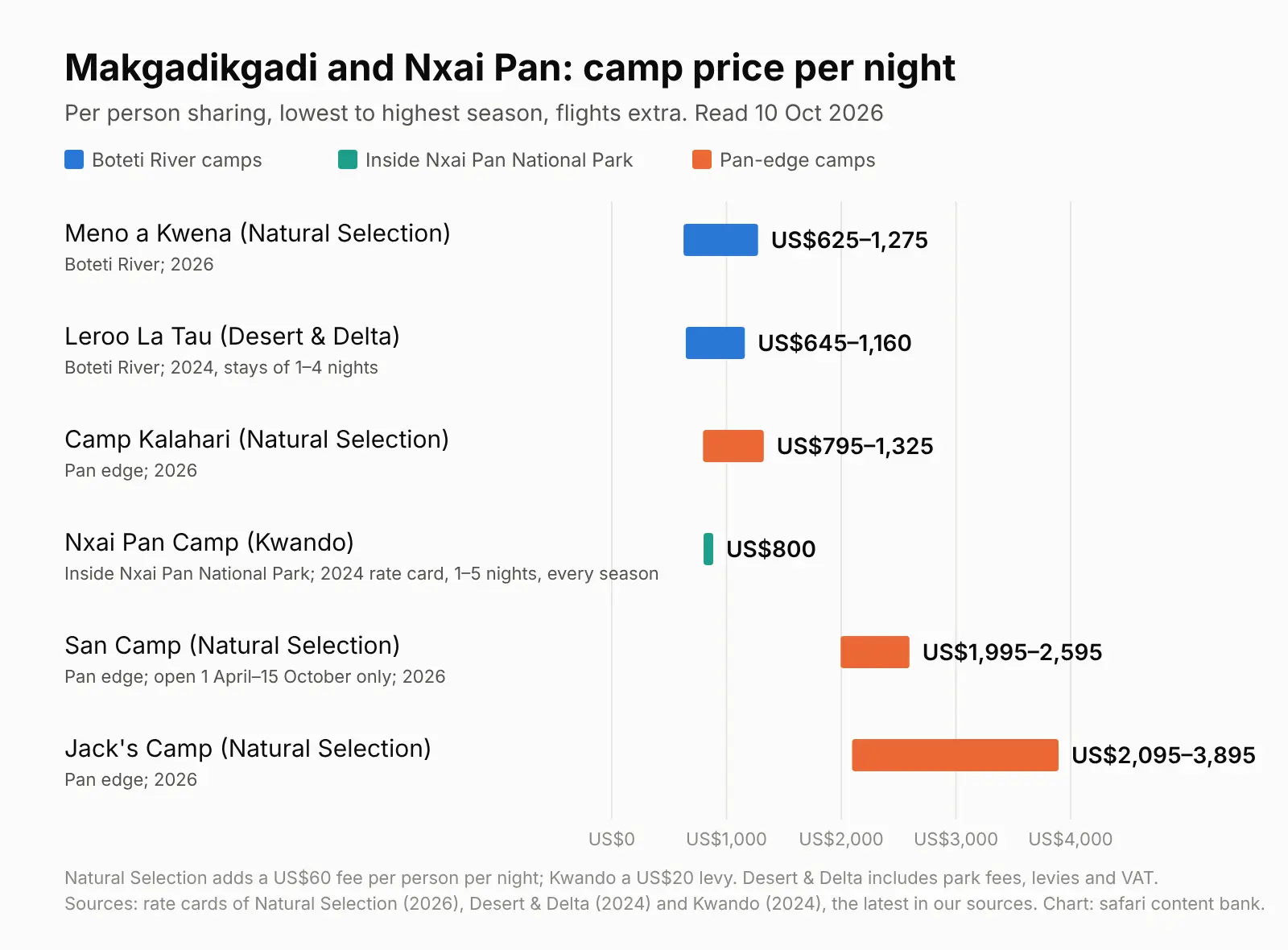 Per person sharing, flights extra. Sources: the rate cards above. Read 10 October 2026.
Natural Selection’s pan and Boteti camps take all ages: under-6s stay free and 6–18s pay half. Families with children aged 9 or younger must book a private vehicle at US$725–935 per vehicle a night. Lodges on the Nata–Maun road, such as Planet Baobab and Gweta Lodge, have no published rate in our sources.
What the Makgadikgadi Pans are
The Makgadikgadi is a group of salt pans left by an ancient lake that dried up “tens of thousands of years ago” (Wikipedia). The main pans are Sua (also spelt Sowa), Ntwetwe and Nxai. Salt and soda ash have been extracted on Sua Pan since 1991, and it holds one of only two greater flamingo breeding populations in southern Africa, the other being Etosha (same source). Nata Bird Sanctuary, 230 km² and community-managed, takes in part of Sua Pan; its flamingos arrive after the rains (Wikipedia).
When to go: wet season or dry season
Go from December to March for zebra and green grass, or from May to November for the dry crust, quad bikes and the Boteti River, best from July to October.
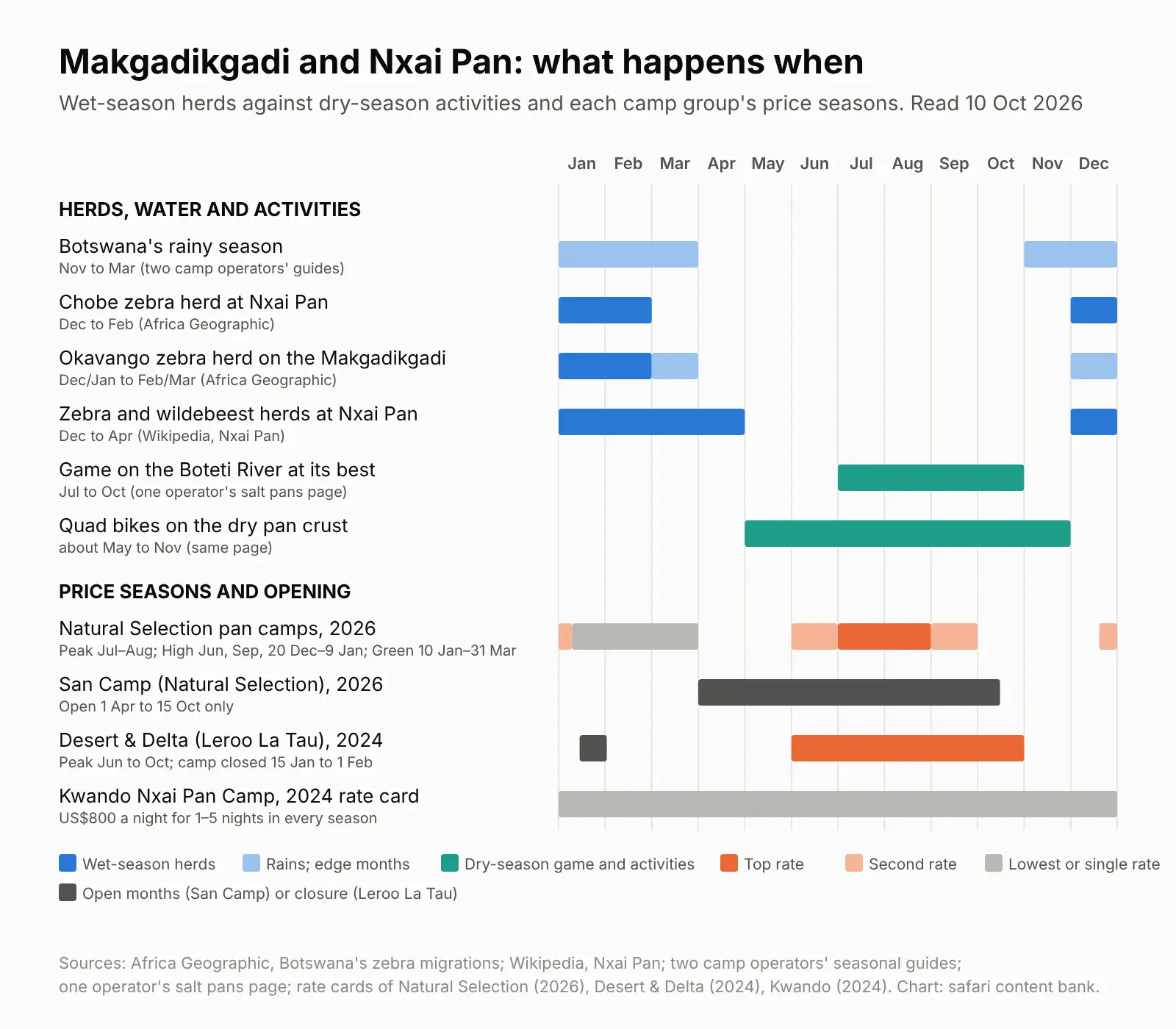 Shoulder seasons left blank. Sources: Africa Geographic; Wikipedia; two camp operators’ seasonal guides; one operator’s salt pans page; the rate cards above. Read 10 October 2026.
- December to March: rains fall (two camp operators’ seasonal guides) and the zebra arrive. Natural Selection’s Green rates run 10 January–31 March: Camp Kalahari US$795, Jack’s US$2,095.
- April and May: Nxai Pan’s herds can stay into April; San Camp opens on 1 April and quad biking starts in about May.
- June to October: Natural Selection charges Peak from 1 July to 31 August (Jack’s US$3,895), Desert & Delta from June to October. San Camp closes on 15 October.
The zebra migration: the Boteti River and Nxai Pan
Two separate zebra herds move onto the pans in the rains: more than 20,000 from the Chobe floodplains to Nxai Pan, and about 15,000 from the Okavango to the Makgadikgadi (Africa Geographic, 20 November 2025).
| Herd | Zebra | Distance | On the pans |
|---|---|---|---|
| Chobe → Nxai Pan | More than 20,000 | “Over 1,000 km each year” | December–February |
| Okavango → Makgadikgadi | About 15,000; only about 55% migrate | 500 km return | December or January to February or March |
Source: Africa Geographic, 20 November 2025. Read 10 October 2026.
- The Boteti River is the water: Africa Geographic calls it “one of the only permanent water sources” on the corridor.
- Eight collared zebras from the Chobe herd covered 955 km on a 500 km straight-line round trip, spending a mean of 10 weeks at Nxai Pan (Naidoo et al., Oryx, 2016).
- Best viewing is December to March, “with March being when zebras are massing” (Africa Geographic).
Meerkats, quad bikes and sleep-outs on the dry pans
These are dry-season trips from the pan-edge camps; quad bikes run only from about May to November, “when the salt flats are firm and dry” (one safari operator’s salt pans page).
- Meerkats: Botswana Tourism lists walking with meerkats among the park’s activities (Botswana Tourism). Ask the camp how its meerkat group is habituated.
- Quad bikes: the same operator warns that “pan surfaces are lethal when wet”. Off-road tourist vehicles threaten Sua Pan’s flamingo colonies (Wikipedia), and off-roading is prohibited in the parks (Botswana Tourism).
- Sleep-outs: some pan-edge camps sell a night sleeping out on the pan, also a dry-season trip; ask whether yours runs one in your month.
Nxai Pan and Baines’ Baobabs
Nxai Pan turns grassy and draws zebra and wildebeest from December to April; May to September is easier to reach but quieter (Wikipedia, Nxai Pan and Nxai Pan National Park).
- Baines’ Baobabs are seven trees on Kudiakam Pan, about 30 km from the Nxai Pan entrance. Thomas Baines painted them “over a century ago”, and “this view remains unchanged today” (Botswana Tourism).
- Where to sleep: Nxai Pan Camp, or Xomae Group’s South Camp (10 sites) and Baines’ Baobabs (3 sites), which needs strong 4x4 skills, forum regulars say (TripAdvisor forum). No night drives in the parks: see night drives and walking.
Kubu Island
Kubu Island is a rocky outcrop with baobabs on Sua Pan, a national monument where stone tools predating Homo sapiens were found (Wikipedia). The Gaing-O Community Trust runs 14 campsites at BWP 150 per person a night, plus P3 entry and a P10 levy; children 14 and under pay half. Rules: bring firewood, remove rubbish, no driving on the pan, dry season only (a safari operator’s campsite sheet).
Makgadikgadi and Nxai Pan park fees
Both parks charge P190 per non-resident adult per day (P270 in Chobe and Moremi) in the last published DWNP schedule (1 April 2022, via Tourism Update). In February 2026 the government news agency BOPA called the existing non-resident fee P380; a P500 rise was announced, then reported postponed (Gabz FM). Confirm the fee with DWNP or your operator.
| Fee | Amount | In force from | Source |
|---|---|---|---|
| Other DWNP parks and reserves (Central Kalahari Game Reserve, Khutse, Nxai Pan, Makgadikgadi Pans), non-resident adult, per person per day | BWP 190 (SADC residents BWP 145; Botswana citizens and residents BWP 20) | Last published DWNP schedule, 1 April 2022 (via Tourism Update). In Feb 2026 the government news agency BOPA called the existing non-resident fee P380; a P500 rise was announced, then reported postponed. No official current tariff: confirm with DWNP or your operator | Tourism Update, 23 Feb 2022 (DWNP fee schedule) |
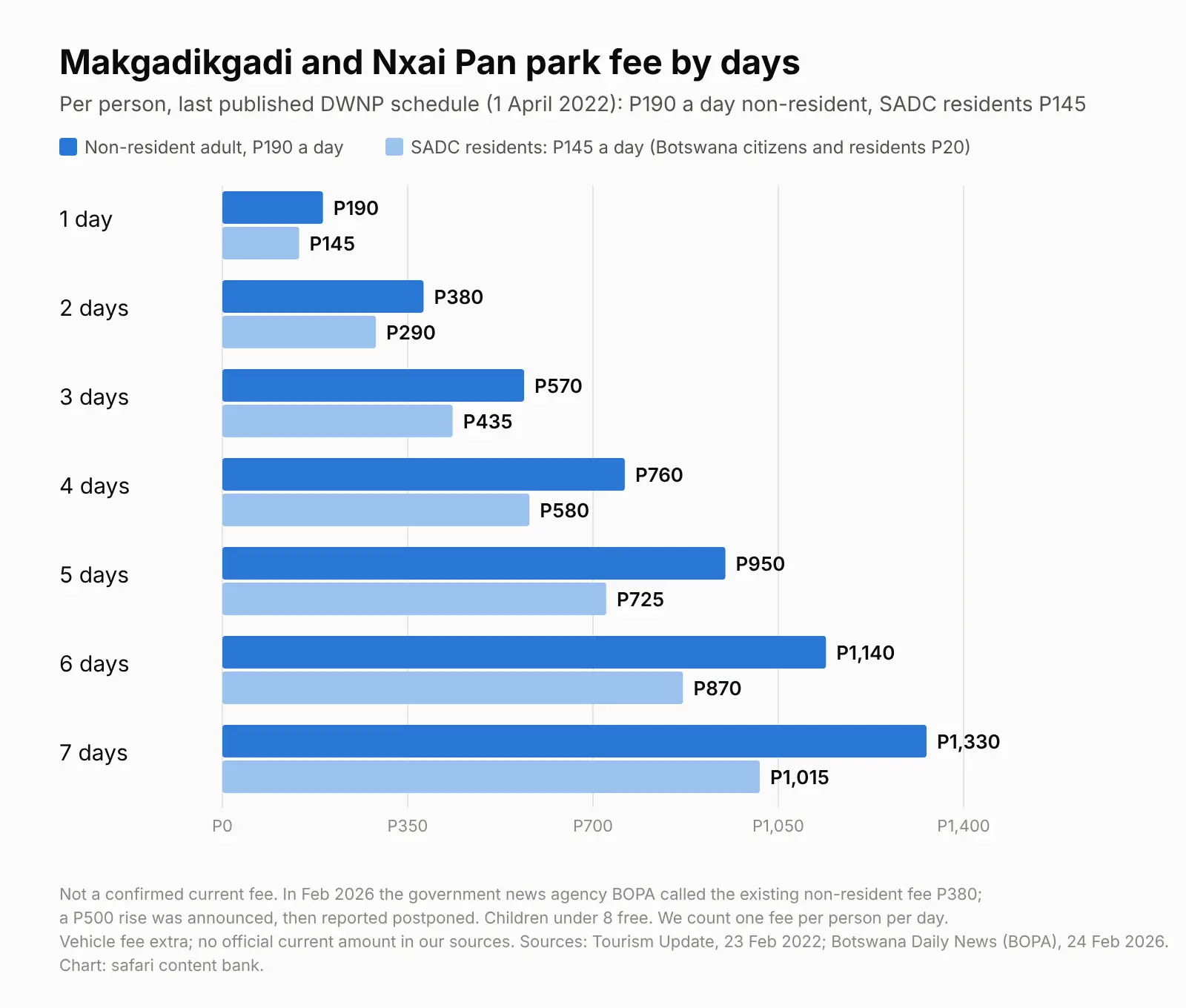 Our arithmetic, one fee per person per day. Sources: Tourism Update, 23 Feb 2022; BOPA, 24 Feb 2026. Read 10 October 2026.
Children under 8 enter free and older children pay half (a safari operator’s campsite sheet); sources give the half-price band as 8–15, 8–17 or 8–18, so check with your operator. The same sheet says DWNP charges per person per 24 hours, so ask how your entry and exit times count. We count one fee per person per day. DWNP also charges a vehicle fee per day, arrival and departure days included; no official source gives the current amount. Pay campsites first and DWNP last (yourbotswana). More: Botswana park fees.
What a Makgadikgadi trip costs
Three nights cost US$1,935–11,865 per person at the camps; two self-drivers pay P2,780 in fees for three days at Nxai Pan at the last published park fee.
| Trip | Our arithmetic | Total |
|---|---|---|
| Leroo La Tau, 3 nights, Green → Peak (2024) | 3 × US$645 → 3 × US$1,160 | US$1,935 → 3,480 per person, levies included |
| Camp Kalahari, 3 nights, Green → Peak | 3 × (US$795 + 60) → 3 × (US$1,325 + 60) | US$2,565 → 4,155 per person |
| Jack’s Camp, 3 nights, Green → Peak | 3 × (US$2,095 + 60) → 3 × (US$3,895 + 60) | US$6,465 → 11,865 per person |
| Nxai Pan Camp, 3 nights, Moremi Air from and to Maun (Kwando 2024 rate card) | 3 × (US$800 + 20) + 2 × US$220 + US$25 departure tax | US$2,925 per person, before other air taxes |
| Self-drive, 2 adults, 3 days, 2 nights at South Camp | Park 2 × 3 × P190; camping 2 × 2 × BWP 400; levy 2 × 2 × P10 | P2,780, plus vehicle fee |
Our arithmetic. Sources: the Natural Selection 2026, Desert & Delta 2024 and Kwando 2024 rate cards (Moremi Air fare and Maun departure tax from the Kwando 2024 rate card); the last published DWNP fee (1 April 2022); a safari operator’s campsite sheet. Read 10 October 2026.
Packages: one operator publishes a 6-night mobile camping trip through the Central Kalahari and Makgadikgadi from US$1,590 (basis not stated; check whether park fees are in the “from” price); two sell 9-day shared trips including the pans for US$2,800 and US$3,544 per person; two more sell 9- and 13-day fly-in trips, land only, from US$8,995 and about US$9,400 per person (prices read 9 September and 8 October 2026). Full ladder: Botswana safari cost.
Getting there: Maun, Nata and Gweta
Drive the A3 tar road between Maun and Nata, or fly from Maun.
- Road: the A3 runs 300 km from Nata to Maun via Gweta, and 180 km from Francistown to Nata (Wikipedia, A3). One safari operator’s salt pans page puts the pans about 250 km, 3–4 hours, by road from Maun. Makgadikgadi Pans to Nxai Pan is 50–80 km, 1.5–2.5 hours (another safari operator’s travel-times page).
- Air: a charter from Maun takes 30–60 minutes (the same salt pans page). Mack Air flies to the Nxai Pan and Tsigaro (Jack’s and San Camp) airstrips (Mack Air). Kwando collects guests at the Nxai Pan gate for US$100 per person each way, minimum 2 (Kwando 2024 rate card). See bush flights.
- Supplies: raw meat may not be taken from Maun towards Nxai Pan, Makgadikgadi or Nata (Tracks4Africa); SKL Camps reports no fuel or phone signal at its sites, Kumaga included (SKL Camps). See self-drive.
Combining the pans with the Okavango Delta and Chobe
Trips that include the pans usually add them before Maun, for 3–5 days (our review of 124 Botswana trips on sale, 9 September 2026). The zebra months fall in the Okavango Delta’s low season; a dry-season trip pairs the Boteti and quad bikes with Delta high water. For Chobe, Nata to Kasane is 300 km, about 4 hours (the same travel-times page).
Common mistakes about the Makgadikgadi
| What you’ll often read | What is correct |
|---|---|
| “Go in the dry season, like the rest of Botswana” | Nxai Pan’s herds come from December to April; May to September is quieter. |
| “Quad bike the pans in January” | Quad bikes run from about May to November. |
| “The zebra migration is Africa’s longest” | The 2016 paper called it the longest; Africa Geographic now calls it the second-longest, after the Great Nile Migration. |
| “The park fee is P500 from April 2026” | P500 was announced, then reported postponed; the last published fee is P190. |
Frequently asked questions
Is the zebra migration worth planning a trip around? Yes, from December to March, as part of a green-season trip. Only about 55% of the Okavango herd migrates, and March is when the zebra mass before turning back (Africa Geographic).
Where do I see meerkats, and are they habituated? At the pan-edge camps: 81% of one safari operator’s travellers to the salt pans saw meerkats, against 48% across Botswana. We have no source on how each camp’s meerkat group was habituated, so ask your camp how its visits work.
Is March a bad month for the pans? No, it is the zebra’s massing month (Africa Geographic), though the crust is too wet for quad bikes. In a March 2026 TripAdvisor thread, one respondent said Nxai Pan delivers exceptional elephant (TripAdvisor forum).
What is the park entry fee and is it included in my safari price? The last published DWNP schedule (1 April 2022) charges non-residents P190 per person per day; in February 2026 the government news agency called the existing fee P380, so confirm it with DWNP or your operator. Natural Selection, Desert & Delta and Kwando include park fees; self-drivers pay DWNP separately.
Where can I camp between Nata and Maun? Forum regulars name Elephant Sands near Nata, Planet Baobab or Gweta Lodge on the road, and Baines’ Baobabs in Nxai Pan (TripAdvisor forum). Inside Nxai Pan, South Camp costs BWP 400 and Baines’ Baobabs BWP 700 per person a night.
Can we self-drive here staying in lodges rather than tents? Yes. Forum respondents suggested Maun to the Makgadikgadi, Nata and Kasane, a tar route, and warned that the inland route through Moremi and Savuti may need advanced 4x4 skills (TripAdvisor forum).
Sources
- Pans and parks: Wikipedia, Makgadikgadi Pan, Nxai Pan National Park, Nxai Pan, Nata Bird Sanctuary; Botswana Tourism, Makgadikgadi, game viewing
- Zebra: Africa Geographic; Oryx, 2016
- Seasons and sightings: two camp operators’ Botswana seasonal guides; one safari operator’s salt pans page, read September 2026 (names and links in our editor notes)
- Rates: Natural Selection 2026; Desert & Delta 2024 and Kwando 2024 rate cards; a safari operator’s campsite sheet; tour operators’ package prices (names and links in our editor notes)
- Travel: Wikipedia, A3; a safari operator’s travel-times page (name and link in our editor notes); Mack Air; Tracks4Africa; SKL Camps; yourbotswana
- Fees: Tourism Update, 23 Feb 2022; BOPA, 24 Feb 2026; Gabz FM
- TripAdvisor threads: March, campsites and lodges
More: the Botswana safari hub, Botswana safari questions, Central Kalahari, green-season safaris and Namibia vs Botswana.
Prices and fees checked 10 October 2026. We will update this page when DWNP publishes a new fee schedule or an official current tariff, and when Kwando, Desert & Delta and Natural Selection publish newer rate cards.
What visitors say
4.6/5 · 249 reviews · Tripadvisor · read
What visitors praise
- Vast, flat salt pans that feel otherworldly, with a visible curve to the horizon
- Sleeping out on the pans under extraordinary starry skies
- Habituated meerkats
- Good game along the Boteti River, including zebra, elephant and hippo
- Giant baobabs and dramatic sunsets
What visitors criticise
- Little wildlife on the pans themselves and few cats
- Long, remote drives
- In wet years the pans flood and are hard to access
- Camping fees feel high for basic facilities
Tips visitors repeat
- Stay a night out on the pans if you can, for the stars
- Treat it as scenery and a break from game drives rather than a big-game park
- For wildlife, head to the Boteti River side
- A 4x4 is needed, and vehicles can get stuck in the salty sand
Steady and high: almost all 4-5 stars from 2019 to 2026.
Ask for a quote
Tell us your dates and we send you a priced itinerary. Free, no obligation.
- Free quote, no obligation
- Trips run by licensed local operators