 Experience

Last verified · Next check due
On this page
- Tarangire vs Lake Manyara at a glance
- What each park is
- Park fees: the same in both parks
- Wildlife: Tarangire’s dry-season elephants vs Manyara’s forest and lake
- When to go to each park
- Drive times from Arusha, and on to Ngorongoro and the Serengeti
- Is a half day enough, or do you need a full day?
- Which to choose
- Common mistakes in Tarangire vs Lake Manyara comparisons
- Frequently asked questions
- Sources
Short answer: Add Tarangire if you can spare a full day, ideally June–October, when its game gathers at the river. Add Lake Manyara as a half-day stop on the road to Ngorongoro Crater, 1 hour further on. Fees do not decide it: both charge US$59 per adult per day (US$53.10 from 15 March to 15 May) and US$47.20 a night inside (last published tariff, 2023/24). Arusha is 2 hours from Tarangire and 2 h 15 from Lake Manyara.
Key facts
- Tarangire and Lake Manyara National Parks share one fee line in the Tanzania National Parks (TANAPA) tariff: US$59 per non-East African adult per day with 18% VAT (US$50 before VAT), or US$53.10 from 15 March to 15 May, in the last published tariff, 2023/24.
- A half day costs the same as a full day. A TANAPA day permit is valid for 12 daylight hours, so three hours in Lake Manyara cost the same US$59 per adult as a whole day in Tarangire.
- Tarangire is the more common add-on: it appears in 67 of 119 Tanzania-only itineraries (56%), Lake Manyara or Mto wa Mbu in 36 (30%), in our sample of operators’ published trips captured on 8 October 2026.
- The two parks are 68 km and 1 h 20 apart by road. Lake Manyara is 56 km and 1 hour from Ngorongoro Crater; southern Tarangire is 148 km and 2 h 30 (a Tanzanian operator’s travel-times table, modified 1 July 2026).
- Both sell night game drives, at US$59 per adult with VAT (last published tariff, 2023/24). Night drives are not permitted in the Serengeti or the Ngorongoro Conservation Area.
- Tarangire’s best months are June–October, which a safari agent’s guide (read 10 October 2026) calls its peak season. Lake Manyara is dry June–October, with rain in November–December and February–May (a safari agent’s guide, read 10 October 2026).
Tarangire vs Lake Manyara at a glance
Tarangire is the bigger, seasonal game park two hours from Arusha; Lake Manyara is a forest-and-lake park on the main road to Ngorongoro, usually seen in half a day.
| Tarangire National Park | Lake Manyara National Park | Source | |
|---|---|---|---|
| Managed by | TANAPA | TANAPA | TANAPA 2023/24 |
| Established | 1970 | 1960 | Wikipedia (Tarangire, Lake Manyara) |
| Area | 2,850 km² | Not printed: our sources give two different figures | A safari agent’s guide, read 9 October 2026 |
| What you drive through | The Tarangire River and swamps; game gathers there in the dry season | Groundwater forest and lakeshore below the Rift Valley escarpment, 850–2,000 m | A UK safari operator’s park guide; a safari agent’s guide, read 9 October 2026 |
| Arusha to the park | 2 h, 109 km to the north gate | 2 h 15, 120 km | A Tanzanian operator’s travel-times table |
| Park to Ngorongoro Crater | 2 h 30, 148 km from southern Tarangire | 1 h, 56 km | A Tanzanian operator’s travel-times table |
| Entry, adult per day | US$59 (US$53.10, 15 March–15 May) | US$59 (US$53.10, 15 March–15 May) | TANAPA, last published tariff, 2023/24 |
| A night inside, adult | US$106.20 entry + concession | US$106.20 entry + concession | TANAPA 2023/24; our sum |
| Night game drive | Yes, US$59 per adult | Yes, US$59 per adult | TANAPA 2023/24 |
| Best months | June–October | June–October for mammals; March–May for birds | A safari agent’s guide, read 9 October 2026; a UK safari operator’s park guide |
| Camps inside, published 2026 rates | US$210–1,650 per person per night | US$563–1,690 (two camps) | Camp rates as listed by a safari agent, read 8–9 Oct 2026 |
| In operators’ Tanzania-only trips | 56% (67 of 119) | 30% (36 of 119) | Our itinerary sample, 8 Oct 2026 |
Fees: TANAPA Tariffs 2023/24 (PDF), effective 1 July 2023, the last published tariff (TANAPA site checked 9 October 2026), with 18% VAT; non-East African adult. Drive times: a Tanzanian operator’s travel-times table, page modified 1 July 2026, read 9 October 2026; gate stops come on top. Other rows as linked. Checked 21 October 2026.
What each park is
Tarangire is a dry-season game park, best known for elephants; Lake Manyara is a smaller-feeling park of forest, lakeshore and escarpment that most trips pass on the way to the crater.
- Tarangire National Park (Tanzania) covers 2,850 km² (a safari agent’s guide, read 10 October 2026) and receives about 372,000 visitors a year (The Citizen, 24 Apr 2026). It is usually the first park after Arusha. A new western entrance, Mamire Gate, opened on 23 April 2026 for visitors coming by SGR train to Dodoma and then by road via Babati (same source). More on our Tarangire page.
- Lake Manyara National Park (Tanzania) sits at the foot of the Rift Valley escarpment between 850 and 2,000 m (a safari agent’s guide, read 10 October 2026). Its main gate is by the town of Mto wa Mbu, on the road from Arusha to Karatu and Ngorongoro. More on our Lake Manyara page.
- The usual northern-circuit order is Arusha → Tarangire → (Lake Manyara) → Ngorongoro → Serengeti, and back along the same road; in our itinerary sample Tarangire is the first park operators add to the Serengeti–Ngorongoro pair, and Lake Manyara the second.
- Neither park replaces the Serengeti or the crater. Both are add-ons; for the full picture of the north against Nyerere and Ruaha, see Tanzania’s northern vs southern circuit.
Park fees: the same in both parks
The fees cannot decide between them: TANAPA puts Tarangire, Lake Manyara and Arusha National Parks in one fee group, at US$59 per adult per day and US$47.20 per night inside (last published tariff, 2023/24).
| Fee (non-East African visitor) | Tarangire | Lake Manyara | Applies |
|---|---|---|---|
| Entry, adult 16+, 16 May–14 Mar | US$59 (US$50 + VAT) | US$59 | per 24 hours |
| Entry, adult 16+, 15 Mar–15 May | US$53.10 (US$45 + VAT) | US$53.10 | per 24 hours |
| Entry, child 5–15 (under 5 free) | US$17.70 | US$17.70 | per 24 hours |
| Concession, lodge or camp inside the park | US$47.20 (US$40 + VAT) | US$47.20 | per adult per night |
| Night game drive, adult / child | US$59 / US$29.50 | US$59 / US$29.50 | per person |
| Vehicle entry, 2,001–3,000 kg (a safari Land Cruiser) | TZS 41,300 Tanzanian-registered; US$177 foreign-registered | Same | per entry; one record says per day |
Source: TANAPA Tariffs 2023/24 (PDF), the last published tariff, as on our Tanzania safari cost and Tarangire safari cost pages; on 9 October 2026 no newer tariff was on TANAPA’s site.
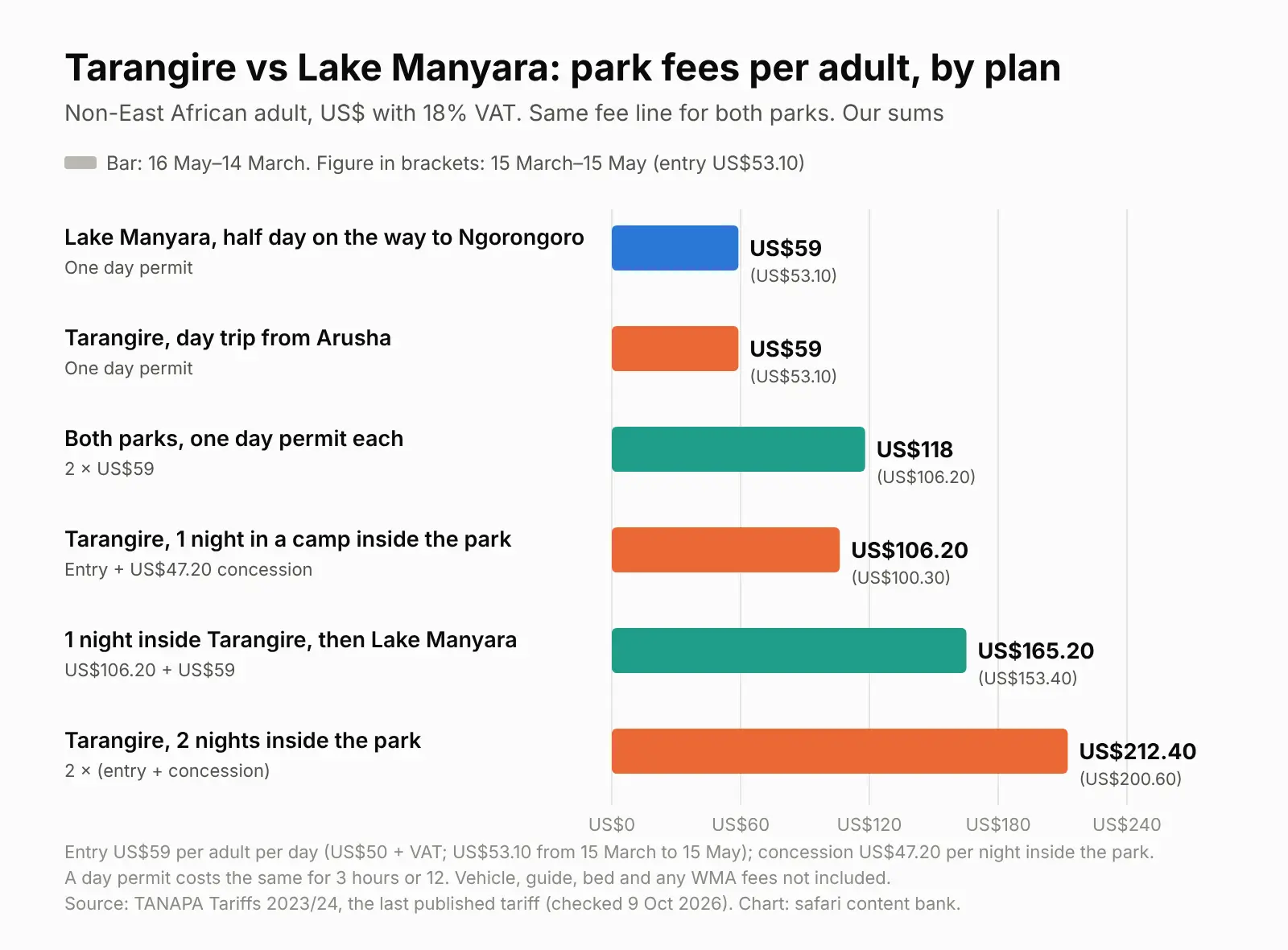 Our sums. Source: TANAPA Tariffs 2023/24, the last published tariff. Vehicle, guide, bed and any Wildlife Management Area (WMA) fees not included. Chart: safari content bank.
- Adding both parks costs US$118 per adult in day permits (our sum: 2 × US$59), against US$59 for one; each extra park day is another permit.
- A night inside either park costs US$106.20 per adult in fees (US$100.30 from 15 March to 15 May), our sum of entry and concession. Sleeping outside, in Karatu, Mto wa Mbu or the WMAs next to Tarangire, saves the US$47.20 concession, not the entry.
- Other extras differ. Lake Manyara sells a canopy walkway, canoeing and cycling; Tarangire sells walking safaris and has a balloon operation fee. Each is a separate TANAPA line on top of entry; see the Lake Manyara and Tarangire pages.
- Whole-trip prices, with vehicle, guide and beds, are on Tanzania safari cost.
The official fee lines, with the date each took effect and the authority’s own source:
| Fee | Amount | In force from | Source |
|---|---|---|---|
| Tarangire, Lake Manyara and Arusha National Parks, non-East African adult, entry per day | Peak USD 50 + VAT = USD 59; low USD 45 + VAT = USD 53.10 | 1 Jul 2023 (2023/24 tariff, last published) | TANAPA Tariffs 2023/24 |
| Tarangire, Lake Manyara and Arusha, concession fee per person per night inside the park | USD 40 + 18% VAT = USD 47.20 | 1 Jul 2023 (2023/24 tariff, last published) | TANAPA Tariffs 2023/24 |
| Night game drive (Katavi, Ruaha, Mikumi, Tarangire, Lake Manyara, Nyerere, Burigi-Chato, Ibanda-Kyerwa), per person | Adult USD 50 + VAT = USD 59; child USD 25 + VAT = USD 29.50 | 1 Jul 2023 (2023/24 tariff, last published) | TANAPA Tariffs 2023/24 |
Wildlife: Tarangire’s dry-season elephants vs Manyara’s forest and lake
Go to Tarangire for elephants and dry-season concentrations of game; go to Lake Manyara for forest, birds and the lake, and do not count on its famous lions.
Tarangire
- Elephants are the reputation. World Travel Awards named Tarangire “Africa’s Leading Elephant Paradise National Park” in 2025 and 2026. That is an award, not a count: we found no verified elephant count, so we print none.
- The dry season concentrates the game at the Tarangire River and the swamps; a UK safari operator’s park guide puts the peak in June–October and advises against April.
- Wildebeest and zebra use the land around the park. In the wider ecosystem wildebeest fell from about 39,000 (1987–94) to about 12,000 by 2011, then stabilised where community Wildlife Management Areas protect their route; zebra in the park increased from 2011 to 2019 (Scientific Reports, 2024).
- It is not empty. A reviewer on a safari booking site wrote in July 2025 that “it felt like being in a safari zoo”; the south of the park is quieter than the north (a UK safari operator’s park guide).
- Tsetse flies bite in patches: guides on the TripAdvisor forum place them near the north gate, along the river and around some camps (TripAdvisor, traveller reports).
Lake Manyara
- Forest first. Much of what a day visitor sees is groundwater forest and lakeshore below the escarpment. A canopy walkway runs 18 m above the forest floor and takes 50–60 minutes (a UK safari operator’s walkway guide).
- Birds and flamingos: over 350 bird species have been recorded at the lake; the last flamingo count we can cite is a 1991 survey of about 1.9 million lesser and 40,000 greater flamingos (Wikipedia). Across 22 East African soda lakes, a 2024 study found flamingo numbers fell as lake area grew (Natural History Museum).
- The lake level changes the visit. The lake overflowed in May 2026, partly submerging more than 400 households in Jangwani village, Mto wa Mbu ward (IPP Media, 29 May 2026).
- Tree-climbing lions are a selling point, not a promise. We found no published sighting rate, and no elephant count for the park either.
- Traveller reports are mixed: two 2025 reviews on a safari booking site read “Lake manyana was in flood not a good day” (February) and “lake manyara was empty didn’t deserve the time” (May).
When to go to each park
June–October suits both; outside those months Lake Manyara holds up better, because Tarangire’s draw is the dry-season gathering at the river.
| Months | Tarangire | Lake Manyara | Entry, both parks |
|---|---|---|---|
| June–October | Peak season (a safari agent’s guide, read 8–9 October 2026); forum regulars rate August–October best | Dry; best for mammals | US$59 |
| November–February | Between seasons; a forum poster warned “Nov. might be the start of the short rains” | Rain in November–December and from February | US$59 |
| March–May | Long rains; Oliver’s Camp closes 16 March–15 May, Sanctuary Swala in April–May | Rains; best for birds; andBeyond Lake Manyara Tree Lodge closes in April | US$53.10 from 15 March to 15 May |
Seasons: a safari agent’s guide (Tarangire, Lake Manyara); a UK safari operator’s park guides; TripAdvisor forum threads (Tarangire, November), traveller reports. Camp closures: 2026 rates as listed by a safari agent, read 8–9 October 2026. Entry: last published tariff, 2023/24.
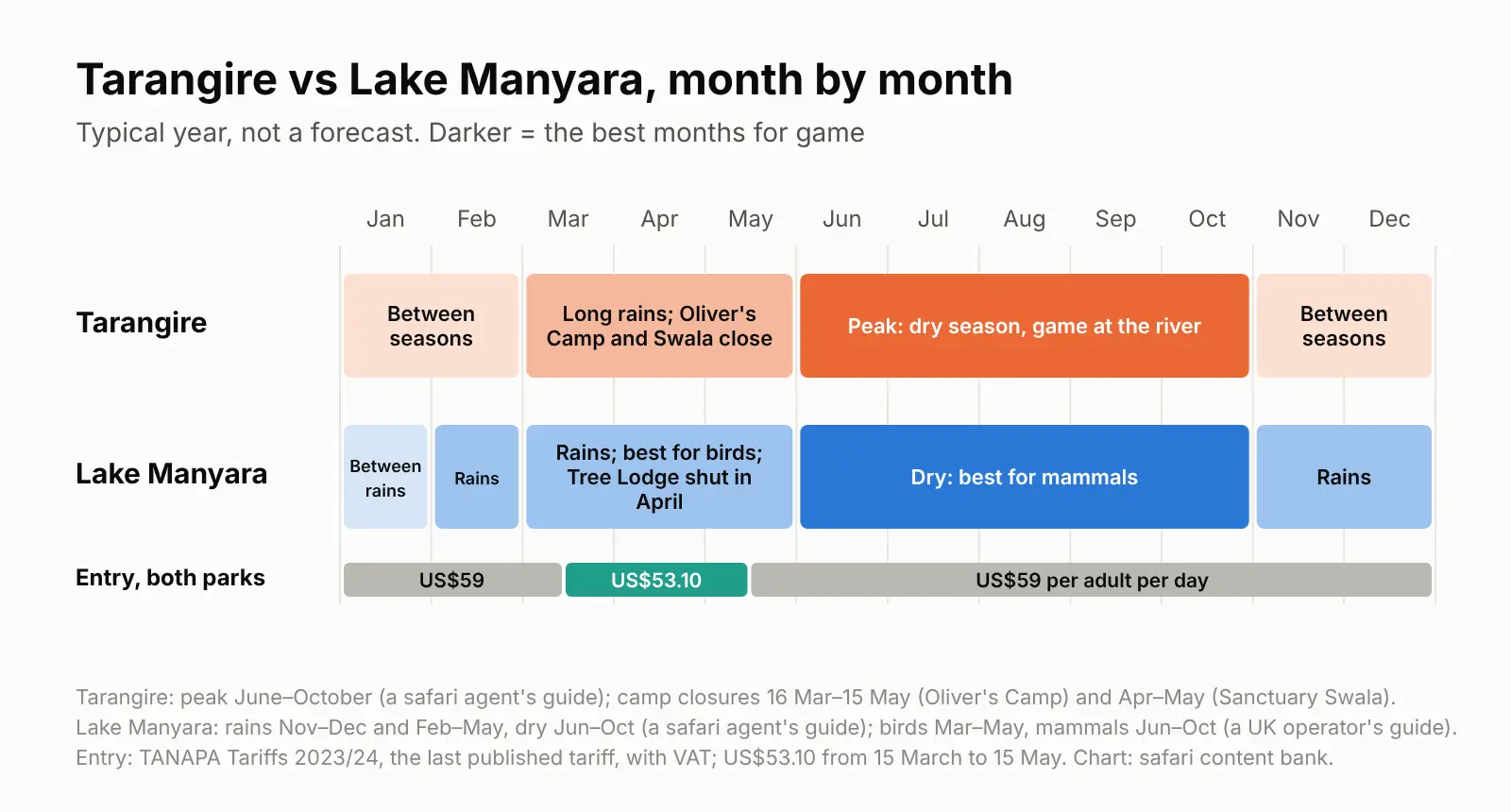 Typical year, not a forecast. Sources: a safari agent’s guide, read 10 October 2026; a UK safari operator’s park guides; camp rate listings; TANAPA Tariffs 2023/24, the last published tariff. Chart: safari content bank.
- We found no monthly rainfall table for either park; the months above are seasons, not measurements.
- For the Serengeti leg of the same trip, see where the wildebeest herds are each month.
Drive times from Arusha, and on to Ngorongoro and the Serengeti
Tarangire is 15 minutes closer to Arusha; Lake Manyara is 1 h 30 closer to Ngorongoro Crater, which is why it works as a stop on the way.
| Leg | Distance | Published driving time |
|---|---|---|
| Kilimanjaro airport (JRO) → Arusha | 55 km | 1 h 20 |
| Arusha → Tarangire north gate | 109 km | 2 h |
| Arusha → Lake Manyara National Park | 120 km | 2 h 15 |
| Tarangire → Lake Manyara | 68 km | 1 h 20 |
| Lake Manyara → Ngorongoro Crater | 56 km | 1 h |
| Southern Tarangire → Ngorongoro Crater | 148 km | 2 h 30 |
| Ngorongoro Crater → Seronera (central Serengeti) | 135 km | 3 h 30 |
A Tanzanian operator’s travel-times table, page modified 1 July 2026, read 9 October 2026. Gate stops come on top.
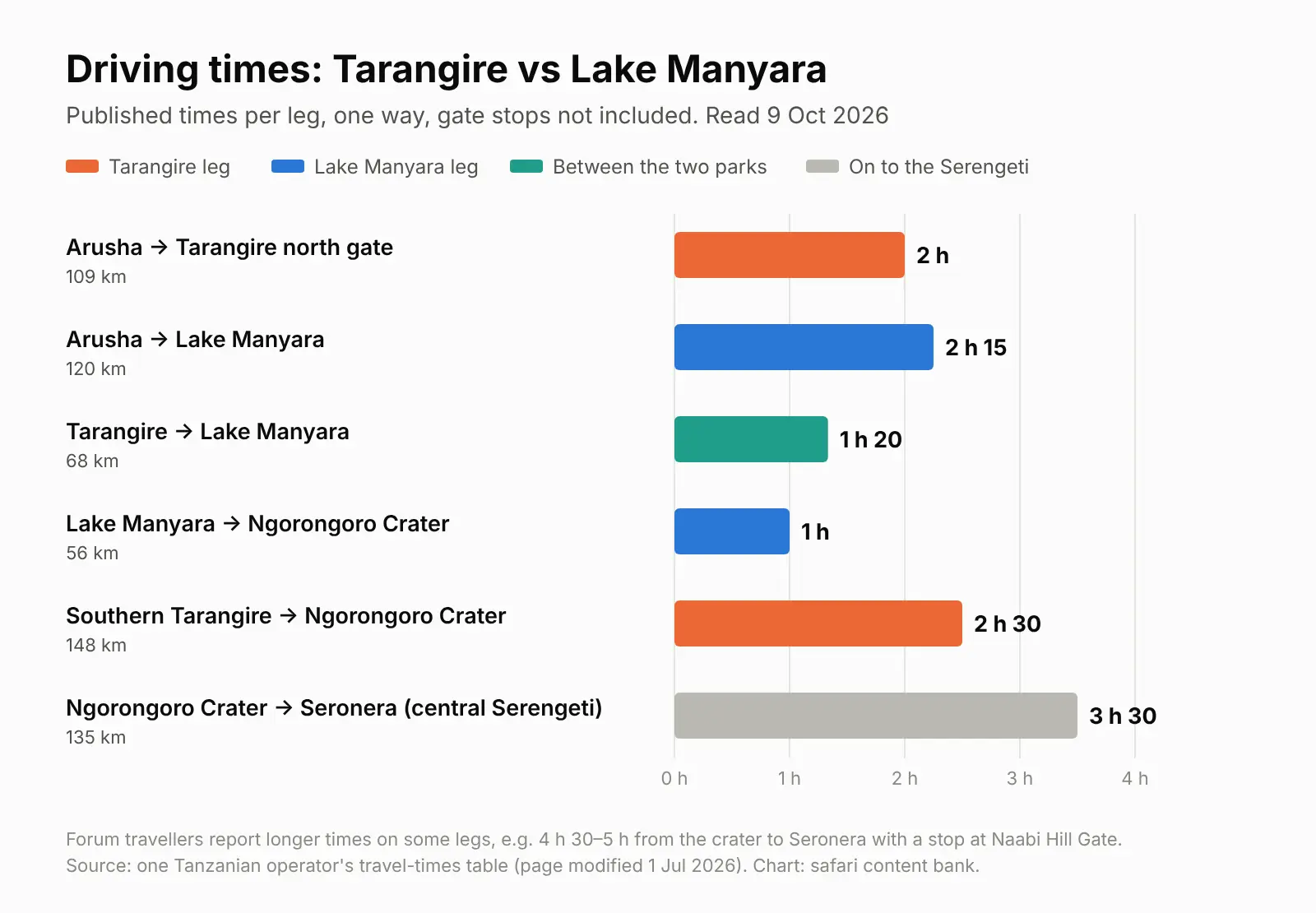 Source: a Tanzanian operator’s travel-times table (modified 1 July 2026). Chart: safari content bank.
- Via both parks, Arusha to the crater is 4 h 20 of driving (our sum: 2 h + 1 h 20 + 1 h); via Lake Manyara alone it is 3 h 15 (2 h 15 + 1 h). Gate stops and game drives come on top.
- Forum times run longer: Tarangire to the Ngorongoro rim “3 to 4 hours including park entrance” (TripAdvisor, Sep 2026), and crater to Seronera 4 h 30–5 h with a stop at Naabi Hill Gate (TripAdvisor), traveller reports.
- No driving after dark: the same travel-times table says tourists are not driven outside towns at night, so reaching either park on arrival day needs a flight landing at Kilimanjaro or Arusha before about 13:00.
- Flying on to the Serengeti starts from Lake Manyara airstrip (LKY), on the escarpment, which also serves Karatu and the Ngorongoro highland lodges. A safari travel company’s 2026 bush-flight guide put LKY to Seronera at about US$200 and under 40 minutes; there are no scheduled flights from Ngorongoro itself (TripAdvisor, traveller reports).
Is a half day enough, or do you need a full day?
A half day is enough for Lake Manyara when the road to Ngorongoro passes its gate anyway; Tarangire needs at least a full day, and forum regulars advise two.
| Plan | Time in the park | Park fees per adult (our sum) | Fits when |
|---|---|---|---|
| Lake Manyara, half day on the way to Karatu or the crater | About half a day | US$59 | You are driving Arusha → Ngorongoro anyway |
| Tarangire, day trip from Arusha | A full day, with about 4 h on the road | US$59 | Short trip; Tarangire only |
| Tarangire, 1 night inside | Afternoon and morning drives | US$106.20 | You want dawn at the river |
| 1 night in Tarangire, then Lake Manyara on the way to the crater | One full day and a half day | US$165.20 | You want both and have the day |
| Tarangire, 2 nights inside | Two full days | US$212.40 | June–October, elephants a priority |
Fees: entry US$59 and concession US$47.20 per adult, last published tariff, 2023/24; US$53.10 entry from 15 March to 15 May. Vehicle, guide, bed and WMA fees not included.
- Tarangire in a few hours is a poor buy. On the TripAdvisor forum: “Rushing around parks and to them is not worth it” and “You need at least 2 days” (TripAdvisor, traveller reports).
- Two days in Tarangire beat a one-day dash to each park, in the same forum’s advice: “You really don’t want to be moving every day” (TripAdvisor).
- On a 5–6 day trip, pick one. A French traveller who spent one day each in Tarangire, the crater and Manyara and three in the Serengeti said she would now do one park (Routard); the French forum’s rule is two parks in six days (Routard), traveller reports.
- Lake Manyara’s northern gate gets very busy in the afternoons, a UK safari operator’s park guide says; sleeping inside gives early, quiet drives but adds US$47.20 per adult (last published tariff, 2023/24) and a camp at US$563 or more per person per night.
- How the extra day fits the whole trip: see how many days a safari needs.
Which to choose
Choose Tarangire if you have a spare full day in June–October; choose Lake Manyara if you only have half a day between Arusha and Ngorongoro.
| If you… | Pick | Why |
|---|---|---|
| Travel June–October and have one extra full day | Tarangire | Its peak season; game gathers at the river |
| Have only half a day between Arusha and the crater | Lake Manyara | 1 h from Ngorongoro Crater; a half day pays the same US$59 permit as a full day |
| Travel March–May | Lake Manyara | Best for birds then; two Tarangire camps close in the long rains |
| Put elephants first | Tarangire | Named “Africa’s Leading Elephant Paradise National Park” by World Travel Awards in 2025 and 2026; no verified count |
| Want a canopy walk, canoe or bike ride | Lake Manyara | TANAPA sells all three there |
| Want a night drive | Either | Both sell them at US$59; a forum reply warned that in Manyara’s forest you “most probably won’t see any wildlife at night” (TripAdvisor) |
| Plan to fly on to the Serengeti | Lake Manyara | The LKY airstrip is on the escarpment above the park |
| Arrive by SGR train to Dodoma | Tarangire | Mamire Gate, opened 23 April 2026, is reached via Babati |
| Have 5–6 days in total | One, not both | Forum regulars call 5–6 days for four parks “a bit packed” |
| Want the cheapest bed near the park | Tarangire | Lake Burunge Tented Lodge, outside the park, lists from US$118 per person per night; Tloma Lodge in Karatu, near Manyara, from US$125 |
Lodge rates: 2026 rates as listed by a safari agent, read 8–9 October 2026; per person sharing; park fees extra. Fees: last published tariff, 2023/24.
Whichever you add, check that your operator holds a current licence: see how to check a safari operator is licensed.
Common mistakes in Tarangire vs Lake Manyara comparisons
| What you’ll often read | What is correct |
|---|---|
| “Lake Manyara is the cheaper park” | Same fee line. Both charge US$59 per adult per day and US$47.20 per night inside (last published tariff, 2023/24). |
| “Entry is US$50” | That is before VAT. You pay US$59 (US$53.10 from 15 March to 15 May). |
| “A half-day visit costs less” | A day permit costs US$59 whether you stay 3 hours or 12. |
| “Only Lake Manyara has night drives” | TANAPA’s night-drive line names Tarangire too, and six other parks. |
| “You’ll see tree-climbing lions and a pink lake” | We found no published sighting rate for the lions; the last flamingo count we can cite is from 1991, and the lake flooded homes in May 2026. |
| “Tarangire is good all year” | It is seasonal: peak June–October, and two of its luxury camps close in the long rains. |
| “Every northern-circuit trip includes Lake Manyara” | In our sample of operators’ trips it is in 30%; Tarangire is in 56%. |
Frequently asked questions
Is Tarangire or Lake Manyara better? Tarangire, for game, if you can give it a full day in June–October: that is its peak season, when game gathers at the river. Lake Manyara is better as a half-day stop on the way to Ngorongoro Crater, 1 hour away, or in March–May for birds. Both cost US$59 per adult per day (last published tariff, 2023/24).
Can you visit Tarangire and Lake Manyara in one day? You can, but it is a rushed day. The parks are 68 km and 1 h 20 apart, you pay two day permits (US$118 per adult, our sum, last published tariff 2023/24), and forum regulars advise against moving every day. One night in Tarangire and Lake Manyara the next morning on the way to the crater works better.
Which is closer to Arusha? Tarangire, by 15 minutes: 109 km and 2 hours to the north gate, against 120 km and 2 h 15 to Lake Manyara (a Tanzanian operator’s travel-times table, 2026). From Kilimanjaro airport add 55 km and 1 h 20 to Arusha.
Are the park fees different? No. TANAPA puts Tarangire, Lake Manyara and Arusha National Parks in one group: US$59 per non-East African adult per day with VAT (US$53.10 from 15 March to 15 May), US$17.70 per child aged 5–15, and US$47.20 per adult per night inside, in the last published tariff, 2023/24.
Is Lake Manyara worth it? Yes as a half day if your road to Ngorongoro passes the gate anyway; no if it costs you a day in Tarangire, the crater or the Serengeti. Traveller reviews are mixed: one 2025 reviewer found the park “empty” in May, another “in flood” in February.
How many days should I spend in Tarangire? At least one full day, and two if elephants are a priority and you travel in June–October. Two nights inside the park cost US$212.40 per adult in park fees (our sum, last published tariff, 2023/24), before vehicle, guide and bed.
Do I need either park if I am going to the Serengeti and Ngorongoro? No. The Serengeti and Ngorongoro are the core of the northern circuit; Tarangire is the first add-on in operators’ trips (56%) and Lake Manyara the second (30%). On a trip of 5–6 days, adding both makes it “a bit packed”, in forum regulars’ words; see how many days a safari needs.
Sources
- TANAPA, Tariffs 2023/24 (PDF), the last published tariff; site checked 9 Oct 2026. Fee figures as on our Tanzania safari cost, Tarangire safari cost and Tanzania park fees pages
- A safari agent’s guides to Tarangire and Lake Manyara, read 10 October 2026; Wikipedia, Tarangire and Lake Manyara National Parks
- The Citizen, Mamire Gate, 24 Apr 2026; IPP Media, Lake Manyara overflow, 29 May 2026
- Wildlife: World Travel Awards 2025 and 2026; Scientific Reports, 2024; Natural History Museum on a 2024 flamingo study
- Travel: a Tanzanian operator’s travel-times table (modified 1 Jul 2026); a safari travel company’s 2026 bush-flight guide
- Seasons and visiting advice: a UK safari operator’s park and walkway guides; camp rates as listed by a safari agent, read 8–9 Oct 2026
- Itinerary sample: 157 published Tanzania itineraries from 29 operators, captured 8 Oct 2026 (119 Tanzania-only)
- Traveller reports: TripAdvisor and Routard forum threads as linked in the text; reviews on a safari booking site (2025)
- Our own pages for the detail: Tarangire, Lake Manyara, Tanzania’s northern vs southern circuit, how many days a safari needs
Fees and prices as read 8–10 October 2026 (TANAPA site checked 9 October 2026); page checked 21 October 2026. We will update this page when TANAPA publishes a new tariff and when the camps above publish their 2027 rates.
Ask for a quote
Tell us your dates and we send you a priced itinerary. Free, no obligation.
- Free quote, no obligation
- Trips run by licensed local operators