 Experience

Last verified · Next check due
On this page
- Where to see gorillas: parks, gorillas and numbers (2026)
- Mountain gorillas: Bwindi, Mgahinga, Volcanoes and Virunga
- Eastern lowland (Grauer’s) gorillas: Kahuzi-Biega, DR Congo
- Western lowland gorillas: Congo-Brazzaville, Central African Republic and Gabon
- How to choose a country for gorillas
- When is the best time to see gorillas?
- Common mistakes about seeing gorillas
- Frequently asked questions
- Sources
Short answer: Mountain gorillas live in four parks: Bwindi and Mgahinga in Uganda (permit US$800, or US$600 in April, May and November), Volcanoes in Rwanda (US$1,500) and Virunga in DR Congo, whose treks are closed until further notice. There are 1,063 mountain gorillas (IGCP). Western lowland gorillas are tracked in Odzala-Kokoua and Nouabalé-Ndoki (Republic of the Congo), Dzanga-Sangha (Central African Republic) and Loango (Gabon); Grauer’s gorillas in Kahuzi-Biega, DR Congo.
Key facts
- There are 1,063 mountain gorillas in the wild, and the subspecies has been Endangered, not Critically Endangered, since 2018 (IGCP, checked 9 October 2026). The total combines 604 in the Virunga massif (minimum count, June 2016) and 459 in Bwindi–Sarambwe (2018 census).
- Mountain gorillas live in only four national parks: Bwindi Impenetrable and Mgahinga Gorilla (Uganda), Volcanoes (Rwanda) and Virunga (DR Congo) (Wikipedia, secondary).
- You can trek them in Uganda and Rwanda in October 2026, not in DR Congo: Virunga’s visitor site says “Gorilla and Nyiragongo treks are closed until further notice” (visit.virunga.org).
- A permit costs US$800 in Uganda, or US$600 in April, May and November, and US$1,500 in Rwanda, for one hour with a habituated family, at most eight visitors, minimum age 15. Every price rule is on gorilla permit prices.
- Lowland gorillas are a different trip: western lowland gorillas in the Congo Basin rainforest, visited in groups of three or four, and Grauer’s (eastern lowland) gorillas in Kahuzi-Biega, in a province the UK advises against all travel to.
- No wild gorillas appear in our Kenya or Tanzania sources; a gorilla trek from there means a flight to Uganda or Rwanda (safari and gorilla trekking).
Where to see gorillas: parks, gorillas and numbers (2026)
Uganda and Rwanda are where you can trek mountain gorillas now; the lowland gorilla parks of the Congo Basin are remote, small-group trips, and three gorilla parks, in DR Congo and the Central African Republic, lie where the UK government advises against all travel. Counts are the latest census figure in our sources, with its year.
| Place | Country | Gorilla | Gorillas (dated count) | Can you visit? (October 2026) | Permit per foreign adult | Source |
|---|---|---|---|---|---|---|
| Bwindi Impenetrable NP | Uganda | Mountain | 459 in Bwindi–Sarambwe (2018 census) | Yes; four trekking sectors | US$800; US$600 in April, May, November | GVTC census release; UWA letter TDO 93/04 |
| Mgahinga Gorilla NP | Uganda | Mountain | Part of the Virunga massif’s 604 (2016) | Yes; one habituated family, 8 permits a day | US$800; US$600 in April, May, November | UWA, Mgahinga |
| Volcanoes NP | Rwanda | Mountain | Part of the Virunga massif’s 604 (2016) | Yes; 12 families, 96 permits a day | US$1,500; 30% off November–May with an Akagera or Nyungwe stay | Visit Rwanda |
| Virunga NP | DR Congo | Mountain; also Grauer’s on Mount Tshiaberimu | About a third of the world’s mountain gorillas (park figure) | No: treks “closed until further notice” | No official price; we print none | visit.virunga.org; virunga.org |
| Kahuzi-Biega NP | DR Congo | Grauer’s (eastern lowland) | At least 181 in the highland sector (April 2011 census) | UK FCDO advises against all travel to South Kivu | No official price read; we print none | Wikipedia, secondary; FCDO |
| Odzala-Kokoua NP | Republic of the Congo | Western lowland | No current count; Ebola killed 70–95% in 2002–2005 | Yes, gorilla tracking from the fly-in Ngaga camp | Not published by the park | African Parks; Wikipedia |
| Nouabalé-Ndoki NP | Republic of the Congo | Western lowland | Over 30,000 great apes in and around the park (2017 estimates) | Yes, on limited dates booked with the park | Not published | NNNP annual report 2025 (PDF) |
| Dzanga-Sangha | Central African Republic | Western lowland | No count published; 3 habituated groups | UK FCDO advises against all travel to the country | Not published; the park asks you to email | dzanga-sangha.org |
| Loango NP | Gabon | Western lowland | No count; one habituated group | Yes | No official price in our sources | US-government-commissioned tourism assessment of Gabon, 2023–24 |
Read 8–10 October 2026. Permit wording copied from gorilla permit prices (UWA letter TDO 93/04, 26 February 2026; Visit Rwanda; RDB booking portal). For Congo, Kahuzi-Biega and the Congo Basin parks, the figures in circulation come from tour operators and disagree, so we print none.
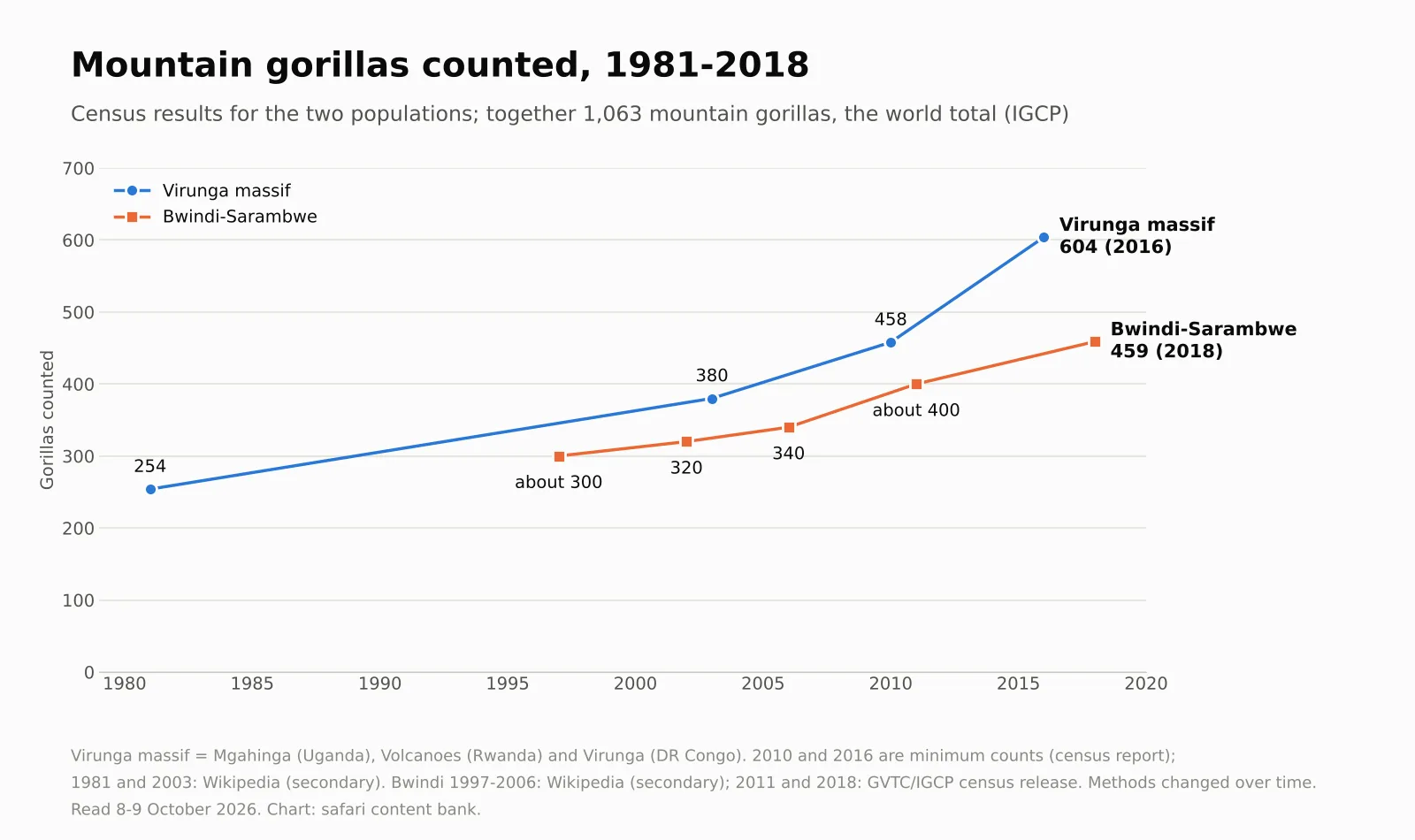 Virunga massif: census report 2015–16 (Hickey et al. 2019) and Wikipedia (1981, 2003; secondary). Bwindi–Sarambwe: Wikipedia (1997–2006; secondary) and the GVTC census release (2011, 2018). Counting methods changed over time. World total: IGCP, checked 9 October 2026. Chart: safari content bank.
- The Virunga massif count is shared by three parks: Mgahinga (Uganda), Volcanoes (Rwanda) and Virunga (DR Congo) sit on the same chain of volcanoes. Visit Rwanda gives the same 604 for the massif.
- The 2016 figure is a minimum: the census found 604 gorillas in 41 groups plus 14 solitary males; 418 of them lived in 28 habituated groups (census report, PDF). Search effort nearly doubled since 2010, so part of the rise is better counting.
- No newer census of either population was in our sources in October 2026.
The official permit lines, with the date each took effect and the authority’s own source:
| Fee | Amount | In force from | Source |
|---|---|---|---|
| Uganda: gorilla tracking permit, Bwindi Impenetrable and Mgahinga Gorilla NPs, foreign non-resident, per person per trek (guide and that day's park entry included) | USD 800 (foreign resident USD 700; rest of Africa USD 500; East African citizens UGX 300,000) | Since 1 Jul 2024 (UWA tariff 2024–26); confirmed unchanged from 1 Jan 2027 by UWA letter TDO 93/04 of 26 Feb 2026 | UWA letter TDO 93/04, 26 Feb 2026 |
| Uganda: gorilla tracking permit in April, May and November (low season), foreign non-resident, per person per trek; cannot be rescheduled | USD 600 (foreign resident USD 500) | Immediate effect from the UWA letter of 26 Feb 2026 | UWA letter TDO 93/04, 26 Feb 2026 |
| Uganda: gorilla habituation experience (4 hours with the gorillas), Bwindi, foreign non-resident | USD 1,500 (foreign resident USD 1,000) | UWA Conservation Tariff July 2024–June 2026, still the tariff UWA links on 9 Oct 2026; applies until 31 Dec 2026 | UWA Conservation Tariff July 2024–June 2026 |
| Uganda: gorilla habituation experience, Bwindi, foreign non-resident, from 1 January 2027 | USD 1,800 (foreign resident USD 1,600; rest of Africa USD 1,000) | 1 Jan 2027 | UWA letter TDO 93/04, 26 Feb 2026 |
| Uganda: park entry, Queen Elizabeth, Bwindi, Mgahinga, Kibale, Kidepo Valley and Lake Mburo NPs, foreign non-resident adult, per 24 hours | USD 40 (child USD 20) | 1 Jul 2024 (UWA Conservation Tariff July 2024–June 2026, the last published park-entry rates; the 2026/27 letter does not cover park entry) | UWA Conservation Tariff July 2024–June 2026 |
| Rwanda: mountain gorilla tracking permit, Volcanoes NP, international visitor, per person per day | USD 1,500 | Current RDB price, checked 9 Oct 2026 | Visit Rwanda (Rwanda Development Board) |
| Rwanda: gorilla permit low-season discount, November–May, with two nights in Akagera or Nyungwe (paid hotel receipt and one paid activity) or one night in each | 30% off (USD 1,050, our sum); one discounted permit per person per 3-day/2-night stay | November–May; conditions checked 9 Oct 2026 | RDB booking portal, low-season discount |
| Rwanda: gorilla permit, promotional rates for African citizens and foreign residents (USD 500) and Rwandan and EAC citizens (USD 200) | USD 500 / USD 200; not valid June–October 2026 | Announced 5 Jan 2026; shown on the RDB portal on 9 Oct 2026 | RDB booking portal |
Mountain gorillas: Bwindi, Mgahinga, Volcanoes and Virunga
All four mountain gorilla parks sit close together where Uganda, Rwanda and DR Congo meet; three are open for treks, and the visit is the same everywhere: one hour with a habituated family, at most eight visitors, minimum age 15. How the day runs is on a gorilla trekking day.
- Bwindi Impenetrable, Uganda: four trekking sectors, Buhoma, Ruhija, Rushaga and Nkuringo, and the permit names the sector. Choosing one is on Bwindi gorilla sectors. Bwindi is the only park in our sources with a 4-hour gorilla habituation experience: US$1,500, and US$1,800 from 1 January 2027 (UWA).
- We print no count of Bwindi’s habituated families: UWA’s web page, its 2018 brochure and operators give different totals, as on our Bwindi page. IGCP counts 44 habituated families across Uganda, Rwanda and DR Congo.
- Mgahinga Gorilla National Park, Uganda, is Uganda’s corner of the Virunga volcanoes, about 15 km south of Kisoro (Wikipedia). It has one habituated family, so it sells 8 permits a day at the same US$800 (UWA, Mgahinga).
- Volcanoes National Park, Rwanda, covers 160 km² on five of the eight Virunga volcanoes. Rwanda names 12 habituated families and sells 96 permits a day; rangers allocate families at Kinigi at 07:00 by fitness (Visit Rwanda). Kigali to Kinigi is 105 km, 2–3 hours by road.
- Virunga National Park, DR Congo, Africa’s oldest national park (1925; Wikipedia), holds about a third of the world’s mountain gorillas, and reported 15 mountain gorilla births from January to 21 September 2026 (virunga.org, page modified 7 October 2026). Its treks are closed until further notice (visit.virunga.org).
- Official travel advice for Virunga: the UK FCDO advises against all travel to North and South Kivu, and says Goma and Bukavu airports have no commercial flights (FCDO, DR Congo, updated 16 September 2026). The US State Department rates all of DR Congo Level 4, “Do not travel” (US State Department, DR Congo, issued 15 July 2026).
Uganda against Rwanda, price for price and hour for hour, is on Uganda or Rwanda for gorilla trekking.
Eastern lowland (Grauer’s) gorillas: Kahuzi-Biega, DR Congo
Grauer’s gorilla, the eastern lowland gorilla, is the other subspecies of the eastern gorilla, and Kahuzi-Biega National Park, near Bukavu in South Kivu, is the one park in our sources where habituated Grauer’s gorillas are visited. We print no permit price: the park’s own price page could not be read, and the figures in circulation come from tour operators and disagree.
- Numbers (secondary sources): Wikipedia gives nearly 17,000 Grauer’s gorillas in the mid-1990s and about 6,800 after a 2021 WCS-led survey (Wikipedia, Eastern lowland gorilla). In the park’s highland sector, about 600 before the wars of the 1990s fell to at least 181 at the April 2011 WCS census (Wikipedia, Kahuzi-Biega).
- The park covers about 6,000 km², from lowland rainforest at about 600 m to Mount Kahuzi at 3,308 m, and has been a UNESCO World Heritage Site since 1980, on the In Danger list since 1997 (Wikipedia).
- Official travel advice: the UK FCDO advises against all travel to South Kivu, says Bukavu was captured by M23 and Rwanda Defence Forces, and that Bukavu airport has no commercial flights (FCDO, DR Congo, updated 16 September 2026). The US rates the whole country Level 4, “Do not travel” (15 July 2026).
- On the Rwandan side, the UK advises against all but essential travel within 10 km of the DR Congo border in Rusizi District, including Kamembe airport (FCDO, Rwanda, updated 4 September 2026).
- Grauer’s gorillas also live on Mount Tshiaberimu in Virunga National Park (virunga.org), which is closed to gorilla treks.
Western lowland gorillas: Congo-Brazzaville, Central African Republic and Gabon
Western lowland gorillas are tracked from research and forest camps in four parks in our sources, in groups of three or four visitors, and usually reached by charter or scheduled light aircraft. None of these parks publishes a gorilla permit price in our sources.
| Park | Country | Habituated gorillas | Visit format | Official travel advice | Source |
|---|---|---|---|---|---|
| Odzala-Kokoua NP | Republic of the Congo (Cuvette-Ouest) | Tracked from Ngaga camp; no group count published | At most 4 guests, up to 1 hour, minimum age 15, masks; 2–7 hours in all | UK: against all travel only within 50 km of the CAR border in Likouala Region (updated 2 June 2026); US: Level 2 (2 October 2024) | Ngaga camp’s gorilla-tracking page; FCDO, Congo |
| Nouabalé-Ndoki NP | Republic of the Congo (Sangha and Likouala) | 4 habituated gorilla groups (2025) | Mondika outing: 45-minute drive and 2.5-hour walk to the research camp; booked with the park on limited dates | As above; the park reaches the CAR border | ndoki.org; NNNP annual report 2025 (PDF) |
| Dzanga-Sangha | Central African Republic | 3 groups, from Bai Hokou and Mongambe camps | At most 3 visitors; 15 minutes to 3 hours of searching | UK: against all travel to the whole country (updated 28 May 2026); US: Level 4, “Do not travel” (January 2026) | dzanga-sangha.org; FCDO, CAR |
| Loango NP | Gabon | 1 group | Rules not in our sources | US: Level 2 (30 March 2026) | Tourism assessment of Gabon, 2023–24; US State Department, Gabon |
Read 8 October 2026. Odzala and Nouabalé-Ndoki checked against the UK FCDO Congo page of 2 June 2026; we found no FCDO page for Gabon in our sources.
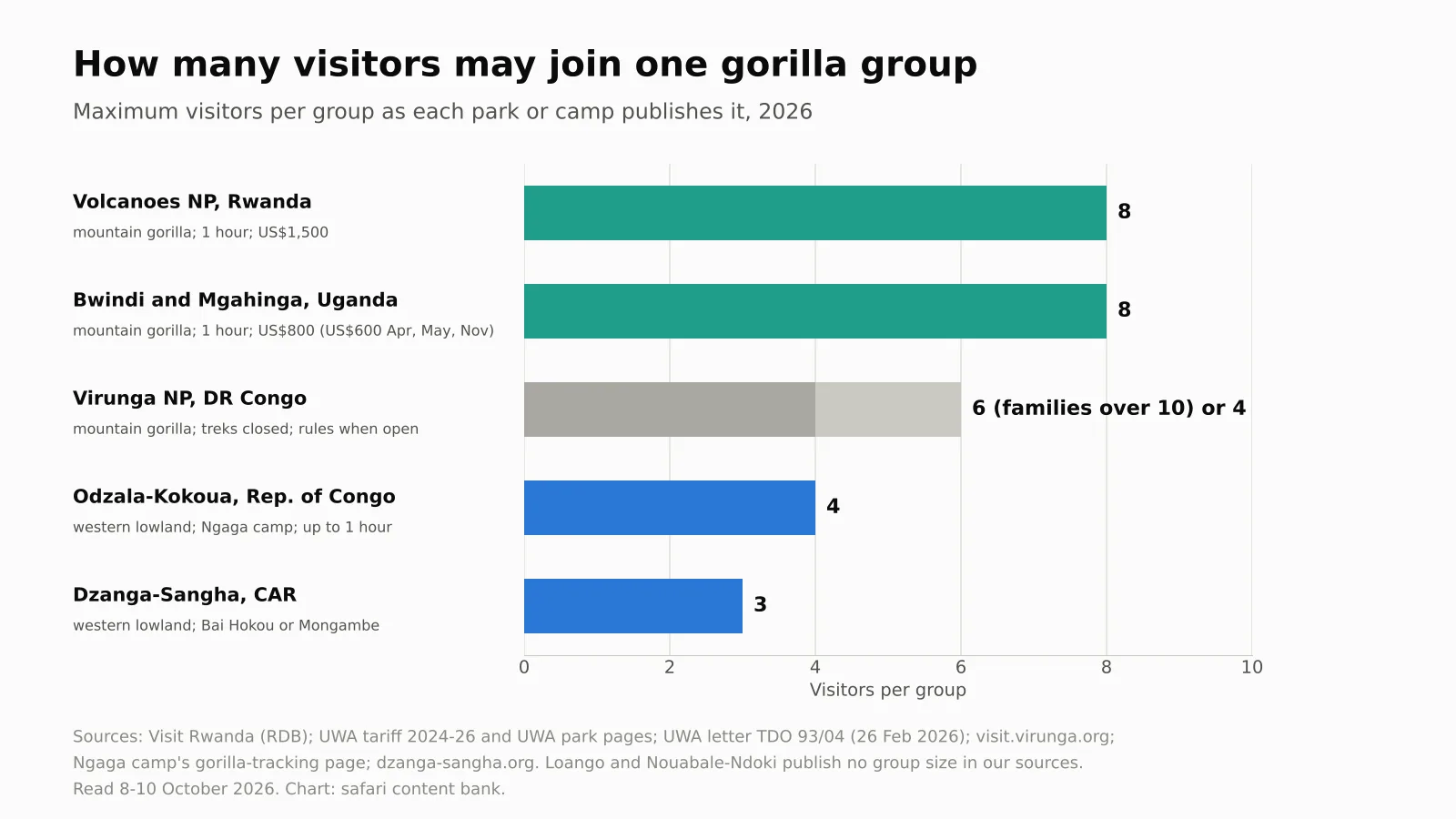 Sources: Visit Rwanda (RDB); UWA tariff 2024–26 and park pages; visit.virunga.org; Ngaga camp’s gorilla-tracking page; dzanga-sangha.org. Loango and Nouabalé-Ndoki publish no group size in our sources. Read 8–10 October 2026. Chart: safari content bank.
- Odzala-Kokoua covers 13,546 km² and has been run by African Parks since 2010 (African Parks). The park once held nearly 20,000 western lowland gorillas; Ebola killed 70–95% of them in 2002–2005 (Wikipedia, secondary).
- Two ways to stay in Odzala: fly-in camps (Ngaga, Lango and Mboko) on set journeys, with flights from Brazzaville on Mondays and Thursdays, or the park-run Camp Imbalanga, which charges US$415 per international adult per night with meals and a bai visit, park fees extra (Camp Imbalanga rates 2026, PDF). Its web page lists gorilla trekking from the camp as “coming in 2025”; we found no confirmation that it has started.
- Nouabalé-Ndoki is a roadless, never-logged forest more than 900 km north of Brazzaville; 134 tourists visited in 2025, and Mbeli Bai recorded 988 gorilla visits that year (NNNP annual report 2025). There is no visa on arrival (ndoki.org).
- Dzanga-Sangha is part of the Sangha Trinational World Heritage Site with Nouabalé-Ndoki and Cameroon’s Lobéké (2012), and is best known for forest elephants at Dzanga Bai (dzanga-sangha.org).
- The Cross River gorilla, the other western gorilla, lives on the Cameroon–Nigeria border and is not visited by tourists in our sources.
How to choose a country for gorillas
Choose Uganda for the lower permit price and a longer visit option, Rwanda for the shortest trip from an airport, and the Congo Basin only if you want lowland gorillas and accept a remote, expensive trip. Total trip costs are on gorilla trekking trip cost.
| If you want… | Go to | Why |
|---|---|---|
| The cheapest mountain gorilla permit | Uganda (Bwindi, Mgahinga) in April, May or November | US$600, against US$800 the rest of the year and US$1,500 in Rwanda (UWA; RDB) |
| The shortest trip from an airport | Rwanda (Volcanoes) | Kigali to Kinigi is 105 km, 2–3 hours by road |
| More than one hour with the gorillas | Bwindi’s habituation experience | 4 hours, US$1,500; US$1,800 from 1 January 2027 (UWA) |
| Uganda’s price with a Kigali flight | Southern Bwindi or Mgahinga | 3–5 hours from Kigali via the Cyanika border (operators’ guides) |
| Gorillas plus a savanna safari | Uganda, or Rwanda with Akagera, or a flight from Kenya or Tanzania | See safari and gorilla trekking |
| Gorillas and chimpanzees | Bwindi with Kibale, or Volcanoes with Nyungwe | See where to see chimpanzees |
| Western lowland gorillas | Odzala-Kokoua, Republic of the Congo | The UK’s only advised-against zone in the country is near the CAR border in Likouala; Odzala is in Cuvette-Ouest |
| The smallest visitor groups | Dzanga-Sangha (3) or Odzala (4) | Dzanga-Sangha is in the Central African Republic, where the UK advises against all travel |
| Grauer’s gorillas | Kahuzi-Biega, DR Congo | The UK advises against all travel to South Kivu; the US rates DR Congo Level 4 |
| A trek with a child under 15 | Not possible for mountain gorillas | Minimum age 15 in Uganda and Rwanda, and at Odzala’s Ngaga camp |
Prices: UWA letter TDO 93/04 (26 February 2026); Visit Rwanda; RDB booking portal, checked 9 October 2026. Travel advice: UK FCDO and US State Department pages, dates as above. Safety and advice for the two open countries: Uganda safari questions and Rwanda safari questions.
When is the best time to see gorillas?
Gorillas do not migrate, so every park on this page can be visited all year; the drier months make forest trails easier. For mountain gorillas, the full month-by-month picture, with rainfall and permit prices, is on the best time for gorilla trekking.
| Place | Drier or better months | Wetter months | Source |
|---|---|---|---|
| Bwindi, Mgahinga, Volcanoes | June–September and December–February | Long rains March–May, short rains October–November; Uganda’s US$600 permit falls in April, May and November | Best time for gorilla trekking |
| Odzala-Kokoua | January–February and June–September | Mid-March to May and October to mid-December | visitodzala-kokoua.org |
| Nouabalé-Ndoki | January–March (dry); August good at Mbeli Bai, when fruiting trees draw gorillas; September and December also good | April–December, easing around July | ndoki.org |
| Dzanga-Sangha | No official best time | Rain peaks May–June and October–November | Wikipedia, secondary |
| Loango | Long dry season June–September; short dry season December–January | Not given | A tour operator’s Gabon page |
Read 8–10 October 2026. General seasons, not gorilla sighting data.
Common mistakes about seeing gorillas
| What you’ll often read | What is correct |
|---|---|
| “Mountain gorillas live all over central Africa” | Only in four parks: Bwindi, Mgahinga, Volcanoes and Virunga. The Congo Basin parks have western lowland gorillas. |
| “Mountain gorillas are Critically Endangered” | Endangered since 2018, with 1,063 in the wild (IGCP). |
| “Rwanda has 1,063 gorillas” | 1,063 is the world total across Uganda, Rwanda and DR Congo; the Virunga massif shared by three parks held 604 in 2016. |
| “Congo is the cheapest place to see mountain gorillas” | Virunga’s treks are closed until further notice, and the UK FCDO advises against all travel to North and South Kivu. |
| “Lowland gorilla trips work like Rwanda’s” | Groups are 3–4 visitors, not 8, the parks are reached by light aircraft or long roads, and none publishes a permit price in our sources. |
| “You can see gorillas on a Kenya or Tanzania safari” | Not in our sources; add a flight to Uganda or Rwanda. |
| “Children can trek with a parent” | The minimum age is 15 in Uganda and Rwanda, with no exceptions in our sources. |
| “A Uganda permit costs US$800 all year” | US$600 in April, May and November since UWA’s letter of 26 February 2026. |
Frequently asked questions
Where is the best place to see gorillas in Africa? For mountain gorillas, Bwindi or Mgahinga in Uganda (US$800, or US$600 in April, May and November) or Volcanoes National Park in Rwanda (US$1,500). Both buy one hour with a habituated family. For western lowland gorillas, Odzala-Kokoua in the Republic of the Congo lies outside the one zone the UK advises against in that country.
How many mountain gorillas are left? 1,063, according to IGCP: 604 in the Virunga massif (minimum count, 2016) and 459 in Bwindi–Sarambwe (2018 census). The subspecies moved from Critically Endangered to Endangered in 2018. We found no newer census.
Where can you see lowland gorillas? Western lowland gorillas: Odzala-Kokoua and Nouabalé-Ndoki (Republic of the Congo), Dzanga-Sangha (Central African Republic) and Loango (Gabon). Grauer’s (eastern lowland) gorillas: Kahuzi-Biega in DR Congo, where the UK FCDO advises against all travel to South Kivu.
Is Uganda or Rwanda better for gorilla trekking? Uganda’s permit is US$700 cheaper (US$800 against US$1,500) and Bwindi adds a 4-hour habituation experience; Rwanda is 2–3 hours from Kigali. The full comparison is on Uganda or Rwanda for gorillas.
Can you see gorillas in DR Congo? Not in Virunga National Park at present: its visitor site says gorilla treks are closed until further notice. The UK FCDO advises against all travel to North and South Kivu, where Virunga and Kahuzi-Biega lie (updated 16 September 2026), and the US rates DR Congo Level 4, “Do not travel” (15 July 2026).
How much does it cost to see gorillas? The permit is US$800 in Uganda (US$600 in April, May and November) and US$1,500 in Rwanda, or US$1,050 (our sum) from November to May with two nights in Akagera or Nyungwe. Lodges, transport and porters come on top: see gorilla trekking trip cost.
When is the best time to see gorillas? Any month; the drier June–September and December–February make mountain gorilla trails easier, and Uganda’s cheaper permit months are rainy ones. Odzala’s better months are January–February and June–September. Details: best time for gorilla trekking.
What is the difference between mountain and lowland gorillas? They are different subspecies. The mountain gorilla and Grauer’s gorilla belong to the eastern gorilla; the western lowland and Cross River gorillas to the western gorilla. For a visitor, the difference is the trip: mountain gorillas mean Uganda or Rwanda with up to eight visitors a family, western lowland gorillas a remote Congo Basin camp with three or four.
Sources
- Mountain gorilla numbers: IGCP, mountain gorillas (1,063; Endangered since 2018; 44 habituated families), checked 9 Oct 2026; Virunga Massif census 2015–16, final report (PDF), Hickey et al. 2019; GVTC census release, Bwindi–Sarambwe 2018 (PDF); Wikipedia, Mountain gorilla and Bwindi Impenetrable National Park (secondary); read 8–9 Oct 2026
- Uganda Wildlife Authority: letter TDO 93/04 on tariff changes 2026–2027 (PDF, scanned), 26 Feb 2026; Conservation Tariff July 2024–June 2026 (PDF); Bwindi and Mgahinga pages; read 9 Oct 2026
- Rwanda Development Board: Visit Rwanda, gorilla tracking and low-season discount, checked 9 Oct 2026
- DR Congo: Virunga visitor site and virunga.org (modified 7 Oct 2026), read 8–9 Oct 2026; Wikipedia, Kahuzi-Biega National Park and Eastern lowland gorilla (secondary)
- Congo Basin parks: African Parks, Odzala-Kokoua; Camp Imbalanga rates 2026 (PDF) and visitodzala-kokoua.org; Wikipedia, Odzala-Kokoua (secondary); ndoki.org and Nouabalé-Ndoki annual report 2025 (PDF); dzanga-sangha.org and Wikipedia, Dzanga-Sangha (secondary); a US-government-commissioned nature-based tourism assessment of Gabon (data Nov 2023–Mar 2024); all read 8 Oct 2026
- Official travel advice: UK FCDO, DR Congo (updated 16 Sep 2026), Rwanda (4 Sep 2026), Republic of the Congo (2 Jun 2026) and Central African Republic (28 May 2026); US State Department, DR Congo (Level 4, 15 Jul 2026), Central African Republic (Level 4, Jan 2026), Republic of the Congo (Level 2, 2 Oct 2024) and Gabon (Level 2, 30 Mar 2026); read 8 Oct 2026
- Camps and operators: Ngaga camp’s gorilla-tracking page and its company’s FAQ; tour operators’ guides to the Cyanika crossing; a tour operator’s Gabon page (names and links kept in our editor notes)
More on where to see the other animals: chimpanzees, giraffes and the Big Five.
Figures checked 8–10 October 2026. We will update this page on 1 January 2027 when Uganda’s new habituation price starts, when a new mountain gorilla census is published, when Virunga reopens its treks, when the UK or US changes its advice for DR Congo, the Republic of the Congo or the Central African Republic, and when a Congo Basin park publishes its gorilla permit price.