 Experience

Last verified · Next check due
On this page
- Where to see each giraffe: parks, numbers and fees (2026)
- Masai giraffe: the Serengeti, the Mara, Tarangire and Amboseli
- Reticulated giraffe: Samburu, Meru and Laikipia
- Nubian (Rothschild’s) giraffe: Murchison Falls and Lake Nakuru
- Thornicroft’s giraffe: only in the Luangwa Valley
- Southern giraffe: Kruger, Etosha, Chobe and the Okavango
- Desert-adapted giraffe: Damaraland and the Kaokoveld
- Which giraffe to choose for your trip
- Walking with giraffe: where it is allowed
- When is the best time to see giraffe?
- Common mistakes about seeing giraffe
- Frequently asked questions
- Sources
Short answer: Each kind of giraffe has its own parks. Masai giraffe: the Serengeti, Masai Mara, Tarangire and Amboseli. Reticulated: Samburu, Meru and Laikipia in northern Kenya. Nubian (Rothschild’s): Murchison Falls and Lake Nakuru. Thornicroft’s: only Zambia’s Luangwa Valley; 95% of one operator’s South Luangwa travellers saw them. Southern: Kruger, Etosha, Chobe and the Okavango, with desert-adapted giraffe in Damaraland. The Giraffe Conservation Foundation estimated about 140,000 wild giraffe in 2025.
Key facts
- The Giraffe Conservation Foundation (GCF) estimated 140,701 wild giraffe in 2025 in its State of Giraffe report; its species page rounds this to “approximately 140,000” (GCF, State of Giraffe 2025, PDF; GCF, giraffe species, checked 9 October 2026).
- How many species there are is still argued over. GCF recognises four species and seven subspecies, and in August 2025 the IUCN’s giraffe specialist group accepted the same four (IUCN, 21 Aug 2025). But the IUCN Red List still assesses giraffe as one species (Vulnerable, 2016) until new assessments are published, CITES and CMS list one species, and a 2020 re-analysis found support for anything from two to six (Wikipedia, secondary). Our sources disagree, so this page uses GCF’s names and says which older name each replaces.
- The southern giraffe is the most numerous: 68,837 in 2025, up from 31,700 in 1995; the Masai giraffe fell from 72,290 to 43,926 over the same 30 years (GCF).
- The rarest giraffe on a mainstream safari is the Luangwa (Thornicroft’s) giraffe: 764, all in Zambia (GCF). 95% of one operator’s South Luangwa travellers saw it (read 8 October 2026).
- Kenya has three kinds: 14,179 Masai, 20,746 reticulated and 1,281 Nubian giraffe (GCF, 2025).
- Some parks have none. Uganda’s Queen Elizabeth, Zambia’s Lower Zambezi and Zimbabwe’s Mana Pools have no giraffe (UWA; one safari operator).
Where to see each giraffe: parks, numbers and fees (2026)
Go to East Africa for three of the four GCF species, and to Zambia’s Luangwa Valley for the one subspecies found in a single valley; southern Africa’s big parks all have the southern giraffe. Counts below are GCF’s 2025 country or species estimates unless marked; no source in our bank gives a current count for a single park.
| Giraffe (GCF name; older name) | Where to see it | Number, GCF 2025 | Seen by (per trip) | Fee to be there, per adult | Source |
|---|---|---|---|---|---|
| Masai giraffe | Serengeti, Tarangire (Tanzania); Masai Mara, Amboseli (Kenya) | 43,926 in all; Tanzania 28,820, Kenya 14,179 | Not published | Serengeti US$82.60 a day, Tarangire US$59 (last published tariff, 2023/24); Mara reserve US$100 a day January–June, US$200 July–December; Amboseli US$90 per 24 hours (KWS) | GCF |
| Reticulated giraffe | Samburu, Meru, Laikipia (Kenya) | 20,901, 20,746 of them in Kenya | Not published | Samburu US$85 a day (county); Meru US$70 per 24 hours (KWS); Ol Pejeta US$110 a day | GCF |
| Nubian giraffe (includes Rothschild’s) | Murchison Falls, Kidepo Valley, Lake Mburo (Uganda); Lake Nakuru (Kenya) | 3,977; Uganda 1,986, Kenya 1,281 | Not published | Murchison US$45 per 24 hours, Kidepo and Lake Mburo US$40 (last published UWA tariff, July 2024–June 2026); Lake Nakuru US$90 per 24 hours (KWS) | GCF |
| Luangwa giraffe (Thornicroft’s), a Masai giraffe subspecies | South Luangwa (Zambia) | 764, all in Zambia | 95% | US$25 a day (DNPW 2025 schedule, the last published) | GCF; one operator’s South Luangwa page |
| Southern giraffe: South African subspecies | Kruger (South Africa); northern Botswana | 53,174; South Africa 29,536 | Not published for Kruger | Kruger R692 (R602 until 31 Oct 2026) | GCF |
| Southern giraffe in Botswana (both subspecies) | Chobe, Okavango Delta, Moremi, Kwando-Linyanti | Botswana 11,477 South African + 1,587 Angolan | 93–100% (see below) | P270 a day in Chobe and Moremi (last published DWNP schedule, 1 April 2022); concessions in the camp rate | GCF; one operator’s Botswana pages |
| Southern giraffe: Angolan subspecies | Etosha (Namibia) | 15,663; Namibia 13,895 | Not published; “Common” on a safari booking site | N$280 per foreign adult + N$60 per vehicle (Government Notice 115 of 2026) | GCF; Etosha |
| Desert-adapted giraffe (Angolan) | Damaraland and the Kaokoveld (Skeleton Coast and Kaokoland), Namibia | No separate count in our sources | Not published; “Occasional” in Damaraland on a safari booking site | No national-park fee; lodges add levies, such as N$280 a night at Etendeka Mountain Camp | Damaraland |
GCF figures from State of Giraffe 2025 (PDF), table values; the report has some internal inconsistencies, so we quote its tables. Sighting rates: one operator’s traveller reports, share of groups who saw giraffe at least once on their trip; Botswana pages read September 2026, South Luangwa 8 October 2026. Fees per non-resident or international adult, copied from our Kenya, Masai Mara, Serengeti, Tanzania, Uganda, Zambia, Botswana, Kruger and Etosha fee and cost pages, read 8–10 October 2026.
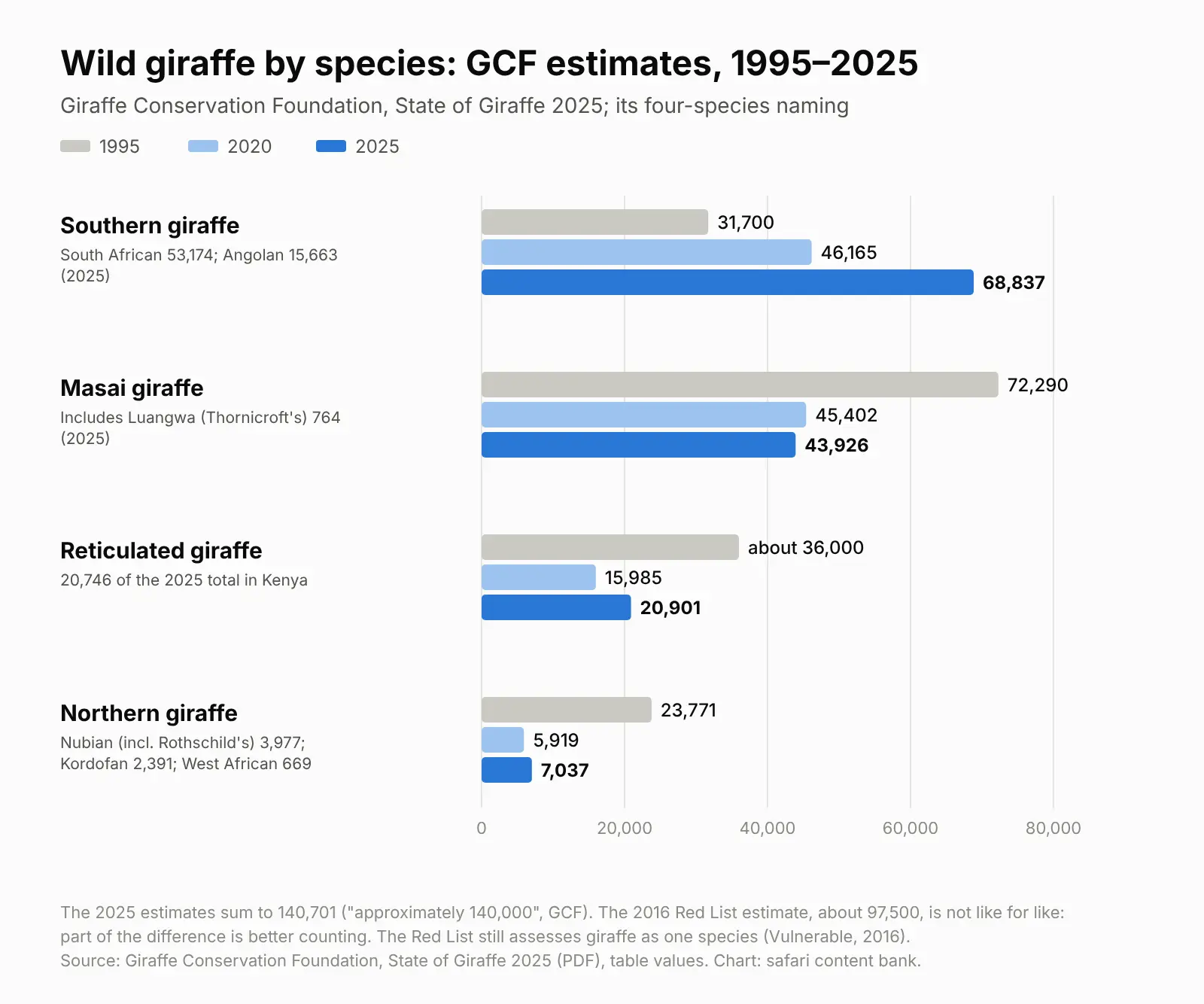 Source: Giraffe Conservation Foundation, State of Giraffe 2025, table values. The 2016 Red List estimate of about 97,500 is not comparable with GCF’s 2025 total: part of the difference is better counting. Chart: safari content bank.
- GCF’s recommended statuses: Masai giraffe Vulnerable, northern giraffe Endangered, reticulated giraffe Endangered, southern giraffe Least Concern (GCF). They are recommendations: the Red List’s own per-species assessments were still to come when IUCN accepted the four species in August 2025.
- The reticulated giraffe has grown fastest recently: 8,761 in 2015, 15,985 in 2020 and 20,901 in 2025 (GCF). In Kenya’s rangelands, giraffe as a whole declined 60–70% between 1977 and 2016 (PLOS ONE, 2016).
- For the other big animals, see where to see elephants and where to see the Big Five; giraffe are not one of the Big Five.
Masai giraffe: the Serengeti, the Mara, Tarangire and Amboseli
The Masai giraffe is the giraffe of a classic Kenya or northern Tanzania safari: 28,820 in Tanzania and 14,179 in Kenya in 2025 (GCF), with jagged, vine-leaf or star-shaped patches. It is also the species that has fallen furthest: 72,290 in 1995, 43,926 in 2025.
- Where: parks in its range include the Serengeti, Tarangire, the Masai Mara, Amboseli and Nyerere (GCF). Akagera in Rwanda had 78 Masai giraffe in 2024, brought in from Kenya in 1986 (Akagera).
- Tarangire’s neighbours count too: community wildlife management areas beside Tarangire (Burunge, Randilen) held giraffe at densities comparable to the national park over 2011–2019, while a nearby area without community management had far fewer (Scientific Reports, 2024).
- How to fit it in: any northern-circuit itinerary passes through Masai giraffe country. Tarangire is about 2 hours by road from Arusha and the usual first park (Tarangire); the Serengeti and the Mara are the parks for the wildebeest herds, so a giraffe costs nothing extra on a migration trip (Mara to Serengeti).
- Fees: Serengeti US$82.60 per adult per day (US$70.80 from 15 March to 15 May); Tarangire US$59 (US$53.10 from 15 March to 15 May), both last published tariff, 2023/24. The Mara reserve charges US$100 a day January–June and US$200 July–December (Narok County FY2025/26 schedule, the last published); Amboseli US$90 per adult per 24 hours (KWS, LN 160/2025).
See also: Serengeti vs Masai Mara and Lake Nakuru vs Amboseli.
Reticulated giraffe: Samburu, Meru and Laikipia
Northern Kenya is the reticulated giraffe’s stronghold: 20,746 of the world’s 20,901 live in Kenya (GCF, 2025). Its coat is crisp reddish-brown polygons separated by thin white lines.
- Samburu: Samburu County lists the reticulated giraffe among the “Samburu Five”, with Grevy’s zebra, Beisa oryx, gerenuk and Somali ostrich (Samburu). The reserve fee is US$85 per adult in every month (Samburu County Finance Act 2025).
- Meru: reticulated giraffe live here with gerenuk, lesser kudu and Somali ostrich; the KWS fee is US$70 per adult per 24 hours (Meru).
- Laikipia: a tour operator’s walking-safari guide names Lewa and Laikipia walking safaris for reticulated giraffe (Laikipia vs Masai Mara). Ol Pejeta charges US$110 per non-resident adult per day, VAT included; Lewa publishes no fee (Laikipia).
- How to fit it in: Samburu is about 350 km, 6–8 hours by road, from Nairobi; Nairobi to Ol Pejeta is about 220 km, 4–4.5 hours (Samburu vs Masai Mara; Laikipia). The Mara has no reticulated giraffe in our sources, so a Kenya trip that wants both Masai and reticulated giraffe needs a northern leg.
Nubian (Rothschild’s) giraffe: Murchison Falls and Lake Nakuru
“Rothschild’s giraffe” is now counted as the Nubian giraffe, a subspecies of GCF’s northern giraffe; there were 3,977 in 2025, 1,986 of them in Uganda and 1,281 in Kenya (GCF). It has chestnut patches with sharp edges and plain white lower legs.
- Murchison Falls (Uganda): Uganda’s main giraffe park. Giraffe once lived only north of the Nile; there were about 250 in 2010 and “around 1,500” in 2016–17, when 37 were moved south of the river (Wikipedia, secondary; Murchison Falls). Murchison’s giraffe restocked Lake Mburo in 2015 and Kidepo Valley, which had 89 by 2022 on Wikipedia and “over 50” on UWA’s page.
- Lake Nakuru (Kenya): UNESCO lists Rothschild’s giraffe in the park (Lake Nakuru). We hold no park count. Entry is US$90 per adult per 24 hours (KWS, LN 160/2025).
- How to fit it in: Murchison is 4–5 hours from Kampala to the southern gate, then 1–2 hours to the lodges; the usual Uganda loop includes both Murchison and Queen Elizabeth, which has no giraffe (Murchison Falls vs Queen Elizabeth). Lake Nakuru is 156 km, about 3.5 hours, from Nairobi (Lake Nakuru).
- Fees: Murchison US$45 per foreign adult per 24 hours, the highest in Uganda; Kidepo and Lake Mburo US$40 (last published UWA tariff, July 2024–June 2026).
Thornicroft’s giraffe: only in the Luangwa Valley
The Luangwa giraffe, still called Thornicroft’s on most safari pages, lives only in Zambia’s Luangwa Valley: GCF estimates 764, all in Zambia, and 95% of one operator’s South Luangwa travellers saw one. GCF treats it as a subspecies of the Masai giraffe.
- South Luangwa has three Luangwa forms: Thornicroft’s giraffe, Cookson’s wildebeest and Crawshay’s zebra (South Luangwa). Its first range-wide density estimate was published in 2025 (Scientific Reports, 2025).
- North Luangwa: the same operator says giraffe are rarely seen north of the Mupamadzi river.
- Not in the Lower Zambezi: giraffe have never been recorded there (South Luangwa vs Lower Zambezi).
- How to fit it in: Mfuwe is a 70-minute Proflight flight from Lusaka. Gate entry is US$25 per international adult per day (DNPW 2025 schedule, the last published), but full-board camps bill US$90–110 per person a night in fees and levies (South Luangwa; Zambia safari cost).
Southern giraffe: Kruger, Etosha, Chobe and the Okavango
The southern giraffe is the easy one: 68,837 in 2025, more than double the 1995 figure (GCF), and every big park in South Africa, Botswana and Namibia has it. The South African subspecies (53,174) lives in South Africa, Botswana and Mozambique; the Angolan subspecies (15,663) is mostly in Namibia.
| Area | Giraffe seen by (one operator’s travellers, per trip) | Fee per adult | Source |
|---|---|---|---|
| Kwando-Linyanti (private concessions, Botswana) | 100% | Camp rate plus levy | one operator’s Kwando-Linyanti page |
| Chobe National Park (Botswana) | 99% | P270 a day (last published DWNP schedule, 1 April 2022) | one operator’s Chobe page; Chobe |
| Okavango Delta reserves (private concessions) | 95% | In the camp rate at many camps | one operator’s Okavango Delta page; Okavango Delta |
| Moremi Game Reserve | 93% | P270 a day (same DWNP line as Chobe) | one operator’s Moremi page; Moremi |
| Botswana, all areas | 93% | – | one operator’s Botswana wildlife page |
| Central Kalahari Game Reserve | 69% | P190 a day (last published DWNP schedule, 1 April 2022) | one operator’s Central Kalahari page; Central Kalahari |
| Makgadikgadi and Nxai Pan | 44% | P190 a day (same DWNP line) | one operator’s salt pans page; Makgadikgadi |
| Kruger National Park | Not published | R692 (R602 until 31 Oct 2026) | Kruger |
| Etosha National Park | Not published; “Common” on a safari booking site | N$280 per foreign adult + N$60 per vehicle | Etosha |
| Hwange National Park (Zimbabwe) | Not published; “common” in one operator’s guide | US$12 a day staying inside, US$24 as a day visitor (ZimParks Tariff 2026) | Hwange |
Botswana pages read September 2026. Botswana’s fee lines are the last published DWNP schedule; in Feb 2026 the government news agency BOPA called the existing non-resident fee P380, a P500 rise was announced, then reported postponed. No official current tariff is published: confirm with DWNP or your operator.
- Kruger: the last census table we hold gives 6,800–10,300 giraffe for 2009–2011 (Wikipedia, secondary, citing SANParks); that is about 15 years old, so read South Africa’s 29,536 in 2025 (GCF) as the current figure. Kruger is a self-drive park: stay in your vehicle except at designated spots (Kruger self-drive).
- Etosha: game gathers at a few waterholes from May to October, which is when giraffe, like everything else, is easiest to find (Etosha). Namibia held 13,895 Angolan and 200 South African giraffe in 2025 (GCF).
- Chobe: Sedudu Gate is 80 km from Victoria Falls, so the riverfront works as a day trip (Chobe day trip from Victoria Falls).
- Zimbabwe held 9,201 giraffe in 2025 (GCF). Mana Pools has none: giraffe never occurred there (Mana Pools).
Desert-adapted giraffe: Damaraland and the Kaokoveld
The giraffe of north-west Namibia’s dry riverbeds are Angolan giraffe living at low density; our sources hold no separate count, and a safari booking site rates giraffe only “Occasional” in Damaraland.
- They are not a separate subspecies. Namibia’s giraffe are almost all Angolan (13,895 of the 14,095 GCF counted in 2025; our sum). GCF’s Namibia programme began in the late 1990s and covers a study area of about 30,000 km² in the north-west (GCF, Namibia).
- Where: Damaraland, between Etosha and the Skeleton Coast, and the Kaokoveld to the north, where Wilderness lists giraffe among the desert-adapted animals at Hoanib Skeleton Coast Camp (Wilderness). Hoanib Valley Camp runs with the Sesfontein Community Conservancy and has GCF as its conservation partner (Natural Selection).
- When: July–September offers “optimal wildlife viewing and comfortable weather” (a safari travel company’s camp page); the dry season runs May–October (Damaraland).
- How to fit it in: most trips cross Damaraland by road between Swakopmund and Etosha. There is no national-park fee; Etosha and the Skeleton Coast charge N$280 per foreign adult plus N$60 per car (Damaraland safari cost; Namibia park fees).
- Giraffe were here long before tourists: ICOMOS’s 2007 evaluation of Twyfelfontein for UNESCO counts over 2,075 engraved images, 40% of them giraffe (Damaraland).
Which giraffe to choose for your trip
Pick the giraffe by the trip you are already planning: almost every East African circuit has Masai giraffe, a northern Kenya leg adds the reticulated, Uganda adds the Nubian, and Zambia’s Luangwa is the only place for Thornicroft’s.
| If you want | Go to | Why |
|---|---|---|
| Giraffe on a migration safari | Serengeti or Masai Mara | Masai giraffe live there all year |
| The most striking coat | Samburu, Meru or Laikipia | Reticulated giraffe; 20,746 of 20,901 are in Kenya |
| Giraffe on a Uganda safari | Murchison Falls | Nubian (Rothschild’s) giraffe; Queen Elizabeth has none |
| A giraffe found in one valley only | South Luangwa | Luangwa (Thornicroft’s) giraffe, 764 in all; seen by 95% |
| The highest published sighting rate | Kwando-Linyanti or Chobe | 100% and 99% of one operator’s travellers |
| A self-drive giraffe safari | Kruger or Etosha | Southern giraffe; stay in your vehicle except at designated spots |
| Giraffe in the desert | Damaraland | Desert-adapted Angolan giraffe; low density, no park fee |
| Giraffe on foot | South Luangwa or Lake Mburo | Ranger- or scout-led walks (see below) |
| A giraffe close-up on a Nairobi layover | Giraffe Centre, Karen | KSh 1,500 per non-resident adult; open 09:00–17:00 daily |
Walking with giraffe: where it is allowed
Giraffe are among the animals you can approach on a guided walk: South Luangwa, Lake Mburo, the Serengeti with a ranger, Samburu, Laikipia and Botswana’s private concessions all allow walking, but Moremi, Chobe National Park and Etosha do not.
| Where | Giraffe | Walking | Rule and cost | Source |
|---|---|---|---|---|
| South Luangwa (Zambia) | Thornicroft’s | Yes | Licensed guide and armed DNPW scout; minimum age 12; walks are one of the two daily activities in bushcamp rates | South Luangwa |
| Lake Mburo (Uganda) | Rothschild’s, moved here in 2015 | Yes | UWA ranger-led walk US$25 per foreign adult; horseback and mountain bikes from lodges | Lake Mburo |
| Samburu (Kenya) | Reticulated | Yes | County fee for walking trails, picnics or bush meals KSh 1,600 per person per day | Samburu safari cost |
| Laikipia (Kenya) | Reticulated | Yes, on conservancies | Named for walking safaris by a tour operator’s walking guide; fees vary by conservancy | Laikipia vs Masai Mara |
| Serengeti (Tanzania) | Masai | With an armed ranger, in designated areas | US$23.60–29.50 per person in park fees, plus a ranger fee per group (last published tariff, 2023/24) | Walking safaris |
| Botswana private concessions (Okavango, Linyanti) | Southern | Yes | Walking allowed on concessions; on horseback in the western Delta for experienced riders | Botswana night drives and walking; Horseback safaris |
| Damaraland (Namibia) | Desert-adapted | At camps with guides | Etendeka Mountain Camp’s full-board rate includes guided walks and drives | Damaraland |
| Moremi, Chobe NP, Etosha | Southern | No | Park rules: stay in your vehicle | Botswana night drives and walking; Etosha |
| Kruger | Southern | SANParks walks and trails only | Otherwise stay in your vehicle except at designated spots | Walking safaris |
| Giraffe Centre, Karen, Nairobi (Kenya) | Not stated in our sources | A visit, not a walk or a safari | KSh 1,500 per non-resident adult, KSh 750 per child 3–12; 09:00–17:00 daily | Nairobi day trip |
Read 8–10 October 2026. “One operator” and “a tour operator” are safari operators’ guides; names and links are in our editor notes.
- Keep your distance anyway. Giraffe have few predators as adults, lions being the main one (Wikipedia, secondary), but a walk in giraffe country is a walk in lion and elephant country: go with a qualified guide.
- Walking costs: what a walking safari costs, park by park, is on walking safari cost.
When is the best time to see giraffe?
Giraffe do not migrate, so you can see them all year in every park on this page; the dry months make all game easier to find, and they are also the peak-price months. No source in our bank gives giraffe-specific months, so the table uses each park’s general dry or best game-viewing season.
| Park | Giraffe | Best months in our sources | Source |
|---|---|---|---|
| Serengeti | Masai | June–October, the dry season; July is the driest month | Serengeti |
| Tarangire | Masai | June–October | Tarangire |
| Masai Mara | Masai | No month is dry (July, 60 mm, is the driest); the reserve fee halves January–June | Masai Mara |
| Amboseli | Masai | June–September, the driest months | Amboseli |
| Samburu | Reticulated | June–October and January–February, when animals gather on the Ewaso Ng’iro | Samburu |
| Laikipia | Reticulated | January–February and June–October (Ol Pejeta) | Laikipia |
| Lake Nakuru | Nubian | December–February, the driest weather | Lake Nakuru |
| Murchison Falls | Nubian | December–February and June–September (UWA) | Murchison Falls |
| South Luangwa | Thornicroft’s | June–October, when every camp is open | South Luangwa |
| Chobe, Okavango Delta | Southern | June–October, the dry season | Chobe |
| Kruger | Southern | April–September, the dry season | Kruger |
| Etosha | Angolan | May–October, when water is limited to a few waterholes | Etosha |
| Damaraland | Desert-adapted | July–September; dry season May–October | Damaraland |
Read 8–10 October 2026. General seasons from our park pages, not giraffe calendars. More: best time for a safari.
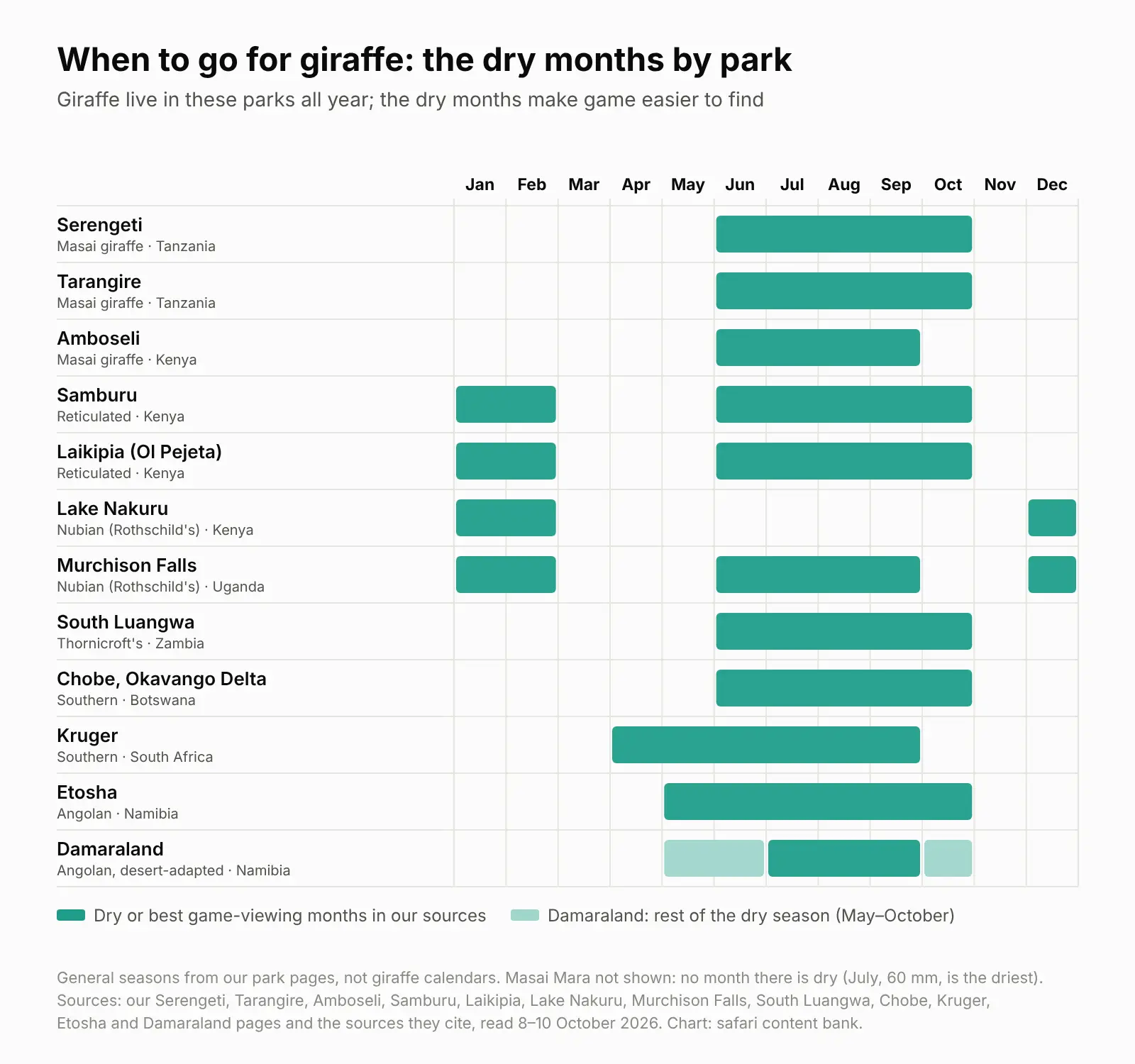 Sources: our park pages and the sources they cite, read 8–10 October 2026. General seasons, not giraffe calendars. Chart: safari content bank.
- The dry months are the peak-price months. Every Tarangire camp in our sources charges its highest rate in June–September (Tarangire), and Samburu’s lodges charge least in March–May (Samburu).
- Fees that change with the season: the Mara reserve (US$100 a day January–June, US$200 July–December) and Serengeti entry (US$70.80 from 15 March to 15 May, US$82.60 the rest of the year; last published tariff, 2023/24). Amboseli and Lake Nakuru charge US$90 per 24 hours in every month (KWS).
The official fee lines, with the date each took effect and the authority’s own source:
| Fee | Amount | In force from | Source |
|---|---|---|---|
| Maasai Mara National Reserve, non-resident adult, per day (12-hour ticket, 06:00–18:00), 1 Jan–30 Jun | USD 100 | Since 1 Jan 2024; Narok County FY2025/26 schedule, the last published | Narok County fee schedule FY2025/26 |
| Maasai Mara National Reserve, non-resident adult, per day (12-hour ticket, 06:00–18:00), 1 Jul–31 Dec | USD 200 | Since 1 Jul 2024; Narok County FY2025/26 schedule, the last published, expired 30 Jun 2026 (no 2026/27 schedule as of 9 Oct 2026); The Kenya Times (6 Aug 2026, secondary) reports US$200 still applies for Jul–Dec 2026 | Narok County fee schedule FY2025/26 |
| Serengeti and Nyerere National Parks, non-East African adult, entry per day, 16 May–14 Mar | USD 70 + 18% VAT = USD 82.60 | 1 Jul 2023 (2023/24 tariff, last published) | TANAPA Tariffs 2023/24 |
| Serengeti and Nyerere National Parks, non-East African adult, entry per day, 15 Mar–15 May | USD 60 + 18% VAT = USD 70.80 | 1 Jul 2023 (2023/24 tariff, last published) | TANAPA Tariffs 2023/24 |
| Tarangire, Lake Manyara and Arusha National Parks, non-East African adult, entry per day | Peak USD 50 + VAT = USD 59; low USD 45 + VAT = USD 53.10 | 1 Jul 2023 (2023/24 tariff, last published) | TANAPA Tariffs 2023/24 |
| Serengeti walking safari, per person, plus ranger fee per group per day | Short (1–4 h) USD 20, long (over 4 h) USD 25; ranger USD 20; all + 18% VAT | 1 Jul 2023 (2023/24 tariff, last published) | TANAPA Tariffs 2023/24 |
| Amboseli and Lake Nakuru National Parks (KWS), non-resident adult, per 24 hours | USD 90 (child under 18, 5 and under free, USD 45) | Legal Notice 160 of 2025, gazetted 22 Sep 2025, which states no start date; in force 1 Oct 2025 per the KWS press release of 29 Sep 2025 | KWS Fees Regulations 2025 (LN 160/2025) |
| Meru, Kora and Aberdare National Parks (KWS), non-resident adult, per 24 hours | USD 70 (child under 18, 5 and under free, USD 40) | Legal Notice 160 of 2025, gazetted 22 Sep 2025, which states no start date; in force 1 Oct 2025 per the KWS press release of 29 Sep 2025 | KWS Fees Regulations 2025 (LN 160/2025) |
| Samburu National Reserve (Samburu County), non-resident adult, per day (basis not stated by the county) | USD 85 (child USD 50) | Samburu County Finance Act 2025, published 22 Dec 2025 | Samburu County Finance Act 2025 |
| Ol Pejeta Conservancy, non-resident adult, per day (24 hours for overnight guests) | USD 110, VAT included (child 3–11 USD 55) | 2026 tariff | Ol Pejeta Conservancy Tariff Guide 2026 |
| Uganda: park entry, Murchison Falls NP, foreign non-resident adult, per 24 hours | USD 45 (child USD 25) | 1 Jul 2024 (UWA Conservation Tariff July 2024–June 2026, the last published park-entry rates; the 2026/27 letter does not cover park entry) | UWA Conservation Tariff July 2024–June 2026 |
| Uganda: park entry, Queen Elizabeth, Bwindi, Mgahinga, Kibale, Kidepo Valley and Lake Mburo NPs, foreign non-resident adult, per 24 hours | USD 40 (child USD 20) | 1 Jul 2024 (UWA Conservation Tariff July 2024–June 2026, the last published park-entry rates; the 2026/27 letter does not cover park entry) | UWA Conservation Tariff July 2024–June 2026 |
| Uganda: guided nature or birding walk, Lake Mburo NP (UWA rate for savanna parks), foreign non-resident, per person | USD 25 (foreign resident USD 20; East African citizens UGX 20,000) | 1 Jul 2024 (UWA Conservation Tariff July 2024–June 2026, the last published rates) | UWA Conservation Tariff July 2024–June 2026 |
| South Luangwa and Lower Zambezi National Parks (DNPW Category A), international adult, entry per day (06:00–18:00) | USD 25 (SADC and resident USD 20; Zambian citizen ZMW 55.60); child 5–13 half price, under 5 free | DNPW 2025 schedule ("official 2025 rates"), the last published; page last modified 8 May 2025, still shown 9 Oct 2026 | DNPW 2025 fee schedule, as shown on a Zambia travel portal |
| Chobe National Park and Moremi Game Reserve (DWNP), non-resident adult, per person per day | BWP 270 (SADC residents BWP 205; Botswana citizens and residents BWP 30) | Last published DWNP schedule, 1 April 2022 (via Tourism Update). In Feb 2026 the government news agency BOPA called the existing non-resident fee P380; a P500 rise was announced, then reported postponed. No official current tariff: confirm with DWNP or your operator | Tourism Update, 23 Feb 2022 (DWNP fee schedule) |
| Kruger National Park daily conservation fee, international adult (12+), per day | ZAR 602 | 1 Nov 2025 to 31 Oct 2026 (SANParks 2025/26 schedule) | SANParks daily conservation fees 2025/26 |
| Kruger National Park daily conservation fee, international adult (12+), per day | ZAR 692 | 1 Nov 2026 to 31 Oct 2027 (SANParks 2026/27 schedule, already published) | SANParks daily conservation fees 2026/27 |
| Tier 1 parks (Etosha, Namib-Naukluft including Sossusvlei, Skeleton Coast, Ai-Ais/Fish River Canyon, Waterberg Plateau, Cape Cross, Dorob, Tsau //Khaeb), foreign adult 16+, per person | NAD 280 (NAD 140 park entrance + NAD 140 conservation fee) | 1 Apr 2026 (Government Notice 115 of 2026; the notice prices fees per person with no period; MEFT's 2021 schedule made fees valid for 24 hours from entry); was NAD 150 under the 2021 schedule | Government Gazette 8877 (Government Notice 115 of 2026), hosted by the Legal Assistance Centre |
| Vehicle up to 10 seats, most national parks (N$50 at Sandwich Harbour), per vehicle | NAD 60 | 1 Apr 2026 (Government Notice 115 of 2026; the notice states no period; MEFT's 2021 schedule made fees valid for 24 hours from entry); was NAD 50 | Government Gazette 8877 (Government Notice 115 of 2026), hosted by the Legal Assistance Centre |
| Samburu National Reserve (Samburu County), walking trails, picnics or bush meals, per person per day | KSh 1,600 | Samburu County Finance Act 2025, published 22 Dec 2025 | Samburu County Finance Act 2025 |
| Other DWNP parks and reserves (Central Kalahari Game Reserve, Khutse, Nxai Pan, Makgadikgadi Pans), non-resident adult, per person per day | BWP 190 (SADC residents BWP 145; Botswana citizens and residents BWP 20) | Last published DWNP schedule, 1 April 2022 (via Tourism Update). In Feb 2026 the government news agency BOPA called the existing non-resident fee P380; a P500 rise was announced, then reported postponed. No official current tariff: confirm with DWNP or your operator | Tourism Update, 23 Feb 2022 (DWNP fee schedule) |
| Hwange National Park, Main Camp (row as labelled in the ZimParks 2026 tariff), international adult, conservation fee per day | USD 24 day visitor; USD 12 if staying overnight in the park (SADC USD 18 / 10; local USD 5 / 3) | ZimParks Tariff 2026 (tariff year 2026, published February 2026); the conservation-fee table does not say whether VAT is included; Robins, Sinamatella and Kazuma Pan are not listed separately in our sources | ZimParks De-Gazetted Tariff 2026 |
Before paying an agent, check the operator’s licence.
Common mistakes about seeing giraffe
| What you’ll often read | What is correct |
|---|---|
| “Rothschild’s giraffe is its own species” | GCF now counts it within the Nubian giraffe, a subspecies of the northern giraffe: 3,977 in 2025. |
| “There is one giraffe species” or “There are four, settled” | Both are contested. GCF recognises four species, and IUCN’s specialist group accepted them in August 2025, but the Red List still assesses one species (2016) and CITES and CMS list one. |
| “Giraffe numbers have jumped from 97,500 to 140,000” | Not a like-for-like series. The 2016 Red List figure and GCF’s 2025 total use different counts; part of the rise is better counting. |
| “You can see reticulated giraffe in the Masai Mara” | Not in our Mara sources. The Mara has Masai giraffe; reticulated giraffe live in Samburu, Meru and Laikipia. |
| “Thornicroft’s giraffe live across Zambia” | Only in the Luangwa Valley: 764 in all (GCF). Giraffe have never been recorded in the Lower Zambezi. |
| “Desert giraffe are a separate subspecies” | They are Angolan giraffe living in dry riverbeds; Namibia’s giraffe are almost all Angolan (GCF). |
| “Queen Elizabeth has giraffe” | It has none (UWA). Uganda’s giraffe are in Murchison Falls, Kidepo Valley and Lake Mburo. |
| “Mana Pools has giraffe” | Giraffe never occurred there (one safari operator). Hwange, in the same country, has them. |
| “Kruger costs R602 a day” | That was the 2025/26 rate, which ended on 31 October 2026. Since 1 November 2026: R692 per international adult per day. |
Frequently asked questions
Where is the best place to see giraffes on safari? Anywhere on a standard East or southern African circuit: on published figures, 100% of one operator’s travellers saw giraffe in Kwando-Linyanti, 99% in Chobe and 95% in South Luangwa and the Okavango Delta reserves (read September–October 2026). For a particular kind, go to Samburu for reticulated, Murchison Falls for Nubian (Rothschild’s) and South Luangwa for Thornicroft’s.
How many giraffe species are there? It depends on whom you ask. The Giraffe Conservation Foundation recognises four species (Masai, northern, reticulated and southern) and seven subspecies, and IUCN’s specialist group accepted the four in August 2025. The IUCN Red List still assesses giraffe as one species (Vulnerable, 2016) until new assessments are published, and CITES and CMS list one species.
How many giraffe are left in the wild? About 140,000: GCF’s 2025 estimates sum to 140,701. By species: southern 68,837, Masai 43,926, reticulated 20,901 and northern 7,037. The 2016 Red List estimate of about 97,500 is not directly comparable, because counting has improved.
Where can I see Rothschild’s giraffe? In Uganda’s Murchison Falls, Kidepo Valley and Lake Mburo, and in Kenya’s Lake Nakuru, where UNESCO lists them. GCF now counts Rothschild’s within the Nubian giraffe: 3,977 in 2025, 1,986 of them in Uganda and 1,281 in Kenya. Murchison entry is US$45 per foreign adult per 24 hours (last published UWA tariff, July 2024–June 2026).
Where can I see Thornicroft’s giraffe? Only in Zambia’s Luangwa Valley, mainly South Luangwa National Park: GCF estimates 764, all in Zambia, and 95% of one operator’s South Luangwa travellers saw one. Entry is US$25 per international adult per day (DNPW 2025 schedule, the last published).
Can you walk with giraffes? Yes, with a guide: in South Luangwa (guide and armed scout, minimum age 12), Lake Mburo (UWA walk US$25), Samburu, Laikipia, the Serengeti with a ranger and Botswana’s private concessions. Walking is not allowed in Moremi, Chobe National Park or Etosha. In Nairobi, the Giraffe Centre in Karen charges KSh 1,500 per non-resident adult.
When is the best time to see giraffes? Any month: giraffe do not migrate. The dry season makes game easier to find: June–October in the Serengeti, Tarangire, Samburu, South Luangwa and northern Botswana, April–September in Kruger and May–October in Etosha. These are general game-viewing seasons from our sources, not giraffe-specific calendars.
Which parks have no giraffe? Uganda’s Queen Elizabeth National Park (UWA), Zambia’s Lower Zambezi (never recorded) and Zimbabwe’s Mana Pools (never occurred), according to our sources. Each has elephant, buffalo, lion and leopard instead.
Sources
- Giraffe numbers and taxonomy: Giraffe Conservation Foundation, State of Giraffe 2025 (PDF), June 2025; GCF, giraffe species (checked 9 Oct 2026); GCF, southern giraffe conservation in Namibia; IUCN, four giraffe species recognised, 21 Aug 2025; Wikipedia, Giraffe (secondary; 2016 Red List figure, 2020 re-analysis, coat descriptions); PLOS ONE, 2016; Scientific Reports, 2025 (Luangwa giraffe); Scientific Reports, 2024 (Tarangire WMAs)
- Sighting rates: one operator’s pages on Botswana wildlife, Chobe, Moremi, the Okavango Delta reserves, Kwando-Linyanti, the Central Kalahari and the salt pans (read September 2026), and on South Luangwa and North Luangwa (read 8 October 2026); a safari booking site’s wildlife ratings for Etosha and Damaraland (names and links kept in our editor notes)
- Parks: Wikipedia, Murchison Falls National Park (secondary); Wikipedia, Kruger National Park (secondary, citing SANParks); Wilderness, Hoanib Skeleton Coast Camp; Natural Selection, Hoanib Valley Camp; UNESCO, UWA, Samburu County and the other sources cited on our park pages linked above
- Fees: Narok County FY2025/26 schedule (PDF); TANAPA Tariffs 2023/24 (PDF), the last published tariff; KWS LN 160/2025 (PDF); Samburu County Finance Act 2025; Ol Pejeta Tariff Guide 2026 (PDF); UWA Conservation Tariff July 2024–June 2026 (PDF); DNPW 2025 schedule, the last published, from a safari agent’s guide read 9 Oct 2026; DWNP schedule effective 1 April 2022 via Tourism Update, 23 Feb 2022; SANParks daily conservation fees 2025/26 and 2026/27; Government Notice 115 of 2026 (PDF); ZimParks Tariff 2026 (PDF); Giraffe Centre FAQ (read 9 Oct 2026)
More on where to see the other animals: lions, leopards, cheetahs and wild dogs.
Figures, rates and fees checked 10 October 2026; SANParks fees checked 1 November 2026. We will update this page when GCF publishes new estimates, when the IUCN Red List publishes its per-species giraffe assessments, when SANParks’ 2026/27 fees take effect on 1 November 2026, when DNPW publishes a 2026 Zambia schedule or Botswana an official tariff, when TANAPA publishes a new tariff, and when UWA publishes park-entry rates after June 2026.