 Experience

Last verified · Next check due
Short answer: The Central Kalahari Game Reserve (Botswana) covers 52,800 km², with no fuel, shops or campsite water inside. Game is best December–May, the reverse of the Okavango. Bigfoot Tours campsites cost BWP 200 per person a night (last published rate). Tau Pan, the only permanent camp open inside, costs US$800 per person a night for 1–5 nights (Kwando’s 2024 rate card). The last published park fee is P190 per non-resident adult a day (DWNP, 1 April 2022).
Key facts
- 52,800 km², set aside in 1961 (Wikipedia), with “no firewood, no fuel, no cell phone reception and no shops” (Tracks4Africa).
- The season runs opposite to the Okavango’s: one operator’s Central Kalahari page gives December–May as the best game viewing (read September 2026).
- Lion is the likeliest big cat: 89% of one operator’s traveller groups in the Central Kalahari saw lion, 33% leopard and 29% cheetah; 16% saw brown hyena.
- No night drives or off-road driving inside: Botswana Tourism says both are “prohibited” in parks and reserves and done “in moderation” on private concessions (Botswana Tourism).
Where to stay in the Central Kalahari (2026)
Self-drivers camp for BWP 200 per person a night; Tau Pan, the only permanent camp open inside, costs US$720–800 per person a night (Kwando 2024 rate card); we have no published rates for the private reserves on the edge.
| Tier | Where | Per person per night | Included, and added on top |
|---|---|---|---|
| Campsite, Bigfoot Tours | Passarge, Piper, Sunday Pan, Lekhubu, Letiahau | BWP 200 non-resident (resident P150, SADC P168, citizen P75) | Long-drop and bucket shower, no water; park fee on top |
| Campsite, DWNP | Deception, Kori, Leopard, Phokoje, Xade, Bape, Xaka | No current rate in our sources | Same; park fee on top |
| Guided mobile camping | One operator’s 6-night Central Kalahari and Makgadikgadi trip, from US$1,590 | About US$265 a night (our division; the operator doesn’t say if per person) | Guide, meals, game drives; check whether park fees are in the “from” price |
| Permanent camp inside | Tau Pan (Kwando), 9 rooms on a dune ridge above a waterhole | US$800 for 1–5 nights in every season; US$720 for 8+ nights, April to mid-November only (Kwando 2024 rate card) | Meals, local drinks, activities, park fees; US$20 levy and flights extra |
| Private reserve on the edge | Dinaka (Ker & Downey Botswana, 40,000 ha); Deception Valley Lodge (150 km² reserve); Gham Dhao Lodge | No published rate in our sources | Outside park rules |
Campsites: a safari operator’s campsite sheet, undated, last published rates. Tau Pan: Kwando 2024 rate card, its latest card in our sources; a booking agent’s listing gives US$900 for 2026–27. Guided trip: one operator’s “from” price, read 9 September 2026; per night is our division. Dinaka: Ker & Downey Botswana; other lodges: one operator’s page. Read 10 October 2026.
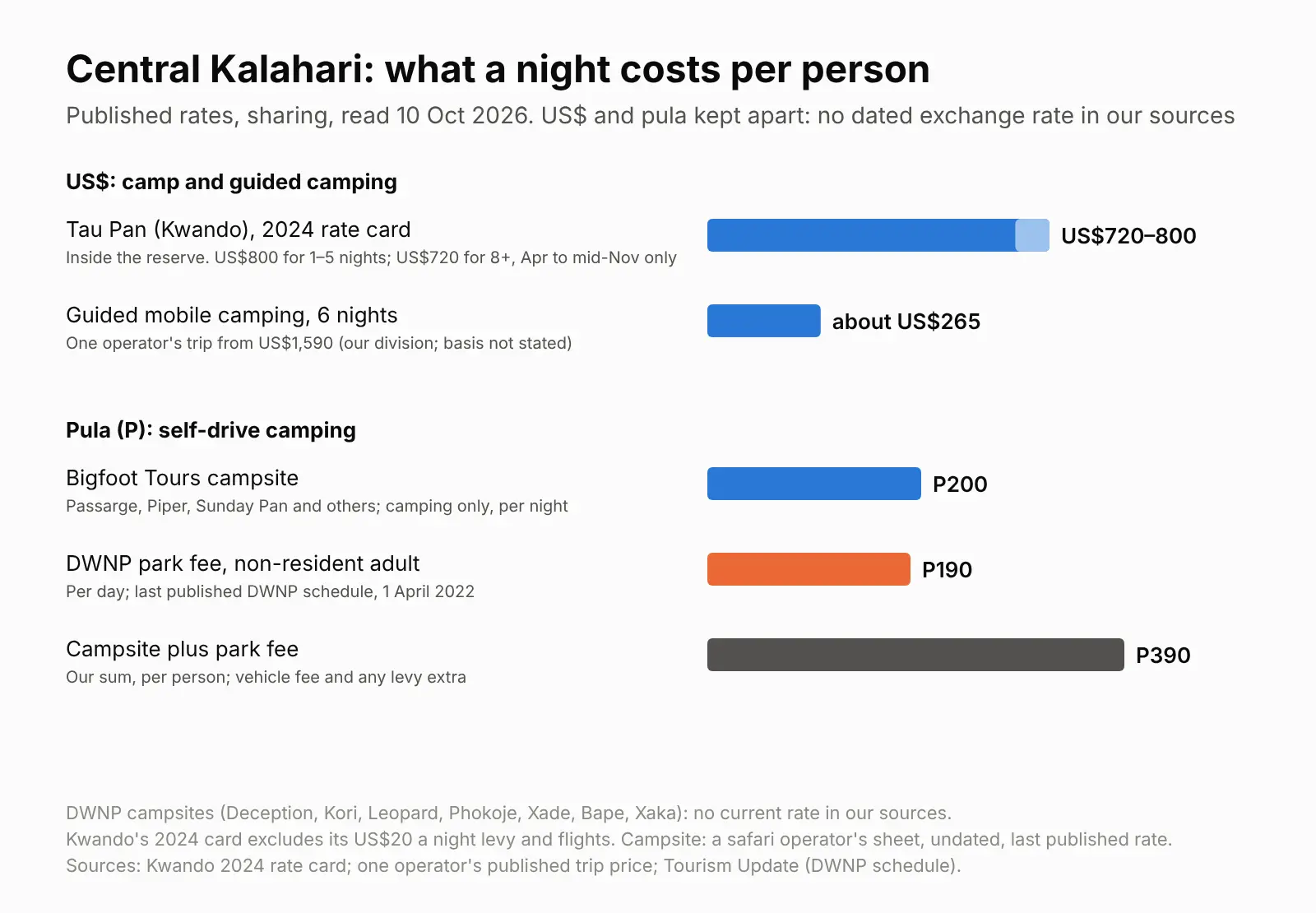 Sources as in the table; park fee: Tourism Update. Dollars and pula are not converted: our sources give no dated exchange rate. Read 10 October 2026.
- Longer stays at Tau Pan cost less only from April to mid-November: US$760 for 6–7 nights and US$720 for 8+; from mid-November to March every stay costs US$800 (Kwando 2024 rate card).
- Closed: Kalahari Plains Camp and Edo’s Camp, per one operator’s page (read October 2026). It suggests about 3 nights at a permanent camp, 5–8 on a mobile safari.
Deception Valley and the pans
The rains bring peak game and birds to the Deception and Passarge valleys, one operator says.
- Deception Valley is one of four fossil river valleys in the reserve and began to form about 16,000 years ago (Wikipedia).
- Sites are far apart, each with only a long-drop toilet and a bucket shower, and none has water.
- Driving is slow: Tracks4Africa drove “deep, rutted and bumpy sand” in first and second gear, and park officials warned that Deception to Xaka, 233 km, was too far for one day (Tracks4Africa).
Wildlife: Kalahari lions, cheetah and brown hyena
89% of one operator’s traveller groups saw lion, 33% leopard, 29% cheetah and 16% brown hyena (read September 2026).
- Also seen: gemsbok and wildebeest 93% each, giraffe 69%, zebra 50%, eland 38%, wild dog and meerkat 10% each.
- Black manes: Botswana Tourism names the “black-maned Kalahari lion” for the Kgalagadi (Botswana Tourism); we have no sourced lion count or mane description for the Central Kalahari itself.
- Tau Pan overlooks a permanent waterhole with resident lions (Kwando fact sheet, PDF).
Compare: where to see lions and cheetahs.
When to go, month by month
Go December–May for game; that overlaps the November–March rains, when the Rakops approach turns to mud.
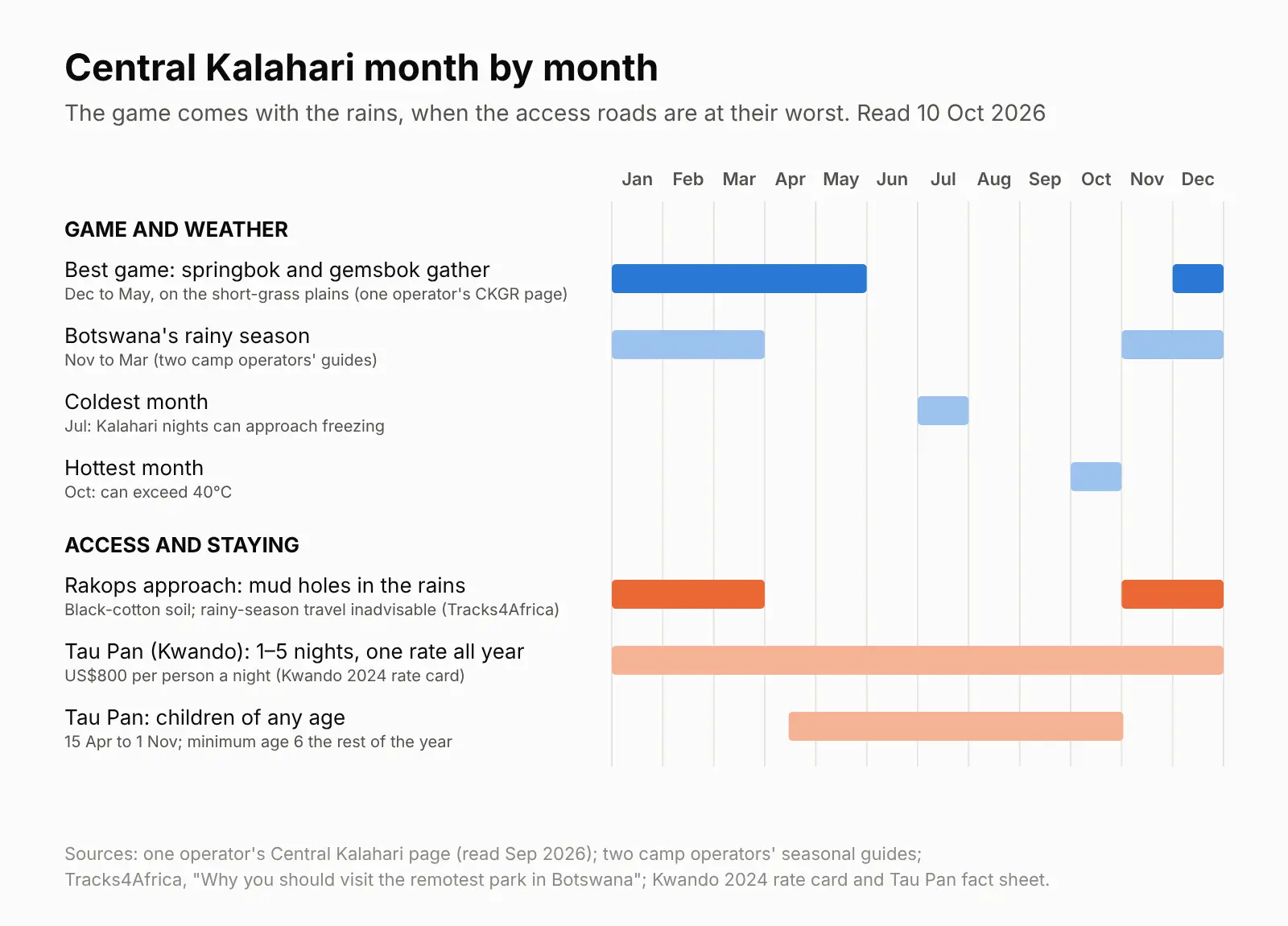 Sources: one operator’s Central Kalahari page; two camp operators’ seasonal guides; Tracks4Africa; Kwando. Read 10 October 2026.
- December–May: best game, when springbok and gemsbok gather on the short-grass plains (one operator). Tracks4Africa calls rainy-season travel on the Rakops approach, with its “mudholes lined with black-cotton soil”, inadvisable (Tracks4Africa).
- April–October: drier and quieter, game dispersed (same operator). July is the coldest month, when Kalahari nights can approach freezing; October is the hottest, when it can exceed 40°C (two camp operators’ seasonal guides).
- Price and children: Tau Pan charges US$800 for 1–5 nights in every season (Kwando 2024 rate card) and takes children of any age 15 April–1 November, otherwise from age 6 (Kwando). See green season safari.
Park fee
The Central Kalahari’s last published park fee is P190 per non-resident adult per day, from the DWNP schedule of 1 April 2022. It is the lower DWNP band, shared with Khutse, Nxai Pan and Makgadikgadi Pans (Tourism Update).
| Fee | Amount | In force from | Source |
|---|---|---|---|
| Other DWNP parks and reserves (Central Kalahari Game Reserve, Khutse, Nxai Pan, Makgadikgadi Pans), non-resident adult, per person per day | BWP 190 (SADC residents BWP 145; Botswana citizens and residents BWP 20) | Last published DWNP schedule, 1 April 2022 (via Tourism Update). In Feb 2026 the government news agency BOPA called the existing non-resident fee P380; a P500 rise was announced, then reported postponed. No official current tariff: confirm with DWNP or your operator | Tourism Update, 23 Feb 2022 (DWNP fee schedule) |
No official current tariff is published. In February 2026 the government news agency BOPA described the existing non-resident fee as P380 and reported a rise to P500 from 1 April 2026 (Botswana Daily News). The rise was then reported postponed; on 5 May 2026 Gabz FM reported the delay as two years (Gabz FM). Confirm the fee with DWNP or your operator before you travel.
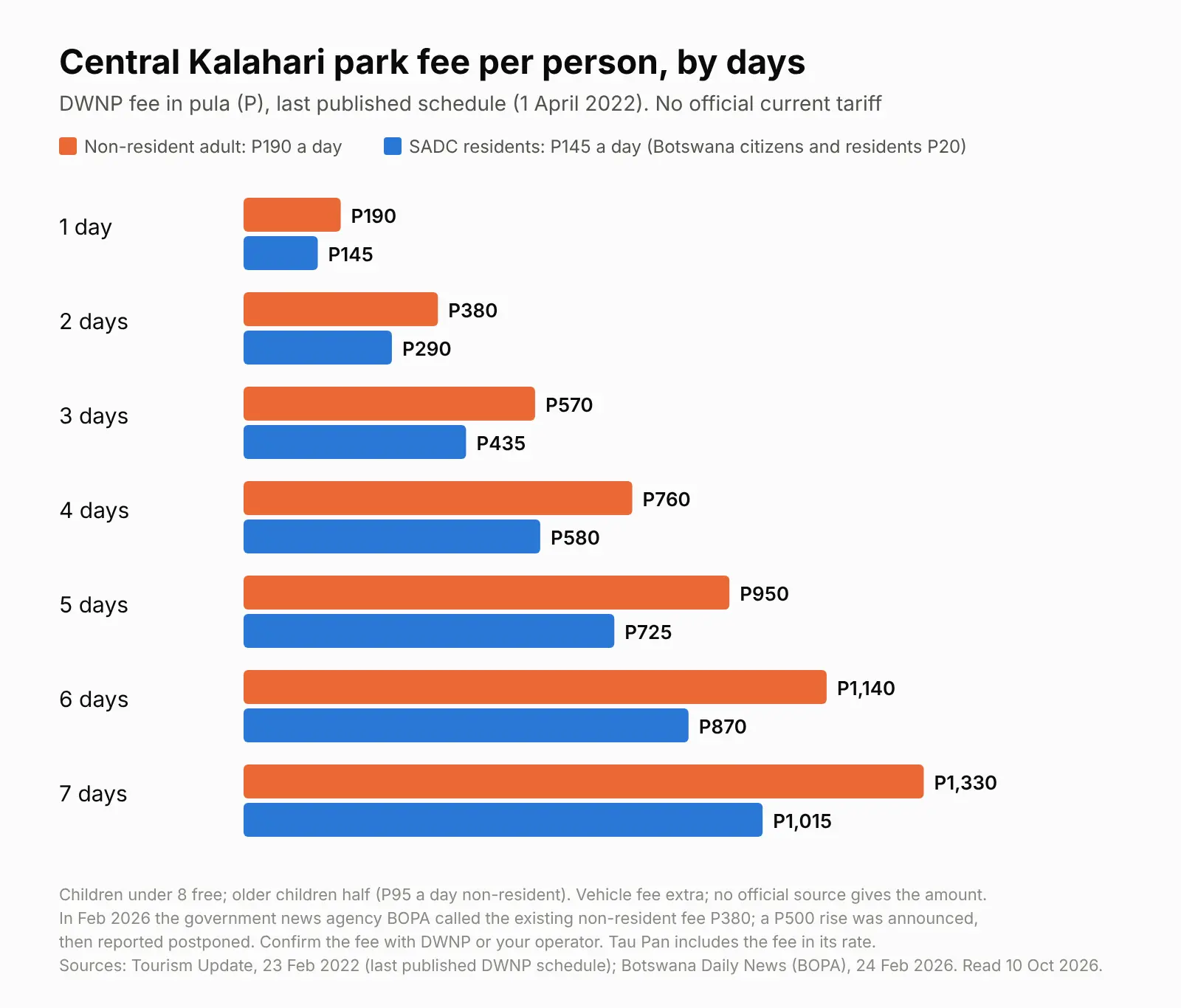 We count one fee per person per day (our arithmetic). Sources: Tourism Update; Botswana Daily News (BOPA). Read 10 October 2026.
- Children under 8 enter free; older children pay half (a safari operator’s campsite sheet), P95 a day for a non-resident (our arithmetic).
- Tau Pan includes the fee; campers pay DWNP separately, plus a daily vehicle fee whose amount no official source gives. All parks: Botswana park fees; full budget: Botswana safari cost.
Self-drive: two vehicles, fuel, water and booking
Drive in only with a high-clearance 4x4, every night booked and paid, and fuel and water for the whole stay.
- Two vehicles: Tracks4Africa advises two for its Botswana route (Tracks4Africa), and travellers on the TripAdvisor forum call it standard here. No rule in our sources makes it compulsory, unlike the Kgalagadi, where Botswana Tourism requires a convoy.
- Fuel: none inside; the nearest is at Rakops or Letlhakane (Tracks4Africa).
- Water: at least 10 litres per person per day plus a 20-litre reserve (Tracks4Africa). On the Kalahari trip above, its party of four carried 140 litres for five days and found the Matswere Gate borehole dry.
- Fire: the same party passed three burnt-out vehicles; don’t park over dry grass.
- Booking: DWNP books its sites via its Gaborone and Maun offices and dwnp@gov.bw; Bigfoot Tours books its own. Book “a year in advance” (Tracks4Africa); DWNP takes park fees only once all camping fees are paid (yourbotswana). More: self-drive in Botswana.
Getting there: Maun, Rakops, Ghanzi or a light aircraft
Fly from Maun in 45–60 minutes (one operator’s page), or drive via Rakops, one of the two nearest fuel stops (Tracks4Africa); from Namibia the tar road runs through Ghanzi.
- Fly: Moremi Air flies Maun–Tau Pan for US$315 per person one way, plus taxes and US$25 Maun departure tax (Kwando 2024 rate card). Mack Air lists Deception Valley and Dinaka airstrips (Mack Air). See Botswana bush flights.
- From Namibia: Maun to Ghanzi is 280 km of tar via Toteng and Sehithwa, and the A3 runs on 45 km to the A2 (Wikipedia, A3); the A2, the Trans-Kalahari Highway, covers 165 km between the Ghanzi area and the Mamuno/Buitepos border (Wikipedia, A2).
Khutse next door, and the Kgalagadi
Khutse Game Reserve adjoins the Central Kalahari to the south, with the same last published park fee, P190 per non-resident adult per day.
Bigfoot Tours runs all of Khutse’s campsites, at BWP 200 per person a night non-resident (a safari operator’s campsite sheet); bring a 4x4 and all your water. The Kgalagadi Transfrontier Park has its own rules: see Kgalagadi.
The San and the court cases
The reserve’s San residents won the right to return in 2006 and to use and drill boreholes in 2011; our sources do not show how many live there in 2026.
- Removals: by 1997 three-quarters of the reserve’s San population had been relocated (Wikipedia); in 2002 services, including water, were cut (High Court judgment, PDF). Court papers use the Setswana term Basarwa.
- 13 December 2006: the High Court, in Sesana and Others v Attorney General, held the removal unlawful and affirmed the right to return (Oxford Public International Law). It did not order services restored.
- 27 January 2011: the Court of Appeal, in Mosetlhanyane and Others v Attorney General, held that residents may use existing boreholes and drill new ones for domestic water (ESCR-Net).
- The Ghaghoo diamond mine opened inside the reserve in 2014 (Wikipedia) and was placed on care and maintenance in 2017; “the sales process continues” (Gem Diamonds).
Common mistakes about the Central Kalahari
| What you’ll often read | What is correct |
|---|---|
| “The best time is June to October” | That is the north. Here the best game is December–May (one operator). |
| “The park fee is P500 from April 2026” | The rise was reported postponed. P190 is the last published fee; confirm with DWNP. |
| “Camping costs P30 a night” | That DWNP rate is listed beside the pre-2022 park fee. We have no current DWNP campsite rate; Bigfoot Tours sites cost BWP 200. |
| “You can refill water at the gate” | Don’t count on it: Tracks4Africa found the Matswere Gate borehole dry. |
Sources as above; read 10 October 2026. More: Botswana hub, safari questions, Namibia vs Botswana.
Frequently asked questions
Do I really need a 4x4, or will a high-clearance 2WD do? You need a 4x4 with low range. Tracks4Africa drove the reserve’s deep, rutted sand in first and second gear and calls it “for experienced overlanders only”.
Should I self-drive in convoy or is one vehicle enough? Two is the advice, not a rule, in our sources: Tracks4Africa and TripAdvisor forum travellers both advise it. The only convoy rule in our sources is Botswana Tourism’s, for self-drive campers in the Kgalagadi.
Why can’t I just check campsite availability online like I can in South Africa? Because Botswana has no shared booking system. DWNP books its Central Kalahari sites through its offices and by email, and Bigfoot Tours books its five sites separately. Tracks4Africa says to book a year ahead.
Is the green season actually bad? Not here: one operator gives December–May as the best game. The cost is access: Tracks4Africa calls rainy-season travel on the Rakops approach inadvisable, so in the rains consider flying in from Maun (45–60 minutes).
Is the Kalahari malaria-free? No health authority in our sources calls the Central Kalahari malaria-free. NaTHNaC rates the northern half of Botswana high risk October–May and low risk June–September, and the southern half very low risk (NaTHNaC). Ask a travel clinic which band your route falls in.
Can I drive from the Okavango through Ghanzi to Windhoek? Yes, and the Botswana legs are tar: Maun to Ghanzi is 280 km on the A3, and the A2 runs 165 km from the Ghanzi area to the Mamuno/Buitepos border (Wikipedia). Raw meat bought in Maun may not cross the veterinary fence toward Ghanzi; cooked food may (Tracks4Africa).
Sources
- Reserve and history: Wikipedia; Sesana judgment (PDF); OPIL; ESCR-Net; Gem Diamonds
- Rules, wildlife, seasons, health: Botswana Tourism, game drives and Kgalagadi; one operator’s traveller reports (September 2026); two camp operators’ seasonal guides; NaTHNaC
- Rates: Kwando 2024 rate card; Tau Pan fact sheet (PDF); a booking agent’s listing; Ker & Downey Botswana; a safari operator’s campsite sheet
- Travel: Tracks4Africa (CKGR, trip, water, route, booking, fences); yourbotswana; Mack Air; Wikipedia, A3 and A2
- Fees: Tourism Update, 23 Feb 2022; Botswana Daily News (BOPA), 24 Feb 2026; Gabz FM
Prices and fees checked 10 October 2026. We will update this page when DWNP publishes a new fee schedule or a current campsite rate, and when Kwando publishes a rate card newer than 2024.
Ask for a quote
Tell us your dates and we send you a priced itinerary. Free, no obligation.
- Free quote, no obligation
- Trips run by licensed local operators