 Experience

Last verified · Next check due
On this page
- The order to book in: campsites, then park fees, then the car
- Who runs which campsite in Moremi and Chobe
- Park permits and fees: what DWNP charges
- No campsite booking, no overnight entry
- Gate times and driving rules
- Distances, driving times and fuel
- River crossings, the flood and seasonal closures
- The 4x4 and what to carry
- Common mistakes on a Moremi and Chobe self-drive
- Frequently asked questions
- Sources
Short answer: Book every campsite first (up to a year ahead), then the DWNP park fees, then the 4x4. Moremi’s and Chobe’s campsites are run by private companies (Kwalate Safaris, SKL Camps, Xomae Group) at about US$40–50 per person per night (last published rates), and DWNP takes park fees only once every campsite is paid. The park fee is P270 per non-resident adult per day in the last published DWNP schedule (1 April 2022); confirm it with DWNP or your operator.
Key facts
- Campsite first, park fees last. “Park fees can only be paid to the DWNP once all camping fees … have been settled” (yourbotswana). The concessionaires’ invoices go to the Department of Wildlife and National Parks (DWNP) to get your park permit (Tracks4Africa).
- DWNP does not run the campsites in Moremi or Chobe. Kwalate Safaris runs South Gate, Xakanaxa and Ihaha; SKL Camps runs North Gate (Khwai) and Linyanti, and is listed for Savuti; Xomae Group runs Third Bridge (Tracks4Africa; a safari operator’s campsite sheet, undated).
- No official current park tariff is published. The last published DWNP schedule (1 April 2022, via Tourism Update) sets P270 a day in Chobe and Moremi. BOPA (24 Feb 2026) called the existing non-resident fee P380; P500 was announced, then reported postponed. Confirm the fee with DWNP or your operator.
- Every park leg needs a high-clearance 4x4. Third Bridge to Savuti alone takes 8–9 hours on sand (Tracks4Africa); Maun 4x4 operators rent from about US$170–300 a day.
- No night driving and no off-road driving in either park. Botswana Tourism states that “off-roading and night driving [are] prohibited” in the national parks and reserves (Botswana Tourism).
- Book up to a year ahead. “Bookings should be done a year in advance”, Tracks4Africa says of park campsites (Tracks4Africa).
The order to book in: campsites, then park fees, then the car
Book and pay every campsite on the route, take the vouchers to DWNP for the park fees, and book the 4x4 once the dates are fixed. The order is not a preference: DWNP will not take park fees until every camping fee is paid (yourbotswana), and the campsites decide your dates.
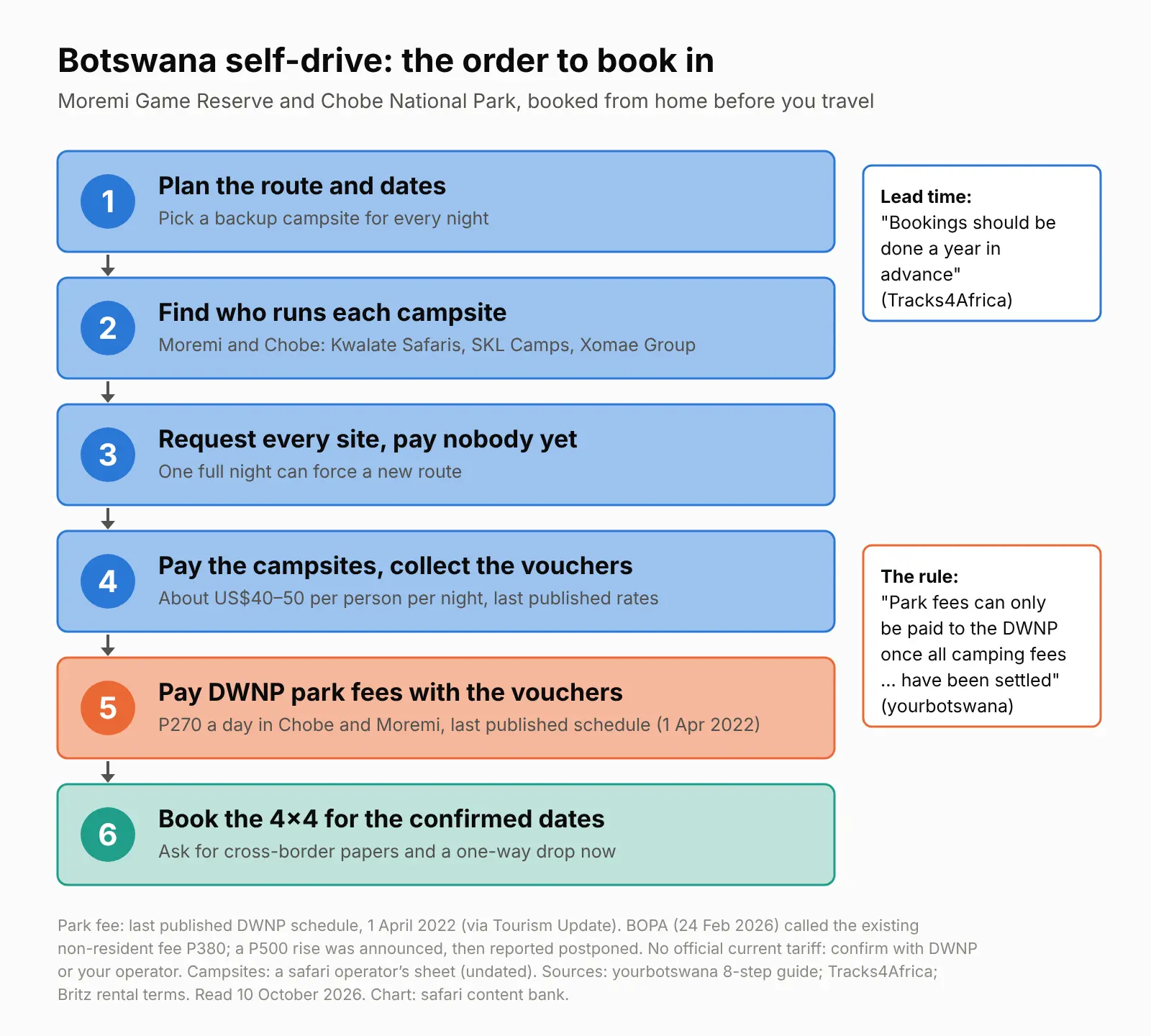 Sources: yourbotswana 8-step guide; Tracks4Africa, campsite booking; a safari operator’s campsite sheet (undated). Park fee: last published DWNP schedule, 1 April 2022 (via Tourism Update). Read 10 October 2026. Chart: safari content bank.
| Step | What you do | Why | Source |
|---|---|---|---|
| 1. Route and dates | Plan every night, with a backup campsite in the same area | A single full site can force a new route | Tracks4Africa |
| 2. Who runs each site | Match each night to Kwalate, SKL, Xomae, a community trust or DWNP | Each one is a separate booking, with its own payment and cancellation terms | A safari operator’s campsite sheet |
| 3. Hold, don’t pay | Ask for every site; confirm the whole trip before paying anyone | A paid night you can’t use is a sunk cost | yourbotswana |
| 4. Pay the campsites | Pay each concessionaire and keep the vouchers | DWNP needs them | Tracks4Africa |
| 5. Pay DWNP | Take the vouchers to DWNP and pay the park fees | “Park fees can only be paid to the DWNP once all camping fees … have been settled” | yourbotswana |
| 6. Book the car | Book the 4x4 for the confirmed dates, with cross-border papers and any one-way drop | The rental needs dates, a start town and an end town | Our reasoning, from steps 1–5 |
Read 10 October 2026. If the route also uses DWNP-run campsites (in the Central Kalahari or Makgadikgadi), check DWNP availability before you contact the concessionaires; DWNP is the slowest link (content bank, booking sequence from Tracks4Africa and yourbotswana).
Why the car comes last: the campsites are the scarce part. Tracks4Africa tells self-drivers to book a year ahead, and its sequence starts with the route and a backup site for every night. A 4x4 is booked for fixed dates and, on a Maun-to-Kasane trip, for a one-way drop, so book it once steps 1–5 hold. This order is our reading of the sources; no source sets a rental lead time.
- Do it all before you leave home. yourbotswana’s guide says to “complete all arrangements before leaving home to avoid gate-side complications” (yourbotswana).
- A Maun agency can do steps 2–5 for you. Tracks4Africa names three Maun companies, one of them a 4x4-hire firm, among the operators that book campsites and DWNP permits (Tracks4Africa). One traveller in a forum thread was quoted P550 per booking plus P450 for international courier by a Maun agency (TripAdvisor forum); that is one traveller’s report, not a published price.
Who runs which campsite in Moremi and Chobe
Three private concessionaires run every public campsite in Moremi Game Reserve and Chobe National Park in our sources; DWNP runs campsites directly only in the Kalahari parks. Each company takes its own bookings, so a Moremi–Chobe loop usually means three separate bookings before DWNP.
| Campsite | Park | Run by | Last published rate, non-resident, per person per night |
|---|---|---|---|
| South Gate (Maqwee) | Moremi | Kwalate Safaris | US$40 |
| Xakanaxa | Moremi | Kwalate Safaris | US$40 |
| Third Bridge | Moremi | Xomae Group | Two different published rates; ask Xomae |
| North Gate (Khwai) | Moremi | SKL Camps | US$50 |
| Ihaha (riverfront) | Chobe | Kwalate Safaris | US$40 |
| Savuti | Chobe | Listed under SKL Camps; one source names Xomae, so confirm | US$50 |
| Linyanti | Chobe | SKL Camps | US$50 |
| Khwai community sites (outside Moremi, by North Gate) | Khwai community concession | Khwai Development Trust | BWP 300 |
Source: a safari operator’s Botswana public campsite information sheet, undated; operators also from Tracks4Africa. The sheet still shows the pre-2022 park fee, so treat these as last published rates and confirm with the operator. Most rows add a government levy of P10 per person per night. Read 10 Oct 2026.
- DWNP runs its own campsites in the Kalahari parks, not in Moremi or Chobe: Deception, Kori, Leopard, Phokoje, Xade, Bape and Xaka in the Central Kalahari Game Reserve, and Njuca Hills and Tree Island in Makgadikgadi (Tracks4Africa; a safari operator’s campsite sheet).
- SKL Camps takes bookings online for Savuti, Linyanti, Khwai and Kumaga, and names payment through a link on the invoice or by bank transfer (SKL Camps).
- Cancellation terms differ by company. Kwalate’s last published terms: the deposit is non-refundable, 50% is refunded if you cancel two months or more before arrival and 20% inside two months (a safari operator’s campsite sheet). Read each operator’s terms separately.
- The Khwai community concession is not Moremi. It admits self-drivers and allows activities the reserve does not, while the Khwai Private Reserve next to it says “No self-drivers or day visitors are permitted” (a safari travel company’s Khwai page). Rules for each area are on our page on where night drives, walking and off-road driving are allowed.
- Forum reports say replies can be slow. In TripAdvisor’s Botswana forum, a contributor said Kwalate “had or still has a reputation of not being very responsive” (TripAdvisor forum). That is a traveller report; it is one more reason to start a year out.
Park permits and fees: what DWNP charges
DWNP charges a park fee per person per day and a vehicle fee per day, paid after the campsites; the last published park fee is P270 per non-resident adult per day in both Moremi and Chobe. That figure is the last published DWNP schedule (1 April 2022, via Tourism Update). BOPA (Botswana Daily News, 24 Feb 2026) calls the existing non-resident fee P380, and P500 was announced, then reported postponed (Gabz FM, 5 May 2026). There is no official current tariff, so confirm the fee with DWNP or your operator.
The official fee lines, with the date each took effect and the source:
| Fee | Amount | In force from | Source |
|---|---|---|---|
| Chobe National Park and Moremi Game Reserve (DWNP), non-resident adult, per person per day | BWP 270 (SADC residents BWP 205; Botswana citizens and residents BWP 30) | Last published DWNP schedule, 1 April 2022 (via Tourism Update). In Feb 2026 the government news agency BOPA called the existing non-resident fee P380; a P500 rise was announced, then reported postponed. No official current tariff: confirm with DWNP or your operator | Tourism Update, 23 Feb 2022 (DWNP fee schedule) |
| National Road Safety Fund levy, foreign-registered vehicle entering Botswana | BWP 40, valid to 31 December of the year paid | Last published on the BURS motor-vehicle clearance page (undated) | Botswana Unified Revenue Service (BURS) |
| Charge | Paid to | When | Amount | Source |
|---|---|---|---|---|
| Campsite | The concessionaire that runs the site | First, when you book | US$40–50 per person per night (last published) | A safari operator’s campsite sheet |
| Park fee | DWNP | After every campsite is paid | P270 per non-resident adult per day, last published schedule (1 April 2022) | Tourism Update |
| Vehicle fee | DWNP | With the park fee | Per day, arrival and departure day both counted; no official source gives the current amount, so we print none | Botswana safari cost |
| Government levy | With the campsite | With the campsite | P10 per person per night on most rows | A safari operator’s campsite sheet |
| Road Safety Fund levy (foreign-registered car) | BURS, at the border | On entering Botswana | BWP 40, valid to 31 December | BURS |
Read 10 October 2026.
- Children under 8 enter free, and older children pay half (a safari operator’s campsite sheet). Sources put the upper age at 15 or 17, so check with your operator.
- A three-night stay is four vehicle-days, because DWNP counts the arrival and the departure day.
- Pay in cash as well as by card. Pula, rand and major currencies are accepted, but cards are unreliable in remote areas (yourbotswana).
- Day visits are different. Forum regulars say day visitors to Moremi pay the park fee at the gate and only an overnight stay needs a booked campsite (TripAdvisor forum); totals by number of days are on Chobe park fees.
No campsite booking, no overnight entry
If you plan to sleep in Moremi or Chobe, arrive at the gate with every campsite confirmed and paid; there is no drive-up camping. A commercial information site about Moremi, rather than DWNP, states: “A valid campsite reservation is required to enter the park at all”. yourbotswana’s guide gives the same instruction: finish every booking before leaving home (yourbotswana).
- Carry a printed voucher for every night. The concessionaire’s invoice is what DWNP issues your permit against (Tracks4Africa).
- We found no official DWNP statement of the rule, and DWNP publishes no booking page that we could read. Treat the campsite voucher as your entry document and confirm with DWNP.
Gate times and driving rules
Botswana Tourism’s rule for every national park and reserve, Moremi and Chobe included, is no night driving and no off-road driving. It states that “off-roading and night driving [are] prohibited” in the parks and reserves, while private concessions outside them allow both (Botswana Tourism).
| Park | Gates | Published gate hours | Source |
|---|---|---|---|
| Chobe National Park | Sedudu (by Kasane), Ngoma (west, by the Namibian border), Ghoha (north of Savuti), Mababe (south of Savuti, from Maun) | April–September 06:00–18:30; October–March 05:30–19:00 | A commercial site run by a booking agent, not DWNP |
| Moremi Game Reserve | South Gate (Maqwee), North Gate (Khwai) | Not published in our sources | Gates: Wikipedia |
Read 10 October 2026. We found no DWNP page with gate hours for either park; confirm on arrival.
- Be at your campsite or out of the park before the gate closes. With no night driving allowed, a late start on a long leg ends in a fine or a night in the wrong place.
- The A33 between Ngoma and Kasane is a tar road through Chobe National Park, along the river (Wikipedia, A33), so expect wildlife on the road.
- The campsites are unfenced. Elephant, hyena and lion move through Moremi, Chobe and Savuti campsites at night, according to forum regulars (TripAdvisor.de forum); SKL lists “no fences around sites” among its standing warnings (SKL Camps).
More on what each area allows: night drives, walking and off-road driving in Botswana and Moremi vs Chobe.
Distances, driving times and fuel
Through the parks, Maun to Kasane is about 465 km of sand and reserve track with no fuel at the campsites; on the tar via Nata it is 600 km and about 7 hours. Distances in the parks do not predict hours: Tracks4Africa gives Third Bridge to Savuti as 8–9 hours and Savuti to Serondela as 160 km in about 4 hours (Tracks4Africa).
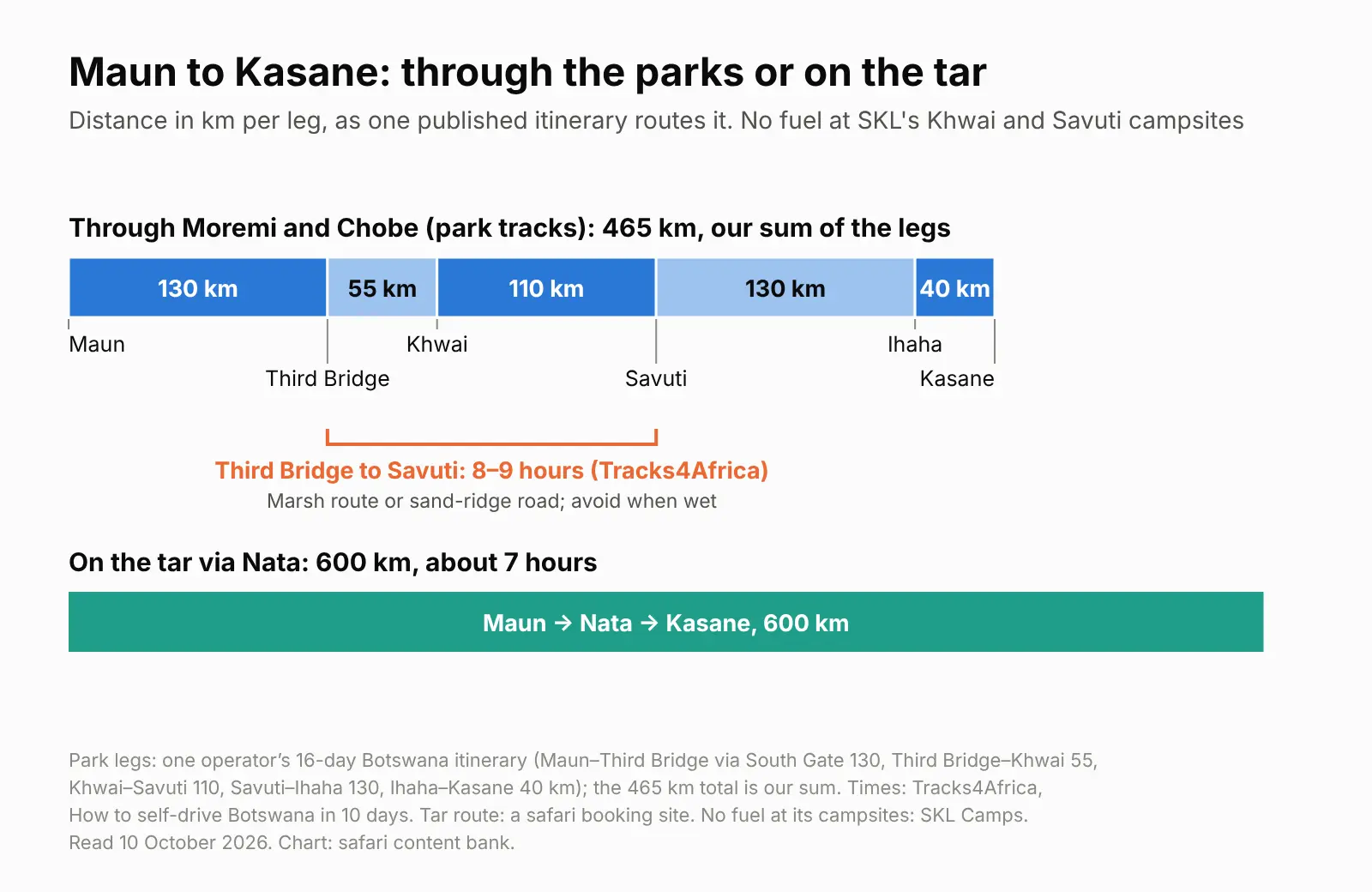 Sources: one operator’s 16-day Botswana itinerary (leg distances); Tracks4Africa (times); a safari booking site (tar route); SKL Camps (no fuel at its campsites). The total is our sum. Read 10 October 2026. Chart: safari content bank.
| Leg | Distance | Time | Surface | Source |
|---|---|---|---|---|
| Maun → Moremi | about 80 km | – | Tar, then sand | Wikivoyage, Maun |
| Maun → Third Bridge (via South Gate) | 130 km | – | Tar, then reserve sand | One operator’s itinerary |
| South Gate → Third Bridge | – | about 2 hours | Thick sand, ending at a narrow log bridge | Tracks4Africa |
| Third Bridge → Khwai (North Gate) | 55 km | – | Reserve sand | One operator’s itinerary |
| Khwai → Savuti | 110 km | – | Sandy tracks | same |
| Third Bridge → Savuti (whole run) | – | 8–9 hours | Marsh route or sand-ridge road; avoid when wet | Tracks4Africa |
| Savuti → Ihaha (Chobe riverfront) | 130 km | – | Sandy tracks | One operator’s itinerary |
| Savuti → Serondela | 160 km | about 4 hours | Park track | Tracks4Africa |
| Ihaha → Kasane | 40 km | – | Park track, then tar | One operator’s itinerary |
| Maun → Kasane on tar | 600 km | about 7 hours | Tar | A safari booking site |
Read 10 October 2026. A dash means the source gives no figure.
- Fill up in Maun and in Kasane. SKL Camps lists no fuel, no phone signal and no internet at its campsites (SKL Camps), and we found no sourced fuel stop between Maun and Kasane on the park route. Carry jerry cans sized for the whole 465 km plus game drives.
- Check the jerry cans at handover. One traveller’s Avis Safari collection in Kasane is documented with the reserved jerry cans missing (TripAdvisor forum); a traveller report, but a cheap thing to check.
- Plan on 40 km/h or less in the parks. That is the figure a forum regular gave a self-driver in February 2026 (TripAdvisor forum), and it matches Tracks4Africa’s 160 km in 4 hours.
- Kasane to Mababe Gate through Chobe in one day is possible but punishing, in the German forum’s verdict on that leg: start early, arrive late, see little (TripAdvisor.de forum).
River crossings, the flood and seasonal closures
Water is the hazard your rental contract does not cover: the Moremi route crosses a log bridge at Third Bridge, Britz’s terms say “a vehicle may not go through water”, and there is no official track-condition bulletin. Check conditions with your rental company and the concessionaires in the week before you drive.
- Third Bridge is reached over a narrow log bridge, after about 2 hours of thick sand from South Gate (Tracks4Africa).
- The flood comes from Angola, not from local rain. Water is highest in most of the Delta from about May to August (one operator’s flood guide), so a dry week in Maun says nothing about the crossings.
- Tracks4Africa says to avoid the Third Bridge–Savuti leg when the roads are wet or slippery (Tracks4Africa).
- Deep crossings happen. On one Tracks4Africa trip, the water at the Linyanti–Savuti canal crossing was over the Land Cruiser’s bonnet, and the party reached Shakawe three days behind schedule (Tracks4Africa, An epic adventure in the Okavango). That is one undated trip report, not a seasonal norm.
- Areas of Moremi can close after heavy rain. In the wet early-2026 season, a forum contributor reported areas of Moremi closed for a couple of weeks (TripAdvisor forum). That is a traveller report; we found no official closure notice. Build in a spare day.
- No official flood or track bulletin exists for the parks, according to German forum regulars, who send self-drivers to their rental company the week before they travel (TripAdvisor.de forum).
We found no sourced depth or condition for the Khwai river crossing at North Gate; it changes each year.
The 4x4 and what to carry
You need a high-clearance 4x4 with low range, and the rental cover will not pay for the three most likely accidents: rollover, undercarriage damage and water. Britz’s terms state that “roll-overs are not covered in any liability cover options”, exclude damage to the “side sills, prop shaft, side shaft, front and rear diff and exhaust system”, and say “a vehicle may not go through water” (Britz terms, PDF).
4x4 rental rates
| Supplier | Base | Published daily rate | Notes | Source |
|---|---|---|---|---|
| Travel Adventures Botswana | Maun | US$170 standard, US$183 fully equipped Land Cruiser | Lowest tier: low season, 21+ days. Collision waiver US$60 a day cuts the excess to US$380 | rates page |
| Chobe 4x4 | Maun | US$260 (Nov–Apr), US$300 (May–Oct) | Land Cruiser 79 camper | Chobe 4x4 |
| McKenzie 4x4 | Maun | BWP 1,500 unequipped, BWP 2,000 fully equipped | Insurance included; excess BWP 15,000; unlimited km | McKenzie 4x4 |
| Britz | Maun, Kasane, Johannesburg, Windhoek | from ZAR 1,360; camp-ready from ZAR 1,610 | Minimum 5 days. Standard excess ZAR 55,000; undercarriage and water damage not covered under any cover level | Britz terms (PDF) |
Published rates, captured September 2026; most pages show no rate year. Prices are per vehicle, not per person. More suppliers on our Botswana safari cost page.
Equipment
| Item | What the sources say | Source |
|---|---|---|
| Spare wheels | Two spares on rims, not one | Tracks4Africa |
| Tyre pressure | 2.5 bar on tar; 1.3–1.5 bar front and 1.5 bar rear on gravel; lower still in deep sand (no figure given) | same |
| Compressor and gauge | A high-volume compressor and a pressure gauge, to reinflate before the tar | same |
| Recovery kit | McKenzie’s fully equipped Maun vehicles carry sand mats, an air compressor, a tool kit, a hi-lift jack and a spade | McKenzie 4x4 |
| Water | At least 10 litres per person per day, plus a 20-litre reserve | Tracks4Africa |
| Satellite phone | Included in Travel Adventures Botswana’s and McKenzie’s rentals, with GPS; air rescue membership US$20 per person for 12 months (Travel Adventures) | Travel Adventures Botswana; McKenzie 4x4 |
| A second vehicle | Tracks4Africa advises two vehicles because of the sand and mud | Tracks4Africa |
Read 10 October 2026.
- One vehicle is common on the busy Moremi–Khwai circuit in high season, forum posters say, because other cars pass; in the low season and on the Savuti sand they advise two (TripAdvisor forum). That is traveller advice, not a rule.
- First 4x4 trip? Forum regulars say start in Namibia, citing deep sand, river crossings and unfenced campsites (TripAdvisor.de forum). Our Namibia vs Botswana page compares the two as self-drives.
- A Maun-to-Kasane one-way hire is possible with some companies. In a forum thread, a contributor said Britz would rent in Maun with a Kasane drop (TripAdvisor forum); ask for the one-way fee when you book.
Crossing the border in a rental, and the veterinary fences
- Cross-border papers cost extra. Britz charges ZAR 1,000 per rental, which “excludes visa, liability insurance and road tax” (Britz terms, PDF). Botswana then charges the BWP 40 Road Safety Fund levy (BURS).
- A foreign-registered vehicle may stay 14 days on a temporary import permit, after which customs duty or VAT can fall due (BURS, same page). Check this before a longer loop on a South African or Namibian rental.
- Buy meat on the right side of the veterinary fence. Raw meat may not be taken from Maun towards Nxai Pan, Makgadikgadi, Nata or Ghanzi, but may be taken towards Moremi, Chobe and Savuti; cooked food may cross (Tracks4Africa, veterinary fences).
- Kazungula is a bridge now, not a ferry. The Kazungula Bridge between Botswana and Zambia opened on 10 May 2021, with a one-stop border post (Wikipedia).
Common mistakes on a Moremi and Chobe self-drive
| What you’ll often read or assume | What is correct |
|---|---|
| “Book the car first, then find campsites” | Campsites first. They are the scarce part and they set your dates; book the 4x4 once they are confirmed. |
| “A campsite booking includes park entry” | Park fees are paid separately to DWNP, after every campsite is paid. |
| “Pay each campsite as soon as you get a yes” | Confirm the whole route first. One full night can force a new route, and a paid night you can’t use is lost money. |
| “DWNP runs the Moremi and Chobe campsites” | Kwalate Safaris, SKL Camps and Xomae Group run them. DWNP runs campsites directly in the Kalahari parks. |
| “Camping in Moremi costs P30 a night” | That is the old DWNP portion. Concessionaires’ last published rates are US$40–50 per person per night, plus the park fee. |
| “Botswana park fees are now P500” | P500 was announced, then reported postponed. The last published DWNP schedule (1 April 2022, via Tourism Update) gives P270; BOPA (24 Feb 2026) called the existing non-resident fee P380. Confirm with DWNP or your operator. |
| “You can drive off-road or at night in your own car” | Both are prohibited in the parks and reserves (Botswana Tourism). |
| “Third Bridge to Savuti is a morning’s drive” | 8–9 hours on sand (Tracks4Africa); avoid it when wet. |
| “Top-tier rental cover means zero risk” | Britz excludes rollover, undercarriage and water damage under every cover level. |
| “Take the Kazungula ferry to Zambia” | The ferry was replaced by the Kazungula Bridge (opened 10 May 2021). |
Frequently asked questions
Do I book the campsites or the park permit first in Botswana? The campsites. DWNP takes park fees only once all camping fees are settled, and it issues the permit against the concessionaires’ vouchers. Pay every campsite on the route, then pay DWNP.
Who do I book Moremi and Chobe campsites with? With the company that runs each site: Kwalate Safaris (South Gate, Xakanaxa, Ihaha), SKL Camps (North Gate, Linyanti, and listed for Savuti) and Xomae Group (Third Bridge). DWNP does not run the campsites in either park. SKL takes bookings online.
How much does a Moremi or Chobe self-drive cost per day in fees? The last published DWNP schedule (1 April 2022, via Tourism Update) charges P270 per non-resident adult per day, and campsites cost about US$40–50 per person per night in the last published rates, plus a P10 levy and a daily vehicle fee. BOPA (24 Feb 2026) called the existing non-resident fee P380, and P500 was announced, then reported postponed. Confirm the fee with DWNP or your operator.
How far ahead should I book a Botswana self-drive? Up to a year for the campsites. “Bookings should be done a year in advance”, Tracks4Africa says, and every booking should be finished before you leave home. Book the 4x4 once the campsite dates are confirmed.
Can I enter Moremi or Chobe without a campsite booking? Not to stay overnight: arrive with every campsite confirmed and paid. Forum regulars say day visitors to Moremi pay the park fee at the gate and only an overnight stay needs a booked site; confirm with DWNP.
Do I need a 4x4 for Moremi and Chobe? Yes, a high-clearance 4x4 with low range. Third Bridge to Savuti takes 8–9 hours on sand, and Maun operators rent equipped 4x4s from about US$170–300 a day. Carry two spare wheels and enough fuel for the park legs.
What are the gate times in Chobe National Park? April to September 06:00–18:30 and October to March 05:30–19:00, according to a booking agent’s commercial site; we found no DWNP page with the hours. Night driving is prohibited in the parks, so be at your campsite or out of the park before closing.
Is there fuel inside Moremi or Chobe? No fuel is listed at the campsites: SKL Camps warns of no fuel, no phone signal and no internet at its sites. Fill up in Maun and Kasane and carry jerry cans for the park legs, which add up to about 465 km between Maun and Kasane on one published itinerary (our sum).
Sources
- Booking order and campsites: yourbotswana, 8-step guide; Tracks4Africa, campsite booking; a safari operator’s campsite sheet (undated); SKL Camps; a commercial Moremi information site (names and links kept in our editor notes)
- Park fees: DWNP schedule effective 1 April 2022, via Tourism Update, 23 Feb 2022; Botswana Daily News (BOPA), 24 Feb 2026; Gabz FM, 5 May 2026
- Rules and gates: Botswana Tourism, game viewing; a booking agent’s commercial site (gates and rules); Wikipedia, Moremi Game Reserve; a safari travel company’s Khwai page (names and links kept in our editor notes)
- Routes and water: Tracks4Africa, self-drive in 10 days, An epic adventure in the Okavango; one operator’s 16-day itinerary; a safari booking site’s Chobe getting-there page; Wikivoyage, Maun; Wikipedia, A33; one operator’s flood guide (names and links kept in our editor notes)
- Vehicles and equipment: Britz terms (PDF); Travel Adventures Botswana; Chobe 4x4; McKenzie 4x4; Tracks4Africa on punctures, water and veterinary fences
- Borders: BURS, clearance of motor vehicles; Wikipedia, Kazungula Bridge
- Traveller reports: TripAdvisor Botswana forums (English and German), threads linked in each section
More: the Okavango Delta, Chobe National Park, Chobe park fees, Moremi vs Chobe, Botswana safari cost, night drives and walking in Botswana, Botswana safari questions and Namibia vs Botswana.
Checked 10 October 2026. We will update this page when DWNP publishes a new fee schedule, an official current tariff or its own booking and gate-hours pages, when the concessionaires publish new campsite rates, and when the rental companies publish 2027 rates.
More photos from Botswana
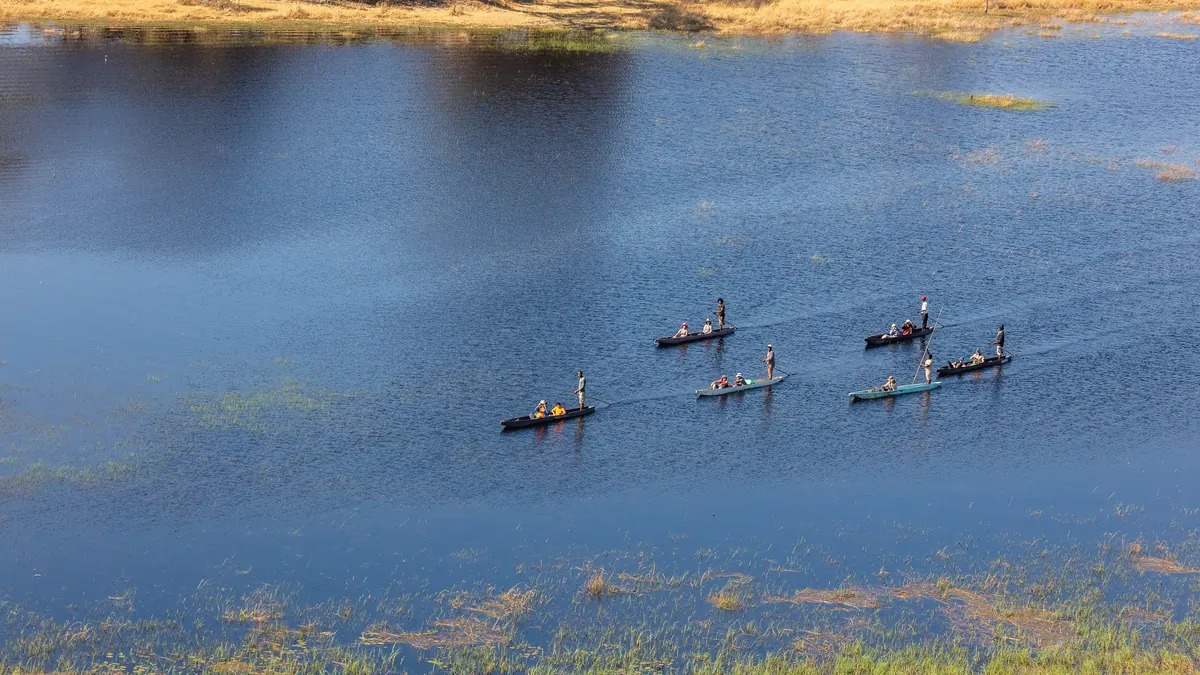
Aerial view of mokoro canoes crossing an Okavango Delta lagoon. Diego Delso, Wikimedia Commons, CC BY-SA 4.0, cropped 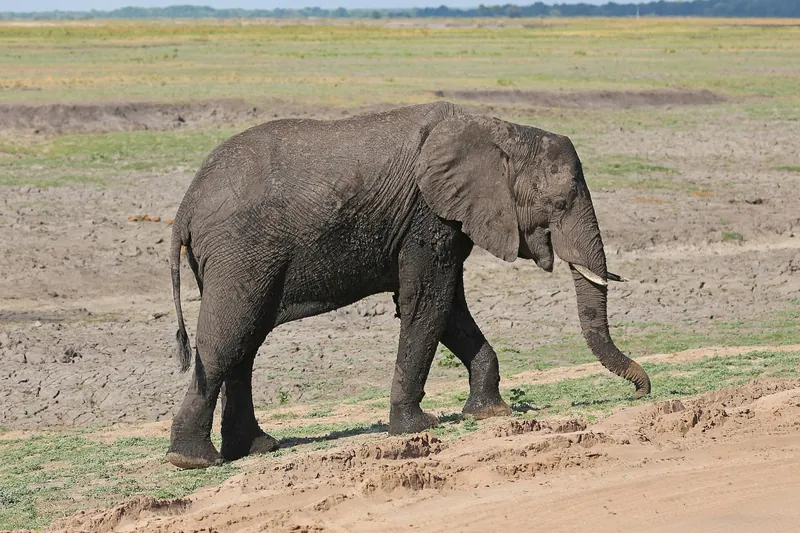
Elephant walking on the Chobe floodplain. Bernard Gagnon, Wikimedia Commons, CC BY-SA 4.0, cropped 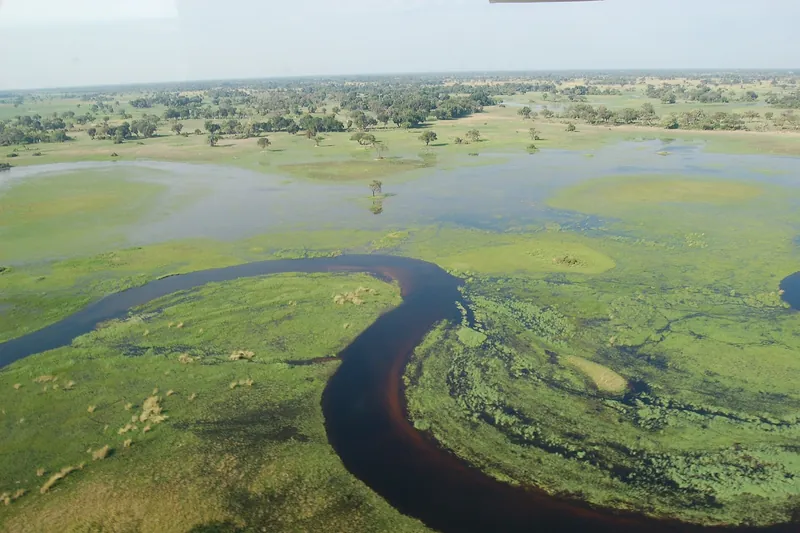
Aerial view of a river bend in the Okavango Delta. Joachim Huber, Wikimedia Commons, CC BY-SA 2.0, cropped


Photos by visitors and photographers, used under their free licences. Click a name to see the original.