 Experience

Last verified · Next check due
On this page
Short answer: Last published DWNP park fees: P270 per non-resident adult per day in Chobe and Moremi, P190 in other parks (1 April 2022). In February 2026 the government news agency called the existing non-resident fee P380; a P500 rise was announced, then reported postponed. Confirm with DWNP or your operator. There is no US$30 border levy. Delta water peaks about May–August, game concentrates June–October; light aircraft allow 20 kg per person in a soft bag. Checked 10 October 2026.
Key facts
- No official current Botswana park fee is published. The last published DWNP schedule (1 April 2022, via Tourism Update) sets P270 in Chobe and Moremi and P190 in other parks. In February 2026 the government news agency BOPA described the existing non-resident fee as P380. A rise to P500 was announced on 24 February 2026, then reported postponed (by two years, according to Gabz FM on 5 May 2026). Confirm the fee with DWNP or your operator before you travel.
- No tourism levy is charged on arrival. The US$30 Tourism Development Levy Bill was withdrawn on 11 December 2017.
- The Okavango Delta floods in the dry season. Its water is Angolan rain that enters Botswana between mid-March and mid-May, so the Delta is fullest when Botswana itself is driest.
- Night drives, off-road driving and walking are not allowed in Chobe National Park or Moremi Game Reserve. They are allowed on private concessions.
- Rhino is the animal visitors miss. 10% of one safari operator’s travelling groups saw a white rhino and 1% a black rhino, against 95% for elephant.
Costs and park fees
How much does a Botswana safari cost per night?
From about US$265 a night on a budget mobile camping trip to US$530–5,345 per person per night at a fly-in camp. One operator publishes a 6-night guided camping trip from US$1,590. Kwando’s Moremi Crossing starts at US$530 per person per night in low season (Kwando 2024 rate sheet), and Wilderness’s Mombo reaches US$5,345 in peak season (Wilderness, Mombo). The full price ladder, with levies and flights, is on our Botswana safari cost page.
What are Botswana’s park fees in 2026?
The last published schedule charges P270 per non-resident adult per day in Chobe National Park and Moremi Game Reserve, and P190 in the Central Kalahari, Khutse, Nxai Pan and Makgadikgadi Pans; no official current tariff is published. These figures come from the Department of Wildlife and National Parks (DWNP) schedule of 1 April 2022 (Tourism Update, 23 Feb 2022). In February 2026 the government news agency BOPA described the existing non-resident fee as P380, and a P500 rise was announced, then reported postponed, so confirm the fee with DWNP or your operator. SADC residents pay P205 and P145, and Botswana citizens and residents P30 and P20. Children under 8 enter free and older children pay half (a safari operator’s public campsite sheet, PDF).
The official fee lines, with the date each took effect and the source:
| Fee | Amount | In force from | Source |
|---|---|---|---|
| Chobe National Park and Moremi Game Reserve (DWNP), non-resident adult, per person per day | BWP 270 (SADC residents BWP 205; Botswana citizens and residents BWP 30) | Last published DWNP schedule, 1 April 2022 (via Tourism Update). In Feb 2026 the government news agency BOPA called the existing non-resident fee P380; a P500 rise was announced, then reported postponed. No official current tariff: confirm with DWNP or your operator | Tourism Update, 23 Feb 2022 (DWNP fee schedule) |
| Other DWNP parks and reserves (Central Kalahari Game Reserve, Khutse, Nxai Pan, Makgadikgadi Pans), non-resident adult, per person per day | BWP 190 (SADC residents BWP 145; Botswana citizens and residents BWP 20) | Last published DWNP schedule, 1 April 2022 (via Tourism Update). In Feb 2026 the government news agency BOPA called the existing non-resident fee P380; a P500 rise was announced, then reported postponed. No official current tariff: confirm with DWNP or your operator | Tourism Update, 23 Feb 2022 (DWNP fee schedule) |
| National Road Safety Fund levy, foreign-registered vehicle entering Botswana | BWP 40, valid to 31 December of the year paid | Last published on the BURS motor-vehicle clearance page (undated) | Botswana Unified Revenue Service (BURS) |
Did Botswana’s park fees go up in April 2026?
The rise was announced, then reported postponed; no official current tariff is published. On 24 February 2026 the government news agency BOPA reported the Ministry of Environment and Tourism’s new fees from 1 April 2026, with non-residents going from the existing P380 to P500 (Botswana Daily News); trade press then reported the increase postponed. On 5 May 2026 Gabz FM reported the delay as two years (Gabz FM). The last published DWNP schedule (1 April 2022, via Tourism Update) gives P270 and P190. Pages that show P500 as the current fee are quoting the proposal. Confirm the fee with DWNP or your operator.
Do I have to pay a US$30 tourism levy at the border?
No. Botswana charges no tourism levy on arrival. A US$30 Tourism Development Levy was announced for 1 June 2017 (BTO notice, 2017, PDF), postponed, and the Bill was withdrawn on 11 December 2017 (Inside Travel). The government said then that a revised Bill could return, so check before you travel.
Are park fees, flights and levies included in a fly-in camp rate?
Park fees often are; flights and camp levies often are not. Natural Selection, Wilderness and Desert & Delta include park fees in their rates, while camp groups charge levies of US$20–100 per person per night on top: US$100 at Great Plains, US$60 at Natural Selection, US$35 at Machaba and US$20 at Kwando (Great Plains 2025; Natural Selection 2026; Machaba 2026; Kwando 2024). Light-aircraft seats cost US$220–594 per sector, unless the group includes air, as Great Plains does on stays of 2+ nights. Tips and premium drinks are extra everywhere.
What is the cheapest way to do a safari in Botswana?
Self-drive or a budget mobile camping safari in the national parks. One operator’s 6-night guided camping trip starts at US$1,590, and Travel Adventures Botswana rents a 4x4 in Maun from US$170 a day at its lowest tier, low season and 21+ days (Travel Adventures Botswana). Self-drivers then add park fees (P190–270 per person per day under the last published DWNP schedule; confirm the current fee with DWNP) and campsite fees of about US$40–50 per person per night.
How much should I tip on a Botswana safari?
One Botswana camp company suggests US$20 per guest per day for the guide, US$20 per guest per day for the camp staff and US$7 per guest per day for a mokoro poler (its guest FAQ). Tips are given once, at the end of the stay, in a communal box, a sealed envelope or by card at departure. Ker & Downey’s camps take Visa and Mastercard but not American Express.
Is there a single supplement, and can it be waived?
Yes, most camps charge one, and some waive it in the low season. Machaba Camp’s 2026 supplement is 40% of the sharing rate (US$526 a night in high season), and its rate card lists none for 11 January–31 March (Machaba 2026). Natural Selection waives it from 10 January to 31 March and from 1 October to 19 December (Natural Selection 2026). Kwando waives it for exclusive use, groups of 4+ tents, or stays of 6+ nights in its Secret season (Kwando 2024).
When to go and the Okavango flood
When is the best time for a Botswana safari?
June to October for game viewing, because animals gather at the remaining water in the dry season. November to March is the green season, with newborn animals, migrant birds and lower rates, but the rains fill pans and the game disperses (a camp operator’s best-time guide for Botswana). October is the hottest month and can pass 40°C (same source).
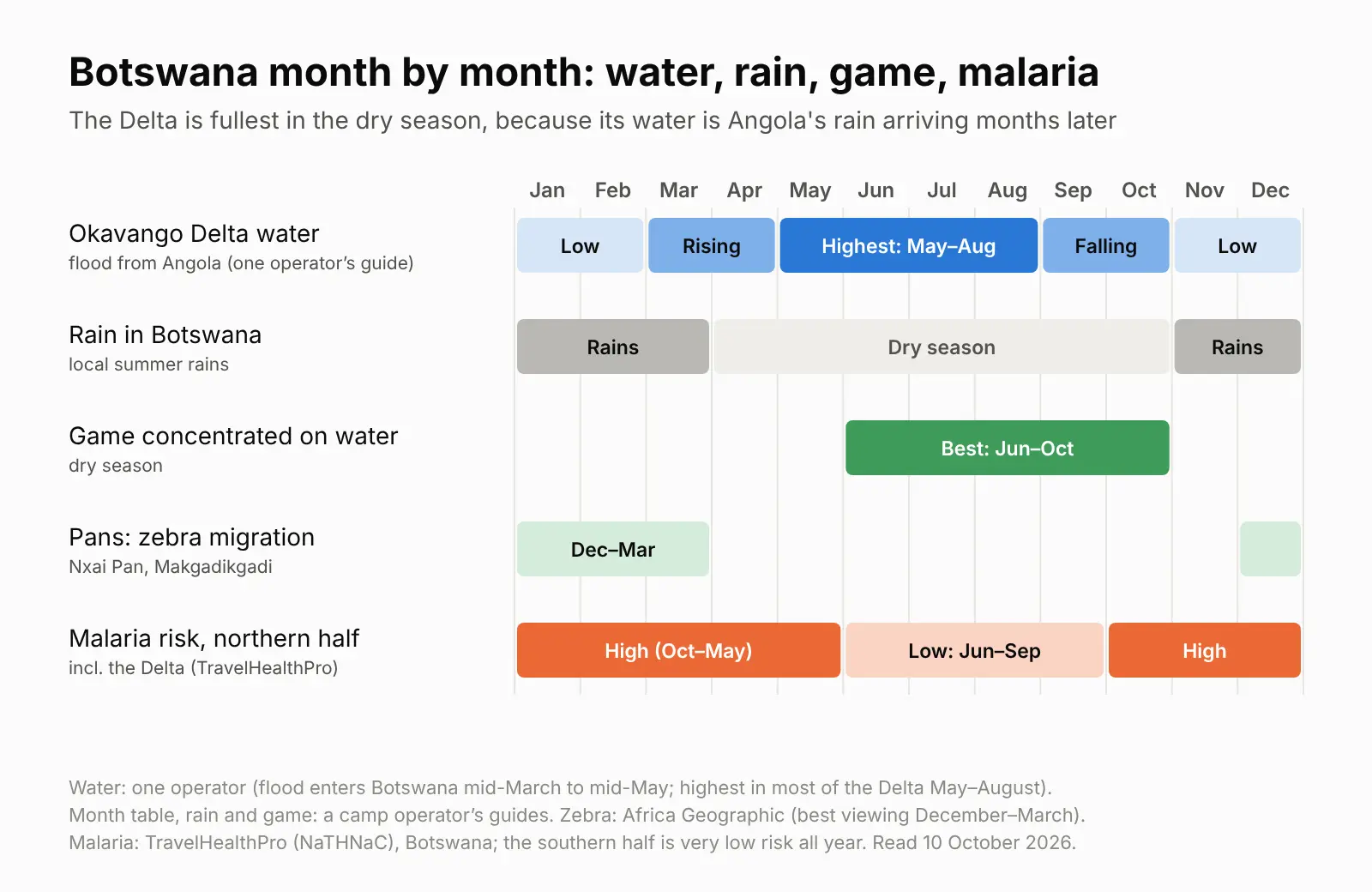 Sources: one operator’s guide (flood timing); a camp operator’s month table; Africa Geographic (zebra); TravelHealthPro (malaria). Read 10 October 2026. Chart: safari content bank.
Why does the Okavango Delta flood in the dry season?
Because the water is rain that fell on the Angolan highlands months earlier, not Botswana’s own rain. One safari operator says the flood peak “generally enters Botswana between mid-March and mid-May”, after the local rains have ended, and that water is highest in most of the Delta from about May to August, falling until around February. The flood can take up to six months to reach the furthest channels.
When can I go on a mokoro or boat trip?
Mostly from late May to about August, while the flood fills the channels. A mokoro needs water, so at most camps it is seasonal and reduced or stopped when levels drop (one safari operator’s Okavango Delta guide). One camp operator’s month table has boating resuming in late May and often stopping at seasonal camps in September (a camp operator’s best-time guide for Botswana). If a mokoro is the reason you are going, get it confirmed in writing for your dates.
Is the green season (November to March) worth it?
Yes for price, birds and newborn animals; no if concentrated game is the priority. Rates drop sharply: Mombo falls from US$5,345 in peak season to US$3,062 in January–March (Wilderness, Mombo), and Machaba from US$1,315 to US$718 (Machaba 2026). The pans are at their best then, with zebra at Nxai Pan and the Makgadikgadi from December to March (Africa Geographic).
Does a high flood reduce game drives?
Yes, at camps on seasonal floodplains. In the wet 2026 season a forum contributor reported GPS data showing under 5,000 hectares of driveable ground at 4 Rivers over three nights, and Pom Pom’s floodplains full of water (TripAdvisor forum, 2026). The Linyanti is outside the Okavango flood and is the usual dry alternative (TripAdvisor forum). Ask a camp how much of its area is dry in your month, not only whether it offers game drives.
When is the zebra migration?
December to March at Nxai Pan and the Makgadikgadi Pans, with March the month the herds mass for the return. More than 20,000 zebra move between the Chobe floodplains and Nxai Pan; of the herd that moves between the Okavango and the Makgadikgadi, only about 55% take part (Africa Geographic). Plan it as part of a green-season pans trip.
Okavango Delta, Moremi and Chobe
Is Moremi Game Reserve the same as the Okavango Delta?
No. Moremi is a state game reserve in the eastern Delta; most of the rest of the Delta is private and community concessions. Park rules apply in Moremi, so “night drives and walking safaris are not permitted within the reserve” (one safari operator’s Moremi guide). On a concession, the camp’s guests can drive off-road and at night (Botswana Tourism).
Are night drives, off-road driving and walking allowed in Chobe and Moremi?
No. Botswana Tourism states that “off-roading and night driving [are] prohibited” in the national parks and reserves, and that private concessions offer both “in moderation” (Botswana Tourism). Walking safaris are not permitted in Moremi (one safari operator’s Moremi guide). Camps inside Moremi, such as Mombo (US$3,062–5,345 a night), fall under the reserve’s rules, so check the camp’s activity list for your dates.
Can I drive into the Okavango Delta, or do I have to fly?
You can drive to the eastern Delta, but not to the water camps. Moremi’s South Gate, North Gate, Third Bridge and Xakanaxa and the Khwai community area are reachable by 4x4 with a booked campsite; the inner and western Delta has no road access (TripAdvisor forum). Those camps are reached by light aircraft, at US$250–350 per person one way from Maun to Kwando’s Delta and Linyanti camps (Kwando 2024).
Is Chobe too crowded?
The Chobe riverfront is the busiest wildlife area in Botswana, and crowding is the main complaint in its reviews. Chobe averages 4.7 out of 5 across 218 user reviews on a safari booking site, and the low scores cite “too many people” on cruises and drives.
Can I visit Chobe on a day trip from Victoria Falls?
Yes. Kasane is about 70 km from Victoria Falls by road, plus the Kazungula border (Wikivoyage, Kasane). Kasane operators sell 3-hour river cruises on their own, and forum regulars recommend the afternoon one, when elephants come to drink (TripAdvisor forum). The Kazungula road border with Zimbabwe is open 06:00–20:00 (Botswana Tourism, Ports of Entry), and the KAZA Univisa (US$50, 30 days) covers Zambia and Zimbabwe plus day trips into Botswana (UK FCDO, Zambia).
How many nights should I spend at each camp?
Three, or at least one three-night stop on the trip. Every move costs half a day or more because light-aircraft transfers cluster around midday, so forum regulars reckon a 2-2-2-1 itinerary loses about a third of its game-viewing time to logistics (TripAdvisor forum). Longer stays inside one group can also cost less a night: Desert & Delta’s standard camps fall from US$645 (1–4 nights) to US$561 (7+ nights) in green season (Desert & Delta 2024).
What wildlife you will see
Is Botswana a Big Five destination?
Not reliably, because few visitors see a rhino. On one safari operator’s traveller reports (11,679 sightings from 1,356 groups since May 2018), 10% of groups saw a white rhino and 1% a black rhino, against 95% for elephant, 91% for lion, 82% for buffalo and 66% for leopard (its Botswana wildlife page). Khama Rhino Sanctuary near Serowe is the usual place to add rhino.
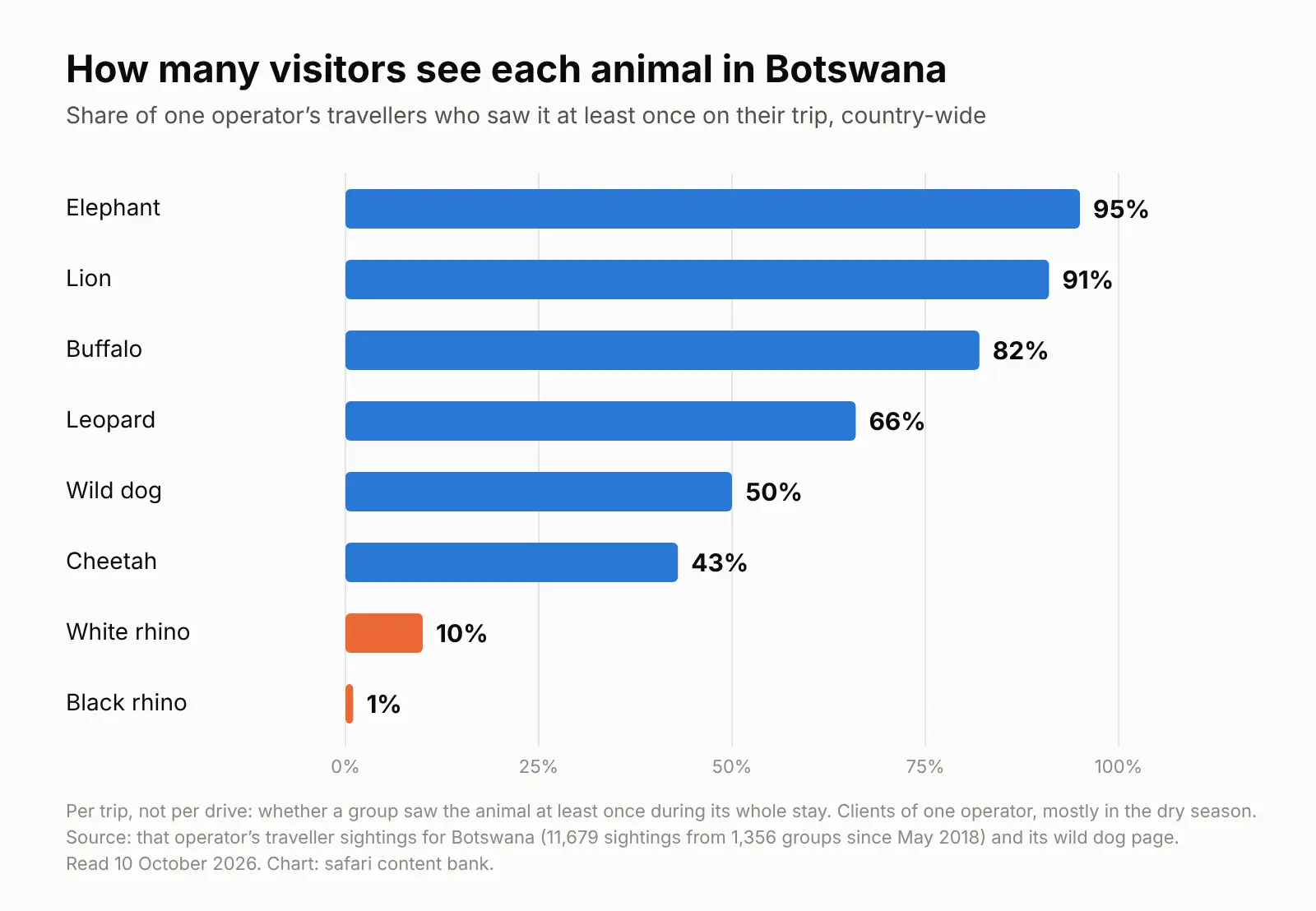 Per trip, not per drive. Source: one safari operator’s traveller sightings for Botswana and its wild dog page. Read 10 October 2026. Chart: safari content bank.
Where are leopard and wild dog easiest to see?
Moremi Game Reserve: 76% of one safari operator’s travellers there saw a leopard and 65% saw wild dog (its Moremi page). Kwando-Linyanti follows at 70% for leopard and 49% for wild dog, while Chobe is lower at 59% and 23% (its Botswana wildlife and wild dog pages). These are per-trip rates over a whole stay, not the chance on one drive.
Will I see gemsbok and meerkats in the Okavango Delta?
No. They are desert animals. The same operator’s travellers saw gemsbok (oryx) on 0% of Okavango Delta trips and 93% of Central Kalahari trips (its Okavango Delta page), and meerkats on 81% of trips to the Makgadikgadi and Nxai Pan area (its salt pans page). A trip that wants both needs both regions.
Self-drive and campsites
Can I self-drive Botswana’s parks?
Yes, in a high-clearance 4x4 with low range, but the park tracks are sandy and slow. Tracks4Africa gives Savuti to Serondela as 160 km in about 4 hours and Third Bridge to Savuti as 8–9 hours (Tracks4Africa). Forum regulars tell first-time 4x4 drivers to start in Namibia, citing deep sand, river crossings and unfenced campsites (TripAdvisor.de forum). Driving at night in the parks is prohibited (Botswana Tourism).
How do I book campsites in Moremi and Chobe?
Book each campsite with the company that runs it, then pay the DWNP park fees last. Most northern sites are run by private concessionaires such as Kwalate Safaris (Ihaha, Xakanaxa, South Gate), SKL Camps (Linyanti, North Gate) and Xomae Group (Nxai Pan) (a safari operator’s public campsite sheet, PDF). “Park fees can only be paid to the DWNP once all camping fees … have been settled” (yourbotswana). SKL now takes bookings online (SKL Camps).
How much does camping cost in Chobe and Moremi?
About US$40–50 per person per night at the concessionaire campsites, plus the park fee. The last published rates are US$40 at Ihaha, Xakanaxa and South Gate and US$50 at Savuti, Linyanti and North Gate, plus a P10 government levy (a safari operator’s public campsite sheet, PDF). The “P30 a night” on older pages is the pre-2022 DWNP portion, not what the concessionaires charge.
How far ahead should I book?
Up to a year ahead for campsites and mid-range camps in peak season. “Bookings should be done a year in advance”, Tracks4Africa says of park campsites (Tracks4Africa). In a July 2026 forum thread, mid-range camps such as Oddballs, Camp Khwai and Jackalberry had “hardly any space” in peak season, while some higher-priced Kwando and Natural Selection camps still had rooms (TripAdvisor forum, 2026).
Are the campsites in Moremi and Chobe fenced?
No. The public campsites in Moremi, Chobe and Savuti are unfenced, and elephant, hyena and lion move through them at night (TripAdvisor.de forum). Lock food in the vehicle, keep children close and use a torch after dark.
Can I take a rental 4x4 across the border into Botswana?
Yes, with the rental company’s cross-border papers and a fee. Britz charges ZAR 1,000 per rental for cross-border documents, excluding “visa, liability insurance and road tax” (Britz terms, PDF). Botswana charges foreign-registered vehicles a BWP 40 National Road Safety Fund levy, and a foreign vehicle may stay 14 days on a temporary import permit (BURS).
Light aircraft and luggage
What is the luggage limit on Botswana light aircraft?
20 kg (44 lb) per person, including hand luggage and camera gear, in one soft bag. Ker & Downey sets a maximum size of 65 × 40 × 30 cm (Ker & Downey, Transfers); Moremi Air and Wilderness Air give 70 × 35 × 30 cm (two operators’ luggage pages). Check the limit with the carrier that flies you.
Can my safari bag have wheels?
It depends on the carrier. Ker & Downey wants soft duffels “with no wheels or frames” (Ker & Downey, Transfers), Moremi Air says “hard case bags will not be accepted” (one operator’s luggage page), and Wilderness Air accepts a soft bag with a rigid base (another operator’s luggage page). Forum regulars report wheeled duffels with squashable sides being carried routinely (TripAdvisor forum).
What happens to luggage that doesn’t fit the limit?
You leave it in Maun or Kasane, or pay for an extra seat. Ker & Downey stores extra luggage free at its Maun office if the safari starts and ends there, and every camp does laundry (Ker & Downey, Transfers). Forum regulars say both airports and Maun lodges hold left luggage, and some operators forward bags between Kasane and Maun (TripAdvisor forum).
How much do light-aircraft transfers cost?
US$220–594 per person per sector, plus US$20–25 departure tax per leg from Maun or Kasane. Moremi Air’s 2024 fares from Maun run from US$220 (Nxai Pan) to US$495 (Kasane) one way (Kwando 2024 rate sheet), and Desert & Delta’s seats between camps cost US$284–594 (Desert & Delta 2024). Great Plains includes scheduled air from Maun or Kasane on stays of 2+ nights (Great Plains 2025).
Can I land in Maun and fly on to camp the same day?
Yes, if your regional flight lands with time to spare. Maun’s port of entry is open 07:30–16:30 and Kasane’s 06:00–18:00 (Botswana Tourism, Ports of Entry), and light aircraft do not fly at night. A late or delayed arrival means a night in Maun.
Entry, visas and health
Do I need a visa for Botswana?
Not if you hold a passport from most European or Commonwealth countries. Botswana Tourism says their citizens “do not require a visa” (Botswana Tourism, Entry Formalities), and UK citizens get 90 days visa-free with a passport valid for 6 months and 3 blank pages (UK FCDO, Botswana, checked 9 October 2026). Nationalities that need a visa apply on the eVisa portal, launched on 12 August 2021 (evisa.gov.bw); the government’s tourist-visa page lists no fee (gov.bw).
What documents do children need to enter Botswana?
A passport plus a full (unabridged) birth certificate naming both parents, and an affidavit from any parent who is not travelling. Border officials at Tlokweng warned in December 2025 that families without them are turned away (BOPA via AllAfrica, 24 Dec 2025). A child travelling with a relative needs affidavits from both parents (same source). A short-form birth certificate is not enough.
Do I need a yellow fever certificate for Botswana?
Only if you arrive from, or transit through, a country with yellow fever risk. The rule covers travellers aged 1 and over, and there is no yellow fever risk in Botswana itself (TravelHealthPro; UK FCDO). Check your whole routing, not just your nationality, if you combine Botswana with East Africa.
Do I need malaria tablets for Botswana?
Yes for the northern half, including the Okavango Delta and Chobe, from October to May, when TravelHealthPro rates the risk high and recommends tablets. From June to September it rates the north low risk, and the southern half is very low risk all year; in both cases it advises bite avoidance only (TravelHealthPro). Which tablets to take is a decision for a travel clinic.
Which vaccinations do I need for a Botswana safari?
Apart from the yellow fever rule above, no vaccine is required to enter; TravelHealthPro recommends hepatitis A, tetanus and typhoid for most travellers, with routine vaccines up to date. Hepatitis B and rabies are recommended for some travellers, such as long stays or remote areas (TravelHealthPro). Confirm with a travel clinic.
Children, money and operators
What is the minimum age at Botswana safari camps?
There is no national minimum age; each camp group sets its own. Kwando takes children from 6, requires a private vehicle for under-12s and allows mokoro and walking from 12 (Kwando 2024); Machaba accepts all ages but requires a private vehicle, at US$550 a night, for under-6s (Machaba 2026). One safari operator says “the majority of camps set the minimum age at either 8 years or 12 years”.
What plugs and money do I need?
Botswana uses plug types D, G and M at 230 V (Wikipedia, mains electricity by country), and the currency is the pula (BWP, “P”). Most safari costs are paid in advance, so little cash is needed in camp; one Botswana camp company says major currencies are accepted (its guest FAQ), and Ker & Downey’s camps take Visa and Mastercard, not American Express (Ker & Downey FAQ).
How do I check a Botswana safari operator?
Ask for the company’s registered name and check it in the Hospitality and Tourism Association of Botswana (HATAB) member directory. On 9 September 2026 the directory listed 443 members, including 82 tour operators and 104 mobile-safari operators (HATAB directory). We found no public online register of licensed tour operators for Botswana. Our guide to checking a safari operator’s licence sets out the method, with the Kenya and Tanzania registers.
Common mistakes in Botswana safari answers
| What you’ll often read | What is correct |
|---|---|
| “Botswana park fees went up to P500 in April 2026” | The P500 rise was announced, then reported postponed. No official current tariff is published: the last published schedule (1 April 2022) gives P270 (Chobe, Moremi) or P190 (other parks), and the government news agency called the existing non-resident fee P380 in February 2026. Confirm with DWNP or your operator. |
| “Chobe costs P120 a day” | That was the fee before 1 April 2022. |
| “Pay a US$30 tourism levy at the border” | No levy is charged. The Bill was withdrawn on 11 December 2017. |
| “The Delta floods in the rainy season” | It floods in the dry season. Angolan rain reaches Botswana from mid-March to mid-May; water is highest from about May to August. |
| “Night drives are part of every Botswana safari” | Not in Chobe or Moremi, where Botswana Tourism says night driving and off-roading are prohibited. Check each camp’s activity list for your dates. |
| “Moremi and the Okavango Delta are the same thing” | Moremi is one state reserve in the eastern Delta; most of the Delta is private and community concessions with different rules. |
| “Botswana is a Big Five destination” | 10% of one safari operator’s groups saw a white rhino and 1% a black rhino. |
| “Camping in Moremi costs P30 a night” | That is the old DWNP portion. Concessionaires charge about US$40–50 per person per night, on top of the park fee. |
| “Soft bag means no wheels” | Carriers differ. Ker & Downey bans wheels; Wilderness Air accepts a soft bag with a rigid base. The 20 kg limit includes hand luggage. |
| “You need malaria tablets all year everywhere in Botswana” | TravelHealthPro rates the north high risk from October to May and low from June to September; the south is very low risk all year. |
Sources
- Park fees: Tourism Update, 23 Feb 2022 (DWNP schedule effective 1 April 2022); Botswana Daily News, 24 Feb 2026; Gabz FM, 5 May 2026; a safari operator’s public campsite sheet (PDF)
- Levy: BTO Tourism Development Levy notice, 2017 (PDF); Inside Travel, Dec 2017
- Rate cards: Kwando 2024, Natural Selection 2026, Machaba 2026, Great Plains 2025, Desert & Delta 2024, Wilderness, Mombo, one operator’s published price (names and links kept in our editor notes), Travel Adventures Botswana
- Seasons and the flood: a camp operator’s best-time guide for Botswana; one safari operator’s Okavango Delta guide (names and links kept in our editor notes); Africa Geographic, zebra migrations
- Parks, rules and wildlife: Botswana Tourism, game viewing; one safari operator’s Moremi, Botswana wildlife, wild dog and salt pans pages; a safari booking site’s Chobe reviews (names and links kept in our editor notes)
- Self-drive: Tracks4Africa, self-drive in 10 days and campsite booking; yourbotswana; SKL Camps; Britz terms (PDF); BURS; Wikivoyage, Kasane
- Flights and luggage: Ker & Downey Botswana, Transfers; two operators’ luggage pages (names and links kept in our editor notes); Botswana Tourism, Ports of Entry
- Entry and health: Botswana Tourism, Entry Formalities; UK FCDO, Botswana and Zambia; evisa.gov.bw; BOPA via AllAfrica, 24 Dec 2025; TravelHealthPro, Botswana
- Families, money and operators: one safari operator’s page on children’s minimum ages (names and links kept in our editor notes); Ker & Downey Botswana FAQ; Wikipedia, mains electricity by country; HATAB member directory
- Traveller reports: TripAdvisor Botswana forums, threads linked in each answer
Answers checked against the content bank on 10 October 2026. We will update this page when DWNP publishes a new fee schedule or a start date for the increase reported postponed, if a tourism levy Bill is reintroduced, when the UK FCDO or Botswana changes its entry rules, and when camps move to 2027 rates on 1 January 2027.
More photos from Botswana
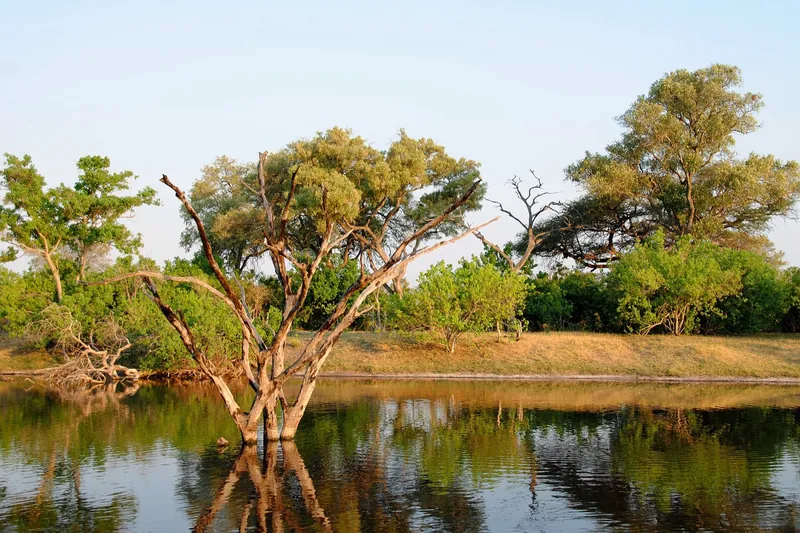
Trees reflected in the water of the Savuti Channel. diego_cue, Wikimedia Commons, CC BY-SA 3.0, cropped 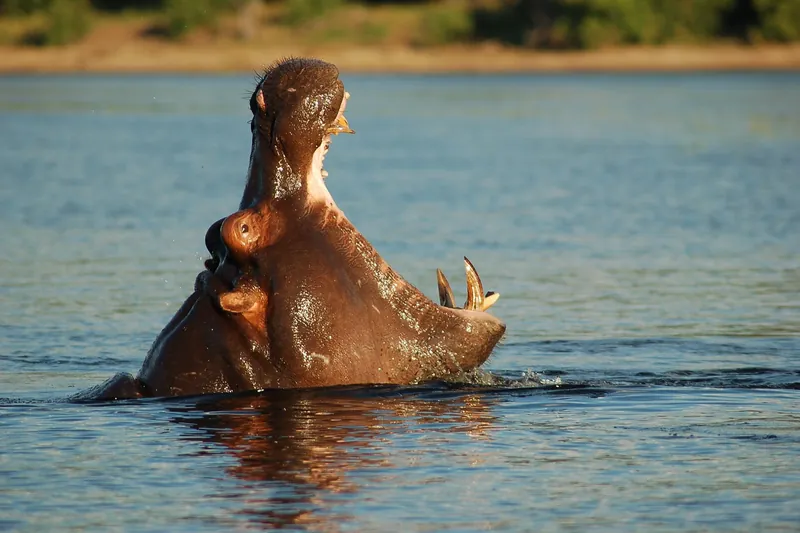
Hippo yawning on the Chobe river front. Joachim Huber, Wikimedia Commons, CC BY-SA 2.0, cropped 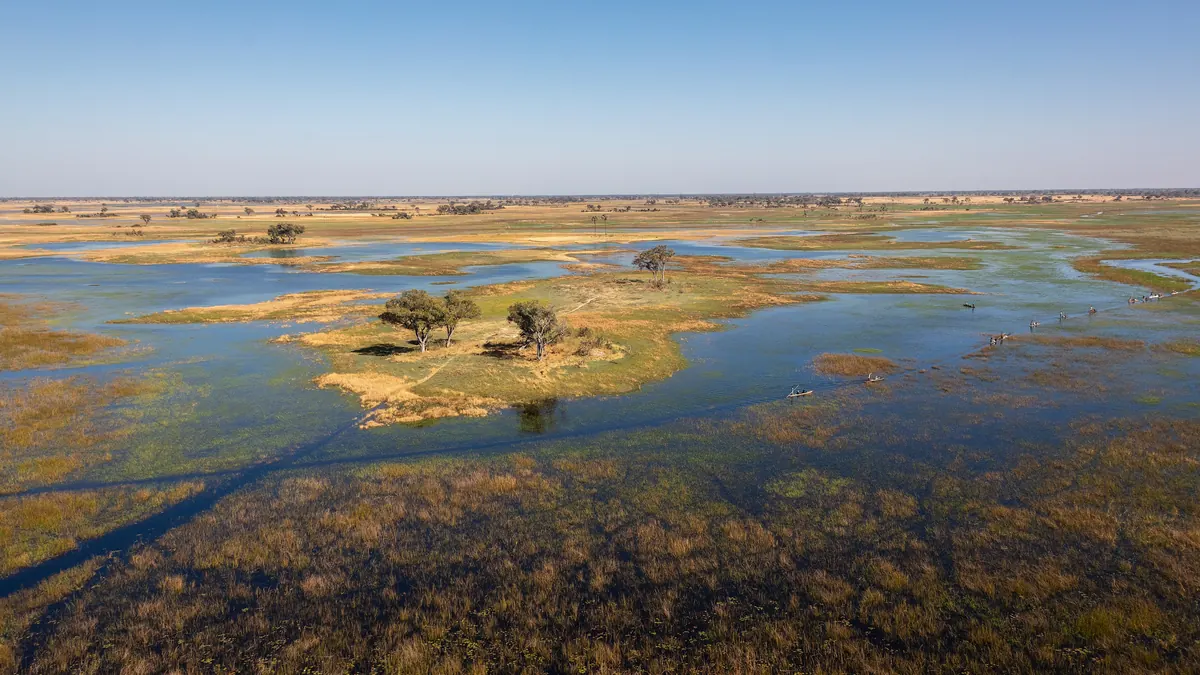
Aerial view of islands and water channels in the Okavango Delta. Diego Delso, Wikimedia Commons, CC BY-SA 4.0, cropped


Photos by visitors and photographers, used under their free licences. Click a name to see the original.