 Experience

Last verified
On this page
- Botswana vs South Africa at a glance (2026)
- Which is cheaper, Botswana or South Africa?
- Park fees: DWNP vs SANParks
- Getting there: bush flights vs tarred roads
- Malaria: the clearest difference
- Wildlife: what each country does best
- When to go: seasons in each country
- Self-drive: Kruger in a hire car, Botswana in a 4x4
- Families: ages, vehicles and malaria
- Crowds and game-drive rules
- Which should you choose?
- Common mistakes in Botswana vs South Africa comparisons
- Frequently asked questions
- Sources
Short answer: Choose South Africa for a first, family or self-drive safari: Kruger can be driven in an ordinary hire car, a campsite costs R484–508 a night per site, the fee is R692 per adult a day (R602 until 31 October 2026), and malaria-free Big Five reserves exist. Choose Botswana for the Okavango Delta, wild dogs and private concessions: fly-in camps publish US$530–5,345 per person a night (2024–2026 rate cards). Botswana’s last published park fee is P270 a day (2022).
Key facts
- South Africa has safari reserves outside the malaria area; northern Botswana has none. UK TravelHealthPro rates North West province and the Eastern Cape (Madikwe, Pilanesberg, Addo) no risk, and northern Botswana, including the Okavango Delta and Chobe, high risk from October to May. Kruger is a risk area, with tablets recommended from September to May.
- No official current Botswana park fee is published. The last published DWNP schedule (1 April 2022, via Tourism Update) sets P270 in Chobe and Moremi. In February 2026 the government news agency BOPA called the existing non-resident fee P380; a P500 rise was announced, then reported postponed. Confirm the fee with DWNP or your operator.
- Kruger’s fee rose on 1 November 2026: R692 per international adult per day from 1 November 2026 to 31 October 2027; the previous rate, to 31 October 2026, was R602 (SANParks 2025/26 and 2026/27 schedules, checked 1 November 2026).
- Most Okavango Delta camps have no road for guests; a light-aircraft seat costs US$220–594 per sector plus US$20–25 departure tax (2024 rate cards). All access roads to Kruger’s 9 entrance gates are tarred (SANParks).
- South Africa held 14,389 rhinos at the end of 2024 and Botswana 345 (IUCN SSC African Rhino Specialist Group, 2025). Only 10% of one safari operator’s Botswana traveller groups saw a white rhino.
- The same rule applies in both countries’ public parks: no off-road driving and no night driving in Botswana’s national parks and reserves or in private cars in Kruger. Botswana’s private concessions and the Greater Kruger private reserves sell both on lodge vehicles.
Botswana vs South Africa at a glance (2026)
South Africa is the road-based, self-drive and malaria-free option with the most rhino; Botswana is the water-based, fly-in option with the strongest wild dog odds and park rules that push night drives onto private land.
| Botswana | South Africa | Source | |
|---|---|---|---|
| Main safari areas | Okavango Delta, Moremi Game Reserve, Chobe National Park, Linyanti, the Kalahari pans | Kruger National Park and the Greater Kruger private reserves; malaria-free reserves in North West, the Waterberg and the Eastern Cape | Botswana safari cost; South Africa safari cost |
| Cheapest bed in the bush | Concession-run park campsite US$40–50 per person per night (last published rates) | SANParks campsite in Kruger R484–508 per site (stays 9–18 Oct 2026) | A safari operator’s public campsite sheet (PDF); SANParks Kruger |
| Lodge or camp, per person sharing per night | US$530–5,345 at fly-in camps (2024–2026 rate cards) | R7,300–44,000 at Sabi Sand and Thornybush lodges (2026) | Operators’ rate cards, below |
| Flagship park fee, foreign adult per day | P270 in Chobe and Moremi (last published DWNP schedule, 1 April 2022; no official current tariff) | R692 in Kruger (R602 until 31 Oct 2026) | Tourism Update; SANParks 2026/27 (PDF) |
| How you reach the wildlife | Light aircraft to most Delta camps; road to the Chobe riverfront | Tarred roads to all 9 Kruger gates, 411–600 km from Johannesburg | Botswana bush flights; Kruger self-drive |
| Self-drive vehicle | High-clearance 4x4 in every park | Ordinary hire car in Kruger | Botswana self-drive; SANParks |
| Malaria | North high risk October–May, low June–September; south very low all year | Kruger a risk area, tablets recommended September–May; North West and Eastern Cape no risk | TravelHealthPro, Botswana; TravelHealthPro, South Africa |
| Night drives and off-road driving | Prohibited in national parks and reserves; allowed on private concessions | Not in private cars in Kruger; on lodge vehicles in the private reserves (per operators) | Botswana Tourism; SANParks |
| Rhino, end of 2024 | 345 (25 black, 320 white) | 14,389 (2,307 black, 12,082 white) | IUCN SSC African Rhino Specialist Group report to CITES, 2025 |
| Visa, UK citizens | None for up to 90 days | None for up to 90 days; online traveller declaration for all arrivals from 1 July 2026 | UK FCDO, Botswana and South Africa |
| Currency of camp and lodge rates | US dollars (park fees in pula) | Rand | Rate cards |
Fees and prices as on our Botswana safari cost and South Africa safari cost pages, checked 9–10 October 2026. Non-resident or international adult. We print each price in the currency the operator publishes and do not convert.
Which is cheaper, Botswana or South Africa?
South Africa has the cheaper floor: Kruger can be done in an ordinary hire car from a SANParks campsite, and the cheapest shared Kruger tours list at US$214 a day, against about US$265 a night for Botswana’s cheapest published mobile safari. Above that, South African lodges price in rand and Botswana’s camps in US dollars; we print each as published and do not convert. At the top, Mombo publishes up to US$5,345 and Singita Ebony up to R60,470 per person a night.
| Tier | Botswana, per person per night | South Africa, per person per night | Source |
|---|---|---|---|
| Self-drive camping | Concession campsite US$40–50, plus the park fee (P270 a day, last published) | SANParks campsite R484–508 per site, plus R692 per adult per day (R602 until 31 Oct 2026) | A safari operator’s public campsite sheet (PDF); SANParks Kruger |
| Budget guided | One operator’s mobile camping trip, 6 nights from US$1,590: about US$265 (basis not stated) | Shared Kruger tours, 3–4 days: US$214–242 per day | One operator’s published price; operators’ published prices on a safari booking site (2 listings) |
| Guided trip, US$ per day | One operator’s fully serviced mobile safari, 9 nights from US$6,395: about US$710 (basis not stated) | Private Kruger safari US$371–405; Sabi Sand luxury fly-in US$1,792–1,980 | One operator’s published 2026 price; operators’ published prices on a safari booking site (2 listings) |
| Lodge by road | Chobe Safari Lodge, Kasane: US$500–550 (2026, park fees included) | Elephant Plains, Sabi Sand: R7,300 rondavel / R9,300 suite (2026) | Chobe Safari Lodge; Elephant Plains |
| Entry-level camp or lodge | Kwando Moremi Crossing: US$530–850 (2024, fly-in) | Umlani Bushcamp, Timbavati: R7,761 (16 Dec 2025–15 Dec 2026) | Kwando 2024 (PDF); Umlani (PDF) |
| Classic | Machaba Camp, Khwai: US$718–1,315 (2026) | Thornybush Game Lodge: R19,800 (2026) | Machaba 2026; Thornybush 2026 (PDF) |
| Premium | Natural Selection Sable Alley: US$995–1,995 (2026, park fees included) | Sabi Sabi Bush Lodge R29,600 to Earth Lodge R44,000 (1 Mar 2026–28 Feb 2027) | Natural Selection 2026 (PDF); Sabi Sabi |
| Top end | Wilderness Mombo: US$3,062–5,345 (2026–27, park fees included) | Singita Ebony: R51,665–60,470 (page undated) | Wilderness Mombo; Singita |
Published rates per person sharing, lowest to highest season where the card has seasons; captured September–October 2026 and checked 9–10 October 2026. Kwando’s 2024 card is the latest from that group in our sources; Singita’s page carries no year. Listings on the safari booking site are usually based on two travellers and do not itemise inclusions. Lodge rates include meals and game drives; what else is included differs, so compare line by line.
What comes on top of the rate
In Botswana, budget for a camp levy and light-aircraft sectors; in South Africa, for the reserve’s gate fee or levy.
| Extra | Botswana | South Africa | Source |
|---|---|---|---|
| Levy per person per night | Camp levies US$20–100 (Kwando US$20, Machaba US$35, Natural Selection US$60, Great Plains US$100) | Timbavati R660 per adult; lodge levies Sabi Sabi R450, Thornybush R650, Simbambili R850 per person | Botswana and South Africa cost pages |
| Gate fee | No concession gate fee in our sources; the camp levy above applies | Sabi Sand R170 per person + R370 per vehicle, per entry (2026) | Sabi Sand access |
| Getting to the camp | Light aircraft US$220–594 per person per sector, plus US$20–25 departure tax per leg (2024 cards), unless the camp includes it | Road, or a flight to Skukuza, Hoedspruit or Kruger Mpumalanga International; no published 2026 airfare in our sources | Botswana bush flights; South Africa safari cost |
| Private vehicle | Natural Selection US$725–935 a night; Machaba US$550 a night | Thornybush R17,500 a day | Rate cards as above |
Read 9–10 October 2026. Great Plains includes scheduled air from Maun or Kasane on stays of 2+ nights (2025 card).
Why Botswana’s floor is higher: the government caps beds on its private concessions and most Delta camps are supplied by air. The mechanics, and how Botswana compares with a self-drive country, are on Namibia or Botswana.
Park fees: DWNP vs SANParks
Park fees are a small part of either bill, and Botswana’s are the less certain: it has no official current tariff, while South Africa has already published Kruger’s fee to October 2027.
| Botswana (DWNP) | South Africa (SANParks, Kruger) | |
|---|---|---|
| Foreign adult, per day | P270 Chobe and Moremi; P190 Central Kalahari, Khutse, Nxai Pan, Makgadikgadi (last published schedule, 1 April 2022) | R692 per day (1 Nov 2026–31 Oct 2027; R602 until 31 Oct 2026) |
| Child | Under 8 free; older children pay half (sources give the upper age as 15 or 17) | Ages 2–11: R345 (R300 until 31 Oct 2026); under 2 free |
| Status | No official current tariff. BOPA (24 Feb 2026) called the existing non-resident fee P380; a P500 rise was announced, then reported postponed | Both schedules published by SANParks |
| In the lodge rate? | Included by Natural Selection, Wilderness and Desert & Delta; check every camp | Charged per person per day on top of SANParks accommodation; private reserves charge their own fee instead |
Sources: DWNP schedule of 1 April 2022 via Tourism Update, 23 Feb 2022; Botswana Daily News (BOPA), 24 Feb 2026; Gabz FM, 5 May 2026; a safari operator’s public campsite sheet (PDF) (child rule); SANParks 2025/26 (PDF) and 2026/27 (PDF) schedules. Checked 9–10 October 2026.
- Two international adults spending 3 days in Kruger in December 2026 pay R4,152 in conservation fees (2 × 3 × R692), as on our South Africa safari cost page.
- Pages that show P500 as Botswana’s current fee are quoting the proposal. The government news agency’s P380 does not match the 2022 schedule, and no published schedule explains the difference. Confirm the fee with DWNP or your operator before you travel; detail on Botswana park fees.
- Kruger’s fee is per person per day, wherever you sleep in the park. Every tier is on Kruger park fees.
The official fee lines, with the date each took effect and the source:
| Fee | Amount | In force from | Source |
|---|---|---|---|
| Chobe National Park and Moremi Game Reserve (DWNP), non-resident adult, per person per day | BWP 270 (SADC residents BWP 205; Botswana citizens and residents BWP 30) | Last published DWNP schedule, 1 April 2022 (via Tourism Update). In Feb 2026 the government news agency BOPA called the existing non-resident fee P380; a P500 rise was announced, then reported postponed. No official current tariff: confirm with DWNP or your operator | Tourism Update, 23 Feb 2022 (DWNP fee schedule) |
| Other DWNP parks and reserves (Central Kalahari Game Reserve, Khutse, Nxai Pan, Makgadikgadi Pans), non-resident adult, per person per day | BWP 190 (SADC residents BWP 145; Botswana citizens and residents BWP 20) | Last published DWNP schedule, 1 April 2022 (via Tourism Update). In Feb 2026 the government news agency BOPA called the existing non-resident fee P380; a P500 rise was announced, then reported postponed. No official current tariff: confirm with DWNP or your operator | Tourism Update, 23 Feb 2022 (DWNP fee schedule) |
| Kruger National Park daily conservation fee, international adult (12+), per day | ZAR 602 | 1 Nov 2025 to 31 Oct 2026 (SANParks 2025/26 schedule) | SANParks daily conservation fees 2025/26 |
| Kruger National Park daily conservation fee, international adult (12+), per day | ZAR 692 | 1 Nov 2026 to 31 Oct 2027 (SANParks 2026/27 schedule, already published) | SANParks daily conservation fees 2026/27 |
| Kruger National Park daily conservation fee, international child (2–11), per day (under 2 free) | ZAR 300 | 1 Nov 2025 to 31 Oct 2026 (SANParks 2025/26 schedule) | SANParks daily conservation fees 2025/26 |
| Kruger National Park daily conservation fee, international child (2–11), per day (under 2 free) | ZAR 345 | 1 Nov 2026 to 31 Oct 2027 (SANParks 2026/27 schedule) | SANParks daily conservation fees 2026/27 |
| Sabi Sand Nature Reserve gate fee, per person, per entry (VAT included) | ZAR 170 (ZAR 180 in 2027) | 1 Jan to 31 Dec 2026 | Sabi Sand Nature Reserve, access and gate fees |
| Timbavati Private Nature Reserve conservation levy, fully catered lodges, per adult (12+) per night | ZAR 660 (child ZAR 330) | 1 Jan to 31 Dec 2026 | Timbavati Private Nature Reserve, getting here |
Getting there: bush flights vs tarred roads
Botswana’s Delta is a fly-in destination and Kruger is a drive-in one; Botswana’s Chobe riverfront is the exception, reached by road from Kasane or Victoria Falls.
| Botswana | South Africa | Source | |
|---|---|---|---|
| Gateway | Maun (Delta, Moremi, Kalahari) or Kasane (Chobe). No airline in our sources flies non-stop from Europe to either | Johannesburg by road; Skukuza (inside Kruger), Hoedspruit Eastgate or Kruger Mpumalanga International by air | Botswana bush flights; Kruger vs private reserves |
| Last leg | Light aircraft to the camp’s airstrip: US$220–594 per sector (2024 cards). Mack Air lists 47 Botswana airstrips | Tarred access roads to all 9 Kruger gates, 411 km (Numbi) to 600 km (Pafuri) from Johannesburg | Mack Air; SANParks gates |
| Luggage | 20 kg per person including hand luggage, soft bag (Ker & Downey) | FedAir to the private reserves: 20 kg in the hold plus 5 kg hand luggage; no limit by road | Ker & Downey; FedAir |
| Daylight limits | Light aircraft do not fly at night; Maun’s port of entry closes at 16:30 on Botswana Tourism’s list | Kruger entrance gates close 17:30–18:30 by month; late entry for emergencies only | Botswana Tourism, Ports of Entry; SANParks gates |
| By road instead | Chobe riverfront: Kasane is 6 km from Sedudu Gate; Victoria Falls 80 km. Moremi: about 80 km from Maun, then sand | Every Kruger gate; Pilanesberg about 220 km from Johannesburg O.R. Tambo | A safari booking site’s Chobe page; Wikivoyage, Maun; Malaria-free safaris |
Read 8–10 October 2026. Airline schedules change by season; check the live timetable before you book.
- Most Botswana visitors arrive by road. In 2024 only 8.0% of tourists entered Botswana by air, and Kazungula Bridge, the road border by Kasane, took 183,371 tourists against 42,112 tourist air arrivals at Maun (Statistics Botswana, TSAR 2024).
- A light-aircraft transfer day costs game-viewing time. Forum regulars report that transfers cluster around midday and reckon a 2-2-2-1 itinerary loses about a third of its game-viewing time to logistics (TripAdvisor forum). That is a traveller report, not an operator rule.
- We could not confirm a current Johannesburg–Maun or Johannesburg–Kasane timetable from an airline source. To combine the two countries, check the live schedule; by road, Johannesburg to Khama Rhino Sanctuary in Botswana is 650 km, about 9 hours including the border (Tracks4Africa, May 2018).
Malaria: the clearest difference
If anyone in your party cannot take antimalarial tablets, South Africa has the answer and Botswana’s safari areas do not. UK TravelHealthPro rates the malaria-free reserves in South Africa’s North West and Eastern Cape no risk; it rates northern Botswana, where the Delta and Chobe are, high risk from October to May and low risk, not no risk, from June to September.
| Area | What UK TravelHealthPro says | Source (checked 10 Oct 2026) |
|---|---|---|
| Northern Botswana (Okavango Delta, Moremi, Chobe) | High risk October–May, tablets recommended; low risk June–September, bite avoidance | TravelHealthPro, Botswana |
| Southern Botswana | Very low risk all year; bite avoidance | TravelHealthPro, Botswana |
| Kruger and the Greater Kruger private reserves | Risk area; tablets recommended September–May. SANParks puts Kruger’s peak at November–April and advises tablets after you see a doctor | TravelHealthPro, South Africa; SANParks |
| Madikwe, Pilanesberg (North West), Waterberg, Addo, Amakhala, Kwandwe (Eastern Cape) | No risk; bite avoidance only | TravelHealthPro, South Africa; Malaria-free safaris |
This is what the sources say, not medical advice: whether you need tablets, and which, is a question for a travel clinic.
- Malaria-free is not cheaper. Pilanesberg’s foreign adult fee is R748 a day plus R168 per vehicle (from 1 December 2025), more than Kruger’s R692 (R602 until 31 October 2026); our malaria-free safari page lists every reserve and price.
- Neither country’s dry season is described as malaria-free in the north. TravelHealthPro’s Kruger season runs September to May and no source exempts winter; in northern Botswana it rates June–September low risk, not no risk.
Wildlife: what each country does best
South Africa is the more reliable Big Five country because of rhino; Botswana leads on wild dog and water-based wildlife. Botswana is the only one of the two with published sighting rates: one safari operator reports the share of its traveller groups who saw each animal at least once on their trip (11,679 sightings from 1,356 groups since May 2018).
| Botswana | South Africa | Source | |
|---|---|---|---|
| Big Five | Four reliably: elephant 95%, lion 91%, buffalo 82%, leopard 66% of traveller groups; white rhino 10%, black rhino 1% | All five in Kruger and the Greater Kruger reserves; no sighting statistics in our sources | One operator’s sighting statistics; Where to see the Big Five |
| Rhino, end of 2024 | 345 | 14,389, 64% of Africa’s total (our sum) | IUCN SSC African Rhino Specialist Group report to CITES, 2025; Where to see rhino |
| Wild dog | Moremi 65%, Okavango Delta reserves 61%, Botswana-wide 50% | Present in Kruger, Sabi Sand and Madikwe; no rate published | One operator’s sighting statistics; Where to see wild dogs |
| Leopard | Moremi 76%, Chobe 59% | No leopard statistics in our sources; one seller calls the reserves bordering Kruger “perhaps Africa’s most reliable Big 5 sightings” | One operator’s sighting statistics; another seller’s Big Five page |
| Water-based safari | Mokoro and boats in the Delta where the flood reaches; boat cruises on the Chobe River | Not covered for Kruger in our sources | Okavango flood calendar; Moremi or Chobe? |
These sighting figures are traveller-reported, per trip, not per drive, read September 2026; they come from one operator’s own clients, so read them as best-case numbers.
- Kruger’s rhino are fewer than they were: the population is down about 60% since 2013 (Save the Rhino), and 175 rhinos were poached in Kruger in 2025, against 88 in 2024 (SANParks).
- For rhino in Botswana, Khama Rhino Sanctuary near Serowe holds white and black rhino and offers morning tracking with a sanctuary guide (one safari operator’s page).
When to go: seasons in each country
Both countries are best in their dry months, but Botswana’s prices follow the season and Kruger’s fee does not. Botswana’s camps charge their top rates from about June to October; Kruger’s fee is the same all year except for the 1 November change, and SANParks’ high season is the December holidays.
| Botswana | South Africa (Kruger) | Source | |
|---|---|---|---|
| Rains | About November–March | About October–March | Best time for a safari |
| Best months for game | June–October; December–March on the Kalahari pans | April–September, the dry season | same |
| Water | Delta water highest from about May to August; boats at seasonal-floodplain camps from late May to September | n/a | Okavango flood calendar |
| Top-rate season | June–October: Mombo US$5,345; Machaba US$1,315 (1 May–31 Oct 2026) | SANParks high season 13 December–15 January (2024/25 tariff); Sabi Sabi +15% for arrivals 20 Dec–5 Jan | Wilderness; Machaba 2026; SANParks 2024/25 (PDF); Sabi Sabi |
| Cheapest window | January–March: Mombo US$3,062; Machaba US$718 (11 Jan–31 Mar 2026) | Kruger fee the same all year; Eastern Cape cheapest in winter: Kwandwe R17,930 (1 May–30 Sep 2026) against R26,180 from 1 Oct 2026 | same; Kwandwe 2026–27 (PDF) |
| Malaria | North high risk October–May | Kruger risk September–May | TravelHealthPro |
Typical year, not a forecast. Read 8–10 October 2026.
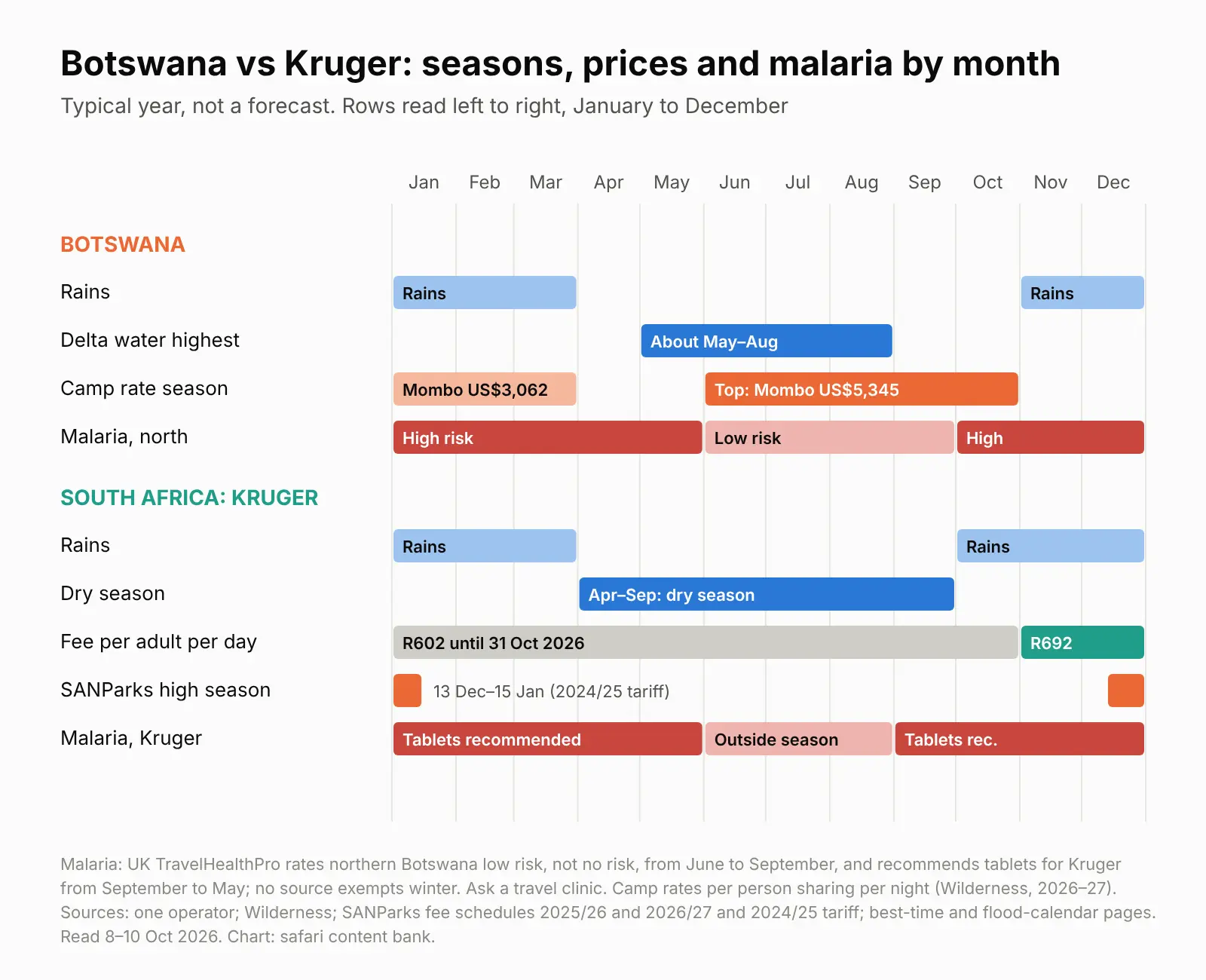 Typical year. Sources: one operator’s flood guide; Wilderness and Machaba rate cards; SANParks fee schedules and 2024/25 tariff; UK TravelHealthPro (malaria). Read 8–10 October 2026. Chart: safari content bank.
- The Delta floods in the dry season. The water comes from Angolan rain and is highest in most of the Delta from about May to August, months after Botswana’s own rains (one operator’s flood guide); month by month on the Okavango flood calendar.
- October is Botswana’s hottest month, above 40 °C at times (best time for a safari).
- Kruger’s gates open longest in summer: 05:30–18:30 from November to February, against 06:00–17:30 from May to July (SANParks gates).
Self-drive: Kruger in a hire car, Botswana in a 4x4
Kruger is the easy self-drive and Botswana the hard one: Kruger needs an ordinary car and one booking system, Botswana a high-clearance 4x4 and separate bookings with each campsite company before the park fee.
| Botswana (Moremi, Chobe) | South Africa (Kruger) | Source | |
|---|---|---|---|
| Vehicle | High-clearance 4x4 in every park; Maun operators from US$170 (Travel Adventures Botswana) to US$300 (Chobe 4x4) a day | Ordinary two-wheel-drive hire car; all access roads to the gates tarred. No car-hire price in our sources | Botswana safari cost; Kruger self-drive |
| Campsite | US$40–50 per person per night, run by Kwalate Safaris, SKL Camps or Xomae Group (last published rates), plus a P10 levy | R484–508 per site (Punda Maria, Pretoriuskop; stays 9–18 Oct 2026) | A safari operator’s public campsite sheet (PDF); SANParks Kruger |
| Booking order | Every campsite first, then DWNP park fees: “Park fees can only be paid to the DWNP once all camping fees … have been settled” | SANParks opens 11–12 months ahead; stays to 31 October 2027 have been bookable since 13 October 2026 at SANParks offices and since 14 October online | yourbotswana; SANParks booking periods |
| How far ahead | “Bookings should be done a year in advance” | 11–12 months, in tranches | Tracks4Africa; SANParks |
| Driving rules | No off-road, no night driving in the parks | No off-road, no night driving in private cars; 50 km/h on tar, 40 km/h on gravel; stay in the car except at designated spots | Botswana Tourism; SANParks rules |
| A long leg | Third Bridge (Moremi) to Savuti (Chobe): 8–9 hours on park tracks | Skukuza to Punda Maria: a full day’s drive | Tracks4Africa; South Africa safari cost |
Read 8–10 October 2026.
One day for two adults, before the car, fuel and food (our sums): in Kruger, a Pretoriuskop campsite and two conservation fees cost R508 (October 2026 site price) + 2 × R692 = R1,892 from 1 November 2026 (R1,712 at the previous R602 fee). SANParks had not published its 2026/27 accommodation tariff when we checked on 1 November 2026, so confirm the price when you book. In Moremi, a Xakanaxa campsite costs 2 × US$40 = US$80, plus 2 × P270 = P540 in park fees (last published schedule) and 2 × P10 = P20 in levies.
- The private Delta concessions are not open to self-drivers. Self-drivers use the public campsites in Moremi and Chobe and the Khwai community area; the Khwai Private Reserve says “No self-drivers or day visitors are permitted” (a safari travel company’s Khwai page).
- Full step-by-step guides: self-driving Moremi and Chobe and Kruger self-drive.
Families: ages, vehicles and malaria
South Africa is the easier family safari: malaria-free reserves, a child park fee from age 2, and lodges that take all ages; many Botswana fly-in camps take no children under 6, and some require a private vehicle for young children.
| Botswana | South Africa | Source | |
|---|---|---|---|
| Malaria-free option | None in the north; TravelHealthPro rates it high risk October–May | Madikwe, Pilanesberg, the Waterberg, Addo and the Eastern Cape reserves | TravelHealthPro; Malaria-free safaris |
| Child park fee | Under 8 free; older children half the adult fee | Kruger: ages 2–11 R345 (R300 until 31 Oct 2026); under 2 free; 12+ pay the adult fee | A safari operator’s campsite sheet; SANParks |
| Youngest age at camps | 6 at Natural Selection’s Okavango camps, Kwando and Great Plains; all ages at Machaba Camp | All ages at Tswalu Motse (children 0–11 free when sharing, 2026) and Kwandwe’s villas; Thornybush Game Lodge takes all ages but under-6s not on shared drives | Family safari |
| Private vehicle | Natural Selection: mandatory for children 9 or younger, US$725–935 a night; Machaba: required for under-6s, US$550 a night | Thornybush Game Lodge R17,500 a day; Tswalu includes one with every booking | Natural Selection 2026; Machaba 2026; Thornybush 2026; Tswalu |
| Children’s documents | Under-18s need a full birth certificate naming both parents, and an affidavit from any parent not travelling | Special documents for under-18s | BOPA via AllAfrica, 24 Dec 2025; Department of Home Affairs |
Rate cards and child policies 2024–2026, read 8–10 October 2026. Ages change; confirm in writing before you book.
- Ask for the private-vehicle price before you book a Botswana camp. It can add more than the accommodation (Botswana safari cost).
- Traveller reports on TripAdvisor’s Kruger forum advise against long Kruger self-drive days with toddlers and suggest a malaria-free reserve instead (TripAdvisor). These are one forum’s opinions, not a rule.
Crowds and game-drive rules
In both countries the public parks are where you share sightings, and in both no vehicle limit at a sighting is published; the private land is where the rules change. Botswana Tourism states that in Botswana’s national parks and reserves “off-roading and night driving [are] prohibited”, while “private concession areas outside the parks and reserves provide opportunities for off-road driving and night drives”. SANParks forbids off-road and night driving in private vehicles in Kruger.
| Rule | Botswana national parks and reserves (Moremi, Chobe) | Botswana private concessions | Kruger National Park | Greater Kruger private reserves |
|---|---|---|---|---|
| Who is on the tracks | Anyone with a park ticket: self-drivers, mobile safaris, lodge guests; Chobe also gets day trips from Victoria Falls | Guests of camps on that lease only | Self-drivers, SANParks drives, day visitors | Lodge guests on lodge vehicles; Sabi Sand takes no day visitors |
| Self-drive game viewing | Yes, 4x4 | No (the Khwai community area is the exception) | Yes, ordinary car | No (Sabi Sand, Timbavati) |
| Off-road driving | Prohibited | Allowed, “in moderation” | Not in private cars | On lodge vehicles, per operators |
| Night drives | Prohibited | Allowed | SANParks’ own guided drives only | On lodge vehicles, per operators |
| Walking | Not in Moremi | Usually offered | With SANParks only | With lodge guides |
| Vehicles per sighting | No published count | No published count | No published limit | No published rule |
Sources: Botswana Tourism; one safari operator’s Moremi and Chobe guides; SANParks vital information; Sabi Sand access; one tour operator’s blog (on off-road and night drives in the private reserves). Read 8–10 October 2026.
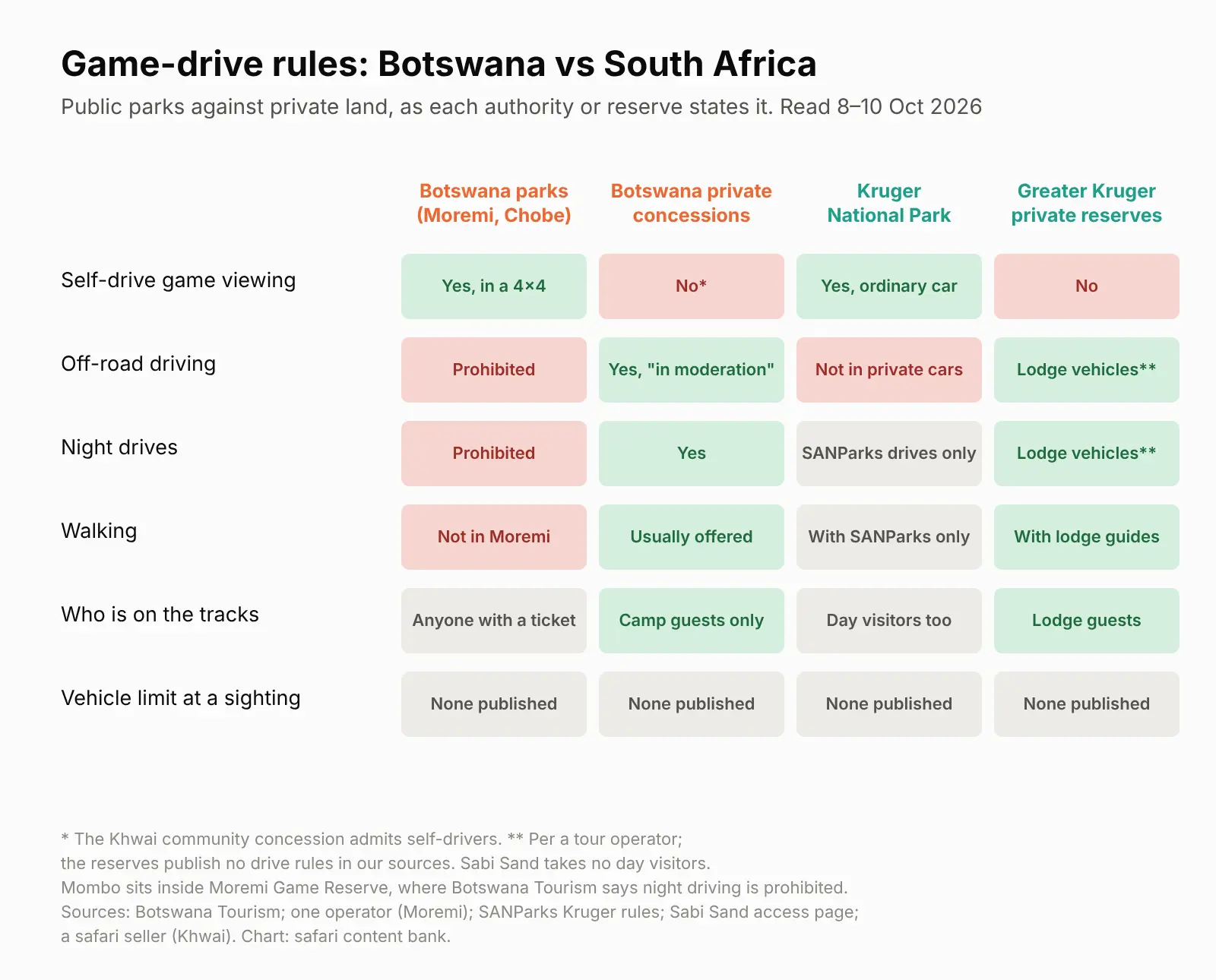 Sources: Botswana Tourism; one safari operator; SANParks; Sabi Sand; another tour operator. Read 8–10 October 2026. Chart: safari content bank.
- Chobe’s riverfront near Kasane is the busiest wildlife area in Botswana. One safari operator says the river nearest Kasane draws the most vehicles, partly from Victoria Falls day trips, and that lodges towards Ngoma in the west are more private. In Moremi, self-drivers, mobile safaris and lodge guests share the same public tracks (Moremi or Chobe?).
- Kruger can stop admitting day visitors. On busy days, when the daily visitor limit is reached, only pre-booked overnight guests get in; SANParks publishes no number (SANParks day visits).
- The rule follows the land, not the price. Mombo (US$3,062–5,345 a night) sits inside Moremi Game Reserve, where Botswana Tourism says night driving is prohibited. Where each rule applies: night drives, walking and off-road driving in Botswana and Kruger vs the private reserves.
Which should you choose?
Choose South Africa for a first safari, a family, a self-drive, a tighter budget, rhino or no malaria; choose Botswana for the Okavango Delta, wild dogs, water-based safaris and private concessions.
| If you… | Pick | Why |
|---|---|---|
| Can’t or won’t take malaria tablets | South Africa (malaria-free reserves) | TravelHealthPro rates North West and Eastern Cape no risk; northern Botswana high risk October–May |
| Want to drive yourself in an ordinary car | South Africa (Kruger) | Tarred access to all 9 gates; Botswana’s parks need a high-clearance 4x4 |
| Want all of the Big Five, rhino included | South Africa | 14,389 rhinos against Botswana’s 345 (end 2024); 10% of Botswana traveller groups saw a white rhino |
| Have young children | South Africa | Child park fee from age 2; many Botswana fly-in camps take no under-6s |
| Want wild dog | Botswana (Moremi, the Delta) | 65% and 61% of one safari operator’s traveller groups |
| Want mokoro and boat safaris | Botswana | The Okavango Delta and the Chobe River |
| Want night drives and off-road tracking | Either, on private land | Botswana’s concessions; the Greater Kruger private reserves |
| Want to fly between camps | Botswana | Light aircraft to most Delta camps, US$220–594 a sector |
| Travel December–March | South Africa, or Botswana’s Kalahari pans | Botswana’s green rates are lower, but its best wet-season game is on the pans |
Whichever you choose, check that the operator holds a current licence: see how to check a safari operator is licensed.
See also: Cape Town and safari and Okavango Delta vs Kruger.
Common mistakes in Botswana vs South Africa comparisons
| What you’ll often read | What is correct |
|---|---|
| “Botswana is malaria-free in the dry season” | TravelHealthPro rates northern Botswana low risk June–September, not no risk, and high risk October–May. |
| “Kruger is malaria-free in winter” | No source says so. TravelHealthPro recommends tablets September to May; SANParks does not exempt any month. |
| “Botswana park fees are now P500” | The P500 rise was announced, then reported postponed. No official current tariff is published: the last published schedule (1 April 2022) gives P270 (Chobe, Moremi), and the government news agency called the existing non-resident fee P380 in February 2026. Confirm with DWNP or your operator. |
| “Kruger costs R602 a day” (with no date) | That was the 2025/26 rate, which ended on 31 October 2026. Since 1 November 2026: R692 per international adult per day. |
| “Botswana is a Big Five destination” | Four reliably. 10% of one safari operator’s Botswana traveller groups saw a white rhino and 1% a black rhino. |
| “You need a 4x4 for Kruger” | An ordinary hire car is enough; all access roads to the gates are tarred. Botswana’s parks are the ones that need a 4x4. |
| “Botswana’s most expensive camps offer night drives” | Not necessarily. Mombo is inside Moremi Game Reserve, where Botswana Tourism says night driving is prohibited. |
| “Private land allows only two or three vehicles at a sighting” | No published number for Botswana’s concessions or the Greater Kruger reserves in our sources. Ask the camp. |
| “Malaria-free reserves are the cheap option” | Pilanesberg charges R748 per foreign adult a day plus R168 per vehicle, more than Kruger. |
Frequently asked questions
Is Botswana or South Africa better for a first safari? South Africa, for most first-timers. Kruger can be self-driven in an ordinary hire car, all of the Big Five are present, and malaria-free reserves exist. Botswana’s best areas are reached by light aircraft at US$220–594 a sector, and its fly-in camps publish US$530–5,345 per person a night (2024–2026 rate cards).
Is Botswana more expensive than South Africa? At the budget end, yes. Shared Kruger tours list at US$214–242 per person per day, and a Kruger campsite costs R484–508 a night per site plus R692 per adult a day (R602 until 31 October 2026); Botswana’s cheapest published mobile safari works out at about US$265 a night, and its fly-in camps start at US$530 (Kwando, 2024) before levies of US$20–100 and flights. South African lodge rates are in rand (R7,300–44,000 per person sharing in Sabi Sand and Thornybush, 2026), so compare quotes in one currency.
What are the park fees in Botswana and South Africa? Kruger charges R692 per international adult per day from 1 November 2026 (R602 until 31 October 2026; SANParks). Botswana’s last published DWNP schedule (1 April 2022) charges P270 in Chobe and Moremi and P190 in other parks. In February 2026 the government news agency called the existing non-resident fee P380; a P500 rise was announced, then reported postponed, so confirm the fee with DWNP or your operator.
Which country has malaria-free safaris? South Africa. UK TravelHealthPro rates North West province (Madikwe, Pilanesberg) and the Eastern Cape (Addo, Amakhala, Kwandwe) no risk. Kruger is a risk area, with tablets recommended September to May, and northern Botswana, including the Okavango Delta and Chobe, is high risk from October to May.
Can you self-drive in Botswana like in Kruger? Not as easily. Kruger needs an ordinary car and one SANParks booking; Botswana’s parks need a high-clearance 4x4 (US$170–300 a day from Maun operators) and a separate booking with each campsite company before DWNP will take the park fee. Tracks4Africa says to book a year in advance.
Which is better for wildlife, Botswana or South Africa? It depends on the animal. South Africa held 14,389 rhinos at the end of 2024 against Botswana’s 345, so it is the reliable Big Five country. Botswana leads for wild dog: 65% of one safari operator’s traveller groups saw them in Moremi and 61% in the Okavango Delta reserves.
Are night drives allowed in Botswana and Kruger? Not in Botswana’s national parks and reserves, and not in private cars in Kruger, where SANParks sells its own guided night drives. Botswana’s private concessions and the Greater Kruger private reserves run night drives on their own vehicles for their guests.
Can you combine Botswana and South Africa on one trip? Yes, but plan the link. We could not confirm a current Johannesburg–Maun or Johannesburg–Kasane timetable from an airline source, so check the live schedule. By road, Johannesburg to Khama Rhino Sanctuary in Botswana is about 650 km, about 9 hours including the border (Tracks4Africa).
Sources
- Fees: DWNP schedule of 1 April 2022 via Tourism Update, 23 Feb 2022; Botswana Daily News (BOPA), 24 Feb 2026; Gabz FM, 5 May 2026; SANParks daily conservation fees 2025/26 (PDF) and 2026/27 (PDF); Sabi Sand access; Timbavati
- Rules: Botswana Tourism, game viewing; SANParks Kruger vital information, entrance gates, day visits and booking periods; a safari travel company’s Khwai page; one tour operator’s blog (names and links kept in our editor notes)
- Health: UK TravelHealthPro, Botswana and South Africa; SANParks, Kruger malaria. Checked 10 Oct 2026
- Wildlife: one safari operator’s Botswana wildlife, Moremi, Chobe and Okavango flood pages, read September–October 2026; IUCN SSC African Rhino Specialist Group report to CITES, 2025; Save the Rhino; SANParks rhino statement; another seller’s Big Five page (names and links kept in our editor notes)
- Rate cards: Kwando 2024, Machaba 2026, Natural Selection 2026, Wilderness Mombo, Chobe Safari Lodge; Elephant Plains, Umlani 2026, Thornybush 2026, Sabi Sabi, Singita Ebony, Kwandwe 2026–27, Tswalu; tour listings on a safari booking site (names and links kept in our editor notes)
- Access: Mack Air; Ker & Downey, Transfers; FedAir baggage; Botswana Tourism, Ports of Entry; Statistics Botswana, TSAR 2024; a safari booking site’s Chobe getting-there page; Wikivoyage, Maun; Tracks4Africa
- Self-drive and families: a safari operator’s public campsite sheet (PDF); yourbotswana; Tracks4Africa, campsite booking; SANParks Kruger; BOPA via AllAfrica, 24 Dec 2025; Department of Home Affairs
- Entry: UK FCDO, Botswana and South Africa entry requirements
- Traveller reports: TripAdvisor forums, Botswana itineraries and Kruger with children
Prices and fees checked 9–10 October 2026; Kruger fees checked 1 November 2026. We will recheck this page on 2 November 2026, after Kruger’s fee changes on 1 November, and when DWNP publishes a new fee schedule, an official current tariff or a start date for the increase reported postponed.