 Experience

Last verified · Next check due
On this page
- Conservation safaris at a glance (2026)
- What you can do on a conservation safari, and what you can’t
- Natural Selection’s Botswana Conservation Safari: what the price buys
- Where the levies go: what camps add per night
- Kenya: conservancies, KWS and the elephant nursery
- Namibia: conservancies, cheetahs and carnivore research
- How to judge a conservation safari before you book
- Common mistakes about conservation safaris
- Frequently asked questions
- Sources
Short answer: A conservation safari takes you to working research bases and anti-poaching teams to watch and learn; you will not collar an animal. Natural Selection’s 8-day Botswana Conservation Safari costs US$9,055–18,086 per person (2026). Ordinary camps fund conservation through levies: US$100 per person a night at Great Plains, US$60 at Natural Selection, US$35 at Machaba and US$20 at Kwando. In Kenya, KWS prices a “wildlife conservation experience” at US$200 a day.
Key facts
- The one fully packaged conservation safari in our sources is in Botswana: Natural Selection’s Botswana Conservation Safari, 8 days and 7 nights at three of its camps, US$9,055–18,086 per person depending on group size and season (Natural Selection, 2026).
- “Join a collaring” cannot be promised. Collaring a lion or an elephant is a veterinary procedure carried out under permit; Natural Selection’s own itinerary does not say guests join collaring or tracking work.
- Most of the money reaches conservation through levies, not special trips. Botswana camp groups add US$20–100 per person per night (2024–2026 rate cards); in the Masai Mara conservancies, camps print a US$130 conservancy fee a day.
- Kenya Wildlife Service lists a “wildlife conservation experience” at US$200 a day for non-residents in its 2025 fee regulations, which do not describe what it includes.
- Namibia’s conservancies earned N$166,855,933 in 2023, about two-thirds of it from tourism (NACSO and MEFT; our sum), so lodge stays on conservancy land are their main income.
- We publish no rhino locations or counts on this page. See why we never publish where a rhino is.
Conservation safaris at a glance (2026)
You can book a packaged conservation itinerary in Botswana, add priced research or nursery visits in Kenya and Namibia, or simply stay at camps whose levy funds conservation. Only the first is sold as a “conservation safari”; the others are add-ons you build into a normal trip.
| Option | Country | What you do | Price, from the programme’s own published rate | Source |
|---|---|---|---|---|
| Botswana Conservation Safari (Natural Selection) | Botswana | 8 days, 7 nights at Meno a Kwena, Little Sable and Duke’s or Duke’s East; visit an elephant research base and a wild dog research camp; meet an anti-poaching team; community projects | US$9,055–18,086 per person (2026) | Natural Selection |
| Camp stay with a conservation levy | Botswana | A normal fly-in safari; the levy goes to the group’s conservation and community work | US$20–100 per person per night on top of the rate | Camp groups’ rate cards, as on our Botswana safari cost page |
| “Wildlife conservation experience” (KWS) | Kenya | Not described in the regulations; ask KWS what it includes | US$200 a day, non-resident | KWS Legal Notice 160 of 2025 (PDF) |
| Sheldrick Wildlife Trust elephant nursery | Kenya (Nairobi) | One public hour, 11:00–12:00, watching orphaned elephants with their keepers | US$20 adult (12+), US$5 child, cash; plus the Nairobi National Park fee; fostering an orphan from US$50 a year | Sheldrick Wildlife Trust |
| “Into AfriCat” at Okonjima | Namibia | A guided activity for Okonjima guests on AfriCat’s carnivore research | N$1,450–1,600 per person (2026) | Okonjima 2026 rack rates, as on our Erindi, Okonjima or Etosha page |
| Cheetah Conservation Fund visitor centre | Namibia | Visitor centre and tours, 44 km east of Otjiwarongo | No price in our sources | CCF |
| Painted Dog Conservation visitor centre | Zimbabwe (Dete, by Hwange) | Visitor centre, open with advance notice | No price in our sources | As on our where to see wild dogs page |
Programme prices are the programme’s or camp’s own published figures, read 8–10 October 2026. Where a programme publishes no price, none is given. Per person unless stated.
What you can do on a conservation safari, and what you can’t
You can visit research bases, meet scientists and anti-poaching teams, and hear the data explained; you cannot count on handling animals, joining a collaring or going on patrol. Our Botswana research notes found that every source they checked describes observation and learning, not participation.
| What the marketing says | What happens | Why |
|---|---|---|
| “Join a collaring operation” | Rarely, and never guaranteed. Guest presence at a darting is occasional and depends on the permit, the vet and the weather | Collaring is a veterinary procedure under permit; Natural Selection’s itinerary does not mention guests joining collaring |
| “Visit a research camp” | Yes, where the itinerary names it. Natural Selection’s trip includes the Elephants for Africa research base and a wild dog research camp | Named in the itinerary; check that each visit is confirmed for your dates |
| “Meet the anti-poaching team” | Yes, as a meeting: Natural Selection’s covers de-snaring, tracking and surveillance | A briefing, not a patrol |
| “Track with the researchers” | Ask what it means. Okonjima’s “Into AfriCat” is a guided activity for lodge guests; AfriCat does not host interns or volunteers | Research tracking is done by permitted staff |
| “Hands-on with orphans” | A public visit, not care work. The Sheldrick nursery opens for one hour a day, 11:00–12:00, booked by email | See ethical wildlife activities on orphanages and sanctuaries |
| “Your stay funds conservation” | True if a levy or lease is published. Ask what it funds and whether there is a report | Most levies are named on rate cards but not accounted for publicly |
- Predator talks happen at lodges. Botswana Predator Conservation, a programme of Wild Entrust that has studied wild dogs, lions, leopards, cheetahs and hyaenas around Moremi since 1989, records 76 presentations to tourist groups at Okavango lodges (Wild Entrust). Its page does not say whether guests can visit its research camp, so ask before you book one.
- Wilderness invites guests to take part “in conservation, community and cultural experiences” in Botswana and names Children in the Wilderness (over 2,700 children through Eco-Clubs), Ecoexist and CLAWS, but its page does not say which camps host which projects (Wilderness).
- A trade poll points the same way: Tourism Update’s reader poll of 28 September 2026 ran under the headline “Most back hands-on conservation experiences” (headline only; we did not read the article).
Natural Selection’s Botswana Conservation Safari: what the price buys
It is 8 days and 7 nights at three Natural Selection camps for US$9,055–18,086 per person, built around six conservation and community projects.
| Item | Detail |
|---|---|
| Length | 8 days, 7 nights |
| Camps | Meno a Kwena → Little Sable → Duke’s Camp or Duke’s East |
| Price | US$9,055–18,086 per person, by group size and season (2026) |
| Projects | Elephants for Africa (a visit to its research base); wild dog research (a visit to the research camp); an anti-poaching team meeting; Khwai community engagement; the Elephant Express human–wildlife-conflict project; CLAWS (a cattle-kraal visit and “Life with Elephants” tours) |
| Named partners | Wild Entrust’s Botswana Predator Conservation, the Okavango Community Trust, the EcoExist Trust |
| Not stated | Guests joining collaring or tracking |
Natural Selection, Botswana Conservation Safari, read 8 October 2026.
- Compare it with a normal stay at the same camps. Natural Selection’s camp rates run US$595–3,895 per person per night in Botswana (2026), plus its US$60 CCR fee; the per-camp detail is on safari camp groups and Botswana safari cost. Our sources do not say whether the conservation safari’s price includes the CCR fee or flights, so ask.
Where the levies go: what camps add per night
Most Botswana camp groups add a conservation or community levy of US$20–100 per person per night, and Masai Mara camps add conservancy, community and trust fees; few publish what each levy funds.
| Levy or fee | Amount | Where | Source |
|---|---|---|---|
| Great Plains Foundation levy | US$100 per person per night, plus a separate mandatory conservation levy | Botswana (Great Plains camps) | Great Plains 2025 |
| Natural Selection CCR fee | US$60 per person per night, all seasons, ages 6+ | Botswana | NS 2026 |
| Machaba Conservation and Community Levy | US$35 per person per night | Botswana | Machaba 2026 |
| Kwando Community and Conservation Levy | US$20 per person per night | Botswana | Kwando 2024 |
| Mara conservancy fee | US$130 per day (what camps print; no conservancy publishes its own tariff) | Kenya, Masai Mara conservancies | As on our Masai Mara safari cost page |
| Community fee (Governors’ Camp, in the reserve) | US$50 per guest per night, payable to Narok County | Kenya, Masai Mara National Reserve | Governors’ Camp |
| Porini Wildlife Habitat Trust fee | US$5 per person per night | Kenya, Porini’s conservancy camps | Porini 2026 |
Charged on top of the camp rate unless stated. Rate cards read 9–10 October 2026, as on our Botswana and Masai Mara cost pages.
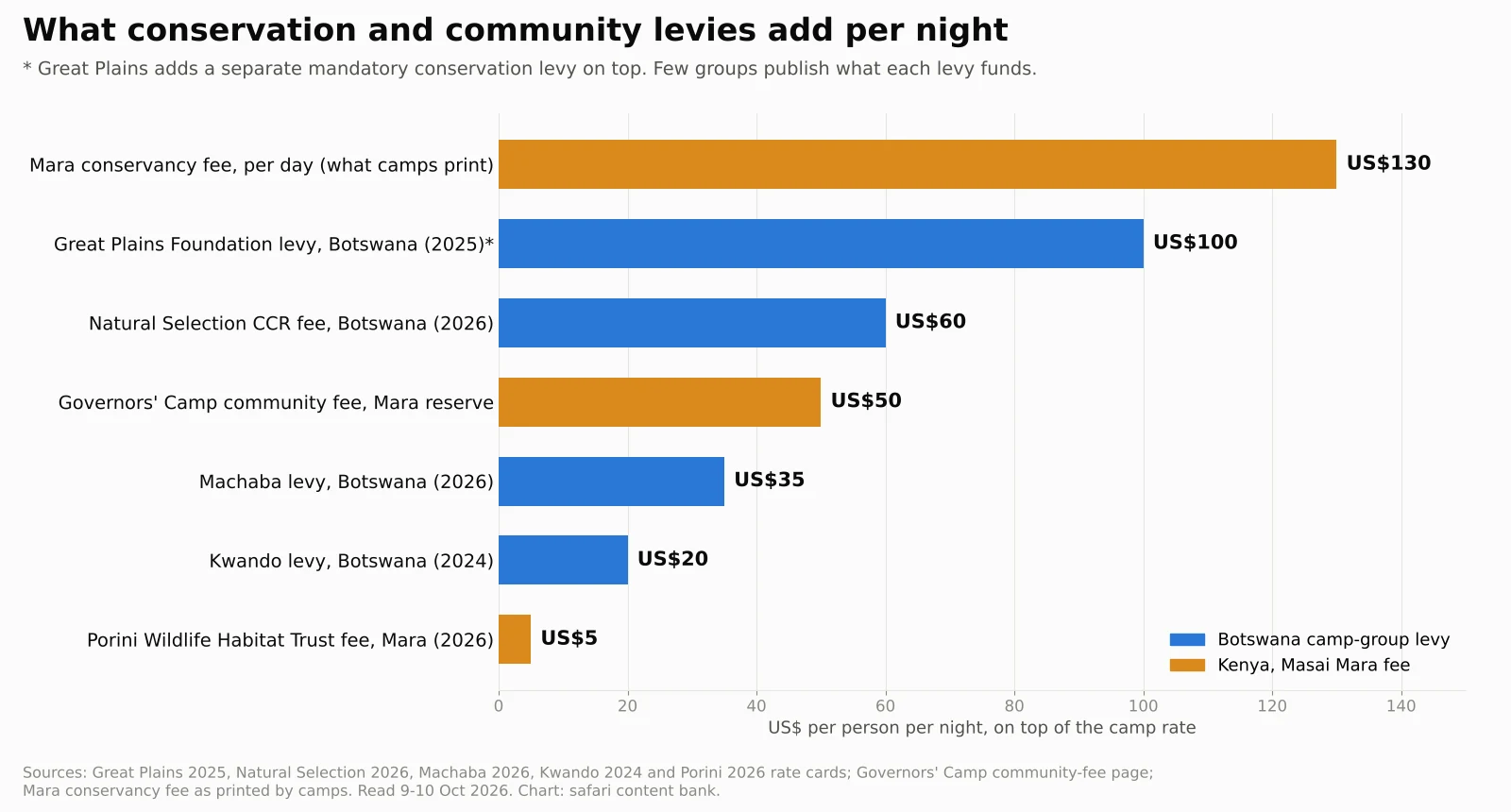 Camp groups’ own rate cards (Great Plains 2025, Natural Selection 2026, Machaba 2026, Kwando 2024, Porini 2026) and Governors’ Camp’s community-fee page; Mara conservancy fee as printed by camps. Read 9–10 October 2026. Chart: safari content bank.
- On a seven-night Great Plains trip, the levy alone is US$700 per person (our sum: 7 × US$100), before the separate conservation levy. Ask what it funds and whether it is the same money as the Great Plains Foundation’s donor appeals.
- State parks share fees by rule in some countries: Rwanda passes 10% of gorilla permit revenue to community projects (Visit Rwanda; see gorilla permit prices), and Uganda shares 20% of park entry fees with boundary parishes (UWA).
Kenya: conservancies, KWS and the elephant nursery
In Kenya, the main way a safari funds conservation in our sources is a conservancy stay; the add-ons are the Sheldrick nursery in Nairobi and a KWS “wildlife conservation experience” priced at US$200 a day.
- Conservancies: Kenya has 167 conservancies in 28 counties covering about 11% of its land, with 930,000 households (KWCA). The Masai Mara’s association counts 24 member conservancies and over 15,000 landowners (MMWCA). How the lease model works, and what it costs at each camp, is on Mara reserve or conservancies.
- KWS: the 2025 fee regulations list a “wildlife conservation experience” at US$200 a day and animal tracking at US$20 per person for non-residents. The notice gives no description, so ask KWS what you get before paying for it.
- Sheldrick Wildlife Trust nursery: US$20 adult (12+), US$5 child, cash; book by email at least two business days ahead, and pay the Nairobi National Park fee as well (Kenya safari cost; Nairobi National Park day trip).
- Rangers you may meet: community ranger teams such as Team Lioness, eight Maasai women formed in 2019 around Amboseli, recruit from the villages they patrol (Africa Defense Forum, 14 October 2021). We hold no source for a bookable visit.
Namibia: conservancies, cheetahs and carnivore research
Namibia’s conservation model is the communal conservancy, so a lodge on conservancy land is the main contribution; AfriCat’s research activity at Okonjima is the one priced add-on in our sources.
- The money: Namibia’s 86 registered communal conservancies earned N$166,855,933 in 2023, of which tourism N$111,167,250 and conservation hunting N$48,986,405 (NACSO and MEFT, 2023 (PDF)). Tourism was about two-thirds and hunting just under a third (our sums).
- AfriCat at Okonjima: “Into AfriCat” costs N$1,450–1,600 per person (Okonjima 2026); AfriCat’s research covers leopard, brown hyena and pangolin, and it does not host interns or volunteers (Erindi, Okonjima or Etosha).
- Cheetah Conservation Fund: founded in 1990, with a public visitor centre 44 km east of Otjiwarongo; its main work is with farmers, including 780 livestock guarding dogs placed so far (CCF 2024 report (PDF)). No visit price in our sources.
- Giraffe research on the Skeleton Coast: the Giraffe Conservation Foundation is a conservation partner at Natural Selection’s Hoanib Valley Camp, with three conservancies; the camp’s rates are on our Skeleton Coast page.
- Desert lions are a research subject, not a sighting promise: a 2022–23 survey found 57–60 adult desert lions plus 14 cubs across about 40,000 km², the lowest density recorded for a free-ranging, self-sustaining lion population in Africa (Heydinger, Muzuma and Packer, African Journal of Ecology, 2024). See Damaraland.
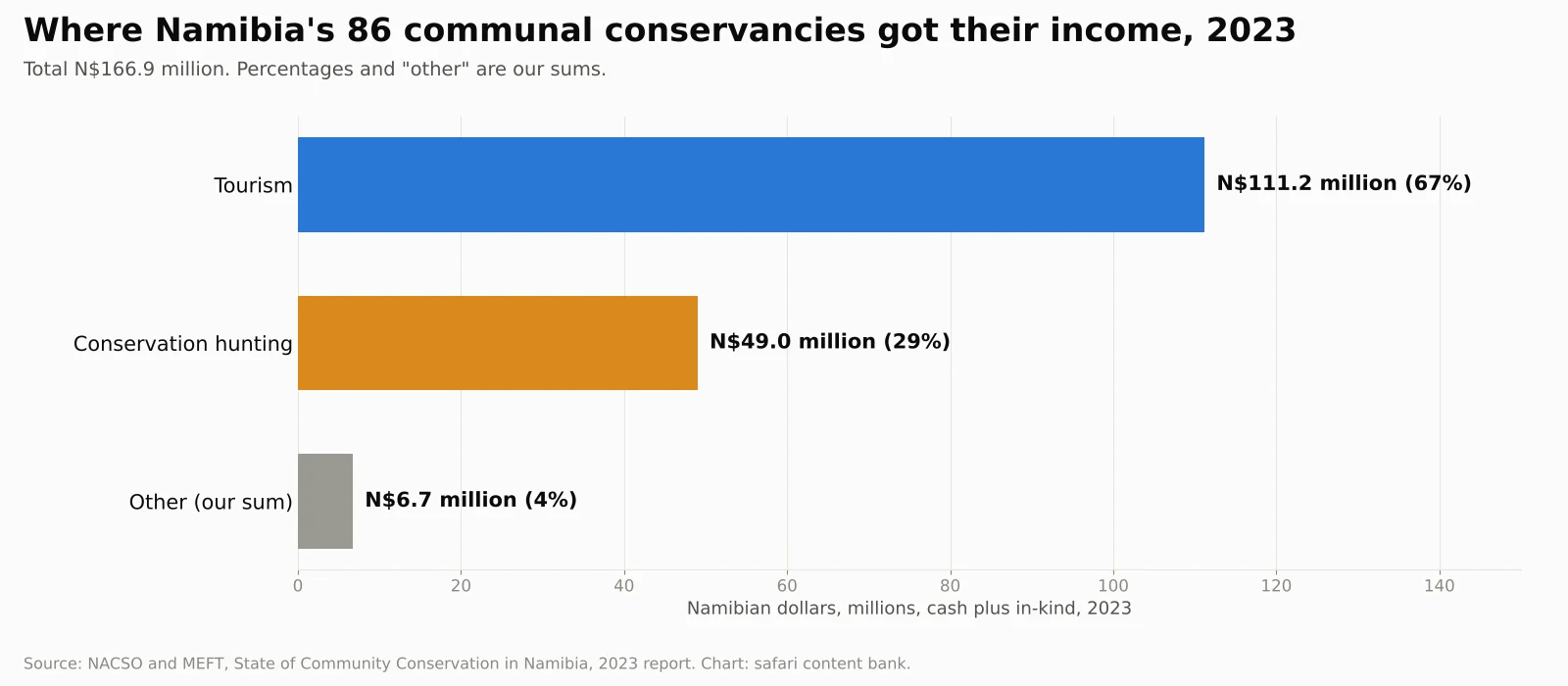 NACSO and MEFT, State of Community Conservation 2023 report; “other” and the percentages are our sums. Chart: safari content bank.
How to judge a conservation safari before you book
Ask two questions: where does the money go, and what will you actually do? Our Namibia research notes use the same test: is there a published financial flow to a named conservation body, and does the guest do anything or only watch?
- Ask for the levy or donation in writing, and what it funds. Most levies are named on rate cards but not accounted for publicly.
- Ask which visits are confirmed for your dates. A research base visit depends on the team being there.
- Challenge any promise of collaring, darting or patrol work in writing. Collaring is done by vets under permit.
- Ask who owns the land and how they are paid: a fixed lease, a bed-night fee or a revenue share.
- Check for volunteer programmes that are really labour: Namibia’s EHRA runs volunteer and building programmes rather than safaris; AfriCat takes no volunteers. A volunteer placement is a different product from a safari.
- Don’t expect rhino locations. We do not publish rhino locations or counts. See where to see rhino.
Common mistakes about conservation safaris
| What you’ll often read | What is correct |
|---|---|
| “You’ll help collar a lion” | Not as a promise. Collaring is a veterinary procedure under permit; Natural Selection’s itinerary does not say guests join it. |
| “A conservation safari is a volunteer trip” | It is a guided safari with research visits. Volunteer programmes (such as EHRA’s in Namibia) are a separate product; AfriCat takes no volunteers. |
| “Conservation safaris cost far more than a normal safari” | The one packaged trip in our sources costs US$9,055–18,086 for 8 days; at the same group’s camps a normal night is US$595–3,895 plus a US$60 CCR fee (2026). Compare like for like. |
| “Only special trips fund conservation” | Every Botswana camp group in our sources adds a levy of US$20–100 a night, and Mara conservancy camps print a US$130 conservancy fee a day. |
| “The levy is a tax” | It is the camp group’s own charge, such as the Great Plains Foundation levy or Kwando’s Community and Conservation Levy; park fees are separate. |
| “You can walk into the Sheldrick orphanage” | One public hour at 11:00, booked by email at least two business days ahead, plus a Nairobi National Park ticket. See ethical wildlife activities on orphanages. |
| “Hunting plays no part in conservancy income” | In Namibia it was just under a third in 2023: N$48,986,405 of N$166,855,933 (NACSO and MEFT). |
Frequently asked questions
What is a conservation safari? A safari built around visits to conservation work: research bases, anti-poaching teams and community projects. Natural Selection’s 8-day Botswana Conservation Safari, at US$9,055–18,086 per person (2026), is the packaged example in our sources; elsewhere you add visits to a normal trip.
Can I take part in collaring or anti-poaching patrols? Not reliably. Collaring is a veterinary procedure under permit, and guests are present only occasionally, when the permit, vet and weather allow. Natural Selection’s trip includes a meeting with an anti-poaching team, not a patrol.
How much does a conservation safari cost? Natural Selection’s Botswana Conservation Safari costs US$9,055–18,086 per person for 8 days, by group size and season (2026). Add-ons cost less: the Sheldrick nursery is US$20, Okonjima’s “Into AfriCat” N$1,450–1,600, and KWS lists a “wildlife conservation experience” at US$200 a day.
Does a normal safari help conservation? Yes, if the camp pays a levy, lease or conservancy fee. Botswana camp groups add US$20–100 per person per night, and Masai Mara conservancy camps print a US$130 conservancy fee a day. Ask what the levy funds and whether a report is published.
Where does the Great Plains levy go? Great Plains charges a US$100 Great Plains Foundation levy per person per night, plus a separate mandatory conservation levy (2025 rates). Its rate card does not break down the spending; ask the camp, and ask whether it is the same money as the Foundation’s donor appeals.
Can I volunteer on a conservation safari? A safari and a volunteer placement are different products. AfriCat in Namibia takes no interns or volunteers; EHRA runs volunteer and building programmes. Check what the work is, who supervises it and what the fee funds.
Can I see rhino conservation on a conservation safari? Some programmes work with rhinos, but we do not publish rhino locations or counts. Ask the programme directly what guests can see. See where to see rhino for how we cover rhino.
Sources
- Packaged trip: Natural Selection, Botswana Conservation Safari, 2026 prices, read 8 October 2026
- Levies: Great Plains 2025 rack rates (PDF); Natural Selection Botswana 2026 rack (PDF); Machaba 2026; Kwando 2024 rate sheet (PDF); Porini 2026 (PDF); Governors’ Camp, Masai Mara community fee; all as on our cost pages, read 9–10 October 2026
- Kenya: KWS Legal Notice 160 of 2025 (PDF); Sheldrick Wildlife Trust, nursery visit, read 9 October 2026; KWCA, status of conservancies and MMWCA, read 9 October 2026; Africa Defense Forum, 14 Oct 2021
- Botswana research: Wild Entrust, Botswana Predator Conservation; Wilderness, conservation in Botswana; read September–October 2026
- Namibia: NACSO and MEFT, State of Community Conservation 2023 (PDF); Cheetah Conservation Fund 2024 report (PDF); AfriCat; Okonjima 2026 rack rates as on our Erindi, Okonjima or Etosha page; Heydinger, Muzuma and Packer (2024), African Journal of Ecology, desert lion survey
- Fee sharing: Visit Rwanda, gorilla tracking; UWA Bwindi brochure
- Trade press: Tourism Update reader-poll headline, 28 September 2026 (headline only)
- More: ethical wildlife activities, where to see rhino, where to see wild dogs, safari camp groups, luxury safari, Mara reserve or conservancies, Botswana safari cost, Kenya safari cost, Namibia safari cost
Prices and levies checked 8–10 October 2026. We will update this page when Natural Selection publishes 2027 prices for its Conservation Safari and when the camp groups publish new rate cards.