 Experience

Last verified · Next check due
On this page
- Reserve vs conservancy at a glance (2026)
- Fees: a reserve day against a conservancy night
- Rules that differ: driving, vehicles, night drives and walks
- Which conservancies are there?
- The Great Migration: reserve or conservancy?
- Crowds: how much quieter are the conservancies?
- Minimum stays and how to split your nights
- Which should you choose?
- Common mistakes
- Frequently asked questions
- Sources
Short answer: Stay in the Maasai Mara National Reserve (Kenya) for the river crossings and, January to June, the lower fee: US$100 per adult per day, rising to US$200 from 1 July to 31 December. Choose a private conservancy for night drives, walks, off-road driving and fewer vehicles: camps’ 2026 rate sheets charge US$130 per adult per night. From July to December that is less than a reserve day; you pay the reserve fee only on days you drive in.
Key facts
- From 1 July to 31 December a conservancy night costs US$70 less in fees than a reserve day: US$130 per adult on camps’ 2026 rate sheets against US$200 (Narok County’s last published schedule, FY2025/26). From January to June the reserve is cheaper, at US$100.
- Night drives and guided walks are sold in the conservancies, not in the reserve. Inside the reserve, off-road driving is prohibited except to approach big cats on nearby open ground, no closer than 25 m (Narok County’s Greater Maasai Mara Ecosystem Management Plan).
- No Mara conservancy publishes a vehicle limit per sighting. The reserve’s rule is five vehicles at an animal, with any others waiting 100 m away.
- The river crossings are in the reserve. A conservancy guest who drives in for the Mara River pays that day’s reserve fee as well as the conservancy fee.
- The Maasai Mara Wildlife Conservancies Association (MMWCA) lists 24 conservancies covering about 450,000 acres, leased from over 15,000 Maasai landowners (MMWCA).
Reserve vs conservancy at a glance (2026)
The reserve is public land run by Narok County that anyone can enter with a day ticket; the conservancies are Maasai-owned land around it, leased to camps whose guests get more freedom and fewer vehicles.
| Masai Mara National Reserve | Mara conservancies | Source | |
|---|---|---|---|
| Who runs it | Narok County; the western Mara Triangle (510 km²) by the not-for-profit Mara Conservancy since 12 June 2001 | Maasai landowners, who lease the land to tourism partners (camps) | Mara Conservancy; MMWCA |
| Fee per adult | US$100 per day (1 Jan–30 Jun); US$200 per day (1 Jul–31 Dec) | US$130 per night on Kicheche, Porini and Hemingways 2026 sheets; US$150 for Mara North on Offbeat’s | Narok County FY2025/26; camps’ 2026 rate sheets |
| Off-road driving | Prohibited, except to approach big cats on nearby open ground, no closer than 25 m | Practised: Porini Lion Camp uses “off-road (4×4) safari vehicles” | Business Daily on the county plan; Olare Motorogi Conservancy |
| Vehicles at one sighting | Five; others stop and wait at least 100 m away | No published cap for any Mara conservancy | Business Daily on the county plan |
| Night drives | Not sold | Included at Kicheche Valley (Naboisho) and at Porini Lion Camp (Olare Motorogi) | Kicheche 2026; Porini Lion Camp factsheet |
| Guided walks | None sold, as far as we found | Included at all three Kicheche camps and at Porini Lion Camp | Kicheche 2026; Porini factsheet |
| River crossings | On the Mara River and the Sand River, in the reserve | A day trip into the reserve, with that day’s reserve ticket | Mara Conservancy; Kicheche 2026 |
| Children | Under 9 free; 9–17 US$50 a day | Child fee US$65 a night on Kicheche’s sheet (US$75 on Offbeat’s); Kicheche Bush and Valley take children from 7, Porini camps from 8 | Narok County FY2025/26; camps’ 2026 sheets |
Non-resident adult. Reserve fees from Narok County’s FY2025/26 schedule, the last published (it expired on 30 June 2026; for July–December 2026 The Kenya Times, 6 Aug 2026, a secondary source, reports US$200 still applies). Conservancy fees are camps’ rate-sheet figures: none of the conservancies publishes its own tariff. Checked 10 October 2026.
Fees: a reserve day against a conservancy night
From July to December a conservancy night (US$130 per adult) costs less in fees than a reserve day (US$200); from January to June the reserve day (US$100) is cheaper. The two are charged differently: the reserve per calendar day, whether you sleep inside or outside it; a conservancy per night of your stay.
The official reserve fee lines, with the date each took effect and Narok County’s own source:
| Fee | Amount | In force from | Source |
|---|---|---|---|
| Maasai Mara National Reserve, non-resident adult, per day (12-hour ticket, 06:00–18:00), 1 Jan–30 Jun | USD 100 | Since 1 Jan 2024; Narok County FY2025/26 schedule, the last published | Narok County fee schedule FY2025/26 |
| Maasai Mara National Reserve, non-resident adult, per day (12-hour ticket, 06:00–18:00), 1 Jul–31 Dec | USD 200 | Since 1 Jul 2024; Narok County FY2025/26 schedule, the last published, expired 30 Jun 2026 (no 2026/27 schedule as of 9 Oct 2026); The Kenya Times (6 Aug 2026, secondary) reports US$200 still applies for Jul–Dec 2026 | Narok County fee schedule FY2025/26 |
| Maasai Mara National Reserve, non-resident child 9–17 or student, per day (under 9 free) | USD 50, all year | Narok County FY2025/26 schedule, the last published | Narok County fee schedule FY2025/26 |
The conservancy fees, as camps print them on their 2026 rate sheets:
| Conservancy | Adult per night | Child per night | Printed on |
|---|---|---|---|
| Mara North | US$130; US$150 on Offbeat’s sheet | US$65; US$75 on Offbeat’s | Kicheche 2026; Offbeat 2026 |
| Olare Motorogi | US$130 | US$65 | Kicheche 2026; Porini 2026 |
| Naboisho | US$130, plus US$5 Reserve Fund at Hemingways | US$65 | Kicheche 2026; Hemingways 2026 |
| Ol Kinyei | US$130 (“per person per day”) | not printed | Porini 2026 |
Camps’ 2026 rate sheets, read 9 October 2026. These are operator documents; the fees are set by each conservancy and “subject to change”. Porini adds a US$5 Wildlife Habitat Trust fee per person per night.
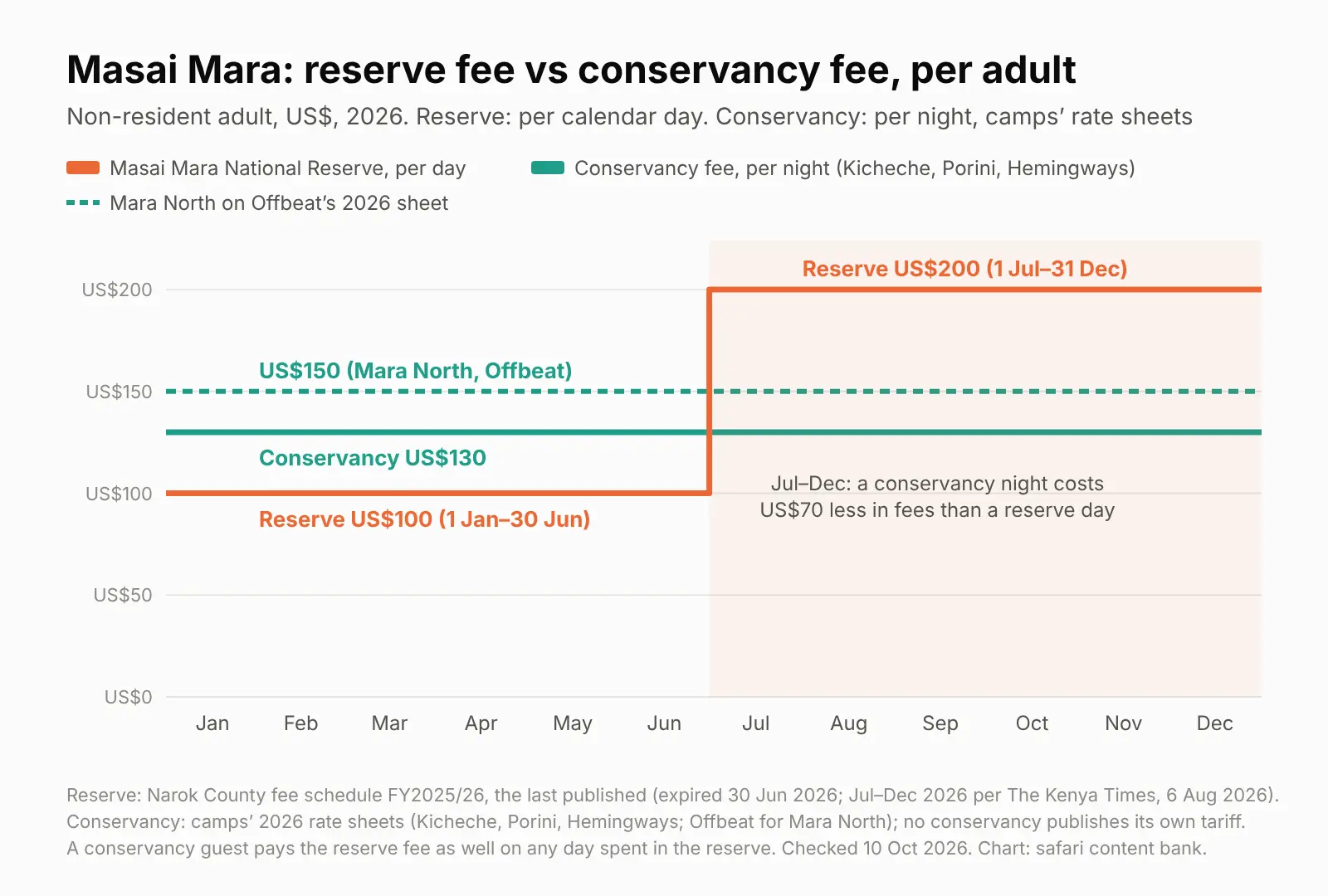 Reserve: Narok County fee schedule FY2025/26, the last published. Conservancy: camps’ 2026 rate sheets. Checked 10 October 2026. Chart: safari content bank.
- Conservancy fees “are payable for any free nights” (Kicheche), so a stay-4-pay-3 offer still costs four conservancy fees.
- The reserve fee is added only on a day you drive into the reserve. Kicheche lists “Masai Mara National Reserve fees (if required)”.
- Some reserve camps add a community fee: Governors’ charges US$50 per guest per night, payable to Narok County (Governors’ Camp).
- The Kenya Revenue Authority has required 16% VAT on conservancy fees since 2 September 2013 (ATC News); the Mara rate sheets do not say whether their US$130 includes it.
What 3 nights cost in fees
Over three nights from July to December a conservancy stay costs US$390–590 per adult in fees, against US$600–800 in a reserve camp; from January to June the reserve camp is cheaper, at US$300–400.
| Three nights, per adult (our sums) | 1 Jan–30 Jun | 1 Jul–31 Dec |
|---|---|---|
| Reserve camp: 3 day tickets | US$300 | US$600 |
| Reserve camp with a game drive on the departure day: 4 tickets | US$400 | US$800 |
| Conservancy camp, no day in the reserve: 3 × US$130 | US$390 | US$390 |
| Conservancy camp plus one day in the reserve | US$490 | US$590 |
Reserve fee per calendar day from Narok County’s FY2025/26 schedule (last published); conservancy fee US$130 per night from the Kicheche and Porini 2026 sheets. At Offbeat in Mara North (US$150) add US$60 to each conservancy row. Fees only: bed rates are extra.
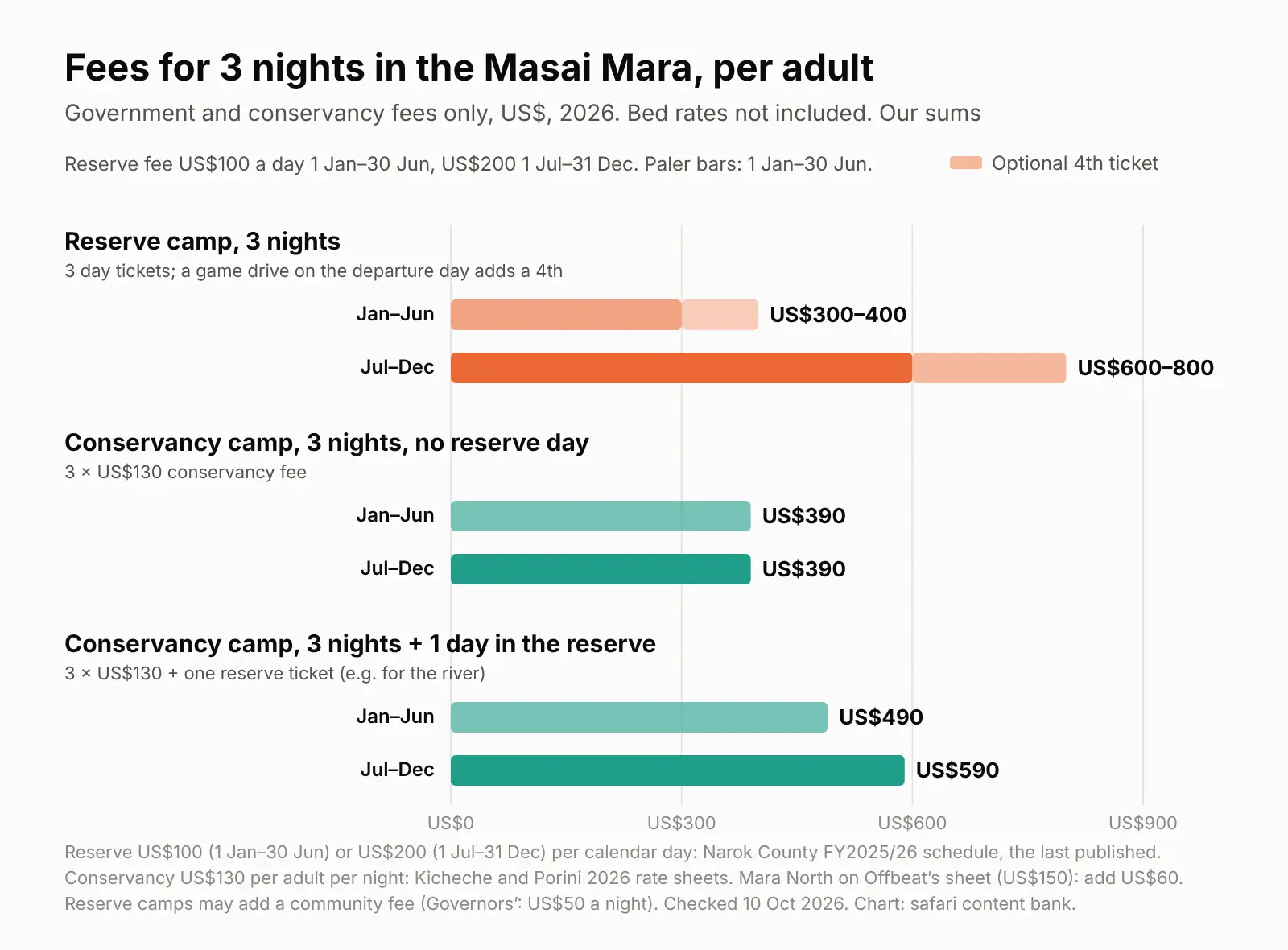 Our sums from the Narok County FY2025/26 schedule and camps’ 2026 rate sheets. Checked 10 October 2026. Chart: safari content bank.
Worked example: beds plus fees, one adult, 3 nights
In August a Kicheche Mara North stay with one day in the reserve comes to US$3,575, against US$3,744–3,944 at Governors’ Camp in the reserve; in February the reserve camp is cheaper.
| One adult, sharing, 3 nights (our sums) | February | August |
|---|---|---|
| Governors’ Camp (reserve): beds + US$50 community fee a night + reserve fee | 3 × US$623 + US$150 + US$300 = US$2,319 (US$2,419 with a departure-day drive) | 3 × US$998 + US$150 + US$600 = US$3,744 (US$3,944) |
| Kicheche Mara North (conservancy): beds + US$130 a night | 3 × US$730 + US$390 = US$2,580 | 3 × US$995 + US$390 = US$3,375 |
| Kicheche Mara North plus one day in the reserve | US$2,680 | US$3,575 |
Bed rates per person sharing, full board with game drives: Governors’ 2026 (recommended selling rates) and Kicheche 2026 (rack rates), read 9 October 2026. Ticket rules and child rates: Masai Mara park fees, US$100 or US$200 a day.
Rules that differ: driving, vehicles, night drives and walks
The reserve keeps vehicles on tracks, caps a sighting at five vehicles and sells no night drives or walks; the conservancies allow all three activities, and none of them publishes its own sighting limit.
Inside the reserve
- Stay on the tracks. Vehicles “must stay on the tracks at all times. Off-road driving is prohibited, except to approach big cats which are sighted on nearby open ground”. The vehicle goes straight to the sighting, no nearer than 25 m, does not follow the animals and goes straight back to the track (Business Daily, reporting Narok County’s management plan).
- Five vehicles at a sighting. “If there are already five cars near the animals”, the next vehicle stops and waits at least 100 metres away (same source). The Mara Triangle’s own rules also limit viewing time once more than five vehicles are waiting (Mara Conservancy park rules).
- Fines are paid on the spot in the Triangle. Failure to pay “can result in banishment from the Mara Triangle for a period of six months” (Mara Conservancy).
- No night drives or walks are sold in the reserve. Wilderness Mara, inside the Triangle, states that it offers no night drives (one safari agent’s conservancy guide).
- No private cars on game drives. Narok County’s memo of 3 June 2024 banned “the usage of private vehicles for game drives” (Kenyans.co.ke). We found no 2026 statement on how it is applied.
In the conservancies
- Off-road driving, night drives and walks are part of the stay. Porini Lion Camp in Olare Motorogi has “night drives and walks permitted” and uses off-road 4×4 vehicles (Porini factsheet). Kicheche’s 2026 rates include guided bush walks at all three of its camps and night game drives at Kicheche Valley in Naboisho.
- Not every camp sells night drives. Kicheche lists them only at its Naboisho camp, not at Kicheche Mara North. Ask each camp.
- Fewer beds, not a published vehicle cap. Olare Motorogi has five partner camps and “None of these camps is larger than 24 beds” (Olare Motorogi Conservancy). We found no written limit on vehicles per sighting for any Mara conservancy.
- Elsewhere in Kenya, conservancies do publish caps. Ol Pejeta allows a “Maximum of 6 vehicles … around wildlife sighting for a maximum of 10 minutes per vehicle” (OPC Tariff Guide 2026); Lewa allows “Strictly a maximum of two vehicles viewing an animal at any one time” (Lewa Code of Conduct). Both are in Laikipia, not the Mara.
Which conservancies are there?
The MMWCA lists 24 member conservancies around the reserve; the four that camps’ 2026 rate sheets price are Mara North, Olare Motorogi, Naboisho and Ol Kinyei.
| Conservancy | Set up (MMWCA) | Camps named in our sources | Conservancy fee per adult, 2026 |
|---|---|---|---|
| Mara North | January 2009 | Kicheche Mara, Offbeat Mara, Elephant Pepper, Karen Blixen, Alex Walker’s Serian, Hemingways River Camp, Saruni Basecamp (maranorth.org) | US$130 (Kicheche); US$150 (Offbeat) |
| Olare Motorogi | Not stated | Kicheche Bush, Mahali Mzuri, Mara Plains, Olare Mara Kempinski, Porini Lion Camp (Olare Motorogi Conservancy) | US$130 (Kicheche, Porini) |
| Naboisho | Not stated | Kicheche Valley, Hemingways Ol Seki, Asilia’s Naboisho Camp and Encounter Mara, Basecamp Eagle View (one safari agent’s conservancy guide) | US$130 (Kicheche, Hemingways) |
| Ol Kinyei | 2005 | Porini Mara Camp, Porini Cheetah Camp (Porini 2026) | US$130 (Porini) |
| Lemek | 2009 | Saruni Wild (one safari agent’s conservancy guide) | Not printed on any sheet we hold |
| Enonkishu | Not stated | House in the Wild (one safari agent’s conservancy guide) | Not printed |
| Siana | 2004 | Entumoto (one safari agent’s conservancy guide) | Not printed |
| Olderkesi | Not stated | Cottars 1920s Camp (one safari agent’s conservancy guide) | Not printed |
Set-up years: MMWCA conservancy list. Other members include Nashulai (2016), Ol Choro Oirouwa (1991, as a wildlife trust) and Pardamat. Read 9 October 2026.
- Porini Mara Camp guests can drive in Naboisho as well as Ol Kinyei: Porini says they have “exclusive permission to conduct game drives within Naboisho” (Porini).
- Travellers on the TripAdvisor Mara forum say the conservancies’ landscapes are similar, and suggest splitting four or more nights between two of them to see different lion prides, leopards and cheetahs; expect cattle grazing in conservancies (TripAdvisor, traveller reports).
The Great Migration: reserve or conservancy?
For the river crossings, the reserve: the herds cross the Mara River and the Sand River inside it, usually from July to October. A conservancy guest sees them on a day trip into the reserve, paying that day’s ticket.
- Crossings cannot be booked. The Mara Conservancy says crossings “happen frequently during the migration but are difficult to predict”; one Mara camp operator says “we cannot guarantee the timing” (a Mara camp operator’s migration page). Month-by-month positions are on where the Great Migration is each month.
- A crossing day costs a conservancy guest US$200 extra from July to December, on top of the night’s US$130 conservancy fee. One safari agent says most conservancy camps include a day in the reserve per three-night stay; check whether yours does.
- January to March is conservancy season. The Loita herd moves into Ol Kinyei by January and calves there in February and March, before moving through Naboisho into Olare Motorogi (a Kenyan camp operator’s Loita migration page). It is a smaller, separate herd from the Serengeti herds: 122,790 animals in 1977, 23,510 in 2016 (Narok County plan).
- April–May closures. Kicheche Mara North and Bush close from 1 April to 22 May 2026, and Kicheche Valley from 10 April to 31 May (Kicheche 2026).
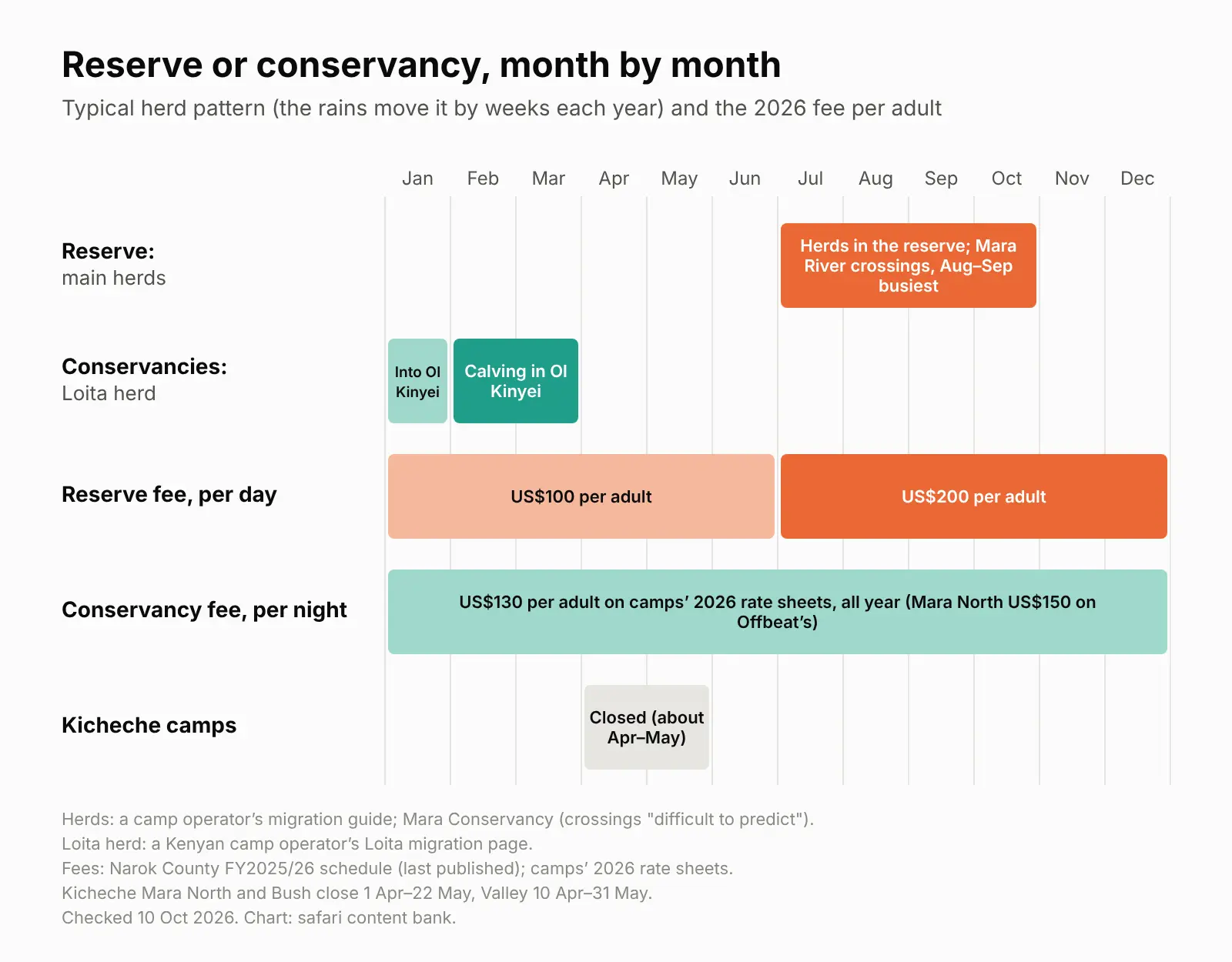 Typical pattern, not a forecast. Sources: a camp operator’s migration guide; Mara Conservancy; a Kenyan camp operator’s Loita migration page; Narok County FY2025/26 schedule; camps’ 2026 rate sheets. Chart: safari content bank.
Going on to the Serengeti? Kenya vs Tanzania compares the Mara with the Serengeti, month by month.
Crowds: how much quieter are the conservancies?
Quieter at sightings, by travellers’ accounts, but no one publishes a vehicle count for either side. The numbers that exist are reviews and visitor totals.
- In the reserve, reviews on a safari booking site from 2019 to 2026 describe 20 to 40 vehicles at a single sighting (traveller reports).
- Forum travellers found the Mara Triangle and the Keekorok area quieter, and advise a conservancy if vehicle numbers bother you (TripAdvisor, traveller reports).
- A Nairobi-based operator on the TripAdvisor Kenya forum (August 2026) said there is not a huge difference in topography; what the conservancy premium buys is fewer vehicles, off-road driving, night drives and walking (TripAdvisor).
- Visitors to the reserve fell from 420,000 in 2023 to 213,000 in 2025 (Kenya Economic Survey 2026, via Business Daily). Travellers still report queues at sightings.
Minimum stays and how to split your nights
We found no minimum stay published by any Mara conservancy or by the reserve; minimums come from camps’ own rate conditions.
- Porini’s 6-night reduced rate needs at least 3 nights at each of two camps (valid 1 June 2026 to 2 January 2028; Porini 2026).
- By road, stay at least two nights. Nairobi to Sekenani Gate takes 5.5–6 hours, so one night leaves two half-days in a vehicle; see Nairobi to the Masai Mara: flight or road?. Kicheche’s camps use the Mara North, Olare Orok and Ol Seki airstrips.
- A common split is both: three nights in a conservancy and two in or near the reserve, or the reverse, so you get night drives and walks as well as a day at the river.
- Children change the choice. The reserve is free under 9; some conservancy camps take no under-7s or under-8s. Ages and child rates across camps: single supplements and child rates.
Which should you choose?
Choose the reserve for the July–October river crossings or a January–June budget; choose a conservancy for night drives, walks, fewer vehicles and the February–March Loita calving.
| If you… | Pick | Why |
|---|---|---|
| Want river crossings, August–September | Reserve camp, or a conservancy plus a reserve day | Crossings are on the Mara River inside the reserve |
| Travel January–June on a tight budget | Reserve | US$100 a day in fees against US$130 a night |
| Travel July–December | Conservancy | US$130 a night against US$200 a day; add US$200 only for a reserve day |
| Want night drives or bush walks | Conservancy | None are sold inside the reserve |
| Dislike crowds at sightings | Conservancy, or the Mara Triangle | Reserve reviews describe 20–40 vehicles at a sighting |
| Travel in February–March | Conservancy (Ol Kinyei, Naboisho) | The Loita herd calves in Ol Kinyei |
| Have children under 7 or 8 | Reserve, or a family-friendly conservancy camp | Under-9s enter the reserve free; Kicheche Bush and Valley take 7+, Porini 8+ |
Whichever you choose, check that your operator holds a current licence: see how to check a safari operator is licensed. For the whole Kenya budget, see Kenya safari cost; for camps, months and prices, the Masai Mara guide.
See also: Laikipia vs Masai Mara and Samburu vs Masai Mara.
Common mistakes
| What you’ll often read | What is correct |
|---|---|
| “Conservancy fees are US$80–150” | Camps’ 2026 rate sheets print US$130 per adult per night at Mara North, Olare Motorogi, Naboisho and Ol Kinyei; Offbeat prints US$150 for Mara North. |
| “Conservancy fees are included in the camp price” | At Kicheche, Porini and Hemingways they are charged on top, even on free nights. |
| “A conservancy is always the more expensive option” | In fees, only from January to June. From July to December a conservancy night (US$130) costs less than a reserve day (US$200). |
| “Staying in a conservancy covers the reserve” | It does not. You pay the reserve fee as well on any day you drive into the reserve. |
| “Night drives in the Masai Mara” | Only in the conservancies, and not at every conservancy camp. |
| “Conservancies allow only two to five vehicles per sighting” | No Mara conservancy publishes a cap. The five-vehicle rule is the reserve’s. |
| “The Mara Triangle is a private conservancy” | It is part of the national reserve, run by the Mara Conservancy, with the same per-person fees. |
Frequently asked questions
Is a conservancy better than the Masai Mara reserve? For night drives, walks, off-road driving and fewer vehicles, yes: the reserve sells none of the first three. For the river crossings, the reserve is where they happen. Many visitors stay in a conservancy and spend one day in the reserve.
Do I pay the Masai Mara reserve fee if I stay in a conservancy? Only for a day you drive into the reserve. The conservancy fee is charged for every night, including that day: US$130 per adult on camps’ 2026 rate sheets, or US$150 on Offbeat’s sheet for Mara North. From July to December a reserve day costs US$200 per adult.
Can you see the river crossings from a conservancy? Yes, on a day trip into the reserve, where the herds cross the Mara River and the Sand River, usually from July to October. That day you pay the reserve fee as well as the conservancy fee. No one can book or guarantee a crossing.
Are night drives allowed in the Masai Mara? Not in the reserve, where none are sold. In the conservancies they are sold by camps: Kicheche includes them at its Naboisho camp and Porini at Porini Lion Camp in Olare Motorogi. Not every conservancy camp offers them, so ask.
How many vehicles are allowed at a sighting in the Masai Mara? Five in the reserve; any further vehicle waits at least 100 metres away, under Narok County’s management plan. No Mara conservancy publishes its own limit. In Laikipia, Ol Pejeta allows six vehicles and Lewa two.
Which Mara conservancies can I stay in? The MMWCA lists 24. The four that camps’ 2026 rate sheets price are Mara North, Olare Motorogi, Naboisho and Ol Kinyei, all at US$130 per adult per night (Mara North US$150 on Offbeat’s sheet). Lemek, Enonkishu, Siana and Olderkesi also have camps.
Is the Mara Triangle a conservancy? No. It is the western part of the national reserve, about 510 km², run by the not-for-profit Mara Conservancy for Narok County. It charges the same reserve fee: US$100 per adult per day from January to June and US$200 from July to December.
Sources
- Narok County, Maasai Mara fee schedule FY2025/26 (PDF), the last published, expired 30 June 2026; for July–December 2026, The Kenya Times, 6 Aug 2026 (press, secondary); Greater Maasai Mara Ecosystem Management Plan 2023–2032, as reported by Business Daily
- Mara Conservancy: conservation fees, park rules, history, wildebeest migration
- Conservancies: MMWCA and its conservancy list; Mara North; Olare Motorogi Conservancy
- Camps’ 2026 rate sheets: Kicheche, Porini and Porini Lion Camp factsheet, Hemingways, Offbeat, Governors’ and its community fee
- Migration: a camp operator’s migration guide; a Mara camp operator’s migration page; a Kenyan camp operator’s Loita migration page
- Other rules: OPC Tariff Guide 2026; Lewa Code of Conduct; Kenyans.co.ke on private vehicles; ATC News on VAT
- Agents and travellers: one safari agent’s conservancy guide; a safari booking site’s traveller reviews; TripAdvisor threads as linked; visitor numbers via Business Daily
Fees and rules checked 9–10 October 2026. We will update this page when Narok County publishes a 2026/27 Mara schedule, when any Mara conservancy publishes its own tariff or sighting rules, and when camps issue 2027 rate sheets.
Ask for a quote
Tell us your dates and we send you a priced itinerary. Free, no obligation.
- Free quote, no obligation
- Trips run by licensed local operators