 Experience

Last verified · Next check due
On this page
- Which activities to avoid, at a glance (2026)
- The SATSA line: who says what
- Cub petting, lion walks and canned hunting: the link
- Captive cheetah encounters
- Elephant rides, elephant walks and orphanages
- How to judge a sanctuary, rescue centre or orphanage
- Rhino experiences: tracking, dehorned rhinos and photos
- Gorillas and chimpanzees: the rules are the ethics
- On a game drive: crowding is a welfare issue too
- How to check your safari operator before you book
- Which to choose
- Common mistakes
- Frequently asked questions
- Sources
Short answer: Skip anything that lets you touch, walk with or ride a wild animal: cub petting, lion or cheetah walks, elephant rides and elephant walks. South Africa’s tourism trade body, SATSA, lists all of them as unacceptable, and flags facilities linked to breeding, trade in body parts or canned hunting. A sound sanctuary or orphanage is hands-off: you watch at set times, from a distance. In the parks, keep to the rules on distance and vehicles.
Key facts
- The clearest written line in our sources is SATSA’s. The Southern Africa Tourism Services Association listed five kinds of activity that stop a facility being “recommended to international operators or visitors”: performing animals, touching any infant wild animal, touching predators, walking with predators or elephants, and riding animals, including elephants (announced 31 October 2019, via Conservation Action Trust).
- It is a trade body’s guideline, not a law. South Africa’s National Department of Tourism welcomed it, and the NSPCA, the national animal-welfare body, approved it (same article).
- SATSA also flags facilities linked to illegal trade, trade in body parts, canned hunting or breeding, and those with misleading advertising or no transparency. That is the link between a cub to stroke and the captive-lion industry.
- Wild lions are listed as Vulnerable, about 23,000 adults and subadults in Africa against an estimated 33,000 in 2006 (CITES, PDF). No source we hold shows captive cubs bred for petting or walks returning to the wild.
- Ethical does not mean distant from wildlife. Tracking wild cheetahs or rhinos on foot with a ranger, a gorilla hour under park rules or the public hour at an elephant orphanage are all on our pages; what they share is that you watch and do not handle.
- Your presence on a game drive matters too: in one study, wild cheetah mothers in high-tourism areas raised 0.21 cubs per litter to independence, against 2.32 in low-tourism areas (Broekhuis 2018).
Which activities to avoid, at a glance (2026)
Anything on SATSA’s list involves touching, walking with, riding or making an animal perform; the watch-only alternative exists for every one of them.
| Activity | What SATSA’s 2019 guideline says | The watch-only alternative | More on our pages |
|---|---|---|---|
| Cub petting (lion, cheetah or tiger cubs to hold or stroke) | Unacceptable: “tactile interaction with any infant wild animal” | Wild lions and cheetahs from a vehicle or on a guided walk | Where to see lions |
| Walking with lions or other predators | Unacceptable: “walking with predators” | A walking safari with an armed guide in a park or concession that sells walks | Walking safari |
| Captive cheetah “encounters” and cheetah walks | Unacceptable: touching predators and walking with predators | SANParks sells tracking wild cheetahs on foot with a ranger in Mountain Zebra National Park | Where to see cheetahs |
| Elephant rides | Unacceptable: “riding animals”, elephants included | Wild elephants from a vehicle, boat or on foot with a guide | Where to see elephants |
| Walking with elephants | Unacceptable: walking with elephants | An elephant orphanage’s public viewing hour | Nairobi day trip |
| Performing animals (elephants, predators, primates, birds) | Unacceptable | None needed | — |
| Ostrich rides | Unacceptable: riding animals, ostriches named | None needed | — |
| Facilities that breed, trade animals or parts, or link to canned hunting | Warning flags, along with misleading advertising and lack of transparency | A rescue sanctuary that is open about where its animals came from | This page, below |
Source: SATSA animal-interaction criteria, announced 31 October 2019, reported by Conservation Action Trust, 19 Nov 2019, read 8 October 2026. SANParks: Mountain Zebra National Park, as on our cheetah page.
The SATSA line: who says what
SATSA, South Africa’s tourism trade association, drew the line in 2019, and the government’s tourism department and the national animal-welfare body backed it; some facilities objected because interactions were their business.
- What SATSA did: its animal-interactions committee published criteria after industry research, with full implementation targeted for the end of July 2020. Facilities offering the five activities “will no longer be recommended to international operators or visitors”. The guide includes a decision tree for judging whether an interaction is ethical (Conservation Action Trust).
- National Department of Tourism: welcomed SATSA’s “commitment to protection of our wildlife and environmental resources” (same article).
- NSPCA: approved the guideline (same article).
- Industry reaction: one lion park said it was “deeply disappointed” and that interactions made up “more than 30% of our turnover”. One cat project had already stopped interactions (“now that we know better, we need to do better”) and saw visitor numbers fall sharply (same article; names in our editor notes).
- Travellers still ask about these activities. A 2026 TripAdvisor thread asks about a cheetah walk near Hoedspruit, outside Kruger (traveller reports).
SATSA’s guideline covers South Africa’s trade. We found no equivalent written standard from a park authority, a government or an NGO for Kenya, Tanzania, Botswana, Namibia, Zambia or Zimbabwe in our sources, so we apply SATSA’s five categories as the test everywhere; they describe the activity, not the country.
Cub petting, lion walks and canned hunting: the link
SATSA puts breeding, trade in body parts and canned hunting on the same warning list as the touching activities; you cannot tell from the visitor side where a cub you stroke ends up, so the safe choice is not to pay for it.
Canned hunting is the shooting of captive-bred animals in enclosures (Wikipedia, Canned hunting; secondary). What our sources show:
| Date | What happened | Who says so |
|---|---|---|
| 2006 | South Africa’s environment minister announced rules to stop canned hunting of large predators and rhino, with captive-bred lions to spend two years free-ranging before a hunt; the measure was later overturned in court | Wikipedia (secondary) |
| November 2015 | The Professional Hunters’ Association of South Africa (PHASA) voted to distance itself from captive-bred lion hunting | Wikipedia (secondary) |
| November 2017 | PHASA reversed that position and was widely criticised | Wikipedia (secondary) |
| 31 October 2019 | SATSA named breeding, body-part trade and canned hunting as warning flags for facilities | Conservation Action Trust |
| 2024 | Lions are on CITES Appendix II with a zero quota for commercial trade in wild-sourced bones, claws, skulls and teeth; only South African captive-bred parts have a quota | CITES Animals Committee paper AC33 (PDF) |
Read 8–9 October 2026.
- Captive lions are not wild lions. The IUCN’s 2023 reassessment keeps the lion as Vulnerable, with an estimated 36% loss of range over 21 years (CITES AC33). Where wild lions are seen, and how often: where to see lions.
- What we do not print: counts of captive lions or facilities, and the later stages of South Africa’s government process on captive lions. Our sources for them are unchecked, so they stay out until we can cite an official document.
Captive cheetah encounters
A cheetah walk, a cheetah to stroke or a cub to hold is not a wild sighting; SATSA lists touching predators, touching any infant wild animal and walking with predators as unacceptable.
- The wild alternative is real: SANParks sells cheetah tracking on foot with a ranger in Mountain Zebra National Park, where cheetah were reintroduced in 2007 (where to see cheetahs).
- Look closely at listings that bundle animals. Lodge and ranch listings sometimes include “encounters” with cheetahs or other predators; apply the SATSA test to what the encounter actually involves before you book.
- The best published odds of a wild cheetah are in northern Botswana’s private concessions, on one operator’s traveller reports; the figures are on our cheetah page.
Elephant rides, elephant walks and orphanages
SATSA lists riding elephants, walking with elephants and performing elephants as unacceptable; an orphanage where you watch at a set hour is the model to look for.
| Experience | Our sources say | Verdict on SATSA’s test |
|---|---|---|
| Elephant-back ride | “Riding animals, including elephants” is unacceptable (SATSA) | Avoid |
| Walking alongside tame elephants | “Walking with … elephants” is unacceptable (SATSA) | Avoid |
| Elephant show or painting | Performing animals of any type are unacceptable (SATSA) | Avoid |
| An “elephant encounter” listing | The term covers anything from watching to riding; ask what happens | Check before booking |
| Orphanage public viewing hour | Nairobi’s best-known elephant nursery: one public hour, 11:00–12:00, booked by email at least two business days ahead, US$20 per adult; fostering from US$50 a year | Fits the test if you only watch |
| Wild elephants from a vehicle or on foot | KWS parks: view from at least 20 m, no feeding | The standard to aim for |
Sources: SATSA criteria via Conservation Action Trust (2019); the nursery’s own visit page, as on our Nairobi National Park day trip page, read 9 October 2026; KWS, Amboseli, read October 2026.
- Kenya Wildlife Service runs its own Animal Orphanage in Nairobi, priced at US$25 per non-resident adult, or US$105 with Nairobi National Park and the Safari Walk on one package ticket (KWS Legal Notice 160 of 2025; Kenya park fees).
- Riding a horse among wild elephants is a different activity: you ride a horse, and the elephants are free-ranging (horseback safari).
- Where to see wild elephants, with sighting rates: where to see elephants.
How to judge a sanctuary, rescue centre or orphanage
Ask what you will be allowed to do, where the animals came from and where they go; any answer that involves touching, breeding or selling animals fails SATSA’s test.
| Ask | Good sign | Warning sign (SATSA’s criteria) |
|---|---|---|
| Can I touch, hold or feed the animals? | No: you watch from a path, platform or vehicle | Cubs or other young animals offered for handling or photos |
| Can I walk with the animals? | Only wild animals, on a guided walk | Walks with lions, cheetahs or elephants |
| Do animals ride, perform or pose? | No | Rides, shows, painting, photo props |
| Does the place breed animals? | No breeding, or breeding only for a stated release programme | Breeding with no explanation of where the young go |
| Where did the animals come from? | Stated: rescued, orphaned, confiscated | Not stated, or vague (“misleading advertising”, “lack of transparency”) |
| Where do animals go when they grow up? | Release, or lifelong care on site | Sold or traded; links to hunting or body-part trade |
Criteria: SATSA, 2019, via Conservation Action Trust. The questions are ours.
- What rescue looks like: Born Free runs two big-cat sanctuaries in South Africa for lions and leopards rescued from circuses and zoos (Wikipedia, secondary; and a reserve’s own experience list).
- Volunteering at a sanctuary is work in the eyes of immigration. Namibia’s embassy in Berlin says “volunteer work of any kind” needs an employment permit or work visa (Namibia visa); in Tanzania “Volunteer work is prohibited on a tourist visa” (US State Department), so you need the business visa (Tanzania visa).
- A good review is not a test. SATSA’s criteria are about what happens to the animals, not about the visitor’s day, so read a listing for the activities it sells.
Rhino experiences: tracking, dehorned rhinos and photos
The ethical rhino experience is watching or tracking wild rhinos with a guide and keeping their location private; a rhino calf offered for touching fails the same SATSA test as a lion cub.
- About 48% of Africa’s rhinos have been dehorned to deter poachers (IUCN SSC rhino specialist groups’ report to CITES, 2025), so a hornless rhino is a protected rhino, not a sign of a bad reserve.
- 63.7% of southern white rhinos are owned or managed by non-state, mostly private, owners (same report), so many rhino you see in southern Africa live on private land.
- Africa had 6,788 black and 15,752 white rhinos at the end of 2024 (same report); national figures, and where travellers see rhino, are on our where to see rhino page.
- Strip GPS, EXIF data and geotags before you post a rhino photo, as a wildlife photographer advises, and do not ask a guide for a location: lodges and guides do not give them out (where to see rhino).
- Tracking on foot is sold by some private reserves and some national parks, with a guide or tracker; prices are on our rhino page. Follow the guide’s instructions on distance and silence.
- Baby rhinos and elephants count as infant wild animals. SATSA’s line on “tactile interaction with any infant wild animal” covers them, so a visit that includes handling a calf fails the test.
Gorillas and chimpanzees: the rules are the ethics
Gorilla visits are rationed to protect the gorillas from human disease: eight people, one hour, age 15 and over, and no trekking when ill.
| Rule | Uganda (UWA) | Rwanda (RDB) |
|---|---|---|
| Visitors per gorilla family per day | 8 | 8 |
| Time with the gorillas | 1 hour | 1 hour maximum |
| Minimum age | 15 | 15 |
| Minimum distance | Not printed: UWA documents give different figures | 7 m |
| If you are ill | Do not trek | Not stated on RDB’s pages |
Sources: UWA Bwindi brochure and Conservation Tariff July 2024–June 2026; Visit Rwanda and the RDB booking portal; as on our gorilla trekking day page, checked 8–9 October 2026.
- Why: respiratory illness is linked to about 20% of sudden gorilla deaths (Wikipedia, Mountain gorilla; secondary).
- Most Virunga gorillas now meet people: 418 of 604 were in habituated groups in the 2015–16 census, whose report warns of disease risk from more overlap between tourist and research visits (Virunga census report 2015–2016, PDF).
All the park rules, with drones and photos: safari etiquette.
On a game drive: crowding is a welfare issue too
Even with wild animals, numbers matter: wild cheetah mothers raised far fewer cubs where tourists were most abundant, which is why the parks cap vehicles and set distances.
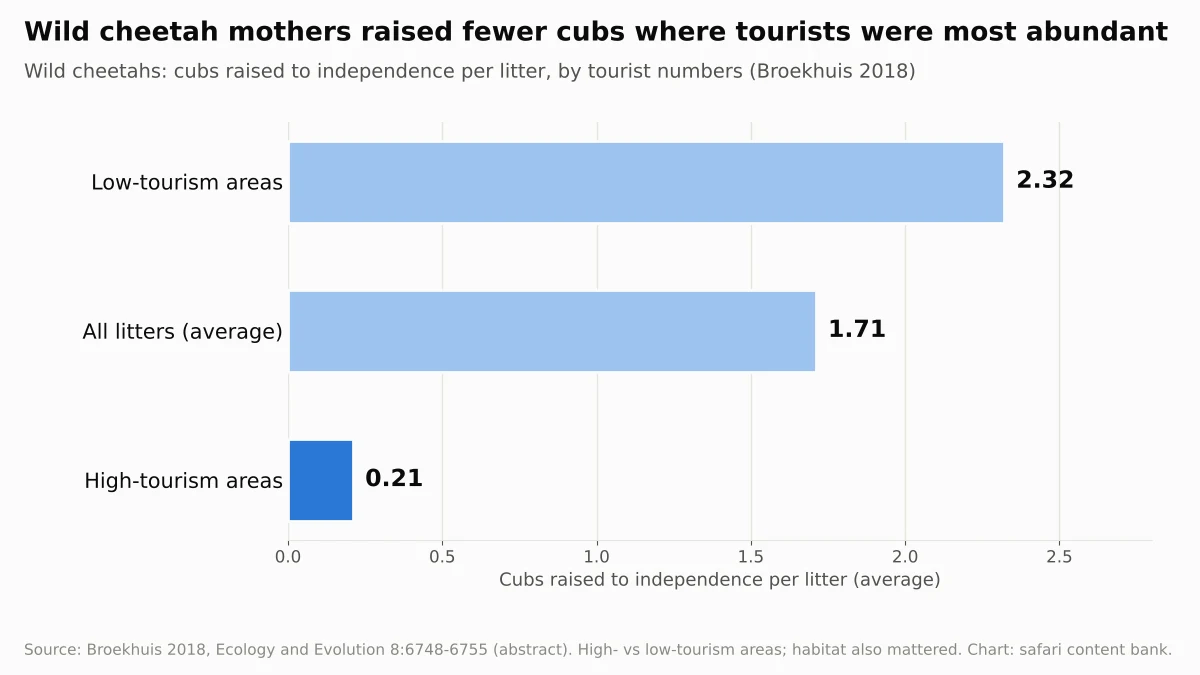 Source: Broekhuis 2018, Ecology and Evolution 8:6748–6755, abstract on the Oxford repository; habitat also mattered (open habitat 1.69, denser 3.04). Read 8 October 2026. Chart: safari content bank.
- Masai Mara reserve: five vehicles at a sighting, the next waiting at least 100 m back; off the track only to approach big cats on nearby open ground, no nearer than 25 m (Narok County plan, via Business Daily).
- Kenya’s KWS parks: at least 20 m from wildlife, no feeding, no hooting (KWS).
- Two Laikipia conservancies publish tighter caps: Lewa two vehicles at a sighting, Ol Pejeta six for 10 minutes each (safari etiquette).
- Ask your guide to wait their turn and not to crowd an animal; off-road driving is banned in every public park in our sources, except the Mara reserve’s narrow big-cat exception. Reserve and conservancy compared: Mara reserve or conservancy.
How to check your safari operator before you book
Ask in writing whether the itinerary includes anything on SATSA’s list, and treat memberships and awards as a floor, not a guarantee.
| Check | What to ask or look for | What it tells you |
|---|---|---|
| Animal interactions | “Does any day include touching, walking with or riding animals, or a stop at a breeding facility?” | Whether the trip passes SATSA’s test |
| Trade membership | SATSA (South Africa), KATO (Kenya), TATO (Tanzania), AUTO (Uganda) | A recognised trade body; a floor, not a guarantee |
| Licence | Kenya: TRA register; Tanzania: TALA licence | The legal minimum (check a safari operator’s licence) |
| Awards | Vote-based awards repeat heavily year to year | Popularity, not an audit |
| Where you stay | Conservancy and concession camps with published vehicle caps | Fewer vehicles at sightings |
Sources: SATSA criteria via Conservation Action Trust; trade bodies as on our how to book a safari page; World Travel Awards winners lists, 2023–2026. Read 8–10 October 2026.
Which to choose
| If you want… | Choose | Instead of |
|---|---|---|
| Close-up lions | A private concession or conservancy with off-road driving and capped vehicles | A lion park with cubs to stroke or lion walks |
| Cheetahs on foot | Ranger-led tracking of wild cheetahs (SANParks, Mountain Zebra) | A captive cheetah walk |
| Elephants up close | A walking safari or a boat on the river; an orphanage’s public hour | An elephant ride or elephant walk |
| Rhinos | Guided tracking of wild rhinos, location kept private | Touching a rhino calf |
| Gorillas or chimpanzees | A permit-based trek under UWA or RDB rules | Any primate photo prop |
| To help animals | Fostering or donating to a rescue that does not breed or trade, or paying conservancy fees | Paying for a cub photo |
Common mistakes
| Mistake | Correction |
|---|---|
| “Cub petting helps conservation” | SATSA lists touching any infant wild animal as unacceptable and flags breeding facilities; no source we hold shows captive cubs returning to the wild. |
| “Walking with lions is like a walking safari” | A walking safari watches wild animals from a distance; SATSA lists walking with predators as unacceptable. |
| “It’s called a sanctuary, so it’s fine” | The name is not a test; ask whether it breeds, trades or lets visitors touch animals. |
| “Elephant rides are banned” | SATSA’s line is a trade guideline, not a law; the choice is yours. |
| “The cheetah was tame, so touching it was harmless” | SATSA lists tactile interaction with predators as unacceptable whatever the animal’s temperament. |
| “A hornless rhino means the reserve is badly run” | About 48% of Africa’s rhinos have been dehorned to deter poachers (IUCN report, 2025). |
| “I can volunteer at a sanctuary on a tourist visa” | Not in Namibia or Tanzania: Namibia wants a work permit, Tanzania the business visa. |
| “Wild viewing has no impact” | In one study, cheetah mothers in high-tourism areas raised 0.21 cubs per litter, against 2.32 in low-tourism areas. |
Frequently asked questions
Is lion cub petting ethical? No source we hold supports it. SATSA lists “tactile interaction with any infant wild animal” as unacceptable and flags facilities linked to breeding, body-part trade and canned hunting. South Africa’s tourism department welcomed the guideline and the NSPCA approved it.
Is walking with lions ethical? SATSA lists walking with predators as unacceptable. If you want to be on foot near lions, take a walking safari with an armed guide in a park or concession that sells walks; you watch wild lions from a distance.
Are elephant rides cruel? SATSA lists riding animals, elephants included, and walking with elephants as unacceptable, along with performing elephants. Our sources hold no Africa-wide law on elephant rides, so it is a choice: watch elephants from a vehicle, a boat or on a guided walk instead.
How can you tell if a wildlife sanctuary is real? Ask whether you can touch or walk with the animals, whether it breeds them, where they came from and where they go. A rescue that is open about origins, does not breed or trade, and keeps visitors at a distance meets SATSA’s criteria; one offering cubs to hold does not.
Is visiting an elephant orphanage ethical? A visit where you only watch fits SATSA’s test. Nairobi’s best-known nursery opens one public hour, 11:00–12:00, booked by email at least two business days ahead, at US$20 per adult. Avoid any orphanage that lets visitors ride or walk with elephants.
What is canned hunting? The shooting of captive-bred animals in enclosures. South Africa announced rules against canned hunting of large predators in 2006, but they were overturned in court; SATSA flags facilities linked to canned hunting or the body-part trade.
Is rhino tracking on foot ethical? Tracking wild rhinos with a guide or tracker who sets the distance is a watch-only activity. Keep the location private: strip GPS and geotags from photos, and do not ask for a sighting’s location. About 48% of Africa’s rhinos are dehorned against poaching.
Can I volunteer at an animal sanctuary in Africa on a tourist visa? Not in Namibia or Tanzania. Namibia’s embassy in Berlin says volunteer work of any kind needs an employment permit or work visa; in Tanzania volunteer work is prohibited on a tourist visa, so you need the business visa. Check the rules for other countries before you go.
Sources
- SATSA animal-interaction criteria (announced 31 October 2019) and reactions from the National Department of Tourism, the NSPCA and the industry: Louzel Lombard Steyn, Conservation Action Trust, 19 Nov 2019, read 8 October 2026; SATSA’s own guide was not opened
- Lions: CITES Animals Committee, AC33 paper on lions (PDF), 2024, read 9 October 2026; Wikipedia, Canned hunting (secondary), read 9 October 2026
- Cheetahs: SANParks, Mountain Zebra National Park, as on our where to see cheetahs page; Broekhuis 2018, Ecology and Evolution 8:6748–6755, abstract, read 8 October 2026; a TripAdvisor thread (2026, traveller reports, not fact)
- Elephants: the Nairobi elephant nursery’s visit page, as on our Nairobi National Park day trip page, read 9 October 2026; KWS Legal Notice 160 of 2025, as on our Kenya park fees page; KWS, Amboseli, read October 2026
- Rhinos: IUCN SSC African and Asian Rhino Specialist Groups and TRAFFIC, report to CITES CoP20 (PDF), 2025, as on our where to see rhino page, checked 10 October 2026
- Gorillas: UWA Bwindi brochure and Conservation Tariff July 2024–June 2026; Visit Rwanda; RDB booking portal; Virunga census report 2015–2016 (PDF); Wikipedia, Mountain gorilla (secondary); checked 8–9 October 2026
- Sanctuaries: Born Free’s big-cat sanctuaries in South Africa, Wikipedia (secondary) and a reserve’s experience list, read 8 October 2026
- Visas for volunteers: Embassy of Namibia, Berlin; US State Department, as on our Tanzania visa page; read October 2026
- Game-drive rules: Narok County’s Greater Maasai Mara Ecosystem Management Plan 2023–2032, via Business Daily; Ol Pejeta Tariff Guide 2026 (PDF); Lewa Code of Conduct; as on our safari etiquette page, read 8–10 October 2026
- Operators: World Travel Awards winners (2023–2026); trade bodies and licences as on our how to book a safari page
More: safari etiquette, walking safari and family safari.
Checked against the sources above 8–10 October 2026. We will update this page when we can cite SATSA’s own guide, an official South African document on captive lions, or a written animal-interaction standard from a park authority or NGO in another safari country.