 Experience

Last verified · Next check due
On this page
- Park rules at a glance (2026)
- Off-road driving and vehicles at a sighting
- Speed limits in the parks
- Night drives and park hours
- In the vehicle: getting out, noise and feeding
- Drones: each country’s official position
- Plastic bags and litter
- Photographing people, and what to wear
- Gorilla trekking rules
- Fines: what the authorities actually publish
- Park, conservancy or concession: which rules apply?
- Common mistakes
- Frequently asked questions
- Sources
Short answer: Stay on the track, in the vehicle and at a distance. Kenya’s national parks set 40 km/h and a 20 m viewing distance; Kruger 50 km/h on tar. The Masai Mara reserve allows five vehicles at a sighting, the next waiting 100 m back. Botswana bans night and off-road driving in its parks and reserves, not on concessions. Gorilla visits are 8 people for 1 hour, age 15 and over. Fly a drone only with permits arranged before you travel.
Key facts
- Off-road driving is banned in every public park in our sources: the Masai Mara reserve (except a direct approach to big cats, no nearer than 25 m), Kenya’s KWS parks, Ngorongoro, Kruger and Botswana’s national parks and reserves.
- Only the Masai Mara reserve publishes a vehicle cap among the big parks: five at a sighting. We found none for the Serengeti, Kruger, Chobe or Moremi (Narok County plan, via Business Daily).
- Night driving is a private-land activity. It is banned in Botswana’s parks and reserves (Botswana Tourism) and for private cars in Kruger (SANParks); the Mara reserve’s ticket runs 06:00–18:00.
- KWS parks list no feeding, no hooting and no single-use plastic among their rules (KWS, Amboseli).
- Few fines are published. TANAPA’s last published tariff (2023/24) fines over-speeding TZS 50,000; the Mara Triangle collects fines on the spot and can ban non-payers for six months.
- Gorillas catch human illness. Uganda’s wildlife authority says do not trek if you are ill; Rwanda’s booking portal sets a 7 m distance.
Park rules at a glance (2026)
The core rules are the same almost everywhere: tracks only, stay in the vehicle, daylight hours; what differs is the speed limit and whether anyone counts vehicles.
| Rule | Masai Mara reserve (Kenya) | KWS national parks (Kenya) | Serengeti (Tanzania) | Ngorongoro (Tanzania) | Kruger (South Africa) | Botswana parks and reserves |
|---|---|---|---|---|---|---|
| Off-road driving | Prohibited, except straight to big cats on nearby open ground, no nearer than 25 m | “Strictly prohibited” | Tracks only (operators’ summaries; not in the tariff) | No, unless the Conservation Commissioner authorises it | Not allowed in private vehicles | Prohibited |
| Vehicles at a sighting | 5; the next waits at least 100 m away | No cap in our sources | No cap in our sources | No cap in our sources | No cap in our sources | No cap in our sources |
| Getting out | Not stated in our sources | “Remain in your vehicle unless in designated areas” | Designated picnic and observation sites only (operator’s summary) | Not stated in our sources | Only at designated spots; no part of your body out of a window or sunroof | Not stated in an official source we hold |
| Speed | Not published in our sources | 40 km/h | 50 km/h (operators); tariff fines over-speeding | 50 km/h; 25 km/h in the crater | 50 km/h tar, 40 km/h gravel | Not stated in an official source we hold |
| Hours and night driving | Ticket 06:00–18:00; no night drives | Gates 06:00–18:00 | “Twelve daylight hours”; no night drives | Driving 06:00–18:00; last crater descent 16:00 | No night driving in private vehicles | Night driving prohibited |
| Viewing distance | 25 m for big cats off the track | 20 m from wildlife | Not stated | Not stated | Not stated | Not stated |
Sources: Narok County’s Greater Maasai Mara Ecosystem Management Plan 2023–2032, via Business Daily; KWS, Amboseli National Park (the same rules appear on the Tsavo, Lake Nakuru and Meru pages); TANAPA Tariffs 2023/24 (PDF), the last published tariff, and two Tanzanian operators’ park-rules summaries; NCAA visitor guidelines; SANParks, Kruger vital information; Botswana Tourism. Read 8–10 October 2026.
The park pages carry the detail: Masai Mara, Amboseli, Serengeti, Ngorongoro, Kruger and Chobe.
Off-road driving and vehicles at a sighting
Stay on the track unless you are on private land, and wait your turn at a sighting: in the Mara reserve the sixth vehicle stops at least 100 m back.
- The Mara reserve’s one exception is narrow. Vehicles “must stay on the tracks at all times. Off-road driving is prohibited, except to approach big cats which are sighted on nearby open ground”; the vehicle goes straight to the sighting, no nearer than 25 m, does not follow the animals and returns straight to the track (Narok County plan, via Business Daily).
- The Mara Triangle limits time, not numbers. “When there are more than five vehicles waiting to see an animal, viewing time is restricted to 10 minutes”, with waiting vehicles 100 m back (Mara Conservancy park rules).
- Two Laikipia conservancies publish tighter caps: Ol Pejeta a “Maximum of 6 vehicles … around wildlife sighting for a maximum of 10 minutes per vehicle” (OPC Tariff Guide 2026); Lewa “Strictly a maximum of two vehicles viewing an animal at any one time” (Lewa Code of Conduct).
- Do not block an animal’s route. National Geographic’s self-drive advice: keep your distance, drive slowly, stay in the vehicle and “do not block an animal’s route” (National Geographic).
- At a river crossing the same rules apply; neither TANAPA nor Narok County publishes rules written for crossings (Great Migration river crossings).
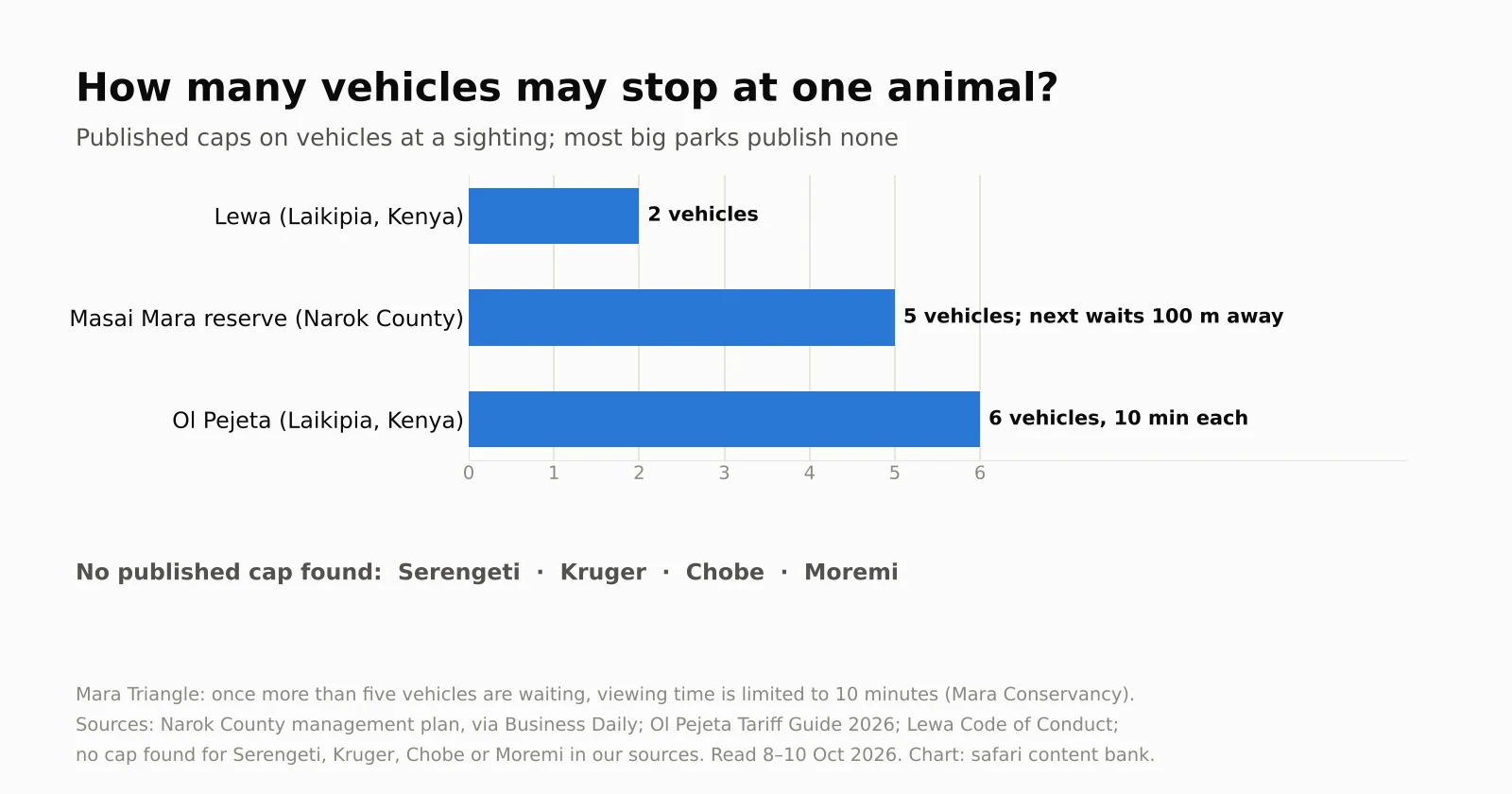 Sources: Narok County management plan, via Business Daily; Ol Pejeta Tariff Guide 2026; Lewa Code of Conduct; Mara Conservancy park rules. Read 8–10 October 2026. Chart: safari content bank.
Vehicle types, seats and what open or pop-top vehicles may do: safari vehicles. The reserve against the conservancies: Masai Mara reserve or a conservancy.
Speed limits in the parks
Expect 40–50 km/h on main park roads and 25–30 km/h on minor tracks; the lower limit is the one that applies in a crater or on a game-viewing track.
| Park | Speed limit | Source |
|---|---|---|
| KWS national parks (Amboseli, Tsavo, Lake Nakuru, Meru) | 40 km/h (“maximum speed limit of 40 km/h (25 mph)”) | KWS park pages |
| Mara Triangle | 50 km/h on graded roads, 30 km/h on other tracks | Mara Conservancy |
| Masai Mara reserve (Narok side) | Not published in our sources | — |
| Ngorongoro Conservation Area | 50 km/h; 25 km/h in the crater | NCAA visitor guidelines |
| Serengeti and other TANAPA parks | 50 km/h in operators’ summaries; the tariff fines over-speeding TZS 50,000 but prints no limit | TANAPA Tariffs 2023/24 (PDF), the last published tariff |
| Kruger | 50 km/h on tar, 40 km/h on gravel | SANParks |
| Etosha | 60 km/h on main roads, 40 km/h near waterholes, per an independent guide site; check the signs at the gate | Our Etosha page |
| Botswana’s parks and reserves | No official text in our sources | — |
Read 8–10 October 2026.
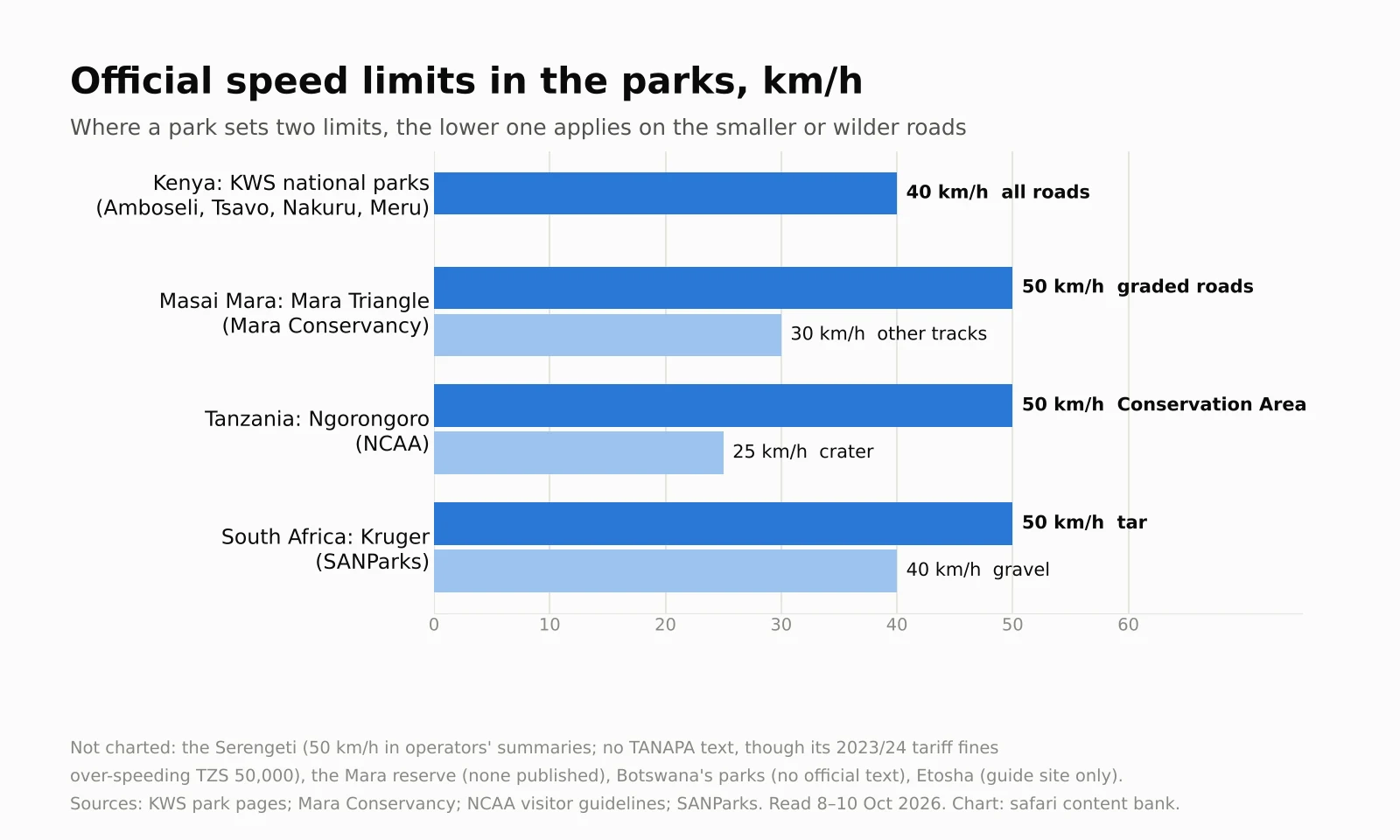 Sources: KWS park pages; Mara Conservancy; NCAA visitor guidelines; SANParks. The Serengeti, the Mara reserve, Botswana and Etosha are left out because no official limit is in our sources. Read 8–10 October 2026. Chart: safari content bank.
Self-driving Kruger, with gate times and the full rules of the road: Kruger self-drive.
Night drives and park hours
Public parks close to visitors’ vehicles at dusk; night drives happen on private conservancies and concessions, and in a few parks where the authority sells them.
| Where | Night driving | Source |
|---|---|---|
| Masai Mara reserve | No: the ticket is valid 06:00–18:00 | Narok County fee schedule, on our Masai Mara park fees page |
| KWS national parks | Gates 06:00–18:00; KWS sells night drives “in selected Parks and Reserves”, which it has not listed | KWS, on our Kenya park fees page |
| Serengeti | No: the day permit covers “twelve daylight hours” | TANAPA Tariffs 2023/24 |
| Ngorongoro | Driving 06:00–18:00; beyond these hours “permission must be obtained” | NCAA visitor guidelines |
| Kruger | Not in private vehicles | SANParks |
| Botswana: Chobe, Moremi, Central Kalahari, Makgadikgadi, Nxai Pan | No: “off-roading and night driving [are] prohibited” in the parks and reserves | Botswana Tourism |
| Botswana: Moremi Game Reserve | No night drives and no walking: “Night drives and walking safaris are not permitted within the reserve” | One safari operator’s Moremi guide |
| Botswana: private and community concessions (Khwai, Selinda, Linyanti and others) | Yes, done “in moderation” | Botswana Tourism |
Read 8–10 October 2026.
- The rule follows the land, not the camp’s price. A camp inside a park works under park rules; a camp on a concession can drive at night (where night drives, walking and off-road driving are allowed in Botswana).
- Be inside your camp or out of the gate by closing time. In the Mara a ticket “will not carry overnight” (Masai Mara park fees).
Where night drives are sold, country by country: night drive safari.
In the vehicle: getting out, noise and feeding
Get out only where the park allows it, keep quiet at sightings, and never feed an animal: KWS lists “no feeding” and “no hooting” among its rules.
- Kenya (KWS parks): “Remain in your vehicle unless in designated areas”; view wildlife from at least 20 m; no feeding; no hooting; “Visitors enter the park at their own risk” (KWS, Amboseli).
- Kruger: stay in your vehicle except at designated spots, with no part of your body out of a window or sunroof; quiet from 21:30 to 06:00; mobile phones only in camps, at gates or in emergencies; day visitors may not bring alcohol (SANParks rules).
- Serengeti: leave the vehicle only at designated picnic and observation sites or on ranger-escorted walks (one Tanzanian operator’s park-rules article; we hold no TANAPA text).
- Ngorongoro crater: “A licensed guide or an official NCAA guide must accompany all crater visitors”, and only 4×4 vehicles up to 3,500 kg tare are allowed on the crater floor (NCAA).
- Etosha: stay in your vehicle except in camps and at marked picnic and toilet stops (Etosha).
- Botswana, Tanzania and South Africa: no official feeding rule in our sources. We print none rather than borrow an unofficial summary; follow your guide.
Drones: each country’s official position
Do not pack a drone unless you hold the permits before you travel; no rule in our sources lets a tourist fly one from a game drive.
| Country | Official position | Source |
|---|---|---|
| Kenya | Importing or exporting a drone without prior Kenya Civil Aviation Authority (KCAA) approval is illegal. No flight above 400 ft, within 50 m of any person, vehicle or structure, or at night; no image of a person without that person’s written consent | FCDO; KCAA UAS Regulations 2020 (PDF) |
| Tanzania | Non-residents apply at least 3 weeks before arrival; “Without TCAA Import Permit, the drone will be confiscated at the entry point upon arrival”. No flight in restricted areas “or any other area notified by the Authority” without written permission | TCAA, drones; TCAA RPAS Regulations 2018, reg. 19 |
| South Africa | SANParks bans drones in and over its parks, including Kruger | SANParks rules |
| Namibia | Civil aviation authorisation at least 60 days ahead, plus environment ministry permission for any national park | Secondary summary, as on our safari packing list |
| Uganda, Rwanda | Neither UWA nor RDB publishes a drone rule on the pages we checked | Gorilla trekking day |
| Botswana, Zambia, Zimbabwe | No official drone rule in our sources | — |
Read 8–10 October 2026. Permit costs, and the KWS park fee for drones: photography safari.
Plastic bags and litter
Kenya’s parks list single-use plastic as prohibited; for Tanzania and Rwanda we hold no official text, so we print no rule for either.
| Country | What our sources show | Source |
|---|---|---|
| Kenya, KWS national parks | Single-use plastic listed as prohibited in the parks’ safety guidelines | KWS, Amboseli |
| Kenya, nationwide | Ban on single-use plastic carrier bags since 28 August 2017, which travellers report applies to luggage; plastic bottles are not banned | Traveller reports on HolidayCheck and Routard |
| Tanzania | No official text in our sources | — |
| Rwanda | No official text in our sources | — |
Read 8–10 October 2026. What else to leave at home: safari packing list.
Photographing people, and what to wear
Ask before you photograph anyone; in Kenya, posting an identifiable person’s photo without consent has already drawn regulator action against businesses.
- Kenya treats a photo of an identifiable person as personal data. The Data Protection Act 2019 defines personal data as “any information relating to an identified or identifiable natural person”, and the Office of the Data Protection Commissioner issued 2023 determinations against a bar and a school for posting people’s photographs without consent.
- Kenya’s drone rules require a person’s written consent before you capture their image from a drone (KCAA UAS Regulations 2020, reg. 41).
- Cultural visits are paid visits. One Tanzanian operator quotes US$30–200 per person for an organised village visit; agree any photography payment before you shoot.
- Do not post where you saw a rhino. A wildlife photographer advises stripping GPS, EXIF data and geotags before posting rhino photos (where to see rhino).
- Dress: wear neutral colours, and avoid dark blue and black where tsetse flies live (an operator’s guide). We found no official text banning camouflage clothing in any safari country in our sources; details on our safari packing list. For gorilla treks, Visit Rwanda’s official list is long trousers and sleeves, gloves, boots with gaiters and a rain jacket.
Tipping is etiquette too, and it has its own page: how much to tip on safari.
Gorilla trekking rules
Eight visitors per gorilla family, one hour with the gorillas, nobody under 15, and no trekking when you are ill. Gorillas catch human diseases: respiratory illness is linked to about 20% of sudden gorilla deaths (Wikipedia, Mountain gorilla).
| Rule | Uganda (Bwindi, Mgahinga) | Rwanda (Volcanoes NP) |
|---|---|---|
| Visitors per family per day | 8 (UWA) | 8 (RDB) |
| Time with the gorillas | 1 hour (UWA) | 1 hour maximum (RDB) |
| Minimum age | 15 (UWA tariff) | 15 (RDB) |
| Minimum distance | Not printed: UWA documents give different figures | 7 m (RDB booking portal) |
| If you are ill | Do not trek (UWA) | Not stated on RDB’s pages |
| Masks | No rule on the UWA pages we checked | No rule on RDB’s pages |
| Photography and drones | No rule published on the pages we checked | No rule published on the pages we checked |
Sources: UWA Bwindi brochure and Conservation Tariff July 2024–June 2026; Visit Rwanda and the RDB booking portal. Checked 8–9 October 2026, as on our gorilla trekking day page.
- Rangers explain the rules at the briefing (Visit Rwanda); the guide’s instructions on the day are the ones that count.
- Being ill is not a free reschedule. Uganda’s low-season permits (April, May, November) cannot be rescheduled, and late rescheduling of other permits costs 25% of the fee (UWA). Prices and terms: gorilla permit prices.
Fines: what the authorities actually publish
Only two fines appear in official texts we hold; for the rest, our sources either disagree or name no amount, so we print none.
| Offence | Penalty | Source |
|---|---|---|
| Over-speeding, TANAPA parks | TZS 50,000 | TANAPA Tariffs 2023/24 (PDF), the last published tariff |
| Breaking Mara Triangle rules | Fines paid on the spot; failure to pay “can result in banishment from the Mara Triangle for a period of six months” (no amounts published) | Mara Conservancy park rules |
| Drone without a TCAA import permit | Confiscated at the entry point | TCAA |
| Off-road driving, Masai Mara reserve | Our sources disagree on the amount, so we print none | — |
| Off-road driving, Serengeti | “Will be fined”, per a self-drive operator’s guide; no amount in the tariff | — |
Read 8–10 October 2026.
Park, conservancy or concession: which rules apply?
Choose private land if you want night drives, walks or off-road tracking; choose a public park for the big set pieces, and accept its rules.
| If you want… | Choose | Why |
|---|---|---|
| Night drives | A conservancy or concession, or a park that sells them | Banned in Botswana’s parks and reserves, the Serengeti and the Mara reserve |
| Off-road tracking of a leopard or wild dog | A private concession or conservancy | Public parks keep vehicles on the tracks |
| Fewer vehicles at a sighting | A conservancy with a published cap (Lewa: 2; Ol Pejeta: 6) | Most big parks publish no cap |
| Walking with a guide | A concession, or a park that sells walks | Not permitted in Moremi; see walking safari |
| River crossings, Ngorongoro Crater | The Mara reserve, the Serengeti, the NCA | Park rules apply in full |
Outside the parks, the rules on cub petting, lion walks, elephant rides and sanctuary visits are a trade guideline rather than a law; see ethical wildlife activities.
Common mistakes
| Mistake | Correction |
|---|---|
| “Off-road is fine if the guide says so” | In the Mara reserve only a direct approach to big cats is allowed, no nearer than 25 m; elsewhere in public parks, tracks only. |
| “A few more vehicles won’t matter” | The Mara reserve’s cap is five; the next waits 100 m back (Narok County plan). |
| “Night drives are part of any safari” | Not in Botswana’s parks and reserves, the Serengeti or the Mara reserve; only on concessions, conservancies or parks that sell them. |
| “I can stretch my legs anywhere quiet” | KWS: “Remain in your vehicle unless in designated areas”; Kruger: designated spots only. |
| “A park ticket covers my drone” | Kenya needs prior KCAA approval; Tanzania confiscates drones without a TCAA import permit; SANParks bans them. |
| “A mild cold won’t matter on a gorilla trek” | UWA says do not trek if ill; gorillas catch human respiratory disease. |
| “Photos of people are fine if I don’t post them” | Ask first anyway; in Kenya, posting without consent has led to data-protection determinations. |
| “Sharing a rhino photo with location is harmless” | Strip GPS and geotags first, as photographers advise. |
Frequently asked questions
Can you get out of the vehicle on safari? Only where the park allows it. KWS parks say “Remain in your vehicle unless in designated areas”, and Kruger allows it only at designated spots, with no part of your body out of a window. In the Serengeti, operators say only at picnic and observation sites or on ranger-escorted walks.
How many vehicles are allowed at a sighting? Five in the Masai Mara reserve, with the next waiting at least 100 m away (Narok County plan). In the Mara Triangle viewing time is limited to 10 minutes once more than five vehicles wait. Ol Pejeta allows six and Lewa two; we found no cap for the Serengeti, Kruger, Chobe or Moremi.
Is off-road driving allowed on safari? Not in public parks: KWS calls it “strictly prohibited”, Kruger and Ngorongoro ban it, and Botswana Tourism bans it in the parks and reserves. The Mara reserve allows only a direct approach to big cats on nearby open ground, no nearer than 25 m. Private concessions and conservancies allow it.
Are night drives allowed in national parks? Mostly not. Botswana bans night driving in its parks and reserves, Moremi bans night drives and walking, the Serengeti permit covers twelve daylight hours and the Mara ticket runs 06:00–18:00. Night drives run on concessions and conservancies, and KWS sells them in selected parks it has not listed.
What is the speed limit in safari parks? 40 km/h in Kenya’s KWS parks; 50 km/h on graded roads and 30 km/h on other tracks in the Mara Triangle; 50 km/h in the Ngorongoro Conservation Area and 25 km/h in the crater; 50 km/h on tar and 40 km/h on gravel in Kruger. TANAPA’s 2023/24 tariff fines over-speeding TZS 50,000.
Can I fly a drone on safari? Not without permits arranged before you travel. Kenya requires prior KCAA approval to import one, Tanzania confiscates drones without a TCAA import permit at the entry point, and SANParks bans drones in and over its parks. We found no drone rule from UWA, RDB or Botswana.
What are the gorilla trekking rules? Eight visitors per family, one hour with the gorillas and a minimum age of 15 in both Uganda and Rwanda. Rwanda’s booking portal sets a 7 m distance; UWA’s documents give different figures. UWA says do not trek if you are ill, because gorillas catch human respiratory disease.
Are plastic bags banned on safari? In Kenya, yes: KWS parks list single-use plastic as prohibited, and the national carrier-bag ban since 28 August 2017 applies to luggage, travellers report. We hold no official text for Tanzania or Rwanda, so we state no rule for either; leave carrier bags at home to be safe.
Sources
- Kenya: KWS park pages, Amboseli, Tsavo East, Lake Nakuru and Meru (read October 2026); Narok County’s Greater Maasai Mara Ecosystem Management Plan 2023–2032, via Business Daily; Mara Conservancy, park rules and driving page; Ol Pejeta Tariff Guide 2026 (PDF); Lewa Code of Conduct; FCDO, Kenya entry requirements; KCAA UAS Regulations 2020 (PDF); Kenya Data Protection Act 2019 and ODPC determinations (2023)
- Tanzania: TANAPA, Tariffs 2023/24 (PDF), the last published tariff; NCAA visitor guidelines; TCAA, drones and RPAS Regulations 2018; two Tanzanian operators’ park-rules summaries (names in our editor notes)
- South Africa: SANParks, Kruger vital information and rules and regulations (read 8 October 2026)
- Botswana: Botswana Tourism, game drives; one safari operator’s Moremi guide (read 10 October 2026)
- Uganda and Rwanda: UWA Bwindi brochure and Conservation Tariff July 2024–June 2026; Visit Rwanda (RDB); RDB booking portal; Wikipedia, Mountain gorilla (checked 8–9 October 2026)
- Namibia: an independent Etosha guide site, as on our Etosha page; drone rules from a secondary summary, as on our safari packing list
- General: National Geographic, self-drive safaris; traveller reports on HolidayCheck and Routard (not fact)
Rules checked against the sources above 8–10 October 2026. We will update this page when TANAPA publishes a new tariff or written park rules, when DWNP publishes Botswana’s park rules, when UWA publishes one gorilla distance rule, and when we find official plastic-bag rules for Tanzania and Rwanda.