 Experience

Last verified · Next check due
On this page
- When are the river crossings?
- Where the crossings happen: northern Serengeti or Masai Mara
- How predictable are the crossings?
- Rules and etiquette at a crossing point
- Park fees on each side of the river
- Where to stay for the crossings, and what a night costs
- Which bank should you choose?
- River crossings or calving season?
- Common mistakes about river crossings
- Frequently asked questions
- Sources
Short answer: The wildebeest cross the Mara River from July to October, busiest in August–September, seen from both banks: the northern Serengeti (Kogatende, Lamai) in Tanzania and the Masai Mara in Kenya. Grumeti River crossings come earlier, in about the first half of June. Nobody publishes odds or can date a crossing. Crossing-season fees: US$153.40 per adult per night inside the Serengeti (last published tariff, 2023/24) and US$200 per adult per day in the Mara reserve.
Key facts
- Two rivers, two seasons. The Grumeti, in the Serengeti’s Western Corridor, is crossed in about the first half of June; the Mara River, on the Kenya–Tanzania border, from July to October, with August the month every calendar agrees on (Great Migration month by month).
- The Mara River crossings are seen from two countries. In Tanzania from Kogatende and the Lamai Wedge in the northern Serengeti; in Kenya from the Masai Mara reserve, including the Mara Triangle. The Mara Conservancy names the Sand River and the Mara River as the rivers the herds cross on the Kenyan side (Mara Conservancy).
- No one can date a crossing. The Mara Conservancy says crossings “happen frequently during the migration but are difficult to predict”; a Mara camp operator says “we cannot guarantee the timing”. In 2026 the first Mara crossings were reported in the second week of July (traveller reports, TripAdvisor).
- Neither authority publishes rules written for crossing points. The general sighting rules apply: in the Mara reserve, five vehicles at a sighting and the next waits at least 100 m away (Business Daily, reporting Narok County’s management plan).
- The Mara fee doubles on 1 July, as crossing season starts: US$100 per adult per day from January to June, US$200 from July to December. Narok County’s FY2025/26 schedule expired on 30 June 2026; The Kenya Times (6 August 2026, a press report) says US$200 still applies for July–December (Masai Mara park fees).
- There is no road across the river between the two parks. The Sand River–Bologonja crossing has been closed since 1977 (The EastAfrican, 4 Apr 2017); switching banks means a flight via Migori and Tarime (Mara to Serengeti).
When are the river crossings?
The Grumeti is crossed in about the first half of June, and the Mara River from July to October, with crossings mostly from south to north in August and in both directions in September. Every row is a historical pattern from operator calendars, not a forecast. One camp operator’s migration guide: “timing all depends on the rains”, and rainfall “is becoming more unpredictable”.
| Month | Grumeti River (Western Corridor, Tanzania) | Mara River, Tanzanian bank (Kogatende, Lamai) | Mara River, Kenyan bank (reserve, Mara Triangle) | Fee per adult that month |
|---|---|---|---|---|
| June | Crossings, about the first half of June | No crossings yet | Usually no herds yet | Serengeti US$141.60 a night inside; Mara US$100 a day |
| July | Herds have moved north | Crossings begin; lead herds at Kogatende | First arrivals, usually from mid or late July | Serengeti US$153.40; Mara US$200 |
| August | — | Crossings, mostly south to north | Crossings | Serengeti US$153.40; Mara US$200 |
| September | — | Crossings in both directions | Crossings in both directions; most animals in the Mara | Serengeti US$153.40; Mara US$200 |
| October | — | Tail end; crossings can run into early October | Herds leave during the month | Serengeti US$141.60; Mara US$200 |
| November | No crossings | No crossings; herds moving south through the east of the park | No herds | Serengeti US$141.60; Mara US$200 |
Herd positions: a camp operator’s migration guide; one tour operator’s guide, Nov 2021; Mara Conservancy; a Mara camp operator’s migration page; read 9–10 Oct 2026. Fees per non-resident adult: Serengeti entry + concession with 18% VAT, TANAPA Tariffs 2023/24 (PDF), the last published tariff; Mara, Narok County fee schedule FY2025/26 (PDF), the last published.
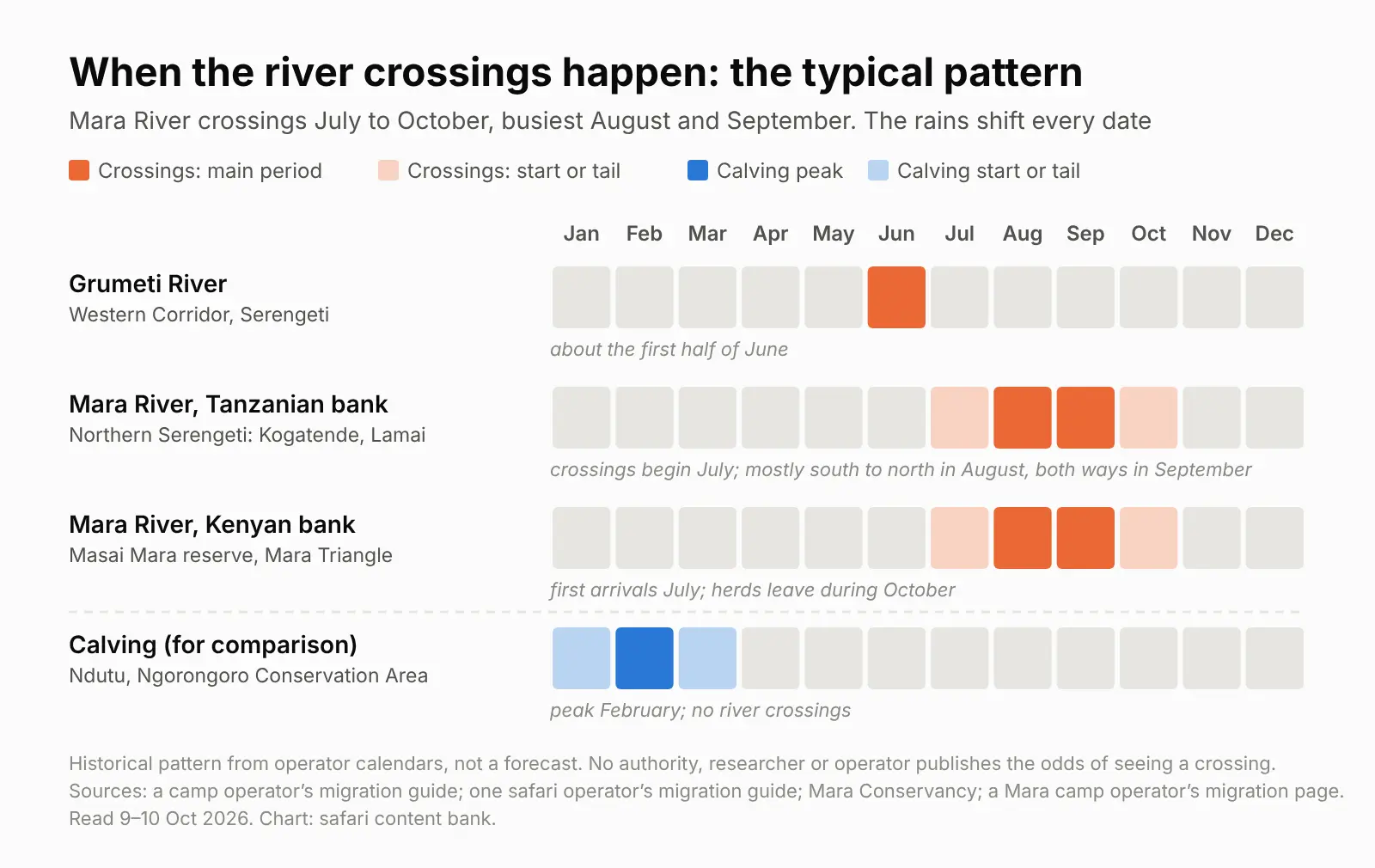 Typical pattern from operator calendars, not a forecast. Sources: a camp operator’s migration guide; one safari operator’s migration guide; Mara Conservancy; a Mara camp operator’s migration page. Read 9–10 October 2026. Chart: safari content bank.
- Early July favours Tanzania. A destination expert on the Serengeti forum: “Most years you would not find the migration in the Masai Mara as early as July 11-15” (TripAdvisor). See safari in July.
- August and September are the safest months on either bank. See safari in August and safari in September.
- October is a gamble. The tail end crosses back into Tanzania toward Lobo, and Lemala Mara Tented Camp drops from US$825 to US$560 per person a night in October 2026 (Lemala rates). See safari in October.
- The Grumeti is a smaller river than the Mara, with a shorter window, and harder to time (a camp operator’s migration guide; one tour operator’s guide). June detail: safari in June.
Where the crossings happen: northern Serengeti or Masai Mara
The Mara River crossings can be watched from the northern Serengeti in Tanzania, around Kogatende and the Lamai Wedge, or from the Masai Mara reserve in Kenya, including the Mara Triangle; Kogatende and Lamai sit just south of the Kenya border, next to the Mara Triangle. The two banks have different authorities, fees, rules and visas.
| Tanzanian bank: northern Serengeti | Kenyan bank: Masai Mara reserve | |
|---|---|---|
| Areas | Kogatende, Lamai Wedge | Narok-run reserve; the Mara Triangle, run by the Mara Conservancy |
| Authority | Tanzania National Parks (TANAPA) | Narok County; the Mara Conservancy in the Triangle |
| Crossing months | July–October; lead herds at Kogatende in July | Usually from mid or late July to October |
| Park fee per adult, Jul–Sep | US$153.40 a night inside (entry US$82.60 + concession US$70.80), last published tariff, 2023/24 | US$200 per 06:00–18:00 day |
| Published sighting rules | No per-sighting limit published | Five vehicles; the next waits at least 100 m away |
| Night drives, walks, off-road | No night drives in the national park; ranger-led walks are on the TANAPA tariff; tracks only, per operators’ summaries | None of the three in the reserve; sold in the conservancies next door, away from the crossing points |
| Getting there | Flightlink flies to Kogatende, Regional Air to Lamai; by road, Seronera → Kogatende 4–5 hours | Nairobi Wilson → Mara 45–60 minutes by air; Nairobi → Sekenani Gate 5.5–6 hours on tarmac |
| Entry document | Tanzania tourist visa US$50 (US citizens US$100) | Kenya eTA US$30 plus card charges |
Sources: TANAPA Tariffs 2023/24 (PDF), the last published tariff; Narok County FY2025/26 schedule, the last published; Business Daily on Narok County’s plan; flights: Serengeti and Nairobi to the Masai Mara; drive times: one operator’s airstrip page and The Kenya Times, 20 Aug 2026; visas: Kenya visa and Tanzania visa. Read 9–11 Oct 2026.
- No source names the individual crossing points. The Mara Conservancy says the herds show at the Sand River first, then at Look-Out Hill and the Mara River; it gives no list of crossing sites, and we print none.
- The Serengeti side is far from Arusha. Arusha → Seronera is 7–7.5 hours and Seronera → Kogatende 4–5 hours more, so a drive-in crossing safari takes two days each way; most travellers fly (Mara to Serengeti).
- The whole-country picture: Tanzania and Kenya hubs; side-by-side, Serengeti vs Masai Mara.
How predictable are the crossings?
Not predictable: the month is fairly reliable, but the day and the hour are not, and no authority, researcher or operator publishes the odds of seeing a crossing. Anyone quoting a percentage is guessing.
| What our sources say | Who says it |
|---|---|
| Crossings “happen frequently during the migration but are difficult to predict” | Mara Conservancy, which runs the Mara Triangle |
| “We cannot guarantee the timing” | A Mara camp operator’s migration page |
| The timing “is entirely dependent upon the rainfall patterns each year” | One safari operator’s migration guide |
| Herds may wait on the bank for days, or cross at once | One tour operator’s guide, Nov 2021 |
| “Hours and days and even weeks can go by between crossings” | A regular on the TripAdvisor Serengeti forum (traveller report) |
| “Trying to view a crossing often takes lots of waiting” | TripAdvisor Kenya forum (traveller report) |
| First Mara crossings of 2026 reported in the second week of July | TripAdvisor Masai Mara forum (traveller reports) |
Read 9–10 October 2026.
- The only lever is time at the river. More days near the river in August–September raise your chances; a crossing day usually means hours parked at the bank and giving up other game drives (TripAdvisor Serengeti forum).
- How many nights? A destination expert on the Serengeti forum suggests “2 or preferably 3 nights Northern Serengeti” on a trip that also covers the centre of the park (TripAdvisor).
- Mobile camps “move with the herds and offer the closest access” (one tour operator’s guide), which helps in a year when the herds run early or late.
Rules and etiquette at a crossing point
Neither TANAPA nor Narok County publishes rules written for river crossings; the general rules for sightings, tracks and hours apply, and only the Mara reserve has a written limit on vehicles at a sighting.
| Rule | Serengeti National Park (Tanzanian bank) | Masai Mara reserve (Kenyan bank) | Mara Triangle (Kenyan bank, Mara Conservancy) |
|---|---|---|---|
| Vehicles at a sighting | No published limit found | Five; the next vehicle stops and waits at least 100 m away | Viewing time is limited once more than five vehicles are waiting; the county plan and the Mara Conservancy give different time limits |
| Off-road driving | Visitors “must keep to the authorized tracks only and will be fined if found off the main tracks” (one self-drive operator’s guide; not in the tariff) | Prohibited, except to approach big cats on nearby open ground, no nearer than 25 m, then straight back to the track | As the reserve |
| Leaving the vehicle | Only at designated picnic and observation sites, or on ranger-escorted walks (an operator’s park-rules article) | Not stated in our sources | Not stated in our sources |
| Hours | Day permit for “twelve daylight hours”; no night drives | Ticket valid 06:00–18:00; no night drives | As the reserve |
| Speed | 50 km/h (an operator’s park-rules article); the tariff fines over-speeding TZS 50,000 | Not published in our sources | 50 km/h on graded roads, 30 km/h on other tracks |
| Fines | Over-speeding TZS 50,000 (TANAPA tariff) | Our sources disagree on the off-road fine, so we print none | Paid on the spot; failure to pay “can result in banishment from the Mara Triangle for a period of six months” |
| Private cars | Self-drive is legal | Banned from game drives by Narok County’s memo of 3 June 2024 | — |
Sources: TANAPA Tariffs 2023/24 (PDF), the last published tariff; Business Daily, reporting Narok County’s Greater Maasai Mara Ecosystem Management Plan 2023–2032; Mara Conservancy park rules and driving page; Kenyans.co.ke, 4 Jun 2024; Serengeti track and vehicle rules: operators’ summaries. Read 9–10 Oct 2026.
What this means on the bank:
- Do not block the animals’ route. National Geographic’s self-drive safari advice: keep your distance, drive slowly, stay in the vehicle and “do not block an animal’s route” (National Geographic).
- Stay on the track and in the vehicle, on both banks. In the Mara reserve, driving off the track to the river is not one of the permitted exceptions, which cover only big cats on nearby open ground (Narok County plan, via Business Daily).
- Expect a crowd and wait your turn. “It is not uncommon for fifty or more trucks to be parked” at a Serengeti crossing point, according to a forum regular (TripAdvisor); Mara reviewers describe being “surrounded by 20–30 vehicles” in August 2025 (a safari booking site’s reviews, traveller reports). No authority counts vehicles at crossings.
- Plan the day around the 06:00–18:00 ticket in the Mara. A ticket “will not carry overnight”, so a crossing watch on your departure day needs another day’s ticket (Masai Mara park fees).
Park fees on each side of the river
In crossing season a night inside the Serengeti costs US$153.40 per adult in park fees (July–September; US$141.60 in October), and a day in the Masai Mara reserve costs US$200 per adult; a Mara conservancy charges US$130 per adult per night instead, plus the reserve fee on the day you drive in for a crossing.
| Dates | Serengeti, per night inside (entry + concession, with 18% VAT) | Masai Mara reserve, per 12-hour day | Mara conservancy, per night (camps’ 2026 sheets) |
|---|---|---|---|
| 1–30 Jun (Grumeti crossings) | US$82.60 + US$59 = US$141.60 | US$100 | US$130 |
| 1 Jul–30 Sep | US$82.60 + US$70.80 = US$153.40 | US$200 | US$130, + US$200 on a reserve day |
| 1–31 Oct | US$82.60 + US$59 = US$141.60 | US$200 | US$130, + US$200 on a reserve day |
Non-East African / non-resident adult. Sources: TANAPA Tariffs 2023/24 (PDF), the last published tariff (no newer TANAPA tariff had been published on 9 Oct 2026); Narok County fee schedule FY2025/26 (PDF), the last published, expired 30 June 2026, with July–December 2026 per The Kenya Times, 6 Aug 2026 (secondary); conservancy fee: Kicheche 2026. Totals are our sums.
- Mobile camps in the Serengeti pay the special campsite fee instead of the concession fee, at the same US$70.80 in July–September and US$59 from October (last published tariff, 2023/24).
- The Mara fee is per calendar day you enter, whether you sleep inside or outside the reserve. Three days in August cost US$600 per adult (our sum).
- The Mara Triangle charges the same per-person rates as the Narok side; its gates take no cash, only M-Pesa or card, or KAPS online with Visa (Masai Mara park fees).
- Fee detail by park: Serengeti park fees, Masai Mara park fees, Tanzania park fees and Kenya park fees.
The official fee lines, with the date each took effect and the authority’s own source:
| Fee | Amount | In force from | Source |
|---|---|---|---|
| Serengeti and Nyerere National Parks, non-East African adult, entry per day, 16 May–14 Mar | USD 70 + 18% VAT = USD 82.60 | 1 Jul 2023 (2023/24 tariff, last published) | TANAPA Tariffs 2023/24 |
| Serengeti and Nyerere, concession fee per person per night inside the park | Jul–Sep USD 60 + VAT = USD 70.80; Oct–Jun USD 50 + VAT = USD 59 | 1 Jul 2023 (2023/24 tariff, last published) | TANAPA Tariffs 2023/24 |
| Serengeti special campsite (used by mobile camps), adult, per night | Jul–Sep USD 60 + VAT = USD 70.80; Oct–Jun USD 50 + VAT = USD 59 | 1 Jul 2023 (2023/24 tariff, last published) | TANAPA Tariffs 2023/24 |
| Ngorongoro Conservation Area, non-East African adult, entry per 24 h (single entry) | USD 70.80 (NCAA's page does not say whether VAT is included) | Undated official page, read 9 Oct 2026 | NCAA |
| Maasai Mara National Reserve, non-resident adult, per day (12-hour ticket, 06:00–18:00), 1 Jan–30 Jun | USD 100 | Since 1 Jan 2024; Narok County FY2025/26 schedule, the last published | Narok County fee schedule FY2025/26 |
| Maasai Mara National Reserve, non-resident adult, per day (12-hour ticket, 06:00–18:00), 1 Jul–31 Dec | USD 200 | Since 1 Jul 2024; Narok County FY2025/26 schedule, the last published, expired 30 Jun 2026 (no 2026/27 schedule as of 9 Oct 2026); The Kenya Times (6 Aug 2026, secondary) reports US$200 still applies for Jul–Dec 2026 | Narok County fee schedule FY2025/26 |
Where to stay for the crossings, and what a night costs
Published crossing-season rates near the Mara River run from US$445 per person a night at a mobile camp at Kogatende to US$2,250 at Sayari on the Tanzanian bank, and from about US$495 at Mara Serena to US$2,028 at Wilderness Mara on the Kenyan bank, before or including fees as shown.
| Bank | Camp, where | Per person per night, crossing season 2026 | Fees to add per adult | Our sum, one August night | Source |
|---|---|---|---|---|---|
| Tanzanian | Camp Zebra, Kogatende (mobile); meals and drinks, no game drives | US$445 | US$153.40 | US$598.40 + vehicle and guide | An agent listing |
| Tanzanian | Lemala Mara Tented Camp, Mara River (open June–October) | US$825 1 Jul–30 Sep; US$560 Oct 2026 | US$153.40 | US$978.40 + vehicle and guide | Lemala rates |
| Tanzanian | Ubuntu Migration Camp, Lamai (mobile); game drives included | US$1,080 | US$153.40 | US$1,233.40 | An agent listing |
| Tanzanian | Sayari, near the Mara River; game drives included | US$2,250 1 Jul–31 Oct | US$153.40 | US$2,403.40 | An agent listing |
| Kenyan | Mara Serena Safari Lodge, Mara Triangle | about US$495 (US$989 per room 16 Jun–30 Sep, halved) | US$200 reserve fee | about US$695 | An agent listing (secondary) |
| Kenyan | Governors’ Camp, on the Mara River in the reserve | US$998 Jul–Oct | US$200 reserve fee + US$50 community fee | US$1,248 | Governors’ 2026 |
| Kenyan | Kicheche Mara North, conservancy | US$995 Jul–Oct | US$130 conservancy fee; + US$200 on a reserve day | US$1,125; US$1,325 on a crossing day in the reserve | Kicheche 2026 |
| Kenyan | Wilderness Mara, Mara Triangle | US$2,028 1 Jun–31 Oct 2026 | None: “Conservation levy and government taxes are included” | US$2,028 | Wilderness |
Per person sharing, full board, read 9–10 October 2026. Lemala excludes government levies, the guide and the vehicle; Ubuntu and Sayari include game drives and exclude park fees; Governors’ and Kicheche include game drives. The Mara Serena figure is an agent’s per-room price halved (our sum). One August night totals are our sums with the fees in the table.
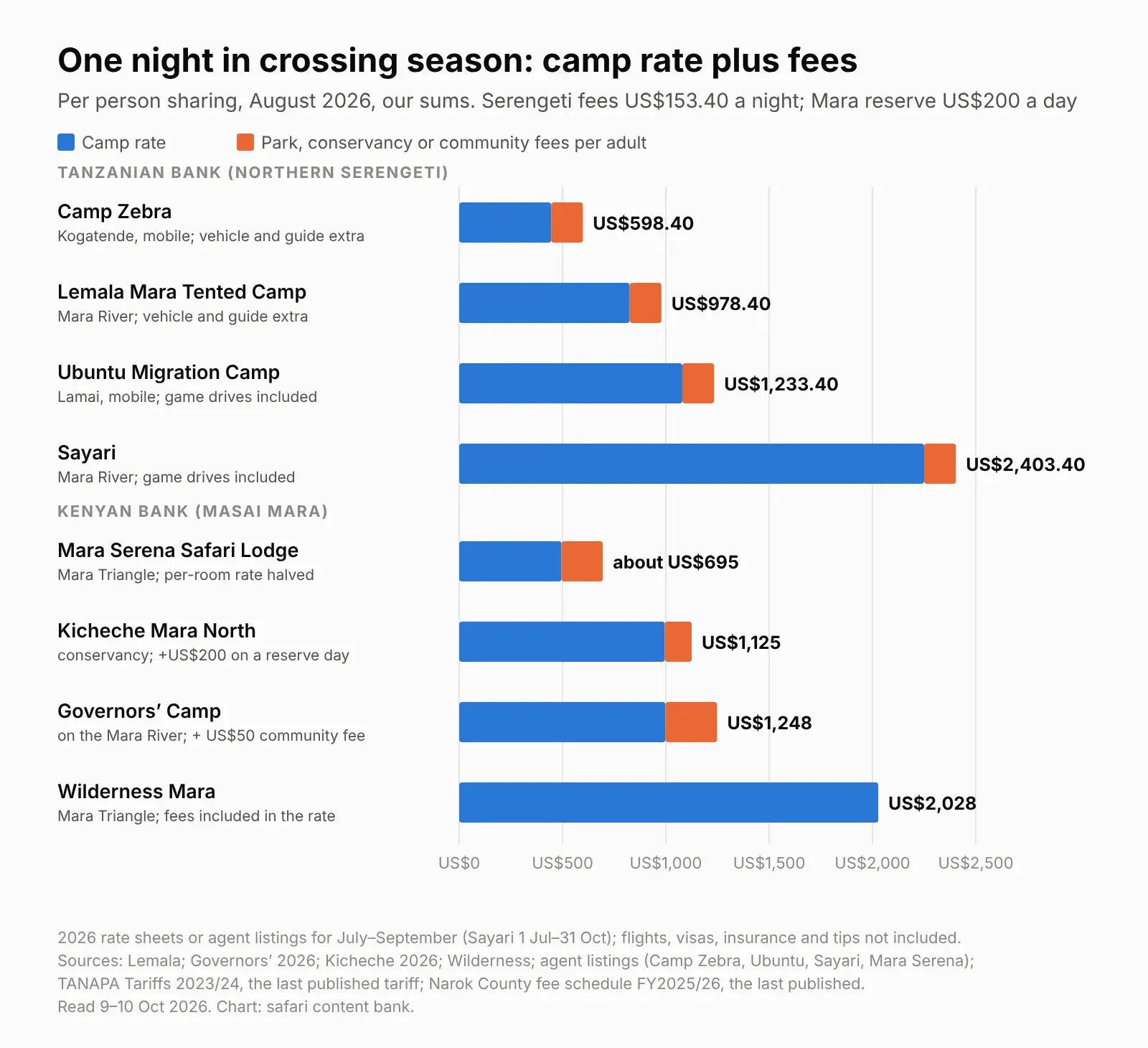 Our sums of camps’ published 2026 rates and park fees. Sources: Lemala; Governors’ 2026; Kicheche 2026; Wilderness; agent listings; TANAPA Tariffs 2023/24, the last published tariff; Narok County FY2025/26, the last published. Chart: safari content bank.
- Three August nights cost US$3,575 at Kicheche Mara North with one reserve day and US$3,744 at Governors’ Camp, before flights (our sums, Masai Mara safari cost).
- Seven August nights at Ubuntu, at Lamai, came to US$8,633.80 per person with park fees (our sum, Great Migration safari cost).
- Reserve camp or conservancy: a conservancy camp is away from the crossing points, so its guests drive into the reserve for a crossing day and pay that day’s ticket. One safari agent says most conservancy camps include a day in the reserve per three-night stay; check whether yours does (Mara reserve vs conservancies).
- A camp’s name is not its location. Forum regulars warn that camps with “Mara” in the name can be far from the river (TripAdvisor). Check the camp’s sector on a map against your dates.
- Book river camps early. One safari operator advises 12–18 months ahead for July–October; forum regulars say 9–12 months, and call planning in March for the same July “very late” (TripAdvisor).
- For the Grumeti in June, the Western Corridor bases named in one safari operator’s area guide are Mbalageti Lodge and Grumeti River Lodge; in the private Grumeti reserve outside the park, Singita Sabora and Faru Faru charge US$3,220 per person a night from 16 May to 30 September, plus a US$177 wildlife fee per adult per night (safari in June).
Which bank should you choose?
Choose the northern Serengeti for early July, mobile camps and a Tanzania trip; choose the Masai Mara for a short trip from Nairobi, written sighting rules and a conservancy base; in August–September either bank works.
| Your situation | Go to | Why |
|---|---|---|
| Travelling 1–20 July | Northern Serengeti (Kogatende, Lamai) | The lead herds reach northern Tanzania first |
| Travelling August–September | Either bank | Crossings on both sides; choose by the rest of the trip and the budget |
| Travelling October | Northern Serengeti early in the month | The tail end crosses back into Tanzania toward Lobo |
| 3–4 nights from Nairobi | Masai Mara | Nairobi Wilson → Mara is 45–60 minutes by air |
| Combining with Ngorongoro or Zanzibar | Northern Serengeti | Same country, one visa |
| Want night drives or off-road driving too | A Mara conservancy, plus a day in the reserve | The reserve sells neither, and the Serengeti National Park has no night drives |
| Want written vehicle limits at sightings | Masai Mara reserve or the Mara Triangle | Five vehicles at a sighting; the Serengeti publishes no limit |
| Want both banks | Fly Mara → Migori → Tarime → Serengeti | The link runs 1 July–31 October; the road between the parks is closed |
Sources: a camp operator’s migration and Mara vs Serengeti guides; TripAdvisor Serengeti forum; Safarilink; Narok County plan via Business Daily. Read 9–10 Oct 2026.
- Both banks on one trip need both entry documents: Kenya’s eTA (US$30 plus card charges) and Tanzania’s visa (US$50, US citizens US$100), plus each country’s government travel insurance, US$44 per adult in Tanzania and up to US$44 in Kenya (eCitizen) (Kenya visa; Tanzania visa; Tanzania visitor insurance; Kenya visitor insurance).
- Arriving in Tanzania from Kenya, travellers aged 1 and over need a yellow fever certificate (WHO), and Safarilink requires the card on the Mara–Serengeti link (Kenya–Tanzania border crossings).
River crossings or calving season?
The crossings are a July–October event on the Mara River in two countries; calving is a January–March event on the southern plains of Tanzania only, and the same migration camps charge the same rate for both.
| River crossings | Calving | |
|---|---|---|
| When | Mara River July–October, busiest August–September; Grumeti about the first half of June | Late January to mid-March, peak February |
| Where | Northern Serengeti (Kogatende, Lamai) and the Masai Mara | Around Ndutu, in the Ngorongoro Conservation Area (NCA), and the Serengeti’s southern plains; Tanzania only |
| What you wait for | A crossing that cannot be dated; often hours at the bank | Calves and the predators they draw, spread across the plains |
| Park fee per adult | Serengeti US$153.40 a night (Jul–Sep); Mara US$200 a day | NCA entry US$70.80 per 24 hours, single entry (NCAA’s page does not say whether VAT is included) |
| Migration camps | Ubuntu US$1,080, Olakira US$1,490, Camp Zebra US$445, Lemala US$825 | The same rates at the same camps’ southern sites |
Sources: a camp operator’s migration guide; NCAA tariffs, read 9 Oct 2026; TANAPA Tariffs 2023/24, the last published tariff; camp rates from Great Migration safari cost. Read 9–10 Oct 2026.
Common mistakes about river crossings
| What you’ll often read | What is correct |
|---|---|
| “A river crossing is guaranteed in August” or “an X% chance of a crossing” | No source guarantees a crossing or publishes odds. The Mara Conservancy calls crossings “difficult to predict”. |
| “The crossings only happen in Kenya” | They are seen from both banks: Kogatende and Lamai in the northern Serengeti, and the Masai Mara reserve. |
| “See the Mara River crossings in June” | June is usually the Grumeti River in the Serengeti’s Western Corridor; the Mara River has no crossings yet. |
| “The migration is in the Masai Mara from 1 July” | In early to mid-July most of the herds are usually still in the northern Serengeti. |
| “Stay in a conservancy and watch crossings from camp” | The crossings are in the reserve. Conservancy guests drive in and pay US$200 for that day from July to December. |
| “The Serengeti side of the river has fewer vehicles” | No source counts vehicles on either bank. A forum regular reports “fifty or more trucks” at a Serengeti crossing point. |
| “Drive across from Kogatende into the Mara” | The Sand River–Bologonja crossing has been closed since 1977. Fly via Migori and Tarime. |
| “Calving season is the cheaper way to see the migration” | The migration camps we checked charge the same in January–February as in July–October. |
Frequently asked questions
When is the best time to see a Mara River crossing? August and September. Crossings run from July to October, mostly south to north in August and in both directions in September, and August is the one month every calendar agrees on (a camp operator’s migration guide). The rains can shift the dates by weeks.
Is a river crossing guaranteed? No. The Mara Conservancy says crossings “happen frequently during the migration but are difficult to predict”, and no authority, researcher or operator publishes odds. Herds may wait on the bank for days; more days near the river is the only lever.
Is the Serengeti or the Masai Mara better for river crossings? Neither in August–September, when the herds cross on both banks. In early and mid-July the northern Serengeti is the better bet, because the lead herds reach Kogatende first. The Mara is quicker to reach from Nairobi; the Serengeti side suits a Tanzania trip with Ngorongoro or Zanzibar.
How much are park fees in river-crossing season? In the Serengeti, US$153.40 per adult per night inside the park in July–September and US$141.60 in October, with VAT (last published tariff, 2023/24). In the Masai Mara reserve, US$200 per adult per day from July to December (Narok County FY2025/26 schedule, the last published). Mara conservancies charge US$130 per adult per night on camps’ 2026 sheets.
Can I see a crossing from a Mara conservancy? Yes, on a day trip into the reserve, where the herds cross the Mara River and the Sand River. You pay the US$200 reserve fee for that day on top of the conservancy fee. Some conservancy camps include a day in the reserve per three-night stay; ask yours.
Are there special rules at the crossing points? Not written ones. Neither TANAPA nor Narok County publishes crossing-point rules; the general rules apply. In the Mara reserve that means staying on the tracks, five vehicles at a sighting with the next 100 m back, and a 06:00–18:00 ticket; in the Serengeti, authorized tracks only and no night drives.
When are the Grumeti River crossings? In about the first half of June, in the Serengeti’s Western Corridor (a camp operator’s migration guide). The Grumeti is smaller than the Mara, with a shorter window that is harder to time. A night inside the Serengeti costs US$141.60 per adult in June (last published tariff, 2023/24).
Can I see the crossings from both Kenya and Tanzania on one trip? Yes, but not by road across the river: the border between the parks has been closed since 1977. Safarilink flies from the Mara to Migori and Coastal Aviation from Tarime to the Serengeti, from 1 July to 31 October. You need Kenya’s eTA, Tanzania’s visa and a yellow fever certificate.
Sources
- A camp operator’s migration and Mara vs Serengeti guides; one safari operator’s migration and area guides; one tour operator’s migration guide, dated 9 Nov 2021; another operator’s Great Migration page, modified 6 Oct 2026; one operator’s airstrip page (names and links kept in our editor notes), read 9 Oct 2026
- Mara Conservancy, wildebeest migration, park rules and driving to the Mara Triangle; a Mara camp operator’s migration page, read 9 Oct 2026
- Business Daily, Private cars in Maasai Mara: facts versus misunderstanding, on Narok County’s Greater Maasai Mara Ecosystem Management Plan 2023–2032; Kenyans.co.ke, Maasai Mara bans self-drive cars, 4 Jun 2024; National Geographic, self-drive safaris
- TANAPA, Tariffs 2023/24 (PDF), the last published national parks tariff; NCAA, Tariffs, read 9 Oct 2026; Narok County, Maasai Mara fee schedule FY2025/26 (PDF), the last published, expired 30 Jun 2026; The Kenya Times, Masai Mara fees 2026, 6 Aug 2026 (press, secondary)
- Camp rates: Lemala rates; Governors’ 2026 (PDF); Kicheche 2026 (PDF); Wilderness Mara; agent listings for Camp Zebra, Ubuntu Migration Camp, Sayari and Mara Serena (names and links kept in our editor notes)
- Access: The EastAfrican, Bologonja border, 4 Apr 2017; Safarilink, Masai Mara to Serengeti; The Kenya Times, Nairobi to the Mara, 20 Aug 2026
- Traveller reports: TripAdvisor Serengeti, Masai Mara and Kenya forums, threads linked in the text, read 9 Oct 2026; a safari booking site’s reviews (August 2025)
Crossing calendar, rules and fees checked 9–10 October 2026. We will update this page when Narok County publishes a 2026/27 Mara fee schedule, when TANAPA publishes a new tariff, if either authority publishes rules for crossing points, and when the 2027 crossing season (July 2027) shows a different timing.