 Experience

Last verified · Next check due
On this page
- Calving season at a glance (2026–27)
- When calving happens, fortnight by fortnight
- Where it happens: NCAA land and TANAPA land
- Where to stay: calving camps and their 2026–27 rates
- Predator action: what you can see and the rules for seeing it
- Rain, roads and health in calving season
- Calving season or river crossings?
- Which base suits you
- What a calving stay costs (our sums)
- Common mistakes about the calving season
- Frequently asked questions
- Sources
Short answer: Wildebeest calve on the short-grass plains around Ndutu and the southern Serengeti from late January to mid-March, with a peak of two to three weeks in February. Ndutu is in the Ngorongoro Conservation Area, so a lodge night there costs US$129.80 per adult in NCAA fees; camps on the Serengeti side pay US$141.60 until 14 March (last published tariff, 2023/24). February camp rates run US$451–2,250 per person, much the same as in river-crossing season.
Key facts
- Calving happens only in Tanzania, on plains that belong to two authorities. Ndutu and Lake Masek are in the Ngorongoro Conservation Area (NCA), run by the NCAA; Kusini, Naabi and Moru are in Serengeti National Park, run by TANAPA. The herds graze across the line (Serengeti; Ngorongoro).
- The window is late January to mid-March; the peak is about two to three weeks in February (a camp operator’s migration guide). No source can date the peak for a given year: timing “is entirely dependent upon the rainfall patterns each year” (one safari operator’s migration guide).
- At the end of March 2023 the Ndutu plains had the lowest wildebeest density in the survey area: the herds had started to leave (TAWIRI 2023 census, PDF).
- Predators follow the calves onto the plains, but no one publishes a sighting rate. Two tour operators’ migration guides describe lions, cheetahs and hyenas on the plains in calving season. Night drives are not allowed in the NCA or the Serengeti.
- It is the wet season. The Serengeti weather station averages 100 mm of rain in February and 130 mm in March (Climates to Travel, an aggregator); February is “the driest month of the wet season” on the southern plains (a camp operator’s migration guide).
- Calving camps charge peak rates. Lemala Ndutu charges US$825 per person a night from 20 December 2026 to 31 March 2027 (Lemala rates), and Ubuntu Migration Camp charges the same US$1,080 at Kusini in February as at the Mara River in August (an agent’s listing).
Calving season at a glance (2026–27)
Go between late January and early March, base at Ndutu or Kusini, and budget for NCAA or TANAPA fees on top of a camp that charges its peak rate.
| Calving season, southern Serengeti and Ndutu | Source | |
|---|---|---|
| When | Late January to mid-March; peak about two to three weeks in February | A camp operator’s migration guide; TripAdvisor Serengeti forum (traveller forum) |
| Where | Ndutu and Lake Masek (NCA); Kusini, Naabi and Moru plains (Serengeti National Park); spreading to the Maswa and Namiri Plains in March | A camp operator’s migration guide |
| Authority and fees, per adult per night | Ndutu lodge US$129.80; Ndutu seasonal camp US$141.60; inside the Serengeti US$141.60 to 14 March, US$129.80 from 15 March | NCAA; TANAPA Tariffs 2023/24 (PDF), last published tariff, 2023/24; our sums |
| Camp rates, February | US$451 (Ndutu Safari Lodge) to US$2,250 (Namiri Plains) per person sharing | Agent’s listings; Lemala |
| Predators | Lions, cheetahs and hyenas on the plains; no sighting rate published | Two tour operators’ migration guides |
| Rain | Serengeti station: 80 mm in January, 100 mm in February, 130 mm in March | Climates to Travel (aggregator); no Ndutu station |
| Crowds | “15–20 vehicles at a single sighting” at Ndutu, March 2026 | TripAdvisor (traveller report) |
| By road from Arusha | About 5.5–6 hours to Ndutu | A Tanzanian operator’s Serengeti guide |
| River crossings | None from January to May | Great Migration month by month |
Read 9–10 October 2026. Fees per non-East African adult: NCAA tariff page, undated, which does not say whether VAT is included; TANAPA Tariffs 2023/24, the last published tariff, with 18% VAT. Camp rates per person sharing per night.
When calving happens, fortnight by fortnight
Most calves are born in a short burst in February; the first come in late January and the last in early March, and by late March the herds are leaving Ndutu. The table is a typical year from operator calendars, not a forecast.
| Period | Herds | Rain (Serengeti station, monthly average) | Fees per adult per night | Camp rates | Verdict |
|---|---|---|---|---|---|
| December | Arriving on the short-grass plains around Ndutu from late November and December | 105 mm; short rains | Serengeti US$141.60; Ndutu US$129.80 | Lemala Ndutu US$330 to 19 December 2026, then US$825 | Herds settling; no calving yet |
| January | Southern plains from Moru south to Naabi, Kusini and Ndutu; first calves; thunderstorms | 80 mm | Same | Lemala Ndutu US$825; Ubuntu US$1,080 from 20 December | Early; the herds may still be spread out |
| February | Ndutu–Kusini, toward the Ngorongoro highlands; peak calving | 100 mm; “the driest month of the wet season” | Same | Peak at every calving camp we checked | The peak |
| 1–14 March | Still Ndutu–Kusini; last calves; spreading to the Maswa and Namiri Plains | 130 mm for the month | Serengeti US$141.60 to 14 March | Ubuntu US$780; Camp Zebra US$325; Lemala Ndutu still US$825 | Late calving, lower rates at some camps |
| 15–31 March | Long rains start late in the month; herds may already be leaving Ndutu | Same | Serengeti US$129.80 from 15 March; Ndutu unchanged | Ubuntu leaves Kusini mid-March | Edge of the window |
| April | Southern and central Serengeti, moving north | 155 mm, the wettest month | Serengeti US$129.80 | Lemala Ndutu closed; Ndutu Safari Lodge US$305 | Calving over |
Herds: a camp operator’s migration guide; one safari operator’s migration guide; TAWIRI 2023 census (PDF). Rain: Climates to Travel, Serengeti station, 1,400 m, an aggregator. Fees: TANAPA, last published tariff, 2023/24; NCAA. Rates: Lemala (2026/27); agent’s listings (Ubuntu 2026–27; Camp Zebra and Ndutu Safari Lodge 2026). Read 9–10 October 2026.
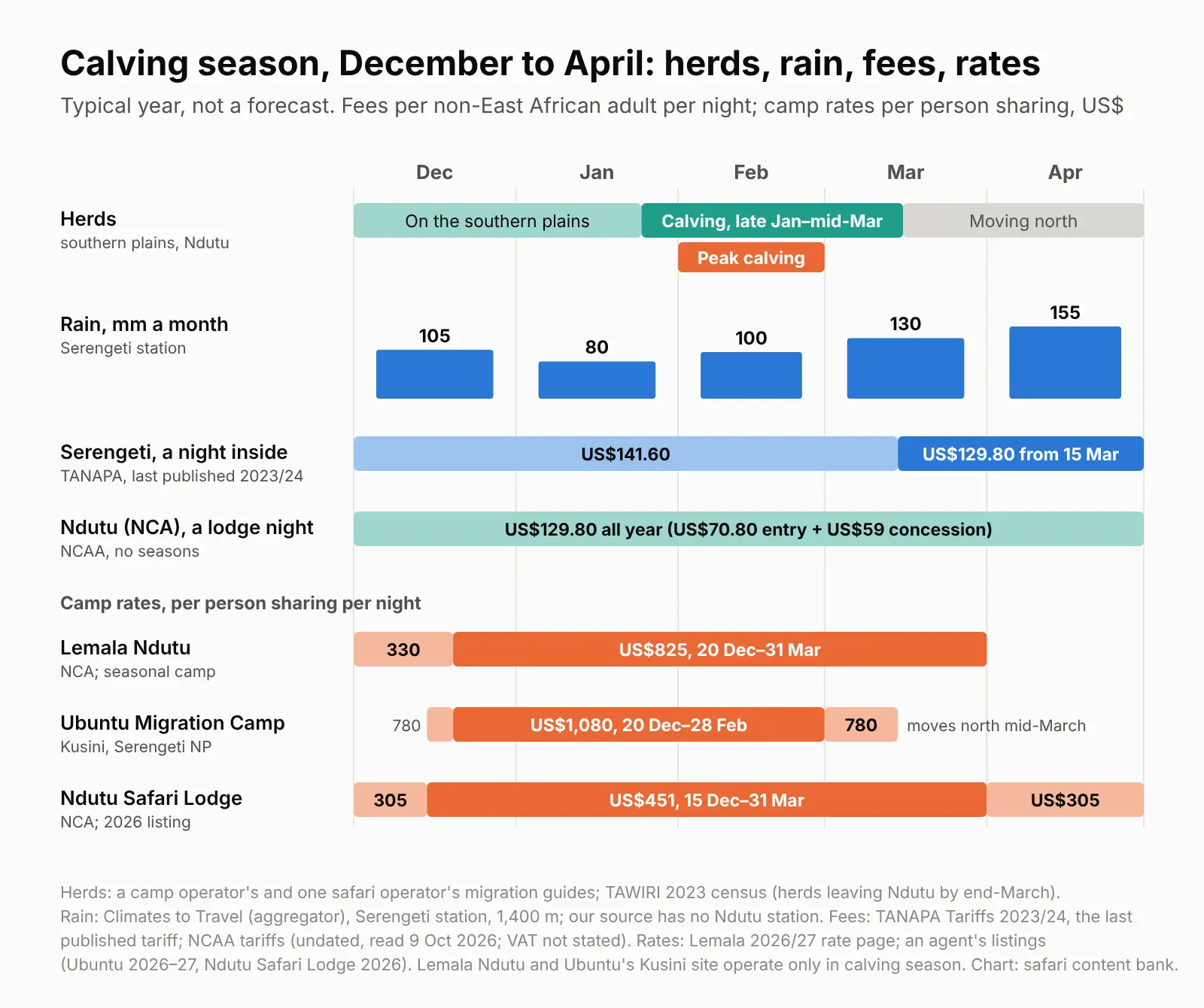 Typical year, not a forecast. Sources: a camp operator’s and one safari operator’s migration guides; TAWIRI 2023; Climates to Travel; TANAPA Tariffs 2023/24 (last published); NCAA; Lemala 2026/27 rates; agent’s listings. Chart: safari content bank.
- Late February is still calving. Experienced forum posters say the herds “usually stay till the middle of March” (TripAdvisor Serengeti forum, traveller forum).
- Our sources disagree on how many calves are born. A camp operator counts about 500,000 calves in two to three weeks; another operator’s guide says “nearly 400,000” across January–March. We found no census of calves, and the “8,000 calves a day” figure repeated on many pages has no primary source in our bank.
- The herd itself is counted differently by method. TAWIRI’s aerial count at the end of March 2023 was 1,366,109 wildebeest (± 231,741 SE); a satellite study counted “fewer than 600,000” in the area it imaged (Mongabay, 3 Oct 2025).
- Month pages: safari in January, safari in February, safari in March. The whole year: Great Migration month by month.
Where it happens: NCAA land and TANAPA land
The calving plains straddle the boundary between the Ngorongoro Conservation Area and Serengeti National Park, so where your camp sits decides which authority you pay. The NCA meets the park at Naabi Hill Gate on the main road (Serengeti vs Ngorongoro).
| Area | Authority | Park fees per adult per night | Herds, typical year | Camps in our sources |
|---|---|---|---|---|
| Ndutu and Lake Masek (south-western plains) | NCAA (Ngorongoro Conservation Area) | Lodge or permanent camp US$129.80 (entry US$70.80 + concession US$59); seasonal camp on a special campsite US$141.60 (entry + US$70.80) | December–March, peak February | Ndutu Safari Lodge, Lake Masek, Lemala Ndutu, Nasikia (Ndutu), Ndutu Wilderness Camp |
| Kusini and the Naabi plains | TANAPA (Serengeti National Park) | US$141.60 to 14 March, US$129.80 from 15 March (entry + concession or special campsite US$59) | January–March; “Ndutu–Kusini” in February | Ubuntu, Wayo Green Camp, Serian Serengeti Mobile |
| Moru plains | TANAPA | Same | January, from Moru south to Naabi | None in our sources for calving season |
| Namiri Plains (eastern Serengeti) | TANAPA | Same | Herds spread here in March | Namiri Plains |
Our sums from TANAPA Tariffs 2023/24 (PDF), the last published tariff (18% VAT included), and the NCAA tariffs page, undated, read 9 October 2026; NCAA’s page does not say whether VAT is included. Herds: a camp operator’s migration guide. Camps: sources in the next section.
- The NCAA lists only one lodge at Ndutu among its 11 lodges, plus 49 special campsites across the NCA (NCAA accommodation). Most Ndutu beds in calving season are seasonal tented camps.
- Ndutu lodges pay the US$59 concession; guests at seasonal mobile camps pay the US$70.80 special-campsite fee instead (Ngorongoro park fees). Our sources do not say which of the two each seasonal camp’s guests pay, so ask the camp.
- NCA entry is “one entry within 24 hours only”. On our reading, a Ndutu stay that runs past the last 24-hour period you paid for needs another US$70.80 permit to drive out, as the road to Arusha crosses the NCA (Ngorongoro park fees).
- We found no rule on game drives that cross the line. Our sources do not say how a drive from Ndutu onto the park’s Kusini plains, or the other way, is charged. Ask your camp which permits its drives use.
- More on both authorities: Serengeti vs Ngorongoro, Serengeti park fees, Tanzania park fees.
Where to stay: calving camps and their 2026–27 rates
Stay at Ndutu for the lowest bed prices and the shortest drive from Arusha and the crater; stay at Kusini, inside the park, for the fly-in mobile camps. Every camp below charges its highest or near-highest rate in calving season.
| Camp | Where, authority | Calving-season rate, per person sharing | Rest of its season | Included | Park fees to add, per adult per night | Source |
|---|---|---|---|---|---|---|
| Ndutu Safari Lodge | Lake Ndutu shore, NCA | US$451 (15 Dec–31 Mar) | US$305 (1 Apr–15 Dec) | Full board, Ndutu airstrip transfers | US$129.80 | An agent’s listing (2026) |
| Lake Masek Tented Camp | Lake Masek, NCA | US$545 (January–March, December) | US$280 (1 Apr–30 Nov) | Full board, soft drinks and house wine | US$129.80 | An agent’s listing (2026) |
| Ndutu Wilderness Camp | Private site on the Ndutu plains, NCA; open December–March | US$425 (24 Dec 2025–28 Feb 2026) | US$295 (1–14 Mar 2026) | All meals, house wine, local beer, soft drinks | US$129.80 or US$141.60 | An agent’s listing (2025–26 season) |
| Nasikia Mobile Migration Camp | Ndutu Small Marsh, NCA; open 1 Dec–31 Mar | US$505 (2026); US$530 (2027) | Same rate at its northern site | Full board, juices, tea and coffee | US$129.80 or US$141.60 | An agent’s listing |
| Lemala Ndutu Tented Camp | Ndutu, NCA; seasonal camp, calving season only | US$825 (20 Dec 2026–31 Mar 2027) | US$330 (1–19 Dec 2026) | Full board, house drinks; guide, vehicle and airstrip transfers extra | US$129.80 or US$141.60 | Lemala rates |
| Camp Zebra | Ndutu area, December–March (Kogatende July–November) | US$445 (January–February 2026) | US$325 (March 2026) | All meals and drinks, laundry | US$129.80–141.60; site’s authority not stated | An agent’s listing |
| Wayo Serengeti Green Camp | Kusini, Serengeti NP, December–March | US$750 (February 2026) | US$563 (15–31 Jan, March 2026) | Full board, drinks, TANAPA camping fees | Entry only: US$82.60 | An agent’s listing |
| Ubuntu Migration Camp | Kusini, Serengeti NP, mid-December–mid-March | US$1,080 (20 Dec 2026–28 Feb 2027) | US$780 (1–14 Mar 2027) | Game drives, house drinks, airstrip transfers | US$141.60 | An agent’s listing |
| Olakira Migration Camp | Ndutu area in the south, December–March | US$1,490 (20 Dec 2026–28 Feb 2027) | US$1,100 (March 2027) | Game drives, house drinks, airstrip transfers | US$129.80–141.60; site’s authority not stated | An agent’s listing |
| Serian Serengeti Mobile, Kusini | Serengeti NP, open December–May | US$1,745 (January–March 2026) | Same in December | All drinks, private vehicle, guide and spotter, walks for ages 12 and over | US$141.60 | An agent’s listing |
| Namiri Plains | Eastern Serengeti NP | US$2,250 (20 Dec 2026–28 Feb 2027) | US$1,400 (March 2027) | House drinks, game drives, airstrip transfers | US$141.60 | An agent’s listing; Serengeti safari cost |
Rates per person sharing per night, read 9–10 October 2026: Lemala rate page (2026/27, the camp’s own); the rest from one agent’s listings, not the camps’ own sheets. Fees: NCAA (undated page; VAT not stated) and TANAPA Tariffs 2023/24, the last published tariff, to 14 March; Serengeti fees fall to US$129.80 from 15 March. Park fees are excluded from every rate except Wayo’s camping fee.
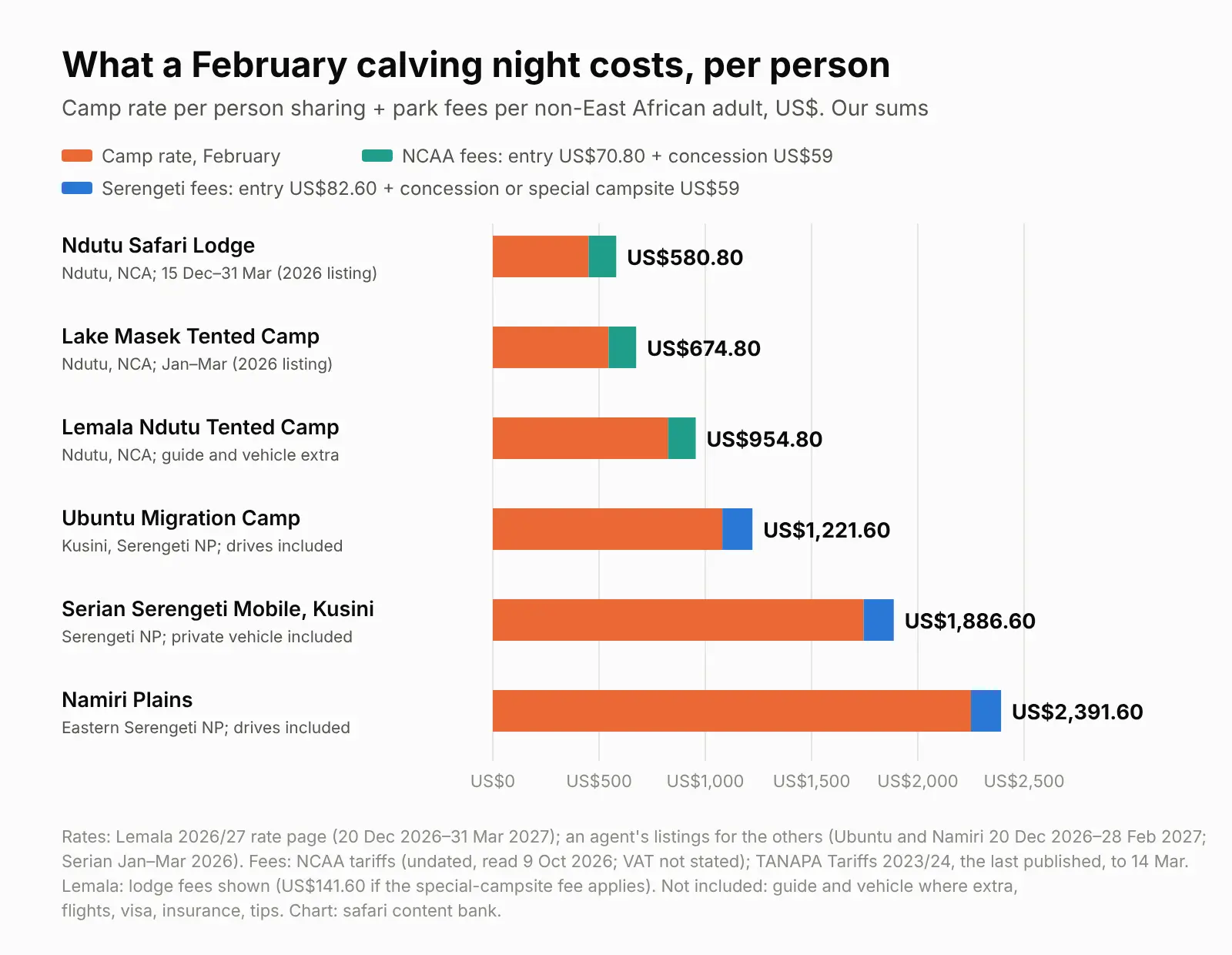 Our sums. Rates: Lemala 2026/27 rate page; one agent’s listings. Fees: NCAA tariffs (undated, read 9 Oct 2026); TANAPA Tariffs 2023/24, the last published tariff. Chart: safari content bank.
- Book early. One safari operator’s area guide notes that Ndutu Safari Lodge “books early for calving”. Forum regulars advise two or three camps a week and no one-night stops (TripAdvisor, traveller forum).
- Check what the rate leaves out. Lemala Ndutu excludes the guide and vehicle; Ubuntu, Olakira and Namiri include game drives; Serian includes a private vehicle; Wayo includes the TANAPA camping fee. A private vehicle and driver-guide costs about US$200–300 per vehicle per day (one operator’s published cost guide; Tanzania safari cost).
- A forum regular tells February travellers to “make sure the camp is in the Ngorongoro Conservation Area (NCA) and not in Serengeti NP” (Tanzania safari questions). That is one view; the herds use both sides, and Kusini camps are inside the park.
Predator action: what you can see and the rules for seeing it
Calves draw lions, cheetahs and hyenas onto the open short-grass plains, so calving season is predator season; but no authority, researcher or operator publishes a sighting rate, and the viewing rules are strict.
| Question | Answer | Source |
|---|---|---|
| Which predators? | Lions, cheetahs and hyenas on the plains in calving season | Two tour operators’ migration guides; where to see cheetahs |
| Sighting rate published? | No, for Ndutu or the Serengeti | Where to see cheetahs |
| Lion or cheetah count for the park? | No dated count found | Serengeti |
| Off-road driving | NCA: “not permitted … unless authorized by the Conservation Commissioner” | NCAA guidelines |
| Driving hours | NCA 06:00–18:00; Serengeti day permit of 12 daylight hours | NCAA guidelines; TANAPA 2023/24 (PDF) |
| Night drives | Not allowed in the NCA or the Serengeti | NCAA guidelines; TANAPA 2023/24 |
| Vehicle limit at a sighting | None published by TANAPA or the NCAA | Where to see cheetahs |
| Vehicles at sightings, as reported | “It was common to see 15–20 vehicles at a single sighting” (Ndutu, March 2026) | TripAdvisor (traveller report) |
- Crowding is the main complaint. The same March 2026 reviewer wrote: “the vehicle density is a dealbreaker for us. We wouldn’t return”, and a forum regular replied “Shame about how Ndutu has now deteriorated” (TripAdvisor, traveller reports, not counts).
- Daylight is when you see hunts. With no night drives, early starts matter: driving in the NCA begins at 06:00. A camp on the plains, rather than a lodge a long drive away, gives more time with the herds; ask the camp how far it is from the herds that week.
- A private vehicle helps at busy sightings. Serian’s Kusini camp includes a private vehicle, guide and spotter per booking (an agent’s listing). Otherwise ask your operator whether the vehicle is yours or shared.
- Species pages: where to see cheetahs, where to see lions; camera advice: photography safari.
Rain, roads and health in calving season
Calving is a wet-season event: the rain brings the short grass the herds calve on, and it also brings storms, mud and the occasional flooded road.
- Rain by month, Serengeti station (1,400 m): December 105 mm, January 80 mm, February 100 mm, March 130 mm, April 155 mm; highs 26–29 °C and lows 14–16 °C all year (Climates to Travel, an aggregator). Our source has no station at Ndutu.
- On the southern plains January brings thunderstorms and February is “the driest month of the wet season”; the long rains start late in March (a camp operator’s migration guide).
- Roads can fail in a wet year. In March 2026 a traveller titled a review “Epic Wildlife, Brutal Roads, & Crowds” and reported that the route from Gol to Seronera “was flooded”; a destination expert on the thread called that rain unusual (TripAdvisor, traveller reports). Another destination expert warned March 2026 travellers of heavy rain “most of April” and plains away from Seronera that may be impassable (TripAdvisor).
- Rain moves the herds. The timing “is entirely dependent upon the rainfall patterns each year” (one safari operator’s migration guide), so in an unusual year the herds can be off the plains you booked. Mobile camps “move with the herds and offer the closest access” (one tour operator’s guide); a fixed lodge cannot move.
- Tsetse flies: guides on the TripAdvisor forum report tsetse at Kusini, but none at Seronera (Serengeti; guide testimony, not an official map).
- Malaria: risk all year below 1,800 m (WHO, via safari in February); more in Tanzania safety and health risks.
- Why it is called green season and still costs peak: see green-season safari. TANAPA’s lower entry fee starts only on 15 March, after the peak.
Calving season or river crossings?
Choose calving for weeks of births and predators on open plains in Tanzania alone; choose the crossings for the river drama in July–October, which you wait for and cannot date. At the same camp, the two cost almost the same per night.
| Calving (Ndutu and the southern Serengeti) | River crossings (northern Serengeti and Masai Mara) | |
|---|---|---|
| When | Late January to mid-March; peak in February | Mara River July–October, August–September busiest; Grumeti River about the first half of June |
| Countries | Tanzania only | Tanzania and Kenya |
| What you watch | Births, young calves and predators on the plains, over weeks | Herds massing and crossing; “hours and days and even weeks can go by between crossings” (traveller report) |
| Published odds | None; no sighting rate | None; the Mara Conservancy calls crossings “difficult to predict” |
| Park fees per adult | Ndutu US$129.80–141.60 a night; Serengeti US$141.60 to 14 March | Serengeti US$153.40 a night July–September; Mara reserve US$200 a day July–December |
| Same camp, a night with fees, per person (our sums) | Ubuntu at Kusini, February 2027: US$1,221.60; Lemala Ndutu: US$954.80 | Ubuntu at Lamai, August 2026: US$1,233.40; Lemala Mara, July–September 2026: US$978.40 |
| Crowds, as reported | “15–20 vehicles at a single sighting” (Ndutu) | “Fifty or more trucks” at a crossing point |
| Weather | Wet season; 100 mm in February | Dry season; 15 mm in July |
| By road from Arusha | Ndutu about 5.5–6 hours | Far north: two days; most trips fly |
| Adding Ngorongoro Crater | Ndutu to the crater 106 km, about 2.5 hours | Northern Serengeti to the crater rim: “an all day drive” (traveller report) |
Sources: Great Migration month by month (Mara Conservancy; traveller reports); Great Migration safari cost (camp rates: Lemala rates page; an agent’s listing for Ubuntu); fees: TANAPA, last published tariff, 2023/24; NCAA; Narok County fee schedule FY2025/26, the last published; drive times: Serengeti vs Ngorongoro; rain: Climates to Travel, Serengeti station. Read 9–10 October 2026.
- You cannot see both in one trip. No crossings happen from January to May, and no calving from April to December.
- Kenya in calving season has resident Mara game and a smaller, separate Loita herd that calves in Ol Kinyei Conservancy in February–March; the Mara reserve fee is US$100 a day from January to June (Narok County FY2025/26 schedule, the last published). There is no road crossing from the Mara into the Serengeti; routes are on Mara to Serengeti.
Which base suits you
Pick the base by budget, transport and how late in the season you travel.
| If you… | Base | Why, with the number |
|---|---|---|
| Want the lowest bed price on the calving plains | Ndutu Safari Lodge or Lake Masek (NCA) | US$451 and US$545 a night in calving season, plus US$129.80 in NCAA fees |
| Are driving from Arusha | Ndutu | About 5.5–6 hours by road; travellers call it “an awfully long day” |
| Want the crater too | Ndutu | Crater to Ndutu is 106 km, about 2.5 hours; the crater adds US$295 per vehicle per descent |
| Are flying in | Kusini or Ndutu | Regional Air flies to Ndutu (ATTA, 29 Jun 2026); our sources disagree on fares, so we print none |
| Want your own vehicle at sightings | Serian Serengeti Mobile, Kusini | Private vehicle, guide and spotter included at US$1,745 |
| Can travel 1–14 March | Ubuntu (Kusini) or Camp Zebra | Ubuntu falls to US$780 from US$1,080; Camp Zebra to US$325 from US$445 |
| Can only travel late March | Central Serengeti, not Ndutu | By end-March 2023 the herds were leaving Ndutu (TAWIRI); Serengeti fees fall to US$129.80 from 15 March |
| Are travelling with children aged 5–15 | Either | Child entry US$23.60 and concession US$11.80 a night at both (NCAA; TANAPA, last published tariff, 2023/24) |
Rates and fees as in the sections above; drive times from Mara to Serengeti and Serengeti vs Ngorongoro; traveller quote from a TripAdvisor thread, September 2026.
What a calving stay costs (our sums)
Three nights for two people sharing cost US$2,142.40–2,342.40 per person at Ndutu Safari Lodge by road, and US$3,664.80 at a luxury mobile camp at Kusini, in park fees, beds and vehicle, before flights, visa, insurance and tips (our sums).
| Per person, two sharing, 3 nights in February | Ndutu Safari Lodge, by road | Lemala Ndutu, by road | Ubuntu Migration Camp, Kusini, fly-in | Ubuntu, 1–14 March 2027 |
|---|---|---|---|---|
| Beds | 3 × US$451 = US$1,353 | 3 × US$825 = US$2,475 | 3 × US$1,080 = US$3,240 | 3 × US$780 = US$2,340 |
| Park fees | 3 × US$129.80 = US$389.40 (NCAA) | 3 × US$129.80 = US$389.40 (NCAA; US$424.80 at the special-campsite fee) | 3 × US$141.60 = US$424.80 (TANAPA) | 3 × US$141.60 = US$424.80 |
| Vehicle and guide | Half of US$200–300 a day × 4 days = US$400–600 | US$400–600 | Game drives included | Included |
| Total | US$2,142.40–2,342.40 | US$3,264.40–3,464.40 | US$3,664.80 | US$2,764.80 |
Our sums. Rates: an agent’s listings (Ndutu Safari Lodge 2026; Ubuntu 2026–27); Lemala rates (2026/27). Fees per non-East African adult: NCAA (undated page, read 9 October 2026; VAT not stated); TANAPA, last published tariff, 2023/24. Vehicle: one operator’s published cost guide (Tanzania safari cost). Not included: flights (fares not printed: our sources disagree), NCA and TANAPA vehicle permits, a fourth NCA permit if you leave more than 72 hours after entering, tips and drinks where extra.
- Add for every trip: a Tanzania visa of US$50 (US citizens US$100) and US$44 government travel insurance per adult as of October 2026 (Tanzania visa; Tanzania visitor insurance); tips of about US$20–30 per person per day (Tanzania safari cost).
- Adding a crater day costs US$295 per vehicle per descent, US$147.50 each for two, plus a US$70.80 NCA permit if it falls outside your other permits (NCAA; Ngorongoro safari cost).
- The same week in early March costs US$900 less at Ubuntu than in February (our sum). Lemala Ndutu keeps US$825 until 31 March.
- We found no published group package dated to the calving season. Published group camping safaris from Arusha cost about US$220–300 per person per day, park fees included, in any month (Tanzania safari cost). More worked weeks: Great Migration safari cost, Serengeti safari cost.
The official fee lines, with the date each took effect and the authority’s own source:
| Fee | Amount | In force from | Source |
|---|---|---|---|
| Serengeti and Nyerere National Parks, non-East African adult, entry per day, 16 May–14 Mar | USD 70 + 18% VAT = USD 82.60 | 1 Jul 2023 (2023/24 tariff, last published) | TANAPA Tariffs 2023/24 |
| Serengeti and Nyerere National Parks, non-East African adult, entry per day, 15 Mar–15 May | USD 60 + 18% VAT = USD 70.80 | 1 Jul 2023 (2023/24 tariff, last published) | TANAPA Tariffs 2023/24 |
| Serengeti and Nyerere, concession fee per person per night inside the park | Jul–Sep USD 60 + VAT = USD 70.80; Oct–Jun USD 50 + VAT = USD 59 | 1 Jul 2023 (2023/24 tariff, last published) | TANAPA Tariffs 2023/24 |
| Serengeti, non-East African child 5–15, entry per day (under 5 free) | USD 20 + 18% VAT = USD 23.60 | 1 Jul 2023 (2023/24 tariff, last published) | TANAPA Tariffs 2023/24 |
| Serengeti, concession fee per child 5–15 per night inside the park | USD 10 + 18% VAT = USD 11.80 | 1 Jul 2023 (2023/24 tariff, last published) | TANAPA Tariffs 2023/24 |
| Serengeti special campsite (used by mobile camps), adult, per night | Jul–Sep USD 60 + VAT = USD 70.80; Oct–Jun USD 50 + VAT = USD 59 | 1 Jul 2023 (2023/24 tariff, last published) | TANAPA Tariffs 2023/24 |
| Ngorongoro Conservation Area, non-East African adult, entry per 24 h (single entry) | USD 70.80 (NCAA's page does not say whether VAT is included) | Undated official page, read 9 Oct 2026 | NCAA |
| Ngorongoro Crater descent (crater service fee), per vehicle | USD 295 (NCAA's page does not say whether VAT is included) | Undated official page, read 9 Oct 2026 | NCAA |
| Ngorongoro concession fee, rim and Ndutu lodges, per person per night | USD 59 (NCAA's page does not say whether VAT is included) | Undated official page, read 9 Oct 2026 | NCAA |
| Ngorongoro Conservation Area, non-East African child 5–15, entry per 24 h (under 5 free) | USD 23.60 | Undated official page, read 9 Oct 2026 | NCAA |
| Ngorongoro concession fee, child, per night | USD 11.80 | Undated official page, read 9 Oct 2026 | NCAA |
| Ngorongoro special campsite, non-East African adult, per night | USD 70.80 (child USD 35.40) | Undated official page, read 9 Oct 2026 | NCAA |
| Maasai Mara National Reserve, non-resident adult, per day (12-hour ticket, 06:00–18:00), 1 Jan–30 Jun | USD 100 | Since 1 Jan 2024; Narok County FY2025/26 schedule, the last published | Narok County fee schedule FY2025/26 |
| Maasai Mara National Reserve, non-resident adult, per day (12-hour ticket, 06:00–18:00), 1 Jul–31 Dec | USD 200 | Since 1 Jul 2024; Narok County FY2025/26 schedule, the last published (no 2026/27 schedule as of 9 Oct 2026) | Narok County fee schedule FY2025/26 |
Common mistakes about the calving season
| What you’ll often read | What is correct |
|---|---|
| “Calving happens in Serengeti National Park” | Partly. Ndutu and Lake Masek are in the Ngorongoro Conservation Area, with NCAA fees; Kusini and Naabi are in the park. The herds use both. |
| “Stay at Ndutu to avoid Serengeti fees” | Ndutu has its own fees: US$70.80 entry per 24 hours plus US$59 concession, US$129.80 a night (NCAA). |
| “Calving season is the cheap way to see the migration” | Not in February. Ubuntu charges US$1,080 at Kusini, the same as at the Mara River in August; Lemala Ndutu US$825 to 31 March. |
| “Calving runs through March” | By the end of March 2023 the herds were leaving Ndutu (TAWIRI). Early March is the end of the window. |
| “8,000 calves are born every day” or “500,000 calves” as a fact | No census of calves exists in our sources; operators say about 500,000 or nearly 400,000, and “8,000 a day” has no primary source. |
| “You can drive off-road anywhere at Ndutu” | The NCAA says off-road driving is “not permitted … unless authorized by the Conservation Commissioner”. Ask your camp what it is allowed. |
| “Night drives to see the predators hunt” | Not allowed in the NCA or the Serengeti; driving in the NCA ends at 18:00. |
| “The Mara has calving too, so go to Kenya” | That is the separate, smaller Loita herd in Ol Kinyei. The Serengeti herds calve only in Tanzania. |
| “Ndutu is a morning’s drive from Arusha” | About 5.5–6 hours by road as published; travellers report “a 7ish hour drive”. |
Frequently asked questions
When is the Serengeti calving season? From late January to mid-March, on the short-grass plains around Ndutu and the southern Serengeti, with most calves born in two to three weeks in February (a camp operator’s migration guide). The timing follows the rain, so no one can date the peak in advance.
Is Ndutu in the Serengeti? No. Ndutu is in the Ngorongoro Conservation Area, on the edge of the Serengeti plains, so NCAA fees apply: US$70.80 entry per 24 hours, plus US$59 a night at its lodges or US$70.80 at a seasonal camp on a special campsite (NCAA, read 9 October 2026). A Ndutu stay does not include Serengeti entry.
Is late February or early March too late for the calving? Late February is still calving, and forum regulars say the herds “usually stay till the middle of March”. Early March brings the last calves and lower rates at some camps (Ubuntu US$780 from 1 March 2027). By the end of March the herds start to leave Ndutu, as TAWIRI’s 2023 census found.
Where should I stay for the calving? At Ndutu for the lowest bed prices and the easiest drive (Ndutu Safari Lodge US$451, Lake Masek US$545 a night in calving season, an agent’s listings), or at Kusini, inside the park, for fly-in mobile camps such as Ubuntu (US$1,080). Add US$129.80–141.60 per adult a night in park fees.
How much does a calving-season safari cost? On our sums, three nights for two sharing cost about US$2,142–2,342 per person at Ndutu Safari Lodge by road with a private vehicle, and US$3,665 at Ubuntu Migration Camp with drives included, before flights, visa (US$50; US citizens US$100), US$44 insurance and tips.
Is the calving season better than the river crossings? It depends on what you want to see. Calving gives weeks of births and predators on the plains in Tanzania; the crossings, from July to October, are a river spectacle you wait for and cannot date. At the same camp they cost almost the same: Ubuntu US$1,221.60 a night with fees at Kusini in February, US$1,233.40 at Lamai in August (our sums).
Does it rain a lot in calving season? It is the wet season, but February is “the driest month of the wet season” on the southern plains (a camp operator’s migration guide). The Serengeti station averages 80 mm in January, 100 mm in February and 130 mm in March; the long rains start late in March.
Can I see Ngorongoro Crater on a calving safari? Yes. The crater is 106 km and about 2.5 hours from Ndutu, and a descent costs US$295 per vehicle plus NCA entry (Ngorongoro; Serengeti vs Ngorongoro).
Sources
- NCAA, tariffs (undated; read 9 Oct 2026), visitor guidelines and accommodation (read 8–9 Oct 2026)
- TANAPA, Tariffs 2023/24 (PDF), the last published national parks tariff, checked 9 Oct 2026; Narok County, Maasai Mara fee schedule FY2025/26 (PDF), the last published
- TAWIRI, Wildebeest census 2023 (PDF); Mongabay, satellite counts, 3 Oct 2025
- Herd calendars: a camp operator’s migration guide; one safari operator’s migration and area guides; two tour operators’ migration guides (dated 9 Nov 2021, and published 2022, modified 8 Oct 2026); names and links kept in our editor notes; read 9 Oct 2026
- Climate: Climates to Travel, Tanzania (an aggregator; Serengeti station, 1,400 m), read October 2026
- Camp rates: Lemala rates (2026/27); one agent’s listings for Ndutu Safari Lodge, Lake Masek, Ndutu Wilderness Camp, Nasikia, Camp Zebra, Wayo, Ubuntu, Olakira, Serian and Namiri Plains; read 9–10 Oct 2026
- Travel: a Tanzanian operator’s Serengeti guide (Arusha–Ndutu); a Tanzanian operator’s travel-times table (modified 1 Jul 2026); one operator’s published cost guide (vehicle and guide); ATTA, 29 Jun 2026
- Traveller reports: TripAdvisor forum threads as linked in the text, read 9 Oct 2026
- Our pages: Serengeti, Ngorongoro, Tanzania, Tanzania park fees, Tanzania safari cost, Tanzania visa, Great Migration month by month, Great Migration safari cost, Serengeti vs Ngorongoro, Mara to Serengeti
Fees and rates checked 9–10 October 2026. We will update this page when TANAPA publishes a new tariff, when the NCAA publishes a dated one, when the 2027 calving camps publish their 2027–28 rates, and after the 2027 calving season (March 2027) if the herds’ timing departs from this pattern.