 Experience

Last verified · Next check due
On this page
- Laikipia vs Masai Mara at a glance (2026)
- What each area is: private conservancies against a county reserve
- Fees: a Mara day against a Laikipia day
- Wildlife: northern species or the migration herds
- Activities: walking, night drives and off-road driving
- Lodges and camps: what a night costs (2026)
- Getting there: flights from Nairobi and road times
- When to go: seasons in Laikipia and the Mara
- Which should you choose?
- Common mistakes
- Frequently asked questions
- Sources
Short answer: Choose the Maasai Mara (Kenya) for the wildebeest herds, usually there from late July to October. Choose Laikipia, the private conservancies north of Mount Kenya, for northern species such as Grevy’s zebra, for chimpanzees at Sweetwaters and for stricter sighting rules on Lewa (two vehicles, against five in the Mara reserve). The Mara reserve charges US$100 per adult per day January–June and US$200 July–December; Ol Pejeta charges US$110 a day, VAT included (2026 tariff).
Key facts
- Laikipia has no single park and no single fee. Its conservancies are private or not-for-profit, not Kenya Wildlife Service (KWS) parks, and each sets its own fees and rules; Ol Pejeta is the only one in our sources that publishes a tariff (Tariff Guide 2026).
- The Maasai Mara National Reserve fee doubles on 1 July: US$100 per non-resident adult per day from 1 January, US$200 from 1 July, under Narok County’s last published schedule (FY2025/26, expired 30 June 2026); press reports (The Kenya Times, 6 Aug 2026, secondary) say US$200 still applies for July–December 2026.
- The Great Migration herds are a Mara event, not a Laikipia one. They are usually in the Mara from late July to October; none of our Laikipia sources mentions them.
- Night drives are not sold inside the Mara reserve. They are sold in the Mara conservancies and in Laikipia, where Ol Pejeta charges US$70 per adult for a shared night drive (2026 tariff).
- Nairobi to Ol Pejeta is about 220 km, 4–4.5 hours by road; Nairobi to the Mara is 275 km, about 5.5 hours. A scheduled flight from Nairobi’s Wilson Airport to the Mara takes about 1 hour and costs US$200 + US$20 fuel surcharge one way (Mombasa Air Safari, 2026).
- January–February are the dry months at Nanyuki in Laikipia (13–23 mm of rain); no month is dry in the Mara, where July’s 60 mm is the lowest.
Laikipia vs Masai Mara at a glance (2026)
The Mara is one county-run reserve ringed by Maasai-owned conservancies; Laikipia is a patchwork of separately run private conservancies and ranches, each with its own fee and rules.
| Laikipia | Masai Mara | Source | |
|---|---|---|---|
| What it is | Private or not-for-profit conservancies and ranches north of Mount Kenya, not KWS parks | Maasai Mara National Reserve (Narok County; the western Mara Triangle run by the not-for-profit Mara Conservancy since 12 June 2001), plus 24 conservancies around it | Ol Pejeta FAQs; Mara Conservancy; MMWCA |
| Size | Ol Pejeta 90,000 acres; Lewa 62,000 (about 364 and 251 km², our conversion) | Reserve about 1,500 km²; conservancies about 450,000 acres (about 1,821 km², our conversion), leased from over 15,000 landowners | Ol Pejeta; Lewa; Mara Conservancy; MMWCA |
| Fee per adult | Ol Pejeta US$110 a day, VAT included; Lewa publishes no fee; others on camps’ rate sheets (US$130–187 a night) or a 24% donation (Borana) | Reserve US$100 (Jan–Jun) or US$200 (Jul–Dec) a day; conservancies US$130 a night on camps’ 2026 sheets | Ol Pejeta Tariff Guide 2026; Narok County FY2025/26; camps’ 2026 rate sheets |
| Wildebeest herds | Not in our Laikipia sources | Usually late July to October; Loita herd in the conservancies January–March | A camp operator’s migration guide; a Kenyan camp operator’s Loita migration page |
| Signature species | Grevy’s zebra; chimpanzees at Sweetwaters, “the only place in Kenya to see” them | The migration herds and river crossings | Lewa; Ol Pejeta FAQs; Mara Conservancy |
| Vehicles at a sighting | Ol Pejeta 6, 10 minutes each; Lewa 2 | Reserve 5; no Mara conservancy publishes a cap | OPC Tariff 2026; Lewa Code of Conduct; Business Daily on the county plan |
| Night drives | Ol Pejeta US$70 per adult; included at some camps | Not sold in the reserve; sold by some conservancy camps | OPC Tariff 2026; Kicheche 2026 |
| Day visitors | Ol Pejeta: yes, one fee per entry, self-drive allowed. Lewa: not stated in our sources; ask your lodge | Reserve: a day ticket, 06:00–18:00; private cars banned from game drives since June 2024 | Ol Pejeta FAQs; Kenyans.co.ke |
| From Nairobi by road | About 220 km, 4–4.5 h to Ol Pejeta | 275 km, about 5.5 h | Ol Pejeta FAQs; one operator’s Kenya travel-times table |
Non-resident adult. Fees as on our Kenya safari cost page and the Laikipia and Masai Mara guides; sources read 8–10 October 2026, page checked 21 October 2026.
What each area is: private conservancies against a county reserve
In the Mara you choose between the reserve and a conservancy; in Laikipia you choose a conservancy, because there is no reserve.
- The Mara reserve is public land that anyone can enter with a day ticket. Narok County runs it, except the western 510 km² Mara Triangle, which the Mara Conservancy manages (Mara Conservancy).
- The Mara conservancies are Maasai-owned land around the reserve, leased to camps. Camps’ 2026 rate sheets price four of them: Mara North, Olare Motorogi, Naboisho and Ol Kinyei. The full comparison is on Masai Mara reserve or a private conservancy.
- Laikipia’s conservancies each run their own gates, fees and rules. Ol Pejeta takes day visitors and self-drivers; on Lewa, only green or brown 4x4s are permitted (Lewa Code of Conduct); Borana bills its conservation charge as a donation inside the bed rate (Borana rates).
- Lewa’s access for visitors who are not staying there: not stated in our sources; ask your lodge. Lewa’s own website has a Code of Conduct and a lodges page but no tariff (Lewa).
Fees: a Mara day against a Laikipia day
From July to December a Mara reserve day (US$200 per adult) costs more in fees than any Laikipia conservancy fee in our sources (US$110–187); from January to June the reserve (US$100) is the cheapest of them.
| Area | Fee per non-resident adult | Child | Basis | Source |
|---|---|---|---|---|
| Masai Mara reserve, 1 Jan–30 Jun | US$100 | US$50 (9–17); under 9 free | Per calendar day, 06:00–18:00; does not carry overnight | Narok County FY2025/26 |
| Masai Mara reserve, 1 Jul–31 Dec | US$200 | US$50 | Same | Narok County FY2025/26 (last published); Jul–Dec 2026 per The Kenya Times |
| Mara conservancies (Mara North, Olare Motorogi, Naboisho, Ol Kinyei) | US$130; US$150 for Mara North on Offbeat’s sheet | US$65 (Kicheche) | Per night on Kicheche’s sheet, “per day” on Porini’s | Kicheche 2026; Porini 2026; Offbeat 2026 |
| Ol Pejeta | US$110, VAT included | US$55 (3–11); under 3 free | Per day; 24 hours for overnight guests; leaving and re-entering needs a new fee | OPC Tariff Guide 2026 |
| Ol Pejeta wilderness zone (Kicheche Laikipia) | US$187 | US$94 | Per night: the entrance plus a wilderness-zone bed-night fee | Kicheche 2026 |
| Sosian | US$140 | – | Per night | Offbeat 2026 |
| Mugie | US$130 | US$65 | Per night; sources disagree on another camp group’s figure, so confirm | Offbeat 2026 (Ekorian’s Mugie Camp) |
| Borana | No fee line | – | A mandatory 24% per person donation to conservation on the bed rate | Borana rates |
| Lewa | No published fee | – | Elewana’s Lewa Safari Camp rates exclude “park or reserve fees, conservancy fees” without an amount | Elewana |
Non-resident rates. The conservancy fees other than Ol Pejeta’s come from camps’ 2026 rate sheets, not from a conservancy tariff. Read 8–10 October 2026.
The official fee lines, with the date each took effect and the authority’s own source:
| Fee | Amount | In force from | Source |
|---|---|---|---|
| Maasai Mara National Reserve, non-resident adult, per day (12-hour ticket, 06:00–18:00), 1 Jan–30 Jun | USD 100 | Since 1 Jan 2024; Narok County FY2025/26 schedule, the last published | Narok County fee schedule FY2025/26 |
| Maasai Mara National Reserve, non-resident adult, per day (12-hour ticket, 06:00–18:00), 1 Jul–31 Dec | USD 200 | Since 1 Jul 2024; Narok County FY2025/26 schedule, the last published, expired 30 Jun 2026 (no 2026/27 schedule as of 9 Oct 2026); The Kenya Times (6 Aug 2026, secondary) reports US$200 still applies for Jul–Dec 2026 | Narok County fee schedule FY2025/26 |
| Maasai Mara National Reserve, non-resident child 9–17 or student, per day (under 9 free) | USD 50, all year | Narok County FY2025/26 schedule, the last published | Narok County fee schedule FY2025/26 |
| Ol Pejeta Conservancy, non-resident adult, per day (24 hours for overnight guests) | USD 110, VAT included (child 3–11 USD 55) | 2026 tariff | Ol Pejeta Conservancy Tariff Guide 2026 |
| Ol Pejeta Conservancy night game drive, per person (19:00–21:00 or 21:00–23:00) | USD 70 adult / USD 35 child | 2026 tariff | Ol Pejeta Conservancy Tariff Guide 2026 |
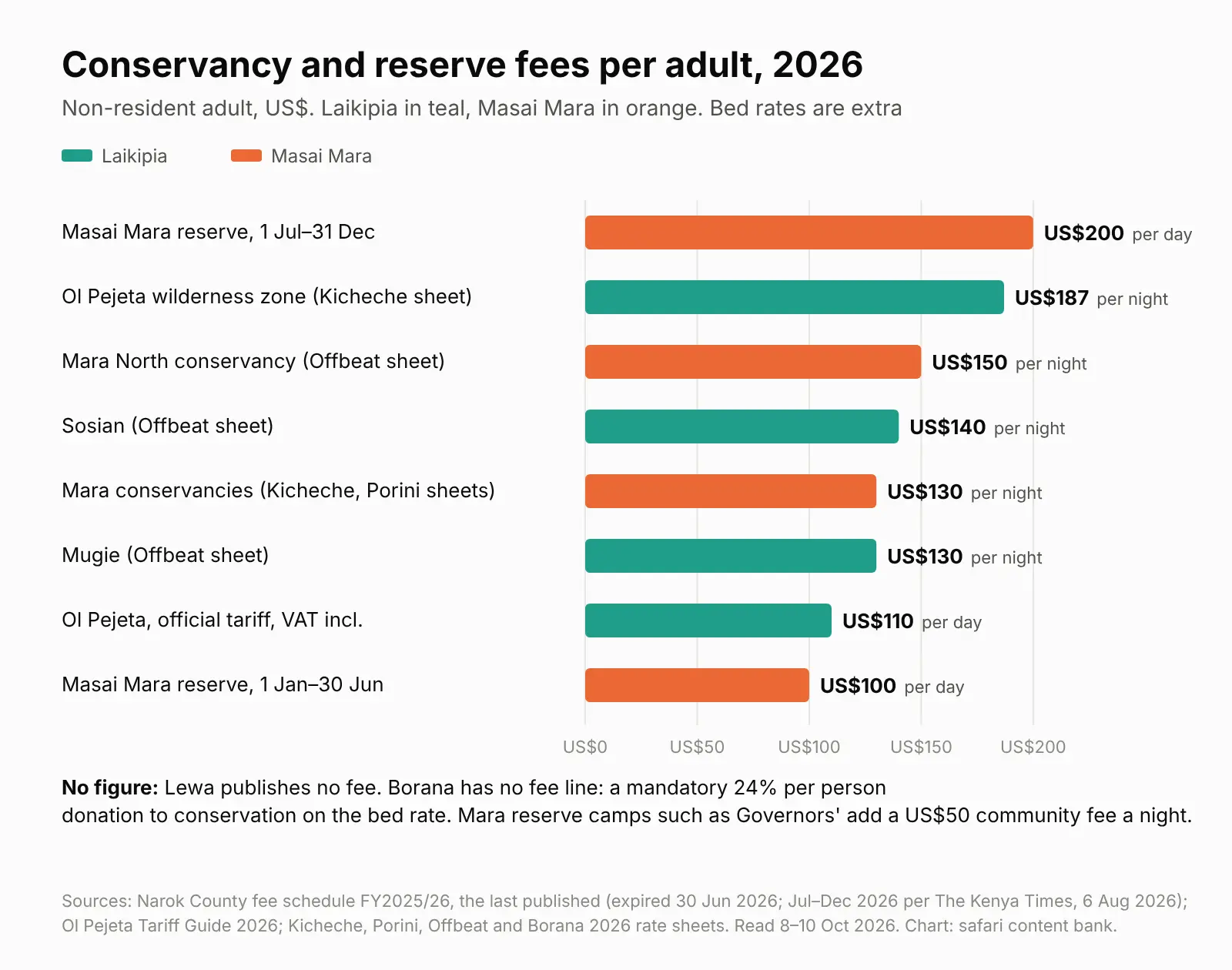 Narok County FY2025/26 schedule (last published; July–December 2026 per The Kenya Times, 6 Aug 2026); Ol Pejeta Tariff Guide 2026; camps’ 2026 rate sheets. Read 8–10 October 2026. Chart: safari content bank.
Three nights in fees, per adult
Over three nights, Ol Pejeta costs US$330 per adult in fees all year; a Mara reserve camp costs US$300 from January to June and US$600 from July to December (our sums).
| Three nights, one adult (our sums) | 1 Jan–30 Jun | 1 Jul–31 Dec |
|---|---|---|
| Ol Pejeta, 3 × US$110 | US$330 | US$330 |
| Ol Pejeta wilderness zone, 3 × US$187 | US$561 | US$561 |
| Mara reserve camp, 3 day tickets | US$300 | US$600 |
| Mara reserve camp with a game drive on the departure day, 4 tickets | US$400 | US$800 |
| Mara conservancy camp, 3 × US$130 | US$390 | US$390 |
Ol Pejeta charges per 24 hours for overnight guests, so three nights inside are three fees. Mara reserve tickets are per calendar day. Some Mara reserve camps add a community fee: Governors’ charges US$50 per guest per night (Governors’ Camp). Ticket rules: Masai Mara park fees; every Kenyan fee: Kenya park fees 2026.
Wildlife: northern species or the migration herds
Go to the Mara for the wildebeest herds and river crossings, usually late July to October; go to Laikipia for species the Mara sources do not list, such as Grevy’s zebra and chimpanzees.
| What you want to see | Laikipia | Masai Mara |
|---|---|---|
| Wildebeest migration | Not in our Laikipia sources | Herds usually in the Mara from mid or late July to October, most animals in August–September; crossings on the Mara and Sand rivers inside the reserve |
| Calving | – | The Loita herd, a smaller separate herd, calves in Ol Kinyei conservancy in February–March |
| Grevy’s zebra | Lewa: “the world’s largest population of endangered Grevy’s zebras”; Kenya counted 2,465 in 2024–25 | Not in our Mara sources |
| Reticulated giraffe | Named for Lewa and Laikipia walking safaris by a tour operator’s walking-safari guide | Not in our Mara sources |
| Chimpanzees | Sweetwaters Chimpanzee Sanctuary on Ol Pejeta, “the only place in Kenya to see” them; open 08:30–12:30 and 14:00–16:30 | None |
| Wild dog | One operator’s Laikipia page calls the western ranches, Laikipia Wilderness and Sosian, wild dog country; we hold no count | Not in our Mara sources |
| Lion | Borana says the landscape it shares with Lewa holds “over 60 lion across multiple prides” | TripAdvisor regulars advising a first-timer (June–July 2026) suggested the Mara conservancies for cats |
Sources: Lewa; Citizen Digital, 11 Dec 2025; Ol Pejeta FAQs; Borana, Your Impact; Mara Conservancy; a camp operator’s migration guide; a Kenyan camp operator’s Loita migration page; one operator’s Laikipia page; a tour operator’s walking-safari guide; TripAdvisor (traveller reports). Read 8–10 October 2026.
- No one can book a river crossing. The Mara Conservancy says crossings “happen frequently during the migration but are difficult to predict”. Month by month: where the Great Migration is each month.
- “Not in our sources” is not “absent”. The table records only what our sources state for each area. Wild dog: where to see wild dogs.
Activities: walking, night drives and off-road driving
Laikipia’s conservancies and the Mara conservancies sell night drives and walks; the Mara reserve sells neither and keeps vehicles on its tracks.
| Activity | Laikipia | Mara reserve | Mara conservancies |
|---|---|---|---|
| Night drives | Ol Pejeta: US$70 adult, US$35 child, shared, 19:00–21:00 or 21:00–23:00, book a day ahead. Included at Kicheche Laikipia and Ekorian’s Mugie Camp | Not sold | Included at Kicheche Valley (Naboisho) and Porini Lion Camp (Olare Motorogi); not at every camp |
| Guided walks | Ol Pejeta bush or bird walk US$70 adult. On Lewa, only with an armed guide authorised by its Chief Conservation Officer, and no one on foot from 18:00 to 07:00 | None sold, as far as we found | Included at all three Kicheche camps and at Porini Lion Camp |
| Off-road driving | Lewa: “discouraged, except under exceptional circumstances”, and “strictly prohibited” in the rainy season. Ol Pejeta: not in our sources | Prohibited, except to approach big cats on nearby open ground, no closer than 25 m | Practised: Porini Lion Camp uses “off-road (4×4) safari vehicles” |
| Self-drive | Ol Pejeta allows it (2WD in the dry season, a 4x4 in the rains); Lewa admits only green or brown 4x4s | Private cars banned from game drives by Narok County’s memo of 3 June 2024; we found no 2026 statement on how it is applied | – |
| Other | Borana Lodge’s rate includes all its conservancy activities, riding among them | Balloon landing fee US$80 per adult in the Mara Triangle | – |
Sources: OPC Tariff Guide 2026 and FAQs; Lewa Code of Conduct; Borana rates; Kicheche 2026; Porini Lion Camp factsheet; Offbeat 2026; Narok County’s management plan via Business Daily; Mara Conservancy; Kenyans.co.ke. Read 8–10 October 2026.
- Vehicle limits at a sighting: Lewa allows two, Ol Pejeta six for 10 minutes each, the Mara reserve five with others waiting 100 m away. No Mara conservancy publishes a cap.
- Crowds in the Mara reserve: reviews on a safari booking site from 2019 to 2026 describe 20 to 40 vehicles at a single sighting (traveller reports). The reserve had 213,000 visitors in 2025, down from 420,000 in 2023 (Kenya Economic Survey 2026, via Business Daily). We hold no visitor count for Laikipia.
- More on walking: walking safaris.
Lodges and camps: what a night costs (2026)
The 2026 rates we found run from US$70 to US$1,320 per person a night in Laikipia and from US$115 to US$2,028 in the Mara, before fees except where stated.
| Area | Camp or lodge | Per person per night, 2026 | Fees to add per adult | Source |
|---|---|---|---|---|
| Laikipia | The Stables, Ol Pejeta, full board | US$70 | US$110 a day | OPC Tariff 2026 |
| Laikipia | Pelican House, Ol Pejeta, self-catering, up to 12 | US$80–100 by group size | US$110 a day | same |
| Laikipia | Lewa Safari Camp | from US$307 (low season) | Not published | An agent listing (secondary) |
| Laikipia | Loisaba Star Beds | from US$494 | Not in our sources | An agent listing (secondary) |
| Laikipia | Ekorian’s Mugie Camp | US$555–800 | US$130 a night | Offbeat 2026 |
| Laikipia | Kicheche Laikipia, Ol Pejeta wilderness zone | US$570–860 | US$187 a night | Kicheche 2026 |
| Laikipia | Sosian Lodge | from US$750 | US$140 a night | Offbeat 2026 |
| Laikipia | Borana Lodge, all activities | US$1,025–1,320 (child 5–15 US$513–660) | 24% donation on the rate | Borana rates |
| Masai Mara | Oldarpoi Mara Camp, community-owned, 3 km from Sekenani Gate | US$115 (US$230 per double tent) | Reserve fee each day you drive in | An agent listing (secondary) |
| Masai Mara | Mara Serena Safari Lodge, Mara Triangle, full board | about US$252–495 (US$503–989 per room) | Reserve fee | An agent listing (secondary) |
| Masai Mara | Governors’ Camp, reserve | US$453–998 | Reserve fee + US$50 community fee | Governors’ 2026 |
| Masai Mara | Offbeat Mara Camp, Mara North | US$580–950 | US$150 a night | Offbeat 2026 |
| Masai Mara | Kicheche Mara North | US$625–995 | US$130 a night | Kicheche 2026 |
| Masai Mara | Governors’ Il Moran, ages 8 and over | US$667–1,592 | Reserve fee + US$50 community fee | Governors’ 2026 |
| Masai Mara | Hemingways Ol Seki, Naboisho | US$810–1,305 | US$130 + US$5 Reserve Fund | Hemingways 2026 |
| Masai Mara | Wilderness Mara, Mara Triangle | US$1,324–2,028 | Nothing: “Conservation levy and government taxes are included” | Wilderness |
Per person sharing, low to peak season, 2026; read 8–10 October 2026. Agent listings priced per tent or room are halved (our sums). Some Laikipia exclusive-use houses charge more than Borana; we found no clean 2026 rate for them.
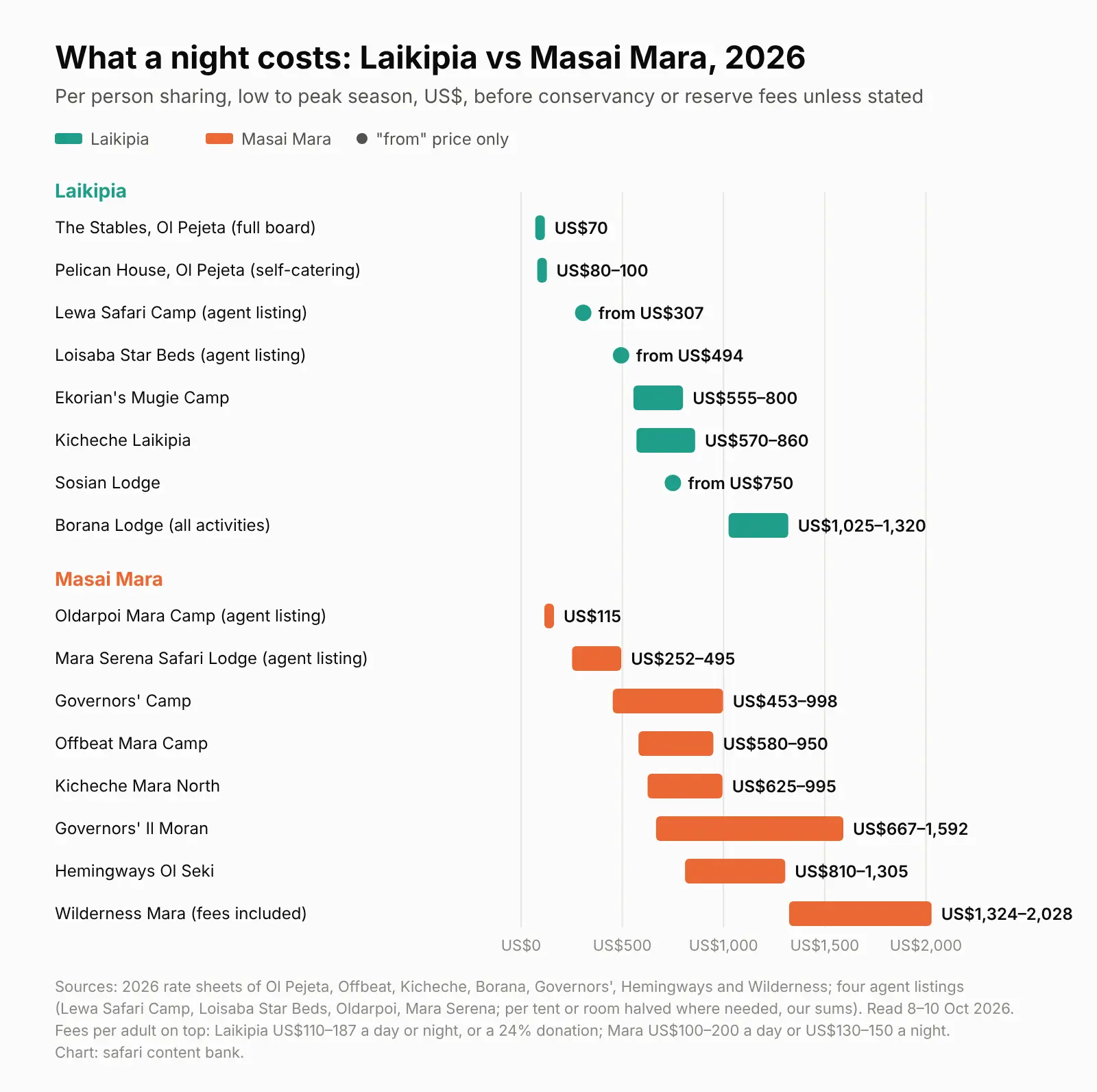 Camps’ 2026 rate sheets and four agent listings, read 8–10 October 2026. Chart: safari content bank.
- Packages: one operator’s published 3-day / 2-night budget Mara group safari costs US$170–180 per person, “park fees NOT included” (read 9 October 2026). We hold no published budget package for Laikipia.
- Closures: Kicheche Laikipia closes from 10 April to 22 May 2026, Kicheche Mara North from 1 April to 22 May (Kicheche 2026).
Worked example: four nights, one adult sharing (our sums)
In August, two nights at Kicheche Laikipia plus two at Kicheche Mara North cost US$4,344 in beds and conservancy fees, against US$4,500 for four nights at Kicheche Mara North.
| Four nights, beds + conservancy fees | February | August |
|---|---|---|
| Split: Kicheche Laikipia 2 nights (beds + US$187 a night) + Kicheche Mara North 2 nights (beds + US$130 a night) | 2 × US$650 + US$374 + 2 × US$730 + US$260 = US$3,394 | 2 × US$860 + US$374 + 2 × US$995 + US$260 = US$4,344 |
| Mara only: Kicheche Mara North 4 nights (beds + US$130 a night) | 4 × US$730 + US$520 = US$3,440 | 4 × US$995 + US$520 = US$4,500 |
| Add a day in the reserve for a river crossing | + US$100 | + US$200 |
Bed rates per person sharing, full board with game drives: Kicheche 2026 rack rates; fees as in the fee table above. The flight between the two areas is extra: we hold no Nanyuki–Mara fare; Safarilink’s Lewa–Mara fare is listed at US$419 in a safari agent’s fare table (secondary; year not stated).
The whole Kenya budget, with vehicles, tips and the eTA: Kenya safari cost.
Getting there: flights from Nairobi and road times
Both are reachable by road or by a scheduled light aircraft from Nairobi’s Wilson Airport; Laikipia is the shorter drive and the Mara has the one published flight timetable in our sources.
| Route | Distance | Time | Fare per person, one way | Source |
|---|---|---|---|---|
| Nairobi → Ol Pejeta, road | about 220 km | 4–4.5 h | – | Ol Pejeta FAQs |
| Nairobi → Masai Mara, road | 275 km | about 5.5 h; 5.5–6 h to Sekenani or Talek, about 6.5 h to Musiara or Oloololo | – | One operator’s Kenya travel-times table; The Kenya Times, 20 Aug 2026 |
| Wilson → Masai Mara, Mombasa Air Safari | – | about 1 h; departs 10:00 and 14:15 | US$200 + US$20 fuel surcharge (return US$370 + US$40) | Mombasa Air Safari 2026 |
| Wilson → Nanyuki, Safarilink | – | Not in our sources | US$194 or US$204, by season | A safari agent’s fare table (secondary; year not stated) |
| Wilson → Lewa, Safarilink | – | Not in our sources | US$256 or US$267 | same |
| Lewa → Masai Mara, Safarilink | – | Not in our sources | US$419 | same |
| Ol Pejeta → Masai Mara, road via Lake Nakuru | Ol Pejeta–Lake Nakuru 190 km | about 3.5 h + about 5 h = about 8.5 h (our sum) | – | One operator’s Kenya travel-times table |
Read 8–10 October 2026. Mombasa Air Safari’s times are “approximate; reconfirm 24 h before”. Safarilink flies from Wilson to Nanyuki, Lewa Downs and Loisaba.
- Pack light: Safarilink allows 15 kg per person including hand luggage, in soft bags (Safarilink).
- The Mara road is tarmac from Narok to Sekenani Gate, finished by June 2021 (Tourism Update). If you drive to the Mara, stay at least two nights. Flight or road compared: Nairobi to the Masai Mara.
- The usual fly-in pattern is Nairobi → a Laikipia conservancy → a Mara conservancy over 7–8 nights. Laikipia appeared in 38 of 153 Kenya itineraries (25%) from 29 tour operators that we read on 8 October 2026. Laikipia also pairs with Samburu, 145 km and about 3 hours by road from Ol Pejeta (one operator’s travel-times table).
When to go: seasons in Laikipia and the Mara
July to October suits both: the herds are usually in the Mara, and Ol Pejeta names June–October among its best months. January–February is the dry season at Nanyuki and the cheaper half of the Mara fee year.
| Month | Mara herds (usual pattern) | Mara reserve fee, per adult per day | Rain, Masai Mara | Rain, Nanyuki (Laikipia) | Ol Pejeta’s view |
|---|---|---|---|---|---|
| Jan | Southern Serengeti; Loita herd moves into Ol Kinyei | US$100 | 95 mm | 13 mm | Best |
| Feb | Southern Serengeti; Loita herd calves | US$100 | 100 mm | 23 mm | Best |
| Mar | Southern Serengeti; Loita calving | US$100 | 145 mm | 46 mm | – |
| Apr | Southern Serengeti, long rains | US$100 | 210 mm | 120 mm | Greener |
| May | Moving towards the Western Corridor | US$100 | 155 mm | 81 mm | – |
| Jun | Western Corridor; usually not in the Mara yet | US$100 | 95 mm | 51 mm | Best |
| Jul | In the Mara from mid or late month | US$200 | 60 mm | 69 mm | Best |
| Aug | Mara full; crossings mostly south to north | US$200 | 80 mm | 66 mm | Best |
| Sep | Most animals in the Mara; crossings both ways | US$200 | 95 mm | 48 mm | Best |
| Oct | The tail crosses back into Tanzania | US$200 | 100 mm | 64 mm | Best |
| Nov | Central Serengeti; short rains | US$200 | 155 mm | 86 mm | – |
| Dec | Spreading south towards Ndutu | US$200 | 115 mm | 38 mm | Greener |
Herds: a camp operator’s migration guide, whose timing “all depends on the rains”; Loita herd: a Kenyan camp operator’s Loita migration page. Rain: Masai Mara station, 1,600 m, Climates to Travel (aggregator); Nanyuki averages, Weatherbase 2011, via Wikipedia. Best months: Ol Pejeta FAQs. Fee: Narok County FY2025/26 (last published; July–December 2026 per The Kenya Times, 6 Aug 2026). Ol Pejeta’s fee is US$110 in every month.
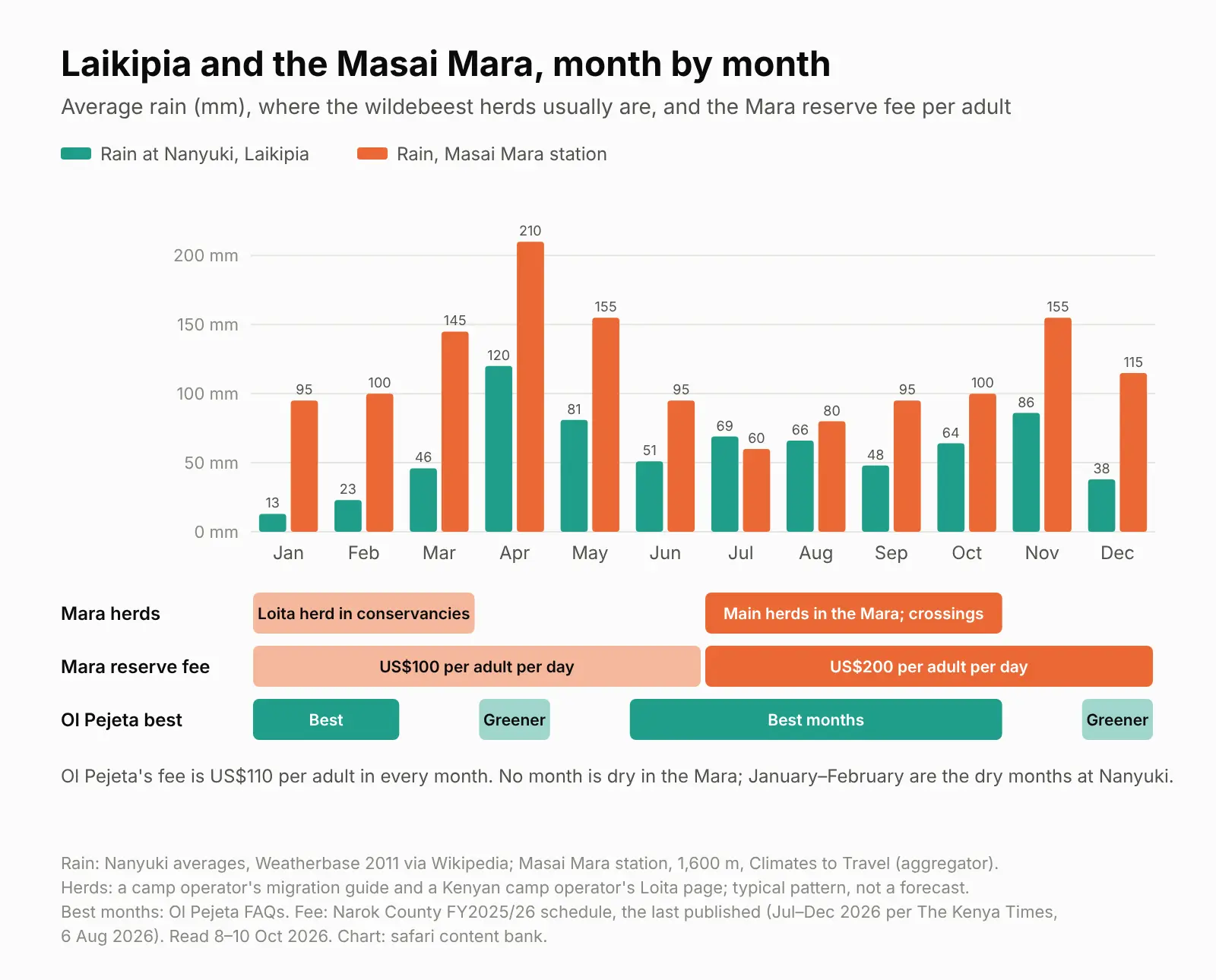 Typical pattern, not a forecast. Sources as under the table; read 8–10 October 2026. Chart: safari content bank.
- Laikipia is colder at night: average lows at Nanyuki are 7–11 °C in every month (Weatherbase, 2011); Mara nights are 11–13 °C all year (Climates to Travel).
- April–May is closure season: both Kicheche camps above close for part of it, and Ol Pejeta calls April “greener”.
- Book the river months early: travellers on the TripAdvisor Mara forum report that reserve camps near the river book up to a year ahead for mid-July to early September (TripAdvisor, traveller reports).
Which should you choose?
Choose the Mara for the migration and a January–June fee saving; choose Laikipia for northern species, chimpanzees, a dry January–February and a shorter drive; many fly-in trips do both.
| If you… | Pick | Why |
|---|---|---|
| Want the wildebeest herds and river crossings | Masai Mara | Herds usually in the Mara late July to October; crossings are inside the reserve |
| Travel January–March | Either: Laikipia for the dry season, a Mara conservancy for the Loita calving | Nanyuki gets 13–23 mm in January–February; the Loita herd calves in Ol Kinyei in February–March |
| Travel January–June on a fee budget | Masai Mara reserve | US$100 a day, against US$110 at Ol Pejeta |
| Travel July–December on a fee budget | Laikipia (Ol Pejeta) or a Mara conservancy | US$110 a day or US$130 a night, against US$200 a day in the reserve |
| Want Grevy’s zebra or chimpanzees | Laikipia | Lewa’s Grevy’s zebra population; Sweetwaters on Ol Pejeta |
| Want night drives or walks | Laikipia or a Mara conservancy | None are sold inside the Mara reserve |
| Want the fewest vehicles at a sighting | Lewa | Two vehicles, against five in the Mara reserve; no Mara conservancy publishes a cap |
| Want to self-drive | Ol Pejeta | Self-drive allowed; private cars are banned from Mara game drives |
| Have a week, by air | Both | The fly-in pattern is Nairobi → Laikipia → a Mara conservancy over 7–8 nights |
Whichever you choose, check that your operator holds a current licence: see how to check a safari operator is licensed. Mara against Serengeti: Kenya vs Tanzania. Mara against Samburu: Samburu vs Masai Mara.
Common mistakes
| What you’ll often read | What is correct |
|---|---|
| “Laikipia is a national park with one entry fee” | Private conservancies and ranches, each with its own fee or none published. Ol Pejeta’s is US$110 per adult a day. |
| “You can see the Great Migration in Laikipia” | The herds are a Mara event, usually late July to October; none of our Laikipia sources mentions them. |
| “Night drives in the Masai Mara” | Only in the conservancies. None are sold inside the reserve. Ol Pejeta in Laikipia sells them at US$70 per adult. |
| “Lewa is open to lodge guests only” | Not stated in our sources; ask your lodge. Lewa publishes no fee or visitor policy that we found. |
| “July is the dry season in Laikipia” | January–February are the dry months at Nanyuki (13–23 mm); July and August get 66–69 mm. |
| “The Mara fee is US$200 all year” | US$100 from 1 January to 30 June, US$200 from 1 July to 31 December, per non-resident adult per day. |
| “Ol Pejeta’s gates open 06:00–18:00” | 07:00–19:00, through Rongai and Serat gates only. The Mara ticket runs 06:00–18:00. |
Frequently asked questions
Is Laikipia or the Masai Mara cheaper? In fees it depends on the month: from January to June the Mara reserve (US$100 per adult per day) is cheaper than Ol Pejeta (US$110); from July to December Ol Pejeta is cheaper than the reserve (US$200). The cheapest 2026 beds we found are US$70 a night at The Stables on Ol Pejeta and US$115 at Oldarpoi outside the Mara’s Sekenani Gate. At the top end, Borana Lodge charges up to US$1,320 and Wilderness Mara up to US$2,028 with fees included.
Can you see the Great Migration in Laikipia? No: none of our Laikipia sources mentions the wildebeest herds. They are usually in the Masai Mara from late July to October, and the smaller Loita herd calves in the Mara’s Ol Kinyei conservancy in February–March.
Can you combine Laikipia and the Masai Mara on one trip? Yes. The usual fly-in pattern is Nairobi, a Laikipia conservancy and a Mara conservancy over 7–8 nights. By road, Ol Pejeta to the Mara via Lake Nakuru takes about 8.5 hours (our sum); Safarilink’s Lewa–Mara fare is listed at US$419 in a safari agent’s fare table (secondary; year not stated).
Can you visit Lewa if you are not staying there? Not stated in our sources; ask your lodge. Lewa publishes no fee, and its Code of Conduct permits only green or brown 4x4 vehicles. Ol Pejeta does take day visitors, at US$110 per adult per entry.
Are night drives and walks allowed? Not inside the Masai Mara reserve, which sells neither. They are sold in the Mara conservancies by some camps and in Laikipia: Ol Pejeta charges US$70 per adult for a shared night drive or a guided walk (2026 tariff). On Lewa, walks need an armed guide authorised by its Chief Conservation Officer.
What is the best month for both areas? July to October: the herds are usually in the Mara, and Ol Pejeta names June–October among its best months. The Mara reserve fee is US$200 per adult per day then. January–February is the dry season at Nanyuki and the US$100 half of the Mara’s fee year.
How many nights should I spend in each? At least two in the Mara if you come by road, because Nairobi is about 5.5 hours away. For Laikipia, TripAdvisor members suggested two nights at Ol Pejeta in one thread, and a sample fly-in trip gave Laikipia three nights in another (June–July 2026); both are traveller reports.
Sources
- Narok County, Maasai Mara fee schedule FY2025/26 (PDF), the last published, expired 30 June 2026; for July–December 2026, The Kenya Times, 6 Aug 2026 (press, secondary); management plan via Business Daily
- Mara Conservancy: conservation fees, history, wildebeest migration; MMWCA
- Ol Pejeta: Tariff Guide 2026 (PDF), FAQs; Lewa: visit, Code of Conduct; Borana: rates, Your Impact
- Camp 2026 rate sheets: Kicheche, Porini and Porini Lion Camp factsheet, Offbeat, Governors’ and its community fee, Hemingways, Wilderness, Elewana; four agent listings (secondary)
- Wildlife and visitors: Citizen Digital, 11 Dec 2025; Kenya Economic Survey 2026 via Business Daily; a camp operator’s migration guide; a Kenyan camp operator’s Loita migration page; one operator’s Laikipia page; a tour operator’s walking-safari guide
- Travel and climate: Mombasa Air Safari 2026; Safarilink baggage; a safari agent’s Safarilink fare table (secondary); The Kenya Times, 20 Aug 2026; Tourism Update; Kenyans.co.ke; one operator’s Kenya travel-times table; Climates to Travel; Wikipedia, Nanyuki
- Traveller reports: TripAdvisor (Safari Advice, 10 days, booking a Mara camp); a safari booking site’s reviews; 153 Kenya itineraries from 29 tour operators, read 8 October 2026 (names and links kept in our editor notes)
Figures read 8–10 October 2026, as printed on our Kenya cost, fee and hub pages; page checked 21 October 2026. We will update this page when Narok County publishes a 2026/27 Mara schedule, when Ol Pejeta publishes its 2027 tariff, when Lewa publishes a fee or visitor policy, and when camps issue 2027 rates.
Ask for a quote
Tell us your dates and we send you a priced itinerary. Free, no obligation.
- Free quote, no obligation
- Trips run by licensed local operators