 Experience

Last verified
On this page
- Masai Mara to the Serengeti: the three routes
- Why can’t you drive from the Mara into the Serengeti?
- Option 1: fly via Migori and Tarime
- Option 2: drive round via Isebania–Sirari
- Option 3: via Nairobi, Namanga and Arusha
- Changing vehicle and guide at the border
- Kenya–Tanzania border posts: hours and paperwork
- Drive times on the main safari legs in Kenya
- Drive times on the main safari legs in northern Tanzania
- Why the published times are optimistic
- No driving after dark, and the 13:00 landing rule
- Common mistakes about getting from the Mara to the Serengeti
- Frequently asked questions
- Sources
Short answer: No. The direct road crossing between the Masai Mara and the Serengeti, Sand River–Bologonja, has been closed since 1977 (The EastAfrican, 4 Apr 2017). The usual link is by air: Safarilink leaves the Mara at 11:30 for Migori, and Coastal Aviation leaves Tarime at 14:00 for the Serengeti (Safarilink, read 9 October 2026). By road you go round through the Isebania–Sirari or Namanga border and change vehicle there.
Key facts
- The Sand River–Bologonja border post between the Masai Mara and the Serengeti closed in 1977, after the first East African Community broke up. Kenya tried to reopen it in 2017 and Tanzania refused. No reopening had been announced on 9 October 2026. The other crossings, and the visas and insurance needed at each, are on Kenya–Tanzania border crossings.
- The Mara–Serengeti air link runs 16 December–31 March and 1 July–31 October. At other times it flies on request with at least 4 passengers. It allows 15 kg of baggage and needs a yellow fever card (Safarilink).
- Tanzanian-plated safari vehicles are “currently banned” in Kenyan parks such as the Mara, and Kenyan-registered vehicles cannot enter Tanzanian parks (a self-drive operator’s guide). Every road route changes vehicle and guide at the border.
- Arusha to Seronera in the central Serengeti is a 7–7.5 hour drive (a Tanzanian operator’s Serengeti guide); Nairobi to the Mara’s Sekenani Gate is 5.5–6 hours, on tarmac all the way (The Kenya Times, 20 Aug 2026). Flight or road from Nairobi: see Nairobi to the Masai Mara.
- Tourists may not be driven outside towns after dark in Tanzania, so a same-day transfer to a park needs a flight landing at Kilimanjaro, Arusha or Dar es Salaam before 13:00 (a Tanzanian operator’s travel-times table, page modified 1 July 2026).
- The Namanga and Isebania–Sirari border posts are listed as open 24 hours, 7 days a week, public holidays included (WFP Logistics Cluster).
Masai Mara to the Serengeti: the three routes
There are three ways from the Mara to the Serengeti: fly via Migori and Tarime, drive round via the Isebania–Sirari border, or go via Nairobi, Namanga and Arusha. None of them crosses the border between the two parks.
| Route | How it works | Published time | Border post | Source |
|---|---|---|---|---|
| 1. Fly via Migori and Tarime (the usual choice) | Safarilink from a Mara airstrip to Migori (Kenya); short road transfer across the Isebania–Sirari border; Coastal Aviation from Tarime (Tanzania) to Serengeti airstrips | Mara 11:30, Migori 12:00; Tarime 14:00 | Isebania–Sirari | Safarilink |
| 2. Drive round via Isebania–Sirari | Mara → Migori area → Isebania–Sirari → Tarime → Serengeti (Ikoma side), with a change of vehicle at the border | Not published: sources disagree by more than a day, so we print none | Isebania–Sirari, 24/7 | WFP Logistics Cluster (border hours) |
| 3. Drive via Nairobi, Namanga and Arusha | Mara → Nairobi (275 km, 5.5 h) → Arusha (5–6 h including the Namanga border) → Seronera (7–7.5 h) | 17.5–19 h of driving across the three legs (our sum of the published times) | Namanga, 24/7 | One operator’s Kenya travel-times page; a self-drive operator’s guide; a Tanzanian operator’s Serengeti guide |
| The gates between the two parks | Closed since 1977 | None open to tourists | The EastAfrican, 4 Apr 2017 |
Times as published by each source, read 9 October 2026. “Our sum” adds the three published leg times and includes no stops. Border hours from the WFP Logistics Cluster’s undated pages for Namanga and Isebania–Sirari.
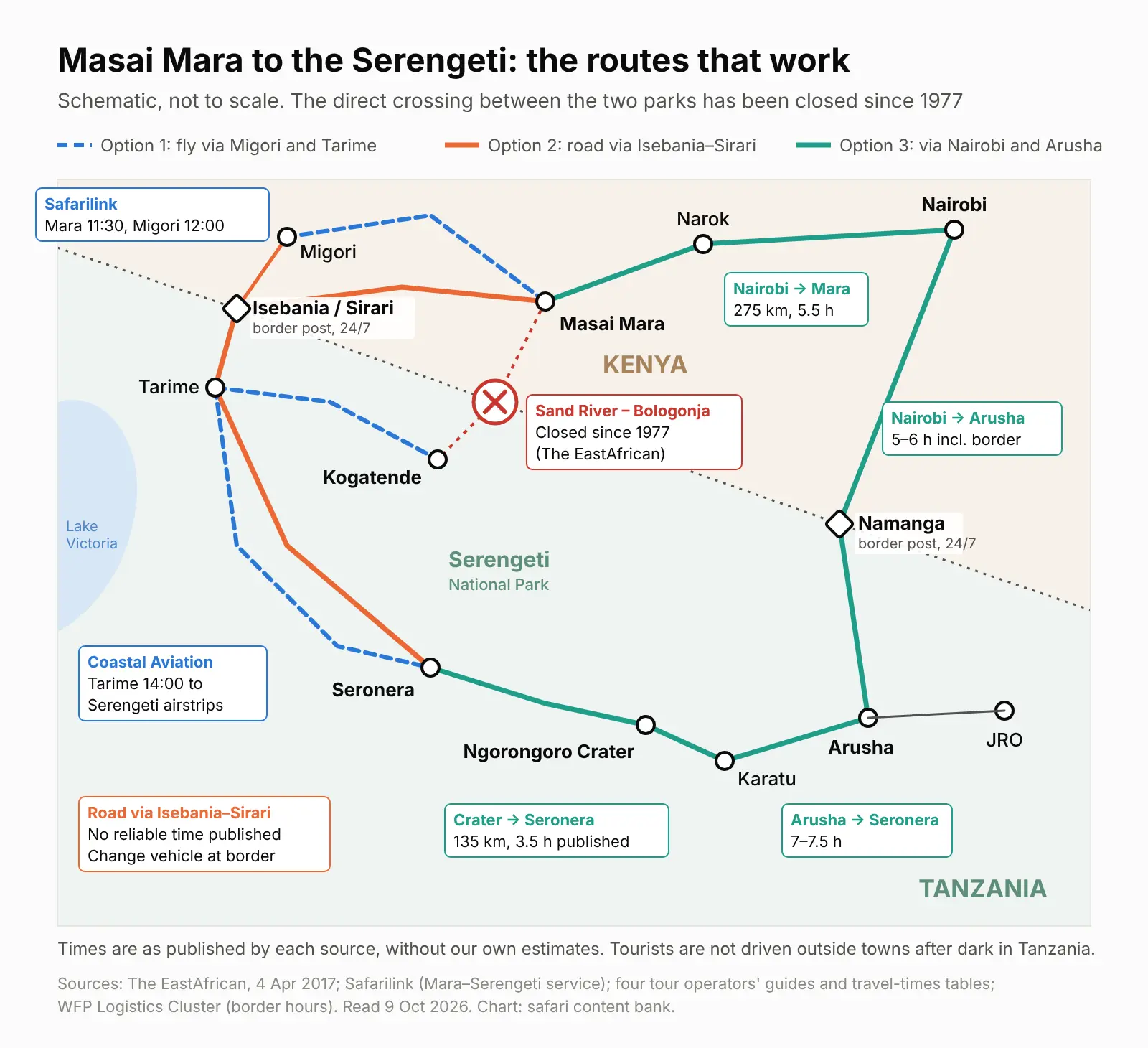 Schematic, not to scale. Sources: The EastAfrican; Safarilink; one operator’s Kenya travel-times page; a self-drive operator’s guide; a Tanzanian operator’s Serengeti guide; a Tanzanian operator’s travel-times table; WFP Logistics Cluster. Read 9 October 2026. Chart: safari content bank.
Why can’t you drive from the Mara into the Serengeti?
Because the only road between the two parks, through the Sand River gate in Kenya and the Bologonja gate in Tanzania, has been closed to traffic since 1977. The two gates are on either side of the border, a few kilometres apart.
- 1977: Bologonja “was closed in 1977 after the breakup of the former East African Community” (The EastAfrican, 4 Apr 2017).
- 2009: Tanzania said it would not reopen the crossing because it “can’t risk environmental damage to the world famous Serengeti National Park” (The EastAfrican, 31 Oct 2009).
- 2017: Narok County was rehabilitating the Sand River Gate office, and Kenya’s government was building an immigration office there. Tourism Cabinet Secretary Najib Balala put the project at US$1 million. Tanzanian tour operators and hoteliers protested, and the crossing stayed shut (The EastAfrican, 4 Apr 2017).
- 2026: No reopening had been announced when we checked on 9 October 2026.
Some websites still describe Bologonja as a gate used “en route to and from Kenya”. It is not open to tourists.
Option 1: fly via Migori and Tarime
The quickest way is the air–road–air connection: a Safarilink flight from the Mara to Migori in Kenya, a short road transfer across the Isebania–Sirari border, and a Coastal Aviation flight from Tarime in Tanzania to the Serengeti.
| Detail | What Safarilink publishes |
|---|---|
| Mara departure | 11:30 |
| Migori | 12:00 |
| Tarime departure (Coastal Aviation) | 14:00 |
| Operating season | 16 December–31 March and 1 July–31 October |
| Outside the season | On request, minimum 4 passengers |
| Baggage | 15 kg |
| Health document | Yellow fever card required |
| Running since | January 2012 |
| Fare | Not published (on request) |
Source: Safarilink, “Masai Mara to Serengeti”, read 9 October 2026.
- Two and a half hours pass between leaving the Mara strip and leaving Tarime on this timetable (our arithmetic: 11:30 to 14:00). The border formalities happen in that gap.
- Regional Air also uses Tarime as its hand-off point for Masai Mara connections with AirKenya (ATTA, 29 June 2026).
- Plan the day as a travel day. You leave the Mara camp in the late morning and reach a Serengeti camp in the afternoon.
- The route works in both directions, and it is the reason a Mara + northern Serengeti trip in July–October does not need to go back through Nairobi and Arusha. For where the herds are each month, see the Great Migration month by month; for the crossings themselves, Great Migration river crossings.
Option 2: drive round via Isebania–Sirari
You can drive from the Mara to the Serengeti through the Isebania–Sirari border west of the parks, but no reliable time is published and you change vehicle and guide at the border.
- The border post is a One Stop Border Post listed as open 24 hours, 7 days a week, public holidays included (WFP Logistics Cluster, Isebania/Sirari). The page is undated and written for cargo.
- On the Tanzanian side, the road from Musoma to the Sirari border is 86 km of “well maintained paved single carriageway”; Mwanza to Sirari is 290 km (WFP Logistics Cluster).
- No published distance or time for Masai Mara → Isebania could be checked. The figures in circulation are unsourced.
- Published estimates for the whole drive disagree by more than a day, so we print none. Plan it with an overnight stop and confirm the timing with the operators on both sides.
- Kenyan-registered vehicles cannot enter Tanzanian parks, so the Kenyan vehicle drops you at the border and a Tanzanian vehicle with a Tanzanian guide takes over (a self-drive operator’s guide).
Option 3: via Nairobi, Namanga and Arusha
The third route goes back to Nairobi, south across the Namanga border to Arusha, and west to the Serengeti: three long published legs, so it only makes sense when the trip already passes through Nairobi and Arusha.
| Leg | Distance | Published time | Source |
|---|---|---|---|
| Masai Mara → Nairobi | 275 km | 5.5 h | One operator’s Kenya travel-times page |
| Nairobi → Namanga border | about 160 km | not published | WFP Logistics Cluster, Namanga |
| Nairobi → Arusha by shuttle | not published | 5–6 h, including the Namanga border | A self-drive operator’s guide |
| Arusha → Seronera (central Serengeti) | not published | 7–7.5 h | A Tanzanian operator’s Serengeti guide |
Read 9 October 2026. “Not published” means the sources disagree or no checked figure exists.
- The three driving legs add up to 17.5–19 hours (our sum: 5.5 + 5–6 + 7–7.5). With no driving after dark in Tanzania, that cannot be done in one day.
- Flying cuts it down: Nairobi Wilson → Masai Mara is 45–60 minutes by light aircraft, and Arusha or Kilimanjaro → Serengeti airstrips 1–2 hours (a tour operator’s guide, revised 26 May 2026).
- Namanga is also the crossing for Amboseli → Arusha. Nairobi → Amboseli’s Meshanani Gate via Namanga is 220 km, “tarmacked up to Namanga and murramed from Namanga to Meshanani Gate” (KWS).
Changing vehicle and guide at the border
Every road route between the Kenyan and Tanzanian parks changes safari vehicle and guide at the border. A self-drive operator’s guide: “Tanzanian-plated safari cars are currently banned in Kenyan parks like the Masai Mara”, and Kenyan-registered vehicles cannot enter Tanzanian parks (a self-drive operator’s guide).
- Book the two halves with operators licensed in each country, or with one operator who partners across the border. Check both licences: see how to check a safari operator is licensed.
- Agree the hand-over point and time in writing: which side of the border, who carries the bags across, and who waits if the other vehicle is late.
- By air the same change of country happens at the Migori–Tarime road transfer, with no safari vehicle involved.
Kenya–Tanzania border posts: hours and paperwork
All four main road crossings between Kenya and Tanzania are One Stop Border Posts that the WFP Logistics Cluster lists as open 24 hours a day, 7 days a week, including public holidays; the Mara–Serengeti crossing is the only one that is shut.
| Border post (Kenya / Tanzania) | Used for | Hours | Source |
|---|---|---|---|
| Namanga / Namanga | Nairobi ↔ Arusha; Amboseli ↔ Arusha | 24 h, 7 days, public holidays included | WFP Logistics Cluster, Namanga |
| Isebania / Sirari | Masai Mara ↔ Serengeti via Migori and Tarime | 24 h, 7 days, public holidays included | WFP Logistics Cluster, Isebania/Sirari |
| Taveta / Holili | Tsavo West and Amboseli ↔ Moshi | 24 h, 7 days, public holidays included; first OSBP to operate, 2016 | WFP Logistics Cluster, Taveta/Holili |
| Lunga Lunga / Horohoro | Diani and Mombasa ↔ Tanga | 24 h, 7 days, public holidays included | WFP Logistics Cluster, Lunga Lunga/Horohoro |
| Sand River / Bologonja | Masai Mara ↔ Serengeti, direct | Closed since 1977 | The EastAfrican, 4 Apr 2017 |
The WFP Logistics Cluster pages are undated and written for cargo traffic; no separate hours for tourist immigration are published. Read 9 October 2026.
What to carry across. Each country needs its own entry document, and the East African Tourist Visa does not cover Tanzania.
| Document | Kenya | Tanzania | Source |
|---|---|---|---|
| Entry document | eTA US$30, applied for before travel; it covers arrivals by “air, ship, land” | Tourist visa, single entry, US$50; US citizens US$100 | KCAA AIC 14/25 (PDF); Tanzania e-visa guidelines |
| Compulsory travel insurance | Required for arrivals since 5 October 2026 (U.S. Embassy Nairobi), up to US$44 (eCitizen) | US$44 per adult, 92 days, under Government Notice 256 of 2026 | VisasNews, 7 Oct 2026; Clyde & Co, 16 Sep 2026 |
| Yellow fever certificate | Needed only if you arrive from a country with yellow fever risk | Needed when you arrive from Kenya, which is a risk country, by road or air (travellers aged 1 and over) | WHO country list (PDF), revised 3 Jan 2023 |
Fees as on our Kenya vs Tanzania page, checked 9 October 2026.
Drive times on the main safari legs in Kenya
Nairobi to the Masai Mara takes 5.5–6.5 hours depending on the gate, and the road is tarmac as far as Sekenani Gate. The Narok–Sekenani road was paved by June 2021; the Kenya News Agency says that stretch used to take four hours (Tourism Update, 3 Jun 2021; KNA).
| Leg | Distance | Published time | Road surface | Source |
|---|---|---|---|---|
| Nairobi → Masai Mara (generic) | 275 km | 5.5 h | Tarmac to Sekenani Gate; gravel inside the reserve | One operator’s Kenya travel-times page |
| Nairobi → Mara, Sekenani Gate | not published | 5.5–6 h | Tarmac throughout: “The road is tarmacked from Narok to Sekenani gate” | The Kenya Times, 20 Aug 2026; Mara Conservancy |
| Nairobi → Mara, Talek Gate | not published | 5.5–6 h | Tarmac to Sekenani; beyond, not published | The Kenya Times |
| Nairobi → Mara, Oloolaimutia Gate | not published | about 6 h | Tarmac to Sekenani; beyond, not published | The Kenya Times |
| Nairobi → Mara, Musiara Gate | not published | about 6.5 h | C13 via Aitong, which “can be rougher in some sections” | The Kenya Times |
| Nairobi → Mara Triangle, Oloololo Gate | not published | about 6.5 h | C13 via Aitong; the Mara Conservancy calls the Aitong route “the fastest” for camps outside the reserve | The Kenya Times; Mara Conservancy |
| Oloololo Gate → Purungat Gate (across the Mara Triangle) | not published | “a little over one hour” at 50 km/h | Graded main road; transit allowed 2 h before fees apply | Mara Conservancy |
| Lake Nakuru → Masai Mara | not published | 5 h | Tarmac Nakuru–Narok, then C12 to Sekenani | One operator’s Kenya travel-times page; a self-drive operator’s guide |
| Nairobi → Lake Naivasha / Hell’s Gate | 103 km | 2 h 15 | Tarmac | One operator’s Kenya travel-times page |
| Nairobi → Lake Nakuru National Park | not published | 3.5 h | Tarmac (A104) | One operator’s Kenya travel-times page; KWS |
| Nairobi → Amboseli, Iremito Gate (via Emali) | not published | 4 h | Tarmac; the C102 “entire road is tarmacked and in good condition” | One operator’s Kenya travel-times page; a self-drive operator’s guide |
| Nairobi → Amboseli, Meshanani Gate (via Namanga) | 220 km | not published | Tarmac to Namanga, then murram | KWS |
| Nairobi → Ol Pejeta Conservancy | about 215–220 km | 4–4.5 h | Tarmac | Ol Pejeta FAQ; one operator’s Kenya travel-times page |
| Lake Nakuru → Ol Pejeta | 190 km | 3.5 h | Tarmac | One operator’s Kenya travel-times page |
| Ol Pejeta → Samburu National Reserve | 145 km | 3 h | Tarmac (A2), then reserve gravel | One operator’s Kenya travel-times page |
| Nairobi → Tsavo West, Mtito Andei Gate | 240 km | not published | Tarmac (A109), heavy trucks | KWS |
| Amboseli → Tsavo East (via Emali and Voi) | 310 km | 6 h (one operator’s Kenya travel-times page); 7 h (a self-drive operator’s guide) | Tarmac | One operator’s Kenya travel-times page; a self-drive operator’s guide |
| Tsavo West → Tsavo East | 100 km | 2 h | Tarmac between the gates | One operator’s Kenya travel-times page |
Read 9 October 2026. “Not published” means the sources disagree or no checked figure exists; we print no estimate in its place. Unlinked Kenya rows: one operator’s Kenya travel-times page.
- Quote the gate, not “the Mara”. Sekenani and the western gates (Musiara, Oloololo) are about an hour apart in published times (The Kenya Times).
- Google Maps sends drivers onto the C11 into the Mara. A self-drive operator’s guide: “don’t take that road. It’s a very rough road, bad for the car, and will take much longer”. Use the C12 through Narok.
- Speed limits in the Mara Triangle are 50 km/h on graded roads and 30 km/h on other tracks (Mara Conservancy).
Drive times on the main safari legs in northern Tanzania
Arusha to the central Serengeti is a full day’s drive, 7–7.5 hours, and every Serengeti leg after the Ngorongoro gate is on gravel.
| Leg | Distance | Published time | Road surface | Source |
|---|---|---|---|---|
| Kilimanjaro Airport (JRO) → Arusha | 55 km | 1 h 20 | Tarmac | A Tanzanian operator’s travel-times table |
| Arusha → Tarangire main gate | not published | 2 h (a Tanzanian operator’s travel-times table); 2.5 h (a self-drive operator’s guide) | Tarmac to within 7 km of the gate | A Tanzanian operator’s travel-times table; a safari agent’s guide, read 10 October 2026; a self-drive operator’s guide |
| Tarangire → Lake Manyara | 68 km | 1 h 20 | Tarmac | A Tanzanian operator’s travel-times table |
| Mto wa Mbu → Tarangire main gate | 85 km | 2 h | Tarmac; last few km gravel | A self-drive operator’s guide |
| Arusha → Lake Manyara gate | not published | not published | Tarmac via Makuyuni | — |
| Arusha → Ngorongoro, Loduare Gate | 160 km | not published | “the entire journey is on tarmac” | a Tanzania travel site, not the NCAA (undated) |
| Arusha → Ngorongoro Crater rim | 190 km | 3.5–4 h | Tarmac to Loduare Gate, then about 15 km of gravel | A Tanzanian safari operator’s guide |
| Karatu → Loduare Gate | 15 km | 30 min | Tarmac | A self-drive operator’s guide |
| Loduare Gate → crater rim | 15 km | 1 h | Steep forest gravel | A self-drive operator’s guide |
| Crater rim → Serengeti, Naabi Hill Gate | 85 km | 2–3 h | Ngorongoro Conservation Area gravel, dusty June–October | A self-drive operator’s guide; a Tanzanian operator’s Serengeti guide |
| Naabi Hill Gate → Seronera | not published | not published | “rocky and badly corrugated”; a self-drive operator’s guide advises keeping under 25 km/h | A self-drive operator’s guide |
| Ngorongoro Crater → Seronera | 135 km | 3.5 h | Conservation-area gravel, then the corrugated Serengeti main road | A Tanzanian operator’s travel-times table |
| Karatu → Seronera | 200 km | 6–7.5 h | Tarmac to Loduare, gravel after | A self-drive operator’s guide |
| Arusha → Seronera | not published | 7–7.5 h | Tarmac to Loduare, gravel after | A Tanzanian operator’s Serengeti guide |
| Arusha → Ndutu | not published | about 5.5–6 h | Tarmac, conservation-area gravel, then plains tracks | A Tanzanian operator’s Serengeti guide |
| Ngorongoro Crater → Ndutu | 106 km | 2.5 h | Gravel, then plains tracks | A Tanzanian operator’s travel-times table |
| Seronera → Kogatende (Mara River) | not published | 4–5 h (one operator’s airstrip page); about 4 h, “often over 5 with game viewing” (a Tanzanian operator’s Serengeti guide) | Park gravel; black-cotton soil near the Mara and Grumeti rivers | One operator’s airstrip page; a Tanzanian operator’s Serengeti guide |
| Seronera → Lobo | 77 km | 2.5 h | Park gravel; “accessible only in the dry season” | A self-drive operator’s guide |
| Seronera → Klein’s Gate area | 100 km | 2.5–3 h | Park gravel via Lobo | A self-drive operator’s guide |
| Seronera → Ikoma (outside Ikoma Gate) | 45 km | 2 h | Park gravel | A self-drive operator’s guide |
| Seronera → Grumeti / Western Corridor | not published | 2–2.5 h | Dirt roads, “some bumps and gravel, but comfortable” | A Tanzanian operator’s Serengeti guide |
| Seronera → Ndabaka Gate (west) | 145 km | not published | Park gravel, Western Corridor | A tour operator’s Serengeti travel blog |
| Mwanza → Ndabaka Gate | about 140 km | about 2 h | Tarmac, Mwanza–Musoma road | A tour operator’s Mwanza–Serengeti trip page |
| Mto wa Mbu → Lake Natron (Engare Sero) | 110 km (a self-drive operator’s guide); 116 km from Manyara (a Tanzanian operator’s travel-times table) | 2.5 h; 3 h | Rough final section | A self-drive operator’s guide; a Tanzanian operator’s travel-times table |
| Klein’s Gate → Lake Natron | 160 km | 4–5 h | Gravel and new tarmac; last stretch “rough and eroded” | A self-drive operator’s guide |
| Lake Natron → northern Serengeti | 159 km | 5 h | As Klein’s Gate → Lake Natron | A Tanzanian operator’s travel-times table |
Read 9 October 2026; the Tanzanian operator’s travel-times table modified 1 July 2026. “Not published” means the sources disagree or no checked figure exists. Distances between Seronera and Kogatende differ by more than 60 km between sources, so we print none.
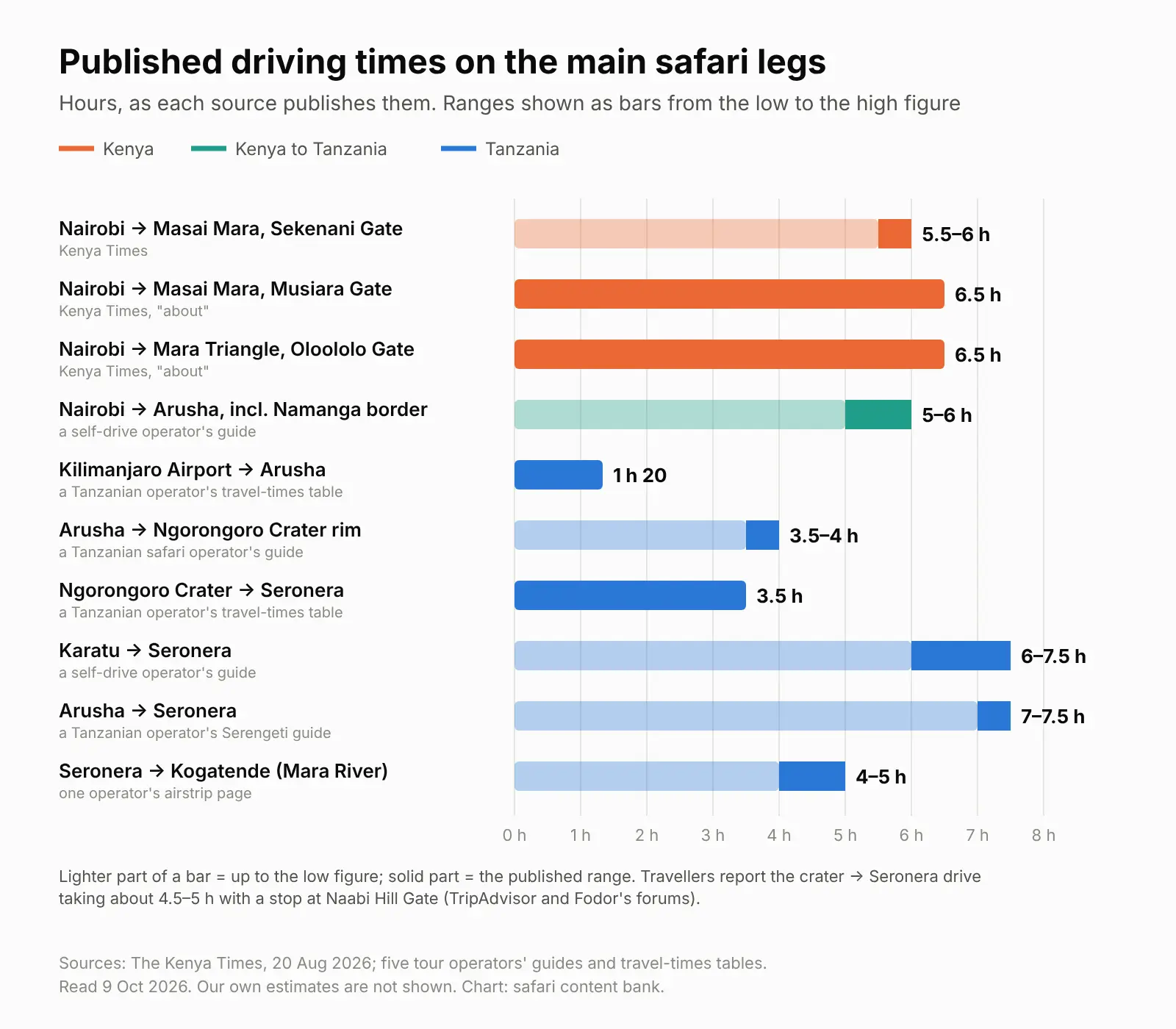 Times as published by The Kenya Times and five tour operators’ guides and travel-times tables, read 9 October 2026. Chart: safari content bank.
Why the published times are optimistic
Operator charts give one time per leg, and on Tanzanian gravel it is the fast one: Ngorongoro Crater to Seronera is published as 3.5 hours, and travellers report about 4.5 to 5.
- Traveller reports, not measurements: “close to 5 hours (with one stop at the Naabi Hill Gate)” (TripAdvisor Tanzania forum, thread closed 9 November 2025); “about 4.5 hrs” and “about 5 hours” (Fodor’s forum, undated posts).
- A self-drive operator’s guide: “Google Maps travel times are misleading”; add roughly 30% (Driving in Tanzania).
- You “rarely drive faster than 50 km/h” on northern Tanzanian routes, and safari Land Cruisers are capped at 80 km/h as trucks (the same guide).
- Gate queues add time: The same self-drive guide says to allow about 30 minutes at the Ngorongoro gate and 30 minutes at the Serengeti gate in July–September and December–January.
- Google Maps does not show the Serengeti park roads; the same guide recommends maps.me.
No driving after dark, and the 13:00 landing rule
In Tanzania, tourists are not driven on roads outside towns after dark, so a flight must land at Kilimanjaro, Arusha or Dar es Salaam before 13:00 for a same-day transfer to a park (a Tanzanian operator’s travel-times table, page modified 1 July 2026). The same page says a flight leaving after 13:00 allows a same-day transfer out of a park.
- Landing after 13:00: sleep in Arusha or near Kilimanjaro Airport and drive on the next morning.
- Arusha → Seronera is 7–7.5 hours published (a Tanzanian operator’s Serengeti guide). Do not plan it on the day you land, and do not add a crater descent to the same day.
- Seronera → Kogatende is 4–5 hours published (one operator’s airstrip page). Most travellers fly it; by road, plan it as the whole day.
- The Mara–Serengeti flight connection leaves Tarime at 14:00 (Safarilink), so a camp within reach of the arrival airstrip before dark is the safe choice for that night.
Common mistakes about getting from the Mara to the Serengeti
| What you’ll often read | What is correct |
|---|---|
| “Drive across from the Masai Mara into the Serengeti” | The Sand River–Bologonja crossing has been closed since 1977. Fly via Migori and Tarime, or drive round via Isebania–Sirari or Namanga. |
| “Bologonja gate is used en route to and from Kenya” | It is closed to tourists; Tanzania refused to reopen it in 2009 and again in 2017 (The EastAfrican). |
| “There’s a direct flight from the Mara to the Serengeti” | The scheduled link is air–road–air: Safarilink to Migori, a road transfer across Isebania–Sirari, Coastal Aviation from Tarime at 14:00. |
| “Keep the same safari vehicle and guide for both countries” | Tanzanian-plated safari cars are banned in Kenyan parks, and Kenyan vehicles cannot enter Tanzanian parks. You change at the border. |
| “Ngorongoro to Serengeti is 3.5 hours” | That is the published figure to Seronera; travellers report about 4.5–5 hours with a stop at Naabi Hill Gate. |
| “Arusha to the Serengeti in 4–5 hours” | Arusha to Seronera is published at 7–7.5 hours (a Tanzanian operator’s Serengeti guide). |
| “No yellow fever card needed for Tanzania” | Needed when you arrive from Kenya, a yellow fever risk country (WHO); Safarilink requires it on the Mara–Serengeti link. |
| “The road to the Mara is terrible” | It is tarmac all the way to Sekenani Gate since about June 2021; the western C13 and the reserve tracks are still rough. |
Frequently asked questions
Can you drive from the Masai Mara to the Serengeti? Not directly. The Sand River–Bologonja border post between the two parks has been closed since 1977, and no reopening had been announced on 9 October 2026. You can drive round via the Isebania–Sirari or Namanga border, changing vehicle and guide there.
How long does it take to get from the Masai Mara to the Serengeti? By air, from late morning to the afternoon: Safarilink leaves the Mara at 11:30, and Coastal Aviation leaves Tarime at 14:00 for the Serengeti airstrips. By road via Nairobi and Arusha, the published legs add up to 17.5–19 hours of driving (our sum), so at least two days. For the road via Isebania–Sirari, sources disagree by more than a day.
Is there a flight from the Masai Mara to the Serengeti? Yes, but not a direct one. Safarilink flies from the Mara to Migori in Kenya, you cross the Isebania–Sirari border by road, and Coastal Aviation flies on from Tarime. It runs 16 December–31 March and 1 July–31 October, and on request with at least 4 passengers at other times.
Which border do safaris use between Kenya and Tanzania? Namanga for Nairobi or Amboseli to Arusha, and Isebania–Sirari for the Masai Mara to the Serengeti. Both are One Stop Border Posts listed as open 24 hours a day, public holidays included (WFP Logistics Cluster).
Do I need a yellow fever certificate to go from Kenya to Tanzania? Yes, if you are aged 1 or over. Kenya is a yellow fever risk country, and Tanzania requires the certificate from arrivals from risk countries (WHO). Safarilink also requires the card on the Mara–Serengeti connection.
How long is the drive from Arusha to the Serengeti? Arusha to Seronera, in the central Serengeti, is published at 7–7.5 hours (a Tanzanian operator’s Serengeti guide). Karatu to Seronera is 200 km and 6–7.5 hours (a self-drive operator’s guide), and Ngorongoro Crater to Seronera 135 km and 3.5 hours (a Tanzanian operator’s travel-times table).
Can I drive at night on safari in Tanzania? No. Tourists are not driven on roads outside towns after dark (a Tanzanian operator’s travel-times table). That is why a flight must land before 13:00 for a same-day transfer to a park.
Can I combine Kenya and Tanzania in one safari? Yes, usually by flying between the Mara and the Serengeti, or by road via Nairobi and Arusha. You need Kenya’s eTA (US$30) and Tanzania’s visa (US$50, US$100 for US citizens). For costs side by side, see Kenya vs Tanzania, Kenya safari cost and Tanzania safari cost.
Sources
- The EastAfrican, Bologonja border, 4 Apr 2017 and 31 Oct 2009
- Safarilink, Masai Mara to Serengeti; ATTA, Regional Air expands Serengeti flight network, 29 Jun 2026; a tour operator’s guide, revised 26 May 2026
- WFP Logistics Cluster capacity assessments: Namanga, Isebania/Sirari, Taveta/Holili, Lunga Lunga/Horohoro (undated)
- Kenya road times: The Kenya Times, Nairobi to the Mara, 20 Aug 2026; Mara Conservancy, driving to the Mara Triangle; one operator’s Kenya travel-times page; Kenya Wildlife Service park pages (Amboseli, Lake Nakuru, Tsavo West); Ol Pejeta FAQ; Tourism Update, 3 Jun 2021; Kenya News Agency
- Tanzania road times: a Tanzanian operator’s travel-times table, modified 1 Jul 2026; a Tanzanian operator’s Serengeti guide; a self-drive operator’s guides (combining the Mara and Serengeti, driving in Tanzania, Serengeti notes, Manyara notes, northern circuit, Kenya bush to beach); a Tanzanian safari operator’s Ngorongoro Crater planning guide; one operator’s airstrip page; a Tanzania travel site (not the NCAA); a safari agent’s Tarangire guide; a tour operator’s Serengeti travel blog; a tour operator’s Mwanza–Serengeti trip page
- Traveller reports: TripAdvisor Tanzania forum; Fodor’s forum
- Entry: Kenya Civil Aviation Authority, AIC 14/25 (PDF); Tanzania Immigration, e-visa guidelines; WHO yellow fever country list (PDF); Clyde & Co, 16 Sep 2026; VisasNews, 7 Oct 2026
Routes, timetables and drive times checked 9–10 October 2026. We will update this page if the Bologonja crossing reopens, when Safarilink changes its Mara–Serengeti timetable or season, and when a checked road time for the Isebania–Sirari route is published.