 Experience

Last verified · Next check due
On this page
- Where to see monkeys and other primates: places and fees (2026)
- Golden monkeys: Volcanoes and Mgahinga
- Colobus monkeys: Nyungwe, Kibale and Bwindi
- Kibale’s 13 primate species: L’Hoest’s, mangabeys and red colobus
- Bushbabies and pottos on night walks
- Baboons and vervets on a savanna safari
- Gishwati-Mukura, Kakamega and Jozani: what our sources hold
- Monkeys with gorillas or chimps
- Which primate trip to choose
- Common mistakes about seeing monkeys on safari
- Frequently asked questions
- Sources
Short answer: Beyond gorillas and chimps, our sources point to four forest parks. For golden monkeys, go to Volcanoes, Rwanda (US$100, age 12+), or Mgahinga, Uganda (US$60 plus US$40 entry). For colobus, Nyungwe has a troop of more than 400 near Uwinka (US$40 plus entry). For variety, Kibale has 13 primate species, including red colobus, L’Hoest’s monkey and the Uganda mangabey, plus night walks for bushbabies. Olive baboons live in Lake Manyara.
Key facts
- Golden monkeys live only in the Virungas and one other Rwandan forest (Wikipedia, Mgahinga), so they are sold next to the gorilla parks: US$100 in Volcanoes National Park (RDB booking portal, checked 9 October 2026) and US$60 plus park entry in Mgahinga Gorilla National Park (UWA tariff 2024–26). The golden monkey is Endangered (Wikipedia, Golden monkey, citing the IUCN 2020 assessment; secondary).
- Kibale and Nyungwe each have 13 primate species (UWA; African Parks), and Bwindi has 10 (UWA). These three are the only parks in our sources with a published primate species count.
- Nyungwe’s colobus are its signature troop: a “super troop” of more than 400 Ruwenzori colobus near Uwinka and a troop of about 50 near Gisakura (visitnyungwe.org). Tracking them costs US$40 plus park entry (Nyungwe pricing 2025–2026).
- Kibale holds East Africa’s largest red colobus population and the Uganda mangabey, Uganda’s only endemic monkey (UWA), and its night walk (US$50, 19:30–22:00) looks for pottos and bushbabies (Kibale).
- Baboons need no permit: Lake Manyara’s baboons are olive baboons (Wikipedia), seen on an ordinary game drive in Lake Manyara.
- Monkey outings cost a fraction of an ape permit: US$90–140 with one day’s entry (our sums), against US$250 for Kibale chimps and US$800–1,500 for gorillas (gorilla vs chimpanzee trekking).
Where to see monkeys and other primates: places and fees (2026)
Four forest parks sell guided primate walks other than great-ape treks in our sources: Volcanoes and Mgahinga for golden monkeys, Nyungwe for colobus and night walks, and Kibale for the widest mix. Fees are per foreign or international adult.
| Place | Country | Primates our sources name | Guided activity and fee per adult | Park entry | Source |
|---|---|---|---|---|---|
| Volcanoes National Park | Rwanda | Golden monkeys; mountain gorillas | Golden monkey tracking US$100; age 12+; up to 16 per group | Not charged separately in our sources | RDB booking portal |
| Mgahinga Gorilla National Park | Uganda | Golden monkeys; mountain gorillas | Golden monkey tracking US$60; a one-hour visit, booked in advance | US$40 per 24 h | UWA tariff 2024–26; UWA Mgahinga brochure (PDF) |
| Nyungwe National Park | Rwanda | 13 species: colobus troop of 400+, chimps; galagos and pottos at night | Colobus and other primate tracking US$40; night walk US$40; 2–8 per group | US$100 first night; US$150 for two | Nyungwe pricing 2025–2026 (PDF) |
| Kibale National Park | Uganda | 13 species: red colobus, L’Hoest’s, two mangabeys, black-and-white colobus, blue and red-tailed monkeys; potto and bushbabies at night | Night walk US$50, 19:30–22:00; nature or birding walk US$40 | US$40 per 24 h (chimp permit includes entry) | UWA, Kibale; UWA tariff 2024–26 |
| Bwindi | Uganda | 10 species, including L’Hoest’s, blue monkey and black-and-white colobus | Birding or nature walk US$40; no monkey-only walk priced | US$40 per 24 h | UWA; UWA tariff 2024–26 (Bwindi) |
| Lake Manyara | Tanzania | Olive baboons | Game drive; no primate permit | See Tanzania park fees | Wikipedia |
Fees copied from our Uganda and Rwanda cost pages and the Volcanoes, Nyungwe and Kibale hubs, read 9–10 October 2026. UWA park entry is the last published rate (tariff July 2024–June 2026); UWA’s 2026/27 letter does not list golden monkeys or park entry.
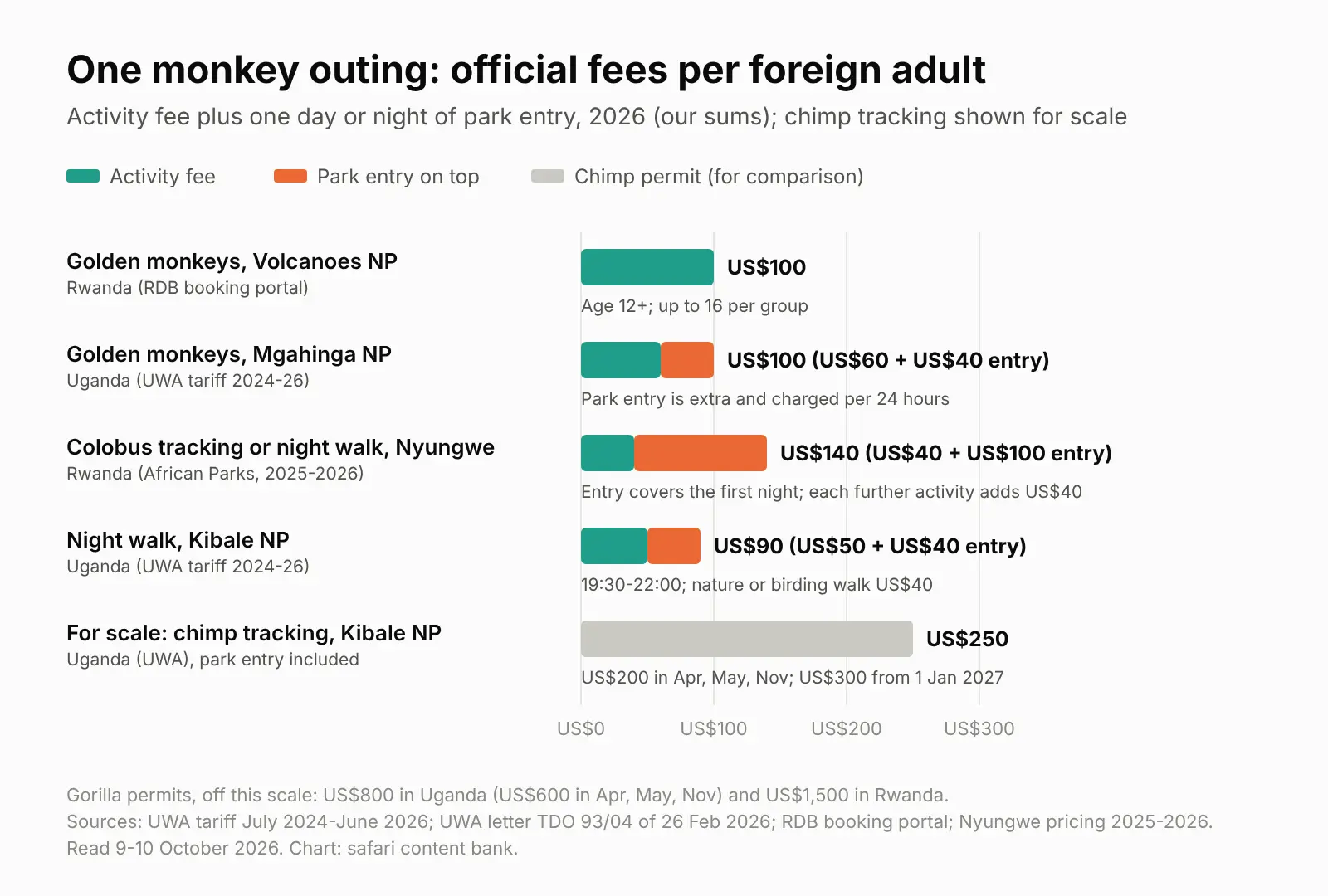 Activity plus one day or night of entry, our sums. Sources: UWA tariff July 2024–June 2026; UWA letter TDO 93/04 of 26 February 2026; RDB booking portal; Nyungwe pricing 2025–2026. Chart: safari content bank.
- Golden monkeys cost the same US$100 in either country once Mgahinga’s entry is added (our sum), but Uganda charges the entry separately.
- In Nyungwe, entry is the bigger part of the bill: US$100 for the first night against US$40 for the colobus walk. A second activity on the same stay adds only its own fee.
The official fee lines, with the date each took effect and the authority’s own source:
| Fee | Amount | In force from | Source |
|---|---|---|---|
| Rwanda: golden monkey tracking, Volcanoes NP, foreign visitor, per person | USD 100 (age 12+; up to 16 per group) | RDB booking portal, checked 9 Oct 2026 (no tariff document or start date published) | RDB booking portal |
| Uganda: park entry, Queen Elizabeth, Bwindi, Mgahinga, Kibale, Kidepo Valley and Lake Mburo NPs, foreign non-resident adult, per 24 hours | USD 40 (child USD 20) | 1 Jul 2024 (UWA Conservation Tariff July 2024–June 2026, the last published park-entry rates; the 2026/27 letter does not cover park entry) | UWA Conservation Tariff July 2024–June 2026 |
| Nyungwe National Park, canopy walkway, guided birding, other primate tracking or night walk, international visitor | USD 40 (park entry extra) | Nyungwe Tourism Pricing Scheme 2025–2026 | Nyungwe NP (African Parks), pricing 2025–2026 |
| Nyungwe National Park, international adult, park entry per person (charged on top of activity fees) | USD 100 first night; USD 150 for two nights; USD 200 for three; nights 4–7 free (child 6–12: USD 50 / 75 / 100) | Nyungwe Tourism Pricing Scheme 2025–2026 (no start or end date printed) | Nyungwe NP (African Parks), pricing 2025–2026 |
| Uganda: chimpanzee tracking, Kibale NP, foreign non-resident (park entry included) | USD 250; USD 200 in April, May and November; USD 300 from 1 Jan 2027 | Tariff July 2024–June 2026; low-season rate from 26 Feb 2026; new rate 1 Jan 2027 | UWA letter TDO 93/04, 26 Feb 2026, and UWA tariff 2024–26 |
| Rwanda: chimpanzee tracking, Nyungwe NP, international visitor (park entry extra: USD 100 for the first night) | USD 150 | Nyungwe Tourism Pricing Scheme 2025–2026 | Nyungwe NP (African Parks), pricing 2025–2026 |
| Uganda: gorilla tracking permit, Bwindi Impenetrable and Mgahinga Gorilla NPs, foreign non-resident, per person per trek (guide and that day's park entry included) | USD 800 (foreign resident USD 700; rest of Africa USD 500; East African citizens UGX 300,000) | Since 1 Jul 2024 (UWA tariff 2024–26); confirmed unchanged from 1 Jan 2027 by UWA letter TDO 93/04 of 26 Feb 2026 | UWA letter TDO 93/04, 26 Feb 2026 |
| Uganda: gorilla tracking permit in April, May and November (low season), foreign non-resident, per person per trek; cannot be rescheduled | USD 600 (foreign resident USD 500) | Immediate effect from the UWA letter of 26 Feb 2026 | UWA letter TDO 93/04, 26 Feb 2026 |
| Rwanda: mountain gorilla tracking permit, Volcanoes NP, international visitor, per person per day | USD 1,500 | Current RDB price, checked 9 Oct 2026 | Visit Rwanda (Rwanda Development Board) |
| Rwanda: gorilla permit low-season discount, November–May, with two nights in Akagera or Nyungwe (paid hotel receipt and one paid activity) or one night in each | 30% off (USD 1,050, our sum); one discounted permit per person per 3-day/2-night stay | November–May; conditions checked 9 Oct 2026 | RDB booking portal, low-season discount |
| Hell's Gate, Mt Longonot, Mt Elgon and Ol Donyo Sabuk National Parks, Lake Elementaita, Shimba Hills and Kakamega (KWS), non-resident adult, per 24 hours | USD 50 (child under 18, 5 and under free, USD 25) | Legal Notice 160 of 2025, gazetted 22 Sep 2025, which states no start date; in force 1 Oct 2025 per the KWS press release of 29 Sep 2025 | KWS Fees Regulations 2025 (LN 160/2025) |
Golden monkeys: Volcanoes and Mgahinga
Golden monkeys are tracked on the bamboo slopes of the Virunga volcanoes: in Volcanoes National Park on the Rwanda side for US$100, and in Mgahinga on the Uganda side for US$60 plus US$40 entry. Both are gorilla parks, so the monkeys fit on the day before or after a gorilla trek.
- What they are: a monkey like a blue monkey, with a golden-orange back and flanks. In the Virungas it is a bamboo specialist, eating shoots and leaves all year; travelling groups of 3 to 62 have been recorded (Wikipedia, Golden monkey, secondary).
- Where else: besides the Virunga parks, Wikipedia places it in Kahuzi-Biega (DR Congo) and Gishwati forest in Rwanda. Illegal bamboo and tree cutting is the main threat (Wikipedia, secondary).
- Volcanoes: US$100, age 12 and over, up to 16 per group (RDB booking portal, checked 9 October 2026). The park covers 160 km² on five of the eight Virunga volcanoes; Kinigi, the headquarters, is 105 km and 2–3 hours from Kigali (Volcanoes).
- Mgahinga: US$60 plus US$40 park entry (UWA tariff 2024–26); the standard visit gives one hour with the monkeys and must be booked in advance (UWA Mgahinga brochure, PDF). At 33.7 km² it is Uganda’s smallest national park (UWA, Mgahinga), about 15 km south of Kisoro (Wikipedia).
- Minimum age: 12 in Volcanoes (RDB). We found no published minimum age for Mgahinga’s golden monkeys (safari age limits).
Volcanoes or Bwindi and Mgahinga for the gorillas themselves: where to see gorillas and Uganda or Rwanda for gorilla trekking.
Colobus monkeys: Nyungwe, Kibale and Bwindi
Nyungwe is the colobus park in our sources: a troop of more than 400 Ruwenzori colobus lives near Uwinka, and tracking it costs US$40 plus park entry. Kibale and Bwindi have black-and-white colobus, and Kibale also has red colobus.
- Nyungwe’s troops: a “super troop” of more than 400 near Uwinka and about 50 near Gisakura (visitnyungwe.org). Colobus and other primate tracking is US$40 a person in groups of 2–8, on top of entry: US$100 for one night, US$150 for two and US$200 for three (Nyungwe pricing 2025–2026).
- Kibale’s colobus: East Africa’s largest red colobus population, plus black-and-white colobus (UWA). UWA’s Kibale walks cost US$40 for a nature or birding walk (Kibale).
- Bwindi: black-and-white colobus is among its 10 primate species (UWA); UWA’s birding or nature walk there costs US$40 (Bwindi).
- The black-and-white colobus, or mantled guereza, is Least Concern (Wikipedia, Mantled guereza, citing the IUCN 2019 assessment; secondary). It lives in groups of 3 to 15, usually one male with several females; leaves are more than half its diet, and males roar at night and dawn (Wikipedia, secondary).
- Nyungwe is a 5–6 hour drive from Kigali, 220 km via Huye (a safari booking site), and wet and cool all year, about 20 °C by day and 10 °C at night (visitnyungwe.org).
Kibale’s 13 primate species: L’Hoest’s, mangabeys and red colobus
Kibale has the widest mix of primates you can walk among in our sources: 13 species, with more than 1,500 chimpanzees among them (UWA, Kibale). Nyungwe also has 13, and Bwindi 10.
- The monkeys UWA names in Kibale: red colobus, L’Hoest’s monkey, the Uganda mangabey (Uganda’s only endemic monkey), grey-cheeked mangabey, black-and-white colobus, blue and red-tailed monkeys and olive baboon; at night, potto and bushbabies (UWA page and brochure).
- L’Hoest’s monkey is named by UWA for Kibale and Bwindi, and by Visit Rwanda for Gishwati-Mukura. We hold no checked IUCN status for it, so we print none.
- Bigodi Wetland Sanctuary, about 5 km south of Kanyanchu, is a community-run papyrus swamp with a boardwalk for primates and birds (UWA brochure). We found no published price for it.
- Kibale is about 6 hours by road from Kampala; walks leave Kanyanchu, 35 km south-east of Fort Portal (UWA). For the chimps themselves, see where to see chimpanzees and chimpanzee trekking permits.
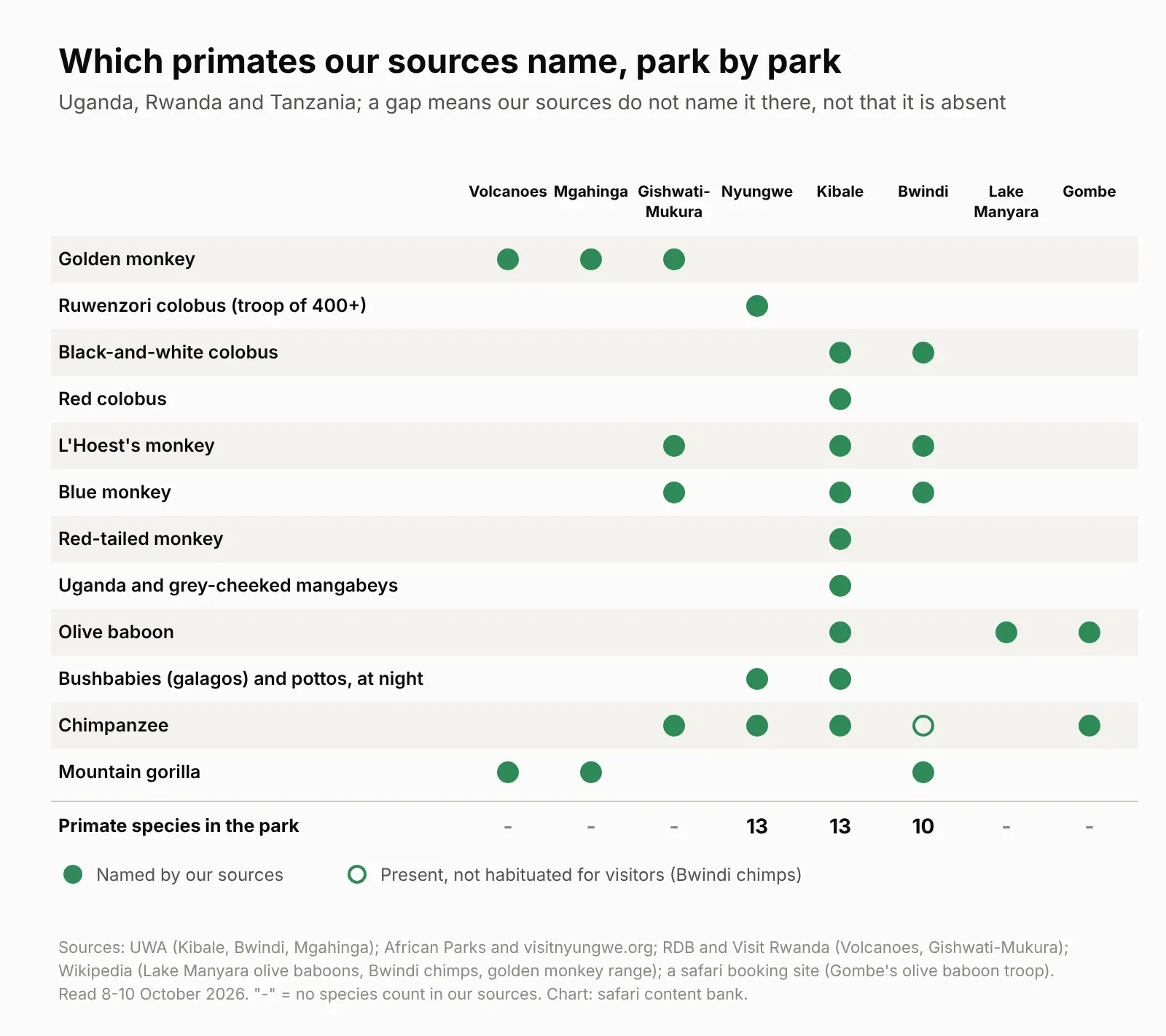 A gap means our sources do not name the species there, not that it is absent. Sources: UWA; African Parks and visitnyungwe.org; RDB and Visit Rwanda; Wikipedia; a safari booking site (Gombe). Chart: safari content bank.
Bushbabies and pottos on night walks
Two forest parks in our sources sell night walks for small nocturnal primates: Kibale at US$50 (19:30–22:00) and Nyungwe at US$40 (17:30 to 20:00 or 21:00), with park entry on top.
- Kibale’s night walk looks for potto and bushbabies (UWA); it costs US$50 for a foreign adult (UWA tariff 2024–26).
- Nyungwe’s night walk looks for galagos, pottos, tree hyraxes and anomalures, at US$40 (visitnyungwe.org; Nyungwe pricing 2025–2026).
- Bushbabies are galagos, and the species are told apart by voice rather than looks; each has its own loud call, and Wikipedia lists 21 living species (secondary). Their ears fold flat when they leap, and they wet their hands and feet with urine to leave a scent trail along regular routes (Wikipedia, citing the African Wildlife Foundation).
- On a savanna safari, night drives are where you might see one, but many parks do not allow them: there are none in Botswana’s parks or the Serengeti. Where they are sold and what they cost: night drive safari. Our sources give no sighting rate for bushbabies anywhere.
Baboons and vervets on a savanna safari
Baboons and vervet monkeys need no permit: you see them on ordinary game drives and around camps. Our sources name olive baboons in Lake Manyara, Kibale and Gombe.
- Lake Manyara’s baboons are olive baboons (Wikipedia). Olive baboons live in troops of 15 to 150 and are the most widespread baboon, in 25 countries from Mali to Ethiopia and Tanzania; they are Least Concern (Wikipedia, citing the IUCN 2020 assessment; secondary).
- Gombe, on Lake Tanganyika, has a habituated olive baboon troop that is usually on the lakeshore (a safari booking site’s Gombe page), alongside its chimps (where to see chimpanzees).
- Baboons raid camps: in Mana Pools, the camp rules say to lock food away from baboons and hyena (Zimbabwe Field Guide).
Gishwati-Mukura, Kakamega and Jozani: what our sources hold
Three other forests come up in primate trip ideas; our sources vouch for only part of the story for each, so we print only that part.
- Gishwati-Mukura National Park, Rwanda: Visit Rwanda lists golden, L’Hoest’s and blue monkeys, a group of 20 chimpanzees, and chimp and monkey tracking (Visit Rwanda, opened 9 October 2026). It prints no fees, and our sources hold none.
- Kakamega Forest, Kenya: our sources hold its KWS entry fee, US$50 per 24 hours for a non-resident adult (Kenya park fees), but no checked list of its primates.
- Jozani–Chwaka Bay National Park, Zanzibar: tour pages quote different entry prices and we found no official fee schedule; our sources hold no checked primate source for it either. Planning a beach stay after the safari: Tanzania safari and Zanzibar.
Monkeys with gorillas or chimps
Every monkey outing in our sources sits in or next to a gorilla or chimp park, so it adds a day, not a trip. Permit totals are our sums or copied from the pages linked.
| Trip | Apes | Monkeys | Fees per person | Source |
|---|---|---|---|---|
| Rwanda, Volcanoes | Gorillas, US$1,500 | Golden monkeys, US$100 | US$1,600, or US$1,150 from November to May with the Akagera or Nyungwe stay (our sums) | Volcanoes |
| Uganda, Mgahinga or Bwindi | Gorillas, US$800 (US$600 in April, May, November) | Golden monkeys in Mgahinga, US$60 + US$40 entry | US$900 (our sum); US$700 in April, May, November | UWA tariff; UWA letter TDO 93/04 |
| Rwanda, Nyungwe (one night) | Chimps, US$150 | Colobus, US$40 | US$290 with one night’s entry (our sum) | Nyungwe pricing 2025–2026 |
| Uganda, Kibale | Chimps, US$250 with entry | Night walk, US$50 | US$300 for the two activities (our sum); our sources do not say whether the evening walk needs a second day’s entry | UWA tariff 2024–26 |
Fees checked 9–10 October 2026. Lodges, transport and porters not included. The Uganda gorilla permit includes that day’s park entry; the US$40 in the Mgahinga row is for the golden monkey day.
- Gorillas are the expensive half: compare the two treks on gorilla vs chimpanzee trekking, and the countries on Uganda or Rwanda for gorilla trekking.
- For a family with a 12- to 14-year-old, golden monkeys (age 12) can be the shared primate day while those aged 15 and over track gorillas (safari age limits).
- The drier months, about June–September and December–February, are the easier ones for forest walks in Uganda and Rwanda (best time for gorilla trekking). We found no month-by-month data for monkey sightings.
Which primate trip to choose
Choose by the animal you most want to see, then fit it to the ape park already on your route.
| If you want… | Go to | Why |
|---|---|---|
| Golden monkeys, cheapest permit | Mgahinga, Uganda | US$60 plus US$40 entry (UWA tariff 2024–26) |
| Golden monkeys on a Rwanda gorilla trip | Volcanoes | US$100, from age 12; gorillas plus golden monkeys US$1,600 (our sum) |
| A big colobus troop | Nyungwe | More than 400 Ruwenzori colobus near Uwinka; US$40 plus entry |
| The most monkey species on one walk | Kibale and Bigodi | 13 primate species, including red colobus, L’Hoest’s and the Uganda mangabey |
| Bushbabies and pottos | Kibale or Nyungwe night walk | US$50 or US$40; guided, on foot |
| Baboons without a permit | Lake Manyara or any savanna park | Olive baboons on a game drive |
| Gorillas and monkeys in one park | Volcanoes or Mgahinga | Golden monkeys share both gorilla parks |
Prices: UWA tariff 2024–26; RDB booking portal; Nyungwe pricing 2025–2026. Checked 9–10 October 2026.
Common mistakes about seeing monkeys on safari
| What you’ll often read | What is correct |
|---|---|
| “Golden monkeys live across East Africa’s forests” | They live only in the Virungas and one other Rwandan forest (Wikipedia), so Volcanoes and Mgahinga are the places to track them. |
| “Uganda’s golden monkey permit includes entry” | Mgahinga’s US$60 excludes park entry, US$40 per 24 hours (UWA tariff 2024–26). |
| “Nyungwe’s colobus walk costs US$40 in all” | Park entry is extra: US$100 for the first night, so US$140 for a one-night visitor (our sum). |
| “A gorilla or chimp permit covers the monkey walks” | Each walk is priced separately: golden monkeys US$60–100, Nyungwe primates US$40, Kibale night walk US$50. |
| “Children under 15 cannot do any primate trek” | Golden monkeys in Volcanoes are open from age 12 (RDB); the 15 limit is for gorillas. |
| “You will see bushbabies on any night drive” | Many parks allow no night drives, and no source gives a bushbaby sighting rate; Kibale and Nyungwe sell guided night walks. |
| “Baboons around camp are harmless” | Camps such as Mana Pools tell you to lock food away from baboons (Zimbabwe Field Guide). |
| “Kakamega and Jozani have published primate counts and fees” | Our sources hold only Kakamega’s KWS entry fee (US$50) and no official Jozani fee or checked primate source. |
Frequently asked questions
Where is the best place to see monkeys on safari? For variety, Kibale in Uganda: 13 primate species, including red colobus, L’Hoest’s monkey and the Uganda mangabey (UWA). For golden monkeys, Volcanoes or Mgahinga; for a colobus troop of more than 400, Nyungwe.
Where can I see golden monkeys? On the Virunga volcanoes: in Volcanoes National Park, Rwanda, and Mgahinga Gorilla National Park, Uganda. Wikipedia also places them in Gishwati forest in Rwanda and Kahuzi-Biega in DR Congo.
How much does golden monkey tracking cost? US$100 in Volcanoes National Park, from age 12 and up to 16 per group (RDB booking portal), and US$60 plus US$40 park entry in Mgahinga (UWA tariff 2024–26). Both come to US$100 a day (our sum).
Where can I see colobus monkeys? In Nyungwe, a troop of more than 400 Ruwenzori colobus lives near Uwinka; tracking costs US$40 plus park entry. Kibale and Bwindi have black-and-white colobus, and Kibale holds East Africa’s largest red colobus population (UWA).
Which park has the most primate species? In our sources, Kibale and Nyungwe each have 13 primate species (UWA; African Parks) and Bwindi has 10 (UWA). Both Kibale and Nyungwe also have chimpanzees.
Can I see bushbabies on safari? Yes, on guided night walks in Kibale (US$50, 19:30–22:00) and Nyungwe (US$40), which look for bushbabies (galagos) and pottos. On savanna trips, only where night drives are allowed: see night drive safari.
Can children go on monkey walks? Golden monkey tracking in Volcanoes is open from age 12 (RDB); we found no published minimum age for Mgahinga’s golden monkeys or for the Nyungwe and Kibale walks. Gorillas need age 15: see safari age limits.
Can I combine monkeys with gorilla or chimp trekking? Yes: gorillas plus golden monkeys in Volcanoes come to US$1,600, or US$1,150 from November to May with the Akagera or Nyungwe stay (our sums). In Nyungwe, chimps and colobus on a one-night stay come to US$290 (our sum). See where to see gorillas and where to see chimpanzees.
Sources
- Uganda Wildlife Authority: Conservation Tariff July 2024–June 2026 (PDF); letter TDO 93/04 on tariff changes 2026–2027 (PDF, scanned), dated 26 Feb 2026; Kibale National Park and Mgahinga Gorilla National Park; brochures for Kibale (PDF) and Mgahinga (PDF); read 8–9 Oct 2026
- Rwanda Development Board: booking portal (golden monkeys), Visit Rwanda, gorilla tracking and low-season discount, checked 9 Oct 2026; Visit Rwanda, Gishwati-Mukura, opened 9 Oct 2026
- African Parks: Nyungwe pricing 2025–2026 (PDF), visitnyungwe.org and Nyungwe, opened 8–9 Oct 2026
- Kenya Wildlife Service: Fees Regulations 2025 (Legal Notice 160 of 2025), as on our Kenya park fees page, read 9 Oct 2026
- Wikipedia (secondary), opened 9 Oct 2026: Golden monkey, Mantled guereza, Olive baboon, Galago, Mgahinga Gorilla National Park; IUCN categories as these pages give them (Red List pages not opened)
- Camps and travel: Zimbabwe Field Guide on Mana Pools camp rules, as on our Mana Pools hub; a safari booking site’s Nyungwe and Gombe pages (read 9 Oct 2026)
More on where to see the other animals: gorillas, chimpanzees, shoebill and the Big Five.
Figures and fees checked 8–10 October 2026. We will update this page when UWA publishes a full tariff after June 2026 (golden monkeys and park entry), when African Parks publishes Nyungwe prices after the 2025–2026 list, and when we find official fees for Gishwati-Mukura or Jozani.