 Experience

Last verified · Next check due
On this page
- Where to see shoebill: places, months and fees (2026)
- Uganda: Murchison Falls, Ishasha, Lake Mburo, Ziwa and Mabamba
- Zambia: the Bangweulu Wetlands
- How a shoebill trip works
- Shoebill with gorilla trekking
- What it costs to see a shoebill
- Which shoebill trip fits your safari?
- Common mistakes about seeing a shoebill
- Frequently asked questions
- Sources
Short answer: Our sources place wild shoebills in Uganda and Zambia. In Uganda, look in the Murchison Falls delta papyrus, best December–February and June–September (UWA); Ziwa sells a US$25 shoebill trek or canoe trip, and Ishasha, Lake Mburo and Mabamba Swamp are other options. In Zambia, Bangweulu is the shoebill’s southernmost stronghold, reached by mokoro while Shoebill Island Camp is open, 1 May–15 December. The shoebill is Vulnerable (IUCN). No sighting is guaranteed.
Key facts
- The shoebill is Vulnerable on the IUCN Red List (IUCN Red List, category as in GBIF’s copy of the Red List checklist, checked 9 Oct 2026); Wikipedia dates the assessment to 2018 and gives 5,000–8,000 birds, mainly in South Sudan’s Sudd, Uganda, eastern DR Congo and Zambia’s Bangweulu (Wikipedia, secondary).
- It is a big, still bird, which is what makes it findable: 110–140 cm tall and grey, with a clog-shaped bill 19–24 cm long; it stands motionless, then lunges, and about 60% of its strikes succeed. Lungfish are a favourite prey (Wikipedia, secondary).
- Uganda has the most shoebill sites in our sources: the Murchison Falls delta, the Lake Edward flats at Ishasha, Lake Mburo, Ziwa’s Lugogo swamp, Lake Albert in Toro-Semliki and Mabamba Swamp on Lake Victoria (UWA brochures and tariff; Africa Geographic).
- Zambia’s Bangweulu Wetlands are a community area, not a national park: about 6,000 km² run since 2008 by African Parks with Zambia’s wildlife department (DNPW) and six Community Resource Boards, with shoebill nest guards drawn from fishing communities (African Parks).
- No shoebill count is published for any site we cover. Neither UWA nor African Parks gives one on the pages in our sources.
- We hold no checked source for shoebill in Rwanda or Tanzania, so this guide does not send you there for them.
Where to see shoebill: places, months and fees (2026)
Uganda gives you six places to try, all reachable on a road safari; Zambia gives you one remote wetland with a camp built around the bird. Fees are per foreign adult and are only the entry to be there; the boat or trek is extra.
| Place | Country | How you look | Best months (our sources) | Fee to be there, per adult | Source |
|---|---|---|---|---|---|
| Murchison Falls delta, Murchison Falls | Uganda | By boat in the delta papyrus | December–February and June–September | US$45 per 24 hours | UWA brochure; UWA tariff 2024–26 |
| Ishasha, Queen Elizabeth | Uganda | On the Lake Edward flats | Not in our sources | US$40 per 24 hours | UWA brochure |
| Lake Mburo | Uganda | Listed as rare; UWA boat trip US$30, about 2 hours | Not in our sources | US$40 per 24 hours | UWA |
| Ziwa Rhino Sanctuary, Lugogo swamp | Uganda | Shoebill trek or canoe trip, US$25 | Not in our sources | US$20 entry | UWA tariff 2024–26 |
| Toro-Semliki Wildlife Reserve, Lake Albert | Uganda | Boat on Lake Albert | Not in our sources | Not on our fee pages | UWA brochure |
| Mabamba Swamp, Lake Victoria | Uganda | Named by a birding guide | Not in our sources | No fee in our sources | Africa Geographic |
| Bangweulu Wetlands | Zambia | Mokoro with a community guide, depending on the water level | Our sources disagree: the camp says May–July, one safari operator about January–April | US$15 a day (2026) | visitbangweulu.org (African Parks) |
Read 8–10 October 2026. Uganda fees from our Uganda safari cost, Murchison Falls, Lake Mburo and Queen Elizabeth pages (UWA Conservation Tariff July 2024–June 2026, the last published); Ziwa’s from our Murchison Falls and Kidepo pages; Bangweulu’s from our Zambia safari cost page.
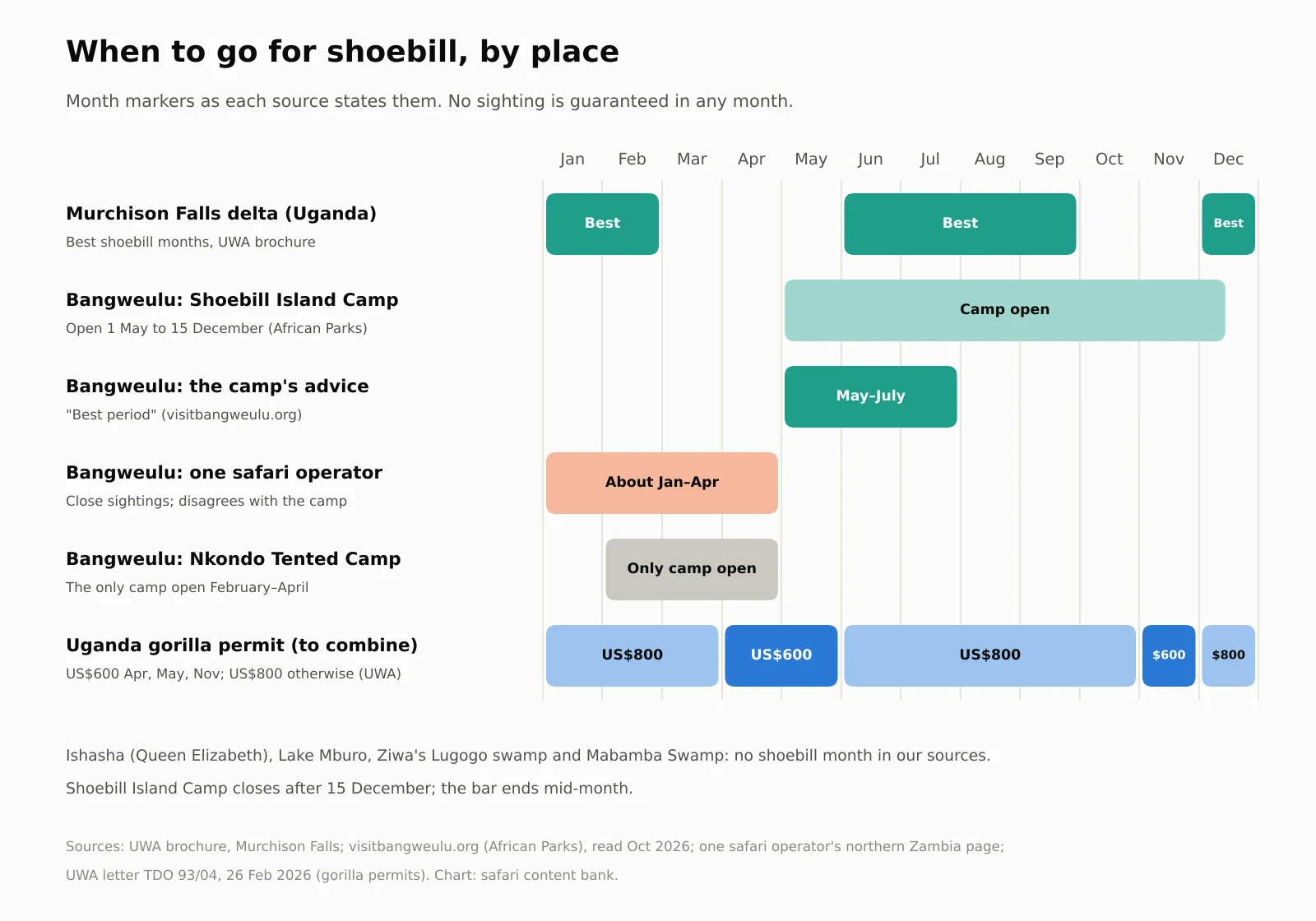 Month markers as each source states them. Sources: UWA brochure, Murchison Falls; visitbangweulu.org (African Parks); one safari operator’s northern Zambia page; UWA letter TDO 93/04, 26 Feb 2026. Chart: safari content bank.
Uganda: Murchison Falls, Ishasha, Lake Mburo, Ziwa and Mabamba
Uganda’s best-documented shoebill site is the papyrus of the Murchison Falls delta, best in the dry months of December–February and June–September (UWA brochure, PDF). The other sites are easier to fit into a southern loop but come with less detail in our sources.
- Murchison Falls delta: the delta is part of the Murchison Falls–Albert Delta Wetland System, a 17,293 ha Ramsar site designated in 2006 (Ramsar site 1640). Park entry is US$45 per 24 hours, the highest in Uganda (UWA tariff 2024–26). UWA’s US$30 launch cruise runs upstream to the foot of the falls; we hold no checked price or schedule for a boat to the delta, so ask what your trip includes.
- Getting to Murchison: Kampala to the southern gate takes 4–5 hours, then 1–2 hours to the lodges (UWA). The usual loop runs Entebbe → (Ziwa) → Murchison → Kibale → Queen Elizabeth → Bwindi → Lake Mburo → Entebbe (Murchison Falls).
- Ziwa Rhino Sanctuary, on the road to Murchison 164 km north of Kampala, sells a shoebill trek or canoe trip on the Lugogo swamp for US$25 (UWA tariff 2024–26), on top of US$20 entry. It is the one shoebill outing in our sources with its own published UWA price.
- Ishasha, Queen Elizabeth’s southern sector, lists shoebill on the Lake Edward flats alongside its tree-climbing lions (UWA brochure). It lies 62 km from Bwindi’s Buhoma sector, so it sits on the road to the gorillas. Entry is US$40 per 24 hours.
- Lake Mburo lists shoebill as rare (UWA). Its UWA boat trip costs US$30 per person for about 2 hours, with at least 4 passengers, and the park is 228 km, about 3.5 hours, from Kampala (Lake Mburo).
- Toro-Semliki Wildlife Reserve offers a boat on Lake Albert for shoebill (UWA brochure, PDF). A Uganda gorilla permit gives one free day’s entry to Toro-Semliki or Mt Elgon within a month (UWA tariff 2024–26). Its shoebill boat price is not on our fee pages.
- Mabamba Swamp, on Lake Victoria, is the shoebill site a birding guide in Africa Geographic names (Africa Geographic). We hold no checked distance, price or season for it, and it appeared in only 2 of the first 100 Uganda tours on one safari booking site (read October 2026).
Zambia: the Bangweulu Wetlands
Bangweulu is the shoebill’s southernmost stronghold, and the only place in our sources where a camp, a nest-guard scheme and a rearing facility are all built around the bird (African Parks). It is remote, and its best months are disputed.
- The wetland is big: the Bangweulu Swamps Ramsar site covers 1,100,000 ha and was designated in 1991 (Ramsar site 531); African Parks manages about 6,000 km² of it, home to about 60,000 people who depend on its fish.
- Conservation you can see: nest guards are drawn from fishing communities, and a captive rearing and rehabilitation facility at Chikuni is “the first of its kind for shoebill”; two captive-raised birds have been released (African Parks). Inside the facility you whisper and take no photographs (visitbangweulu.org).
- Shoebill Island Camp is open 1 May–15 December and costs US$495 per person a night, full board, with activities and the levy included (2026; rates, PDF). Nkondo Tented Camp, near the park headquarters, is the only camp open February–April; Nsobe Community Campsite runs about May–November, depending on water levels (visitbangweulu.org).
- Which months? Our sources disagree. visitbangweulu.org calls May–July the best period; one safari operator gives about January–April for the closest sightings. The camp’s mokoro trips depend on the water level, so ask what to expect in your month.
- Getting there: 10–12 hours by road from Lusaka in a high-clearance 4x4, or a charter to Inja airstrip (usable from 1 May) or Chimbwi airstrip near Shoebill Island (visitbangweulu.org). One safari operator usually combines Bangweulu with Kasanka. Visa rules: Zambia visa.
- The fee: Bangweulu sets its own, US$15 a day (2026), so the DNPW park-fee table does not apply (Zambia safari cost).
How a shoebill trip works
You look for a shoebill from the water, in a launch, a canoe or a mokoro, with a guide who knows where the birds are standing; nothing in our sources promises a sighting. The bird stands still in papyrus, so the boat does the moving.
| Where | How | Group and rules | Price | Source |
|---|---|---|---|---|
| Murchison Falls delta | Boat in the delta papyrus | — | No checked delta price; UWA’s launch to the falls is US$30 | UWA brochure and tariff |
| Lake Mburo | UWA boat trip, about 2 hours | At least 4 passengers | US$30 | UWA tariff 2024–26 |
| Ziwa, Lugogo swamp | Shoebill trek or canoe trip | — | US$25, plus US$20 entry | UWA tariff 2024–26 |
| Bangweulu | Mokoro with a community guide, from Nsobe or Chikuni, not Nkondo | 2–4 people on the wild-shoebill outing; no children under 12 on shoebill activities; guides may end a sighting if the birds are disturbed | In the Shoebill Island Camp rate (US$495 a night, 2026) | visitbangweulu.org (African Parks) |
Read 8–10 October 2026. More on water-based safaris: boat safari and canoe safari.
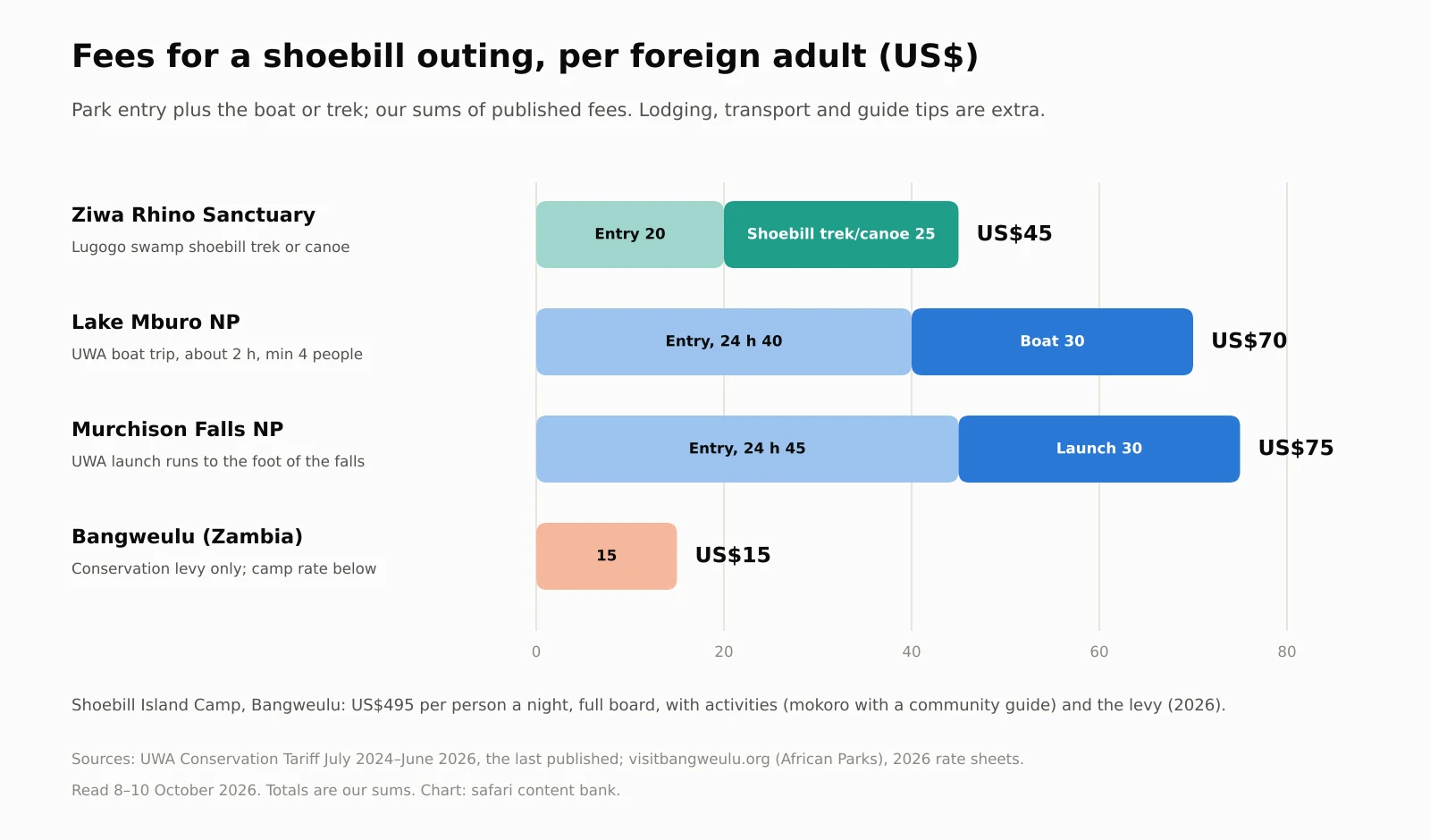 Our sums of fees on our Uganda and Zambia pages: UWA Conservation Tariff July 2024–June 2026, the last published; visitbangweulu.org (African Parks), 2026. Lodging and transport extra. Chart: safari content bank.
- In Bangweulu the water decides the outing. Mokoro trips depend on the water level, and a sighting can depend on how far you are willing to wade, so ask the camp what to expect in your month (visitbangweulu.org).
- Children under 12 may not join shoebill activities in Bangweulu (visitbangweulu.org). Our sources give no age rule for Uganda’s shoebill trips.
Shoebill with gorilla trekking
Uganda is the easy pairing: Ishasha and Lake Mburo sit on the road to Bwindi, and Murchison is on the northern half of the usual loop. For how to plan the gorilla side, see safari and gorilla trekking, where to see gorillas and gorilla permits.
- A Bwindi or Mgahinga gorilla permit costs US$800, or US$600 in April, May and November (UWA letter of 26 Feb 2026). Murchison’s best shoebill months, December–February and June–September, all fall in US$800 months (our reading of the two sources).
- The permit gives one free day’s entry to Toro-Semliki Wildlife Reserve within a month, where UWA lists a shoebill boat on Lake Albert (UWA tariff 2024–26).
- For birds beyond the shoebill, our birding safari guide covers Uganda’s other specials and when to go; best time for gorilla trekking covers the gorilla months.
What it costs to see a shoebill
The fees are small: US$45–75 per person for a Uganda shoebill outing with park entry (our sums), and US$15 a day at Bangweulu, where the camp rate of US$495 a night is the real cost.
| Item | Fee per foreign adult | Basis | Source |
|---|---|---|---|
| Murchison Falls entry | US$45 (child US$25) | Per 24 hours | UWA tariff 2024–26, the last published |
| Queen Elizabeth (Ishasha) or Lake Mburo entry | US$40 (child US$20) | Per 24 hours | same |
| UWA launch (Murchison) or boat trip (Lake Mburo) | US$30 | Per person | same |
| Ziwa entry + shoebill trek or canoe trip | US$20 + US$25 | Per person | same |
| Bangweulu | US$15 | A day (2026) | African Parks, on Zambia safari cost |
| Shoebill Island Camp, Bangweulu | US$495 | Per person a night, full board, activities and levy included (2026) | visitbangweulu.org (African Parks) |
| Uganda gorilla permit, to combine | US$800 (US$600 in April, May and November) | Per person per trek | UWA letter, 26 Feb 2026 |
Copied from our Uganda safari cost, Murchison Falls, Lake Mburo, Kidepo, Zambia safari cost, birding safari and gorilla permits pages, read 8–10 October 2026. Full trip costs: Uganda safari cost, Zambia safari cost.
The official fee lines, with the date each took effect and the authority’s own source:
| Fee | Amount | In force from | Source |
|---|---|---|---|
| Uganda: park entry, Murchison Falls NP, foreign non-resident adult, per 24 hours | USD 45 (child USD 25) | 1 Jul 2024 (UWA Conservation Tariff July 2024–June 2026, the last published park-entry rates; the 2026/27 letter does not cover park entry) | UWA Conservation Tariff July 2024–June 2026 |
| Uganda: park entry, Queen Elizabeth, Bwindi, Mgahinga, Kibale, Kidepo Valley and Lake Mburo NPs, foreign non-resident adult, per 24 hours | USD 40 (child USD 20) | 1 Jul 2024 (UWA Conservation Tariff July 2024–June 2026, the last published park-entry rates; the 2026/27 letter does not cover park entry) | UWA Conservation Tariff July 2024–June 2026 |
| Uganda: launch cruise, Murchison Falls NP (same price on the Kazinga Channel, Queen Elizabeth NP, and at Lake Mburo NP), foreign non-resident, per person | USD 30 (foreign resident USD 25; rest of Africa USD 20; East African citizens UGX 30,000) | 1 Jul 2024 (UWA Conservation Tariff July 2024–June 2026, the last published rates) | UWA Conservation Tariff July 2024–June 2026 |
| Uganda: gorilla tracking permit, Bwindi Impenetrable and Mgahinga Gorilla NPs, foreign non-resident, per person per trek (guide and that day's park entry included) | USD 800 (foreign resident USD 700; rest of Africa USD 500; East African citizens UGX 300,000) | Since 1 Jul 2024 (UWA tariff 2024–26); confirmed unchanged from 1 Jan 2027 by UWA letter TDO 93/04 of 26 Feb 2026 | UWA letter TDO 93/04, 26 Feb 2026 |
| Uganda: gorilla tracking permit in April, May and November (low season), foreign non-resident, per person per trek; cannot be rescheduled | USD 600 (foreign resident USD 500) | Immediate effect from the UWA letter of 26 Feb 2026 | UWA letter TDO 93/04, 26 Feb 2026 |
Which shoebill trip fits your safari?
Choose by the trip you are already planning: Murchison on a northern Uganda loop, Ishasha or Lake Mburo on the way to Bwindi, Ziwa on the drive north, and Bangweulu if the shoebill is the reason for the trip.
| If your trip is… | Try | When | Watch out for |
|---|---|---|---|
| A full Uganda loop from Entebbe | Murchison Falls delta | December–February or June–September | UWA’s launch goes to the falls; ask how you reach the delta |
| Bwindi gorillas from Kampala | Ishasha or Lake Mburo | No shoebill month in our sources | Lake Mburo lists the bird as rare |
| Kampala north to Murchison | Ziwa’s Lugogo swamp | No month in our sources | Entry US$20 plus the US$25 trek or canoe |
| Western Uganda with a gorilla permit | Toro-Semliki, Lake Albert | No month in our sources | Use the permit’s free day; the boat price is not on our pages |
| A shoebill-first trip | Bangweulu, Zambia | Shoebill Island Camp open 1 May–15 December | Sources disagree on the best months; 10–12 hours by road from Lusaka |
Common mistakes about seeing a shoebill
| What you’ll often read | What is correct |
|---|---|
| “You are bound to see a shoebill” | No sighting is guaranteed. In Bangweulu it depends on the water level and how far you will wade. |
| “The Murchison launch takes you to the shoebill” | UWA’s US$30 launch runs to the foot of the falls. The shoebill are in the delta papyrus. |
| “January–April is the best time for shoebill in Bangweulu” | Our sources disagree, and Shoebill Island Camp is closed from mid-December to April; only Nkondo is open February–April. The camp recommends May–July. |
| “Bring the children on the shoebill mokoro” | No under-12s on shoebill activities in Bangweulu. |
| “Bangweulu is a national park” | It is a Game Management Area run with six Community Resource Boards; it charges its own US$15 a day, not DNPW park fees. |
| “Photograph the chicks at the rearing facility” | No photography inside it, and you whisper. Photos are allowed on the wild-shoebill mokoro outing. |
Frequently asked questions
Where is the best place to see a shoebill in Africa? In our sources, Uganda’s Murchison Falls delta and Zambia’s Bangweulu Wetlands. Murchison’s best months are December–February and June–September (UWA brochure); Bangweulu is the shoebill’s southernmost stronghold, with a camp open from 1 May to 15 December. Uganda also has Ishasha, Lake Mburo, Ziwa, Toro-Semliki and Mabamba Swamp.
When is the best time to see a shoebill? In Murchison Falls, December–February and June–September (UWA brochure). In Bangweulu our sources disagree: the camp’s site says May–July, one safari operator about January–April. Shoebill Island Camp is closed from mid-December to April, so May–July is the window that fits both the camp and its advice.
How much does it cost to see a shoebill? In Uganda, US$45–75 per person for park entry plus the boat or trek (our sums): Ziwa US$20 + US$25, Lake Mburo US$40 + US$30, Murchison US$45 + US$30 (UWA tariff 2024–26, the last published). In Zambia, Bangweulu charges US$15 a day and Shoebill Island Camp US$495 per person a night, activities included (2026).
Is the shoebill endangered? It is Vulnerable on the IUCN Red List, one step below Endangered; Wikipedia dates the assessment to 2018 and gives 5,000–8,000 birds. Neither UWA nor African Parks publishes a count for any of the sites on this page.
Can I see a shoebill on a short trip from Kampala? Ziwa Rhino Sanctuary, 164 km north of Kampala, sells a US$25 shoebill trek or canoe trip on the Lugogo swamp (UWA). A birding guide in Africa Geographic names Mabamba Swamp on Lake Victoria, but we hold no checked distance, price or season for it.
Can I combine a shoebill with gorilla trekking? Yes, in Uganda. Ishasha and Lake Mburo are on the road to Bwindi, and a gorilla permit (US$800, US$600 in April, May and November) gives one free day’s entry to Toro-Semliki, where UWA lists a shoebill boat on Lake Albert. See safari and gorilla trekking.
Can children go on a shoebill trip? Not in Bangweulu: children under 12 may not join shoebill activities (visitbangweulu.org). Our sources give no age rule for Uganda’s shoebill boats or Ziwa’s trek.
Can I see a shoebill in Rwanda or Tanzania? We hold no checked source for shoebill in Rwanda’s Akagera or anywhere in Tanzania, so we do not recommend either for the bird. For a dependable plan, choose Uganda or Zambia’s Bangweulu.
Sources
- Park authorities: UWA, Conservation Tariff July 2024–June 2026 (PDF), the last published; UWA brochures, Murchison Falls (PDF) and Semuliki and Toro-Semliki (PDF), and UWA’s Queen Elizabeth and Lake Mburo brochures as cited on our park pages; UWA letter TDO 93/04, 26 Feb 2026 (PDF); read 8–10 Oct 2026
- Bangweulu: African Parks, Bangweulu; visitbangweulu.org, Shoebill Island Camp rates 2026 (PDF), Nsobe Campsite rates 2026 (PDF) and Shoebill Programme 2026 (PDF); read 8 Oct 2026
- Status and wetlands: IUCN Red List (category as in GBIF’s copy of the checklist, checked 9 Oct 2026); Ramsar Sites Information Service, Murchison Falls–Albert Delta, site 1640 and Bangweulu Swamps, site 531, checked 9 Oct 2026; Wikipedia, Shoebill (secondary)
- Media: Africa Geographic, Uganda’s 10 best birding spots
- Unnamed sellers (names and links in our editor notes): one safari operator’s northern Zambia page (Bangweulu months; Kasanka combination); one safari booking site’s Uganda tour listings (Mabamba in 2 of 100 tours)
- Our pages for the detail: Murchison Falls, Queen Elizabeth, Lake Mburo, Uganda, Zambia, birding safari, boat safari, gorilla permits, Uganda or Rwanda for gorillas
Seasons, fees and rates checked 8–10 October 2026. We will update this page when UWA publishes park-entry rates for after June 2026, when a shoebill count is published for any of these sites, and when we can check a source for Mabamba Swamp’s access and fees or for shoebill in Rwanda and Tanzania.