 Experience

Last verified · Next check due
On this page
- East and southern Africa at a glance
- Best months: migrants, rains and closures
- Best parks and the birds our sources name
- Boats, canoes and walking: the birding activities and their fees
- Specialist guides, private vehicles and group birding tours
- What a birding safari costs
- Which to choose
- Common mistakes on a birding safari
- Frequently asked questions
- Sources
Short answer: Go in the rains if birds come first: migrants are present from about November to April, when big game disperses and camp rates fall. Uganda leads our sources: Queen Elizabeth lists 600+ species, Bwindi 23 Albertine Rift endemics, and Murchison Falls the shoebill. Elsewhere, Ruaha lists 570+, Kafue 500+ and the Okavango Delta 482. Boats and bird walks cost extra: a UWA launch US$30, a birding walk US$25–40. Checked 10 October 2026.
Key facts
- The birding season is the green season. A safari booking site says Namibia’s birdlife “is at its best from November to April, when migratory birds from Europe and Asia are present”; a Botswana camp operator sells November–March on “newborn animals, migrant birds and lower rates”; two East African safari operators give November–April for Kenya and Tanzania. Details: green-season safari.
- Uganda has the most bird detail in our sources: more than 600 species in Queen Elizabeth, about 475 in Kidepo, more than 350 in Bwindi (UWA), and a national list of 1,047 in a UWA brochure, against “more than 1,065” in a birding guide in Africa Geographic. Our sources disagree, so treat both as approximate.
- Country totals are mostly missing. Apart from Uganda, the only national figure in our sources is Botswana’s 615 species, none endemic, in Wikipedia’s list citing BirdLife Botswana’s checklist (May 2023, secondary). We print no total for Kenya, Tanzania, Rwanda, Zambia, Zimbabwe, Namibia or South Africa.
- Water trips are where the birds are: the Kazinga Channel and the Nile launch in Uganda (US$30), Akagera’s boat (US$35), Nyerere’s boat safari (US$23.60), mokoro and boats in the Okavango (late May to September on the seasonal floodplains), canoes in Lower Zambezi and Mana Pools.
- A private vehicle is the usual way to bird at your own pace: US$200–300 a day per vehicle on a Tanzanian road safari, US$385–935 a day or night at camps on 2026 rate cards. One Zambian camp company adds a private guide for US$750 a night (2027).
- Specialist group birding tours cost about US$327–655 a day per person on one specialist company’s 2026 schedule (land only, our sums), and one northern Botswana birding tour says its price “typically exceed[s] $20,000 per person sharing” for 9 days.
East and southern Africa at a glance
For bird numbers and specials, Uganda and Rwanda’s forests lead; for boats and waterbirds, the Okavango, Chobe and the Zambezi valley; for an easy self-drive, Kruger and Etosha. Counts are as each park authority or listed source publishes them; “no count” means we hold none we can print.
| Country | Where our sources point birders | Best months for birds | Bird counts we can print | More |
|---|---|---|---|---|
| Uganda | Queen Elizabeth, Murchison Falls, Bwindi (Ruhija), Kibale and Bigodi, Lake Mburo, Kidepo, Semuliki | Murchison: January–March for birding; shoebill December–February and June–September (UWA brochure) | Queen Elizabeth 600+; Kidepo ~475; Semuliki ~435–441; Kibale ~370; Bwindi 350+; Lake Mburo 315–332 (UWA) | Uganda safari cost |
| Rwanda | Nyungwe (guided birding), Akagera (boat trip) | No birding calendar in our sources | Akagera almost 500 (African Parks) | Rwanda safari cost |
| Kenya | Lake Nakuru and the Rift Valley lakes, Amboseli, Tsavo West, Samburu, Laikipia | November–April (two safari operators) | Tsavo West “over 600”; Lake Nakuru ~450; Amboseli 400+ (KWS); Samburu 350+ (Samburu County) | Kenya safari cost |
| Tanzania | Ruaha, Nyerere, Lake Manyara, the Serengeti | Ruaha December–April; Lake Manyara March–May (one safari operator); Serengeti November–April (one operator) | Ruaha 570+; Nyerere ~440 (a safari agent’s guide, read 8–10 October 2026); Serengeti 500+ (UNESCO); Lake Manyara 350+ (Wikipedia) | Tanzania safari cost |
| Zambia | South Luangwa, Lower Zambezi, Kafue, Bangweulu, Kasanka | Carmine bee-eaters August–October; Kafue and Kasanka November–March | Kafue 500+ (African Parks); Lower Zambezi 378; Bangweulu 400+ (African Parks) | Zambia safari cost |
| Zimbabwe | Hwange in the green season; Mana Pools by canoe | The green season, for birds and lower rates | No count: our sources disagree for Hwange | Zimbabwe safari cost |
| Botswana | Okavango water camps and the Panhandle, Chobe riverfront, Makgadikgadi’s Sua Pan | November–March for migrants | Okavango Delta 482 (UNESCO); national list 615, no endemics (secondary) | Botswana safari cost |
| Namibia | Zambezi Region (Nkasa Rupara), Etosha, Walvis Bay, Spitzkoppe and the Erongo, the Namib dunes | November–April | Etosha 340 (an independent guide site) | Namibia safari cost |
| South Africa | Kruger’s far north (Pafuri), Addo, the Kgalagadi, the KwaZulu-Natal and North West reserves | October–March in the summer-rain parks | Addo 418; Kgalagadi 272 (SANParks); Hluhluwe-iMfolozi ~340; Pilanesberg 360+; Madikwe ~300 | South Africa safari cost |
Read 8–10 October 2026, from our park pages as linked in the sections below, the bank’s park files and the sources named. A count is the number of species recorded or listed, not what you will see.
Best months: migrants, rains and closures
Most of the region’s bird calendar runs opposite to its game calendar: migrants arrive with the rains, from about November, and leave by about April, while big game is easiest in the dry months. The trade-off is access: several parks close camps or roads in the same months.
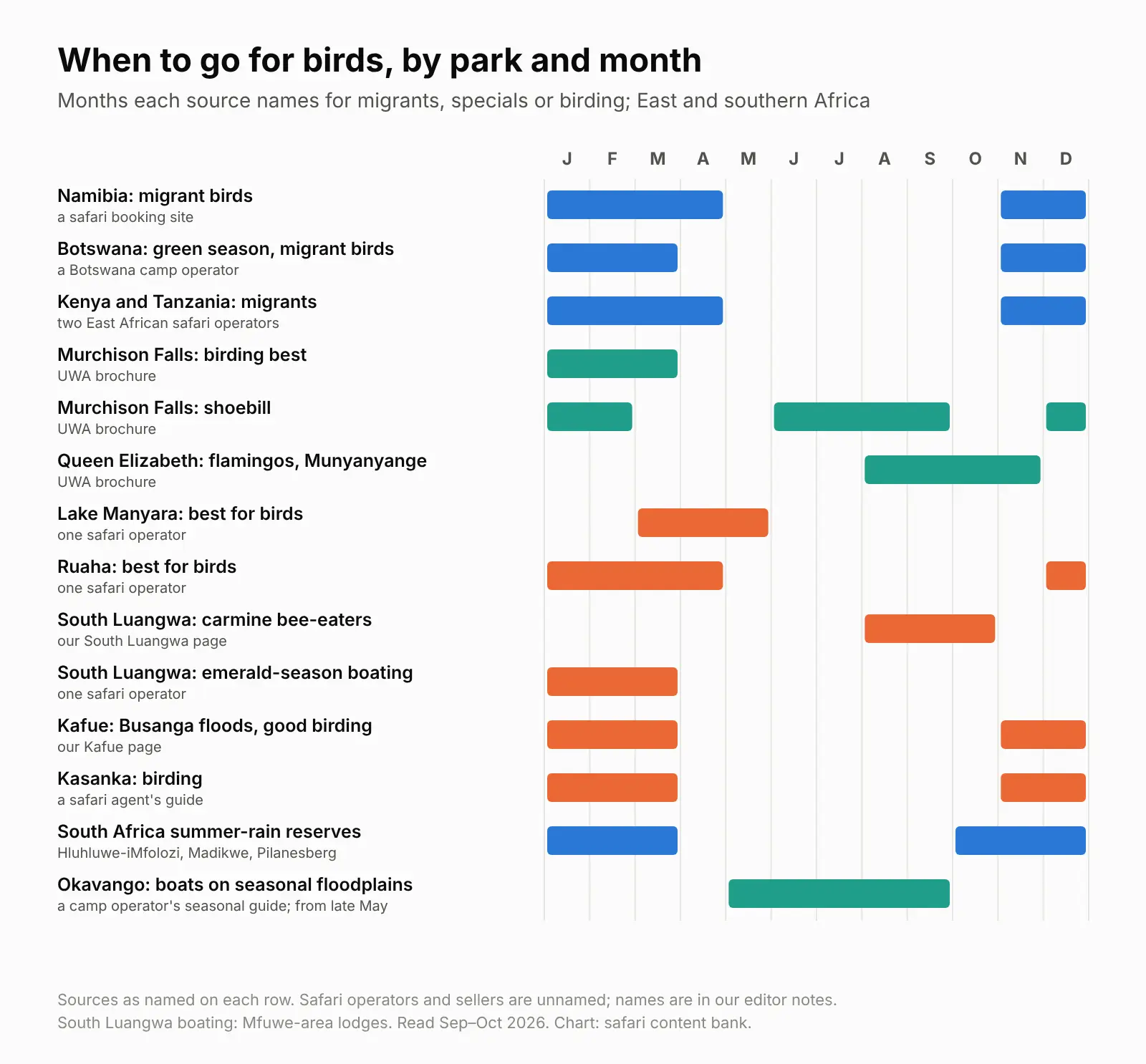 Sources: a safari booking site (Namibia); a Botswana camp operator’s best-time guide; two East African safari operators; UWA brochures (Murchison Falls, Queen Elizabeth); one safari operator (Lake Manyara, Ruaha, South Luangwa); our Kafue page; a safari agent’s guide (Kasanka); our Hluhluwe-iMfolozi, Madikwe and Pilanesberg pages; a camp operator’s seasonal guide (Okavango boats). Read September–October 2026. Chart: safari content bank.
| Month | For birds | Watch out for | Source |
|---|---|---|---|
| January | Migrants across the region; Murchison’s best birding months begin; South Luangwa’s Mfuwe lodges run boat trips on the swollen river | Most South Luangwa bush camps closed; Lower Zambezi tracks impassable and most camps closed; Okavango seasonal camps run no boats; Gonarezhou closed from 10 January | South Luangwa; Lower Zambezi; Okavango flood calendar; Zimbabwe safari questions |
| February | Peak rains and migrants; yellow-billed storks breed in South Luangwa’s Nsefu Sector (one safari operator) | Nkasa Rupara roads can be impassable (November–April) | South Luangwa; green-season safari |
| March | Murchison’s birding season ends; Lake Manyara’s best bird months begin | Most southern Tanzanian camps close from mid-March to May | Murchison Falls; Lake Manyara; northern vs southern circuit |
| April | Last migrant month in Namibia and East Africa | Long rains in Kenya and Tanzania; Uganda’s gorilla permit is US$600 in April, May and November | Gorilla permits |
| May | Lake Manyara still good for birds; Okavango boats resume late in the month | — | Lake Manyara; Okavango Delta |
| June | Murchison’s dry-season shoebill months begin; Okavango floodplains reachable by boat | Fewer migrants | Murchison Falls; Okavango flood calendar |
| July | Boats on the Okavango’s seasonal floodplains | Peak rates in Botswana and Kenya | Okavango Delta |
| August | Carmine bee-eaters reach South Luangwa; flamingos on Queen Elizabeth’s Lake Munyanyange | — | South Luangwa; Queen Elizabeth |
| September | Carmine bee-eaters and South Luangwa’s best game; last month of Murchison’s shoebill season; last boats on the Okavango’s seasonal floodplains | — | South Luangwa; Murchison Falls; Okavango flood calendar |
| October | Bee-eaters still nesting in South Luangwa; the rains and birding season start in South Africa’s summer-rain reserves | South Luangwa’s peak heat | South Luangwa; Madikwe; Hluhluwe-iMfolozi |
| November | Migrants return to Botswana, Namibia and East Africa; most camps cut rates on 1 November (Machaba US$1,315 to US$882 a night) | Game disperses as the pans fill | Safari in November |
| December | Murchison’s dry season and shoebill months return; Ruaha’s best bird months begin | Mana Pools and Lower Zambezi camps closed; Shoebill Island Camp (Bangweulu) closes after 15 December | Murchison Falls; Ruaha; Mana Pools |
From our park and planning pages as linked, read 8–10 October 2026, and visitbangweulu.org (African Parks). Kruger’s own birding calendar is not in our sources.
- Botswana’s worst game months are its best bird months. A Botswana camp operator’s guide sells November–March on migrant birds and lower rates while warning that the rains fill pans and the game disperses (Botswana safari questions).
- Specialist Botswana birding tours often go in the dry season instead. One specialist company’s northern Botswana itinerary runs “roughly June–November”, which suits logistics and water levels but misses most migrants.
- Rates follow the same calendar. In Hwange, Camp Hwange drops from US$1,080 to US$550 a night in the green season (2026, Zimbabwe safari cost).
Best parks and the birds our sources name
Uganda’s savanna and forest parks hold the most species and the most named specials in our sources; southern Africa’s draw is waterbirds, Pel’s fishing owl and carmine bee-eaters. Species named below are those a park authority, UNESCO, BirdLife or a named birding writer lists; we add none from field guides.
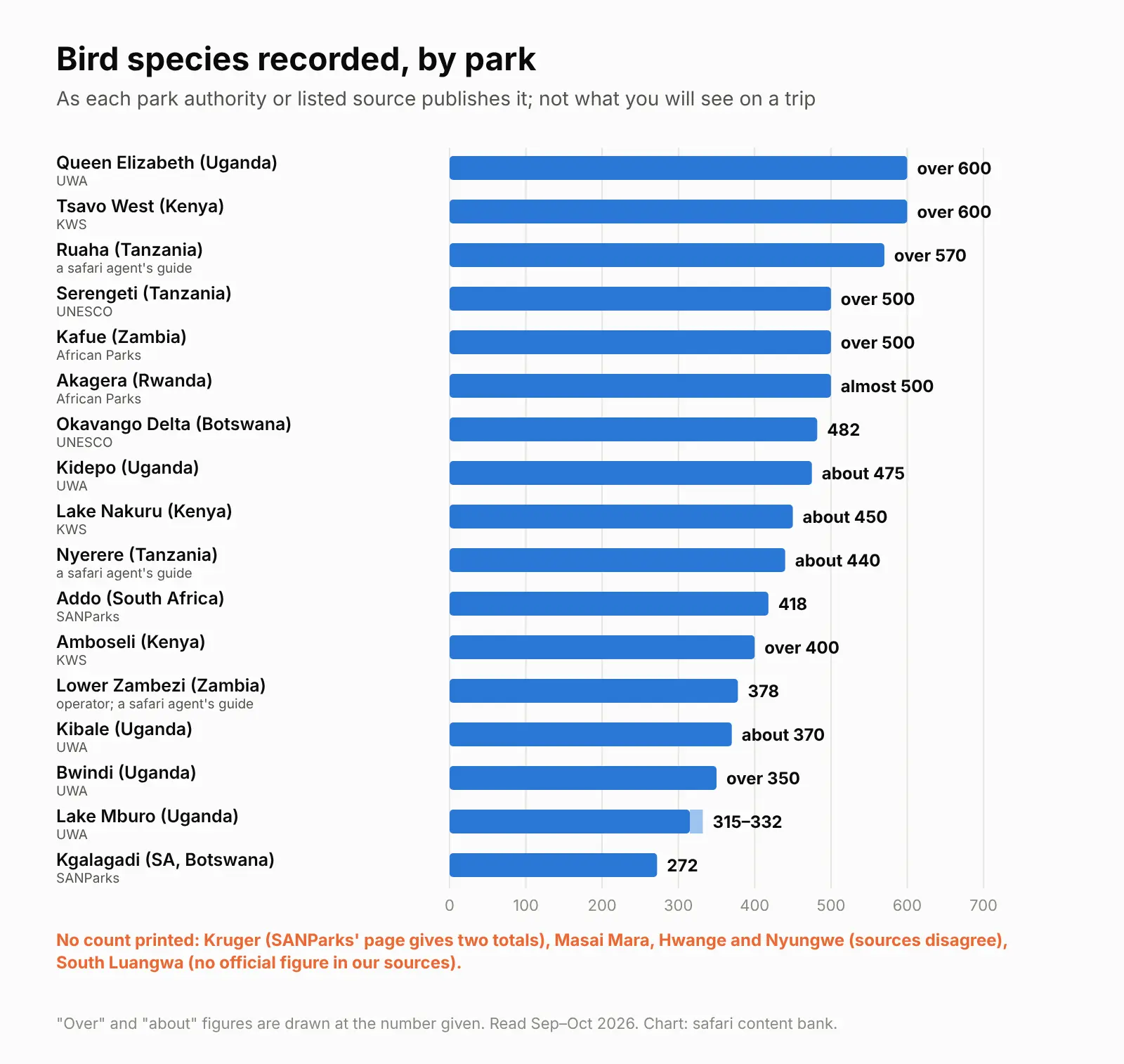 Species recorded or listed, as each source publishes it; “over” figures are drawn at the number given. Read September–October 2026. Chart: safari content bank.
| Park | Birds (source) | Specials and set pieces named in our sources | Best for birds |
|---|---|---|---|
| Queen Elizabeth (Uganda) | 600+ (UWA) | African skimmer, grey crowned crane, blue-throated roller (a birding guide in Africa Geographic); flamingos on Lake Munyanyange; shoebill on the Lake Edward flats at Ishasha (UWA brochure) | Flamingos August–November |
| Murchison Falls (Uganda) | No single UWA figure we print | Shoebill in the delta papyrus (UWA brochure); Vulnerable (IUCN) | Birding January–March; shoebill December–February and June–September |
| Bwindi (Uganda) | 350+ (UWA) | 23 Albertine Rift endemics, such as the African green broadbill; 14 species found nowhere else in Uganda (UWA brochure); Ruhija is the birding sector (Mubwindi Swamp, Bamboo Trail) | — |
| Kibale (Uganda) | ~370 (UWA) | Green-breasted pitta, African pitta, black bee-eater, Kibale ground thrush; Bigodi Wetland Sanctuary boardwalk (UWA brochure) | — |
| Lake Mburo (Uganda) | 315–332 (UWA) | Red-faced barbet, Tabora cisticola, African finfoot (Africa Geographic) | — |
| Kidepo (Uganda) | ~475, second only to Queen Elizabeth (UWA brochure) | 56 birds of prey, kori bustard, secretary bird, Karamoja apalis (UWA) | — |
| Semuliki (Uganda) | ~435–441 (UWA brochure) | 35 Guinea–Congo forest species found nowhere else in East Africa, such as the Nkulengu rail and Congo serpent eagle (UWA brochure) | — |
| Nyungwe (Rwanda) | No count: our sources disagree | Part of the Albertine Rift Endemic Bird Area: 37 restricted-range species, 11 globally threatened (BirdLife) | — |
| Akagera (Rwanda) | Almost 500 (African Parks) | — | — |
| Lake Nakuru (Kenya) | ~450 (KWS) | Part of the Kenya Lake System World Heritage Site with Elementaita and Bogoria: 13 globally threatened species, more than 100 migratory species, a major great white pelican nesting ground (UNESCO); flamingos come and go with the lake level | — |
| Amboseli (Kenya) | 400+, 40 of them birds of prey (KWS) | One of Kenya’s Important Bird Areas (KWS) | — |
| Tsavo West (Kenya) | “Over 600” (KWS) | Lake Jipe and Mzima Springs on KWS’s list | — |
| Ruaha (Tanzania) | 570+ (a safari agent’s guide, read 8–10 October 2026) | Boating on the Usangu wetlands from one camp, June–November | December–April (one safari operator) |
| Nyerere (Tanzania) | ~440 (a safari agent’s guide, read 8–10 October 2026) | Boat safaris on the Rufiji and its lakes | — |
| Serengeti (Tanzania) | 500+, five endemic to Tanzania (UNESCO) | Probably Africa’s largest ostrich population (UNESCO) | November–April (one operator) |
| Lake Manyara (Tanzania) | 350+ (Wikipedia) | Flamingos: the last count we can cite is from 1991 | March–May (one safari operator) |
| South Luangwa (Zambia) | No official count in our sources | Carmine bee-eaters; yellow-billed storks breeding in the Nsefu Sector | Bee-eaters August–October; boating January–March |
| Lower Zambezi (Zambia) | 378 (one safari operator; a safari agent’s guide, read 8–10 October 2026) | Carmine bee-eaters, Pel’s fishing owl | Dry season, when camps are open |
| Kafue (Zambia) | 500+ (African Parks) | Busanga floods | November–March |
| Bangweulu (Zambia) | 400+ (visitbangweulu.org, African Parks) | Shoebill, its southernmost stronghold; nest guards from fishing communities (African Parks) | Our sources disagree on the best shoebill months |
| Okavango Delta (Botswana) | 482 (UNESCO) | Pel’s fishing owl and African skimmer in the Panhandle (one safari operator); slaty egret, “Selinda’s signature bird” (Great Plains) | Migrants November–March |
| Makgadikgadi (Botswana) | No count we print | Sua Pan holds one of southern Africa’s two greater flamingo breeding populations; Nata Bird Sanctuary’s flamingos arrive after the rains (Wikipedia) | After the rains |
| Etosha (Namibia) | 340 (an independent guide site) | — | November–April |
| Spitzkoppe and the Erongo (Namibia) | — | Herero chat, a near-endemic of the escarpment (Travel News Namibia) | — |
| Walvis Bay and the Namib (Namibia) | — | Dune lark, between the Koichab and Kuiseb rivers; Damara tern on the gravel plains inland of the coast (Travel News Namibia) | — |
| Kruger (South Africa) | No count: SANParks’ page gives two totals | “Big Six”: lappet-faced vulture, martial eagle, saddle-billed stork, kori bustard, ground hornbill, Pel’s fishing owl; the far north (Punda Maria, Pafuri) is the birding region | No birding calendar in our sources |
| Addo (South Africa) | 418 (SANParks) | Bird Island: about 120,000 Cape gannets | — |
| Kgalagadi (South Africa, Botswana) | 272 (SANParks) | About 30 raptors (Wikipedia, secondary) | — |
Read 8–10 October 2026. Counts as published by UWA, KWS, Samburu County, a safari agent’s guide, UNESCO, African Parks and SANParks, except where another source is named. “One safari operator” is an unnamed seller; names are in our editor notes.
- The conservation context matters for raptors and vultures. Four African vultures, the white-backed, hooded, white-headed and Rüppell’s, are Critically Endangered (CMS vulture action plan, PDF); of 42 savanna raptor species assessed in 2024, 88% are declining, and the secretarybird, bateleur and martial eagle are declining faster than their Red List categories suggest (Nature Ecology & Evolution).
- Flamingos are not a fixture. Lake Nakuru once held more than a million birds at a time; the flocks left between 2014 and 2018, began returning in 2020 and were short of food in 2023 (Lake Nakuru).
- Namibia’s endemic count depends on the source: Travel News Namibia names one true endemic, the dune lark; a safari booking site names two. We print neither total.
Boats, canoes and walking: the birding activities and their fees
Most birding in our sources happens from a boat or on foot, and nearly every water trip or guided walk is charged on top of park entry. Prices are per person unless stated.
| Activity | Where | Price | Notes | Source |
|---|---|---|---|---|
| Launch cruise | Kazinga Channel (Queen Elizabeth), the Nile to the foot of Murchison Falls, Lake Mburo | US$30 | About 2 hours from Mweya; Lake Mburo needs at least 4 passengers | UWA tariff 2024–26 |
| Shoebill trek or canoe trip | Lugogo swamp, Ziwa (Uganda) | US$25 | — | UWA tariff 2024–26, on Murchison Falls |
| Birding or nature walk | Uganda’s savanna parks (Murchison Falls, Queen Elizabeth, Lake Mburo) | US$25 | With a UWA ranger | UWA tariff 2024–26 |
| Birding or nature walk | Bwindi, Kibale | US$40 | Bwindi’s Ruhija sector for birders | UWA tariff 2024–26, on our Bwindi and Kibale pages |
| Guided birding | Nyungwe (Rwanda) | US$40 | 2–8 per group; park entry extra | Nyungwe (African Parks) 2025–2026 |
| Boat trip | Akagera (Rwanda) | US$35; sunset US$45 | One hour; private boat US$200 (up to 11) | African Parks, 2024 list |
| Bush or bird walk | Ol Pejeta, Laikipia (Kenya) | US$70 adult | VAT included | Ol Pejeta 2026 tariff |
| Boat safari | Nyerere (Tanzania) | US$23.60 | Last published tariff, 2023/24 | TANAPA |
| Canoeing | Lake Manyara (Tanzania) | US$23.60 per 2 hours | Last published tariff, 2023/24 | TANAPA |
| Walking safari | TANAPA parks | US$23.60 (1–4 h) or US$29.50 (over 4 h) | Last published tariff, 2023/24 | TANAPA |
| Boating or canoeing | Zambia’s national parks: South Luangwa, Lower Zambezi, Kafue | US$20 a day each | DNPW 2025 schedule, the last published | A safari agent’s guide, read 8–10 October 2026 (DNPW) |
| Mokoro and boats | Okavango Delta (Botswana) | In camp rates | Seasonal floodplains: boats from about late May to September; none in January and February | Okavango flood calendar |
| Canoe trips | Mana Pools (Zimbabwe) | No price for a canoe trail alone | Half a day to several days; motorboats banned except on Ruckomechi’s concession | Mana Pools |
| Mokoro with a community guide | Bangweulu (Zambia) | Included at Shoebill Island Camp (US$495 per person a night, full board, 2026) | Camp open 1 May–15 December; no under-12s on shoebill activities | visitbangweulu.org (African Parks) |
| Morning walk | Kruger (South Africa) | R726 (R848 from Crocodile Bridge) | Plus the conservation fee: R692 (R602 until 31 Oct 2026) | SANParks tariffs 2024/25 |
Read 8–10 October 2026. UWA: last published tariff, July 2024–June 2026. Fee details with dates and sources:
| Fee | Amount | In force from | Source |
|---|---|---|---|
| Uganda: launch cruise, Murchison Falls NP (same price on the Kazinga Channel, Queen Elizabeth NP, and at Lake Mburo NP), foreign non-resident, per person | USD 30 (foreign resident USD 25; rest of Africa USD 20; East African citizens UGX 30,000) | 1 Jul 2024 (UWA Conservation Tariff July 2024–June 2026, the last published rates) | UWA Conservation Tariff July 2024–June 2026 |
| Uganda: guided nature or birding walk, Lake Mburo NP (UWA rate for savanna parks), foreign non-resident, per person | USD 25 (foreign resident USD 20; East African citizens UGX 20,000) | 1 Jul 2024 (UWA Conservation Tariff July 2024–June 2026, the last published rates) | UWA Conservation Tariff July 2024–June 2026 |
| Uganda: gorilla tracking permit in April, May and November (low season), foreign non-resident, per person per trek; cannot be rescheduled | USD 600 (foreign resident USD 500) | Immediate effect from the UWA letter of 26 Feb 2026 | UWA letter TDO 93/04, 26 Feb 2026 |
| Nyungwe National Park, canopy walkway, guided birding, other primate tracking or night walk, international visitor | USD 40 (park entry extra) | Nyungwe Tourism Pricing Scheme 2025–2026 | Nyungwe NP (African Parks), pricing 2025–2026 |
| Akagera National Park, night drive and scheduled boat trip, adult | Night drive USD 40; boat trip USD 35; sunset boat trip USD 45 | 2024 price list, the latest we found | African Parks, Akagera NP price list 2024 |
| Ol Pejeta Conservancy guided bush or bird walk, per person | USD 70 adult / USD 35 child, VAT included | 2026 tariff (January–December 2026) | Ol Pejeta Conservancy Tariff Guide 2026 |
| Nyerere boating safari fee, per person | USD 20 + 18% VAT = USD 23.60 | 1 Jul 2023 (2023/24 tariff, last published) | TANAPA Tariffs 2023/24 |
| Lake Manyara canoeing, per person per 2 hours | Adult USD 20 + VAT = USD 23.60; child USD 10 + VAT = USD 11.80 | 1 Jul 2023 (2023/24 tariff, last published) | TANAPA Tariffs 2023/24 |
| Walking safari, adult, per person (Nyerere and other TANAPA parks) | Short (1–4 h) USD 20, long (over 4 h) USD 25; + 18% VAT = USD 23.60 / USD 29.50 | 1 Jul 2023 (2023/24 tariff, last published) | TANAPA Tariffs 2023/24 |
| All national parks, non-resident activity fees, per person per day | Boating USD 20; canoeing or rafting USD 20; angling USD 30; camping USD 5 per person | DNPW 2025 schedule, the last published; page last modified 8 May 2025, still shown 9 Oct 2026 | DNPW 2025 fee schedule, as shown on a Zambia travel portal |
| Kruger National Park guided walks and backpack trail, per person | Morning walk ZAR 726 (ZAR 848 from Crocodile Bridge); afternoon walk ZAR 580; Olifants river walk ZAR 424; Mphongolo backpack trail, 3 nights, ZAR 3,460–4,018 | SANParks tariffs 2024/25, the latest in our sources | SANParks tariffs 2024/25 |
| Kruger National Park daily conservation fee, international adult (12+), per day | ZAR 602 | 1 Nov 2025 to 31 Oct 2026 (SANParks 2025/26 schedule) | SANParks daily conservation fees 2025/26 |
| Kruger National Park daily conservation fee, international adult (12+), per day | ZAR 692 | 1 Nov 2026 to 31 Oct 2027 (SANParks 2026/27 schedule, already published) | SANParks daily conservation fees 2026/27 |
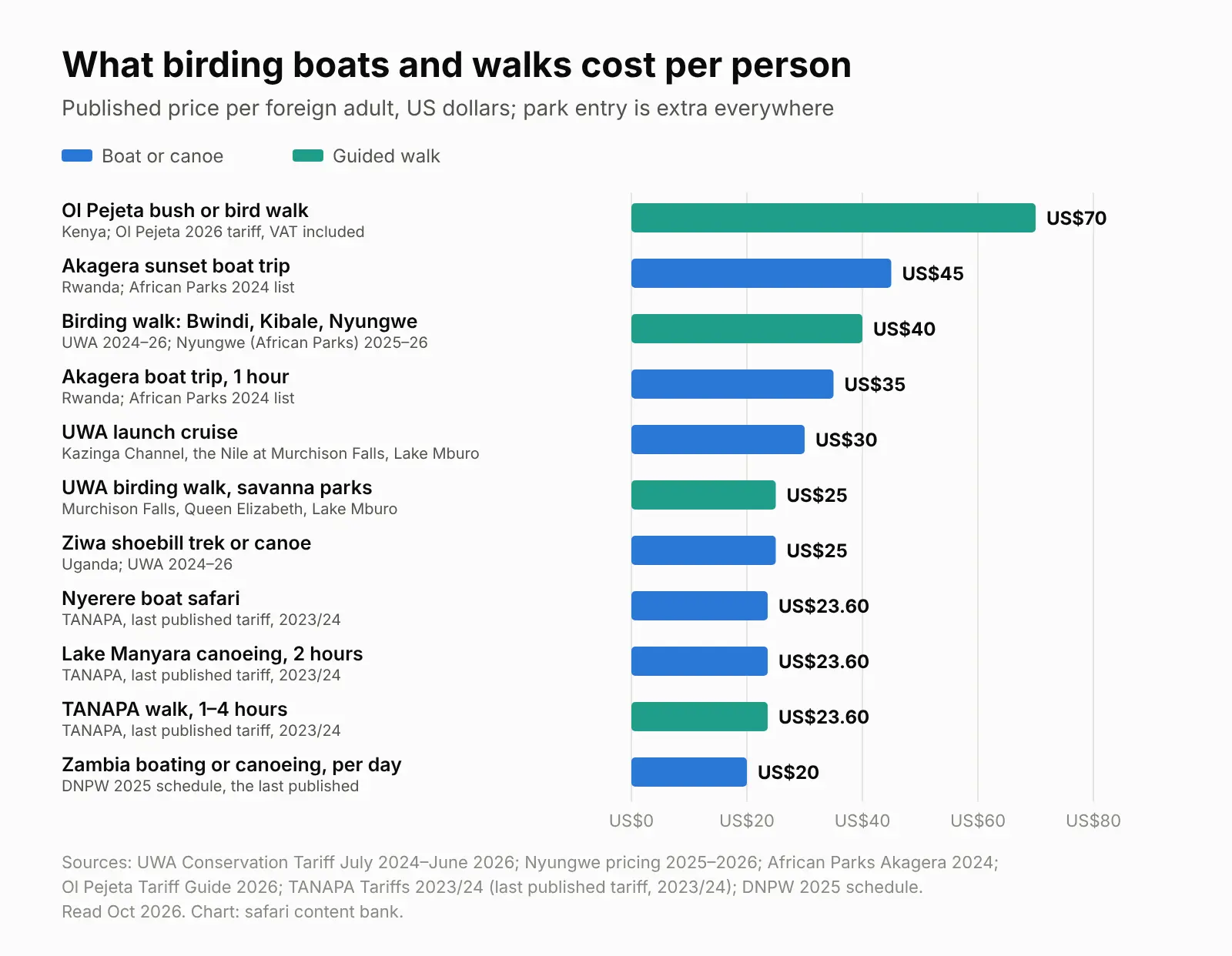 Sources: UWA tariff 2024–26; Nyungwe (African Parks) 2025–2026; African Parks Akagera 2024 list; Ol Pejeta 2026 tariff; TANAPA Tariffs 2023/24 (last published tariff, 2023/24); DNPW 2025 schedule, the last published. Park entry is extra everywhere. Chart: safari content bank.
- A mokoro is for quiet and birds, not big game: mokoro trips focus on “silence and birdlife rather than large animals”, one forum regular says (TripAdvisor forum, traveller report). One UK safari operator describes the Delta’s water-first camps as trading big game for mokoro and birding (Okavango water vs land camps).
- Chobe’s boats and houseboats are the riverfront’s water option; the houseboats moor on the Namibian bank, and guests clear Botswana immigration at Kasane (Chobe).
- Walking is a park-by-park rule, not a country one. You can walk in South Luangwa, Mana Pools, Kruger, the Mara conservancies, Botswana’s private concessions and the Serengeti, but not in Moremi (walking safari; walking safari cost).
- Bangweulu is a long way in: 10–12 hours by road from Lusaka in a high-clearance 4x4, or a charter to Inja or Chimbwi airstrip (visitbangweulu.org). Whisper, and take no photographs, inside its shoebill rearing facility.
Specialist guides, private vehicles and group birding tours
On a camp or road safari you share the guide and the vehicle with people who may not want to stop for a cisticola; a private vehicle, a private guide or a specialist birding tour buys that time. Our sources hold no birding-specific guide qualification for any country.
| Option | What you get | Price, as published | Source |
|---|---|---|---|
| Shared camp or group vehicle | Shared trips publish 4–7 guests per vehicle in East Africa; Botswana’s lodge vehicles seat six or nine | In the camp or tour rate | Safari vehicles |
| Private vehicle, Tanzania road safari | Your party, with a driver-guide | US$200–300 per vehicle per day | One Arusha operator’s 2026 cost guide, on Tanzania safari cost |
| Private vehicle at a camp | Your party; you choose where to stop and for how long | Governors’ Camp (Masai Mara) US$385–512 a day (2026); Machaba (Khwai) US$550 a night (2026); The Bushcamp Company (South Luangwa) US$600 a night (2026); Natural Selection (Okavango) US$725–935 a night, free for parties of 6–7 (2026) | Camps’ rate cards, on photography safari |
| Private vehicle and private guide | Your own guide as well as the vehicle | Time + Tide (Zambia) US$570 a night for the vehicle; US$750 with a private guide (2027) | Time + Tide 2027 (PDF) |
| Specialist group birding tour | A birding leader, a target list, a fixed itinerary | US$3,900 (South Africa, 10 days) to US$10,300 (Kenya and Tanzania, 18 days) per person sharing, land only (2026) | One specialist birding company’s 2026 schedule |
| Specialist northern Botswana tour | 9 days, 2–8 participants; targets include Pel’s fishing owl, slaty egret, wattled crane, African skimmer and rock pratincole | “typically exceed $20,000 per person sharing” | Another specialist birding company’s itinerary page |
Read 8–10 October 2026. Specialist companies, the Arusha operator and the vehicle-guide sellers are unnamed; names and links are in our editor notes.
What one specialist birding company charges per day (2026, land only, per person sharing; our sums):
| Tour | Days | Price | Per day (our sum) | Single supplement |
|---|---|---|---|---|
| South Africa: Cape and Kruger | 10 | US$3,900 | US$390 | US$420 |
| South Africa: eastern (small group) | 15 | US$4,900 | US$327 | US$410 |
| Zimbabwe: comprehensive | 12 | US$5,200 | US$433 | Not yet set |
| Namibia: desert birds and big game | 12 | US$6,200 | US$517 | US$380 |
| Namibia, Okavango and Victoria Falls (small group) | 17 | US$9,100 | US$535 | US$840 |
| Kenya: highlights | 15 | US$7,500 | US$500 | US$1,180 |
| Tanzania: highlights | 11 | US$7,200 | US$655 | US$610 |
| Kenya and Tanzania: birds and big game (small group) | 18 | US$10,300 | US$572 | US$750 |
| Uganda: birds and gorillas | 17 | US$9,300 (small group US$10,800) | US$547 (US$635) | US$950 |
Prices from the company’s 2026 schedule and rates (PDF), read October 2026; per-day figures are our sums, rounded to the dollar. We did not check whether park fees or Uganda’s gorilla permit are included. Gorilla permit prices: gorilla permits.
- For two people a private vehicle at a camp adds US$192.50–467.50 each a day or night (our sums from US$385–935 per vehicle); on a Tanzanian road safari the vehicle is usually yours anyway at US$200–300 a day.
- Ask who the guide is. Kenya’s guide body grades guides bronze, silver and gold, and South Africa has a graded field-guide ladder; neither, in our sources, certifies birding as such (walking safari).
- Bring the field guide for the region. The publisher lists Birds of East Africa (Stevenson and Fanshawe, covering Kenya, Tanzania, Uganda, Rwanda and Burundi) and Birds of Southern Africa (Sinclair and others, the Sasol guide) (Princeton University Press).
What a birding safari costs
Park fees and the activity extras are small next to the camp or tour price; the choice of season moves the total most. All figures below are as published on our cost pages, or our sums from them.
| Item | Price | Source |
|---|---|---|
| Uganda: entry plus a Kazinga Channel launch | US$70 per foreign adult for one day (US$40 + US$30, our sum) | UWA tariff 2024–26, on Queen Elizabeth |
| Uganda: Murchison entry, the launch and the walk to the top of the falls | US$90 per person (our sum) | UWA, on Murchison Falls |
| Uganda: Lake Mburo night with the boat and a guided walk | US$95 per foreign adult (our sum) | UWA, on Lake Mburo |
| Rwanda: Akagera one night’s entry with a boat trip and a night drive | US$175 (our sum) | African Parks, on Akagera |
| Group camping safari, Tanzania | US$220–300 per person per day, park fees included | Private vs group safari cost |
| Private Tanzanian safari for two, mid-range | US$406–656 per person per day | Tanzania safari cost |
| Specialist birding tour | About US$327–655 per person per day, land only (our sums) | One specialist company’s 2026 schedule |
| Bangweulu: Shoebill Island Camp | US$495 per person a night, full board, activities and levy included (2026) | visitbangweulu.org (African Parks) |
Read 8–10 October 2026. Country-by-country totals: safari cost per day by country.
Which to choose
Pick by the bird you most want and the month you can travel; the cheapest months are usually the best for birds.
| If you want… | Go to | When | Why |
|---|---|---|---|
| The most species in one trip, with primates | Uganda: Queen Elizabeth, Bwindi (Ruhija), Kibale, Murchison Falls | Murchison January–March; Uganda’s gorilla permit US$600 in April, May and November | 600+ species in Queen Elizabeth; 23 Albertine Rift endemics in Bwindi (UWA) |
| A shoebill | Murchison Falls delta by launch; Bangweulu by mokoro | Murchison December–February and June–September; Bangweulu while Shoebill Island Camp is open, 1 May–15 December | UWA brochure; African Parks |
| Waterbirds from a boat or mokoro | Okavango water camps; Chobe riverfront | Okavango boats late May–September | Mokoro trips are about “silence and birdlife” |
| Carmine bee-eaters | South Luangwa, Lower Zambezi | August–October | Colonies in the river banks |
| Migrants at low prices | Botswana, Namibia, Hwange, Kafue | November–March or April | Green-season rates; some camps and roads close |
| A self-drive birding trip | Kruger’s far north; Etosha | Any season; South Africa’s summer-rain reserves October–March | Your own car, at your own pace |
| Desert specials | Namibia: the Namib dunes, Walvis Bay, Spitzkoppe and the Erongo | — | Dune lark, Damara tern, Herero chat |
| Rift Valley lakes | Lake Nakuru, Elementaita, Bogoria | Ask about lake levels | Flamingos come and go |
Common mistakes on a birding safari
| What you’ll often read | What is correct |
|---|---|
| “The dry season is the best time for everything” | Not for birds. Migrants are present from about November to April; the dry months are best for big game. |
| “Lake Nakuru is pink with flamingos” | Not reliably. The flocks left in 2014–2018 and were short of food in 2023; numbers depend on the lake level. |
| “You are bound to see a shoebill” | No sighting is guaranteed. Murchison’s best months are December–February and June–September (UWA brochure), and our sources disagree on Bangweulu’s best months. |
| “Bird walks and boat trips are in the park fee” | They are extra: a UWA launch US$30, a birding walk US$25–40, Akagera’s boat US$35, Ol Pejeta’s bird walk US$70. |
| “A specialist dry-season tour gets the migrants” | It trades migrants for logistics. One northern Botswana tour runs “roughly June–November”; migrants are there November–March. |
| “Everything is open in the green season” | Not everywhere. Most South Luangwa bush camps close January–March; Mana Pools and Lower Zambezi camps close December–March; Nkasa Rupara’s roads can be impassable November–April. |
| “A mokoro trip shows you the big game” | It shows you birds and quiet. Use a land camp or a game drive for big cats. |
| “Every park publishes one bird total” | Not even Kruger: SANParks’ own page gives two totals, and our sources disagree for Hwange and Nyungwe. |
Frequently asked questions
When is the best time for a birding safari in Africa? From about November to April, when migrants from Europe and Asia are present: a safari booking site gives November–April for Namibia, a Botswana camp operator November–March, and two East African operators November–April. Some parks differ: Lake Manyara is best March–May and Ruaha December–April (one safari operator), and South Luangwa’s carmine bee-eaters are there August–October.
Which country is best for birding on safari? Uganda has the most species and named specials in our sources: Queen Elizabeth lists more than 600 species, Kidepo about 475 and Bwindi more than 350, with 23 Albertine Rift endemics (UWA). For waterbirds from a boat or mokoro, the Okavango Delta (482 species, UNESCO) and the Zambezi valley are the southern choices.
How many bird species does each country have? Our sources hold only two national figures: Uganda’s 1,047 in a UWA brochure, against “more than 1,065” in Africa Geographic, and Botswana’s 615, none endemic, in Wikipedia’s list citing BirdLife Botswana (May 2023). We hold no national total for Kenya, Tanzania, Rwanda, Zambia, Zimbabwe, Namibia or South Africa.
Where can I see a shoebill? In Murchison Falls’ delta papyrus, best December–February and June–September (UWA brochure); on the Lake Edward flats at Ishasha in Queen Elizabeth; on a US$25 shoebill trek or canoe trip at Ziwa; and in Zambia’s Bangweulu Wetlands, where Shoebill Island Camp opens from 1 May to 15 December. A birding guide in Africa Geographic also names Mabamba Swamp on Lake Victoria.
Do I need a specialist birding guide? Not to see birds, but a shared vehicle stops for what the group wants. A private vehicle costs US$200–300 a day on a Tanzanian road safari and US$385–935 a day or night at camps on 2026 rate cards; Time + Tide adds a private guide for US$750 a night (2027). One specialist company’s 2026 group tours cost about US$327–655 per person per day, land only (our sums).
Is the green season good for birding? Yes, and it is the cheapest season: Machaba in Botswana drops from US$1,315 to US$882 a night on 1 November, and Camp Hwange from US$1,080 to US$550 (2026). The catch is access: most South Luangwa bush camps close January–March, Mana Pools and Lower Zambezi camps December–March, and Nkasa Rupara’s roads can be impassable.
Can I go birding on foot? Yes, in many places, with a ranger or guide: UWA birding walks cost US$25 in savanna parks and US$40 in Bwindi and Kibale, Nyungwe’s guided birding US$40, Ol Pejeta’s bush or bird walk US$70, and a TANAPA walk US$23.60–29.50 (last published tariff, 2023/24). Walking is not allowed in Moremi.
Where can I see flamingos? On Queen Elizabeth’s Lake Munyanyange from August to November (UWA brochure); on Botswana’s Sua Pan and at Nata Bird Sanctuary after the rains; and at Lake Nakuru when the lake level suits them. Nakuru’s flocks left in 2014–2018 and were short of food in 2023, so ask before you go.
Sources
- Park authorities: UWA, Conservation Tariff July 2024–June 2026 (PDF), the last published, and UWA park brochures (Murchison Falls, Queen Elizabeth, Bwindi, Kibale, Kidepo, Semuliki (PDF)); KWS park pages (Lake Nakuru, Amboseli, Tsavo West); Samburu County; a safari agent’s guides to Ruaha and Nyerere, read 10 October 2026; TANAPA, Tariffs 2023/24 (PDF), the last published tariff; African Parks, Kafue, Akagera price list 2024 (PDF), Nyungwe 2025–2026 (PDF), Bangweulu and visitbangweulu.org; a safari agent’s guide to park entry fees (DNPW), read 10 October 2026; SANParks, Addo, Kgalagadi, tariffs 2024/25 (PDF) and daily conservation fees 2025/26 (PDF) and 2026/27 (PDF); Ol Pejeta Tariff Guide 2026 (PDF)
- World Heritage and bird science: UNESCO, Okavango Delta, Serengeti and Kenya Lake System; BirdLife, Albertine Rift Endemic Bird Area factsheet; Nature Ecology & Evolution, African raptors; CMS vulture action plan (PDF); Natural History Museum on flamingos
- Birding writers and media: Africa Geographic, Uganda’s 10 best birding spots; Travel News Namibia, endemic birds; a safari agent’s guide, read 10 October 2026
- Secondary: Wikipedia, List of birds of Botswana (citing BirdLife Botswana’s checklist), Lake Manyara National Park, Makgadikgadi Pan, Nata Bird Sanctuary, Kgalagadi Transfrontier Park
- Camps’ own rates and guides: Governors’ 2026 (PDF); Machaba 2026; Natural Selection 2026 (PDF); Time + Tide 2027 (PDF); The Bushcamp Company 2026 (PDF); Great Plains seasonal guide (PDF); Camp Hwange 2026 rates, as on Zimbabwe safari cost
- Field guides: Princeton University Press, Birds of East Africa and Birds of Southern Africa
- Unnamed sellers (names and links in our editor notes): two specialist birding companies (2026 schedule and rates; a northern Botswana itinerary); safari operators’ park and season guides (Lake Manyara, Ruaha, South Luangwa, Lower Zambezi, the Okavango Panhandle, Kenya and Tanzania migrants); a Botswana camp operator’s best-time guide; a safari booking site’s Namibia birding page; one Arusha operator’s 2026 cost guide
- Traveller reports, not facts: TripAdvisor, mokoro trips
- Our pages for the detail: green-season safari, best time for a safari, photography safari, safari vehicles, walking safari, Okavango water vs land camps, Tanzania northern vs southern circuit, Bwindi gorilla sectors
Bird counts, seasons, fees and rates checked 8–10 October 2026; SANParks fees checked 1 November 2026. We will update this page when UWA publishes park-entry rates for after June 2026, when TANAPA publishes a tariff after 2023/24, when SANParks resolves its two Kruger bird totals, and when we can read national bird lists for Kenya, Tanzania, Zambia, Zimbabwe, Namibia and South Africa.