 Experience

Last verified · Next check due
On this page
Short answer: UK and US passports need no visa for Zambia (UK FCDO; others should check); nationalities that do need one pay US$50 for a single entry since 1 January 2026. South Luangwa’s gate fee is US$25 a day, but lodges bill US$90–110 per person per night in fees and levies. Most bush camps open only from late May to mid-November. Lusaka to Mfuwe takes about 70 minutes by air or 9–10 hours by road. Checked 10 October 2026.
Key facts
- UK and US passport holders need no visa for Zambia, and British tourists may stay 90 days in any 12 months (UK FCDO); trade press adds Canada, Germany, France, Italy, Spain, the Netherlands and Belgium (VisasNews), and other passports, Australia included, should check before travel. Nationalities that need a visa pay US$50 for a single entry and US$80 for double or multiple entry since 1 January 2026 (a safari agent’s guide, 7 Jan 2026).
- South Luangwa and Lower Zambezi charge US$25 per international adult per day; Kafue and North Luangwa charge US$20. These are the Department of National Parks and Wildlife (DNPW) 2025 rates, the last published, still shown on 9 October 2026. Camps bill US$90–110 per person per night for fees and levies.
- Zambia’s bush camps are seasonal: Time + Tide’s South Luangwa bush camps open 20 May–15 November, most Busanga Plains camps in Kafue open June to the end of October, and Remote Africa’s North Luangwa camps 15 June–31 October.
- There are no rhino in South Luangwa and no giraffe in Lower Zambezi, but 83% of one safari operator’s South Luangwa travellers saw leopard, and night drives are allowed inside the park (the same operator’s South Luangwa guide).
- Every walk in South Luangwa goes with a licensed guide and an armed scout, and no one under 12 may walk (one safari operator).
- This page answers 32 questions drawn from 42 Zambia forum threads on TripAdvisor (38) and two other forums (4), collected on 8 October 2026; camp choice is the most-asked theme, then trip reports and transfers.
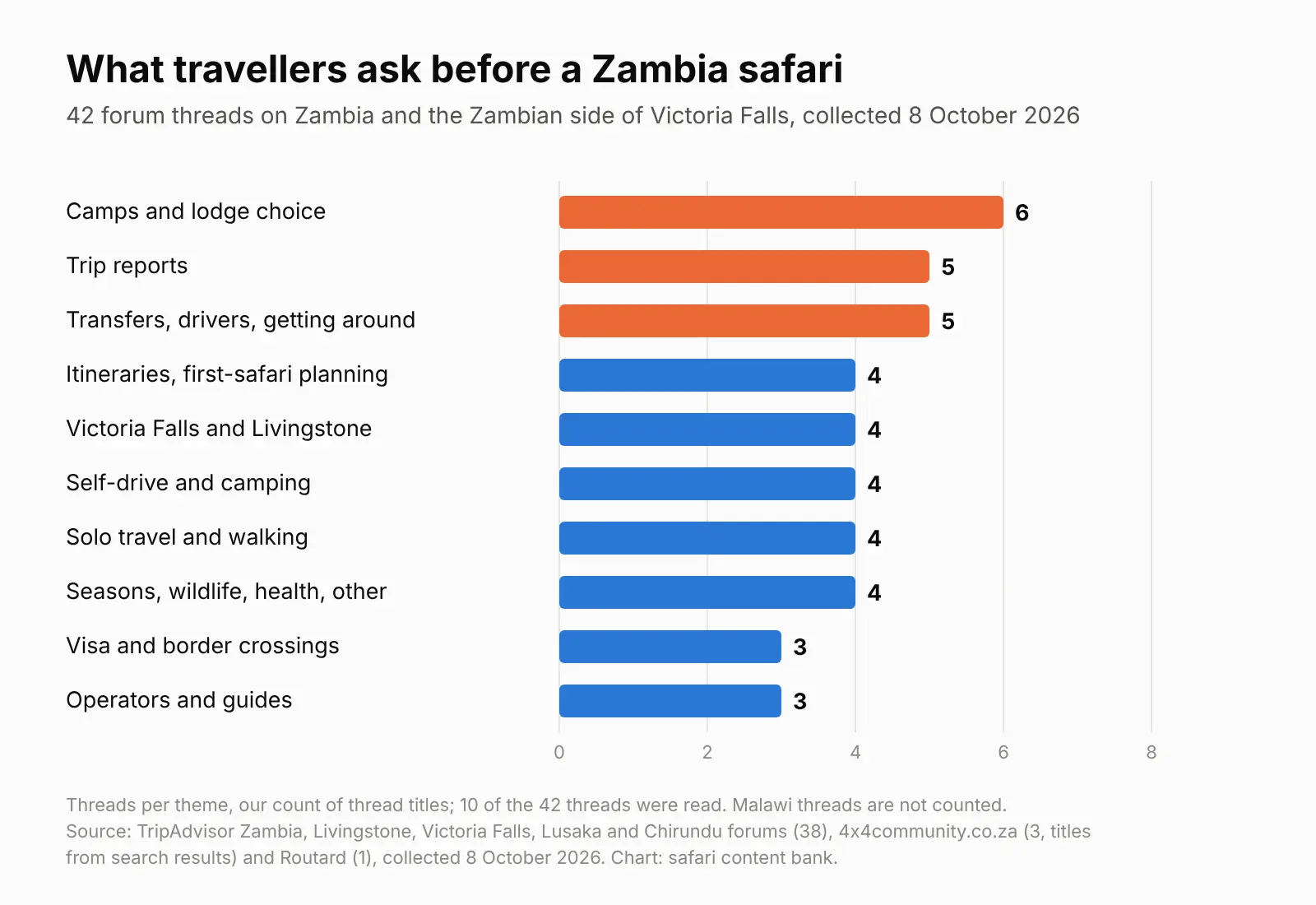 Thread titles on the TripAdvisor Zambia, Livingstone, Victoria Falls, Lusaka and Chirundu forums (38), 4x4community.co.za (3) and Routard (1), collected 8 October 2026. Our count by theme. Chart: safari content bank.
Visa and entry
Do I need a visa for Zambia in 2026?
Not with a UK or US passport (UK FCDO; trade press adds Canada, Germany, France, Italy, Spain, the Netherlands and Belgium; other passports, Australia included, should check); nationalities that do need one pay US$50 for a single entry since 1 January 2026, up from US$25 (a safari agent’s guide, 7 Jan 2026; Tourism Update). The same notice lists US$80 for a double-entry or multiple-entry visa (were US$40 and US$75), US$10 for a day-tripper visa and US$50, unchanged, for the KAZA Univisa. British visitors may stay 90 days in any 12 months (UK FCDO, Zambia entry requirements). Full entry costs are on our Zambia safari cost page.
Can I get the visa on arrival, or must I apply online?
If your passport needs a visa, you can apply online at eservices.zambiaimmigration.gov.zm or get one on arrival; VisasNews says most nationalities that need a visa can buy it at the border (VisasNews). “Visa at airport” was asked on the TripAdvisor Livingstone forum in 2026; the thread’s replies are not in our sources. Your passport needs six months’ validity and two blank pages (UK FCDO, updated 1 June 2026).
Do I need the KAZA Univisa?
Only if it saves you visas: the KAZA Univisa costs US$50, lasts 30 days and covers Zambia and Zimbabwe with unlimited crossings, plus day trips into Botswana through Kazungula (a Victoria Falls booking site, updated 27 June 2025; price unchanged for 2026 per a safari agent’s guide, read 10 October 2026). A night in Botswana voids it, it cannot be extended, and you carry US$50 in cash. If your passport is visa-free for Zambia, the Univisa pays only when you would otherwise need more than a single-entry Zimbabwe visa. Where it is issued and how the two sides of Victoria Falls compare are on Victoria Falls: Zimbabwe or Zambia side.
Do I need a yellow fever certificate for Zambia?
Only if you arrive from a country with yellow fever risk; flying in from Europe or North America, you do not (UK FCDO, Zambia, updated 1 June 2026). Kenya and Uganda are risk countries, so a Zambia trip that follows a safari there needs the card. Our sources do not say whether Zimbabwe or Botswana treat Zambia as a risk country for travellers going on from Zambia. Every route is on our yellow fever certificate page.
Parks: where to go and what you will see
Which park should I choose for a first Zambia safari?
South Luangwa, usually paired with Lower Zambezi: South Luangwa has the most camps, walking and leopard, and Lower Zambezi adds canoeing and boating on the Zambezi. One safari operator lists about 40 camps and lodges in and around South Luangwa (its South Luangwa guide), and in the Zambia itineraries we read, Lower Zambezi is its most common pairing.
| Park | Size | Known for | Camps open | Gate fee, international adult per day |
|---|---|---|---|---|
| South Luangwa | 9,050 km² | Walking, night drives, leopard (seen by 83% of one safari operator’s travellers) | Some Mfuwe-area lodges all year; bush camps late May to mid-November | US$25 |
| Lower Zambezi | 4,092 km² | Canoeing, boat trips, tigerfish; lion seen by 96%, leopard by 88% | About April to mid-November | US$25 |
| Kafue | 22,400 km² | Busanga Plains, lion seen by 83%, antelope | Busanga camps June to end October | US$20 |
| North Luangwa | 4,636 km² | Walking in a park with few camps | 15 June–31 October | US$20 |
| Liuwa Plain | 3,660 km² | Wildebeest gathering, late October to December | Not stated in our sources | US$40 (African Parks, 2025) |
| Mosi-oa-Tunya (Livingstone) | – | Victoria Falls; guarded white rhino walks | – | US$10 (game section) |
Gate fees: DNPW 2025 schedule, the last published, on a safari agent’s guide, still shown 9 October 2026; Liuwa from African Parks’ 2025 sheet, as on our Zambia safari cost page. Sizes: Wikipedia, South Luangwa; a safari agent’s guide to Lower Zambezi; African Parks, Kafue; Frankfurt Zoological Society, North Luangwa; Visit Liuwa. Sighting shares: one safari operator’s traveller surveys for South Luangwa, Lower Zambezi and Kafue (names and links kept in our editor notes), not population data. Seasons: operators’ open dates as in the month chart below. Read 8–10 October 2026.
The park itself, its camps and its month-by-month calendar are on our South Luangwa National Park page.
South Luangwa or Lower Zambezi: which is better?
Choose South Luangwa for walking, leopard and night drives, and Lower Zambezi for water: canoeing, boat trips and fishing, with game on a narrow valley floor. Lower Zambezi lies on the north bank of the Zambezi opposite Zimbabwe’s Mana Pools, and most of its game is between the river and the escarpment (one safari operator’s Lower Zambezi guide). In that operator’s traveller surveys, Lower Zambezi scores higher for lion (96% against 86%) and leopard (88% against 83%) and about the same for wild dog (46% against 45%). Lower Zambezi has no giraffe, and never had any on record (the same operator). Both parks charge US$25 a day at the gate. On the TripAdvisor Zambia forum in July 2026, replies to a traveller planning a June week in both parks suggested two nights at each of two camps (TripAdvisor, “Itinerary question June 2027 – LZ and SLNP”, traveller reports).
Is Kafue worth visiting?
Yes, for space and the Busanga Plains, but only from June to October for Busanga, and with lower leopard odds than South Luangwa. Kafue is Zambia’s largest park at 22,400 km², run by African Parks with DNPW under a 20-year partnership signed in 2022; African Parks counts 158 mammal species, 21 of them antelope (African Parks, Kafue). In August 2025 it released 1,567 wildebeest and 172 zebra into the park (same page). One safari operator’s travellers saw lion on 83% of trips and leopard on 61% (its Kafue guide). Busanga floods in the rains: most of its camps open in June and close at the end of October (the same operator; Visit Kafue). Kafue has no scheduled flights; the road from Lusaka is about 4 hours on tar (a safari booking site). Side by side: Kafue vs South Luangwa.
Can I see the Big Five in Zambia?
Not reliably: South Luangwa has no rhino, its black rhino were gone by 1987, and no cheetah has been seen there for decades (one safari operator’s South Luangwa guide; Wikipedia). Elephant, buffalo, lion and leopard are seen there by most visitors: 99%, 89%, 86% and 83% of that operator’s travellers. In North Luangwa, its travellers saw black rhino on 2% of trips (its North Luangwa guide). Near Livingstone, Mosi-oa-Tunya National Park keeps white rhino under round-the-clock guard, and a morning walk to find them takes about four hours (the same operator’s Livingstone guide). On the TripAdvisor Zambia forum in 2026, an older couple asked whether those guarded rhino were “authentic”; replies called the guarding “a sad necessity” (TripAdvisor, “First and likely only Safari”, traveller reports). Africa’s rhino parks are compared on where to see rhino.
Where am I most likely to see wild dogs in Zambia?
Lower Zambezi and South Luangwa, where 46% and 45% of one safari operator’s travellers saw them; in South Luangwa sightings increase from February to May (its Lower Zambezi and South Luangwa guides). North Luangwa’s figure is 20% (the same operator). In the west, the Greater Liuwa pack held 12 adults and yearlings in 2023 (Zambian Carnivore Programme, 2023 annual report, PDF). On the TripAdvisor Zambia forum in May 2026, replies said South Luangwa’s dogs den in June and July (traveller reports). Africa’s best areas are compared on where to see wild dogs.
Will I share sightings with many vehicles?
Near Mfuwe sometimes; in the remote sectors rarely, according to travellers. Posters on the TripAdvisor Zambia forum in 2026 said South Luangwa’s remote sectors are nearly vehicle-free, while the area by the main gate sees more short-stay traffic (TripAdvisor, “First and likely only Safari”, traveller reports). A first-timer’s June 2026 trip report counted 12 vehicles at one lion sighting and disliked a camp about 50 minutes by boat from the park (TripAdvisor, “Our first Safari – Trip Report – Zambia June 2026”). Another guest in May 2026 complained that his guide left sightings early under a six-vehicle limit (TripAdvisor, “Trip report May 19–28”, traveller reports). Before booking, ask how far the camp is from the park boundary.
Walking, night drives and canoeing
Do I have to walk on a South Luangwa safari?
No: full-board rates cover two activities a day, and game drives are one choice. On the TripAdvisor Zambia forum in 2026, replies to a couple with bad knees said only a minority of guests walk, put the share at 10–20%, and described walks of 3–5 km over 2–3 hours (TripAdvisor, “First and likely only Safari”, traveller reports). Trails camps differ: in 2024, three of Remote Africa’s five Luangwa camps were walking-only (Fortune, April/May 2024). North Luangwa’s Mwaleshi camp is walking-only (one safari operator’s North Luangwa guide).
What are the rules on a walking safari, and can children join?
Every walk in South Luangwa has a licensed guide and an armed DNPW scout, and the minimum age is 12 (one safari operator’s South Luangwa guide). Time + Tide sets 12 for walking, canoeing and sleep-outs, and Remote Africa sets 12 at its trails camps and in North Luangwa, 8 at Tafika (walking safaris). The walking season is June to October. Norman Carr opened Zambia’s first safari camp in South Luangwa in 1950 and promoted walking there (a tour operator’s walking-safari guide, a secondary source). A solo traveller who asked about a first walking safari in August 2026 was advised to take a 5–7-night mobile walking trip in late July (TripAdvisor, “Solo walking safari”, traveller reports).
Are night drives allowed in Zambia’s parks?
Yes, in South Luangwa, which few African national parks allow: afternoon drives continue after dark with a spotlight (one safari operator’s South Luangwa guide). Flatdogs says its guests’ park fee covers them until 20:00, two hours past the 06:00–18:00 DNPW day (Flatdogs rates, 2026). Kafue runs night drives for overnight guests, with at most seven guests to a vehicle (Visit Kafue), and Lower Zambezi’s camps run them in the dry season (the same operator’s Lower Zambezi guide). Self-drivers must be out of the parks by 18:00. Botswana’s national parks allow no night drives (night drives in Botswana).
Can I canoe on the Zambezi?
Yes, in Lower Zambezi: guests paddle two-person Canadian canoes with a guide, drifting downstream on the main river and side channels such as the Chifungulu, in the dry season (one safari operator’s Lower Zambezi guide). Under-12s may not canoe. The same operator names hippo and crocodile as the real risk and says to follow the guide’s instructions. DNPW charges non-residents US$20 a day for canoeing or rafting and US$20 for boating (2025 schedule, the last published), usually inside a lodge’s levy line (Zambia safari cost).
When to go
What are the best months for a Zambia safari?
June to October: June is cool and ideal for walking, September has the best game, and October is the hottest month, when the Luangwa and Zambezi valleys pass 40°C (one safari operator’s Zambia weather and South Luangwa guides). The rains, which Zambians call the emerald season, run from December to March. Peak rates start on 1 July: The Bushcamp Company’s bushcamps cost US$809 a night in June against US$951 in July–September (2026 rates), and a reply on the TripAdvisor Zambia forum made the same point to a traveller planning a July trip (TripAdvisor, “South Luangwa bush camp in combination with Flatdogs”). Other countries by month are on best time for a safari.
Are Zambia’s camps open in May?
Some are: Mfuwe-area lodges are open, but South Luangwa’s seasonal bush camps open between 20 May and 1 June, and Busanga and North Luangwa not until June. Chinzombo stays open all year, Flatdogs from 15 March and Tafika from 1 May; Time + Tide’s bush camps open on 20 May and Nsefu Camp on 22 May (South Luangwa). On the TripAdvisor Zambia forum in September–October 2026, replies to a traveller weighing Zambia and Botswana for mid-May said Nsefu had high-water access problems in May 2026 after a very wet season, and that Botswana’s shoulder rates exceed Zambia’s peak rates (TripAdvisor, “Zambia or Botswana in May”, traveller reports).
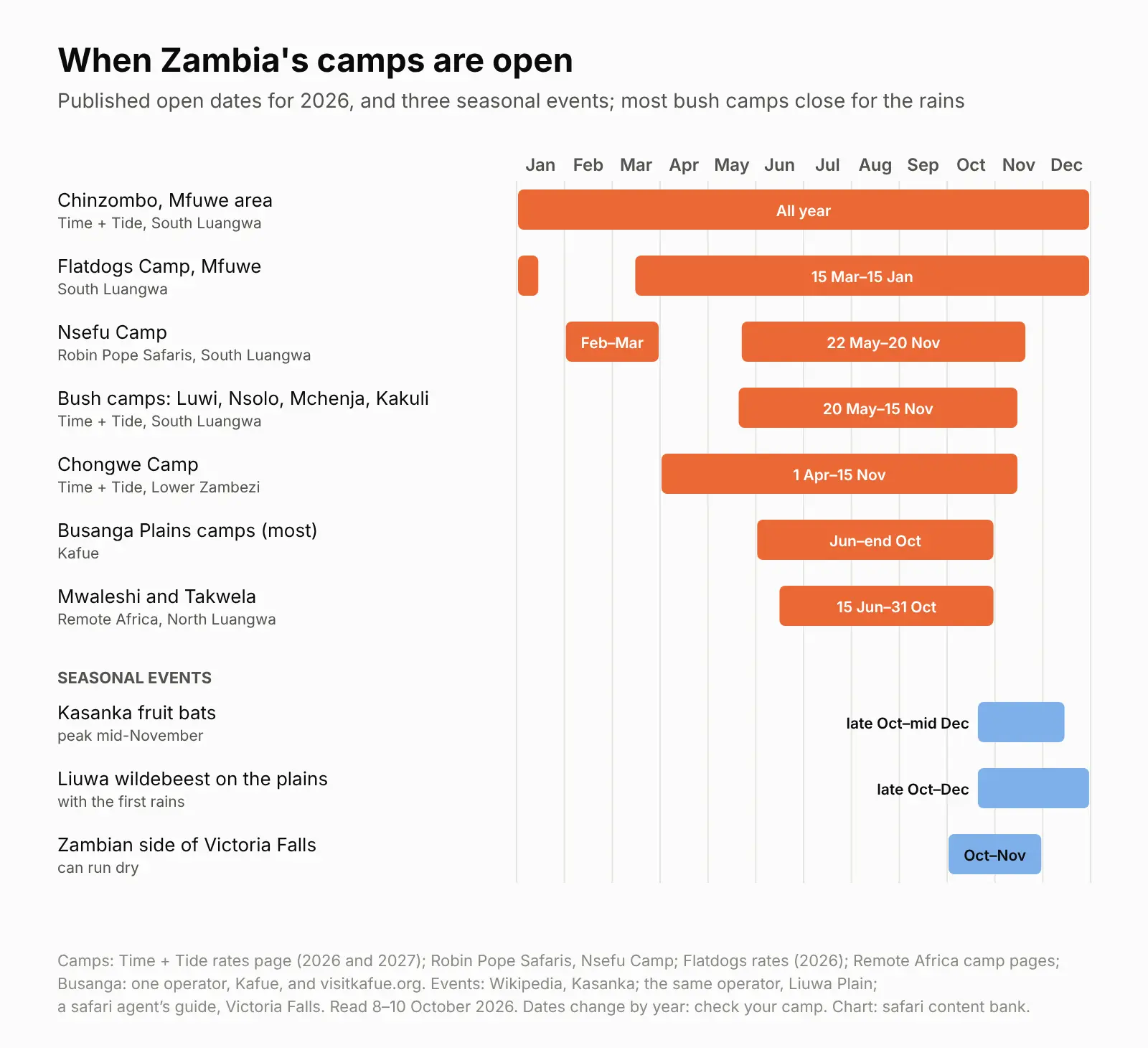 Operators’ published open dates for 2026: Time + Tide, Robin Pope Safaris, Flatdogs, Remote Africa; Busanga: one safari operator’s Kafue guide and Visit Kafue. Events: the same operator, Wikipedia, a safari agent’s guide. Read 8–10 October 2026. Chart: safari content bank.
Is the emerald (green) season worth it?
For lower rates and birds, yes, around Mfuwe; for walking and a choice of camps, no, because most bush camps are closed and walking is impractical from January to March (one safari operator’s South Luangwa guide). Chinzombo drops from US$1,840 to US$1,330 a night, Mfuwe Lodge from US$751 to US$565 and Nsefu Camp from US$1,150 to US$735 (2026 rates, Zambia safari cost). A few Mfuwe-area lodges run boat trips on the swollen river, and yellow-billed storks breed in the Nsefu Sector (the same operator). From late October to mid-December, elephants walk through Mfuwe Lodge’s reception (The Bushcamp Company). In Lower Zambezi most camps close from mid-November to April, and its tracks are impassable from December to March (the same operator’s Lower Zambezi guide). More on travelling in the rains: green-season safaris.
When are the Kasanka bats and the Liuwa wildebeest?
Kasanka’s fruit bats roost from late October to mid-December, peaking in mid-November; Liuwa’s wildebeest mass on the plains with the first rains, from late October to December. The bats are straw-coloured fruit bats, and the first arrive in early to mid-October (Wikipedia, Kasanka National Park); Kasanka’s DNPW fee is US$10 a day. Liuwa Plain, in the far west, has “over 47,000” wildebeest (African Parks, Liuwa Plain) and charges US$40 a day on African Parks’ own 2025 tariff, not the DNPW table. Liuwa is about 10 hours by road from Lusaka or 8 from Livingstone to Kalabo, and a high-clearance 4x4 is mandatory (Visit Liuwa).
Will Victoria Falls be dry when I visit?
The Zambian side can be: in October and November its Eastern Cataract can shrink to “small rivulets, in places no water at all”, while the Main Falls on the Zimbabwe side keep flowing (a safari agent’s guide, read 10 October 2026). From February to May the Falls carry the most water, and spray hides much of the view. Devil’s Pool, on the lip of the Falls beside Livingstone Island, is reached only from Zambia, only at low water, on a tour of about three hours (one safari operator’s Livingstone guide). On the TripAdvisor Victoria Falls forum in October 2026, replies to a visitor who wanted to walk there said the boat trip to Livingstone Island is the only legal access, with at most 24 people per trip (TripAdvisor, “Walk to Devil pool”, traveller reports). No official Zambian Falls gate fee is confirmed; the full comparison is on Victoria Falls: Zimbabwe or Zambia side, and the town and activities on our Victoria Falls page.
Getting there and around
How do I get from Lusaka to the parks?
Fly to South Luangwa and Lower Zambezi, or drive: Mfuwe is 9–10 hours by road, Lower Zambezi at least 5 and Kafue about 4, and Kafue has no scheduled flights.
| Route | By road | By scheduled flight | Source |
|---|---|---|---|
| Lusaka → South Luangwa (Mfuwe) | 9–10 h on the Great East Road via Chipata | Proflight, up to 3 a day, about 70 min; lowest return fare shown US$373 | A safari booking site; Proflight; one safari operator |
| Lusaka → Lower Zambezi | 216 km, 5 h minimum; high-clearance 4x4; many lodges switch guests to a boat at Chirundu | Proflight to Jeki twice a day; lowest return fare shown US$483 | A safari booking site; Proflight |
| Lusaka → Kafue (Hook Bridge area) | 360 km, about 4 h on tar | None: charter only | A safari booking site |
| Lusaka → Livingstone | – | Proflight, up to 3 a day; lowest return fare shown US$426 | Proflight |
| Mfuwe → Livingstone | – | 2–2.5 h direct, or 3–5 h via Lusaka | One safari operator |
| Lilongwe (Malawi) → Mfuwe | 321 km, about 5.5 h plus the border (2017 figures) | No current scheduled fare found | A South Luangwa safari website |
Sources: a safari booking site’s getting-there pages for South Luangwa, Lower Zambezi and Kafue; Proflight home page fares, 9 October 2026; one safari operator’s South Luangwa guide; a South Luangwa safari website (road times taken October 2017); names and links kept in our editor notes. One way; fares are return and change with demand.
On the TripAdvisor Zambia forum, travellers asked in 2026 how to get from Lusaka to Livingstone without flying and from Lusaka airport into the city; we hold no checked road time or transfer price for either.
What is the luggage limit on Zambia’s bush flights?
15 kg per person in a soft bag on light aircraft; Proflight’s scheduled domestic flights allow 23 kg checked (one safari operator’s Zambia travel information; Proflight). A traveller who flew between three Zambian parks in August 2026 reported a limit of 15 kg in a soft bag plus a 5 kg small bag (TripAdvisor, “Trip Report August 2026”, traveller report). Check your own operator’s rule; what to pack within it is on our safari packing list.
Can I fly into Victoria Falls in Zimbabwe and stay in Zambia?
Yes: the Victoria Falls Bridge border is open 24 hours, and the two airports are about 45 minutes apart (Victoria Falls: Zimbabwe or Zambia side). You enter Zimbabwe first, so you need whatever Zimbabwe asks of your passport, then Zambia’s entry; the KAZA Univisa covers both countries for US$50. Livingstone is about 10–11 km from the Falls (one safari operator’s Livingstone guide). “Transfer from Vic Falls Airport to accommodation in Zambia” was asked on the TripAdvisor Zambia forum in 2026; we hold no checked transfer price. Zimbabwe’s own visa fees are not printed on this site because no official 2026 figure is in our sources.
Can I self-drive Zambia’s parks?
Yes, in Kafue and on South Luangwa’s all-weather loops near Mfuwe; Lower Zambezi needs a high-clearance 4x4. A self-driver pays US$30 a day in South Luangwa and Lower Zambezi instead of US$25, plus US$15 a day for a foreign-registered car under 3 tonnes, and camping costs US$5 per person (DNPW 2025 schedule, the last published). Kafue’s spine is tar, but a safari booking site says a real 4x4 is needed for any distance inside the park. A park day runs 06:00–18:00. In the rains only South Luangwa’s central all-weather network is reliably passable (one safari operator). Land Cruiser rental and South Luangwa campsites came up on the TripAdvisor and 4x4community forums, but no rental price in our sources is checked.
Can I combine South Luangwa with Lake Malawi?
Yes, through Lilongwe: Mfuwe is 321 km and about 5.5 hours from Lilongwe by road, plus the border (2017 figures) (a South Luangwa safari website). British passport holders need a US$50 single-entry Malawi visa (UK FCDO, Malawi, updated 3 July 2026). Mfuwe’s international status allows flights from Lilongwe, but we found no current scheduled fare (South Luangwa).
Costs, money and planning
How much does a Zambia safari cost?
About US$234–331 per person per day on a group camping trip, US$397–751 a night at a Mfuwe-area lodge and US$731–1,200 at a classic bush camp, with luxury camps up to US$1,840, before US$90–110 a night in fees and levies (operators’ and lodges’ published 2026 prices, read 8 October 2026). Seven nights at The Bushcamp Company’s South Luangwa camps cost US$6,281 per person in June or US$7,140 in July–September, including levies and the Lusaka–Mfuwe flight (our sum). The full price ladder, lodge tiers and worked example are on our Zambia safari cost page and South Luangwa safari cost.
Why do lodges charge US$90–110 a night in park fees?
Because the lodge line bundles the DNPW gate fee of US$25 with bed levies, community levies and conservation funds. The Bushcamp Company bills US$90 at Mfuwe Lodge and US$110 at its bushcamps for “govt levies, park fees, LCCF, ZCP”; Time + Tide bills US$100 for “park fees + conservation levies”; Mawimbi in Kafue itemises a US$30 bed levy, US$20 park fee, US$20 boating fee and US$30 community levy (Zambia safari cost). LCCF is the Luangwa Conservation and Community Fund, which pays for Conservation South Luangwa’s anti-poaching and community work (CSL); ZCP is the Zambian Carnivore Programme. We found no DNPW fee document for 2026.
The official fee lines, with the date each took effect and the source:
| Fee | Amount | In force from | Source |
|---|---|---|---|
| South Luangwa and Lower Zambezi National Parks (DNPW Category A), international adult, entry per day (06:00–18:00) | USD 25 (SADC and resident USD 20; Zambian citizen ZMW 55.60); child 5–13 half price, under 5 free | DNPW 2025 schedule ("official 2025 rates"), the last published; page last modified 8 May 2025, still shown 9 Oct 2026 | DNPW 2025 fee schedule, as shown on a Zambia travel portal |
| Kafue and North Luangwa National Parks, international adult, entry per day | USD 20 (SADC and resident USD 15; Zambian citizen ZMW 44.80) | DNPW 2025 schedule, the last published; page last modified 8 May 2025, still shown 9 Oct 2026 | DNPW 2025 fee schedule, as shown on a Zambia travel portal |
| South Luangwa and Lower Zambezi, self-driver entry per person per day (resident and non-resident) | USD 30 | DNPW 2025 schedule, the last published; page last modified 8 May 2025, still shown 9 Oct 2026 | DNPW 2025 fee schedule, as shown on a Zambia travel portal |
| All national parks, foreign-registered vehicle, per day | USD 15 under 3 tonnes; USD 30 over 3 tonnes | DNPW 2025 schedule, the last published; page last modified 8 May 2025, still shown 9 Oct 2026 | DNPW 2025 fee schedule, as shown on a Zambia travel portal |
| All national parks, non-resident activity fees, per person per day | Boating USD 20; canoeing or rafting USD 20; angling USD 30; camping USD 5 per person | DNPW 2025 schedule, the last published; page last modified 8 May 2025, still shown 9 Oct 2026 | DNPW 2025 fee schedule, as shown on a Zambia travel portal |
How can a solo traveller avoid the single supplement?
Pick a camp that charges none: Robin Pope Safaris charges no supplement at Nsefu Camp for up to three single travellers, while Time + Tide charges 50% (Robin Pope Safaris, Nsefu Camp; Time + Tide rates). Long-stay offers cut the rest: The Bushcamp Company gives 10% off seven nights or more and Time + Tide offers stay 7 pay 6 (Zambia safari cost). On the TripAdvisor Zambia forum in May 2026, a solo traveller who found supplements “very costly” was told the same, plus that peak pricing starts on 1 July, that room-only at Flatdogs is pointless without activities, and that some remote bush camps include transfers only for a minimum stay (TripAdvisor, “South Luangwa bush camp in combination with Flatdogs”, traveller reports). Africa-wide rules are on single supplements and child rates.
How many nights should I plan, and how should I split them?
Published Zambia packages cluster at 7–11 days, and the itineraries we read move camp every two or three nights. Of 59 packages including Zambia with a US-dollar price in our sources, the commonest length is 8 days (11 listings), then 7 and 11 days (7 each) (listings read 8 October 2026; our count). On the TripAdvisor Zambia forum in July 2026, replies on splitting a June week between Lower Zambezi and South Luangwa favoured a 2–2 split by camp, put the game area ahead of room comfort, and warned that an 8 a.m. flight costs a morning drive (TripAdvisor, “Itinerary question June 2027 – LZ and SLNP”, traveller reports). Allow two nights at Victoria Falls, three if you cross to Zimbabwe or Chobe (one safari operator’s Livingstone guide). More on trip length: how many days for a safari.
Do I need kwacha, and how much should I tip?
Camp and lodge rates are priced in US dollars, and Zambia’s currency is the kwacha (ZMW); we hold no checked figure for tipping in Zambia. DNPW prints its citizen rates in kwacha and its international rates in US dollars (a safari agent’s guide to park entry fees, read 10 October 2026). Our safari tipping guide gives sourced amounts for Kenya, Tanzania, Botswana, Namibia, South Africa, Uganda and Rwanda, but not for Zambia. Ask your camp or operator what it suggests before you travel.
Health and safety
Do I need malaria tablets for Zambia?
One UK safari operator says malaria is present across Zambia and all year in the valleys, and advises taking prophylaxis (its Zambia travel information, May 2025). We could not read the WHO country entry for Zambia, so this page has no official malaria detail. Whether you take tablets, and which, is a decision for a travel clinic; this page gives no medical advice.
Will tsetse flies be a problem?
In parts of the parks, possibly: a traveller who visited three Zambian parks in August 2026 reported tsetse bites that swelled (TripAdvisor, “Trip Report August 2026”, traveller report). We hold no official source on where in Zambia tsetse occur or how common they are, so we give no map or health advice here.
Is Zambia safe for a safari?
We did not read a current UK FCDO or US State Department safety summary for Zambia for this page, so we give no risk rating; read the FCDO’s Zambia advice before you go. In the parks, the rules carry the safety: every South Luangwa walk goes with an armed scout, under-12s may not walk or canoe, and self-drivers must be out of the parks by 18:00. On the river, one safari operator names hippo and crocodile as the main risk on canoe trips (its Lower Zambezi guide). The August 2026 trip report quoted above describes a smooth trip with one mock charge (traveller report). If you pay a company in full before you travel, see how to check a safari operator’s licence.
Common mistakes in Zambia safari answers
| What you’ll often read | What is correct |
|---|---|
| “South Luangwa park fees are US$25” | That is the gate fee per day. Lodges bill US$90–110 per person per night once levies and conservation funds are added. |
| “The Zambia visa costs US$25” | Single entry doubled to US$50 on 1 January 2026, and UK and US passport holders need no visa (UK FCDO; trade press adds Canada, Germany, France, Italy, Spain, the Netherlands and Belgium; other passports should check). |
| “These are the 2026 DNPW fees” | They are the 2025 schedule, the last published, still shown in October 2026. |
| “South Luangwa is Big Five country” | No rhino (gone by 1987) and no cheetah seen for decades. |
| “Lower Zambezi has giraffe” | Never recorded there (one safari operator). |
| “Bush camps open in May” | Most South Luangwa bush camps open between 20 May and 1 June; Busanga and North Luangwa in June. |
| “Fly into Kafue” | Kafue has no scheduled flights: charter, or about 4 hours by road from Lusaka. |
| “The Univisa covers Botswana” | Day trips only. A night in Botswana voids it. |
| “Children can join walks and canoe trips” | Not under 12 in South Luangwa and on Lower Zambezi canoes. |
| “The Falls are always full from the Zambian side” | In October and November the Eastern Cataract can be bare rock; the Zimbabwe side keeps flowing. |
| “The US$10 Mosi-oa-Tunya fee is the Falls ticket” | It covers the national park’s game section; no official Zambian Falls gate fee is confirmed. |
| “All Zambian parks use the DNPW fee table” | Liuwa charges US$40 a day on African Parks’ own 2025 tariff. |
Sources
- Entry: a safari agent’s guide to updated visa fees for 2026, 7 Jan 2026; Tourism Update, Zambia doubles visa fees; VisasNews; UK FCDO, Zambia entry requirements (updated 1 Jun 2026) and Malawi entry requirements (3 Jul 2026); Zambia e-visa portal; a Victoria Falls booking site’s KAZA Univisa page (27 Jun 2025; names and links kept in our editor notes)
- Fees: a safari agent’s guide to park entry fees (DNPW 2025 schedule, last modified 8 May 2025), re-checked 9 Oct 2026; lodge levies and rates as on our Zambia safari cost page: The Bushcamp Company, Time + Tide, Robin Pope Safaris, Flatdogs; Conservation South Luangwa, LCCF
- Parks and wildlife: one safari operator’s South Luangwa, Lower Zambezi, Kafue, North Luangwa, Livingstone and Victoria Falls, Zambia weather and general information pages (read Oct 2026; names and links kept in our editor notes); African Parks, Kafue and Liuwa Plain; Visit Kafue; Visit Liuwa; Frankfurt Zoological Society, North Luangwa; Zambian Carnivore Programme, 2023 annual report (PDF); a safari agent’s guides to Lower Zambezi and Victoria Falls; Wikipedia, South Luangwa National Park and Kasanka National Park
- Walking: a tour operator’s walking-safari guide (secondary); Fortune, April/May 2024
- Travel: Proflight home page fares, read 9 Oct 2026; a safari booking site’s getting-there pages for South Luangwa, Lower Zambezi and Kafue; a South Luangwa safari website (2017 road times); names and links kept in our editor notes
- Package lengths: our count of 59 Zambia packages with a US-dollar price on operators’ and marketplace listing pages, read 8 Oct 2026
- Traveller reports (opinion and experience, not official findings): TripAdvisor Zambia, Livingstone, Victoria Falls, Lusaka and Chirundu forums; 4x4community.co.za and Routard (titles only); threads linked in each answer, collected 8 October 2026
- How we source and date fees: our method
Answers checked against the content bank on 10 October 2026. Forum lines are travellers’ reports, not official findings. We will update this page when DNPW publishes a new fee schedule, when the bush camps publish their 2027 open dates, when Zambia changes its visa fees, and once we have read an official malaria source and a current FCDO safety summary for Zambia.
More photos from Zambia
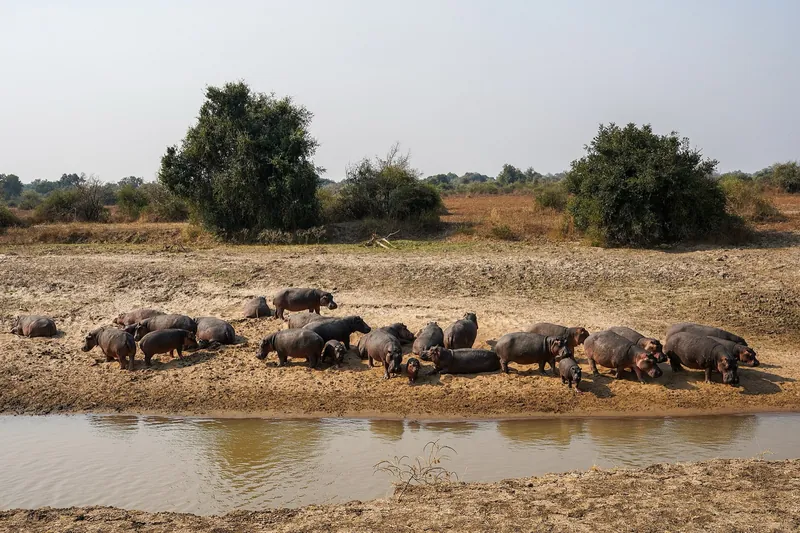
Herd of hippos leaving a sandbank in the Luangwa Valley. Timothy A. Gonsalves, Wikimedia Commons, CC BY-SA 4.0, cropped 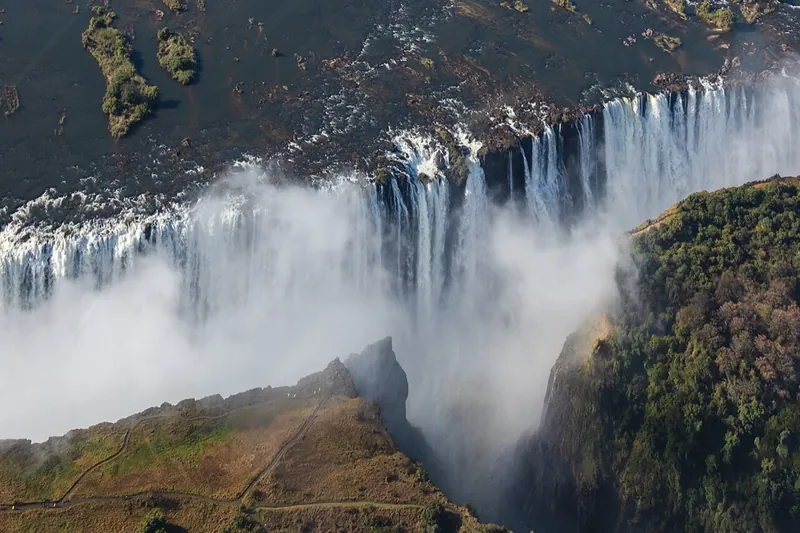
Close aerial view of the curtain of water at Victoria Falls. Diego Delso, Wikimedia Commons, CC BY-SA 4.0, cropped 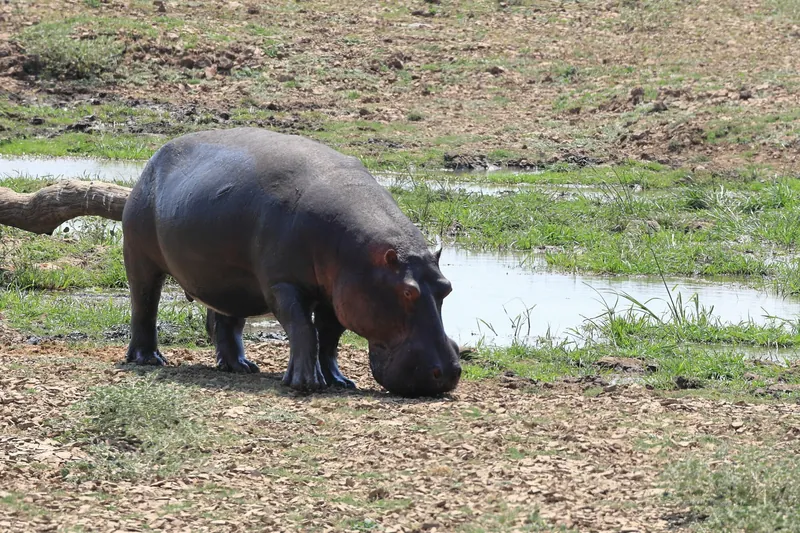
Hippopotamus in the Luangwa Valley, Zambia. Darren Obbard, iNaturalist, CC BY 4.0, cropped


Photos by visitors and photographers, used under their free licences. Click a name to see the original.